
Reports
The Global Metal Powder Market was valued at USD 8,024.5 Million in 2025 and is anticipated to reach a value of USD 12,408.8 Million by 2033 expanding at a CAGR of 5.6% between 2026 and 2033. Growth is being driven by additive manufacturing, automotive lightweighting, aerospace components, and higher adoption of precision powder-metallurgy processes.
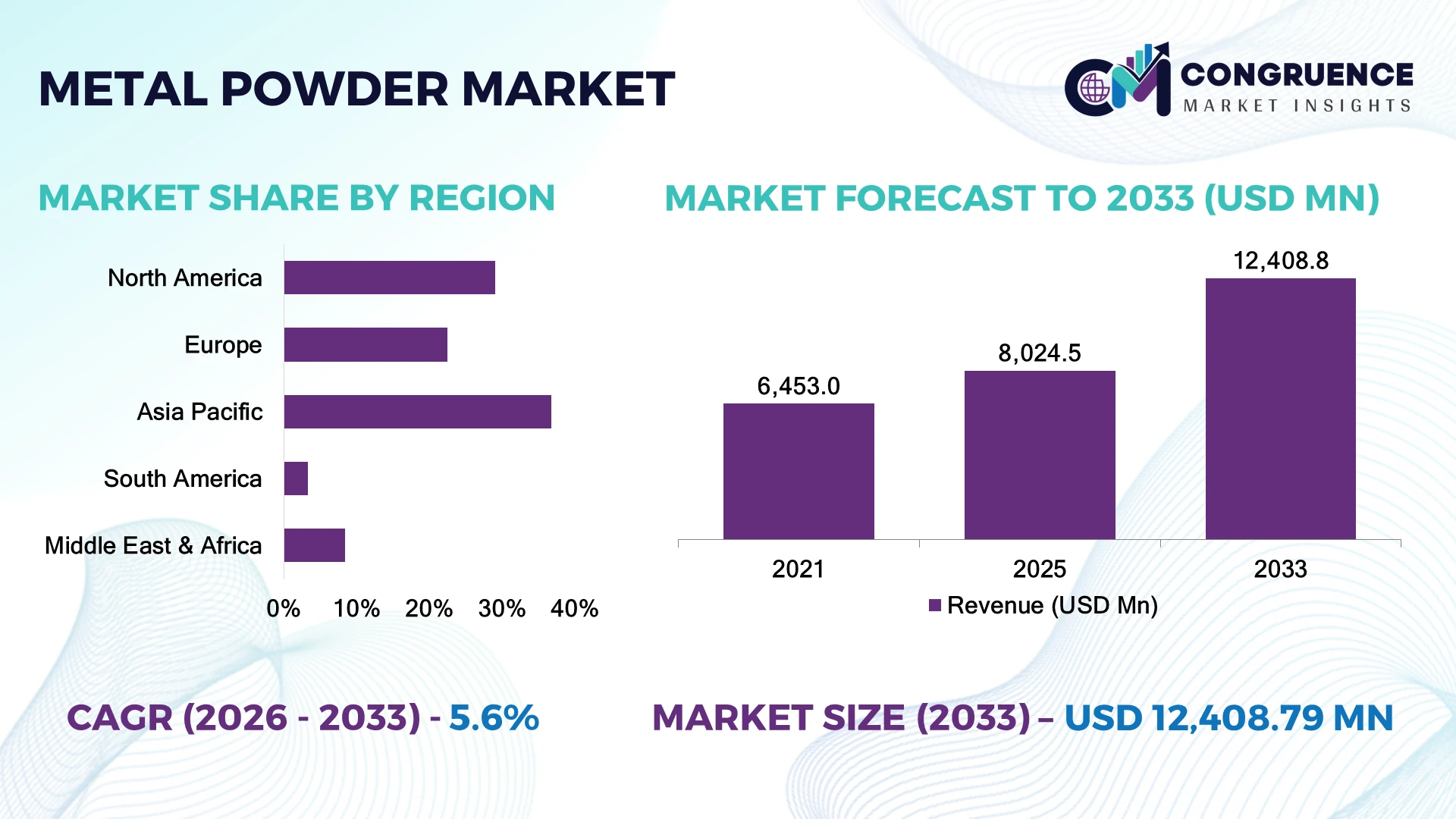
China leads the global metal powder supply base through automotive, electronics, aerospace, and additive manufacturing demand, with Asia-Pacific holding 36.8% of the market in 2025. China alone represented 14.4% globally, while its market was USD 1.10 billion. India is smaller but expanding advanced manufacturing and domestic powder capacity, creating a sharper localization contrast. In 2026, geopolitical restrictions on critical metals are reinforcing regional sourcing and inventory strategies.
Strategic implication: manufacturers should prioritize qualified regional suppliers, application-specific grades, and resilient powder-processing capacity to reduce exposure to concentrated critical-material supply chains.
Market Size & Growth: USD 8,024.5 million in 2025 to USD 12,408.8 million by 2033 at 5.6% CAGR, driven by additive manufacturing and lightweighting.
Top Growth Drivers: Additive manufacturing +15–21%; medical applications +6.3%; Asia-Pacific demand +5.5% through localization.
Short-Term Forecast: By 2028, automated classification can lift efficiency 8–12% and reduce off-specification batches 5–8%.
Emerging Technologies: AI inspection, gas atomization, and closed-loop powder recycling are reshaping production.
Regional Leaders: Asia-Pacific reaches USD 3.33 billion in 2026; North America remains aerospace-led; Europe expands certified additive deployment.
Consumer/End-User Trends: Transportation captured 65.2% of 2025 demand, while additive manufacturing gains traction in complex aerospace and medical parts.
Pilot/Case Example: 2026 CNPC Powder expansion covers 76.5 acres, adding high-value powder manufacturing, storage, and logistics capacity.
Competitive Landscape: Höganäs, Sandvik, Rio Tinto, Carpenter Technology, and GKN Powder Metallurgy anchor global supply.
Regulatory & ESG Impact: Critical-metal controls are accelerating regional sourcing, while recycling reduces material losses and supply exposure.
Investment & Funding: 2026 expansion financing is supporting high-value powder capacity, with aerospace and defense driving localized titanium and nickel investment.
Innovation & Future Outlook: Next-generation titanium, nickel, aluminum, and iron powders will prioritize tighter particle control, traceability, and recycling.
Advanced metal powders support automotive lightweighting, additive manufacturing, aerospace, medical implants, electronics, and precision tooling. Atomization remains central, accounting for 69.8% of market share, while additive manufacturing is accelerating demand for tightly controlled titanium, nickel, aluminum, and stainless-steel grades. In 2026, supply-chain localization and critical-metal controls are strengthening interest in qualified regional powder sources, supporting the strategic discussion ahead.
Metal powder is becoming strategically important because material composition, particle consistency, and supply security increasingly determine manufacturing economics for automotive, aerospace, medical, and additive applications. The competitive shift is toward localized, specification-controlled supply as geopolitical restrictions and critical-metal policies increase the value of qualified regional production.
Technology is changing cost structures. Modern atomization and powder-classification systems improve consistency and throughput versus older batch-intensive routes, while additive manufacturing can reduce material waste by roughly 20–40% for complex near-net-shape parts. Asia-Pacific combines the largest scale, with a 44.3% share in 2025, while North America emphasizes aerospace, defense, and reshoring. Europe remains strong in certified aerospace and precision applications.
Over the next 2–3 years, automated particle classification, closed-loop powder recycling, AI-assisted quality monitoring, and localized titanium and nickel capacity will become stronger procurement differentiators. A 2026 CNPC Powder expansion is adding high-value powder manufacturing and logistics capacity, illustrating the move toward vertically integrated supply. Companies should prioritize qualified regional capacity, tighter powder traceability, and partnerships with downstream OEMs. Competitive advantage will increasingly come from reliable specification control, shorter supply chains, and application-specific powder engineering.
Industrial adoption of metal additive manufacturing is shifting powder demand toward tightly controlled titanium, nickel, aluminum, and stainless-steel grades. Powder-bed fusion typically achieves material utilization rates of 80–95% for complex parts, compared with substantially higher material losses in subtractive machining. Aerospace and medical applications are also increasing demand for narrow particle-size distributions and high-purity feedstock. In the United States, defense and aerospace reshoring is reinforcing domestic powder qualification, while German automotive suppliers are expanding automated powder-processing capabilities. Producers are responding through atomization capacity, advanced classification, and application-specific alloy development. The strategic advantage is moving beyond tonnage toward certified powder consistency, where tighter specifications support higher-value contracts and reduce downstream qualification cycles.
Metal powder producers remain exposed to concentrated supplies of titanium, nickel, cobalt, and other alloying inputs, creating volatility in feedstock economics and qualification continuity. Raw materials can represent more than 50% of powder-production costs for several specialty grades, while energy-intensive atomization can account for roughly 10–20% of conversion costs. Export controls and geopolitical restrictions affecting critical minerals are increasing procurement complexity in 2026. Chinese processors retain significant influence over several upstream metal chains, while European and U.S. manufacturers face pressure to qualify alternative suppliers. Companies are responding through dual-source contracts, recycled feedstock, regional inventories, and vertical integration. The immediate operational priority is not simply lowering powder price, but securing consistent chemistry and particle specifications without repeatedly requalifying downstream production processes.
Powder recycling is creating a distinct efficiency opportunity as additive manufacturing volumes increase and unused feedstock accumulates within production workflows. Controlled reuse can recover approximately 70–90% of eligible unused powder, although qualification requirements vary by alloy and process. Automated sieving, particle characterization, oxygen monitoring, and digital batch tracking are enabling higher-confidence reuse. Aerospace manufacturers in the United States and Europe are particularly positioned to benefit because expensive titanium and nickel powders create strong economic incentives for recovery. Producers are developing recycling partnerships with additive-manufacturing service bureaus and machine OEMs, while powder suppliers are integrating traceability into material platforms. The non-obvious opportunity is recurring revenue from powder-management services, not only material sales. Companies that control recycling data can strengthen customer retention while reducing material waste and procurement exposure.
Scaling advanced metal powders requires simultaneous control of chemistry, morphology, particle-size distribution, flowability, apparent density, and oxygen content. Small deviations can alter melt-pool behavior, porosity, and final-part properties, making qualification considerably more demanding than conventional bulk-metal supply. Automated production can reduce manual process intervention by 20–30%, but highly controlled powder handling still requires specialized technicians and laboratory infrastructure. U.S. aerospace programs face particularly stringent qualification requirements, while smaller manufacturers often lack advanced characterization equipment. Companies must therefore invest in in-line monitoring, automated classification, laboratory capacity, and workforce training. A key strategic pressure is maintaining batch-to-batch equivalence as capacity expands: adding atomization equipment without replicating powder morphology and process controls can create costly requalification cycles and undermine customer confidence.
Powder Recycling Moves In-House — Additive manufacturers are shifting from disposal-oriented handling toward controlled powder recovery, with eligible unused feedstock often reaching 70–90% recovery. Automated sieving, oxygen monitoring, and batch tracking are improving reuse consistency. Aerospace producers are increasingly integrating recycling directly into production cells, reducing material waste and improving control over expensive titanium and nickel feedstock.
Atomization Becomes More Automated — Advanced gas and water atomization systems are incorporating automated process controls, particle classification, and real-time quality monitoring. Automation can reduce manual intervention by 20–30% while improving batch consistency. Producers in China, Germany, and the United States are upgrading facilities to support tighter particle-size specifications, particularly for additive manufacturing and high-performance alloy applications.
Critical Minerals Reshape Sourcing — Export controls and geopolitical supply-chain disruptions are pushing manufacturers toward dual sourcing, regional inventories, and recycled inputs. Specialty producers are targeting 10–20% reductions in single-source exposure through supplier diversification and localized processing. U.S. and European buyers are increasingly prioritizing qualified domestic or allied suppliers, making traceability and chemistry consistency commercially important alongside price.
Digital Qualification Gains Importance — Powder manufacturers are connecting laboratory characterization with digital batch records, machine data, and customer process parameters. Automated quality analytics can reduce inspection-cycle time by approximately 10–15% while strengthening traceability. The shift is particularly relevant for aerospace and medical applications, where documented powder genealogy supports qualification. Suppliers are increasingly using digital material passports and application-specific datasets to differentiate premium grades.
Ferrous metal powders lead the market, accounting for approximately 65% of demand, supported by established powder-metallurgy supply chains, high-volume automotive components, and favorable strength-to-cost economics. Iron powders alone represent about 44% of the market, making them the commercial backbone for gears, bearings, structural parts, and magnetic components. Companies are improving atomization, particle-size control, and alloy formulations to protect margins as automotive designs evolve. Non-ferrous powders, including aluminum, copper, nickel, and titanium, command a smaller base but increasingly serve higher-value aerospace, electronics, medical, and additive-manufacturing applications. Aluminum and copper benefit from lightweighting and thermal-management requirements, while specialty alloys typically deliver greater value per kilogram.
Titanium and other advanced powders represent the fastest-changing portion of the portfolio, driven by aerospace components, medical implants, and complex additive-manufactured parts. Advanced powder demand is shifting toward tighter morphology and purity specifications, with premium applications increasingly requiring controlled particle distributions below conventional industrial ranges. Producers are responding with gas atomization, specialized alloy development, and qualification partnerships. The strategic implication is clear: ferrous capacity protects volume, while non-ferrous and specialty grades increasingly determine margin expansion and technology positioning.
The Metal Powder Industries Federation reports that more than 70% of North American iron powder shipments serve passenger vehicles, confirming automotive concentration while reinforcing the need for suppliers to diversify toward higher-value applications.
Powder metallurgy remains the leading application, representing approximately 58–60% of global metal powder consumption because pressing, compaction, and sintering support repeatable high-volume production. Automotive components account for a substantial portion of this installed base, particularly gears, bearings, structural parts, and drivetrain components. Companies benefit from established tooling, predictable cycle economics, and mature qualification pathways. Additive manufacturing is the fastest-growing application, with adoption accelerating as aerospace, medical, defense, and industrial manufacturers move beyond prototyping toward serial production. Its ability to produce complex geometries and reduce material-intensive machining creates a distinct value proposition.
Metal injection molding, thermal spraying, welding and cutting, and other specialized applications remain important for precision components, surface engineering, and industrial processing. Additive manufacturing is increasingly absorbing premium titanium, nickel, and stainless-steel powders, while conventional powder metallurgy remains dominated by iron and steel grades. Producers are therefore separating product strategies: high-volume customers receive cost-optimized powders and long-term contracts, whereas additive customers receive application-specific alloys, tighter specifications, and technical support. This segmentation is pushing investment toward flexible production platforms rather than single-purpose capacity.
The Metal Powder Industries Federation identifies more than 750 automotive powder-metallurgy parts across engine, transmission, and body/chassis categories, illustrating the depth of established industrial deployment.
Transportation is the leading end-user group, accounting for approximately 65% of metal powder demand in 2025. High-volume automotive production uses ferrous powders extensively for gears, bearings, structural components, and other near-net-shape parts, creating strong recurring demand for consistent grades and competitive pricing. Electric and hybrid vehicle architectures are gradually changing the component mix, increasing interest in soft-magnetic materials, lightweight alloys, and thermally conductive powders. Industrial machinery and manufacturing represent another major customer base, with demand tied to tooling, wear-resistant components, and automated production equipment. Companies serving these segments increasingly emphasize application engineering, process compatibility, and localized inventory.
Medical is the fastest-growing strategic end-user because implants, surgical instruments, and patient-specific components require high-purity powders and complex geometries. Medical-grade titanium and cobalt-chrome powders command tighter qualification and traceability requirements than commodity grades, encouraging suppliers to invest in certified production and technical partnerships. Electronics and electrical manufacturers are simultaneously expanding demand for copper, iron, and specialty magnetic powders for thermal management and electromagnetic components. The competitive shift is therefore from volume-led transportation supply toward a two-track model: scale efficiency for automotive buyers and certification-driven specialization for medical and electronics customers.
Current industry analysis places transportation at about 65.21% of metal powder demand, while medical applications are expanding faster, strengthening the commercial case for suppliers to build certified specialty-material capabilities alongside automotive volume.
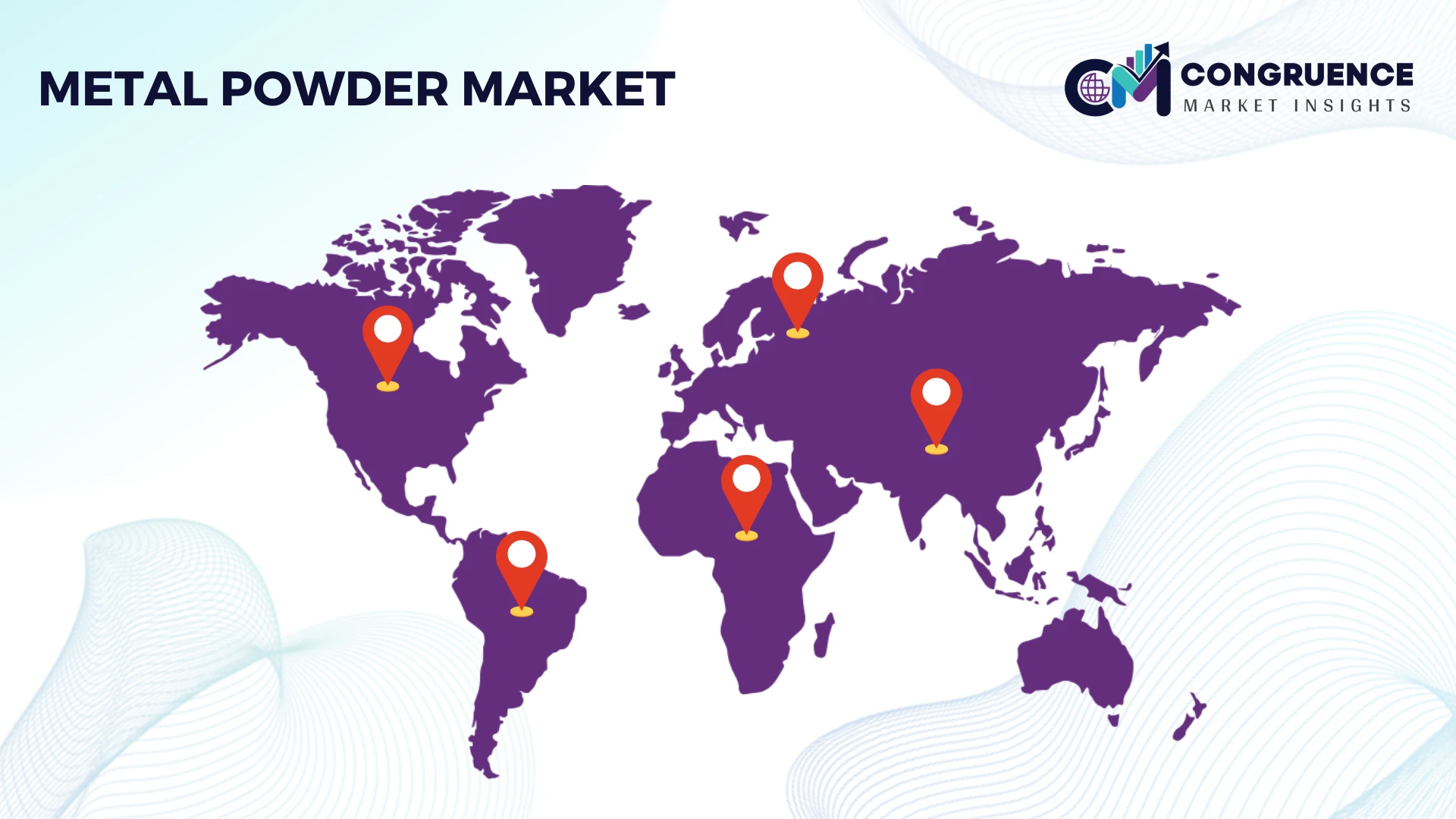
Asia-Pacific accounted for the largest market share at 36.8% in 2025 however, North America is expected to register the fastest growth, expanding at a CAGR of 5.7% between 2026 and 2033.
Aerospace Reshoring Strengthens Specialty Powder Capacity
North America represented approximately 29% of global metal powder demand in 2025, supported by U.S. aerospace, defense, automotive, medical, and additive manufacturing activity. Domestic titanium and specialty-alloy production is gaining strategic importance as manufacturers reduce exposure to overseas critical-material supply. U.S. qualification programs are also increasing demand for traceable, application-specific powders rather than commodity grades. In 2025, 6K Additive secured a USD 27.4 million financing package to expand its Pennsylvania powder facilities from 200 metric tons to more than 1,000 metric tons annually, demonstrating the shift toward localized capacity.
U.S. Market Outlook: The United States remains the regional technology and consumption center, combining aerospace manufacturing, defense procurement, medical-device production, and additive manufacturing infrastructure. Domestic titanium powder investment is particularly important as qualification-intensive applications increasingly require secure material genealogy. Defense-supported capacity expansion is strengthening vertically integrated powder-to-component supply chains and reducing dependence on imported specialty feedstock.
Certified Production Aligns With Circular Manufacturing
Europe accounted for approximately 22.5% of global metal powder demand in 2025, with Germany, Italy, France, and the Nordic manufacturing base supporting automotive, aerospace, industrial machinery, and additive applications. European producers face tighter environmental and traceability requirements, encouraging higher-efficiency atomization, recycled feedstock, and application-specific grades. Outokumpu expanded commercial stainless-steel powder production for aerospace applications in 2025, illustrating how established metals companies are entering higher-value additive manufacturing rather than competing solely in conventional powder markets.
Germany Market Outlook: Germany remains a critical manufacturing hub because automotive engineering, industrial automation, tooling, and aerospace suppliers provide a dense downstream customer base for ferrous and specialty powders. Its industrial ecosystem supports rapid integration of powder metallurgy with automated production and additive manufacturing. German producers increasingly emphasize energy efficiency, material traceability, and process qualification as purchasing criteria tighten across precision manufacturing.
Manufacturing Scale Drives Cost and Capacity Leadership
Asia-Pacific held approximately 36.8% of global metal powder demand in 2025, making it the largest production and consumption center. China anchors regional scale through automotive, electronics, machinery, and powder-metallurgy manufacturing, while Japan and South Korea specialize in higher-precision copper, silver, and specialty powders. India is expanding domestic powder-metallurgy and advanced-manufacturing capacity. China’s integration of upstream metal processing with water atomization provides cost advantages, while Japan and South Korea retain stronger positions in precision electronic-material applications.
China Market Outlook: China is the region’s dominant manufacturing base, supported by extensive automotive and industrial-component production and a large domestic supplier ecosystem. Its powder industry benefits from integrated raw-material access, established atomization capacity, and substantial downstream demand. CNPC Powder’s 2,500-square-meter Shanghai Additive Intelligence & Materials Science Center, launched in 2025, illustrates growing investment in AI, process automation, and advanced powder development.
Brazil Anchors Industrial Powder Consumption
South America remains a smaller but established metal powder market, with Brazil accounting for approximately 3.3% of global demand in 2025. Automotive manufacturing, industrial machinery, construction, mining, and medical applications provide the core demand base, while powder metallurgy remains more commercially established than advanced additive production. Brazil’s press-and-sinter segment represented 45.6% of its metal powder market in 2025, indicating the continued importance of conventional high-volume applications. Additive manufacturing is gaining traction in prototyping, aerospace, dental, and specialized industrial components, but skilled-labor and equipment requirements continue to constrain broader deployment.
Brazil Market Outlook: Brazil offers the strongest manufacturing platform in South America, supported by automotive production, mining infrastructure, engineering capabilities, and established industrial supply chains. Companies are increasingly positioning metal powders for specialized manufacturing rather than relying solely on commodity applications. Medical and dental demand is particularly relevant because patient-specific components favor additive manufacturing and higher-value titanium and cobalt-chrome powders, creating opportunities for localized technical partnerships.
Industrial Diversification Accelerates Advanced-Material Adoption
Middle East & Africa is emerging as a strategically relevant market as Saudi Arabia, the UAE, and other industrial hubs invest in aerospace, energy, defense, manufacturing, and localized component production. The region represented roughly 7% of global metal powder demand in 2025 in broader market estimates, with additive manufacturing gaining importance for spare parts and complex industrial components. Saudi Arabia remains the largest market within the regional cluster, while the UAE is advancing faster in additive manufacturing deployment.
Saudi Arabia Market Outlook: Saudi Arabia benefits from large-scale industrial diversification programs, aerospace ambitions, energy infrastructure, and localized manufacturing initiatives. Metal powder adoption is increasingly linked to additive production of replacement parts and specialized components, reducing dependence on imported inventory for selected applications. Companies are positioning through partnerships, localized service centers, and advanced-material capabilities, while regional additive-manufacturing ecosystems are creating demand for titanium, nickel, stainless-steel, and high-performance alloy powders.
Höganäs, GKN Powder Metallurgy, Rio Tinto Metal Powders, Sandvik, and Carpenter Technology compete globally, while Chinese and Indian producers challenge them on cost and responsiveness. The top five control approximately 30% of the global market, reflecting a fragmented structure. Competition centers on powder consistency, price, atomization technology, qualification speed, and supply security; advanced grades command 10–20% premiums, while localized supply can cut lead times 20–40%. Höganäs emphasizes portfolio breadth, GKN integrates powder with component manufacturing, Sandvik links gas-atomized powders with additive platforms, and Carpenter leverages vertically integrated specialty-alloy capabilities. CNPC and other Asian producers are expanding localized capacity to pressure established suppliers on delivery and cost. The competitive shift is toward application-specific powders, closed-loop recycling, digital traceability, and regional production rather than commodity volume alone. Entry barriers include atomization expertise, certification, metallurgy laboratories, and OEM qualification. Winning suppliers need consistent morphology, rapid customization, secure feedstock, and technical integration with customer processes.
Höganäs AB
GKN Powder Metallurgy
Rio Tinto Metal Powders
Sandvik AB
Carpenter Technology Corporation
ATI
JFE Steel Corporation
Kymera International
CNPC Powder
H.C. Starck
Daido Steel
MolyWorks Materials
AMETEK Specialty Metal Products
Sumitomo Electric Industries
Metal powder production is moving from conventional water atomization and batch classification toward gas atomization, plasma processing, automated sieving, and digital particle characterization. Modern automated classification can reduce manual handling by 20–30%, while tighter particle-size control can improve batch consistency by 10–15%. Gas-atomized powders are increasingly standard for demanding additive manufacturing, aerospace, medical, and MIM applications.
Emerging systems integrate AI-assisted inspection, in-line oxygen monitoring, closed-loop recycling, and digital batch genealogy. Automated quality analytics can reduce inspection-cycle time by 10–15%, while controlled powder recovery can reclaim 70–90% of eligible unused feedstock. Sandvik benefits from integrating atomization expertise with additive-machine workflows, while Carpenter gains through custom alloy development, qualification testing, and specialty-metal integration.
During 2026–2028, localized automated atomization, low-carbon reduction, powder-management software, and application-specific alloy platforms will gain commercial importance. Compared with legacy batch workflows, connected production can reduce handling and traceability delays by 15–25%. CNPC’s California facility, planned with six automated atomization lines, signals the shift toward regional production. Suppliers acting now can shorten qualification cycles, improve material utilization, reduce logistics exposure, and capture premium demand from aerospace, defense, medical, and serial additive manufacturing programs. Smaller qualified batches support faster qualification, reduce obsolete inventory, and improve responsiveness to changing customer specifications.
June 2025 Sandvik partnered with Additive Industries to supply Osprey powders directly into 175-liter Powder Load Tools, initially covering three alloys. The inert workflow reduces powder handling and storage burden, strengthening quality, safety, and factory integration for industrial additive manufacturing. Source: sandvik.com (Metal powder | Sandvik)
January 2025 Höganäs partnered with Blykalla to develop corrosion-resistant powder materials for the SEALER small modular reactor. The collaboration covers industrialization, qualification, and commercialization, targeting advanced alloys for critical reactor components and expanding specialized powder opportunities in nuclear-energy applications. Source: hoganas.com (Höganäs)
November 2025 6K Additive secured USD 27.4 million in EXIM financing to expand Burgettstown powder capacity from 200 metric tons to more than 1,000 metric tons annually. The investment strengthens domestic supply for defense, aerospace, nuclear, and additive manufacturing applications. Source: 6kadditive.com (6K Additive)
June 2025 Höganäs launched re-Astaloy 85 Mo with a 14% lower product carbon footprint while retaining equivalent material performance. Replacing natural gas with biogas strengthens lower-carbon powder metallurgy procurement and gives automotive manufacturers a pathway to reduce Scope 3 emissions. Source: hoganas.com (Höganäs)
The Metal Powder Market Report evaluates ferrous, non-ferrous, and specialty alloy powders across powder metallurgy, additive manufacturing, metal injection molding, thermal spraying, and other precision applications. Coverage spans transportation, industrial machinery, aerospace and defense, medical, electronics, energy, and emerging advanced-manufacturing uses. Regional analysis includes North America, Europe, Asia-Pacific, South America, and Middle East & Africa, with country-level assessment of manufacturing capacity, technology adoption, supply-chain localization, and regulatory conditions.
The report examines atomization, powder classification, AI-enabled quality control, closed-loop recycling, digital traceability, low-carbon production, and application-specific alloy development. Powder metallurgy represents approximately 58–60% of application demand, while transportation accounts for about 65% of end-user consumption. Competitive analysis covers leading producers, regional challengers, capacity expansion, partnerships, and vertical integration. Findings support investment planning, geographic expansion, supplier strategy, competitive positioning, technology prioritization, and market direction through 2033.
| Report Attribute/Metric | Report Details |
|---|---|
|
Market Revenue in 2025 |
USD 8,024.5 Million |
|
Market Revenue in 2033 |
USD 12,408.8 Million |
|
CAGR (2026 - 2033) |
5.6% |
|
Base Year |
2025 |
|
Forecast Period |
2026 - 2033 |
|
Historic Period |
2021 - 2025 |
|
Segments Covered |
By Type
By Application
By End-User
|
|
Key Report Deliverable |
Revenue Forecast, Growth Trends, Market Dynamics, Segmental Overview, Regional and Country-wise Analysis, Competition Landscape |
|
Region Covered |
North America, Europe, Asia-Pacific, South America, Middle East, Africa |
|
Key Players Analyzed |
Höganäs AB, GKN Powder Metallurgy, Rio Tinto Metal Powders, Sandvik AB, Carpenter Technology Corporation, ATI, JFE Steel Corporation, Kymera International, CNPC Powder, H.C. Starck, Daido Steel, MolyWorks Materials, AMETEK Specialty Metal Products, Sumitomo Electric Industries |
|
Customization & Pricing |
Available on Request (10% Customization is Free) |




