
Reports
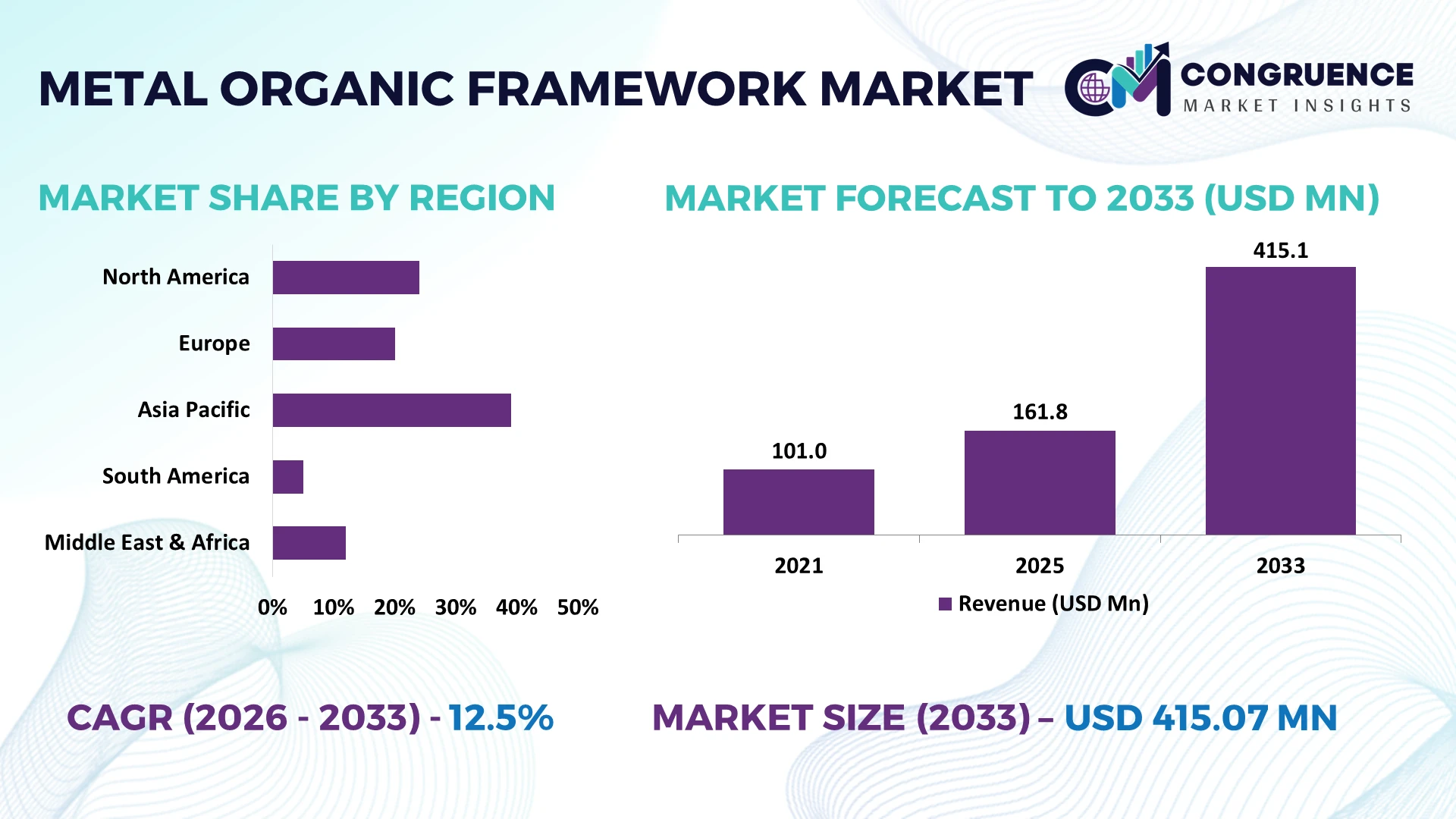
The Global Metal Organic Framework Market was valued at USD 161.77 Million in 2025 and is anticipated to reach a value of USD 415.07 Million by 2033 expanding at a CAGR of 12.5% between 2026 and 2033. Commercial-scale CO₂ capture, semiconductor dopant-gas storage, molecular separation, atmospheric water harvesting, and defense filtration are converting MOFs from laboratory materials into engineered industrial adsorbents.
The United States represents roughly 27–28% of current global activity under leading regional estimates, supported by BASF’s South Carolina production of CALF-20 at several hundred tons annually and Numat’s manufacturing footprint exceeding 100 tons. Semiconductor fabrication, carbon management, defense filtration, and specialty chemicals anchor adoption, while Numat continues expanding U.S. high-volume manufacturing capacity. Canada provides a strong comparison: Svante’s 141,000-square-foot Burnaby facility can manufacture MOF-coated filters supporting up to 10 million tonnes of annual CO₂ capture, shifting North American commercialization toward infrastructure-scale deployment.
Strategically, suppliers controlling scalable synthesis, application engineering, precursor security, and downstream integration will capture the strongest advantage as geopolitical pressure accelerates localized advanced-material supply chains.
Market Size & Growth: USD 161.77 million in 2025 advances toward USD 415.07 million by 2033 at 12.5%, driven increasingly by industrial CO₂ capture and precision gas separation.
Top Growth Drivers: Carbon capture, gas storage, and separation represent the strongest commercialization pathways, while North America holds approximately 35–37% of current industry activity.
Short-Term Forecast: By 2028, commercial MOF production will increasingly move beyond 100-ton manufacturing scales, improving material availability and lowering qualification barriers for industrial customers.
Emerging Technologies: AI-guided MOF discovery, structured sorbent filters, mechanochemical synthesis, and membrane integration are accelerating material screening and application-specific molecular selectivity.
Regional Leaders: Applying current share benchmarks to 2033 yields approximately USD 145 million for North America, USD 120 million for Europe, and USD 108 million for Asia-Pacific, with capture, chemicals, and manufacturing respectively supporting adoption.
Consumer/End-User Trends: Semiconductor manufacturers already deploy MOF-based ION-X systems across major global regions, with the platform compatible with existing implantation equipment and rated for 100% dopant-gas stability.
Pilot/Case Example: A 2026 Japanese demonstration by Kobe Steel, Atomis, and Nagase captured 30 kg of CO₂ daily and advanced planning toward metric-ton-scale testing.
Competitive Landscape: BASF holds above 24% under one 2026 market assessment, competing with Numat, novoMOF, Promethean Particles, and specialized MOF developers on synthesis scalability and application performance.
Regulatory & ESG Impact: Svante’s MOF-coated filter factory is designed around capacity equivalent to 10 million tonnes of annual CO₂ capture, connecting advanced materials directly with industrial decarbonization mandates.
Investment & Funding: Svante’s Redwood facility represents approximately USD 150 million of manufacturing investment, while novoMOF secured CHF 4.4 million in 2025 for scalable CO₂-capture materials.
Innovation & Future Outlook: MOFs with surface areas reaching 10,000 m² per gram are moving into carbon capture, atmospheric water recovery, semiconductor gases, and protective materials, shifting competition toward application-engineered frameworks.
The Metal Organic Framework Market is increasingly shaped by carbon capture, semiconductor gas handling, molecular filtration, water harvesting, and protective materials. Industrial production has already crossed several-hundred-ton annual scales, while MOF-coated filters are entering automated manufacturing. The 2025 Nobel Prize recognition strengthened technology visibility as localization, lower-cost synthesis, AI-assisted discovery, and application-specific framework design move commercialization into its next strategic phase.
Metal organic frameworks are becoming strategically important because industrial buyers are moving beyond laboratory screening toward commercial carbon capture, semiconductor gas handling, molecular separation, and environmental filtration. BASF has already scaled CALF-20 production to several hundred tons annually, while Canadian carbon-management infrastructure is moving MOF-coated sorbents into automated filter manufacturing. This shifts competitive advantage toward companies controlling synthesis scale, forming, activation, and application engineering.
Technology economics are also improving. Microwave-assisted CALF-20 synthesis reduces reaction time twelvefold, achieves 97% yield, and delivers roughly 20% higher CO₂ adsorption than conventionally synthesized material. Mechanochemical routes exceed 90% yield versus approximately 70% conventionally, strengthening the case for lower-solvent, higher-throughput manufacturing. Canada leads deployment-oriented carbon capture, while the United States maintains strength in semiconductor and specialty-gas applications.
Through 2026–2028, commercial qualification will increasingly focus on durability, shaped sorbents, regeneration efficiency, and continuous manufacturing. Svante’s 141,000-square-foot facility can manufacture filters supporting up to 10 million tonnes of annual CO₂ capture. Companies are therefore expanding production, licensing materials, and forming application partnerships. Long-term leadership will belong to suppliers converting molecular performance into reliable, manufacturable industrial systems.
Carbon capture is moving MOFs from research-scale powders into engineered industrial sorbents. CALF-20 systems have demonstrated approximately 90% CO₂ recovery with 95% purity, while structured materials have operated for more than 450,000 cycles under cement-kiln conditions at around 90% capture efficiency. Canada is accelerating this transition through large-scale filter manufacturing designed for industrial emitters in cement, pulp and paper, ethanol, and waste-to-energy facilities. The shift matters because MOFs combine selective adsorption with lower-temperature regeneration than many solvent-intensive capture systems. BASF, Svante, and specialist developers are responding through commercial-scale synthesis, structured sorbent production, plant demonstrations, and licensing partnerships. The strategic insight is that capture economics increasingly depend on sorbent manufacturability and cycling stability, not laboratory adsorption capacity alone.
High production cost remains the principal structural limitation because specialty organic linkers, solvents, activation steps, and purification can outweigh the underlying metal cost. More than 100,000 MOF structures have been synthesized academically, yet only a very small fraction have reached commercial products, highlighting the scale-up bottleneck. Conventional CALF-20 synthesis yields around 70%, compared with above 90% for emerging mechanochemical routes, while solvent-intensive processes increase waste handling and energy requirements. Moisture also constrains some frameworks; CALF-20 performance deteriorates in certain gas streams when relative humidity exceeds roughly 40% and CO₂ concentration falls below 15%. Companies are responding by simplifying linker chemistry, recycling solvents, adopting mechanochemical synthesis, and localizing precursor procurement. Commercial success therefore depends on manufacturing chemistry that survives real operating conditions without eroding adsorption economics.
Advanced synthesis routes create a major opportunity to reduce the gap between laboratory performance and industrial economics. Microwave-assisted CALF-20 production achieves 97% synthesis yield, cuts reaction time by roughly 92% through a twelvefold acceleration, and increases CO₂ adsorption capacity by approximately 20%. Mechanochemical production exceeds 90% yield versus approximately 70% conventionally and can deliver exceptionally high space-time productivity without conventional bulk solvents. These improvements create opportunities beyond carbon capture, including gas purification, atmospheric water harvesting, semiconductor gas storage, membranes, and specialty filtration. European and U.S. developers are investing in continuous processing, proprietary linker production, computational discovery, and application-specific framework design. The non-obvious advantage lies in process innovation: manufacturers that redesign synthesis itself can reduce capital intensity while producing MOFs tailored directly to downstream equipment and regeneration cycles.
The long-term challenge is proving that laboratory adsorption performance survives forming, contamination, regeneration, and thousands of industrial operating cycles. MOF powders must be converted into pellets, membranes, coatings, or structured filters without materially reducing pore accessibility or selectivity. CALF-20 has demonstrated durability beyond 450,000 cycles and approximately 90–97% CO₂ purity under tested wet-flue-gas conditions, yet performance can weaken when humidity exceeds around 40% in low-concentration streams. This illustrates why application qualification remains more difficult than material discovery. Companies must validate pressure drop, mechanical strength, thermal stability, impurity tolerance, recyclability, and end-of-life handling before industrial customers commit to long-duration contracts. Developers are therefore investing in pilot plants, accelerated cycling tests, coatings, hydrophobic framework engineering, and OEM partnerships. Competitive sustainability depends on proving reproducible performance across full equipment lifetimes, not achieving record adsorption values under controlled conditions.
Commercial Forms Replace Research Powders: MOF commercialization is shifting toward pellets, membranes, monoliths, and coated filters rather than loose powders. Powder still represents about 61% of 2025 supply, while membranes and thin films are advancing rapidly. Companies are investing in shaping technologies that reduce pressure drop, improve mechanical stability, and simplify integration into industrial adsorption equipment.
Continuous Synthesis Gains Ground: Solvothermal and hydrothermal routes still represent roughly 55% of synthesis activity, but manufacturers are introducing mechanochemical, microwave-assisted, and continuous processes. Yield improvements above 90% versus about 70% conventionally can reduce solvent consumption and processing time, pushing producers toward lower-waste manufacturing and more predictable batch quality.
Framework Stability Becomes Procurement Metric: Industrial customers increasingly prioritize humidity resistance, regeneration durability, and cycle life rather than record surface area. Zirconium frameworks such as UiO-66 remain stable under highly acidic and basic conditions up to pH 14, strengthening adoption in harsh separation and sensing environments. Suppliers are redesigning pore chemistry and hydrophobicity around real process streams.
Application Engineering Drives Differentiation: Gas storage and separation represent roughly 34–40% of market activity, while catalysis accounts for about 16–24% depending on classification. Suppliers are moving beyond catalog materials toward application-specific pore engineering, membrane integration, and structured adsorption systems. The non-obvious shift is that downstream process compatibility increasingly determines commercial value more than material novelty alone.
Copper-Based MOFs represent the leading type, accounting for approximately 38.4% of 2025 market activity under a current metal-specific assessment. Their dominance reflects established synthesis protocols, accessible copper salts, open-metal sites, and strong selectivity for CO₂, methane, and nitrogen separations. Zinc-Based MOFs are the fastest-expanding type as CALF-20 commercialization demonstrates that zinc frameworks can move from academic synthesis into industrial carbon-capture procurement. Zinc systems also benefit from adaptable coordination chemistry and established ZIF families.
Aluminum-Based MOFs remain strategically important where low metal cost, chemical stability, and adsorption durability matter, while Iron-Based MOFs benefit from catalytic activity and comparatively economical feedstocks. Zirconium-Based MOFs occupy a smaller premium segment but offer exceptional hydrothermal and chemical resilience; UiO-66 derivatives can tolerate environments reaching pH 14. Suppliers are therefore balancing high-volume copper and zinc portfolios against specialized iron, aluminum, and zirconium frameworks. Investment is shifting toward application-specific chemistry rather than broad material catalogs, because buyers increasingly select frameworks according to humidity tolerance, regeneration requirements, and downstream process economics.
Gas Storage remains the leading individual application, accounting for approximately 26–32% of current market activity across recent assessments. Demand is concentrated in hydrogen, methane, and CO₂ handling because MOFs combine high porosity with tunable adsorption sites and surface areas exceeding 6,000 square meters per gram. Gas Separation follows closely and gains importance in natural-gas purification, carbon removal, and industrial stream conditioning. Catalysis represents roughly 16–24% under available application classifications, supported by configurable active sites and selective reaction pathways.
Drug Delivery is the fastest-emerging application among the provided categories, representing roughly 10–14% in one 2025 assessment as controlled release, biocompatibility, and precision-medicine research expand. Sensing remains smaller but strategically valuable because framework chemistry can be tuned toward specific gases, ions, and biomolecules. Developers are adapting through nanoscale particle engineering, functionalized pores, membranes, and composite structures. Commercial priorities are consequently diverging: energy and chemical customers emphasize cyclic stability and adsorption performance, while pharmaceutical and sensing developers prioritize biocompatibility, selectivity, and miniaturization.
Chemical Industry buyers remain the dominant end-user group, accounting for approximately 30% under current end-user assessments, supported by continuous requirements for adsorption, separation, purification, and catalysis. Energy & Gas follows at roughly 25%, where hydrogen handling, methane storage, carbon management, and gas purification create direct process demand. Research Institutions maintain about 25% participation because framework discovery, characterization, and application validation still require intensive laboratory development before commercial qualification.
Environmental Technology is the fastest-developing commercial end-user as carbon capture, atmospheric water harvesting, and contaminant removal move MOFs into engineered systems. Pharmaceutical Companies represent approximately 20% in one current end-user assessment and remain focused on drug encapsulation, controlled release, and diagnostic platforms. Suppliers are segmenting portfolios accordingly: chemical and energy customers receive bulk sorbents and structured media, pharmaceutical buyers require high-purity biocompatible materials, and research institutions demand customizable small-batch frameworks. Competitive positioning is shifting toward vertical-specific technical support and application engineering, because each buyer group imposes fundamentally different validation, purity, cycling, and integration requirements.
Asia-Pacific accounted for the largest market share at 40.87% in 2025 however, Asia-Pacific is expected to register the fastest growth, expanding at a CAGR of approximately 14% between 2026 and 2033.
Commercial Carbon Capture Moves to Manufacturing Scale
North America represents a major commercialization center for metal organic frameworks, combining U.S. specialty-material manufacturing with Canadian carbon-capture deployment. The region accounts for roughly 35–37% under recent market classifications. In Canada, Svante commissioned its 141,000-square-foot Redwood facility in Burnaby in 2025, establishing automated production of MOF-coated structured sorbent filters. The plant can manufacture sufficient filters to support capture of up to 10 million tonnes of CO₂ annually. U.S. activity is more diversified across semiconductor gas handling, molecular filtration, carbon management, and advanced-material research. Numat has expanded high-volume MOF manufacturing, while BASF produces CALF-20 in South Carolina at several hundred tonnes annually. The regional advantage increasingly rests on converting proprietary framework chemistry into qualified products supported by repeatable manufacturing, application engineering, and industrial customer relationships.
United States Market Outlook: The United States combines commercial synthesis, semiconductor applications, carbon-management investment, and extensive advanced-material research. BASF’s Seneca, South Carolina operation can manufacture customized MOFs at several-hundred-tonne annual scale, while Numat has expanded Wisconsin manufacturing for high-volume applications. U.S. leadership increasingly reflects specialized manufacturing capability rather than laboratory discovery alone, particularly in semiconductor gas delivery and protective filtration.
Process Innovation Redefines MOF Manufacturing
Europe’s competitive position centers on chemical engineering, continuous synthesis, carbon separation, membrane technology, and industrial decarbonization. Germany provides large-scale chemical manufacturing expertise through BASF, while the United Kingdom hosts Promethean Particles and Nuada, and Switzerland supports novoMOF and UniSieve. European suppliers increasingly compete through lower-solvent synthesis, continuous-flow manufacturing, structured sorbents, and application-specific frameworks rather than research-grade powders. Promethean Particles shipped approximately 4 metric tonnes of material to a European gas-storage customer in 2025, demonstrating movement toward multi-tonne commercial orders. Switzerland’s novoMOF simultaneously expanded industrial carbon-capture development following new financing in 2025. Tightening industrial emissions requirements strengthen the value of MOFs in CO₂ separation and purification, but European suppliers must maintain competitive production economics against larger chemical platforms. Partnerships with process-equipment companies and industrial emitters are therefore becoming central to commercialization.
Germany Market Outlook: Germany holds a strategic advantage through its established chemical-production infrastructure, process-engineering expertise, and industrial decarbonization requirements. BASF’s ability to manufacture MOFs at several-hundred-tonne scale gives Germany an unusually strong bridge between specialty chemistry and commercial deployment. Demand increasingly connects MOF development with cement, chemicals, gas purification, atmospheric water recovery, and carbon-management applications requiring consistent industrial-grade material specifications.
Manufacturing Depth Accelerates Industrial Adoption
Asia-Pacific accounted for approximately 40.87% of 2025 market activity under one current market classification, supported by China’s advanced-material manufacturing base and strong research ecosystems in Japan, South Korea, India, and Australia. China combines precursor availability, specialty chemical production, large-scale industrial emissions, and expanding carbon-management requirements. Commercial suppliers are moving beyond research quantities: Guangdong-based Kargen reports more than 40 MOF products and mass-production capability, alongside 17 patent applications and six granted patents. Japan adds strength through Atomis and SyncMOF, particularly in gas storage, separation, and engineered porous materials. Deployment is increasingly connected with hydrogen infrastructure, petrochemical purification, environmental treatment, and industrial carbon capture. Suppliers are expanding customized synthesis and application-development capabilities rather than competing solely on material availability. Asia-Pacific’s strategic advantage lies in combining research depth with scalable chemical supply chains and comparatively rapid manufacturing iteration.
China Market Outlook: China is strategically positioned through integrated chemical supply chains and expanding domestic MOF manufacturing. Kargen reports that more than 60% of its workforce is dedicated to R&D, with over 80% of that team holding master’s or doctoral degrees. This combination of technical specialization, precursor access, patent development, and scalable production strengthens China’s ability to compete in customized gas-separation and carbon-capture frameworks.
Industrial Decarbonization Opens Selective Demand
South America remains an emerging MOF commercialization environment, with demand concentrated around carbon management, gas processing, mining, water purification, and academic materials development. Brazil offers the strongest industrial foundation because its cement, steel, petrochemical, ethanol, and natural-gas sectors create technically relevant adsorption and separation requirements. The country’s ethanol industry is particularly important for biogenic CO₂ capture because fermentation streams contain concentrated carbon dioxide, reducing separation complexity compared with dilute combustion gases. Brazil also operates one of the world’s largest biofuel systems, with ethanol blending in gasoline increased to 30% in 2025, reinforcing infrastructure around low-carbon fuels and concentrated biogenic streams. Commercial MOF manufacturing remains limited compared with North America, Europe, and China, making imported materials and technology partnerships important. Suppliers entering South America therefore benefit from application-led pilots, local engineering partners, and targeted industrial demonstrations rather than broad production expansion.
Brazil Market Outlook: Brazil combines large ethanol, petrochemical, mining, cement, and natural-gas industries with expanding industrial decarbonization requirements. Its nationwide E30 gasoline blend creates a distinctive bioenergy ecosystem where concentrated fermentation CO₂ provides a technically attractive capture pathway. MOF suppliers can differentiate through structured sorbents designed for humid process streams, supported by partnerships with universities, engineering contractors, and industrial operators.
Water and Gas Systems Shape Deployment
Middle East & Africa presents specialized MOF opportunities driven by gas processing, hydrogen, carbon capture, water scarcity, petrochemicals, and industrial filtration. Saudi Arabia and the UAE offer the strongest near-term environment because large hydrocarbon processing assets increasingly operate alongside carbon-management and clean-hydrogen programs. Saudi Arabia also provides a globally significant MOF research base through KAUST, where porous-material research targets gas separation, carbon capture, and water harvesting. Atmospheric water harvesting is particularly relevant across arid Gulf environments because advanced frameworks can selectively adsorb water vapor at low relative humidity. South Africa provides additional potential in mining emissions, industrial gas treatment, and water purification, although commercialization infrastructure remains less developed. Suppliers are positioning through university partnerships, application demonstrations, and integration with existing gas-processing systems. Regional competitiveness depends on matching framework chemistry to extreme heat, humidity variation, and industrial contaminants.
Saudi Arabia Market Outlook: Saudi Arabia combines large-scale petrochemical and gas-processing infrastructure with advanced materials research and aggressive industrial decarbonization programs. KAUST has established deep expertise in reticular chemistry and porous materials, giving the country an innovation platform for MOF-enabled gas separation and atmospheric water harvesting. Commercial opportunity increasingly lies in connecting this research capability with domestic energy, hydrogen, desalination, and carbon-management infrastructure.
BASF competes with Numat Technologies, Promethean Particles, Nuada, and novoMOF across commercial MOF synthesis, while application specialists challenge chemical-scale suppliers through proprietary carbon capture, gas separation, and semiconductor platforms. The top five participants collectively hold approximately 45% share, indicating moderate concentration around scalable manufacturing and validated intellectual property. BASF leads with about 24.3%, supported by several-hundred-tonne production capability. Competition centers on adsorption performance, cycling stability, manufacturing cost, customization, and application integration; mechanochemical synthesis can lift yields above 90% versus roughly 70% conventionally. Companies are scaling continuous-flow production, expanding manufacturing, licensing frameworks, and partnering with carbon-capture equipment developers. Competition is shifting from novel framework discovery toward structured sorbents, membranes, and application-ready systems. Qualification cycles, proprietary synthesis, precursor control, and industrial-scale reproducibility create formidable entry pressure. Winning requires scalable chemistry, validated lifecycle performance, application engineering, secure supply, and customer-specific integration capabilities.
BASF SE
Numat Technologies
novoMOF
Promethean Particles
Nuada
Framergy
Immaterial
Svante Technologies
ACSYNAM
MOFapps
ProfMOF
Atomis
SyncMOF
UniSieve
Current MOF technology is moving from solvothermal laboratory batches toward continuous-flow synthesis, shaped sorbents, and industrial-scale activation. BASF already produces CALF-20 at several-hundred-tonne scale, while Numat operates reactors of 10,000 liters and above. Continuous and mechanochemical routes can push synthesis yields above 90% versus roughly 70% conventionally, cutting solvent intensity and improving batch consistency. These gains lower qualification risk for carbon-capture, filtration, and semiconductor customers.
Emerging systems integrate MOFs into structured filters, membranes, pellets, and pressure-swing adsorption equipment rather than selling powders alone. Svante’s filters capture and release CO₂ in under 60 seconds, compared with hours for many traditional solid-sorbent processes, delivering a material-cycle speed improvement exceeding 90%. Commercial adoption is now visible at multi-tonne scale: Promethean Particles shipped four tonnes for a European gas-storage application, while semiconductor MOFs are already deployed in hazardous-gas handling.
Disruptive development is shifting toward AI-guided framework discovery, water-stable chemistries, low-solvent manufacturing, and application-specific pore engineering. From 2026–2028, suppliers integrating chemistry, shaping, process equipment, and lifecycle analytics will capture the strongest advantage. Carbon-capture developers, semiconductor suppliers, and gas-storage OEMs benefit most because faster cycling, reproducible manufacturing, and lower regeneration requirements directly improve equipment productivity and operating economics while strengthening supply resilience across high-volume industrial deployments.
February 2024 — Numat Technologies announced a second high-volume MOF manufacturing facility in Wisconsin, strengthening domestic supply for defense, first-responder, and decarbonization applications. The expansion added another U.S. production site and reinforced North American supply-chain resilience for customers. Source: bizjournals.com
May 2025 — novoMOF secured CHF 4.4 million to scale point-source CO₂ capture materials targeting costs below €100 per tonne. The funding strengthens commercialization across industrial and heavy-transport applications while accelerating manufacturing scale-up and customer qualification programs globally. Source: psi.ch
November 2025 — Promethean Particles completed its largest MOF order, shipping four tonnes to a European customer developing energy-efficient gas storage. Continuous-flow manufacturing moved production from gram-kilogram batches to tonne scale, demonstrating commercial supply-chain readiness for industrial customers. Source: prometheanparticles.co.uk
April 2026 — Atomis, Kobe Steel, and Nagase completed Japan’s first practical-scale MOF-PSA CO₂ capture demonstration at 30 kg per day. The partners began evaluating metric-ton-scale testing, advancing MOF adsorption from pilot validation toward industrial deployment and commercialization. Source: kobelco.co.jp
The Metal Organic Framework Market report covers Zinc-Based, Copper-Based, Iron-Based, Aluminum-Based, and Zirconium-Based frameworks across Gas Storage, Gas Separation, Catalysis, Drug Delivery, and Sensing. End-user analysis spans the Chemical Industry, Energy & Gas, Pharmaceutical Companies, Environmental Technology, and Research Institutions. Regional coverage includes North America, Europe, Asia-Pacific, South America, and Middle East & Africa, with country-level evaluation of commercialization, manufacturing, research intensity, and deployment readiness.
Technology coverage assesses continuous-flow synthesis, mechanochemistry, shaped sorbents, membranes, pressure-swing adsorption, AI-guided framework discovery, and moisture-stable chemistries. Commercial indicators include multi-tonne production, several-hundred-tonne manufacturing capacity, and structured filters designed for million-tonne-scale carbon capture. The report evaluates supply-chain localization, precursor economics, application qualification, competitive positioning, and industrial partnerships, supporting investment planning, geographic expansion, technology selection, and portfolio strategy through 2033.
| Report Attribute/Metric | Report Details |
|---|---|
Market Revenue in 2025 | USD 161.77 Million |
Market Revenue in 2033 | USD 415.07 Million |
CAGR (2026 - 2033) | 12.5% |
Base Year | 2025 |
Forecast Period | 2026 - 2033 |
Historic Period | 2021 - 2025 |
Segments Covered | By Type
By Application
By End-User
|
Key Report Deliverable | Revenue Forecast, Growth Trends, Market Dynamics, Segmental Overview, Regional and Country-wise Analysis, Competition Landscape |
Region Covered | North America, Europe, Asia-Pacific, South America, Middle East, Africa |
Key Players Analyzed | BASF SE, Numat Technologies, novoMOF, Promethean Particles, Nuada, Framergy, Immaterial, Svante Technologies, ACSYNAM, MOFapps, ProfMOF, Atomis, SyncMOF, UniSieve |
Customization & Pricing | Available on Request (10% Customization is Free) |




