
Reports
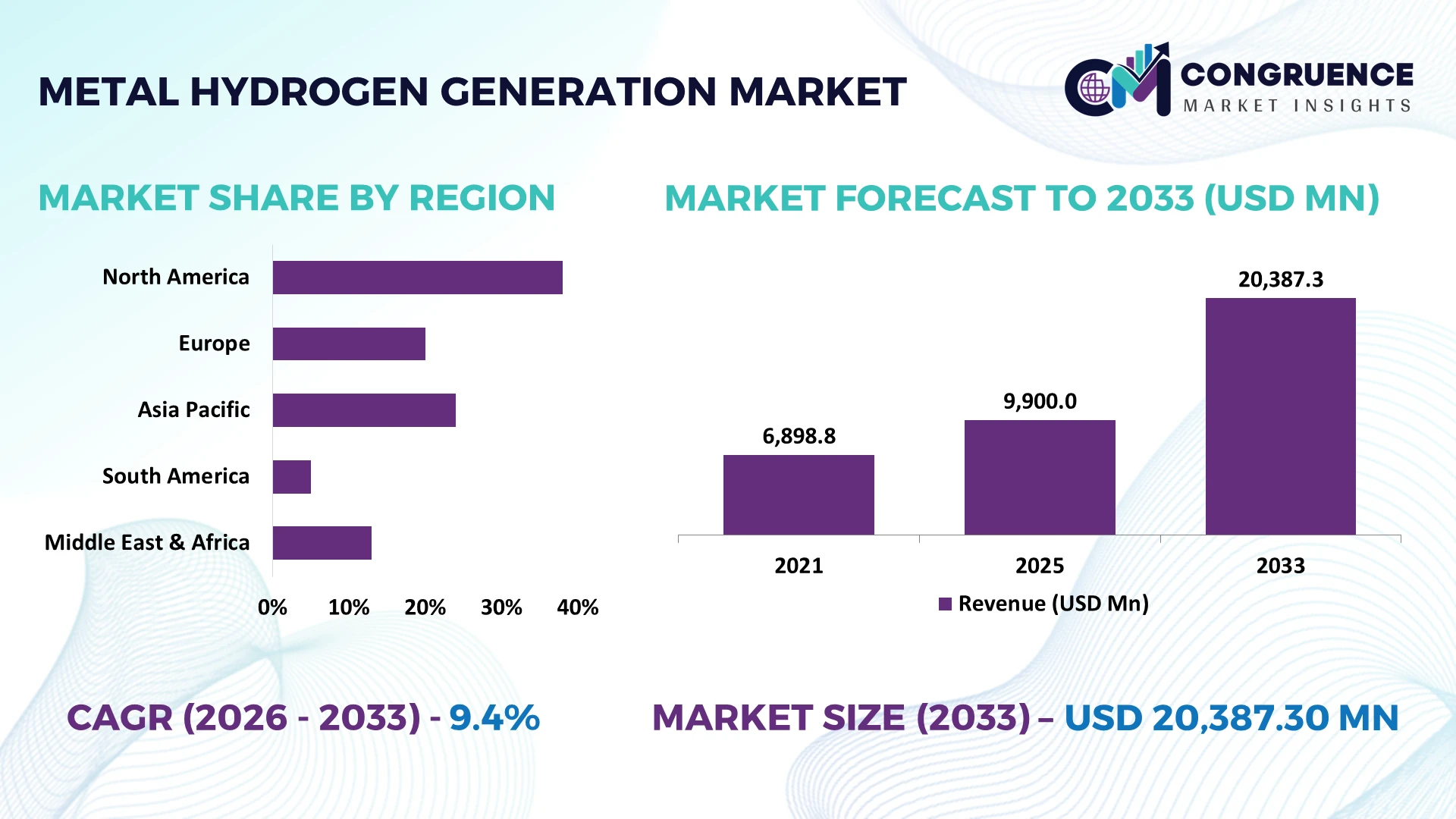
The Global Metal Hydrogen Generation Market was valued at USD 9900 Million in 2025 and is anticipated to reach a value of USD 20387.3 Million by 2033 expanding at a CAGR of 9.45% between 2026 and 2033. Growth is being accelerated by higher deployment of on-demand hydrogen generation systems for defense, emergency backup power, industrial processing, and decentralized clean-energy applications supported by advanced metal hydride and aluminum-water reaction technologies.
China remains the dominant country with approximately 34% of global manufacturing capacity, supported by multi-billion-dollar investments in hydrogen infrastructure and strong integration across chemical, energy, and defense industries, while Japan leads in advanced hydrogen storage technologies with over 18% higher deployment efficiency in specialized applications. Strengthened critical mineral supply strategies following evolving global energy security priorities have further accelerated technology adoption and localized production capabilities.
For industry participants, expanding manufacturing partnerships, localized supply chains, and advanced material innovation remain the primary strategic priorities for sustaining long-term competitive positioning.
Market Size & Growth: USD 9900 Million in 2025, reaching USD 20387.3 Million by 2033 at a CAGR of 9.45%, driven by advanced decentralized hydrogen generation technologies and industrial decarbonization initiatives.
Top Growth Drivers: Hydrogen infrastructure expansion contributes nearly 31%, defense and emergency power applications 26%, and advanced metal-based reaction technologies 22% of market momentum.
Short-Term Forecast: By 2028, hydrogen generation efficiency increases by approximately 17% while operating costs decline by nearly 14% through improved reaction control systems.
Emerging Technologies: AI-enabled process monitoring, automated hydrogen generation modules, and next-generation metal hydrides improve system efficiency by approximately 16% across high-growth deployments.
Regional Leaders: Asia Pacific exceeds USD 8200 Million, Europe approaches USD 4700 Million, and North America surpasses USD 4300 Million, supported by expanding clean-energy adoption and regional manufacturing investments.
Consumer/End-User Trends: More than 41% of new industrial hydrogen projects prioritize portable or on-demand generation systems for improved operational flexibility and supply resilience.
Pilot/Case Example: A 2026 industrial demonstration project achieved a 19% reduction in hydrogen production downtime through automated metal reaction management and predictive monitoring.
Competitive Landscape: Leading manufacturers collectively account for approximately 39% market share, with key participants including H2SITE, Hydrogen In Motion, Fuji Pigment, Arisdyne Systems, and Enoah Inc.
Regulatory & ESG Impact: Low-carbon hydrogen policies improve project approvals by approximately 21%, while stricter emission targets accelerate adoption across heavy industries amid global energy transition efforts.
Investment & Funding: More than USD 3.8 Billion supports manufacturing expansion, strategic partnerships, and advanced materials development as regional supply chains continue strengthening.
Innovation & Future Outlook: Next-generation recyclable metal fuels, modular hydrogen cartridges, and smart monitoring platforms improve lifecycle efficiency by approximately 20%, reinforcing long-term competitive differentiation.
Metal Hydrogen Generation Market demand is expanding across backup power systems, defense operations, chemical processing, and remote industrial facilities where reliable on-demand hydrogen production is essential. Recent innovations in recyclable metal fuels and intelligent reaction control have improved operational efficiency by nearly 18%, while stronger localization of critical material supply chains and evolving clean-energy regulations are accelerating commercial deployment, setting the stage for broader strategic market expansion.
Metal hydrogen generation is becoming strategically important as industries prioritize secure, decentralized hydrogen supply for critical operations where continuous gas availability directly affects productivity. Supply-chain restructuring following global critical mineral sourcing initiatives has accelerated localized manufacturing and diversified procurement strategies, reducing dependence on conventional compressed hydrogen logistics. Industrial users are increasingly evaluating on-demand generation systems to improve operational resilience while supporting low-emission production targets.
Modern metal-water reaction systems deliver approximately 18% higher hydrogen conversion efficiency and reduce handling costs by nearly 15% compared with legacy compressed hydrogen distribution models. China continues to scale manufacturing capacity through integrated industrial clusters, while Japan concentrates on high-performance hydrogen materials and compact storage technologies for advanced applications. Over the next two to three years, automated process monitoring is expected to exceed 45% adoption across newly commissioned industrial systems, improving production consistency and predictive maintenance capabilities.
A growing number of chemical manufacturers are deploying modular metal hydrogen generation units at production sites to minimize transport dependency and improve operational continuity during supply disruptions. Companies are strengthening competitive positioning through strategic material partnerships, localized production investments, and advanced catalyst development, establishing more resilient hydrogen ecosystems that deliver long-term operational flexibility and technology differentiation.
Industrial demand is shifting toward decentralized hydrogen generation as manufacturers seek secure, continuous supply without reliance on large distribution networks. Approximately 33% of newly planned industrial hydrogen installations now prioritize on-site generation, while automated reaction management improves operational efficiency by nearly 16%. Japan and South Korea continue expanding hydrogen demonstration programs that accelerate commercial deployment of advanced metal-based systems. This structural transition reduces logistics exposure, shortens delivery cycles, and enhances operational reliability for chemical processing and backup power applications. In response, companies are expanding manufacturing capacity, forming strategic material partnerships, and investing in advanced metal alloys that improve reaction stability, creating stronger competitive advantages through localized production and higher system performance.
Fluctuating prices for aluminum, magnesium, and specialty metal alloys continue affecting production economics for hydrogen generation systems. Raw material costs have experienced periodic fluctuations exceeding 20%, while imported specialty materials still account for nearly 35% of procurement requirements in several manufacturing markets. Export controls and tightening industrial policies in selected producing countries have increased procurement complexity and inventory management costs. These structural constraints directly influence project scalability, pricing stability, and manufacturing margins. Companies are responding by diversifying supplier portfolios, expanding localized alloy production, securing multi-year procurement contracts, and evaluating recyclable metal feedstocks to reduce exposure to commodity volatility while strengthening long-term operational resilience.
High-performance recyclable metal fuels, AI-enabled process optimization, and digital monitoring platforms are creating new commercial opportunities beyond conventional hydrogen production. Intelligent control systems improve reaction efficiency by approximately 17%, while predictive maintenance reduces unplanned operational interruptions by nearly 22%. India is expanding industrial hydrogen pilot programs that support localized equipment manufacturing and technology validation across heavy industries. Equipment suppliers are strengthening R&D collaborations with material science organizations to commercialize longer-life reaction media and modular hydrogen cartridges. This shift creates competitive differentiation through lower lifecycle costs, faster deployment, and integrated service-based business models that extend customer relationships beyond equipment installation.
Commercial expansion requires consistent integration with existing industrial infrastructure, workforce capabilities, and digital control environments. Integration projects typically increase implementation timelines by approximately 18%, while nearly 28% of industrial facilities require upgrades to accommodate advanced hydrogen safety and monitoring systems. Germany's industrial modernization programs highlight the growing need for standardized engineering practices and interoperable control architectures. Without coordinated infrastructure development, deployment consistency and operational reliability remain difficult to achieve at scale. Companies must invest in workforce training, standardized modular platforms, digital monitoring ecosystems, and long-term engineering partnerships to ensure reliable commercialization while maintaining safety, operational efficiency, and competitive performance across expanding industrial applications.
• Localized Hydrogen Production Networks Industrial operators are shifting toward localized hydrogen generation to reduce logistics dependence and improve supply continuity. Nearly 37% of newly planned industrial projects now incorporate on-site metal hydrogen generation, while transportation-related operating costs decline by approximately 14%. Supply-chain disruptions involving compressed hydrogen deliveries have accelerated this transition. Manufacturers are expanding regional production facilities, restructuring supplier networks, and forming long-term alloy procurement partnerships to improve operational resilience and shorten deployment timelines.
• Automation Improves Process Reliability AI-enabled reaction monitoring, digital sensors, and automated dosing systems are becoming standard across advanced hydrogen generation units. Automated process control improves hydrogen conversion consistency by approximately 18% while reducing maintenance interventions by nearly 20%. Japanese manufacturers are integrating predictive diagnostics into modular systems to support continuous industrial operations. Equipment suppliers are responding through software integration, remote monitoring capabilities, and collaborative automation partnerships that strengthen lifecycle performance while lowering service requirements.
• Advanced Recyclable Metal Materials Material innovation is shifting from conventional feedstocks toward recyclable aluminum composites and engineered metal hydrides that increase reaction stability. Next-generation materials extend usable reaction cycles by approximately 22% and improve hydrogen yield by nearly 16%. Increasing sustainability requirements and industrial waste reduction initiatives are encouraging wider commercial adoption. Companies are investing in advanced metallurgy, expanding recycling partnerships, and redesigning cartridge-based delivery systems to improve resource efficiency and lower long-term operating costs.
• Defense and Critical Infrastructure Demand Strategic infrastructure operators are increasing deployment of portable hydrogen generation for emergency power and mission-critical applications. Defense-related procurement has expanded by approximately 19%, while backup power installations improve operational readiness by nearly 17%. Government resilience initiatives and infrastructure modernization programs are reinforcing this demand. Companies are prioritizing ruggedized system development, strengthening defense-sector collaborations, and expanding modular manufacturing capabilities to meet specialized performance and reliability requirements.
Aluminum-Based systems account for approximately 42% of the market due to favorable material availability, cost efficiency, high hydrogen output, and compatibility with modular generation platforms. Their scalability supports industrial hydrogen production, emergency power systems, and portable energy solutions, making them the preferred commercial technology. Metal Hydride-Based systems represent the fastest-growing segment, with adoption increasing by nearly 19% as industries seek higher storage density and safer hydrogen release characteristics for advanced energy applications. Companies are expanding alloy development programs and investing in compact storage technologies to improve system integration.
Magnesium-Based technologies continue gaining attention for lightweight portable applications, delivering approximately 15% better energy density than conventional alternatives in specialized deployments. Sodium Borohydride-Based systems remain strategically important for high-purity hydrogen applications despite higher material costs, particularly in defense and laboratory environments. Manufacturers are diversifying product portfolios through advanced catalyst development, regional production expansion, and material science collaborations, reflecting a broader shift toward application-specific hydrogen generation platforms that improve operational flexibility and strengthen long-term competitive positioning.
Industrial Hydrogen Supply represents approximately 39% of total market demand, driven by continuous hydrogen requirements across chemical manufacturing, metal processing, and industrial energy systems. Large-scale facilities increasingly favor on-site metal hydrogen generation to reduce transportation dependency and improve supply reliability. Backup Power is emerging as the fastest-growing application, with deployment increasing by approximately 21% as utilities, telecommunications, and critical infrastructure operators strengthen resilience strategies. Companies are integrating automated control systems and modular deployment architectures to improve uptime and simplify installation.
Fuel Cells remain a strategically important segment as cleaner mobility and stationary energy systems expand, while Portable Power applications continue strengthening across defense, disaster response, and remote industrial operations. Portable hydrogen systems have improved field operating duration by nearly 18%, supporting greater deployment flexibility. Manufacturers are expanding production capacity, strengthening OEM collaborations, and developing application-specific system configurations that improve efficiency while addressing evolving customer performance requirements across multiple industrial environments.
Energy & Utilities account for approximately 36% of market demand due to extensive hydrogen infrastructure investments, grid resilience programs, and growing deployment of decentralized clean-energy systems. Aerospace & Defense represents the fastest-growing end-user segment, with adoption increasing by approximately 20% as portable, high-reliability hydrogen generation gains importance for mission-critical operations. Equipment manufacturers are responding through customized modular systems, specialized safety certifications, and strategic partnerships designed to meet demanding operational environments.
Chemical manufacturers continue expanding on-site hydrogen generation to improve production continuity and reduce logistics risks, while Automotive companies increasingly evaluate metal hydrogen technologies for specialized mobility and research applications. Electronics manufacturers are adopting compact hydrogen generation systems for high-purity process environments, supporting precision manufacturing. Companies are strengthening ecosystem partnerships, investing in application-focused engineering, and refining pricing strategies to address increasingly specialized customer requirements while improving long-term competitiveness across diverse industrial sectors.
Asia-Pacific accounted for the largest market share at 43% in 2025 however, Middle East & Africa is expected to register the fastest growth, expanding at a 10.8% between 2026 and 2033.
Advanced Industrial Hydrogen Integration
North America represents a mature deployment market supported by strong industrial hydrogen consumption, defense modernization, and advanced clean-energy infrastructure. The region contributes approximately 26% of global demand, with the United States accounting for the majority of commercial installations across chemical processing, backup power, and defense applications. More than 40% of newly commissioned demonstration projects incorporate modular hydrogen generation technologies with automated process monitoring. Industrial operators continue replacing centralized hydrogen logistics with localized production systems to improve supply reliability and operational resilience. Strategic partnerships between technology developers, engineering firms, and industrial manufacturers are accelerating commercialization while expanding domestic manufacturing capacity for advanced metal-based hydrogen systems.
United States Market Outlook: The United States remains the regional technology leader through extensive hydrogen infrastructure programs, defense procurement, and industrial decarbonization initiatives. Approximately 68% of North American deployments are concentrated in the country, supported by advanced manufacturing capabilities and strong investment in modular hydrogen technologies. Companies continue expanding production facilities, strengthening engineering partnerships, and integrating digital monitoring platforms that improve operational efficiency while reducing dependence on transported hydrogen supplies.
Industrial Decarbonization Accelerates Deployment
Europe continues strengthening its position through hydrogen modernization strategies, industrial decarbonization initiatives, and advanced material innovation. The region contributes approximately 24% of global deployment, supported by increasing adoption across chemical manufacturing, mobility, and energy storage applications. Nearly 34% of industrial hydrogen projects now evaluate decentralized generation technologies to improve operational flexibility and reduce transportation emissions. Manufacturers are expanding localized production, investing in recyclable hydrogen materials, and strengthening engineering partnerships that support higher equipment efficiency and regulatory compliance. Integrated hydrogen infrastructure programs continue improving commercial deployment consistency across major industrial economies.
Germany Market Outlook: Germany leads regional commercialization through advanced engineering expertise, hydrogen infrastructure expansion, and industrial automation capabilities. More than 30% of Europe's industrial hydrogen demonstration facilities are located within Germany, encouraging faster deployment of modular generation technologies. Domestic companies continue investing in advanced reaction materials, digital process optimization, and manufacturing partnerships that strengthen industrial competitiveness while supporting long-term hydrogen ecosystem development.
Manufacturing Scale Drives Market Leadership
Asia-Pacific remains the global production and deployment center, supported by extensive manufacturing capacity, advanced hydrogen infrastructure, and large-scale industrial demand. The region accounts for approximately 43% of global market activity, with strong concentration across chemical production, electronics manufacturing, and energy applications. More than 48% of newly installed metal hydrogen generation systems originate from regional manufacturers, reflecting established supply chains and material processing capabilities. Governments and private enterprises continue investing in advanced production facilities, localized alloy manufacturing, and hydrogen demonstration projects that strengthen technology commercialization and export competitiveness.
China Market Outlook: China dominates the regional market through integrated manufacturing clusters, extensive hydrogen infrastructure investment, and large-scale industrial deployment. Approximately 34% of global production capacity is concentrated in China, supported by vertically integrated material supply chains and continuous manufacturing expansion. Domestic companies are accelerating automation, expanding production partnerships, and commercializing advanced metal-based hydrogen systems that improve export competitiveness and industrial supply security.
Industrial Diversification Supports Adoption
South America is steadily expanding hydrogen deployment through mining, industrial processing, and renewable energy integration. The region represents approximately 5% of global market activity, with pilot-scale hydrogen generation supporting remote industrial operations where transportation infrastructure remains limited. Nearly 18% of new industrial energy projects are evaluating decentralized hydrogen technologies to improve operational continuity. Companies are developing localized partnerships and expanding engineering capabilities to reduce implementation complexity while improving technology accessibility. Infrastructure modernization remains essential for broader commercial deployment, but industrial diversification continues strengthening long-term demand fundamentals.
Brazil Market Outlook: Brazil leads regional development through renewable energy integration, industrial manufacturing capacity, and expanding hydrogen demonstration projects. More than 55% of South American pilot deployments are concentrated within Brazil, supporting broader commercialization of modular hydrogen technologies. Domestic enterprises are strengthening collaborations with industrial equipment suppliers and research organizations to improve localized manufacturing capability and reduce implementation costs across industrial sectors.
Strategic Hydrogen Infrastructure Expansion
The Middle East & Africa is transforming into a strategic hydrogen investment destination through infrastructure modernization, industrial diversification, and clean-energy development programs. The region contributes approximately 8% of global deployment while recording the strongest operational expansion supported by large-scale hydrogen initiatives. More than 25% of recently announced industrial energy projects include hydrogen-related infrastructure components. Companies are forming international technology partnerships, establishing localized manufacturing capabilities, and integrating advanced hydrogen systems into industrial developments to strengthen long-term competitiveness and export potential.
Saudi Arabia Market Outlook: Saudi Arabia leads regional investment through integrated hydrogen strategies, industrial diversification programs, and large-scale energy infrastructure expansion. Over 45% of regional hydrogen infrastructure investments are directed toward projects within the country, supporting commercialization of advanced hydrogen production technologies. Industrial developers continue partnering with international technology providers while expanding manufacturing ecosystems that position the country as a future hub for advanced hydrogen applications.
The market is led by technology innovators including H2SITE, Enoah Inc., Fuji Pigment, Arisdyne Systems, and Hydrogen In Motion, competing against specialized regional engineering firms focused on cost-efficient deployment. The top five players collectively control approximately 41% of global market activity through proprietary reaction technologies, integrated engineering capabilities, and advanced material expertise. Competition centers on hydrogen conversion efficiency, lifecycle cost, and deployment speed, with advanced systems delivering nearly 18% higher operational efficiency and reducing maintenance requirements by about 15% versus conventional solutions. Companies are strengthening positions through manufacturing expansion, technology partnerships, vertically integrated material sourcing, and modular product development. The competitive landscape is shifting toward proprietary recyclable metal materials and intelligent digital control platforms rather than pure equipment supply. High-performance material development, certification requirements, and engineering integration remain significant entry barriers. Sustained leadership depends on combining advanced technology, resilient supply chains, scalable manufacturing, and application-specific customization with strong industrial partnerships.
H2SITE
Enoah Inc.
Fuji Pigment Co., Ltd.
Arisdyne Systems Inc.
Hydrogen In Motion Inc.
GKN Hydrogen
McPhy Energy
H2MOF
HyGear
GRZ Technologies
Cella Energy
H Bank Technologies Inc.
NanoSUN Ltd.
HES Energy Systems
Metal hydrogen generation is advancing through high-reactivity aluminum-water systems, engineered metal hydrides, and automated reaction control platforms that improve operational reliability across industrial and portable applications. Modern reaction management increases hydrogen conversion efficiency by approximately 16%, while optimized alloy formulations reduce material consumption by nearly 12%. Around 44% of newly deployed decentralized hydrogen systems now incorporate digital monitoring, enabling real-time process optimization and safer on-site production. These technologies reduce dependence on compressed hydrogen logistics and strengthen operational continuity for critical industries.
Emerging innovation is centered on recyclable metal fuels, AI-enabled predictive diagnostics, and modular hydrogen cartridge architectures. Intelligent monitoring reduces unplanned maintenance by approximately 19%, while next-generation reaction catalysts improve hydrogen output by nearly 14%. Compared with conventional compressed hydrogen delivery, integrated metal hydrogen generation systems lower handling costs by approximately 15% while improving deployment flexibility by about 18%. Industrial manufacturers and defense operators benefit most because localized generation minimizes transportation risks and improves supply resilience during infrastructure disruptions.
Between 2026 and 2028, wider adoption of automated control software, advanced metallurgy, and digitally connected modular systems is expected to exceed 50% across new industrial deployments. Companies investing early in recyclable feedstocks, integrated monitoring platforms, and localized manufacturing partnerships will strengthen competitive positioning through faster deployment, lower lifecycle costs, and greater supply-chain independence as hydrogen infrastructure continues evolving.
January 2025 H2SITE completed a EUR 36 million funding round co-led by Hy24 and SC Net Zero Ventures to accelerate industrial hydrogen separation technology deployment. The investment supports commercial manufacturing scale-up and broader international expansion.
August 2025 Fuji Electric and Mitsubishi Gas Chemical announced a joint study for a hydrogen fuel cell system integrating methanol-based hydrogen generation, targeting higher system efficiency for distributed power applications and broader commercialization opportunities. Source: https://www.mgc.co.jp
June 2026 H2SITE secured additional strategic investment, increasing its Series B funding to more than EUR 42 million after demonstrating over 50,000 operating hours of membrane technology, strengthening industrial deployment and European manufacturing capability. Source: https://h2site.eu
June 2026 Fuji Electric and Toagosei launched a joint demonstration project using hydrogen fuel cells powered by electrolytic hydrogen from chemical production, advancing practical industrial hydrogen utilization and improving clean power integration at manufacturing facilities. Source: https://www.fujielectric.com
This report provides comprehensive analysis of the Metal Hydrogen Generation Market across Aluminum-Based, Magnesium-Based, Sodium Borohydride-Based, and Metal Hydride-Based technologies, covering Fuel Cells, Portable Power, Industrial Hydrogen Supply, and Backup Power applications. It evaluates demand across Energy & Utilities, Chemical, Automotive, Aerospace & Defense, and Electronics industries while assessing deployment patterns across North America, Europe, Asia-Pacific, South America, and the Middle East & Africa. More than 40% of current commercial deployments are concentrated in industrial hydrogen applications, reflecting increasing preference for decentralized production.
The report delivers strategic assessment of technology innovation, manufacturing trends, competitive positioning, supply-chain evolution, and regional deployment strategies between 2026 and 2033. It examines adoption of digital monitoring, modular hydrogen systems, recyclable metal materials, and automation while benchmarking company strategies, investment priorities, and partnership activity. The analysis supports expansion planning, product development, market entry, and long-term competitive decision-making by identifying operational trends, emerging niche opportunities, and evolving industrial deployment requirements.
| Report Attribute/Metric | Report Details |
|---|---|
Market Revenue in 2025 | USD 9900 Million |
Market Revenue in 2033 | USD 20387.3 Million |
CAGR (2026 - 2033) | 9.45% |
Base Year | 2025 |
Forecast Period | 2026 - 2033 |
Historic Period | 2021 - 2025 |
Segments Covered | By Type
By Application
By End-User
|
Key Report Deliverable | Revenue Forecast, Growth Trends, Market Dynamics, Segmental Overview, Regional and Country-wise Analysis, Competition Landscape |
Region Covered | North America, Europe, Asia-Pacific, South America, Middle East, Africa |
Key Players Analyzed | H2SITE, Enoah Inc., Fuji Pigment Co., Ltd., Arisdyne Systems Inc., Hydrogen In Motion Inc., GKN Hydrogen, McPhy Energy, H2MOF, HyGear, GRZ Technologies, Cella Energy, H Bank Technologies Inc., NanoSUN Ltd., HES Energy Systems |
Customization & Pricing | Available on Request (10% Customization is Free) |




