
Reports
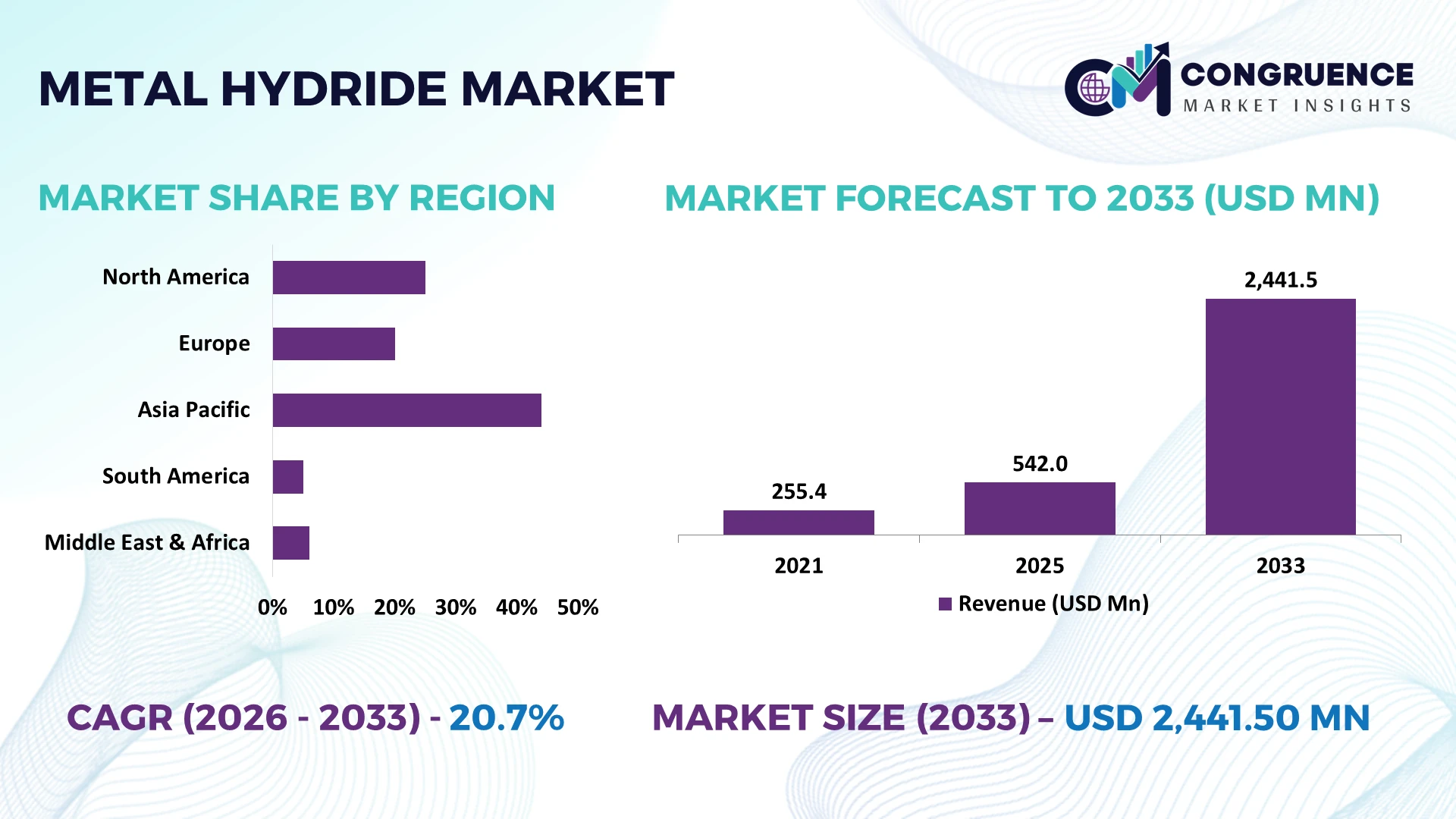
The Global Metal Hydride Market was valued at USD 542 Million in 2025 and is anticipated to reach a value of USD 2441.5 Million by 2033 expanding at a CAGR of 20.7% between 2026 and 2033. Growth is driven by hydrogen storage alloy commercialization, nickel-metal hydride battery applications, and solid-state hydrogen storage systems supporting industrial decarbonization.
China holds a strong position in the global metal hydride supply chain through rare-earth processing, battery materials manufacturing, and hydrogen technology deployment. The country accounts for approximately 91% of global rare-earth separation and processing, providing a substantial upstream advantage for lanthanum-based hydrogen storage alloys. Japan maintains competitive strength in nickel-metal hydride battery technology, particularly through established automotive battery manufacturing. China's rare-earth processing dominance, compared with Japan's specialized battery manufacturing capabilities, highlights distinct competitive advantages across raw material availability, alloy production, and downstream energy storage applications.
Strategically, manufacturers should prioritize rare-earth supply diversification and advanced hydrogen storage alloy development to reduce procurement exposure and strengthen industrial competitiveness.
Market Size & Growth: USD 542 million in 2025, reaching USD 2,441.5 million by 2033 at 20.7% CAGR, driven by solid-state hydrogen storage commercialization.
Top Growth Drivers: Hydrogen storage efficiency reaching 82.3%, integrated fuel-cell system efficiency of 49%, and 90% hydrogen release demonstrated in experimental reactors.
Short-Term Forecast: By 2028, Europe's REMEDHYS project targets 100 kg hydrogen storage capacity, strengthening commercial-scale validation.
Emerging Technologies: AI-assisted alloy optimization, automated reactor controls, and AB2-type hydrides support advanced storage systems operating above 700 bar.
Regional Leaders: Asia Pacific leads rare-earth alloy processing; North America advances megawatt-scale demonstrations; Europe develops 100 kg modular hydrogen storage. Regional market revenue forecasts remain unverified.
Consumer/End-User Trends: Industrial hydrogen applications gain traction, with experimental hydride reactors demonstrating 82.3% maximum energy storage efficiency.
Pilot/Case Example: A 2024 integrated metal hydride and fuel-cell study demonstrated 49% efficiency, approximately 1.8 times conventional system performance.
Competitive Landscape: GKN Hydrogen, Japan Metals & Chemicals, HBank Technologies, GRZ Technologies, and Whole Win Materials compete across storage technologies; company market shares remain undisclosed.
Regulatory & ESG Impact: China's 91% share of global magnet rare-earth refining highlights critical material supply-chain concentration and procurement exposure.
Investment & Funding: SoCalGas contributed USD 400,000 toward a hydrogen storage demonstration with GKN Hydrogen and NREL, supporting technology validation.
Innovation & Future Outlook: Europe's approximately EUR 4 million REMEDHYS initiative advances recycled-metal hydrides, integrating a 2 MW electrolyzer with modular storage.
The global metal hydride industry is evolving through solid-state hydrogen storage, nickel-metal hydride battery materials, thermal energy management, and hydrogen compression technologies. Advanced alloy formulations, improved reactor heat transfer, and integrated fuel-cell systems are strengthening industrial applications. Experimental multi-tube reactors have achieved 82.3% energy storage efficiency, demonstrating measurable progress in hydrogen absorption and recovery. European development programs increasingly emphasize recycled metal feedstocks to reduce critical mineral import dependence. These advances are shifting competitive priorities toward storage performance, material sourcing, system integration, and manufacturing scalability, establishing the foundation for strategic investment and technology differentiation.
Metal hydrides are becoming strategically important as hydrogen infrastructure operators seek compact, reversible storage technologies that reduce dependence on high-pressure gas handling. China's dominant rare-earth processing position creates procurement advantages for lanthanum-based alloys while exposing international manufacturers to concentrated upstream supply. Industrial competition is consequently shifting toward diversified alloy chemistry, integrated thermal management, and modular hydrogen storage equipment. Companies developing complete storage systems rather than standalone materials gain stronger positioning in distributed hydrogen infrastructure and industrial energy applications.
Conventional compressed hydrogen systems commonly operate at 350–700 bar, whereas selected metal hydride systems absorb hydrogen at substantially lower pressures, reducing pressure containment requirements. However, hydride systems introduce additional mass and thermal management demands, making stationary installations more attractive than weight-sensitive transport applications. Japan maintains expertise in nickel-metal hydride battery manufacturing, while Germany advances industrial hydrogen storage integration. Over 2026–2028, operational priorities include increasing reversible storage capacity, improving absorption kinetics, and validating repeated charging cycles under industrial operating conditions.
GKN Hydrogen's modular solid-state storage systems illustrate practical deployment opportunities for renewable hydrogen buffering and stationary power applications. Developers are strengthening partnerships with electrolyzer manufacturers, engineering contractors, and industrial hydrogen users to improve system compatibility. Investment priorities increasingly emphasize heat exchanger design, automated pressure control, and lifecycle validation. Competitive advantage will depend on delivering predictable hydrogen availability, lower integration complexity, and dependable storage performance across commercial installations.
Industrial hydrogen infrastructure modernization is accelerating interest in reversible metal hydride storage systems. Conventional compressed hydrogen equipment operates at 350–700 bar, while Europe's REMEDHYS project targets operation below 50 bar, representing at least an 85.7% reduction against the 350-bar benchmark. This pressure advantage supports simplified containment strategies for stationary storage, although total system economics depend on thermal management. China's hydrogen industrialization initiatives and India's National Green Hydrogen Mission are strengthening demand for alternative storage configurations. India's awarded electrolyzer manufacturing capacity totals 3,000 MW annually, creating potential integration opportunities. Manufacturers are developing modular hydride vessels, partnering with electrolyzer suppliers, and improving absorption kinetics to secure industrial demonstration contracts.
Rare-earth processing concentration creates substantial procurement exposure for metal hydride alloy manufacturers using lanthanum-rich compositions. China controls approximately 88% of global light rare-earth oxide separation capacity and 93% of metal refining, despite accounting for approximately 58% of light rare-earth mining output. This imbalance limits the effectiveness of mine-level diversification and exposes downstream alloy producers to processing bottlenecks. China's 2025 export restrictions further demonstrated how administrative controls disrupt critical material supply chains. Manufacturers face higher inventory requirements, supplier qualification expenses, and unpredictable alloy procurement schedules. Companies are responding through Australian sourcing partnerships, alternative AB2 alloy development, recycled metal recovery, and longer-term procurement agreements. Processing diversification offers greater resilience than mineral sourcing diversification alone.
Recycled-metal hydride technologies are creating opportunities for localized hydrogen storage manufacturing and circular material utilization. Europe's REMEDHYS program targets a 100 kg hydrogen storage installation integrated with a 2 MW electrolyzer, demonstrating the potential for industrial-scale modular deployment. Advanced complex hydrides offer theoretical or material-level hydrogen capacities of approximately 4–20 wt%, compared with typically below 2 wt% for conventional intermetallic hydrides. However, higher capacity requires improvements in reversible reaction temperatures and practical cycling performance. Germany's offshore hydrogen initiatives provide opportunities for storage suppliers to integrate renewable hydrogen production with maritime operations. Developers are investing in recycled alloy formulations, heat exchanger integration, and modular reactor engineering. The strategic opportunity lies in delivering application-specific storage systems rather than competing exclusively on material capacity.
Commercial deployment requires manufacturers to overcome the coupled thermal and kinetic limitations of metal hydride reactors. Conventional intermetallic hydrides generally store approximately 1–2 wt% hydrogen, while the U.S. Department of Energy's light-duty vehicle system target is 6.5 wt%, highlighting the challenge of weight-sensitive applications. Certain complex hydrides require hydrogen release temperatures exceeding 200°C, increasing auxiliary heating requirements and reducing system-level efficiency. India's NIT Rourkela project is developing 25 kg hydride reactor modules and a 5 kg optimized canister to investigate practical absorption and desorption performance. Manufacturers must improve thermal conductivity, validate repeated cycling, and standardize reactor control architectures. Competitive differentiation depends on consistent hydrogen delivery rates, thermal integration, and reliable operation under variable industrial loads.
Automated Alloy Production Gains Industrial Traction: Metal hydride manufacturers are introducing automated induction melting, controlled atmosphere processing, and precision powder classification to improve alloy consistency. AB5 compositions typically deliver 1–1.5 wt% hydrogen capacity, while selected AB2 alloys achieve approximately 1.5–2 wt%. Japanese materials producers are refining particle-size distribution and surface activation processes to improve repeatability. Automated quality inspection supports tighter production tolerances and reduces batch rejection exposure.
Hybrid Battery Architectures Reshape Product Development: Nickel-metal hydride battery manufacturers are refining electrode formulations for automotive auxiliary power and industrial backup applications. Commercial NiMH cells typically operate at 1.2 V nominal voltage and deliver approximately 60–120 Wh/kg specific energy. Japanese manufacturers are improving electrode durability and charge acceptance while integrating battery management electronics. The shift favors established producers capable of supplying reliable cells for applications where operating life outweighs maximum energy density.
Hydride-Based Thermal Systems Enter Specialized Applications: Researchers are advancing reversible metal hydride reaction systems for industrial temperature regulation and heat transformation. Selected magnesium-based hydrides contain approximately 7.6 wt% hydrogen theoretically, while magnesium hydride decomposition generally requires temperatures above 250°C without substantial modification. Engineering teams are developing catalytic additives and improved heat transfer surfaces. These innovations support specialized thermal cycling applications, although operating temperature remains a critical equipment design constraint.
Digital Monitoring Strengthens Storage Asset Reliability: Metal hydride equipment developers are integrating distributed temperature sensors, pressure transducers, and programmable controllers into modular storage installations. Hydrogen absorption and desorption involve 2 distinct thermal operating phases, while commercial storage configurations increasingly require coordinated pressure and temperature regulation. German system integrators are refining supervisory control interfaces to improve operational visibility. Predictive monitoring supports maintenance planning, identifies abnormal thermal behavior, and reduces unplanned storage interruptions.
AB5 alloys represent the leading commercial metal hydride type, supported by established nickel-metal hydride battery production and reliable hydrogen absorption characteristics. Their estimated market share is approximately 45–50%, although this specific five-type distribution remains unverified. Conventional AB5 formulations provide approximately 1–1.5 wt% reversible hydrogen capacity, supporting applications requiring predictable cycling performance and moderate operating pressures. Japanese battery manufacturers maintain established alloy processing capabilities, enabling consistent electrode quality and scalable production. AB2 alloys provide approximately 1.5–2 wt% hydrogen capacity in selected compositions, making them attractive for stationary hydrogen storage systems requiring improved gravimetric performance.
Magnesium-Based Alloys represent a promising emerging segment, with magnesium hydride offering 7.6 wt% theoretical hydrogen capacity. Their commercial expansion depends on reducing desorption temperatures and improving reaction kinetics. AB Alloys retain relevance in specialized hydrogen storage formulations, while A2B Alloys support targeted material engineering where composition-dependent equilibrium pressures provide advantages. Manufacturers are prioritizing alloy substitution, catalytic modification, and advanced powder processing. Investment decisions increasingly balance usable hydrogen capacity against operating temperature, material cost, and cycle durability rather than theoretical storage density alone.
Hydrogen Storage is a leading application in the global metal hydride market, with one published market estimate placing its share at approximately 41.2% in 2025. Demand is supported by stationary hydrogen buffering, renewable energy integration, and industrial hydrogen handling. Metal hydride systems provide volumetrically compact storage at comparatively moderate pressures, making them suitable for facilities prioritizing containment safety and predictable hydrogen delivery. Nickel-Metal Hydride Batteries remain an established application, particularly in Japanese hybrid automotive platforms and industrial rechargeable battery systems. Commercial NiMH cells generally achieve 60–120 Wh/kg, supporting applications where cycle reliability and established manufacturing infrastructure outweigh maximum energy density.
Hydrogen Compression represents an emerging high-growth application as thermally driven metal hydride compressors reduce reliance on conventional mechanical compression components. Thermal Energy Storage provides another specialized opportunity through reversible absorption and desorption reactions. Manufacturers are integrating improved heat exchangers, automated thermal controls, and application-specific alloy formulations. Commercial priorities increasingly favor integrated hydrogen storage and compression equipment capable of meeting defined industrial operating conditions, rather than standalone hydride material supply.
Automotive represents the leading end-user category, with published 2025 market estimates placing its share between approximately 36.75% and 39.8%, depending on market coverage. Demand reflects established nickel-metal hydride battery applications in hybrid vehicles and specialized energy storage components. Japanese automotive manufacturers maintain extensive hybrid powertrain production capabilities, supporting recurring procurement of hydrogen-absorbing electrode alloys. Conventional NiMH batteries operate at approximately 1.2 V per cell, offering established charge-discharge performance for automotive applications. Energy and Power is positioned as an emerging high-growth end-user category, driven by renewable hydrogen storage, distributed generation, and stationary power system integration.
Industrial Manufacturing is expanding specialized adoption of metal hydrides for hydrogen handling, purification, and thermally activated compression. Electronics manufacturers continue using NiMH batteries in rechargeable devices and backup systems, while Aerospace applications emphasize lightweight materials, controlled hydrogen release, and operational reliability. Suppliers are differentiating their portfolios through automotive-grade alloy consistency, modular stationary storage equipment, and customized thermal management systems. Investment priorities are shifting toward applications where predictable operating performance and lifecycle durability justify specialized material engineering.
Asia-Pacific accounted for the largest market share at an estimated 48% in 2025 however, Europe is expected to register the fastest growth, expanding at an estimated CAGR of 23.5% between 2026 and 2033.
Industrial Hydrogen Storage Integration and Advanced Materials Commercialization
North America's metal hydride market is shaped by hydrogen infrastructure modernization, advanced materials research, and stationary energy storage commercialization. The United States leads regional technology development through national laboratories, hydrogen equipment manufacturers, and industrial research partnerships. The U.S. Department of Energy's Hydrogen and Fuel Cell Technologies Office supports research into hydrogen storage materials, thermal management, and system integration. GKN Hydrogen's collaboration with Southern California Gas and the National Renewable Energy Laboratory demonstrates growing interest in modular solid-state storage. The region benefits from established aerospace engineering, specialty alloy production, and industrial gas infrastructure. However, high manufacturing costs and dependence on imported rare-earth processing constrain domestic supply-chain competitiveness. Manufacturers are prioritizing system engineering, automated controls, and commercial demonstration partnerships to improve equipment reliability and accelerate industrial qualification.
United States Market Outlook: The United States maintains a competitive position through hydrogen storage research, materials characterization, and integrated equipment engineering. The Department of Energy's light-duty hydrogen storage target of 6.5 wt% highlights the performance benchmark confronting advanced hydride developers. Companies are concentrating on stationary applications where system weight is less restrictive, while national laboratory collaborations support thermal optimization, durability testing, and technology validation.
Hydrogen Infrastructure Modernization and Modular Storage Deployment
Europe's metal hydride industry is transitioning toward integrated hydrogen storage, industrial decarbonization, and specialized thermal management applications. Germany, France, Switzerland, and the Netherlands support technology development through engineering companies, hydrogen research institutions, and equipment manufacturers. The European Union's renewable hydrogen framework encourages industrial hydrogen infrastructure investment, creating opportunities for alternative storage configurations. The REMEDHYS initiative targets a 100 kg hydrogen storage installation connected to a 2 MW electrolyzer, demonstrating practical integration between renewable hydrogen production and solid-state storage. European manufacturers are developing compact hydride modules, improved heat exchangers, and automated system controls. Industrial users increasingly evaluate hydrogen storage technologies according to pressure requirements, operational flexibility, and lifecycle maintenance. Equipment suppliers are strengthening partnerships with electrolyzer developers and engineering contractors to address integration costs and establish commercially repeatable system configurations.
Germany Market Outlook: Germany combines industrial hydrogen demand, precision engineering, and advanced energy technology manufacturing. GKN Hydrogen supports the commercialization of metal hydride storage systems through modular equipment development and industrial partnerships. Germany's national hydrogen strategy targets at least 10 GW of domestic electrolyzer capacity by 2030, strengthening the potential customer base for stationary hydrogen buffering, thermal integration, and specialized storage equipment.
Rare-Earth Processing Leadership and Established Battery Manufacturing
Asia-Pacific holds the strongest manufacturing position in the global metal hydride industry through China's rare-earth processing capacity and Japan's established nickel-metal hydride battery ecosystem. China dominates upstream separation and refining activities, providing material sourcing advantages for hydrogen storage alloy manufacturers. Japan maintains advanced expertise in AB5 alloy engineering, battery electrode production, and automotive hybrid powertrain integration. South Korea contributes specialized battery materials development, while India is expanding its hydrogen technology research and industrial manufacturing capabilities. China's large-scale materials processing infrastructure supports alloy availability and competitive manufacturing economics. Japanese companies differentiate through electrode consistency, cycle durability, and established automotive qualification processes. Regional manufacturers are investing in improved alloy compositions, automated powder production, and localized downstream processing. These capabilities strengthen Asia-Pacific's competitive position across established battery applications and emerging stationary hydrogen storage technologies.
China Market Outlook: China combines extensive rare-earth processing infrastructure with industrial materials manufacturing and hydrogen technology development. Its approximately 91% share of global rare-earth separation and processing provides a substantial upstream advantage for selected metal hydride alloy supply chains. Domestic manufacturers benefit from established metallurgical processing clusters, industrial equipment capacity, and access to hydrogen infrastructure development programs. Export controls also increase the strategic importance of domestic alloy processing capabilities.
Industrial Hydrogen Hubs Create Specialized Storage Demand
South America's metal hydride market is developing alongside renewable hydrogen infrastructure, mining decarbonization, and industrial energy diversification. Brazil and Chile provide the strongest potential deployment environments through renewable electricity resources and emerging hydrogen production clusters. Brazil's Pecém Industrial and Port Complex hosts hydrogen development activities supporting industrial processing and export infrastructure. An existing demonstration facility incorporates a 1.25 MW electrolyzer, providing operational experience in modular hydrogen production. Chile's mining industry presents opportunities for stationary hydrogen buffering and specialized compression equipment where industrial users require controlled hydrogen delivery. However, electricity grid access, permitting timelines, and limited commercial storage installations constrain near-term adoption. Metal hydride manufacturers can establish early positions through pilot engineering, local equipment partnerships, and integration with electrolyzer suppliers. Commercial qualification remains dependent on demonstrating thermal efficiency and reliable industrial operation.
Brazil Market Outlook: Brazil offers significant opportunities through renewable hydrogen production, industrial manufacturing, and port infrastructure modernization. The federal government has identified 12 hydrogen hub projects across seven states under Pró-Hubs Brasil. Ceará's industrial ecosystem supports electrolyzer deployment and hydrogen equipment development. Metal hydride suppliers can target industrial hydrogen buffering, research installations, and specialized compression applications while adapting equipment to local certification requirements and operating conditions.
Hydrogen Megaprojects Accelerate Storage Technology Evaluation
The Middle East and Africa metal hydride market is influenced by large-scale hydrogen infrastructure investment, industrial diversification, and specialized energy storage requirements. Saudi Arabia leads major hydrogen production development through NEOM Green Hydrogen Company, while the United Arab Emirates and Oman are expanding hydrogen industrial ecosystems. NEOM's project integrates approximately 4 GW of renewable electricity generation and targets up to 600 tonnes of hydrogen production daily, establishing substantial hydrogen handling requirements. These facilities primarily rely on established industrial storage technologies, but their development creates opportunities to evaluate metal hydrides for distributed buffering and auxiliary applications. Namibia and South Africa are advancing renewable hydrogen initiatives linked to industrial processing and mineral beneficiation. Equipment suppliers are prioritizing thermal management engineering, partnerships with industrial contractors, and localized technical services to address high ambient temperatures and infrastructure integration requirements.
Saudi Arabia Market Outlook: Saudi Arabia provides a substantial industrial hydrogen investment environment through Vision 2030 and integrated energy infrastructure development. NEOM Green Hydrogen Company reported 80% construction completion across its project sites in early 2025. Metal hydride technology developers can pursue specialized industrial storage, hydrogen compression, and auxiliary power applications through engineering partnerships, provided systems meet demanding thermal, reliability, and maintenance requirements.
GKN Hydrogen and GRZ Technologies compete in integrated solid-state hydrogen storage, while Japan Metals & Chemicals, Santoku, and Mitsui Mining & Smelting emphasize alloy manufacturing and materials quality. Hydrexia targets modular storage commercialization, creating competition between equipment integrators and specialized material suppliers. A verified combined market share for the five largest companies is unavailable because comparable metal hydride sales disclosures are limited. Performance differences remain material: conventional AB5 alloys typically store 1–1.5 wt% hydrogen, selected AB2 alloys reach approximately 2 wt%, and magnesium hydride offers 7.6 wt% theoretical capacity but requires more demanding thermal management. Suppliers compete through absorption kinetics, pressure control, cycling durability, customization, and procurement reliability. Partnerships with electrolyzer developers and industrial operators support qualification, while automated alloy processing improves production consistency. Concentrated rare-earth refining increases entry barriers for independent manufacturers. Winning requires validated system efficiency, dependable alloy sourcing, application-specific engineering, and repeatable commercial deployments rather than laboratory capacity claims.
GKN Hydrogen
GRZ Technologies SA
Japan Metals & Chemicals Co., Ltd.
Santoku Corporation
Mitsui Mining & Smelting Co., Ltd.
Nippon Denko Co., Ltd.
Hydrexia Holding Limited
HBank Technologies Inc.
Albemarle Corporation
Merck KGaA
Otto Chemie Pvt. Ltd.
Panasonic Energy Co., Ltd.
Mitsubishi Chemical Group Corporation
Conventional metal hydride technologies rely on AB5 and AB2 intermetallic alloys for reversible hydrogen absorption, battery electrodes, and stationary storage. AB5 compositions typically achieve 1–1.5 wt% hydrogen capacity, while selected AB2 formulations approach 2 wt%, offering approximately 33% greater gravimetric capacity than a 1.5 wt% benchmark. Automated induction melting, controlled powder processing, and integrated temperature sensors improve alloy consistency and reactor operation. Established nickel-metal hydride battery manufacturing provides commercial adoption, while modular storage systems remain at demonstration and early commercialization stages.
Emerging technologies combine catalytic alloy modification, nanostructured particles, and advanced heat exchangers to improve hydrogen release kinetics. Magnesium hydride provides 7.6 wt% theoretical capacity, approximately 280% above a 2 wt% conventional alloy benchmark, although practical system capacity remains lower. Digital thermal controllers coordinate absorption and desorption, supporting predictable hydrogen delivery. German and Japanese developers benefit from established materials engineering capabilities, while equipment integrators gain differentiation through application-specific reactor design.
Between 2026 and 2028, disruptive development will emphasize recycled-metal hydrides, thermochemical compression, and integrated electrolyzer storage architectures. Modular demonstrations targeting 100 kg hydrogen capacity will test commercial scalability. Manufacturers prioritizing thermal efficiency, cycling durability, and standardized controls will strengthen qualification prospects. Investment decisions should favor verified system-level performance over theoretical material capacity, particularly where operating temperatures determine commercial viability.
November 2024: GKN Hydrogen and NREL commissioned a solid-state hydrogen storage demonstration integrating 500 kg capacity with renewable energy infrastructure. The project supported industrial validation of metal hydride storage for grid resilience and distributed power. Source: nrel.gov
January 2025: Institute for Energy Technology launched REMEDHYS, developing recycled-metal hydrogen storage operating below 50 bar. The initiative targets modular storage validation, strengthening Europe's circular materials ecosystem while reducing dependence on imported critical metals. Source: ife.no
November 2025: Marubeni Corporation completed its hydrogen supply-chain demonstration connecting Australia and Indonesia through metal hydride transportation. The project validated cross-border hydrogen logistics, while supporting fuel-cell electricity generation at an industrial park near Jakarta. Source: marubeni.com
February 2026: Hydrexia completed its first regional maritime shipment of solid-state hydrogen using MHX containers, following a roadshow launched in September 2025. Collaboration with SEDC Energy demonstrated hydrogen transportation across Asian seaports, advancing commercial logistics validation. Source: prnewswire.com
The Metal Hydride Market Report evaluates industry development between 2026 and 2033 across five alloy types: AB5 Alloys, AB2 Alloys, AB Alloys, A2B Alloys, and Magnesium-Based Alloys. Application coverage includes Hydrogen Storage, Nickel-Metal Hydride Batteries, Thermal Energy Storage, and Hydrogen Compression. End-user analysis examines Automotive, Energy and Power, Electronics, Aerospace, and Industrial Manufacturing. The assessment compares material performance, manufacturing scalability, commercialization maturity, and procurement requirements across these segments.
Geographical coverage encompasses North America, Europe, Asia-Pacific, South America, and the Middle East & Africa, emphasizing country-level manufacturing capabilities, hydrogen infrastructure, and supply-chain dependencies. Technology analysis addresses reversible hydrogen capacity, thermal management, automated reactor controls, and recycled alloys. Competitive benchmarking evaluates product differentiation, industrial partnerships, and commercialization strategies, supporting investment prioritization, geographic expansion, supplier selection, and long-term market positioning.
| Report Attribute/Metric | Report Details |
|---|---|
Market Revenue in 2025 | USD 542 Million |
Market Revenue in 2033 | USD 2441.5 Million |
CAGR (2026 - 2033) | 20.7% |
Base Year | 2025 |
Forecast Period | 2026 - 2033 |
Historic Period | 2021 - 2025 |
Segments Covered | By Type
By Application
By End-User
|
Key Report Deliverable | Revenue Forecast, Growth Trends, Market Dynamics, Segmental Overview, Regional and Country-wise Analysis, Competition Landscape |
Region Covered | North America, Europe, Asia-Pacific, South America, Middle East, Africa |
Key Players Analyzed | GKN Hydrogen, GRZ Technologies SA, Japan Metals & Chemicals Co., Ltd., Santoku Corporation, Mitsui Mining & Smelting Co., Ltd., Nippon Denko Co., Ltd., Hydrexia Holding Limited, HBank Technologies Inc., Albemarle Corporation, Merck KGaA, Otto Chemie Pvt. Ltd., Panasonic Energy Co., Ltd., Mitsubishi Chemical Group Corporation |
Customization & Pricing | Available on Request (10% Customization is Free) |




