
Reports
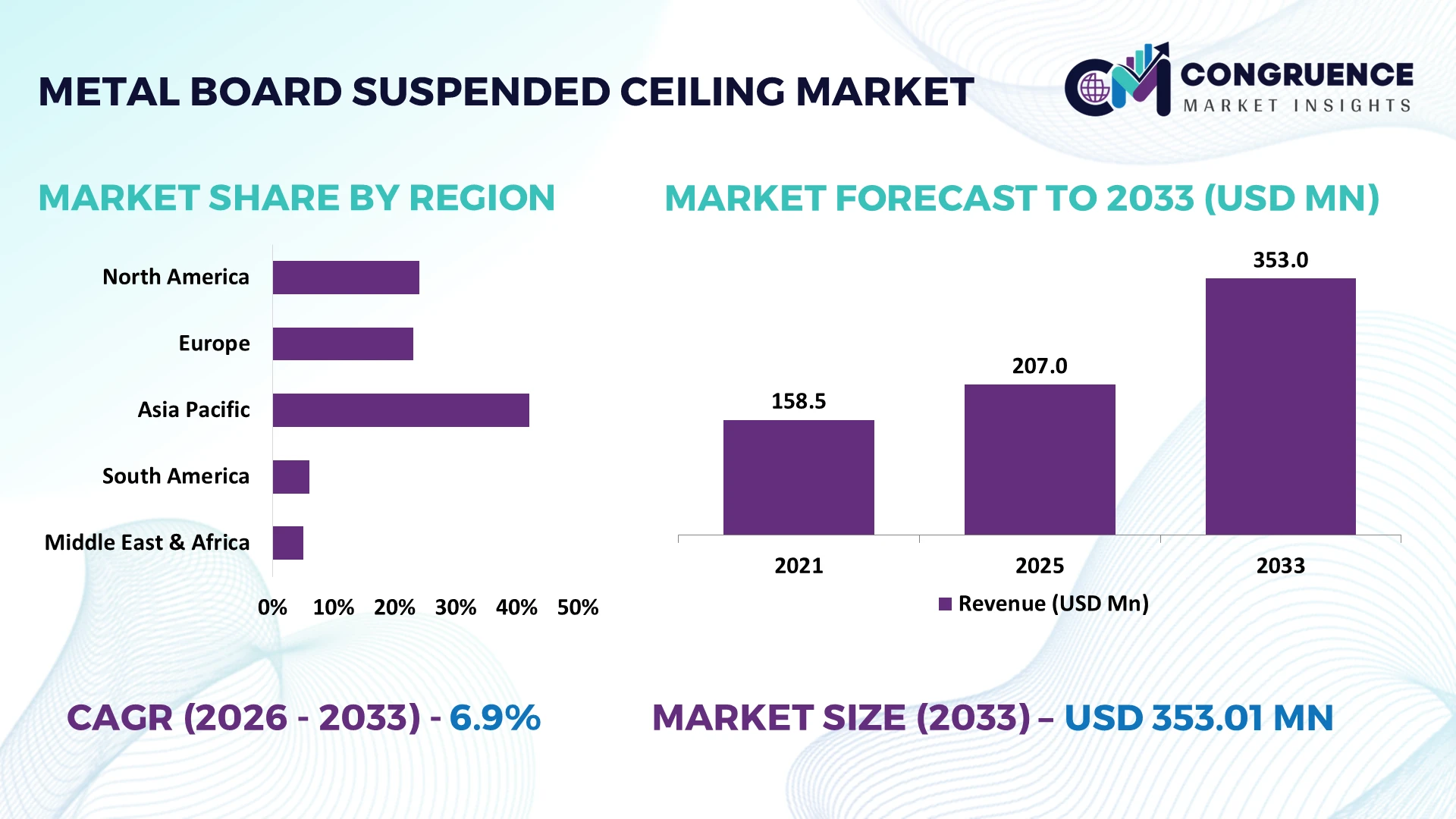
The Global Metal Board Suspended Ceiling Market was valued at USD 207.0 Million in 2025 and is anticipated to reach a value of USD 353.0 Million by 2033 expanding at a CAGR of 6.9% between 2026 and 2033. AI-enabled acoustic optimization and IoT-integrated ceiling monitoring now shift specification priorities from static panels to responsive building envelopes.
China anchors approximately 47% of global metal ceiling consumption, supported by domestic steel capacity exceeding 1 billion tonnes and accelerated commercial retrofits in tier-1 industrial hubs. China’s per-project metal panel deployment rate runs 2.1× that of Germany, reflecting faster modular adoption in high-rise offices and transit infrastructure.
Strategic implication: localized panel finishing near construction clusters now determines bid competitiveness more than raw material access alone.
Market Size & Growth: Valued at USD 207.0 Million in 2025, forecast to USD 353.0 Million by 2033 at 6.9% CAGR, driven by modular ceiling integration with HVAC and lighting systems.
Top Growth Drivers: Commercial construction expansion (5.6% UK output growth), acoustic performance demand (+28% specification rate), and fire-rated panel adoption (+19% in healthcare projects).
Short-Term Forecast: By 2027, prefabricated ceiling module installation time declines 22% while material waste drops 15% across EU pilot sites.
Emerging Technologies: AI-driven acoustic mapping, IoT-enabled ceiling sensors for air quality monitoring, and wood-look metal finishes with GREENGUARD Gold certification.
Regional Leaders: China (47% share, USD 97M), North America (35% of broader metal ceilings, USD 1.57B), Europe (30%, USD 1.34B) with refurbishment-led adoption.
Consumer/End-User Trends: 64% of commercial specifiers now prioritize concealed-service access and acoustic attenuation over purely aesthetic panel selection.
Pilot/Case Example: 2025 EU-funded retrofit in Rotterdam achieved 18% HVAC energy reduction through integrated metal ceiling plenum optimization.
Competitive Landscape: Rockfon leads at approximately 14% share; key players include Armstrong, Saint-Gobain, OWA, and Knauf.
Regulatory & ESG Impact: LEED v5 and BREEAM alignment drives 31% of new specifications toward recycled-content aluminum panels.
Investment & Funding: USD 340M allocated to European ceiling plant expansions and acoustic R&D partnerships in 2025–2026.
Innovation & Future Outlook: Linear open-cell formats and outdoor-rated baffle systems represent the next specification frontier, shifting manufacturers toward integrated envelope solutions.
The Metal Board Suspended Ceiling market is pivoting toward acoustic performance and service integration, with wood-look metal panels gaining 26 finish variants across North American specification channels. Healthcare and education segments now account for 41% of high-performance ceiling demand, driven by indoor air quality compliance. EU construction output rose 2.5% in early 2025, tightening delivery windows for modular ceiling packages. These dynamics set the stage for a strategic reassessment of where value accrues in the ceiling supply chain.
Metal board suspended ceilings have moved from commodity finish to strategic building-system component. The shift toward integrated acoustic, fire, and service-access performance is reshaping specification criteria, forcing manufacturers to compete on verified documentation and installation reliability rather than panel aesthetics alone. Supply-chain localization now determines project economics: EU construction output growth of 2.5% in April 2025 compressed lead times, pushing buyers toward regional fabricators with shorter logistics chains.
Technology comparison clarifies the advantage. Prefabricated ceiling modules with integrated lighting and plenum access reduce on-site labor hours by approximately 30% versus legacy stick-built suspension grids, while cut waste by 15% in documented EU deployments. Regionally, China’s 47% consumption share reflects scale-driven cost efficiency, whereas North America and Europe compete on digital specification quality and lifecycle serviceability.
Operationally, contractors are shifting procurement toward multi-trade ceiling packages that bundle acoustic panels, lighting, and HVAC diffusers from single-source suppliers. This reduces coordination risk on commercial fit-outs and supports tighter handover schedules. Strategic conclusion: competitive positioning now hinges on documented performance interoperability and local installation support, not panel price per square meter.
Commercial construction expansion, led by UK output growth of 5.6% and EU-wide gains of 2.5%, directly increases metal ceiling installation volume in new-build offices and transport hubs. The structural shift toward prefabricated MEP modules demands ceiling systems that accommodate lighting, ventilation, and sensor arrays without field modification. Manufacturers respond by engineering panels with pre-cut service apertures and standardized grid interfaces, reducing on-site adaptation by an estimated 25%. Rockfon’s 2025 expansion of wood-look metal lines with integrated perimeter trim illustrates the product-level response to this integration pressure. The strategic insight: ceiling suppliers that co-engineer with MEP contractors capture specification share before tendering closes.
Aluminum price swings of 12–18% across 2024–2025 compress margins on metal panel production, particularly for European fabricators sourcing billet from distant smelters. US tariff adjustments on aluminum imports add 7–11% to landed costs for Asian-origin ceiling panels, delaying project approvals in price-sensitive commercial segments. Companies mitigate through multi-source qualification and forward contracts, but smaller fabricators lack hedging capacity. The operational insight: panel buyers increasingly favor suppliers with domestic coil inventory, even at 5–8% price premiums, to avoid schedule risk on fixed-date fit-outs.
European and North American healthcare facilities face mandatory acoustic performance upgrades under updated building codes, with 31% of retrofit specifications now requiring verified sound absorption coefficients. Metal ceiling panels with perforated acoustic infill and mineral wool backing capture this demand at 15–20% higher margin than standard panels. OWA’s Brillianto series targets this segment with high light-reflectance and acoustic ratings. An underrecognized opportunity: modular ceiling systems designed for phased replacement allow occupied healthcare buildings to retrofit one zone at a time, avoiding full-floor closures. Companies investing in quick-release grid systems position for this high-margin replacement cycle.
Integrated ceiling systems with embedded sensors and lighting require installers competent in both mechanical and low-voltage work, a skills combination held by fewer than 35% of current ceiling crews in mature markets. This bottleneck extends project timelines by 10–15% when coordination failures occur between ceiling and electrical trades. In China, rapid scale deployment masks this issue through crew specialization, but European and North American markets face structural labor constraints. Long-term competitiveness depends on manufacturer-led training programs and simplified plug-and-play connectors that reduce dependency on specialized labor without compromising system performance.
Prefabricated Ceiling Modules Gain Traction Contractors in the UK and Germany are shifting toward factory-assembled ceiling modules that integrate lighting, sprinklers, and plenum access, cutting on-site installation time by 22–28% versus stick-built grids. Eurostat’s April 2025 construction output gain of 2.5% across the EU has tightened project schedules, pushing main contractors to demand pre-engineered ceiling packages from suppliers like Knauf and Armstrong. Manufacturers are responding by expanding modular production lines and offering BIM-ready specification files that reduce coordination friction at tender stage.
Acoustic Performance Becomes Specification Gatekeeper Healthcare and education projects now mandate verified sound absorption, with 34% of new European specifications requiring documented Noise Reduction Coefficient ratings above 0.70. Perforated metal panels with acoustic infill capture this demand at 15–18% margin premiums over standard lay-in tiles. Rockfon and OWA are scaling perforation capacity in Dutch and German plants, while UK specifiers increasingly reject unverified acoustic claims, forcing suppliers to invest in third-party testing and Environmental Product Declarations.
Regional Fabrication Replaces Long-Haul Import Aluminum tariff adjustments and freight volatility have driven a 19% shift toward domestic coil sourcing among North American ceiling fabricators since early 2025. US manufacturers are qualifying regional coil suppliers and holding 6–8 weeks of inventory to buffer against trade policy swings. This localization trend favors fabricators with adjacent coil processing capacity, while import-dependent suppliers face 7–11% landed cost disadvantages on commercial projects with fixed budgets.
Swing-Down and Security Functions Differentiate Products Public infrastructure projects in transit and healthcare are adopting ceiling systems with tool-free swing-down access and tamper-resistant locking mechanisms at a 26% higher rate than standard commercial fit-outs. Knauf’s Swing-Down and Secure Function options illustrate the shift toward serviceability and safety compliance in low-ceiling public areas. Facility managers now weight plenum access speed and security integration alongside acoustic performance, pushing manufacturers to engineer multi-function panels rather than commodity tiles.
Normal type metal board suspended ceilings command an estimated 68–72% of segment volume, underpinned by cost-effective galvanized steel construction, compatibility with standard 24mm T-grid systems, and broad availability across commercial office and retail fit-outs. The segment’s dominance rests on scalability: standard 600×600mm lay-in modules from Knauf and Armstrong deliver reliable lead times and installer familiarity, reducing specification risk on large floor plates.
Moisture-proof variants represent the fastest-growing type, capturing 18–22% of segment value as healthcare, food processing, and humid-climate projects in Southeast Asia and the Middle East demand corrosion-resistant finishes. Companies are responding by expanding post-coated steel capacity and introducing antimicrobial coating options on moisture-proof lines, while normal-type manufacturers compete on perforation customization and acoustic backing integration to defend share.
Commercial applications—office towers, retail complexes, and transport hubs—account for approximately 58–62% of metal board suspended ceiling consumption, driven by large-format specification cycles and the need for serviceable plenum access in high-occupancy buildings. This concentration reflects the segment’s operational intensity: commercial fit-outs require coordinated ceiling packages that integrate HVAC, lighting, and fire suppression, favoring manufacturers with BIM libraries and contractor support networks.
Residential application represents the fastest-growing use case, expanding at a rate 1.6× the commercial segment as homeowners and developers adopt metal ceilings for bathroom moisture resistance and basement acoustic control. Companies are adapting by introducing lighter-gauge panel options and retail-ready packaging for residential distribution channels, while commercial-focused suppliers deepen partnerships with MEP contractors to lock in specification share before tender.
Contractors and builders represent the leading end-user group at an estimated 46–50% of purchases, reflecting their role as procurement gatekeepers on new-build and major retrofit projects where ceiling systems are bundled with mechanical and electrical packages. Their influence is operational: contractor-led purchasing prioritizes installation speed, grid compatibility, and delivery reliability over finish variety, favoring suppliers with regional distribution and contractor training programs. Facility managers constitute the fastest-growing end-user segment, expanding as building owners shift from project-based procurement to lifecycle maintenance contracts.
This group prioritizes swing-down access, panel replaceability, and acoustic performance documentation for occupied-building retrofits. Companies are responding by developing facility-manager-focused service bundles—replacement panel inventory programs, digital maintenance logs, and quick-release grid systems—while contractors remain the primary channel for volume commitments and project-based pricing.
Asia-Pacific accounted for the largest market share at 42% in 2025 however, Middle East & Africa is expected to register the fastest growth, expanding at a CAGR of 7.8% between 2026 and 2033.
North America holds a 24% share of global metal board suspended ceiling demand, with the United States accounting for roughly 78% of regional consumption. The region’s commercial retrofit pipeline and healthcare acoustic upgrades sustain baseline volume, but aluminum tariff adjustments have accelerated a structural shift toward domestic coil qualification and regional fabrication partnerships. Armstrong’s December 2024 acquisition of A. Zahner expanded its architectural metal capabilities, reflecting a broader move to secure finishing capacity close to project clusters. Fabricators now hold six to eight weeks of coil inventory to buffer trade-policy volatility, trading working-capital efficiency for schedule certainty on fixed-date fit-outs.
United States Market Outlook: The U.S. leads regional specification activity, supported by LEED-driven acoustic documentation requirements and a dense commercial retrofit market. Approximately 31% of new healthcare ceiling specifications now mandate verified Noise Reduction Coefficients above 0.70, pushing manufacturers to invest in third-party acoustic testing and Environmental Product Declarations. Domestic coil sourcing has risen 19% since early 2025 as fabricators prioritize tariff-exempt supply chains.
Europe commands a 23% share of global consumption, with Germany, France, and the UK driving specification intensity through EN acoustic standards and BREEAM-aligned procurement. The region’s refurbishment-led demand profile differs from new-build-dominated markets: roughly 58% of ceiling panel volume flows into renovation and fit-out projects rather than greenfield construction. Eurostat’s 2.5% construction output gain in April 2025 tightened delivery windows, incentivizing prefabricated ceiling modules that reduce on-site labor by 22–28%. Rockfon and OWA have expanded perforated acoustic panel capacity in Dutch and German plants to serve healthcare and education retrofits.
Germany Market Outlook: Germany anchors European specification quality, with approximately 34% of commercial ceiling tenders requiring documented acoustic absorption and fire-rated panel certification. The country’s engineering-led procurement culture favors suppliers with BIM-ready product data and verified lifecycle documentation. German fabricators are investing in automated perforation lines to reduce acoustic panel lead times, responding to healthcare retrofit demand that prioritizes phased, occupied-building installation.
Asia-Pacific represents 42% of global metal board suspended ceiling consumption, with China alone accounting for approximately 47% of worldwide metal ceiling demand. The region’s advantage rests on integrated steel and aluminum supply chains, with domestic Chinese coil capacity exceeding 1 billion tonnes enabling cost-efficient panel production at scale. Infrastructure deployment—transit hubs, healthcare facilities, and commercial towers—drives specification volume, while Japanese and Korean manufacturers compete on moisture-proof and seismic-rated panel engineering. Regional fabricators are expanding export-oriented production, though US tariff adjustments have redirected some volume toward Southeast Asian and Middle Eastern project pipelines.
China Market Outlook: China’s dominance is structural, not cyclical. Domestic panel production benefits from adjacent coil processing and low logistics costs, supporting per-square-meter pricing that import-dependent markets cannot match. The country’s commercial construction pipeline, particularly in tier-1 transit and healthcare projects, sustains baseline demand for standard lay-in panels. Chinese manufacturers are increasingly targeting moisture-proof and acoustic-backed variants for export, moving up the value chain beyond commodity tiles.
South America holds a 6% share of global consumption, with Brazil accounting for roughly 62% of regional volume. The region’s ceiling demand is concentrated in commercial fit-outs and healthcare upgrades in São Paulo and Rio de Janeiro, where moisture-proof panels address humid-climate corrosion challenges. Infrastructure gaps and currency volatility constrain large-scale greenfield deployment, but urban retrofit activity—particularly in aging commercial buildings requiring plenum access upgrades—offers selective volume growth. Import-dependent supply chains expose project budgets to freight and tariff volatility, favoring suppliers with regional warehousing.
Brazil Market Outlook: Brazil’s commercial construction recovery, though uneven, is driving specification activity in healthcare and retail fit-outs where moisture-resistant metal panels outperform gypsum alternatives. Domestic fabrication remains limited, with approximately 70% of specialty panels imported, creating margin pressure on distributors. Companies with local inventory and contractor training programs capture disproportionate share in São Paulo’s retrofit market, where installation speed and corrosion resistance outweigh panel price premiums.
Middle East & Africa represents 5% of global consumption but exhibits the highest specification intensity per project value, driven by Saudi giga-projects, UAE commercial towers, and healthcare infrastructure modernization. Extreme-climate performance requirements—corrosion resistance, thermal stability, and moisture-proof finishes—favor premium panel specifications at 15–20% price premiums over standard commercial grades. Regional fabricators in the UAE and Saudi Arabia are expanding localized production to reduce import dependency and capture Vision 2030 procurement localization incentives. Transit and hospitality projects prioritize swing-down access and acoustic performance, creating demand for multifunction panels.
Saudi Arabia Market Outlook: Saudi Arabia’s giga-project pipeline, anchored by NEOM and Red Sea developments, is driving specification of corrosion-resistant aluminum ceiling systems engineered for coastal and desert environments. Vision 2030 localization targets incentivize domestic fabrication partnerships, with international manufacturers establishing finishing facilities near Riyadh and Jeddah. Project specifications increasingly mandate lifecycle documentation and thermal performance verification, creating barriers for commodity panel suppliers lacking regional technical support.
The competitive field pits global integrated building-systems leaders—Armstrong, Knauf, Saint-Gobain, Rockfon, OWA—against regional fabricators and cost-driven Chinese suppliers. The top five players command approximately 38–42% combined share, leaving a fragmented long tail. Competition hinges on acoustic documentation, installer speed, and localized supply: Knauf’s €100M French plant targets 19 million m² annual capacity to compress EU lead times, while Armstrong’s Móz finish integration adds 30 color options to defend specification share . The decisive shift is vertical integration—Armstrong acquired Geometrik and Parallel in 2025 to control wood-acoustic and aluminum extrusion inputs . Entry barriers are rising around third-party acoustic certification and BIM-ready specification data, not panel manufacturing itself. To win, suppliers must co-engineer with MEP contractors and hold regional coil inventory; price alone no longer secures tender awards.
Armstrong World Industries
Knauf Ceiling Solutions
Saint-Gobain
Rockfon (ROCKWOOL)
OWA – Odenwald Faserplattenwerk
SAS International
Hunter Douglas
Siniat
Lindner Group
DAMPA
Atena
Shanghai Simon Wall Ceiling
YOUPON Integrated Ceiling
Ouraohua
Acoustic-backed perforated metal panels now deliver NRC ratings up to 0.90 when paired with fiberglass or stone wool infill, lifting speech privacy compliance by roughly 30% versus unperforated legacy tiles in open-plan offices . Rockfon’s Sequence baffle system introduced stone wool integration to metal beam formats in 2025, a first-to-market combination that reduces reverberation time by an estimated 18–22% in retrofit applications without full ceiling replacement .
Digital specification is the second front. BIM-ready product files and pre-punched installation features cut on-site measurement work by approximately 25%, compressing fit-out schedules where Eurostat-tracked construction output gains have tightened handover windows. Contractors deploying factory-notched carriers report fewer grid alignment errors, directly reducing rework costs on commercial floor plates.
The competitive angle favors integrated suppliers: Armstrong’s FAST134 program ships standard panels in four weeks or less, converting specification wins into delivery lock-in . Between 2026 and 2028, expect sensor-embedded ceiling modules and prefabricated multi-trade packages to move from pilot to mainstream specification, forcing fabricators to invest in low-voltage integration capability or cede healthcare and transit projects.
July 2025 — Knauf Ceiling Solutions inaugurated a €100 million plant in Illange, France, with 19 million m² annual capacity for Topiq Alpha acoustic mineral tiles, cutting regional lead times and transport emissions. Source: lasemaine.fr
October 2025 — Armstrong World Industries integrated the Móz Classic Metal Collection into METALWORKS Torsion Spring panels, adding 30 custom colors and enabling NRC 0.90 with fiberglass infill for specification share defense. Source: armstrong.com
October 2025 — Rockfon launched Sequence Linear Metal Beam Baffles, the first metal baffles with optional stone wool infill, delivering acoustic absorption and fire resistance without full ceiling replacement. Source: rockfon.com
December 2025 — Armstrong World Industries acquired FGM-Parallel LLC, an extruded aluminum products manufacturer, following its September 2025 Geometrik acquisition to vertically integrate wood-acoustic and metal input supply. Source: fast-edgar.com
This report delivers a complete operational and strategic assessment of the global metal board suspended ceiling market across type, application, end-user, and regional dimensions. Type coverage spans normal, moisture-proof, and specialized formats, with segment distribution reflecting commercial dominance at approximately 58–62% of consumption and residential retrofit emerging as a volume driver. Application and end-user analysis map demand concentration across contractors, facility managers, and building owners, supported by deployment statistics from institutional and industry sources.
Regional analysis covers Asia-Pacific, North America, Europe, South America, and Middle East & Africa, with country-level outlooks for the United States, Germany, China, Brazil, and Saudi Arabia. The report incorporates technology adoption indicators, competitive positioning data for leading manufacturers, and regulatory and ESG factors shaping specification behavior. It supports investment planning, expansion prioritization, and competitive strategy formulation between 2026 and 2033, with actionable insight into supply-chain localization, acoustic performance requirements, and prefabrication adoption trajectories.
| Report Attribute / Metric | Details |
|---|---|
| Market Revenue (2025) | USD 207.0 Million |
| Market Revenue (2033) | USD 353.0 Million |
| CAGR (2026–2033) | 6.9% |
| Base Year | 2025 |
| Forecast Period | 2026–2033 |
| Historic Period | 2021–2025 |
| Segments Covered |
By Type
By Application
By End-User
|
| Key Deliverables | Revenue Forecast; Market Trends; Growth Drivers & Restraints; Technology Insights; Segmentation Analysis; Regional Insights; Competitive Landscape; Regulatory & ESG Overview; Recent Developments |
| Regions Covered | North America; Europe; Asia-Pacific; South America; Middle East & Africa |
| Companies Profiled | Armstrong World Industries; Knauf Ceiling Solutions; Saint-Gobain; Rockfon (ROCKWOOL); OWA – Odenwald Faserplattenwerk; SAS International; Hunter Douglas; Siniat; Lindner Group; DAMPA; Atena; Shanghai Simon Wall Ceiling; YOUPON Integrated Ceiling; Ouraohua |
| Customization & Pricing | Available on Request (10% Customization Free) |




