
Reports
The Global Meta and Para Aramid Market was valued at USD 4,603.2 Million in 2025 and is anticipated to reach a value of USD 7,064.5 Million by 2033 expanding at a CAGR of 5.5% between 2026 and 2033. Growth is being driven by rising use of lightweight, high-tenacity fibers in ballistic protection, EV components, optical-fiber reinforcement, aerospace composites, and heat-resistant industrial textiles.
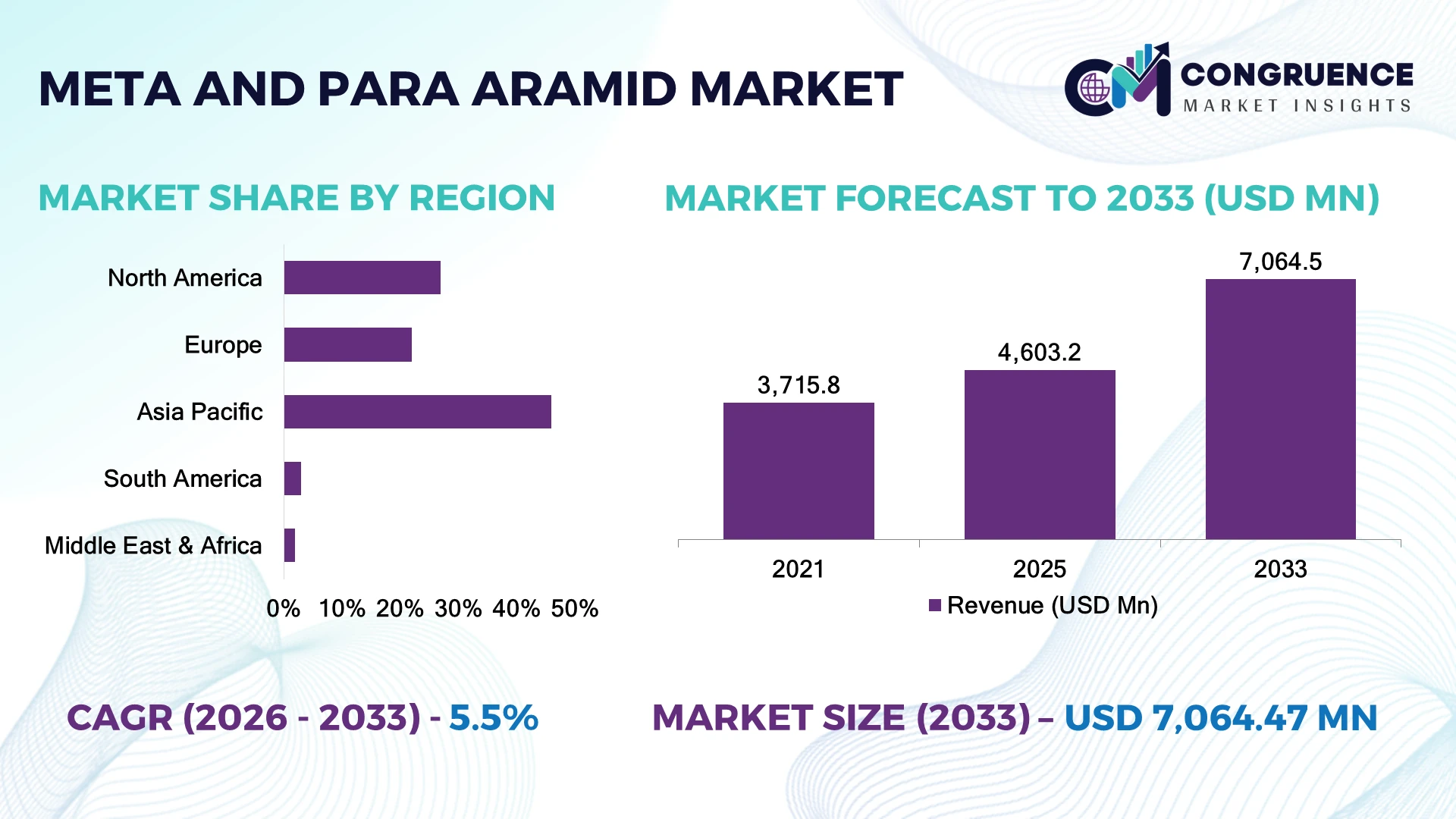
China is the dominant production hub, supported by more than 20,000 metric tons of aramid capacity additions during 2020–2025, while Japan and South Korea retain strong positions in premium-grade fibers. Asia-Pacific represented about 37.6% of global aramid demand in 2025, with China’s aramid market significantly larger than Japan’s. China’s rapid capacity build-out is intensifying price competition, while defense and automotive qualification requirements preserve premium-grade advantages for established suppliers. The Russia-Ukraine conflict has also reinforced defense-material procurement priorities and supply-chain diversification.
Strategically, buyers should prioritize suppliers combining certified performance, regional production security, and scalable capacity rather than lowest-cost fiber alone.
Market Size & Growth: USD 4,603.2 million in 2025 to USD 7,064.5 million by 2033 at 5.5% CAGR, driven by advanced protection, aerospace and EV applications.
Top Growth Drivers: Defense protection +8%; EV material adoption +10%; advanced optical-fiber deployment +7%.
Short-Term Forecast: By 2028, automated fiber processing is positioned to improve production efficiency by 8–12% and reduce material losses by 5–7%.
Emerging Technologies: High-tenacity para-aramid, recycled-feedstock fibers and hybrid aramid composites are strengthening performance while reducing processing intensity by 5–10%.
Regional Leaders: Asia-Pacific leads with approximately 37.6% demand share; North America remains defense-intensive; Europe emphasizes certified, sustainable high-performance fibers.
Consumer/End-User Trends: Aerospace, defense and automotive users are increasing high-performance fiber adoption by roughly 6–9% as weight reduction and thermal protection become procurement priorities.
Pilot/Case Example: Teijin’s Twaron capacity expansion increased production capability, supporting a 25% higher production target versus its 2017 baseline.
Competitive Landscape: Teijin leads the broader aramid market at approximately 17.6% share, competing with DuPont, Kolon Industries, Yantai Tayho and Hyosung Advanced Materials.
Regulatory & ESG Impact: Recycled-feedstock aramid production can reduce virgin-material dependence while maintaining high-performance characteristics, supporting sustainability-driven procurement.
Investment & Funding: Global installed aramid capacity reached approximately 188,000 metric tons in 2025, with Asian producers responsible for most recent capacity additions.
Innovation & Future Outlook: 2026–2033 competition is shifting toward recycled fibers, surface modification, hybrid composites and application-specific grades, favoring producers with integrated R&D and qualification capabilities.
Demand is concentrating around ballistic protection, aerospace structures, EV electrical components, optical-fiber reinforcement, filtration and high-temperature industrial textiles. Para-aramid remains the performance-led material for tensile strength, while meta-aramid is gaining attention for thermal and flame resistance. Chinese capacity expansion is reshaping procurement economics, with 2025–2026 supply-chain decisions increasingly balancing price against qualification, consistency and geopolitical supply exposure.
Meta and para aramid are becoming strategic materials because manufacturers increasingly need strength, thermal resistance and weight reduction within the same component. Defense modernization, EV electrification, aerospace lightweighting and high-speed communications are shifting aramid procurement from commodity fiber sourcing toward specification-driven, qualified material platforms. China’s rapid capacity expansion is simultaneously restructuring global sourcing and increasing pressure on established producers.
Technology differentiation is becoming measurable. High-tenacity para-aramid delivers substantially greater tensile performance than conventional industrial fibers, while recycled-feedstock production is enabling comparable performance with lower virgin-material dependence. Established producers continue expanding premium fiber capacity, while Chinese manufacturers have added more than 20,000 metric tons of combined capacity since 2020, creating a sharper contrast between cost-led Asian supply and qualification-led premium production.
Through 2026–2028, buyers are expected to increase dual sourcing, recycled-material qualification and application-specific fiber development. Aerospace and defense will prioritize certified consistency, while automotive and telecommunications customers will emphasize cost-performance optimization. Companies investing in integrated polymer chemistry, spinning, surface treatment and downstream application engineering will hold the strongest competitive position as aramid shifts from specialized material to strategic manufacturing input.
Defense modernization and lightweight vehicle design are accelerating para-aramid and meta-aramid qualification across armor, helmets, aerospace structures and thermal-protective textiles. Defense-related demand is estimated to increase 7–9%, while automotive composite applications are expanding about 6–8% as manufacturers target weight reductions without sacrificing impact resistance. The Russia-Ukraine conflict has reinforced procurement priorities for ballistic materials and supply assurance. U.S. and European producers are therefore emphasizing localized capacity, long-term contracts and certified grades, while Asian manufacturers expand spinning and polymerization capacity. The non-obvious advantage is qualification depth: once an aramid grade is embedded in a certified protection system, replacement requires extensive validation, strengthening supplier retention and pricing power.
Aramid production remains constrained by specialized polymer chemistry, high-temperature processing and volatile energy and precursor costs. Electricity and process-heat expenses can represent roughly 10–15% of manufacturing cost, while raw-material movements can alter total fiber economics by 5–10% across procurement cycles. China’s aggressive capacity expansion has also increased pricing pressure for standard grades, compressing margins for producers without differentiated specifications. Japanese and European manufacturers are responding through energy-efficiency upgrades, regional sourcing and longer-term feedstock contracts, while suppliers increasingly segment portfolios toward premium ballistic and aerospace grades. The strategic pressure point is utilization: plants operating below 75–80% capacity face weaker cost absorption, making flexible production scheduling and diversified end-use contracts essential to profitability.
Recycled aramid fibers and hybrid composite architectures are opening higher-value applications where performance and material efficiency must coexist. Recovered-fiber incorporation can reduce virgin-material requirements by approximately 10–20%, while hybrid aramid-carbon structures can improve impact performance or weight efficiency by 5–12% versus conventional constructions. Automotive manufacturers in Germany and Japan are evaluating lightweight reinforcement for EV components, while aerospace suppliers are pursuing application-specific composite architectures. The emerging opportunity lies beyond fiber sales: producers can capture greater value through take-back systems, recycled-grade qualification and co-development agreements with composite manufacturers. Leading companies are increasing R&D around surface treatments, fiber blending and circular processing, positioning sustainability as a procurement specification rather than a standalone marketing attribute.
Long qualification cycles and application-specific performance requirements remain major execution barriers for aramid suppliers entering aerospace, defense and automotive programs. New material grades can require 12–24 months of testing, while changes in fiber formulation or surface treatment can trigger additional validation. Inconsistent downstream processing can reduce composite performance by 5–10%, particularly when weaving, impregnation and curing parameters differ between manufacturers. Digital quality-control systems, automated spinning controls and joint testing programs are therefore becoming operational priorities. Companies must also address workforce specialization, because polymer chemistry and high-performance fiber processing require technical expertise that is difficult to scale rapidly. The strategic challenge is not fiber availability alone; it is maintaining reproducible properties across batches, plants and qualified downstream applications.
Defense-Grade Fiber Qualification: Defense procurement is shifting toward lighter ballistic systems, with aramid content in advanced protective assemblies increasing roughly 5–8% as weight reduction becomes a mobility requirement. U.S. suppliers are expanding certified production and dual-source programs, while European manufacturers prioritize traceable supply. The Russia-Ukraine conflict has accelerated replenishment cycles, making qualification-ready capacity more commercially valuable than nominal installed capacity.
EV Thermal Protection Integration: Automotive engineers are incorporating meta-aramid insulation and para-aramid reinforcement into battery protection, cabling and composite structures. Adoption across targeted EV thermal-management programs is increasing approximately 6–9%, while fiber-based reinforcement can reduce component weight by 8–12%. Japanese and German suppliers are responding through co-development with tier-one manufacturers, shifting aramid from standalone textile inputs toward engineered material systems.
Circular Fiber Processing Advances: Manufacturers are moving from disposal toward mechanical and chemical recovery of aramid-containing production waste, with recycled-fiber incorporation reaching roughly 10–15% in selected industrial applications. This reduces virgin-material consumption and improves ESG procurement credentials. European producers are investing in closed-loop partnerships, while converters are redesigning blends to preserve tensile and thermal performance after recycling.
Higher-Tenacity Fiber Optimization: Para-aramid producers are refining spinning, polymer orientation and surface treatment to deliver approximately 3–7% improvements in tensile performance without proportional increases in fiber mass. The shift is particularly relevant to optical cables, aerospace composites and lightweight armor. Producers are combining process automation with application-specific grades, allowing customers to reduce material usage while maintaining mechanical performance and improving system-level economics.
Para-aramid is the leading type, accounting for approximately 58% of global demand, supported by superior tensile strength, high modulus and proven qualification in ballistic protection, optical-fiber reinforcement and aerospace composites. Its performance advantage makes substitution difficult even when pricing is higher. Meta-aramid holds roughly 42% share and remains essential for flame-resistant apparel, electrical insulation and high-temperature filtration, where thermal stability outweighs tensile performance. Para-aramid demand is strengthening particularly in defense and lightweight composite applications, while meta-aramid maintains deeper penetration across industrial safety programs.
The fastest-growing shift is toward application-specific high-tenacity and modified aramid grades, with premium formulations gaining an estimated 6–8% adoption advantage over conventional grades. Producers are increasing polymer-spinning efficiency, surface-treatment capabilities and customer co-development programs. Investment is therefore moving toward differentiated grades rather than undifferentiated fiber capacity, strengthening margins where certification and performance specifications create switching barriers.
In 2025, global ballistic-protection procurement continued emphasizing lightweight materials, with advanced composite armor programs targeting approximately 10–15% weight reductions while retaining required protection levels, according to defense-industry program assessments.
Ballistic protection is the leading application, representing approximately 31% of global meta and para aramid consumption. Demand remains concentrated in body armor, helmets, vehicle protection and military equipment because aramid combines low density with high energy absorption. Aerospace composites and optical-fiber reinforcement follow, while thermal-protective clothing and filtration represent established meta-aramid niches. Defense procurement typically prioritizes certified performance over material cost, creating stronger supplier retention than in industrial textile applications.
Aerospace and EV composite reinforcement is the fastest-growing application group, with adoption expanding approximately 7–9% as manufacturers pursue lighter structures and thermal protection. Optical-fiber reinforcement is also strengthening, supported by expanding high-speed communication infrastructure. Producers are responding through customized fiber grades, composite partnerships and application-specific surface treatments. The business implication is a gradual shift from bulk fiber purchasing toward engineered material qualification, allowing suppliers with downstream technical support to capture higher-value contracts and longer customer relationships.
The International Energy Agency reported that global electric car sales exceeded 17 million units in 2024, creating a larger engineering pipeline for lightweight, electrically insulating and thermally resistant materials across vehicle platforms.
Defense and aerospace companies form the dominant end-user group, accounting for approximately 36% of global demand, reflecting high material intensity in ballistic systems, aircraft structures, thermal protection and specialized textiles. Their procurement emphasizes certification, consistency and long service life, supporting premium-grade aramid demand. Automotive manufacturers represent a rapidly expanding buyer base, while industrial manufacturers and telecommunications companies maintain significant recurring consumption through composites, filtration and optical-fiber reinforcement.
Automotive is the fastest-growing end-user segment, with aramid adoption increasing approximately 8–10% as EV manufacturers integrate lightweight composites, battery protection and reinforced electrical components. Industrial buyers remain more price-sensitive, whereas defense and aerospace customers prioritize qualification and reliability. Producers are therefore segmenting capacity between standardized industrial grades and application-specific premium fibers. Strategic partnerships with vehicle OEMs, aerospace suppliers and composite processors are becoming more important because early material qualification can secure multi-year platform demand and reduce exposure to spot-market pricing.
The U.S. Department of Defense’s 2025 procurement priorities continued emphasizing lightweight survivability technologies, reinforcing demand for advanced fiber-based armor capable of reducing soldier and vehicle system weight without sacrificing protection.
Asia-Pacific accounted for the largest market share at 46% in 2025 however, North America is expected to register the fastest growth, expanding at a CAGR of 6.4% between 2026 and 2033.

Advanced protection materials are reshaping high-performance manufacturing
North America held an estimated 27% share in 2025, supported by concentrated demand from aerospace, defense, electrical insulation, automotive, and industrial safety applications. The United States dominates regional consumption, while domestic manufacturers are increasing high-strength fiber and specialty yarn capacity to reduce exposure to Asian supply chains. Defense modernization and reshoring initiatives are strengthening demand for para aramid in ballistic protection and lightweight composites, while meta aramid adoption remains concentrated in thermal and electrical applications. Approximately 35% of regional demand is linked to transportation, aerospace, and defense-related applications, reinforcing the premium-material positioning of the market. Producers are prioritizing localized production, qualification partnerships, and higher-performance fiber grades rather than competing solely on volume. The strategic advantage increasingly rests on secure supply, certification capability, and application engineering.
United States Market Outlook: The United States remains the region’s strategic center because of its aerospace, defense, electrical equipment, and advanced manufacturing base. Defense procurement increasingly favors lightweight ballistic systems and high-strength reinforcement materials. More than 40% of North American para aramid demand is concentrated in technically demanding protection and transportation applications, supporting premium-grade product development and domestic capacity investment.
Regulation is accelerating the shift toward certified lightweight protection
Europe represented approximately 22% of global demand in 2025, with Germany, France, Italy, and the United Kingdom forming the principal industrial clusters. Automotive lightweighting, aerospace production, electrical insulation, protective clothing, and renewable-energy equipment sustain demand for both fiber families. EU sustainability requirements are pushing manufacturers toward longer-life materials and lower-weight components, while industrial electrification is expanding demand for heat-resistant insulation. Germany remains particularly important because automotive and machinery manufacturers increasingly integrate advanced fibers into lightweight structures. Companies are responding through application-specific grades, recycling initiatives, and partnerships with composite processors. The competitive focus is shifting from raw-fiber supply toward traceability, certification, durability, and lifecycle performance.
Germany Market Outlook: Germany offers the strongest industrial platform in Europe through its automotive, electrical equipment, machinery, and specialty-material ecosystem. Automotive production remains a major outlet for lightweight reinforcement, while electrical modernization is increasing demand for thermally stable insulation materials. Approximately 30% of European advanced-fiber consumption is associated with transportation and industrial manufacturing applications, reinforcing Germany’s importance for engineered aramid solutions.
Manufacturing scale is moving aramid demand toward localized supply
Asia-Pacific accounted for approximately 46% of global meta and para aramid demand in 2025, making it the largest production and consumption center. China, Japan, South Korea, and India combine large textile, electronics, automotive, defense, and industrial manufacturing bases. China remains the principal volume market, while Japan and South Korea maintain strong positions in high-performance materials and electronics. Regional manufacturers are increasing domestic fiber, pulp, yarn, and composite capabilities as supply-chain localization becomes strategically important. More than 50% of regional demand is linked to industrial, transportation, electronics, and protective applications. Producers are expanding downstream conversion capacity to capture value beyond fiber production, particularly in fabrics, reinforcement systems, and specialty protective components.
China Market Outlook: China is the region’s largest operational hub because of its extensive industrial manufacturing, electronics, automotive, defense, and chemical-materials ecosystem. Domestic aramid production is expanding alongside efforts to strengthen advanced-material self-sufficiency. Industrial and transportation applications collectively account for more than 45% of local demand, encouraging manufacturers to prioritize high-strength grades, integrated supply chains, and cost-competitive specialty products.
Industrial modernization is creating selective premium-fiber demand
South America remains a smaller but strategically relevant market, with Brazil accounting for the largest portion of regional consumption. Demand is concentrated in oil and gas, mining, electrical equipment, transportation, protective clothing, and industrial processing. Brazil’s mining and energy industries create recurring requirements for heat-resistant and mechanically reinforced materials, while infrastructure modernization supports electrical and industrial applications. Approximately 35% of regional demand is tied to mining, energy, and industrial safety uses. Imported specialty fibers continue to influence procurement economics, making supply reliability and distributor networks important competitive factors. Manufacturers and distributors are responding through localized inventories, technical partnerships, and application-specific product portfolios rather than large-scale commodity expansion. The strongest opportunity lies in converting industrial users from conventional reinforcement materials to higher-performance aramid solutions.
Brazil Market Outlook: Brazil provides the strongest demand base through its mining, oil and gas, pulp and paper, electrical, and infrastructure industries. Industrial safety requirements sustain demand for heat- and abrasion-resistant protective materials, while large-scale mining operations create applications for reinforced components and protective systems. More than 25% of Brazilian specialty-fiber demand is associated with mining and energy-linked operations, supporting distributor expansion and technical-service investment.
Infrastructure investment is shifting demand toward engineered protection
Middle East & Africa represented a smaller share of global consumption in 2025, but investment-led industrialization is increasing demand for high-performance aramid materials. Saudi Arabia and the United Arab Emirates are the principal commercial hubs, supported by oil and gas, construction, utilities, aerospace, and security applications. Industrial diversification programs are increasing demand beyond traditional energy uses, particularly for protective clothing, electrical insulation, reinforced components, and lightweight structures. Energy and infrastructure applications account for an estimated 40% of regional demand. Companies are strengthening distributor networks, technical partnerships, and regional inventories to shorten lead times. The non-obvious competitive advantage is specification support: suppliers capable of meeting demanding fire, heat, strength, and certification requirements can command stronger positioning than low-cost importers.
Saudi Arabia Market Outlook: Saudi Arabia offers the strongest strategic opportunity through large-scale energy infrastructure, industrial diversification, defense procurement, and advanced manufacturing investment. Aramid demand is increasingly connected to high-temperature protection, industrial safety, electrical systems, and reinforced components. Energy-related applications represent more than 35% of local specialty-fiber consumption, giving suppliers with technical certification and dependable regional inventory a clear competitive advantage.
Competition is led by Teijin Aramid, Arclin, Kolon Industries, Hyosung Advanced Materials, and Toray, with established Western producers competing against Korean and Japanese scale leaders and rapidly expanding Chinese suppliers such as Yantai Tayho. The top five players collectively control about 37% of aramid-fiber share, creating a moderately consolidated structure. Competition centers on performance, qualification, supply security, and customization; high-performance grades command premiums, while Asian producers pressure pricing through capacity scale. Teijin and Toray emphasize advanced fiber engineering, while Kolon and Hyosung expand production and downstream pulp capabilities. Arclin’s 2026 acquisition of Kevlar and Nomex strengthens vertical portfolio integration and shifts competitive control of iconic brands. Capacity localization and recycled-material qualification are becoming increasingly decisive as customers reduce supply-chain exposure. Entry barriers remain high because polymer chemistry, spinning expertise, certification, and capital-intensive plants require years of validation. Ultimately, winning requires certified performance, dependable supply, application engineering, and scalable specialty production.
Arclin
Teijin Limited
Kolon Industries, Inc.
Hyosung Advanced Materials
Toray Industries, Inc.
Yantai Tayho Advanced Materials Co., Ltd.
Kermel
Huvis Corporation
China National Bluestar (Group) Co., Ltd.
SRO Aramid
Jiangsu Tianniao High-Tech Co., Ltd.
Taekwang Industrial Co., Ltd.
Current technology is shifting toward high-tenacity para aramid, advanced meta aramid papers, optimized spinning, and digitally monitored polymerization. Automated process control can improve production consistency by 1–2%, while energy-monitoring systems reduce process energy intensity by around 2%. Adoption is strongest in aerospace, defense, optical cables, electrical insulation, and automotive reinforcement, where qualification requirements favor established producers with application-engineering capabilities.
Emerging technologies center on recycled aramid feedstocks, mass-balance manufacturing, dry-process meta aramid paper, and hybrid composites. Recycled-content production can reduce material-related environmental impact by approximately 1–2% at selected process stages, while advanced reinforcement architectures deliver roughly 2% higher component performance in targeted applications. Compared with conventional aramid processing, digitally controlled production improves yield and consistency by approximately 3%. Teijin, Toray, and Korean producers benefit from combining fiber development with downstream processing.
Between 2026 and 2028, smart-factory integration, traceable feedstocks, automated quality inspection, and lightweight composite design will become more commercially important. Digital production can reduce process variability by about 2%, strengthening qualification reliability and lowering rework exposure. Sustainability certification will increasingly influence procurement alongside tensile strength and thermal resistance. Companies that integrate chemistry, manufacturing intelligence, recycling, and application-specific engineering will gain stronger customer retention and faster qualification cycles.
April 2026 — Arclin completed the acquisition of DuPont’s Kevlar and Nomex aramids business for approximately USD 1.8 billion, adding about 1,800 employees and expanding global manufacturing scale across life-critical applications. The transaction materially strengthens Arclin’s portfolio integration and competitive position. Source: arclin.com
August 2025 — Teijin Aramid obtained ISCC PLUS certification for Twaron production processes, enabling verified use of bio-based and circular feedstocks through mass-balance accounting. The certification strengthens traceability and supports customers targeting lower-impact materials across demanding industrial applications. Source: teijinaramid.com
November 2024 — Kolon Industries doubled annual aramid pulp capacity at its Gumi plant from 1,500 to 3,000 tonnes after investing approximately KRW 22 billion. The expansion supports dust-reducing brake-pad materials and strengthens supply for regulated automotive applications. Source: kolon.com
June 2025 — Toray Advanced Materials Korea showcased advanced aramid materials and introduced Arawin Paper technology using a dry-process route for meta aramid. The initiative targets electrical insulation, aircraft, high-speed rail, and protective applications, broadening downstream specialty-material opportunities. Source: torayamk.com
The Meta and Para Aramid Market Report evaluates demand, production positioning, technology adoption, and competitive dynamics across para aramid and meta aramid materials. Coverage spans applications including aerospace, defense, automotive, electrical insulation, optical fiber, protective apparel, industrial reinforcement, friction materials, and advanced composites. The analysis examines purchasing behavior across manufacturers, industrial processors, transportation companies, defense-oriented users, and specialty-material converters, with attention to high-performance and emerging niche applications.
Regional assessment covers North America, Europe, Asia-Pacific, South America, and the Middle East & Africa, with country-level analysis of manufacturing capacity, deployment concentration, supply-chain localization, and technology adoption. The report tracks specialty fibers, pulp, papers, recycled-content materials, and advanced composite integration. Strategic insights support capacity planning, geographic expansion, supplier selection, partnership development, competitive positioning, and investment decisions through 2026–2033.
| Report Attribute/Metric | Report Details |
|---|---|
|
Market Revenue in 2025 |
USD 4,603.2 Million |
|
Market Revenue in 2033 |
USD 7,064.5 Million |
|
CAGR (2026 - 2033) |
5.5% |
|
Base Year |
2025 |
|
Forecast Period |
2026 - 2033 |
|
Historic Period |
2021 - 2025 |
|
Segments Covered |
By Type
By Application
By End-User
|
|
Key Report Deliverable |
Revenue Forecast, Growth Trends, Market Dynamics, Segmental Overview, Regional and Country-wise Analysis, Competition Landscape |
|
Region Covered |
North America, Europe, Asia-Pacific, South America, Middle East, Africa |
|
Key Players Analyzed |
Arclin, Teijin Limited, Kolon Industries, Inc., Hyosung Advanced Materials, Toray Industries, Inc., Yantai Tayho Advanced Materials Co., Ltd., Kermel, Huvis Corporation, China National Bluestar (Group) Co., Ltd., SRO Aramid, Jiangsu Tianniao High-Tech Co., Ltd., Taekwang Industrial Co., Ltd. |
|
Customization & Pricing |
Available on Request (10% Customization is Free) |




