
Reports
The Global Merchant Cash Advance Market was valued at USD 20570.39 Million in 2025 and is anticipated to reach a value of USD 35875.7 Million by 2033 expanding at a CAGR of 7.2% between 2026 and 2033. Growth is driven by AI-enabled transaction underwriting, embedded financing through payment platforms, and automated sales-linked repayment that connects funding recovery directly to merchant cash flow.
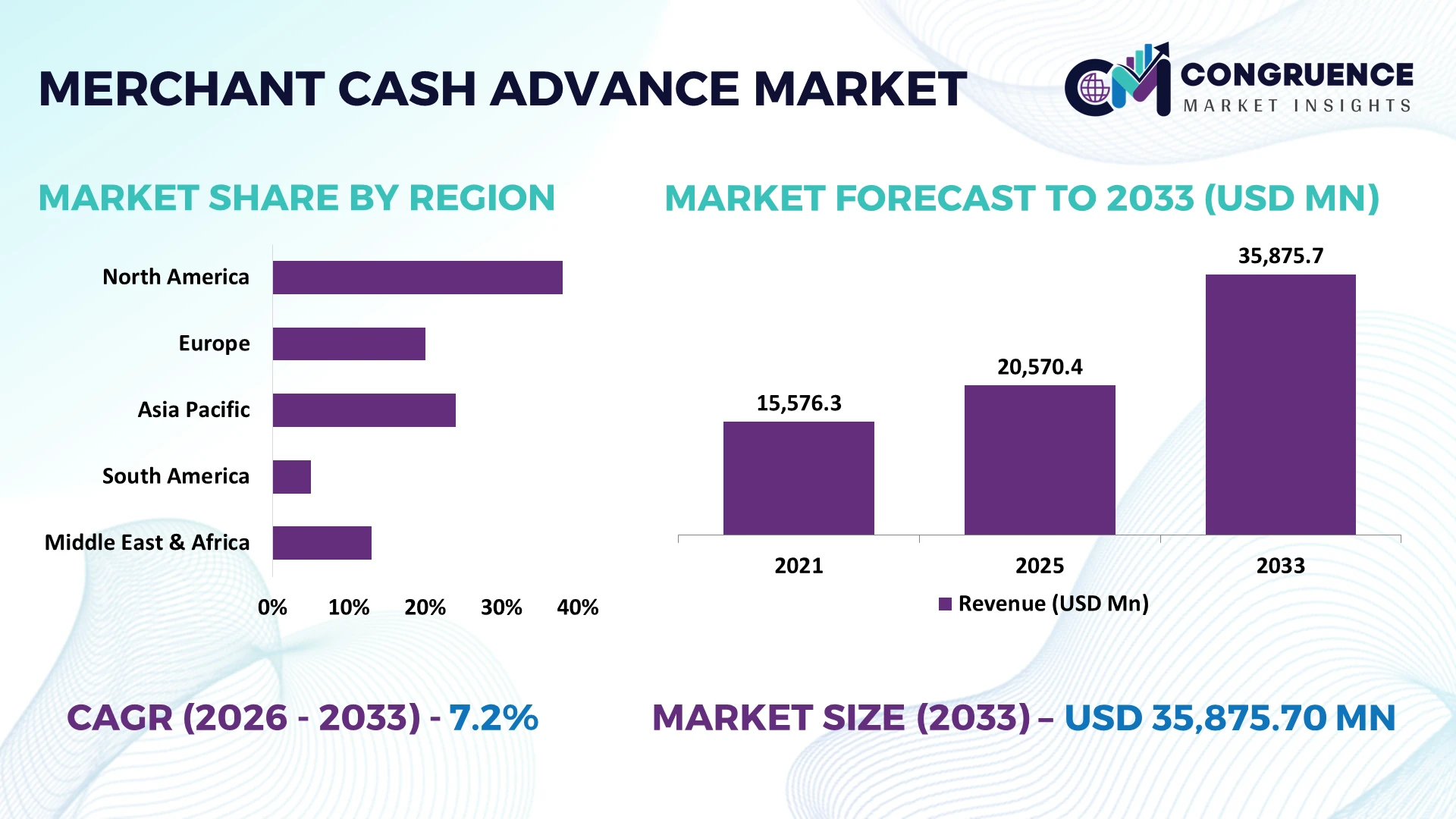
The United States maintains a leading position through its established fintech ecosystem, extensive card-payment infrastructure, and demand from retail, hospitality, and e-commerce businesses. North America accounts for approximately 40% of the global market, while Asia-Pacific represents a high-growth opportunity supported by expanding digital commerce and SME financing needs. In the United States, platform-based financing benefits from established payment networks; in India, the expansion of digital payments and the UPI ecosystem strengthens the infrastructure for transaction-led business finance. Federal Reserve lending conditions and California's commercial financing disclosure requirements further influence funding strategies, risk assessment, and compliance investment.
Strategic implication: Prioritize transaction-rich merchant segments and markets with scalable digital-payment infrastructure, while aligning underwriting models and disclosure practices with local regulatory requirements.
Market Size & Growth: Valued at USD 20570.39 Million in 2025, projected to USD 35875.7 Million by 2033 at 7.2% CAGR, driven by digital payment expansion and SME credit access gaps.
Top Growth Drivers: Micro and small enterprise financing demand at 72.1% market volume, renewal and recontract deals at 57.2% of market volume in 2025, and embedded finance platform integration .
Short-Term Forecast: By 2027, AI-driven underwriting integration reduces approval decision times as real-time transaction data and behavioral scoring models replace traditional credit assessment.
Emerging Technologies: AI-powered behavioral credit models for embedded MCA underwriting, real-time portfolio intelligence platforms for originators, and API integration with POS and accounting systems .
Regional Leaders: North America at 38.5% digital lending penetration with established fintech ecosystem, Asia-Pacific fastest-growing at 12.7% CAGR through UPI and platform-based lending, and Europe with UK and Germany driving revenue-based finance adoption .
Consumer/End-User Trends: Retail and e-commerce command dominant application share; restaurants and hospitality represent high-volume segments with daily card sales enabling natural repayment alignment.
Pilot/Case Example: Shopify Capital reached USD 1.784 billion in outstanding merchant funds, growing approximately 50% annually through AI-driven pre-approvals based on merchant performance data .
Competitive Landscape: PayPal, Stripe Capital, Shopify Capital, Square Capital, and OnDeck Capital lead; CAN Capital, National Funding, Fundbox, Credibly, and YouLend compete across regional and vertical segments .
Regulatory & ESG Impact: CFPB's May 2026 final rule excludes MCAs from Section 1071 small business lending data collection, removing compliance burden but leaving ECOA credit status unresolved .
Investment & Funding: CAN Capital launched USD 175 million funding program including securitization in June 2024 to expand small-business financing capacity .
Innovation & Future Outlook: Embedded finance integration with payment processors and e-commerce platforms, AI behavioral underwriting replacing bureau-dependent models, and hybrid repayment structures reshaping product design.
The Merchant Cash Advance Market is supported by demand from retail, hospitality, e-commerce, and service businesses that require rapid working capital for inventory, payroll, and expansion. AI-powered underwriting and payment-platform integrations are improving transaction-level risk assessment, while automated repayments align collections with merchant sales activity. Platform-led financing is gaining traction, with Shopify Capital's 40% increase in advances and loans during 2025 illustrating the commercial scale of embedded business finance. Meanwhile, California's disclosure requirements increase the importance of transparent pricing and compliant digital onboarding, positioning data-driven underwriting and disciplined portfolio management as strategic priorities.
The Merchant Cash Advance Market is becoming strategically important as fintech lenders, payment processors, and merchant platforms compete to control small-business financing relationships. Unlike conventional term loans, merchant cash advances recover funds through agreed portions of future sales, linking repayment to transaction activity. This model strengthens the role of payment data in credit decisions and creates opportunities for providers to embed financing directly into checkout, point-of-sale, and business-management systems.
Technology is reshaping operating economics. Automated transaction analysis replaces parts of manual document review, while integrated payment data supports faster eligibility decisions and continuous portfolio monitoring. However, precise industry-wide cost savings remain unverified. The United States benefits from established card-processing networks and mature fintech distribution, whereas India offers opportunities through expanding digital-payment infrastructure and a large base of small enterprises. California's commercial financing disclosure requirements also demonstrate how regulation is influencing product design, pricing transparency, and customer onboarding.
Over the next two to three years, providers will prioritize automated underwriting, repeat-advance management, fraud detection, and partnerships with payment platforms. Operational indicators to monitor include approval turnaround time, repeat-funding rates, delinquency by merchant segment, and acquisition cost per funded account. Companies are increasingly aligning capital facilities with origination pipelines and integrating risk controls into merchant software. Competitive advantage will depend on converting transaction intelligence into responsible funding decisions while maintaining transparent pricing, efficient distribution, and resilient portfolio performance.
Merchant cash advance growth is supported by the convergence of digital payment adoption and persistent small-business financing needs. In the United States, 66% of consumer purchases were completed using debit, credit, or prepaid cards in 2024, strengthening the transaction-data foundation for merchant underwriting. Meanwhile, 59% of employer firms sought financing during the preceding 12 months, and 40% of applicants sought less than USD 50,000. These conditions favor short-duration, sales-linked funding. Payment processors and fintech lenders are responding through embedded financing, automated eligibility assessments, and capital partnerships. The strategic advantage lies in converting verified payment histories into faster funding decisions without weakening credit controls.
Merchant affordability remains a structural constraint because repayment deductions compete directly with operating cash requirements. In the United States, 24% of financing applicants received none of the funding they sought, while 41% of firms denied some or all requested financing cited existing debt burdens. These indicators highlight the limitations of expanding advances without evaluating repayment capacity. High-cost funding can compress merchant margins when sales weaken or inventory costs rise, particularly for businesses with limited liquidity buffers. Providers are responding through more frequent cash-flow assessments, exposure limits, and segmented underwriting. The operational priority is to distinguish temporary working-capital shortages from persistent overleveraging before additional advances erode repayment capacity.
Embedded financing creates an opportunity to reach underserved merchants through payment processors, accounting software, and e-commerce platforms. In the United States, 66% of consumer purchases already relied on payment cards in 2024, providing a substantial transaction-data base for cash-flow assessment. In India, the expanding UPI ecosystem offers a complementary pathway for developing merchant-level digital financial records, although UPI transaction access alone does not establish eligibility for an advance. Providers can invest in consent-based data integration, predictive cash-flow models, and partnerships with merchant software platforms. The differentiated opportunity is to serve smaller businesses with irregular sales using risk-adjusted repayment structures, while reducing manual verification and improving customer acquisition efficiency.
Scaling merchant cash advances requires consistent underwriting across fragmented payment systems, merchant categories, and jurisdictions. In the United States, 35% of consumer payments were made by credit card in 2024, underscoring the importance of accurate transaction classification when assessing card-linked merchant cash flow. However, payment volume does not automatically establish profitability, repayment capacity, or protection against fraud. Providers integrating multiple processors must reconcile settlement delays, refunds, chargebacks, and inconsistent merchant records. California's commercial financing disclosure requirements add further complexity to digital product design and customer communications. Companies must invest in interoperable data systems, cybersecurity controls, model validation, and compliance automation. Long-term competitiveness depends on scaling distribution without compromising underwriting consistency or transparent financing terms.
Fixed-Percentage Advances represent a core product structure because repayment adjusts with merchant sales, making the model suitable for businesses with variable daily transaction volumes. However, a reliable, independently verified percentage share for this specific type is not publicly established. Its competitive position rests on straightforward repayment calculations, compatibility with card-processing systems, and relatively standardized servicing. Providers are improving transaction reconciliation and automating collections to reduce operational friction. Split-Withholding Advances remain relevant where processors deduct an agreed share directly from settlements, while Lockbox-Based Advances suit arrangements requiring centralized control over receivables.
Hybrid Repayment Advances offer differentiation by combining sales-linked deductions with fixed or scheduled repayment components. Their adoption depends on merchant cash-flow predictability, contractual design, and lender risk appetite; no defensible comparative growth percentage is available. Providers are therefore prioritizing flexible repayment architecture and clearer eligibility criteria rather than assuming a universal winning structure. Investment decisions should reflect processor compatibility, servicing costs, repayment volatility, and the merchant's sales profile.
Working Capital is the principal functional use case for merchant cash advances because businesses need liquidity for payroll, rent, supplier payments, and routine operating expenses. A verified application-level market share is not publicly established, so assigning a precise percentage would create false precision. The Federal Reserve Banks' 2026 small-business survey found that 56% of financing-seeking firms cited operating expenses as a reason for borrowing, underscoring the importance of liquidity management. Providers are responding with faster funding decisions and repayment structures aligned with transaction activity.
Inventory Financing and Business Expansion create additional demand when merchants need to replenish stock, open locations, or respond to changing customer orders. Marketing and Advertising can support customer acquisition, while Equipment Purchases fund productive assets; Emergency Expenses and Seasonal Cash Flow address less predictable liquidity requirements. The Federal Reserve Banks reported that 46% of financing-seeking firms pursued expansion or another business opportunity. This supports investment in purpose-specific underwriting, merchant accounting integrations, and funding limits tied to repayment capacity. Providers that distinguish recurring operating needs from discretionary expansion can improve portfolio allocation and reduce mismatches between advance duration and cash-flow generation.
Retail Businesses represent a structurally important end-user group because inventory replenishment, supplier payments, and seasonal sales cycles create recurring working-capital requirements. However, an independently verified percentage share by merchant cash advance end-user is not publicly established. Restaurants also have strong operational relevance because payroll, food procurement, and daily sales variability influence short-term liquidity. Providers are tailoring underwriting to transaction frequency, gross-margin patterns, refunds, and seasonal fluctuations instead of applying identical risk thresholds across merchant categories.
E-commerce Businesses offer a distinct distribution opportunity because digital storefronts generate transaction histories that can support remote underwriting and embedded financing. The Federal Reserve Banks' 2026 survey found that 29% of financing applicants sought credit from online fintech lenders in 2025, compared with 17% in 2020. This measures lender-channel adoption rather than e-commerce merchant share, but it demonstrates a meaningful shift in financing access. Healthcare Practices, Construction Companies, Hospitality Businesses, Personal Care Services, and Transportation Businesses present more specialized needs, including equipment purchases, delayed receivables, and uneven demand. Providers are developing sector-specific eligibility models and partnerships to improve underwriting precision. Competitive positioning will increasingly depend on matching repayment mechanisms to each industry's operating cycle.
North America accounted for the largest market share at approximately 40% in 2025; however, Asia-Pacific is positioned to register the fastest growth between 2026 and 2033 as digital payment adoption and embedded SME financing expand. These regional rankings are directional rather than verified market estimates, as consistent, independently validated regional market-share and growth-rate data for merchant cash advances are not publicly established.

Payment-platform integration and institutional funding strengthen market leadership
North America benefits from established card-processing networks, mature fintech infrastructure, and strong demand for flexible small-business financing. The United States anchors regional activity through payment-linked underwriting, digital merchant acquisition, and specialist funding platforms serving retail, restaurants, and e-commerce. Competition centers on approval speed, underwriting precision, renewal management, and access to institutional capital. Canada's market offers additional opportunities through digital merchant services, although product distribution and regulatory requirements differ by jurisdiction. Providers are strengthening partnerships with payment processors and funding institutions to expand origination capacity while managing credit exposure. California's commercial financing disclosure requirements also reinforce the need to embed transparent pricing and repayment disclosures into digital application workflows. The region's strategic advantage lies in combining transaction data with established capital markets and scalable merchant distribution.
United States Market Outlook: The United States remains the region's central merchant cash advance market because of its extensive payment-processing ecosystem and established alternative-finance providers. The Federal Reserve's 2025 Small Business Credit Survey found that 29% of financing applicants used online fintech lenders, compared with 17% in 2020. This shift supports investment in embedded offers, automated underwriting, and repeat-funding systems. Providers that combine rapid disbursement with robust repayment monitoring are better positioned to defend market share.
Regulatory consistency and digital SME financing shape market development
Europe's merchant cash advance market operates across diverse national lending frameworks, payment systems, and small-business financing practices. The United Kingdom provides a developed environment for alternative business finance, while Germany and France offer opportunities linked to merchant digitization and SME working-capital needs. The European Union's Digital Operational Resilience Act, applicable since January 2025, raises expectations for ICT risk management among covered financial entities and relevant service providers. These requirements increase the importance of resilient underwriting platforms, third-party oversight, and secure payment-data integration. Providers are responding through compliance automation, technology partnerships, and market-specific distribution strategies. Unlike the more unified commercial scale of the United States, European expansion requires careful adaptation to local legal structures and merchant practices. Companies that standardize core technology while localizing product terms can improve operational efficiency without compromising regulatory alignment.
United Kingdom Market Outlook: The United Kingdom benefits from established fintech infrastructure, widespread digital business payments, and a developed alternative-finance ecosystem. The British Business Bank's Small Business Finance Markets reporting provides a framework for tracking financing conditions and SME funding channels. Providers can leverage accounting integrations, payment-provider relationships, and automated cash-flow assessment to reach smaller businesses. Clear product disclosures and robust affordability assessment remain essential to sustainable distribution.
Digital payment expansion broadens access to transaction-based financing
Asia-Pacific offers substantial structural potential through its large SME population, expanding digital commerce, and rapid modernization of merchant payment infrastructure. Australia has an established alternative-finance market, while India and Southeast Asian economies present opportunities to develop transaction-informed financing for smaller businesses. India's digital-payment ecosystem is particularly relevant: the National Payments Corporation of India reported approximately 18,300 crore UPI transactions during calendar year 2025. This scale improves the availability of digital transaction records, although access to payment data does not automatically establish creditworthiness or legal eligibility for merchant cash advances. Providers are investing in consent-based data integration, local payment partnerships, and merchant-specific risk models. The key commercial challenge is converting high transaction volumes into reliable repayment signals across fragmented merchant systems and differing regulatory frameworks.
India Market Outlook: India's UPI infrastructure and growing digital acceptance provide a foundation for transaction-based SME financing. Providers can combine authorized payment data with accounting records and bank-statement analysis to assess cash-flow consistency. Partnerships with payment aggregators and merchant software platforms can lower acquisition friction, while localized underwriting helps distinguish high-volume merchants from businesses with thin margins or irregular settlements.
Digital commerce expands financing access amid cost and credit constraints
South America's market development is shaped by SME funding gaps, inflation exposure, and growing digital-payment adoption. Brazil represents the most strategically significant market because of its scale, established electronic-payment infrastructure, and extensive small-business sector. Argentina and Colombia offer additional opportunities, although macroeconomic volatility and differences in financial regulation affect underwriting and funding costs. Brazil's Pix instant-payment system recorded more than 63 billion transactions in 2024, illustrating the scale of digital payment activity; this figure measures payments generally, not merchant cash advance adoption. Providers are developing partnerships with payment facilitators and business-management platforms to improve merchant identification and repayment monitoring. Currency volatility and inconsistent cash-flow histories require localized pricing and tighter portfolio controls. Commercial expansion therefore depends on combining digital distribution with disciplined risk segmentation rather than treating payment growth as direct evidence of credit quality.
Brazil Market Outlook: Brazil offers a strong base for merchant-financing innovation through Pix, established card-acquiring networks, and a large ecosystem of small enterprises. Providers can integrate transaction histories with consent-based financial data to assess settlement patterns and operating liquidity. Partnerships with merchant acquirers and accounting platforms can extend reach, while inflation-sensitive underwriting and local regulatory expertise remain important to sustainable portfolio performance.
Fintech infrastructure and SME digitization create new financing pathways
The Middle East and Africa market is developing through digital-payment modernization, fintech investment, and demand for flexible business financing. The United Arab Emirates benefits from advanced digital financial services and a concentrated ecosystem of technology-enabled businesses, while Saudi Arabia's digital transformation agenda supports broader electronic-payment adoption. In South Africa, established financial infrastructure provides a foundation for alternative SME lending, although access to affordable capital remains uneven. Saudi Arabia's Vision 2030 financial-sector initiatives reinforce investment in digital services and private-sector financing infrastructure. Providers are building relationships with payment processors, local lenders, and merchant platforms to improve customer acquisition and transaction visibility. Market expansion nevertheless depends on jurisdiction-specific licensing, reliable merchant data, and access to local funding. Companies that establish compliant distribution partnerships can reduce entry friction and build a stronger foundation for sustainable lending operations.
United Arab Emirates Market Outlook: The UAE offers a strategic entry point through its digital commerce ecosystem, advanced payment infrastructure, and concentration of small businesses in retail, hospitality, and professional services. Providers can integrate merchant-management software with authorized transaction data to improve eligibility assessments. Partnerships with licensed financial institutions and payment service providers support local distribution, while transparent pricing and robust compliance controls remain essential for building merchant confidence.
The merchant cash advance market combines payment-platform leaders, specialist fintech lenders, and independent financing companies. Shopify and Block compete through embedded merchant ecosystems, while PayPal leverages payment relationships; CAN Capital and Rapid Finance focus on specialist small-business funding. These models compete on distribution reach, underwriting speed, repayment flexibility, and funding access. A reliable combined market share for the five leading providers is not publicly established, making claims of concentrated market control difficult to substantiate. Competition increasingly favors transaction-level risk analytics, automated servicing, and direct integration with merchant platforms. Digital financing adoption is rising: 29% of US financing applicants used online fintech lenders in 2025, compared with 17% in 2020. California's commercial financing disclosure requirements also increase compliance demands. Providers are expanding through payment partnerships, institutional funding facilities, and automated underwriting rather than relying exclusively on branch-based acquisition. Entry barriers include capital access, repayment-data quality, fraud controls, and jurisdiction-specific compliance. Sustainable advantage requires efficient distribution, disciplined risk selection, transparent pricing, and dependable funding capacity.
Shopify
Block
PayPal
CAN Capital
Rapid Finance
Credibly
Fora Financial
National Funding
Libertas Funding
Reliant Funding
Kalamata Capital Group
Mulligan Funding
Kapitus
Idea Financial
Merchant cash advance technology is shifting from manual application review and fixed collection workflows toward transaction-driven underwriting. AI-assisted risk scoring, bank-data aggregation, and payment-platform integrations enable lenders to evaluate sales volatility, settlement patterns, and repayment capacity with less document handling. The advantage is not automation alone: verified transaction histories help distinguish high-volume merchants from businesses with weak operating margins.
Real-time payment integration is also changing repayment administration. Legacy reconciliation relies on manual matching and delayed reporting, whereas API-connected systems can synchronize transaction records and collections more frequently. However, industry-wide percentage improvements in processing efficiency or operating costs are not independently established. Adoption is strongest where lenders already control merchant payment relationships, giving embedded-finance platforms an advantage in customer acquisition and data continuity.
During 2026–2028, competitive differentiation will increasingly depend on explainable AI, fraud detection, consent-based financial-data access, and automated compliance. Providers integrating these capabilities can target faster eligibility decisions and more consistent portfolio monitoring, while lenders using fragmented systems face higher reconciliation burdens. Investment should prioritize measurable outcomes: approval turnaround time, underwriting cost per application, fraud losses, and delinquency by merchant cohort. The strategic imperative is to modernize underwriting and servicing together, ensuring that faster funding does not compromise affordability assessments, transparent disclosures, or portfolio quality.
The Merchant Cash Advance Market Report examines market structure, financing models, technology adoption, competitive positioning, and strategic developments influencing merchant funding between 2026 and 2033. Type coverage includes Fixed-Percentage Advances, Split-Withholding Advances, Lockbox-Based Advances, and Hybrid Repayment Advances. Application analysis covers Working Capital, Inventory Financing, Equipment Purchases, Business Expansion, Marketing and Advertising, Emergency Expenses, and Seasonal Cash Flow. End-user coverage includes Retail Businesses, Restaurants, E-commerce Businesses, Healthcare Practices, Construction Companies, Hospitality Businesses, Personal Care Services, and Transportation Businesses.
Geographic coverage spans North America, Europe, Asia-Pacific, South America, and the Middle East and Africa, with country-level assessments of payment infrastructure, regulation, financing access, and digital distribution. Technology analysis evaluates AI-enabled underwriting, transaction-data integration, automated collections, fraud detection, and embedded financing. Competitive assessment examines provider differentiation, institutional funding arrangements, partnerships, and expansion priorities. These insights support investment allocation, market-entry decisions, product development, risk management, and competitive positioning, helping decision-makers identify commercially attractive merchant segments while accounting for underwriting quality, regulatory obligations, and operational scalability.
| Report Attribute/Metric | Report Details |
|---|---|
Market Revenue in 2025 | USD 20570.39 Million |
Market Revenue in 2033 | USD 35875.7 Million |
CAGR (2026 - 2033) | 7.2% |
Base Year | 2025 |
Forecast Period | 2026 - 2033 |
Historic Period | 2021 - 2025 |
Segments Covered | By Type
By Application
By End-User
|
Key Report Deliverable | Revenue Forecast, Growth Trends, Market Dynamics, Segmental Overview, Regional and Country-wise Analysis, Competition Landscape |
Region Covered | North America, Europe, Asia-Pacific, South America, Middle East, Africa |
Key Players Analyzed |
|
Customization & Pricing | Available on Request (10% Customization is Free) |




