
Reports
The Global MEMS-Based Inertial Measurement Unit (IMU) Market was valued at USD 121.0 Million in 2025 and is anticipated to reach a value of USD 285.1 Million by 2033 expanding at a CAGR of 11.31% between 2026 and 2033. Miniaturized 6-axis modules embedded in robotic surgical tools and automotive stability systems anchor replacement demand for legacy ring-laser gyroscopes across defense and industrial navigation applications.
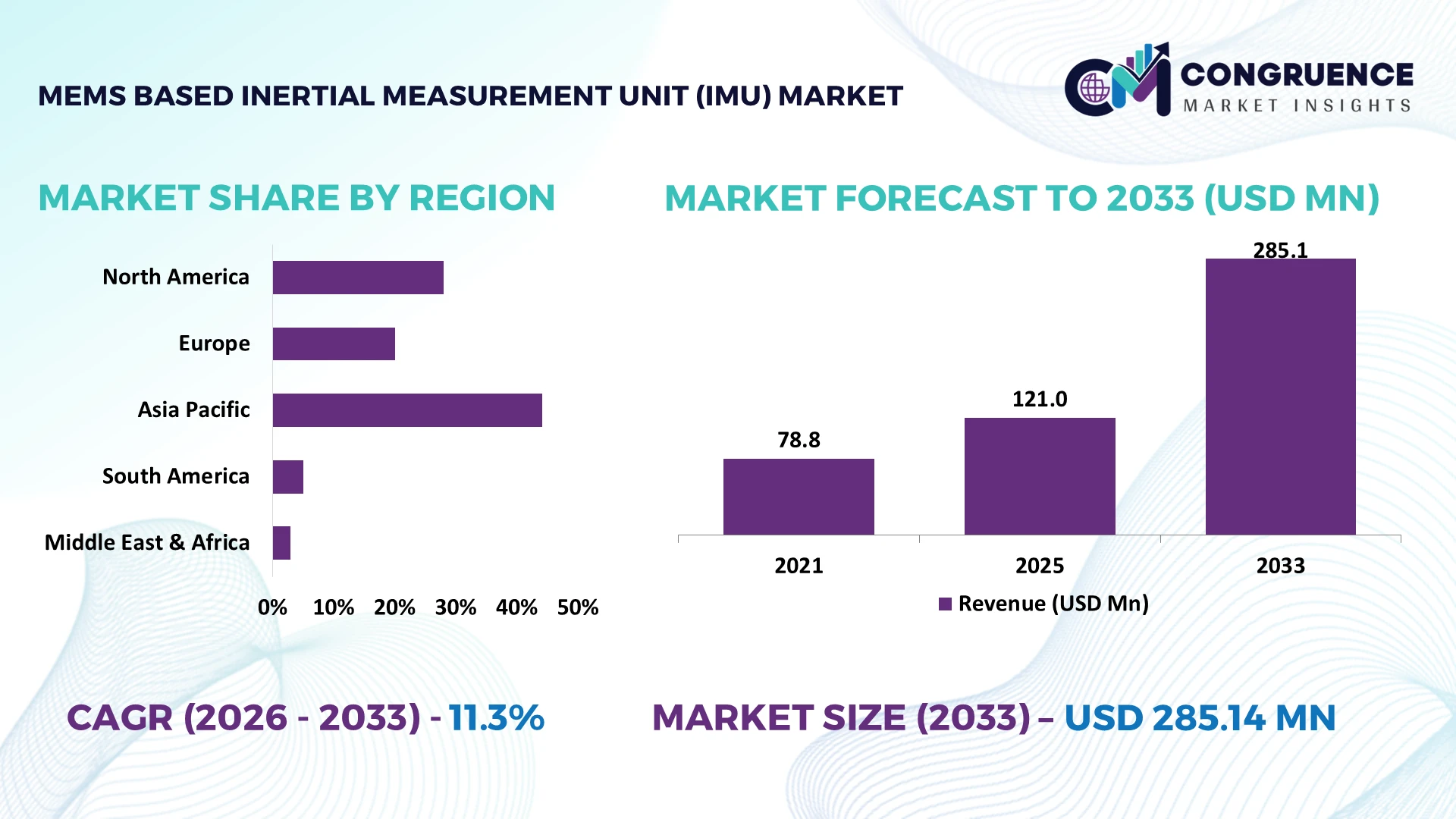
Asia Pacific commands 44.10% of global revenue, with China’s USD 143 billion Integrated Circuit Fund and Japan’s MEMS foundry density compressing lead times to eight weeks; Germany’s EUR 10 billion semiconductor program expands Bosch’s Dresden lines by 30%, while U.S. CHIPS Act funding lifts GlobalFoundries’ automotive-grade IMU output 25% .
The strategic implication is clear: supply-chain localization now determines IMU cost competitiveness more than sensor specification alone.
Market Size & Growth: USD 1.21 billion in 2025 to USD 2.07 billion by 2030 at 11.31% CAGR, driven by aerospace/defense replacement of ring-laser gyroscopes and IoT-enabled industrial automation demand.
Top Growth Drivers: Medical robotics precision requirements (12.43% sector growth), consumer electronics at 31.85% revenue share, and 9-axis module adoption at 12.74% CAGR.
Short-Term Forecast: By 2027, on-chip ML cores like STMicroelectronics’ LSM6DSV16X deliver 40% system power reduction, accelerating integration in battery-constrained wearables and AR headsets.
Emerging Technologies: AI-embedded IMUs with decision-tree execution, 9-axis combo modules eliminating external magnetometers, and wafer-level packaging shrinking footprints to 2.5mm × 3.0mm.
Regional Leaders: Asia Pacific at 44.10% share led by China’s USD 143 billion IC fund; North America driven by U.S. CHIPS Act’s USD 39 billion; Europe supported by Germany’s EUR 10 billion semiconductor program.
Consumer/End-User Trends: 97% smartphone accelerometer penetration and 82% TWS earbud gyroscope attachment stabilize high-volume MEMS demand despite handset margin compression.
Pilot/Case Example: Stryker’s 2024 Mako SmartRobotics with 6-axis IMUs achieved 0.5-degree surgical precision, capturing 38% of the U.S. knee-replacement market.
Competitive Landscape: Bosch, STMicroelectronics, TDK, Analog Devices, and Honeywell lead; TDK and Murata collectively hold 35% of consumer MEMS shipments through vertical integration.
Regulatory & ESG Impact: Export controls on high-performance IMUs and 90-day NIST recalibration cycles impose compliance burdens, favoring well-capitalized vendors with calibration infrastructure.
Investment & Funding: U.S. CHIPS Act allocates USD 39 billion to fabrication incentives; GlobalFoundries expands Malta, NY, output 25% for automotive IMUs; South Korea’s KRW 622 trillion roadmap lifts Samsung MEMS capacity 40% by 2027.
Innovation & Future Outlook: IMU array technology and silicon photonics promise navigation-grade accuracy from low-cost MEMS clusters, shifting value from single-sensor specs to fusion-algorithm differentiation.
The MEMS-Based Inertial Measurement Unit (IMU) Market is pivoting from component sales toward system-level fusion, with 6-axis modules holding 40.55% revenue share while 9-axis devices accelerate at 12.74% . Bosch’s BMI323 and STMicroelectronics’ ML-core IMUs demonstrate that power efficiency—40% reduction in system draw—now differentiates products as much as precision. Industrial robotics and surgical navigation represent the most defensible demand pockets, where Stryker’s 0.5-degree surgical accuracy translates directly into market share capture. Supply-chain localization across China, Japan, and the U.S. is reshaping procurement priorities, making foundry access a strategic asset. This convergence of precision demand and regional fabrication investment frames the competitive analysis that follows.
MEMS IMU competition is shifting from sensor specifications to supply-chain control and fusion-algorithm depth. China’s USD 143 billion Integrated Circuit Fund and Japan’s eight-week foundry lead times demonstrate that fabrication proximity now determines cost positioning as much as MEMS design does . Export controls on high-performance IMUs add a geopolitical layer, pushing defense and aerospace buyers toward domestic or allied-nation sources.
Technology comparison reveals the efficiency gap: 9-axis modules with on-chip machine-learning cores cut system power 40% versus legacy discrete sensor architectures, directly extending battery life in wearable and AR platforms . Regionally, Asia Pacific’s 44.10% revenue share reflects volume manufacturing dominance, while North America’s CHIPS Act-driven USD 39 billion fabrication incentive targets high-value automotive and defense IMU production—a scale-versus-precision contrast .
Operationally, Stryker’s integration of 6-axis IMUs into Mako SmartRobotics achieved 0.5-degree surgical precision, capturing 38% of the U.S. knee-replacement market . Over the next two to three years, expect automotive Tier-1 suppliers to lock in multi-year foundry agreements and medical device firms to prioritize IMU suppliers with calibrated, NIST-traceable production lines. Strategic positioning hinges on securing fabrication access and embedding fusion intelligence at the chip level—advantages that compound as end markets demand smaller, smarter, and more power-efficient inertial sensing.
Minimally invasive surgical robotics requiring sub-degree precision now integrate 6-axis MEMS IMUs as standard, with Stryker’s Mako system achieving 0.5-degree accuracy and capturing 38% of the U.S. knee-replacement market . Automotive Level 2 vehicles embed 2–4 IMUs per platform for electronic stability control, creating volume demand that supplier consolidation cannot fully absorb. The structural shift is toward integrated 9-axis modules that eliminate external magnetometers, with this segment growing at 12.74% as AR headsets and drones demand heading data in compact form factors . Companies are responding through foundry partnerships and ML-core integration—STMicroelectronics’ LSM6DSV16X executes 16 decision trees on-chip, cutting system power 40% and locking in design wins across medical and consumer platforms . The strategic insight: precision certification now determines supplier selection more than unit price.
High-performance IMU production remains gated by calibration stands costing USD 400,000 each and requiring NIST recalibration every 90 days, restricting participation to well-capitalized vendors . Export controls on tactical-grade IMUs create nine-month licensing delays for suppliers like Turkey’s ASELSAN, disrupting delivery schedules for KAAN fighter programs and forcing defense contractors to qualify alternative sources . These constraints directly compress margins for smaller MEMS fabricators and slow deployment in price-sensitive industrial segments. Companies are mitigating exposure through regional calibration partnerships and dual-sourcing strategies that prioritize jurisdictions with streamlined export frameworks. The operational reality: compliance and calibration overhead now rival sensor design as cost drivers, favoring incumbents with established testing infrastructure.
Industrial machinery deploying MEMS IMUs for predictive maintenance shortens payback cycles by detecting vibration anomalies before catastrophic failure, with industrial IMU installations in AGVs and collaborative robots climbing 18.7% year-over-year . IMU array technology—clustering low-cost sensors with fusion algorithms—offers navigation-grade accuracy at a fraction of single high-precision unit cost, opening defense and autonomous navigation applications previously priced out of MEMS adoption . France’s Crolles advanced-packaging joint venture cutting module footprints 40% for wearable and medical clients signals ecosystem-level investment in form-factor innovation . Companies positioning early in array-fusion IP and medical-grade calibration will capture margin pools that component-level competitors cannot access.
Scaling MEMS IMU production for automotive and medical markets requires calibration technicians and fusion-algorithm engineers in short supply, with South Korea’s KRW 622 trillion semiconductor roadmap projecting a 40% capacity increase by 2027 that will strain specialized labor availability . Integration complexity rises as customers demand 9-axis fusion with embedded ML, creating validation cycles that extend product qualification timelines across automotive Tier-1 and medical device supply chains. Cybersecurity concerns compound these pressures as IMUs become nodes in connected industrial and automotive networks. Companies must invest in calibration automation and application-engineering teams or risk losing design wins to suppliers offering turnkey integration support—a capability gap that will separate tier-one partners from commodity vendors over the next three years.
Automotive Safety Mandates Reshape IMU Sourcing Level 2+ platforms now embed 2–4 IMUs per vehicle for electronic stability control redundancy, with Tesla’s Hardware 4 adopting Bosch’s SMI230 6-axis unit across Model 3 and Model Y lines in 2024 . China alone shipped 4.8 million Level 2+ vehicles in 2024, each carrying at least two IMUs, establishing a demand floor exceeding 9 million units annually . Tier-1 suppliers are locking multi-year foundry agreements to secure automotive-grade capacity, prioritizing AEC-Q100 qualification over unit price.
Surgical Robotics Demands Sub-Degree Precision Stryker’s Mako SmartRobotics captured 38% of the U.S. knee-replacement market by integrating 6-axis IMUs achieving 0.5-degree surgical precision . Medtronic’s Hugo system deploys tactical-grade gyros counteracting respiratory motion, delivering a 22% reduction in tissue trauma during laparoscopic procedures . Medical device OEMs now require NIST-traceable calibration documentation as a procurement precondition, forcing MEMS vendors to invest in dedicated medical-grade testing infrastructure.
Export Controls Trigger Dual-Sourcing Urgency Tightened export controls on high-performance MEMS fabrication equipment have extended standard automotive IMU lead times from 8 weeks to 18–22 weeks, with customized 9-axis fusion modules queuing beyond 30 weeks . Chinese OEMs report BOM cost increases of approximately 12% as they parallel-qualify domestic suppliers to reduce single-source exposure . The non-obvious shift: procurement teams now treat IMU availability as a production scheduling variable rather than a tactical purchasing decision.
On-Chip ML Cuts System Power Demands STMicroelectronics’ LSM6DSV16X integrates a machine-learning core executing 16 decision trees, delivering a 40% reduction in system power versus discrete sensor architectures . Bosch’s BMI323 at 2.5mm × 3.0mm operates at 1.8 mA during continuous use, enabling spatial audio in compact earbuds . Wearable and AR device makers are migrating from raw accelerometer-gyroscope pairs to intelligent IMU modules, shifting value capture from sensor fabrication toward fusion-algorithm IP.
Integrated 6-axis modules commanded 40.55% of revenue in 2025, sustained by automotive stability control and smartphone motion-sensing volume that rewards mature yields and sub-USD pricing . These modules dominate through integration efficiency—combining accelerometer and gyroscope dies in a single package eliminates board-space and calibration complexity for Tier-1 automotive suppliers. Integrated 9-axis devices represent the fastest-growing segment at 12.74%, driven by AR headset and drone demand for heading data without external magnetometers . Stand-alone accelerometers remain indispensable for airbag crash detection requiring 100 G ranges, while discrete gyros serve optical image stabilization in smartphone cameras . Companies are responding by embedding ML cores into 9-axis modules, with STMicroelectronics positioning its LSM6DSV16X as a system-power differentiator rather than a component specification play.
Consumer electronics accounted for 31.85% of 2025 revenue, anchored by smartphone and smartwatch volume, though handset margin compression is slowing segment momentum . Medical devices represent the fastest-growing application at 12.43%, propelled by surgical robotics requiring sub-degree precision and gait analysis monitors demanding continuous inertial tracking . Automotive integrates 2–4 IMUs per Level 2 vehicle for stability control, but supplier consolidation constrains expansion to 10.55% . Aerospace and defense adoption accelerates as MEMS replace ring-laser gyroscopes in drones and compact missiles, while industrial machinery leverages IMUs for predictive maintenance with shortened payback cycles. Companies are adapting through application-specific calibration: medical-grade IMUs command premium pricing justified by NIST-traceable documentation, while automotive suppliers compete on AEC-Q100 qualification timelines and multi-year capacity commitments.
Consumer electronics led end-user demand with 31.85% of 2025 revenue, driven by smartphone accelerometer penetration and TWS earbud gyroscope attachment . This segment operates on high-volume, low-margin economics where Japanese suppliers TDK and Murata captured 35% of consumer shipments through vertically integrated foundry chains compressing lead times to eight weeks . Medical represents the fastest-growing end-user group, with surgical robotics and wearable diagnostics demanding calibrated precision that commands premium pricing and longer qualification cycles. Automotive buyers integrate 2–4 IMUs per vehicle but face supply constraints from consolidation, while aerospace and defense prioritize tactical-grade replacements for legacy gyroscopes. Companies are targeting medical OEMs through dedicated calibration partnerships and NIST-traceable production lines, while automotive suppliers invest in AEC-Q100 certification capacity to lock in design wins before platform freezes.
Asia-Pacific accounted for the largest market share at 44.1% in 2025 however, North America is expected to register the fastest growth, expanding at a CAGR of 12.4% between 2026 and 2033.
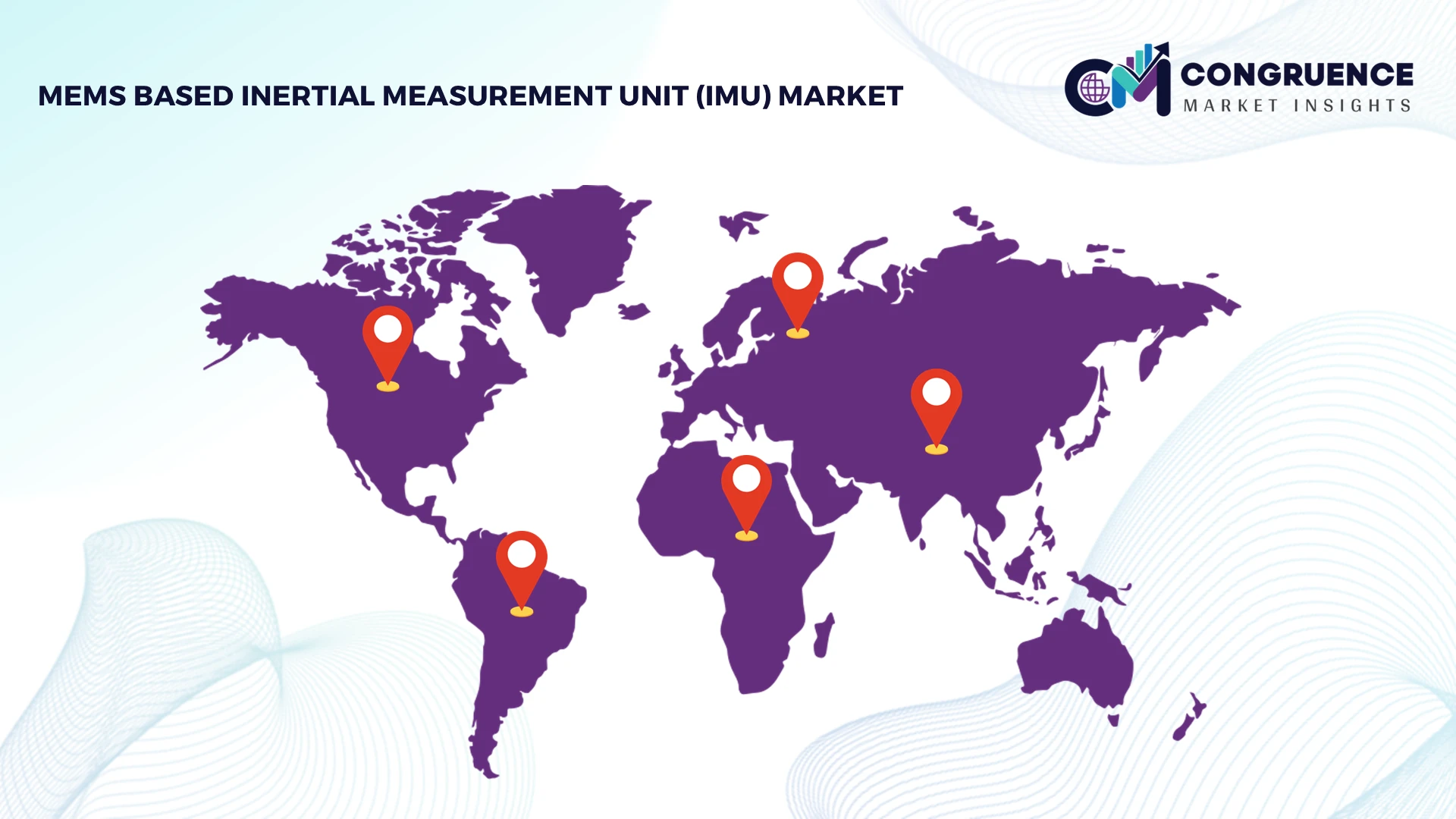
North America holds 28.0% of global MEMS IMU value, concentrated in U.S. defense programs requiring tactical-grade modules for GPS-denied navigation and automotive ADAS platforms. Honeywell’s March 2025 SmartNav IMU-400 launch reinforced domestic production depth for drones and autonomous platforms. The region’s strategic edge lies in navigation-grade fusion algorithms and ITAR-compliant qualification infrastructure rather than volume manufacturing. Analog Devices is expanding tactical MEMS lines to serve aerospace and surgical robotics customers, where NIST-traceable calibration documentation commands premium pricing.
United States Market Outlook: The U.S. represents roughly 82% of North American MEMS IMU demand, supported by USD 39 billion in CHIPS Act fabrication incentives and defense procurement cycles prioritizing domestic sourcing. Automotive Tier-1 suppliers and medical robotics OEMs drive adoption, with stateside foundry access compressing qualification timelines by an estimated 15%.
Europe commands 20.0% of global MEMS IMU value, with Germany’s automotive sensor cluster and France’s aerospace navigation ecosystem driving premium demand. ADAS penetration reached 68.4% in European vehicles, mandating multi-IMU architectures for electronic stability control redundancy. Bosch Sensortec’s March 2025 BNO085 launch reinforced Germany’s MEMS innovation position, while Safran’s HRG production expansion targets GNSS-denied defense applications. The region’s focus is certification depth over cost leadership, with companies investing in dual-use MEMS lines serving automotive functional safety and aerospace qualification standards.
Germany Market Outlook: Germany represents approximately 31% of European MEMS IMU consumption, underpinned by Bosch’s Dresden fabrication expansion and the EUR 10 billion semiconductor subsidy program. Automotive Tier-1 suppliers require AEC-Q100 qualification and ISO 26262 documentation as standard procurement gates, favoring vendors with established testing infrastructure.
Asia-Pacific leads global MEMS IMU value with 44.1% share, anchored by China’s USD 143 billion Integrated Circuit Fund and Japan’s vertically integrated foundry chains that compress lead times to eight weeks. TDK and Murata collectively control 35% of consumer MEMS shipments, while South Korea’s KRW 622 trillion semiconductor roadmap targets a 40% expansion of Samsung’s System LSI MEMS capacity by 2027. The region’s competitive advantage is volume manufacturing economics: smartphone accelerometer penetration exceeds 97%, and China’s EV production base embeds 2–4 IMUs per vehicle for stability control. Companies are localizing MEMS production through foundry partnerships to reduce geopolitical exposure and shorten qualification cycles for automotive and consumer customers.
China Market Outlook: China accounts for approximately 58% of Asia-Pacific MEMS IMU demand, supported by USD 520 million in advanced sensor research funding and the world’s largest smartphone manufacturing ecosystem. Domestic sensor subsidies targeting SMIC and Huahong are accelerating import substitution, with local suppliers targeting 30% of automotive-grade demand by 2027.
South America represents 5.0% of global MEMS IMU value, with Brazil accounting for 52.61% of regional inertial system demand through defense modernization and deepwater energy infrastructure. Adoption concentrates in guided weapons, UAV stabilization, and offshore navigation where GNSS denial requires inertial backup. Honeywell Aerospace launched its SmartNav IMU-200 in Brazil in January 2025, targeting UAV and autonomous vehicle orientation tracking. Infrastructure limitations constrain volume deployment, but SIATT’s September 2025 facility expansion added local production lines for guided weapons and surveillance systems, signaling gradual supply-chain localization.
Brazil Market Outlook: Brazil dominates South American demand with defense procurement programs and Petrobras offshore operations requiring subsea inertial navigation. Local-content policies favor suppliers with domestic assembly partnerships, positioning AEL Sistemas and SIATT as integration partners for multinational MEMS vendors seeking regional access.
Middle East & Africa accounts for 2.9% of global MEMS IMU value, with Israel’s defense electronics sector and Gulf states’ military modernization programs representing concentrated demand. Israel’s IMU market demonstrated 54.58% growth from 2023 to 2024, reflecting urgent procurement for precision-guided systems and UAV navigation. Teledyne’s February 2025 ADXRS645 MEMS IMU launch targeted regional UAV and autonomous system requirements. The region’s adoption pattern favors tactical-grade MEMS over navigation-grade systems, balancing performance with cost constraints. Companies position through defense offset agreements and local assembly partnerships rather than direct manufacturing investment.
Israel Market Outlook: Israel represents the region’s most concentrated MEMS IMU demand node, driven by defense electronics exports and indigenous UAV production. Procurement emphasis on GNSS-denied navigation and miniaturized tactical modules aligns with MEMS capabilities, with local defense firms integrating imported sensor components into complete navigation solutions for export markets.
Bosch Sensortec, STMicroelectronics, TDK InvenSense, Murata, and Analog Devices form the competitive core, with the top five commanding an estimated 62% of MEMS IMU value. Competition splits along two axes: consumer volume players (Bosch, TDK) defending handset and wearable sockets through integrated ML cores and sub-USD pricing, versus automotive/industrial specialists (ST, Murata, ADI) competing on AEC-Q100 qualification depth and functional safety documentation. ST’s early-2026 acquisition of NXP’s MEMS business reshapes automotive supply, consolidating combination-sensor capability behind a single 15-year longevity commitment. Murata’s SCH1633-D05 targets zonal ECU integration with factory-calibrated thermal performance, eliminating customer-side calibration steps that typically add 8–12% to module cost. The decisive competitive shift is from component specifications toward platform-level integration—Bosch’s BMI5 shared hardware architecture and TDK’s PositionSense 9-axis fusion solution signal that software and calibration IP now determine design-win probability. The barrier is qualification infrastructure: NIST-traceable calibration stands and ISO 26262 documentation require capital commitments that exclude sub-scale entrants. Winning requires foundry-secured capacity, embedded fusion intelligence, and certification depth—not sensor precision alone.
Bosch Sensortec GmbH
STMicroelectronics NV
TDK InvenSense
Murata Manufacturing Co., Ltd.
Analog Devices, Inc.
Honeywell International Inc.
Safran Electronics & Defense
Northrop Grumman Corporation
Thales Group
Exail Technologies
Advanced Navigation
SBG Systems
VectorNav Technologies
Silicon Sensing Systems
On-chip machine-learning cores now define the current technology frontier, with STMicroelectronics’ LSM6DSV16X executing 16 decision trees directly on the sensor to cut system power 40% versus host-processed architectures. Bosch’s BMI5 platform extends this with edge-AI classification that recognizes motion patterns while keeping devices in always-on states at minimal battery draw. Adoption is accelerating: premium wearables and XR devices are migrating from raw sensor pairs to intelligent IMU modules at an estimated 28% of new designs in 2025.
The emerging transition is toward factory-calibrated, fusion-ready 9-axis solutions. Murata’s SCH1633-D05 delivers ceramic-grade thermal stability in a plastic SOIC package, eliminating customer-side temperature calibration that traditionally consumes 8–12% of module cost. TDK’s PositionSense integrates TMR magnetometer and 6-axis IMU with on-chip fusion software, targeting humanoid robots and smart glasses where absolute orientation without GPS is operationally critical. These platforms shift value capture from die fabrication toward calibration IP and fusion algorithms.
Between 2026 and 2028, competitive advantage will accrue to suppliers embedding edge intelligence without sacrificing power budgets. Automotive zonal architectures will demand IMUs that arrive pre-calibrated for ECU-mounted deployment, while robotics will require vibration-resistant gyroscopes with extended dynamic range. Vendors unable to deliver fused, certified modules will be relegated to commodity die supply. Acting now means locking in calibration infrastructure and fusion-software partnerships before qualification cycles close.
January 2026 — Bosch Sensortec launched the BMI5 sensor platform at CES, featuring shared hardware architecture across BMI560/563/570 variants for XR, robotics, and wearables, with measurement range doubled versus predecessors and edge-AI classification enabling always-on sensing at reduced power. The platform reinforces Bosch’s volume position across premium consumer segments. Source: bosch.co.jp
May 2026 — Murata announced the SCH1633-D05 6DoF IMU for direct AD/ADAS ECU integration, delivering gyroscope offset below 0.15°/s across all axes through factory calibration that eliminates customer-side temperature compensation. Mass production begins June 2026, targeting zonal architecture adoption. Source: murata.com
October 2026 — TDK InvenSense released PositionSense globally, a two-chip 9-axis solution pairing a 6-axis IMU with a TMR magnetometer and on-chip fusion software for absolute orientation in wearables, drones, and humanoid robots. The solution addresses GNSS-denied navigation demands in physical AI devices. Source: tdk-electronics.tdk.com
October 2026 — STMicroelectronics launched its first automotive safety combination sensors following the NXP MEMS acquisition, integrating multi-axis accelerometer and gyroscope in ISO 26262-compliant packages with SafeSPI support and a 15-year longevity commitment. Four variants enter mass production for ADAS and stability control. Source: bisinfotech.com
This report delivers a comprehensive assessment of the global MEMS-based IMU landscape, spanning type segmentation across 6-axis, 9-axis, and discrete sensor configurations, with application coverage extending from automotive ADAS and surgical robotics to industrial automation, aerospace defense, and consumer electronics. End-user analysis profiles demand patterns across automotive OEMs, medical device manufacturers, industrial robot integrators, and consumer electronics brands, quantifying adoption velocity and procurement criteria.
Regional analysis covers Asia-Pacific’s manufacturing dominance at 44.10% value share, North America’s defense and automotive safety concentration, Europe’s certification-driven precision ecosystem, and emerging demand pockets across South America and the Middle East. The report tracks technology transitions including on-chip ML integration, factory-calibrated fusion modules, and IMU array architectures, alongside competitive positioning across Bosch, STMicroelectronics, TDK, Murata, and Analog Devices. Strategic insights support investment planning through 2033, identifying where qualification infrastructure, foundry access, and fusion-software IP determine competitive outcomes. The scope prioritizes actionable intelligence for supplier selection, capacity investment, and regional expansion decisions.
| Report Attribute / Metric | Details |
|---|---|
| Market Revenue (2025) | USD 121.0 Million |
| Market Revenue (2033) | USD 285.1 Million |
| CAGR (2026–2033) | 11.31% |
| Base Year | 2025 |
| Forecast Period | 2026–2033 |
| Historic Period | 2021–2025 |
| Segments Covered |
By Type
By Application
By End-User
|
| Key Deliverables | Revenue Forecast; Market Trends; Growth Drivers & Restraints; Technology Insights; Segmentation Analysis; Regional Insights; Competitive Landscape; Regulatory & ESG Overview; Recent Developments |
| Regions Covered | North America; Europe; Asia-Pacific; South America; Middle East & Africa |
| Companies Profiled | Bosch Sensortec GmbH; STMicroelectronics NV; TDK InvenSense; Murata Manufacturing Co., Ltd.; Analog Devices, Inc.; Honeywell International Inc.; Safran Electronics & Defense; Northrop Grumman Corporation; Thales Group; Exail Technologies; Advanced Navigation; SBG Systems; VectorNav Technologies; Silicon Sensing Systems |
| Customization & Pricing | Available on Request (10% Customization Free) |




