
Reports
The Global Memristor Market was valued at USD 169 Million in 2025 and is anticipated to reach a value of USD 741.33 Million by 2033 expanding at a CAGR of 20.3% between 2026 and 2033. Growth is being accelerated by commercial deployment of neuromorphic computing, AI edge hardware, and next-generation non-volatile memory architectures requiring ultra-low power and high-speed data processing.
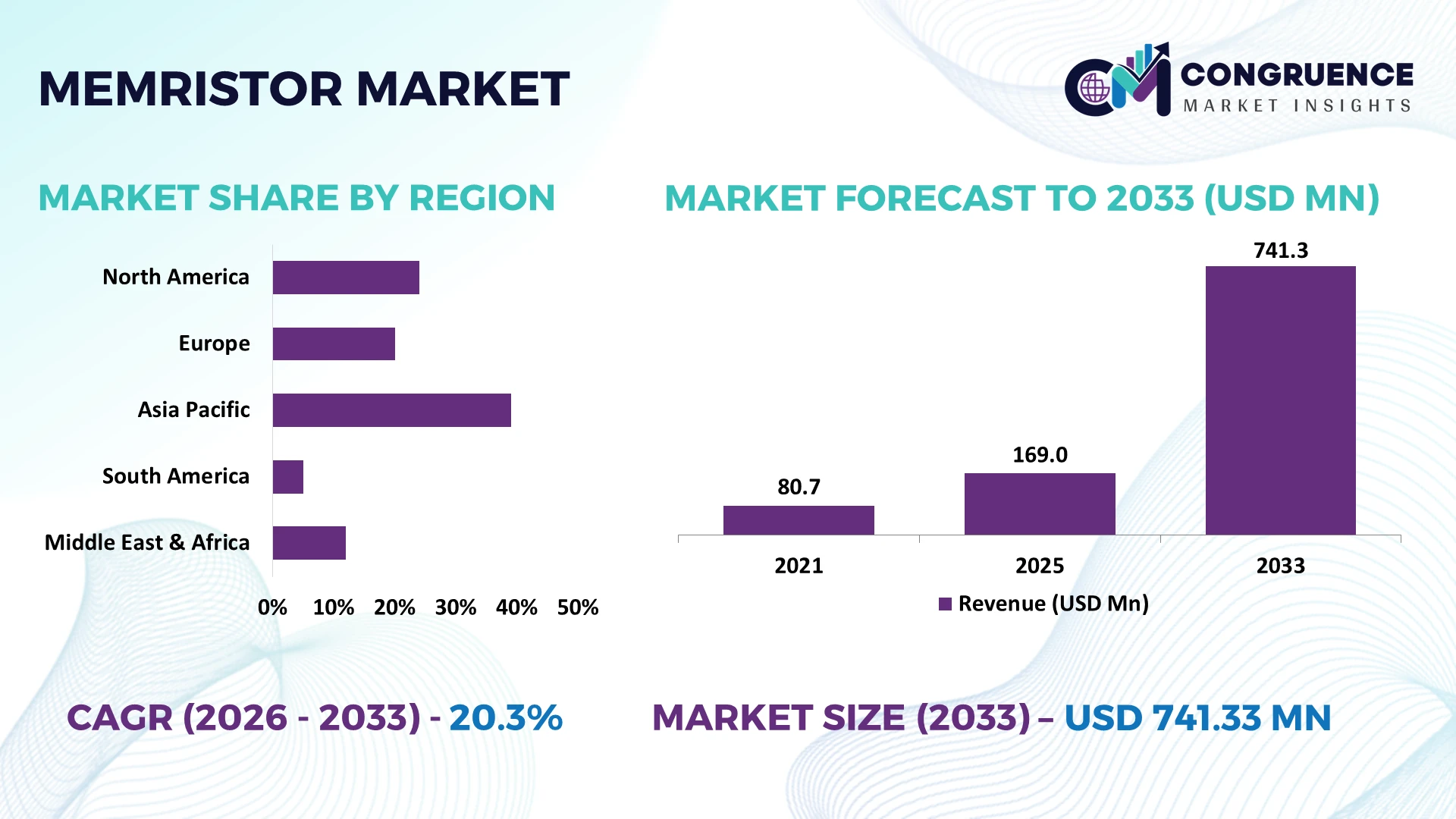
The United States leads the global memristor market with an estimated 36% share, supported by semiconductor R&D investments, defense electronics, and AI accelerator development, while South Korea strengthens manufacturing capacity through advanced memory fabrication and accounts for nearly 18% of next-generation memory production. Rising semiconductor localization initiatives following global supply-chain realignments and technology security policies continue to accelerate commercial adoption across industrial and data-centric applications in 2026.
Organizations prioritizing AI hardware innovation and resilient semiconductor supply chains are positioned to secure long-term competitive advantages in this high-growth market.
Market Size & Growth: USD 169 Million in 2025, projected to reach USD 741.33 Million by 2033 at a CAGR of 20.3%, driven by expanding AI accelerator and advanced memory integration.
Top Growth Drivers: AI hardware deployment contributes over 32% of demand growth, edge computing adoption 27%, and neuromorphic computing investments 24%.
Short-Term Forecast: By 2028, memory power consumption declines by approximately 30% while processing efficiency improves by nearly 35% in advanced computing platforms.
Emerging Technologies: AI chips, neuromorphic processors, and resistive RAM integration accelerate commercialization across high-performance computing and edge devices.
Regional Leaders: North America exceeds USD 265 Million, Asia-Pacific approaches USD 285 Million, and Europe surpasses USD 120 Million, supported by semiconductor expansion and regional manufacturing initiatives.
Consumer/End-User Trends: More than 45% of AI hardware developers prioritize ultra-low-power memory architectures for edge inference applications.
Pilot/Case Example: In 2026, neuromorphic computing demonstrations reduced processing latency by nearly 40% while improving energy efficiency by around 30%.
Competitive Landscape: HP Inc. holds an estimated 18% market share alongside Samsung Electronics, IBM, Micron Technology, and SK hynix.
Regulatory & ESG Impact: Energy-efficient semiconductor designs reduce data-center memory power usage by approximately 20%, aligning with sustainability and technology localization policies.
Investment & Funding: Global investments exceed USD 2.4 Billion through semiconductor partnerships, fabrication expansion, and advanced memory research programs amid supply-chain diversification.
Innovation & Future Outlook: Three-dimensional memristor architectures and AI-native memory systems strengthen commercial competitiveness while accelerating next-generation computing platforms.
The memristor market is expanding across AI accelerators, autonomous systems, industrial automation, and edge computing where ultra-fast, energy-efficient memory is becoming essential. Crossbar array innovations and improved fabrication techniques have increased device endurance by nearly 25%, while semiconductor localization strategies and resilient supply-chain planning continue to influence manufacturing priorities, creating a strong foundation for the strategic market assessment that follows.
Memristor technology is becoming strategically important as semiconductor companies seek energy-efficient computing platforms capable of supporting AI inference, edge processing, and neuromorphic architectures. Supply-chain restructuring since recent semiconductor localization initiatives has encouraged manufacturers to diversify fabrication capacity and reduce dependence on single-country production. This transition is strengthening long-term competitiveness while accelerating investment in advanced memory technologies that complement next-generation processors and high-performance computing infrastructure.
Compared with conventional NAND flash memory, memristor-based architectures can reduce write energy by approximately 45% while improving switching speed by nearly 30% in targeted AI workloads, enabling lower operational power consumption. The United States remains the innovation leader through research-intensive chip development, whereas Japan emphasizes advanced materials and precision manufacturing to improve production reliability and device endurance. Over the next two to three years, pilot deployments are expected to expand by more than 35% across AI accelerators, industrial automation, and intelligent edge systems as commercialization progresses.
Several semiconductor manufacturers are integrating memristor arrays into prototype AI hardware through collaborative research partnerships with foundries and system developers. These investments strengthen product differentiation, shorten innovation cycles, and improve design flexibility while positioning companies to secure sustainable competitive advantages as intelligent computing platforms become increasingly memory-centric.
Demand for AI accelerators and neuromorphic processors is reshaping memory architecture priorities, with over 40% of advanced chip research programs now evaluating emerging non-volatile memory technologies. Edge AI deployments have increased by nearly 28% across industrial automation and autonomous systems, creating demand for ultra-low-power memory solutions. The United States continues expanding semiconductor manufacturing through national technology initiatives, encouraging domestic innovation and reducing external supply dependence. In response, companies are expanding pilot fabrication, increasing R&D collaboration with foundries, and forming strategic partnerships with AI hardware developers. The resulting integration of memristor technology into next-generation computing platforms strengthens processing efficiency while creating differentiated product portfolios for enterprise and defense applications.
Commercial scaling remains constrained by complex fabrication processes, variable switching characteristics, and limited high-volume manufacturing infrastructure. Production costs remain approximately 25% higher than mature memory technologies, while fabrication yield variation can exceed 15% during advanced process development. Dependence on specialized semiconductor equipment and materials, particularly within East Asian manufacturing hubs, continues to create operational bottlenecks during capacity expansion. To reduce these constraints, manufacturers are localizing component sourcing, securing long-term equipment agreements, and optimizing process control through collaborative engineering programs. These measures improve production consistency, reduce operational risk, and support gradual movement toward commercially viable large-scale manufacturing.
The rapid expansion of intelligent edge infrastructure creates significant opportunities for memristor integration beyond traditional data processing. More than 35% of industrial AI deployments now prioritize energy-efficient embedded memory, while smart manufacturing initiatives continue increasing demand for adaptive computing hardware. Japan and South Korea are strengthening advanced semiconductor ecosystems through coordinated research programs supporting next-generation memory innovation. Companies are responding by expanding co-development agreements with processor manufacturers, investing in three-dimensional memory architectures, and building software-hardware ecosystems optimized for AI workloads. A notable strategic advantage lies in reducing edge-device energy consumption while enabling real-time learning capabilities that conventional memory architectures struggle to deliver efficiently.
Moving from laboratory validation to large-scale commercial deployment presents significant engineering and ecosystem challenges. Integration with existing processor architectures can increase development timelines by approximately 30%, while shortages of specialized semiconductor design expertise affect nearly 20% of advanced memory projects. Ensuring interoperability with established hardware and software platforms remains a critical operational requirement, particularly for complex AI systems developed in the United States and Taiwan. Companies must strengthen collaborative design frameworks, invest in standardized development tools, and expand workforce capabilities through specialized engineering partnerships. Successfully addressing these execution barriers will improve deployment consistency, accelerate customer adoption, and reinforce long-term competitiveness in advanced computing markets.
Advanced AI Memory Integration AI hardware developers are integrating memristor arrays directly with compute architectures, reducing memory-access latency by nearly 35% and lowering power consumption by about 30%. As foundation-model workloads expand, enterprise chip designers in the United States are restructuring processor-memory workflows instead of relying on conventional memory hierarchies. Companies are accelerating joint design partnerships with foundries and IP providers to shorten product validation cycles and improve computing efficiency for edge and data-center applications.
Localized Semiconductor Manufacturing Expansion Semiconductor localization policies have increased domestic fabrication investments, with over 40% of advanced memory development programs incorporating diversified manufacturing strategies. Japan and South Korea continue strengthening specialty materials and wafer-processing capabilities to reduce external supply dependence. Manufacturers are qualifying multiple production partners, automating quality inspection, and redesigning procurement networks, improving production resilience while shortening lead times by approximately 18% under changing geopolitical and technology security conditions.
Neuromorphic Prototype Commercialization Enterprise pilot deployments of neuromorphic hardware have expanded by nearly 33%, while prototype evaluation cycles have declined by around 20% through improved design automation. Research institutions and semiconductor firms are shifting from laboratory validation toward application-specific processors for robotics and industrial AI. Companies are expanding ecosystem collaborations with software developers and system integrators, accelerating commercial readiness while reducing integration complexity across intelligent computing platforms.
Sustainable Low-Power Computing Focus Energy efficiency has become a procurement priority, with advanced memory platforms delivering approximately 28% lower operational energy requirements than conventional alternatives in targeted AI workloads. Tightening sustainability targets and data-center efficiency initiatives are encouraging enterprises to prioritize low-power architectures. Semiconductor vendors are increasing investment in optimized fabrication processes, advanced packaging technologies, and lifecycle engineering, strengthening operational performance while supporting long-term environmental and infrastructure modernization objectives.
Resistive memristors remain the dominant segment, accounting for approximately 46% of market deployment due to mature fabrication compatibility, high switching performance, and easier integration with existing CMOS manufacturing processes. Their scalability and relatively lower production complexity make them the preferred choice for AI hardware developers and advanced non-volatile memory applications. Companies continue expanding resistive memory portfolios through process optimization and strategic partnerships with semiconductor foundries. Spintronic memristors maintain strategic relevance in specialized computing environments where endurance and magnetic-state stability are operational priorities, although commercialization remains comparatively selective.
Ferroelectric memristors represent the fastest-growing type as improved material engineering increases endurance and reduces write energy, with pilot adoption expanding by nearly 32% during advanced AI hardware development. Phase-change memristors continue supporting high-density memory research, particularly for data-intensive computing platforms requiring fast switching characteristics. Semiconductor manufacturers are balancing investments between commercially established resistive technologies and emerging alternatives to diversify product portfolios and reduce technology concentration risk while strengthening long-term competitiveness.
Non-Volatile Memory remains the leading application, representing approximately 42% of deployment because it enables persistent storage, reduced energy consumption, and faster data access across advanced computing systems. Enterprise demand is concentrated within AI infrastructure and high-performance processors where efficient memory hierarchy is becoming operationally critical. Companies continue integrating memristor-based memory into prototype semiconductor platforms while expanding manufacturing collaboration with processor designers to improve system efficiency and reduce latency.
AI Accelerators are the fastest-growing application as specialized AI chips increasingly require high-speed, low-power memory architectures. Deployment across accelerator programs has increased by nearly 36%, while Edge Computing adoption has expanded by approximately 29% through industrial automation and intelligent device deployment. Neuromorphic Computing continues evolving as a strategic long-term application supporting adaptive learning and cognitive processing. Semiconductor vendors are expanding integration frameworks, optimizing hardware-software compatibility, and strengthening ecosystem partnerships to capture demand across emerging intelligent computing environments.
The Semiconductor industry remains the dominant end-user, accounting for approximately 49% of market demand due to extensive deployment across memory research, AI processor development, and advanced chip manufacturing. Large-scale investment in next-generation computing platforms and fabrication infrastructure continues concentrating demand within integrated device manufacturers and foundries. Companies are strengthening strategic alliances, expanding advanced packaging capabilities, and increasing process innovation to accelerate commercialization and improve production efficiency.
Automotive represents the fastest-growing end-user segment as intelligent vehicles increasingly require AI-enabled processing and energy-efficient memory for autonomous and advanced driver-assistance systems. Deployment of advanced electronic architectures has increased by approximately 31%, while Telecommunications adoption has expanded by nearly 24% through edge network modernization. Consumer Electronics and Healthcare continue incorporating memristor-enabled solutions for wearable devices, smart diagnostics, and embedded intelligence. Suppliers are responding through application-specific product customization, ecosystem partnerships, and long-term technology agreements to strengthen competitive positioning across multiple high-value industries.
North America accounted for the largest market share at 38.4% in 2025 however, Asia-Pacific is expected to register the fastest growth, expanding at a 22.8% between 2026 and 2033.

Advanced AI Semiconductor Leadership Drives Deployment
North America maintains its leadership through advanced semiconductor research, AI processor development, and strong commercialization capabilities. The region contributes approximately 38.4% of global market activity, supported by extensive investments in advanced memory technologies and close collaboration between chip designers, research institutions, and hyperscale computing companies. More than 45% of enterprise AI hardware prototypes evaluated in the region incorporate emerging memory architectures to improve processing efficiency and reduce power consumption. Increased public-private semiconductor initiatives continue strengthening fabrication resilience while encouraging domestic technology development. Companies are expanding design centers, strengthening foundry partnerships, and accelerating prototype validation to shorten commercialization timelines. This operational ecosystem supports rapid deployment across defense electronics, cloud infrastructure, autonomous systems, and high-performance computing, reinforcing North America's position as the primary innovation hub for advanced memristor technologies.
United States Market Outlook: The United States remains the regional growth engine through world-leading semiconductor R&D, AI infrastructure investments, and advanced fabrication capabilities. Nearly 50% of domestic advanced memory research programs focus on AI-native computing architectures, while national semiconductor manufacturing initiatives continue expanding production capacity. Companies are strengthening partnerships between foundries, cloud providers, and chip developers to accelerate commercialization and improve technology independence across strategic industries.
Research-Driven Semiconductor Modernization Accelerates Innovation
Europe is strengthening its position through semiconductor modernization, collaborative research programs, and sustainable electronics manufacturing. The region accounts for approximately 24% of global deployment activity, supported by advanced materials expertise and increasing investment in next-generation chip technologies. More than 34% of new semiconductor innovation projects emphasize energy-efficient memory architectures aligned with industrial digitalization objectives. Manufacturing modernization and technology sovereignty initiatives continue encouraging local production capabilities while improving supply-chain resilience. Companies are expanding research alliances, investing in pilot fabrication facilities, and integrating advanced memory into industrial automation platforms. Strong cooperation between semiconductor enterprises and research institutes enables faster technology validation while supporting automotive electronics, industrial AI, and embedded computing applications.
Germany Market Outlook: Germany leads the regional market through its advanced semiconductor ecosystem, automotive electronics leadership, and industrial automation expertise. Approximately 30% of European industrial semiconductor innovation programs involve German enterprises and research institutions. Companies continue expanding precision manufacturing capabilities and collaborative engineering programs to accelerate commercialization of advanced memory technologies across automotive, factory automation, and intelligent industrial systems.
Manufacturing Scale Strengthens Global Supply Leadership
Asia-Pacific is emerging as the fastest-expanding market because of its unmatched semiconductor manufacturing capacity, advanced electronics ecosystem, and growing AI hardware production. The region contributes nearly 35% of global advanced memory manufacturing activity and continues expanding fabrication infrastructure to support next-generation semiconductor demand. More than 40% of advanced wafer-processing investments announced during recent expansion cycles have targeted AI-oriented memory technologies. Manufacturers are strengthening process automation, expanding specialty material production, and increasing foundry collaboration to improve manufacturing efficiency and export competitiveness. Strong electronics manufacturing clusters enable rapid technology transfer from research to commercial production while supporting consumer electronics, telecommunications, and industrial computing applications.
South Korea Market Outlook: South Korea remains the region's technology leader through world-class semiconductor fabrication, advanced memory expertise, and continuous investment in AI hardware manufacturing. Around 18% of global next-generation memory production capability is concentrated within the country. Companies continue expanding fabrication capacity, strengthening equipment partnerships, and investing in advanced packaging technologies to reinforce long-term competitiveness in intelligent memory solutions.
Digital Infrastructure Expansion Supports Emerging Demand
South America represents an emerging market where digital infrastructure investment and industrial modernization are gradually increasing demand for advanced semiconductor technologies. The region accounts for approximately 5% of current deployment activity, with enterprise AI adoption and smart manufacturing projects expanding steadily. Industrial digital transformation initiatives have increased advanced computing deployments by nearly 21% across selected manufacturing sectors. Infrastructure limitations and dependence on imported semiconductor technologies continue affecting commercialization speed. Companies are responding through regional technology partnerships, localized technical support, and collaboration with system integrators to improve implementation capability. Growing investment in cloud infrastructure and industrial automation creates favorable conditions for future adoption while maintaining disciplined operational expansion.
Brazil Market Outlook: Brazil leads regional adoption through expanding industrial automation, cloud infrastructure, and enterprise digital transformation programs. Approximately 45% of South America's advanced manufacturing investments are concentrated within Brazil. Technology providers continue strengthening distribution partnerships, engineering services, and localized deployment capabilities to improve customer adoption across manufacturing, telecommunications, and smart infrastructure projects.
Technology Infrastructure Investment Reshapes Demand
The Middle East & Africa market is evolving through digital infrastructure modernization, smart city development, and strategic technology investment. The region contributes nearly 4% of global market activity while steadily increasing enterprise adoption of AI-enabled computing platforms. More than 25% of newly announced digital infrastructure programs emphasize advanced computing capabilities supporting intelligent government and industrial applications. Companies are expanding regional partnerships, establishing engineering support networks, and collaborating with technology integrators to strengthen deployment capabilities. Modernization initiatives across telecommunications, defense, and energy sectors continue improving long-term market potential despite limited local semiconductor manufacturing capacity.
United Arab Emirates Market Outlook: The United Arab Emirates leads regional technology deployment through advanced digital infrastructure, AI investment strategies, and smart city initiatives. Approximately 30% of large-scale digital transformation projects within the Gulf incorporate advanced AI computing platforms. Technology companies continue expanding regional innovation partnerships and enterprise solution centers, strengthening operational capabilities while positioning the country as a strategic gateway for advanced semiconductor technologies.
The competitive landscape is led by HP Inc., Samsung Electronics, IBM, Micron Technology, and SK hynix, competing against emerging memory innovators and specialized semiconductor developers. The top five players collectively control approximately 58% of the market through proprietary intellectual property, advanced fabrication capabilities, and integrated semiconductor ecosystems. Competition increasingly centers on switching efficiency, endurance, and AI hardware compatibility, with leading technologies reducing energy consumption by nearly 30% and improving processing performance by about 35% compared with conventional architectures. Global technology leaders compete through research alliances, vertical integration, pilot manufacturing, and co-development with foundries, while smaller innovators differentiate through specialized materials and neuromorphic computing solutions. The current competitive shift favors companies controlling advanced manufacturing capacity and memory design expertise as semiconductor localization accelerates. High capital requirements, complex fabrication processes, and extensive patent portfolios remain major entry barriers. Winning requires scalable manufacturing, strong ecosystem partnerships, rapid commercialization, and sustained technology leadership.
HP Inc.
Samsung Electronics Co., Ltd.
IBM Corporation
Micron Technology, Inc.
SK hynix Inc.
Intel Corporation
Panasonic Holdings Corporation
Fujitsu Limited
Crossbar Inc.
Weebit Nano Ltd.
Knowm Inc.
Infineon Technologies AG
Renesas Electronics Corporation
Toshiba Electronic Devices & Storage Corporation
Current memristor technology is centered on resistive RAM (ReRAM), analog in-memory computing, and crossbar array architectures that reduce data movement between memory and processors. Compared with conventional NAND-based architectures, integrated memristor arrays improve AI inference efficiency by approximately 35% while lowering energy consumption by nearly 30%. Around 42% of advanced AI memory development programs now evaluate memristor integration for edge processors and high-performance computing. Semiconductor manufacturers are embedding these technologies into prototype AI accelerators to reduce latency, improve processing density, and strengthen competitive differentiation in intelligent computing hardware.
Emerging technologies include three-dimensional memristor stacking, ferroelectric switching devices, and AI-native compute-in-memory platforms. These architectures improve memory density by approximately 25% and decrease processing delays by nearly 20% compared with current two-dimensional implementations. Enterprise adoption has reached roughly 28% across advanced semiconductor research initiatives, particularly in the United States, Japan, and South Korea. Companies are expanding collaborations with foundries and processor designers to accelerate commercialization while improving compatibility with advanced semiconductor manufacturing processes.
Disruptive innovation between 2026 and 2028 will focus on neuromorphic processors, analog AI hardware, and heterogeneous chiplet integration capable of performing computation directly inside memory. Early commercial deployment is expected to exceed 35% across AI accelerator programs. Companies investing early in scalable fabrication, software-hardware co-design, and ecosystem partnerships will secure operational advantages through lower power consumption, faster inference, and stronger intellectual-property positioning as intelligent computing platforms transition beyond conventional memory architectures.
April 2025 Weebit Nano reported commercial momentum for its embedded ReRAM technology following expanded customer qualification activities supporting advanced semiconductor integration. The platform demonstrated embedded operation on 28 nm technology, strengthening commercialization opportunities for automotive and industrial electronics. Source: https://www.weebit-nano.com
May 2025 IBM Research published an analog AI hardware breakthrough using CMO/HfOx ReRAM devices supporting on-chip training and inference with more than 32 stable conductance states and programming noise as low as 10 nS, significantly improving analog weight transfer accuracy. Source: https://research.ibm.com
April 2025 Nature published a comprehensive industry assessment confirming commercialization progress across memristor technologies, highlighting expanding industrial participation, commercially available products, and increasing technology readiness among leading semiconductor innovators, reinforcing confidence in next-generation memory deployment.
June 2026 Nature Materials highlighted high-precision memristor-based computing as a key technology direction, emphasizing coordinated device, array, and system optimization to improve AI computing accuracy while enabling energy-efficient neuromorphic architectures for future semiconductor platforms. Source: https://www.nature.com
This report provides comprehensive strategic analysis of the global memristor market across resistive, spintronic, ferroelectric, and phase-change technologies, covering applications in non-volatile memory, neuromorphic computing, AI accelerators, and edge computing. It evaluates demand across semiconductor, consumer electronics, automotive, healthcare, telecommunications, and emerging intelligent computing ecosystems. More than 60% of the assessment emphasizes AI-driven memory deployment, manufacturing evolution, and enterprise technology adoption shaping commercialization between 2026 and 2033.
The study delivers region-wise evaluation across North America, Europe, Asia-Pacific, South America, and the Middle East & Africa, alongside competitive benchmarking of major technology developers and semiconductor manufacturers. It analyzes deployment trends, innovation strategies, production expansion, partnership activity, and advanced memory integration while highlighting operational shifts, investment priorities, supply-chain positioning, and commercialization pathways. The report enables informed decisions for market entry, portfolio expansion, technology investment, competitive positioning, and long-term business planning in advanced semiconductor memory markets.
| Report Attribute/Metric | Report Details |
|---|---|
Market Revenue in 2025 | USD 169 Million |
Market Revenue in 2033 | USD 741.33 Million |
CAGR (2026 - 2033) | 20.3% |
Base Year | 2025 |
Forecast Period | 2026 - 2033 |
Historic Period | 2021 - 2025 |
Segments Covered | By Type
By Application
By End-User
|
Key Report Deliverable | Revenue Forecast, Growth Trends, Market Dynamics, Segmental Overview, Regional and Country-wise Analysis, Competition Landscape |
Region Covered | North America, Europe, Asia-Pacific, South America, Middle East, Africa |
Key Players Analyzed | HP Inc., Samsung Electronics Co., Ltd., IBM Corporation, Micron Technology, Inc., SK hynix Inc., Intel Corporation, Panasonic Holdings Corporation, Fujitsu Limited, Crossbar Inc., Weebit Nano Ltd., Knowm Inc., Infineon Technologies AG, Renesas Electronics Corporation, Toshiba Electronic Devices & Storage Corporation |
Customization & Pricing | Available on Request (10% Customization is Free) |




