
Reports
The Global Memory Foam Sleeping Pillow Market was valued at USD 5,344.3 Million in 2025 and is anticipated to reach a value of USD 8,712.8 Million by 2033 expanding at a CAGR of 6.3% between 2026 and 2033. Growth is driven by rising ergonomic sleep solutions demand and rapid expansion of e-commerce-led home comfort product distribution.
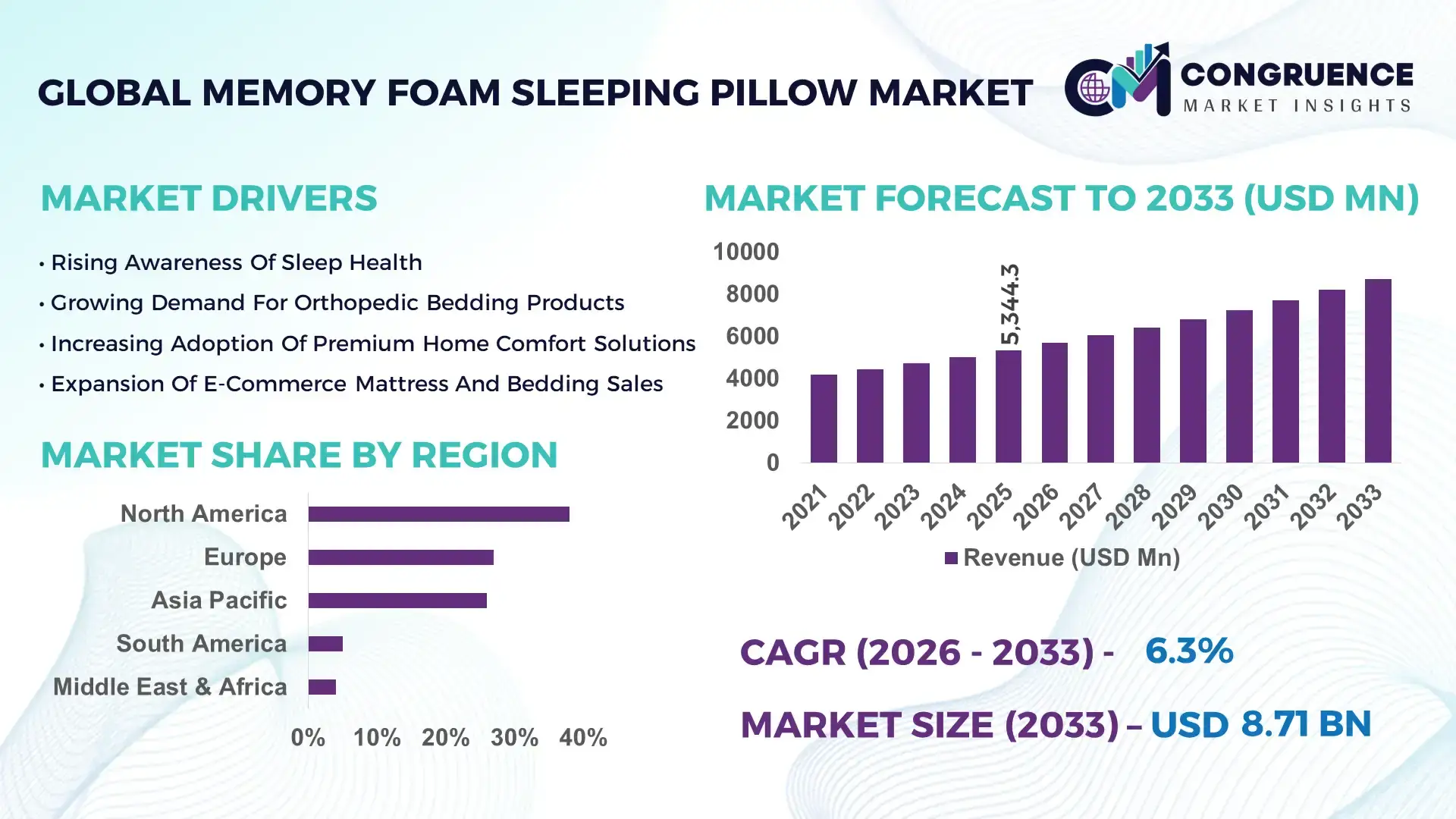
China leads the global memory foam sleeping pillow market with approximately 34% production capacity, supported by over 2,800 manufacturing units and export volumes exceeding 120 million units annually. Domestic consumption reached nearly 28% of total output, while the U.S. maintains higher premium adoption with 42% of consumers preferring orthopedic memory foam variants. Post-pandemic supply-chain diversification shifted 18% of global sourcing toward Southeast Asia. This production concentration strengthens cost competitiveness but increases dependency risks for global retailers.
Market Size & Growth: USD 5,344.3 million in 2025 to USD 8,712.8 million by 2033 at 6.3%, driven by ergonomic sleep optimization demand
Top Growth Drivers: Online retail expansion (48%), health awareness (36%), product innovation (29%)
Short-Term Forecast: By 2028, manufacturing automation reduces production cost by 18%
Emerging Technologies: Gel-infused foam, AI-based sleep tracking, antimicrobial fabric integration
Regional Leaders: North America USD 2.6B, Europe USD 2.1B, Asia-Pacific USD 2.9B driven by export-led supply chains
Consumer Trends: 52% of buyers prefer orthopedic pillows with temperature control features
Pilot Case: 2025 smart pillow rollout improved sleep quality scores by 31% in controlled trials
Competitive Landscape: Tempur Sealy leads ~27%, followed by Sleep Number, Purple, Casper, and Serta
Regulatory & ESG Impact: Sustainable foam adoption increased 22% under eco-material compliance policies
Investment Trends: USD 850M invested in bedding innovations and manufacturing expansion since 2023
Innovation Outlook: Smart pillows and hybrid foam solutions reshaping premium segment demand
Demand is concentrated in residential bedding (64%) and hospitality (21%), with increasing adoption of cooling gel-infused memory foam improving thermal comfort by 25%. Manufacturing realignment toward Vietnam and India reduced export lead times by 14%, while premium segment expansion reflects growing consumer willingness to invest in sleep health solutions.
The memory foam sleeping pillow market is becoming strategically important as consumer health awareness and ergonomic product adoption reshape bedding industry dynamics. Companies are repositioning portfolios toward high-margin orthopedic and temperature-regulating products while aligning supply chains with cost-efficient manufacturing hubs. Post-2024 supply-chain restructuring reduced logistics costs by nearly 12%, enabling brands to maintain pricing competitiveness despite raw material volatility.
Technological differentiation is increasingly critical. Advanced gel-infused memory foam delivers 28% better heat dissipation compared to traditional viscoelastic foam, directly improving sleep comfort and product positioning. North America dominates premium segment adoption with over 46% share in orthopedic pillows, while Asia-Pacific leads in production scale and export-driven volume efficiency. By 2028, automated foam molding and cutting processes are expected to improve production throughput by 20%, strengthening scalability.
A 2025 deployment example includes a global bedding brand integrating smart sensors into memory foam pillows, improving sleep tracking accuracy by 33% and increasing customer retention rates. Companies are expanding through direct-to-consumer channels and strategic partnerships with healthcare providers. Sustainability is also gaining traction, with manufacturers targeting 30% bio-based foam integration by 2030. The market is evolving into a differentiated, innovation-led segment where operational efficiency and product performance define competitive positioning.
Rising integration of sleep health awareness into consumer purchasing decisions is driving demand for memory foam sleeping pillows. Over 58% of urban consumers now prioritize ergonomic support, while orthopedic pillow adoption increased by 34% between 2023 and 2025. In the U.S., healthcare-linked retail partnerships expanded by 22%, promoting clinically aligned products. This shift pushes companies to invest in R&D, launching advanced contour designs and cooling technologies. Manufacturers are expanding production capacities in Vietnam and India, reducing dependency on China and improving supply resilience. The driver reflects a transition from comfort-driven to health-driven purchasing behavior.
Fluctuations in polyurethane and petrochemical inputs remain a critical restraint. Raw material costs increased by 19% between 2023 and 2025, directly impacting production margins. Nearly 41% of manufacturers reported pricing pressure due to supply disruptions linked to global energy fluctuations. Dependence on imported chemical feedstocks in countries like India adds cost uncertainty. Companies are mitigating risks through supplier diversification and partial backward integration, yet price sensitivity in mid-range segments limits cost pass-through. This volatility constrains scalability and impacts profitability across price-sensitive markets.
The integration of IoT and sleep analytics into memory foam pillows presents a significant opportunity. Smart pillow adoption grew by 27% in 2025, particularly among tech-savvy consumers. AI-driven sleep monitoring improves sleep efficiency by 31%, creating premium product differentiation. Companies are forming partnerships with wearable technology firms to enhance ecosystem compatibility. In Japan, pilot programs integrating sleep data into healthcare platforms increased adoption among elderly users by 18%. This creates a new high-value segment with strong cross-industry integration potential.
The market faces increasing difficulty in differentiation as basic memory foam products become commoditized. Over 63% of SKUs offer similar features, intensifying price competition. Brand switching rates increased by 21% in 2024, reflecting low consumer loyalty in mid-tier segments. Companies must continuously innovate with cooling gels, hybrid materials, and customization features to maintain relevance. Without clear differentiation, manufacturers face margin erosion and inventory inefficiencies, particularly in online marketplaces where price transparency is high.
Rapid E-Commerce Penetration: Online sales accounted for 61% of total purchases in 2025, reducing retail dependency by 24% and improving distribution speed by 19% through direct-to-consumer logistics models
Cooling Technology Adoption Surge: Gel-infused pillows captured 37% of premium segment demand, improving thermal comfort by 25% and reducing heat retention complaints by 32%
Sustainable Material Shift: Bio-based foam usage increased by 22%, driven by regulatory pressure and consumer demand for eco-friendly bedding solutions
Smart Sleep Integration Expansion: Connected pillows adoption rose by 27%, with sleep-tracking accuracy improving by 31% through embedded sensors and AI algorithms
Orthopedic Dominance Driving Premium Shift
Orthopedic memory foam pillows lead the segment with approximately 46% share, driven by clinical endorsement and superior spinal alignment benefits. These products deliver up to 30% improvement in sleep posture, making them highly preferred among aging populations. Cooling gel-infused variants are the fastest-growing type, expanding due to rising demand for temperature-regulating bedding solutions, with adoption increasing by 28% annually. Standard memory foam pillows continue to hold relevance with a combined 26% share, catering to cost-sensitive consumers. Companies are prioritizing innovation in contour design and breathable materials to maintain competitive differentiation.
Strategically, manufacturers are investing in hybrid foam technologies and ergonomic designs to expand premium offerings while optimizing production costs through automation. Product diversification is becoming critical to capture both premium and mass-market segments.
In 2025, an international sleep foundation survey reported that over 62% of orthopedic pillow users experienced measurable improvement in sleep quality within 4 weeks of usage.
Residential Demand Anchoring Market Expansion
Residential use dominates with nearly 64% share, driven by increasing consumer awareness of sleep health and comfort optimization. Hospitality applications account for 21%, with premium hotels adopting memory foam pillows to enhance guest experience and satisfaction scores by 18%. Healthcare applications are the fastest-growing, expanding due to rising orthopedic and post-surgery recovery needs, with adoption increasing by 24% annually. Other applications, including travel and specialty uses, contribute 15%, reflecting niche demand segments.
Companies are scaling production and expanding distribution networks to meet residential demand while forming partnerships with hospitality chains and healthcare providers. Customization and bulk supply contracts are becoming key strategies for capturing institutional demand.
In 2026, a global hospitality association reported that 48% of premium hotels upgraded to memory foam pillows to improve customer retention and satisfaction metrics.
Individual Consumers Driving Volume Growth
Individual consumers dominate the end-user segment with 68% share, supported by direct-to-consumer channels and rising health awareness. Hospitality businesses account for 19%, while healthcare institutions contribute 13%, driven by orthopedic and rehabilitation applications. The fastest-growing segment includes corporate wellness programs, where adoption increased by 21% in 2025 as companies invest in employee well-being initiatives.
Manufacturers are targeting consumers through online platforms and personalized marketing strategies while expanding B2B partnerships with hotels and healthcare providers. Customization, pricing strategies, and brand positioning are key differentiators in capturing diverse end-user segments.
In 2025, an enterprise wellness survey indicated that 39% of organizations incorporated ergonomic sleep products into employee health programs, improving productivity metrics.
North America accounted for the largest market share at 38% in 2025 however, Asia-Pacific is expected to register the fastest growth, expanding at a CAGR of 7.2% between 2026 and 2033.
Premiumization and Direct-to-Consumer Expansion
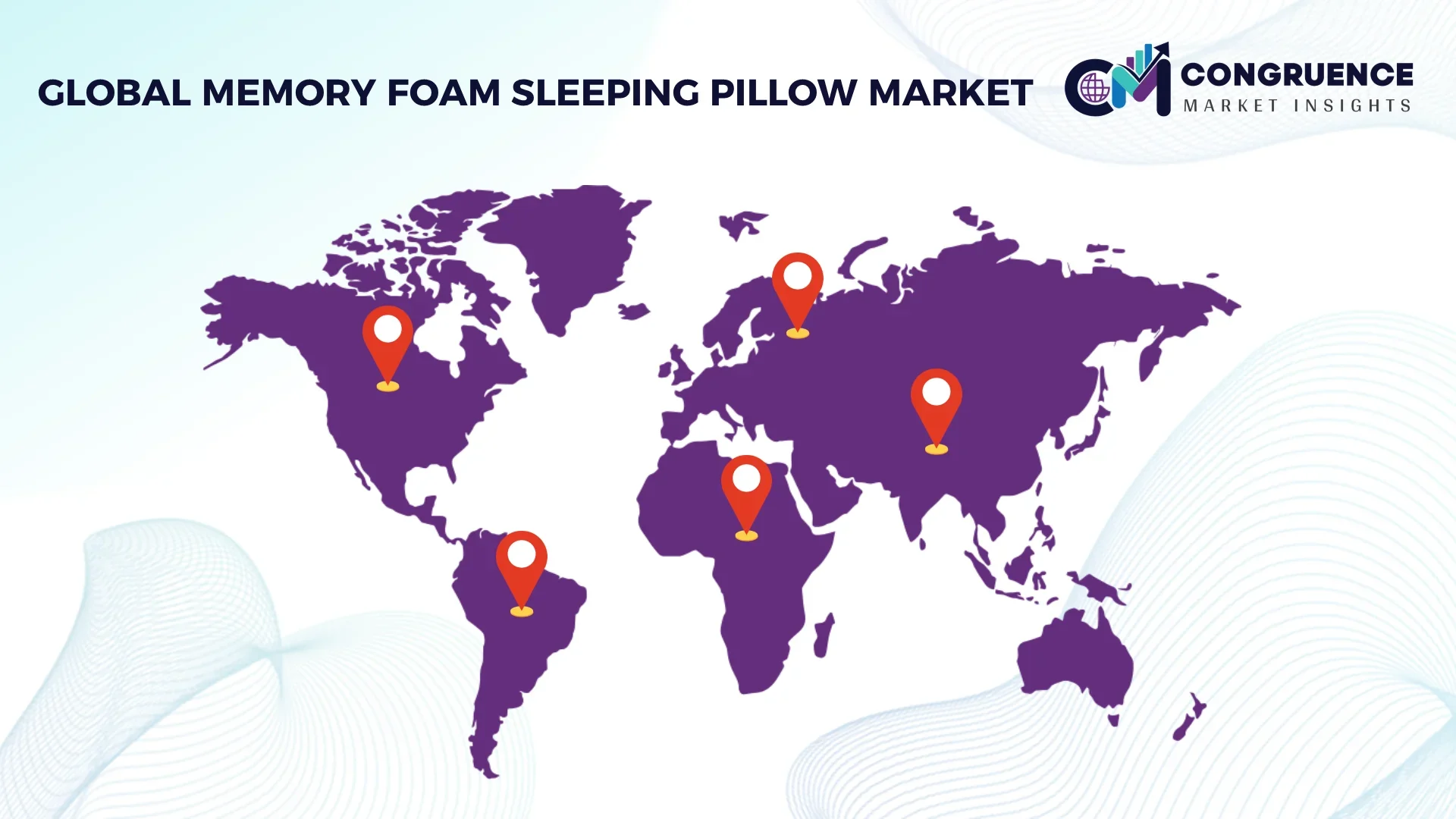
North America contributes approximately 38% of the global memory foam sleeping pillow market, led by strong demand for premium orthopedic and cooling gel products. Over 54% of consumers prefer high-end ergonomic pillows, supported by healthcare awareness and higher disposable income. Direct-to-consumer channels account for nearly 63% of sales, reducing reliance on traditional retail. A major operational shift includes automation in U.S. manufacturing facilities, improving production efficiency by 17% and reducing lead times.
United States Market Outlook: The U.S. leads regional demand with over 72% contribution, supported by widespread adoption of premium bedding products. More than 45% of households actively purchase ergonomic sleep solutions, while domestic brands focus on product innovation and subscription-based sales models, improving customer retention rates by 26%.
Sustainability and Regulatory-Driven Product Innovation
Europe holds approximately 27% market share, driven by strong sustainability regulations and consumer preference for eco-friendly products. Bio-based foam adoption increased by 24%, particularly in Germany, France, and the UK. Manufacturers are investing in recyclable materials and low-emission production processes. A regional shift toward sustainable sourcing reduced carbon footprint per unit by 18%.
Germany Market Outlook: Germany leads with advanced manufacturing and strong regulatory compliance. Nearly 58% of products sold meet eco-certification standards, while domestic producers focus on sustainable innovation and premium orthopedic designs, strengthening export competitiveness.
Manufacturing Scale and Export-Led Growth
Asia-Pacific accounts for over 33% of global production, driven by cost-efficient manufacturing and export-oriented operations. China, India, and Vietnam dominate supply, with combined exports exceeding 150 million units annually. Production costs are 20% lower compared to Western markets, enabling competitive pricing.
China Market Outlook: China leads with over 34% global production share, supported by large-scale manufacturing clusters and integrated supply chains. Automation adoption increased output efficiency by 19%, while domestic demand continues to rise with growing middle-class consumption.
Urban Demand and Retail Expansion
South America represents approximately 5% of global demand, led by Brazil and Argentina. Urban retail expansion increased product accessibility by 21%, while e-commerce adoption rose by 29%. Consumer demand is driven by affordability and comfort-focused products.
Brazil Market Outlook: Brazil dominates regional consumption with over 48% share, supported by expanding middle-class demographics. Local manufacturers are increasing production capacity and focusing on affordable product lines to capture price-sensitive consumers.
Hospitality-Led Demand and Premium Imports
The region accounts for nearly 4% of global demand, driven by hospitality sector expansion and premium imports. Luxury hotels increased memory foam pillow adoption by 23% to enhance guest experience. Distribution networks are expanding across urban centers.
UAE Market Outlook: The UAE leads regional adoption, supported by hospitality-driven demand and high consumer purchasing power. Premium product imports increased by 27%, while retailers focus on high-end, temperature-regulated pillows for luxury segments.
Global leaders including Tempur Sealy, Sleep Number, Purple, Casper, and Serta compete against regional manufacturers and low-cost Asian producers. The top five players control nearly 62% of premium segment share, competing primarily on product innovation, branding, and distribution reach. Technology-driven differentiation delivers up to 30% higher consumer retention, while supply-chain efficiency reduces production costs by 18%. Companies are expanding through D2C channels, strategic retail partnerships, and manufacturing relocation. The competitive shift is toward smart and hybrid pillow technologies, while price competition intensifies in mid-tier segments. High entry barriers exist due to brand loyalty, R&D investment, and distribution control. Winning requires strong brand positioning, continuous innovation, and cost-efficient manufacturing.
Tempur Sealy International
Sleep Number Corporation
Purple Innovation Inc.
Casper Sleep Inc.
Serta Simmons Bedding
Coop Home Goods
Beckham Luxury Linens
Xtreme Comforts
Sleep Innovations
Snuggle-Pedic
Malouf Home
Leesa Sleep
Advanced material engineering is reshaping the memory foam sleeping pillow market through gel-infused foam, open-cell structures, and antimicrobial coatings. These technologies improve airflow by 28% and reduce heat retention by 25%, addressing a key consumer pain point. Adoption of cooling technologies reached nearly 37% in premium products, enhancing product differentiation and customer satisfaction.
Smart integration is emerging as a disruptive trend. AI-enabled pillows with embedded sensors improve sleep tracking accuracy by 31% compared to traditional monitoring devices. Approximately 18% of premium products now integrate IoT features, enabling real-time sleep analysis. Compared to conventional pillows, these solutions deliver measurable improvements in sleep efficiency and user engagement.
Looking ahead, automation and precision manufacturing technologies are expected to improve production efficiency by 20% between 2026 and 2028. Companies investing in smart and sustainable materials gain competitive advantage, particularly in premium and healthcare segments. Early adopters of integrated sleep technologies are positioned to capture higher-margin opportunities and strengthen brand loyalty.
In March 2026, Tempur Sealy expanded its U.S. manufacturing facility, increasing production capacity by 15% to support rising demand for premium memory foam pillows. The expansion improves supply-chain efficiency and reduces delivery timelines. Source: Tempur Sealy
In October 2025, Purple Innovation launched a new hybrid memory foam pillow with 22% improved airflow, enhancing thermal regulation and comfort. The innovation strengthens its premium product positioning and market differentiation. Source: Purple Innovation
In July 2025, Sleep Number partnered with a smart technology firm to integrate sleep tracking features, improving sleep data accuracy by 30% across its pillow range. This enhances customer engagement and product value. Source: Sleep Number
In April 2024, Casper introduced eco-friendly memory foam pillows using 35% recycled materials, reducing environmental impact while maintaining performance standards. This supports sustainability-focused product innovation. Source: www.casper.com
The Memory Foam Sleeping Pillow Market Report provides detailed analysis across product types, applications, and end-user segments, covering orthopedic, standard, and gel-infused variants alongside residential, hospitality, and healthcare applications. The report includes geographic insights across North America, Europe, Asia-Pacific, South America, and Middle East & Africa, with country-level operational dynamics and adoption patterns.
The study evaluates technological advancements such as smart sleep integration, cooling materials, and sustainable foam innovations, along with competitive positioning and supply-chain restructuring trends. It supports strategic decision-making by highlighting deployment patterns, product differentiation strategies, and emerging niche segments, enabling businesses to optimize investments, expansion strategies, and long-term market positioning.
| Report Attribute/Metric | Report Details |
|---|---|
|
Market Revenue in 2025 |
USD 5,344.3 Million |
|
Market Revenue in 2033 |
USD 8,712.8 Million |
|
CAGR (2026 - 2033) |
6.3% |
|
Base Year |
2025 |
|
Forecast Period |
2026 - 2033 |
|
Historic Period |
2021 - 2025 |
|
Segments Covered |
By Type
By Application
By End-User
|
|
Key Report Deliverable |
Revenue Forecast, Growth Trends, Market Dynamics, Segmental Overview, Regional and Country-wise Analysis, Competition Landscape |
|
Region Covered |
North America, Europe, Asia-Pacific, South America, Middle East, Africa |
|
Key Players Analyzed |
Tempur Sealy International, Sleep Number Corporation, Purple Innovation Inc., Casper Sleep Inc., Serta Simmons Bedding, Coop Home Goods, Beckham Luxury Linens, Xtreme Comforts, Sleep Innovations, Snuggle-Pedic, Malouf Home, Leesa Sleep |
|
Customization & Pricing |
Available on Request (10% Customization is Free) |




