
Reports
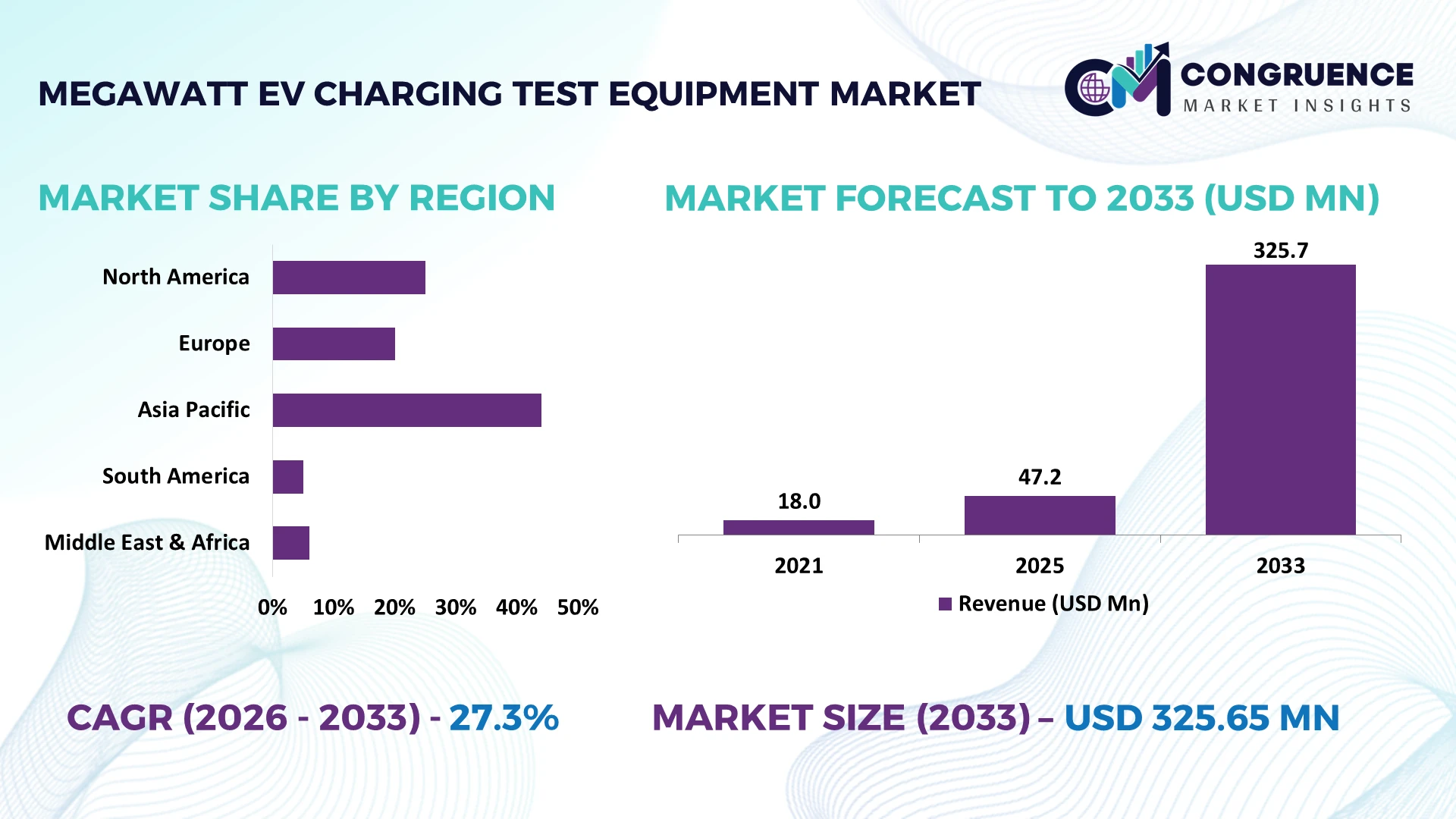
The Global Megawatt EV Charging Test Equipment Market was valued at USD 47.22 Million in 2025 and is anticipated to reach a value of USD 325.65 Million by 2033 expanding at a CAGR of 27.3% between 2026 and 2033. Growth is driven by megawatt charging system standardization, heavy-duty electric truck electrification, high-current connector validation, and mandatory interoperability testing across charging infrastructure.
China holds a dominant position in heavy-duty electric vehicle electrification, supported by extensive commercial vehicle manufacturing, battery production, and high-power charging infrastructure. Chinese manufacturers are advancing megawatt charging architectures exceeding 1,000 kW, while BYD introduced charging technology reaching 1,000 kW in 2025. Compared with Germany, where CharIN promotes standardized Megawatt Charging System interoperability, China emphasizes rapid infrastructure deployment and vertically integrated production. High-current validation requirements covering 1,500 V and 3,000 A strengthen demand for specialized electrical safety, thermal performance, and communication testing equipment.
Strategically, equipment suppliers should prioritize China-linked charging infrastructure programs and European interoperability certification, combining high-current measurement accuracy with automated conformance testing.
Market Size & Growth: USD 47.22 million in 2025, reaching USD 325.65 million by 2033 at 27.3% CAGR, driven by megawatt charging validation.
Top Growth Drivers: MCS testing addresses 100% higher power than 500 kW chargers, 200% higher current than 1,000 A systems, and increasingly stringent interoperability requirements.
Short-Term Forecast: By 2028, projected market demand reaches USD 97.43 million, representing a 106.3% increase from 2025.
Emerging Technologies: Automated hardware-in-the-loop simulation, digital twins, and liquid-cooled connector diagnostics support validation of 3 critical charging subsystems.
Regional Leaders: Indicative 2033 allocations place Asia-Pacific at USD 136.77 million, Europe at USD 97.70 million, and North America at USD 65.13 million, reflecting manufacturing, certification, and fleet electrification.
Consumer/End-User Trends: Heavy-duty charging developers increasingly specify equipment compatible with 1,500 V and 3,000 A MCS architectures, requiring specialized test benches.
Pilot/Case Example: In 2025, BYD demonstrated 1,000 kW charging technology, claiming approximately 400 kilometers of driving range from 5 minutes of charging under specified conditions.
Competitive Landscape: Keysight Technologies, Chroma ATE, EA Elektro-Automatik, AVL, and Rohde & Schwarz compete in high-power testing; verified market leadership shares remain unavailable.
Regulatory & ESG Impact: IEC 61851-23 governs DC charging equipment safety, while IEC 61851-24 addresses digital communication, creating 2 essential validation areas.
Investment & Funding: The United States allocated USD 5 billion to the NEVI program, supporting charging infrastructure development and associated testing requirements.
Innovation & Future Outlook: MCS architecture supports up to 3.75 MW, driving investment in regenerative power testing, automated compliance systems, and thermal measurement technologies.
The Megawatt EV Charging Test Equipment Market is evolving around high-current electrical validation, automated interoperability testing, and thermal safety verification for heavy-duty charging infrastructure. Equipment manufacturers are developing regenerative DC power systems, programmable electronic loads, and communication protocol analyzers capable of evaluating megawatt charging equipment under simulated operating conditions. The MCS specification targets up to 3,750 kW, significantly exceeding conventional passenger vehicle charging requirements. European standardization initiatives and Chinese commercial vehicle electrification are strengthening demand for integrated test platforms. These developments position certification capability, measurement precision, and automated test throughput as critical competitive priorities.
Megawatt EV charging test equipment is becoming strategically important as heavy-duty vehicle electrification shifts charging infrastructure toward substantially higher power levels. The Megawatt Charging System architecture supports up to 1,500 V and 3,000 A, creating demanding requirements for electrical safety, connector thermal management, and communication interoperability. Standardization efforts led by CharIN are encouraging charging equipment manufacturers to strengthen qualification processes before commercial deployment, making advanced testing capabilities essential for product certification and procurement competitiveness.
Compared with conventional 500 kW charging equipment, a 1,000 kW system delivers 100% greater rated power, requiring more sophisticated programmable loads, regenerative power supplies, and automated fault simulation. China emphasizes rapid high-power charging deployment, while Germany concentrates on interoperability validation and engineering standardization. Between 2026 and 2028, suppliers are prioritizing automated compliance testing, liquid-cooled connector diagnostics, and hardware-in-the-loop simulation to improve testing coverage and accelerate product development.
BYD's 2025 demonstration of 1,000 kW charging technology illustrates the transition toward megawatt-scale infrastructure. Keysight Technologies, Chroma ATE, and AVL are positioned to address increasingly complex validation requirements through high-power measurement platforms and integrated testing capabilities. Competitive advantage depends on precise high-current testing, adaptable software, and reliable certification workflows.
The transition toward megawatt-scale commercial vehicle charging is increasing demand for high-power electrical testing systems. A 1,000 kW charger delivers 100% greater rated power than a 500 kW unit, while the Megawatt Charging System supports up to 3,000 A, representing 200% more current than a 1,000 A charging architecture. These technical differences require advanced load simulation, connector temperature measurement, and high-voltage insulation testing. China's accelerating high-power charging development is strengthening demand for automated verification equipment across charging manufacturers. Test equipment suppliers are expanding programmable DC power capabilities, regenerative electronic loads, and communication protocol validation. Manufacturers capable of combining electrical safety testing with thermal and interoperability assessment gain stronger positions in commercial charging equipment qualification.
Megawatt charging validation requires substantial electrical infrastructure, specialized cooling, and high-current measurement equipment, creating significant barriers for smaller laboratories. The MCS architecture supports 1,500 V and 3,000 A, while a 1,000 kW test setup requires twice the rated power of a 500 kW installation. High-capacity transformers, protective systems, and thermal management infrastructure increase facility requirements. In Germany, grid connection procedures and industrial electricity costs influence laboratory expansion decisions. Equipment manufacturers face challenges balancing test coverage with capital-intensive infrastructure. Suppliers are responding through modular power systems, regenerative load technology, and partnerships with accredited testing laboratories. Shared validation facilities and scalable test benches offer practical alternatives to fully dedicated megawatt laboratories, improving equipment utilization and reducing infrastructure duplication.
Automated interoperability validation presents opportunities as charging manufacturers transition from proprietary high-power systems toward standardized Megawatt Charging System architectures. MCS supports power levels up to 3.75 MW, approximately 275% higher than a 1 MW charging installation. Testing must coordinate electrical performance, connector thermal behavior, and digital communication across multiple operating conditions. Germany's charging equipment ecosystem is strengthening standardization through CharIN initiatives, supporting demand for reusable test procedures and automated certification platforms. Equipment suppliers are developing hardware-in-the-loop simulation, programmable fault injection, and digital test reporting. These capabilities enable testing laboratories to offer recurring qualification services rather than relying exclusively on equipment sales. Suppliers combining modular power hardware with adaptable software gain advantages as charging standards and vehicle architectures evolve.
Commercial megawatt charging deployment creates long-term challenges in connector durability, cooling performance, and coordinated electrical protection. At 3,000 A, resistive heating becomes nine times greater than at 1,000 A for identical electrical resistance, illustrating the sensitivity of high-current systems to contact quality. A 1,500 V architecture also increases insulation coordination requirements compared with lower-voltage charging platforms. China's high-power charging development places additional pressure on manufacturers to validate equipment under repeated thermal cycling and realistic duty conditions. Testing companies must integrate electrical measurement, coolant monitoring, communication analysis, and automated fault response into consistent procedures. Suppliers are investing in synchronized data acquisition, thermal diagnostics, and specialized engineering expertise. Long-term competitiveness depends on reproducible testing across complex operating conditions and evolving connector designs.
Regenerative Test Benches Replace Dissipative Loads: Charging equipment manufacturers are shifting toward regenerative DC test systems that return electrical energy to the facility grid rather than dissipating it as heat. Modern regenerative systems can achieve energy recovery efficiencies exceeding 90% under specified conditions. Chroma and EA Elektro-Automatik are advancing bidirectional power platforms, reducing cooling requirements and operating electricity consumption during prolonged 500 kW and 1 MW qualification cycles.
Liquid Cooling Verification Becomes More Specialized: Megawatt charging connectors require thermal assessment under sustained high-current operation. Testing laboratories increasingly combine coolant temperature measurement, flow monitoring, and contact resistance analysis. At 3,000 A, resistive heating is nine times higher than at 1,000 A for unchanged resistance. German charging equipment developers are strengthening thermal cycling procedures, while measurement suppliers integrate synchronized electrical and cooling diagnostics to improve fault identification.
Vehicle Communication Testing Gains Priority: Charging system developers are expanding validation of ISO 15118 communication, including Plug and Charge authentication and charging session negotiation. ISO 15118-20 introduces bidirectional power transfer communication capabilities, extending test requirements beyond earlier communication profiles. Keysight and specialized protocol testing suppliers are developing software-driven validation platforms covering 2 critical interfaces: vehicle-to-charger communication and charging equipment control, reducing compatibility problems during commissioning.
Modular Testing Platforms Improve Laboratory Utilization: Manufacturers are replacing fixed-capacity laboratory configurations with modular power equipment supporting multiple voltage and current ranges. A 1,500 V testing architecture accommodates the MCS voltage ceiling, while configurable 500 kW and 1 MW operating points support different charger classes. Indian and Chinese equipment suppliers are emphasizing reusable power modules, programmable protection settings, and automated test sequencing to improve utilization across product development programs.
Programmable DC Loads Lead High-Power Validation
Programmable DC Loads represent the leading equipment type, accounting for an indicative 35% market share in 2025. Their dominance reflects extensive use in charger output characterization, transient response assessment, and sustained high-power simulation. Power Analyzers contribute approximately 25%, supporting measurement of electrical efficiency, power quality, and conversion losses. Manufacturers prioritize programmable loads because configurable operating profiles allow a single laboratory platform to evaluate multiple charging architectures without replacing the entire testing installation. Chroma and EA Elektro-Automatik are strengthening modular power equipment portfolios to address higher capacity requirements.
High-Voltage Test Systems remain essential for insulation verification, dielectric withstand assessment, and protective circuit validation. Charging Protocol Testers represent the fastest-growing type, with an indicative 18% share, reflecting increasing complexity in vehicle communication and standardized charging interfaces. Keysight Technologies and specialist testing companies are advancing software-based protocol analysis and automated conformance testing. Investment priorities are shifting toward integrated platforms combining power electronics validation with communication diagnostics, reducing dependence on separate testing workflows and improving qualification consistency.
DC Fast Charger Testing Dominates Equipment Demand
DC Fast Charger Testing represents the leading application, holding an indicative 38% market share in 2025. Demand concentrates around charger output verification, dynamic load response, current regulation, and high-power operating stability. Charging Performance Testing accounts for approximately 26%, covering charging efficiency, thermal behavior, and performance consistency under changing electrical loads. Chinese charging equipment manufacturers are expanding high-power product portfolios, increasing requirements for configurable test benches that evaluate different voltage and current combinations. Suppliers are responding with regenerative power systems, automated measurement platforms, and synchronized thermal diagnostics.
Safety and Compliance Testing represents the fastest-growing application, with an indicative 21% share, supported by evolving high-current connector requirements and standardized electrical safety procedures. Power Conversion Testing remains strategically important for evaluating rectifier performance, conversion losses, and power electronics durability. Equipment suppliers are integrating insulation measurement, protective function testing, and automated reporting into unified platforms. This shift strengthens demand for repeatable qualification processes, particularly among manufacturers preparing equipment for multiple national certification regimes and commercial fleet charging deployments.
Charging Equipment Manufacturers Control Core Procurement
EV Charging Equipment Manufacturers represent the leading end-user segment, accounting for an indicative 42% market share in 2025. Their purchasing concentration reflects responsibility for charger design validation, production qualification, and compliance testing before commercial deployment. Automotive OEMs account for approximately 27%, supported by electric truck development and vehicle-to-charger compatibility requirements. Charging equipment manufacturers prioritize scalable power test benches and automated production verification, while automotive OEMs emphasize charging interface compatibility and vehicle electrical architecture validation. Equipment suppliers are adapting products to accommodate both development laboratories and manufacturing quality assurance operations.
Testing Laboratories represent the fastest-growing end-user group, with an indicative 19% share, as independent certification and interoperability assessment become more important for megawatt charging equipment. Charging Infrastructure Operators contribute approximately 12%, focusing on commissioning verification, equipment reliability, and operational performance. Keysight Technologies, AVL, and other testing specialists are strengthening configurable measurement solutions and integration services. Future procurement increasingly favors equipment supporting multiple customer programs, standardized test documentation, and repeatable qualification across different charger manufacturers.
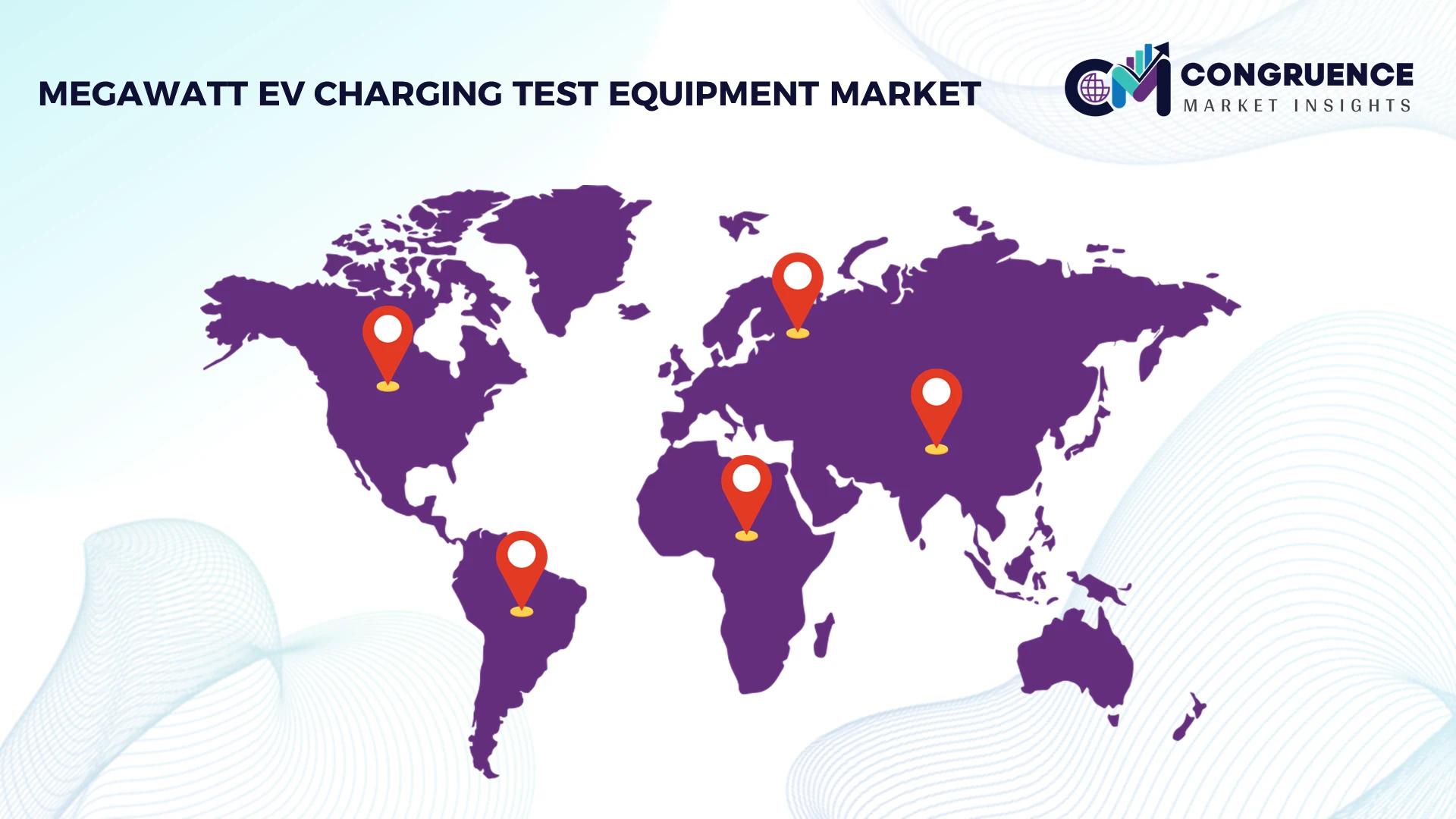
Asia-Pacific accounted for the largest market share at an estimated 42% in 2025 however, Asia-Pacific is expected to register the fastest growth, expanding at an estimated CAGR of 30.1% between 2026 and 2033.
Heavy-Duty Fleet Electrification Strengthens High-Power Validation Infrastructure
North America accounts for an indicative 20% of the global Megawatt EV Charging Test Equipment Market, supported by commercial vehicle electrification, advanced power electronics engineering, and established electrical testing infrastructure. The United States leads regional activity through electric truck development, charging equipment manufacturing, and automotive research laboratories. California's Advanced Clean Trucks regulation establishes increasing zero-emission vehicle sales requirements, strengthening the commercial rationale for heavy-duty charging validation. The National Electric Vehicle Infrastructure program allocated USD 5 billion toward charging infrastructure development, although this funding is not dedicated to megawatt testing equipment. Testing suppliers are expanding programmable power systems, high-voltage measurement capabilities, and charging communication analysis. Canadian engineering organizations contribute through battery research and commercial vehicle development. Regional procurement increasingly emphasizes electrical safety certification, laboratory scalability, and compatibility with emerging charging architectures.
United States Market Outlook: The United States benefits from established automotive engineering centers, specialized instrumentation suppliers, and commercial vehicle electrification programs. Tesla's Semi charging ecosystem and Daimler Truck's electric vehicle development strengthen demand for high-power validation capabilities. The Megawatt Charging System specification supports up to 1,500 V and 3,000 A, creating demanding laboratory requirements. American equipment suppliers are prioritizing programmable loads, regenerative power testing, and automated charger communication verification to support vehicle manufacturers and infrastructure developers.
Charging Standardization Drives Certification and Interoperability Investment
Europe represents an indicative 30% of global market activity, supported by stringent electrical safety requirements, established automotive engineering capabilities, and coordinated charging infrastructure development. Germany leads regional testing demand through commercial vehicle manufacturers, power electronics suppliers, and automotive certification laboratories. CharIN's Megawatt Charging System initiative establishes a common technical framework for high-power charging, increasing requirements for connector compatibility and communication testing. The European Union's Alternative Fuels Infrastructure Regulation requires dedicated charging infrastructure for heavy-duty vehicles along major transport corridors. Its requirements include charging pools providing at least 1,400 kW on specified core network sections by the end of 2025. European suppliers are strengthening regenerative test platforms, automated conformance systems, and thermal validation capabilities. Procurement priorities increasingly favor equipment supporting standardized qualification across different vehicle and charger manufacturers.
Germany Market Outlook: Germany maintains a strong position through established commercial vehicle manufacturing, industrial automation expertise, and electrical testing infrastructure. Daimler Truck, MAN Truck & Bus, and associated engineering suppliers support demand for advanced charging validation. The HoLa high-performance charging project has demonstrated megawatt charging applications for electric trucks, strengthening practical interoperability requirements. German laboratories are emphasizing automated communication testing, high-current connector assessment, and reproducible safety verification to support charging equipment certification.
Manufacturing Scale Accelerates Megawatt Testing Equipment Deployment
Asia-Pacific holds an indicative 42% market share, supported by concentrated electric vehicle manufacturing, power electronics production, and extensive charging infrastructure development. China dominates regional activity through large-scale battery manufacturing, charging equipment production, and commercial vehicle electrification. BYD introduced charging technology rated at 1,000 kW in 2025, highlighting the transition toward megawatt-class charging architectures. Japan contributes through advanced measurement instrumentation and automotive engineering, while South Korea strengthens high-voltage power electronics development. India's electric mobility initiatives are encouraging domestic charger manufacturing and associated testing capabilities. Regional equipment suppliers are expanding programmable DC loads, high-voltage test systems, and automated production verification platforms. Vertically integrated manufacturing enables closer coordination between charger developers and testing equipment providers, reducing development handoffs and strengthening demand for configurable laboratory systems.
China Market Outlook: China benefits from integrated battery supply chains, extensive power electronics manufacturing, and large-scale charging infrastructure deployment. BYD's 2025 Super e-Platform introduced a 1,000 V architecture and charging capability reaching 1,000 kW under specified conditions. These specifications increase demand for high-voltage insulation measurement, dynamic load testing, and thermal verification. Chinese manufacturers are strengthening domestic testing capabilities to accelerate product qualification and support international equipment exports.
Electric Bus Electrification Creates Specialized Testing Demand
South America represents an indicative 4% of global demand, supported by electric bus adoption, charging infrastructure modernization, and developing automotive testing capabilities. Brazil leads regional activity through commercial vehicle manufacturing, electric mobility initiatives, and established automotive engineering infrastructure. Chile and Colombia contribute through electric public transport deployment, particularly in Santiago and Bogotá. Santiago's electric bus fleet exceeded 2,500 vehicles by 2024, demonstrating substantial charging infrastructure requirements. However, much of the installed equipment operates below megawatt charging power, limiting immediate demand for dedicated MCS testing systems. Regional laboratories increasingly require configurable DC power equipment capable of supporting multiple charging classes. Suppliers are developing partnerships with vehicle manufacturers, charging infrastructure providers, and local engineering organizations to strengthen technical support and reduce dependence on imported testing services.
Brazil Market Outlook: Brazil offers the strongest regional industrial foundation through established automotive manufacturing, electrical equipment production, and commercial vehicle engineering. BYD's manufacturing investments and domestic electric bus initiatives strengthen the local charging equipment ecosystem. Brazil's heavy-duty charging validation requirements remain concentrated in development and qualification activities rather than widespread megawatt infrastructure deployment. Testing suppliers are targeting modular power systems, electrical safety verification, and engineering partnerships that support future commercial vehicle charging upgrades.
Charging Infrastructure Modernization Expands Technical Validation Requirements
Middle East & Africa accounts for an indicative 4% of global market activity, supported by charging infrastructure investment, automotive industrial development, and expanding electrical engineering capabilities. Saudi Arabia and the United Arab Emirates lead regional charging infrastructure modernization through national electric mobility initiatives. Saudi Arabia's Electric Vehicle Infrastructure Company, EVIQ, announced plans to establish more than 5,000 fast chargers across 1,000 locations by 2030. These installations are not exclusively megawatt systems but establish supporting infrastructure and technical service requirements. South Africa contributes through automotive manufacturing, electrical engineering services, and commercial fleet electrification initiatives. Regional testing demand remains concentrated in equipment qualification, commissioning, and infrastructure reliability assessment. International suppliers are strengthening distributor relationships, technical training, and service partnerships to address limited specialized laboratory capacity and challenging operating conditions.
Saudi Arabia Market Outlook: Saudi Arabia benefits from government-supported industrial diversification, electric mobility investment, and expanding charging infrastructure programs. EVIQ's planned national network provides a foundation for future high-power charging deployment. The country's automotive manufacturing ambitions also strengthen requirements for electrical safety testing and power electronics validation. Equipment suppliers are targeting local engineering partnerships, high-temperature operating assessments, and scalable laboratory infrastructure capable of supporting advanced charging technologies.
The Megawatt EV Charging Test Equipment Market features competition between Keysight Technologies, Chroma ATE, AVL, Rohde & Schwarz, and EA Elektro-Automatik. Their combined share is indicatively estimated at 45%, although independently verified concentration data is unavailable. Chroma and EA Elektro-Automatik compete through programmable power equipment, while Keysight and Rohde & Schwarz emphasize measurement precision and communication validation. AVL differentiates through integrated automotive engineering and charging system testing. Regenerative power platforms can recover over 90% of processed energy under specified conditions, improving laboratory operating economics. Modular architectures supporting 1,500 V and 3,000 A strengthen testing flexibility across charging configurations. Suppliers are expanding automated verification software, engineering partnerships, and high-power laboratory capabilities. Competitive pressure increasingly favors integrated electrical, thermal, and communication testing rather than standalone instruments. High-current infrastructure requirements and certification expertise restrict entry. Winning suppliers must combine measurement accuracy, scalable power capacity, and reliable technical support.
Keysight Technologies, Inc.
Chroma ATE Inc.
AVL List GmbH
Rohde & Schwarz GmbH & Co. KG
EA Elektro-Automatik GmbH & Co. KG
National Instruments Corporation (NI)
AMETEK, Inc.
NH Research, LLC
ITECH Electronic Co., Ltd.
Cinergia Power Solutions
dSPACE GmbH
Typhoon HIL, Inc.
Vector Informatik GmbH
Kikusui Electronics Corporation
Current technologies combine programmable DC loads, precision power analyzers, high-voltage insulation testers, and charging communication simulators. Regenerative electronic loads recover more than 90% of processed energy under specified operating conditions, compared with conventional resistive loads that dissipate virtually 100% as heat. This improves laboratory electricity utilization and reduces cooling requirements. Commercial systems support testing at 1,500 V, enabling equipment manufacturers to validate advanced charging architectures while consolidating electrical measurements within coordinated laboratory workflows.
Emerging technologies include hardware-in-the-loop simulation, automated fault injection, and synchronized thermal diagnostics. Software-controlled test benches reproduce vehicle battery behavior, charging interruptions, and connector temperature changes without requiring physical trucks. Modular power platforms combine multiple units to reach megawatt capacities, improving utilization across development programs. German automotive laboratories increasingly integrate communication conformance testing with electrical safety assessment. Suppliers offering reusable test sequences and configurable interfaces gain advantages through faster engineering changeovers and more consistent qualification documentation.
Disruptive developments focus on digital twins, predictive component diagnostics, and automated certification workflows. Megawatt Charging System specifications support 3,000 A, making contact resistance and cooling performance critical measurement variables. Between 2026 and 2028, manufacturers are prioritizing integrated validation of power electronics, communication protocols, and connector durability. Chinese equipment producers benefit from proximity to charging manufacturers, while independent laboratories differentiate through reproducible testing and accredited technical expertise.
January 2026: Keysight Technologies introduced 2 EV charging test solutions supporting high-power and megawatt charging applications. The systems address interoperability and compliance across charging standards, helping manufacturers streamline validation, reduce engineering rework, and strengthen product readiness. Source: keysight.com
July 2026: Chroma ATE introduced its 1.8 MW megawatt charging test solution, integrating the Chroma 8000 automated test system. The platform supports sustained high-current and liquid-cooled connector validation, strengthening qualification capabilities for electric truck charging equipment manufacturers. Source: chromaate.com
November 2025: Vector Informatik launched vCTS.performance with EA Elektro-Automatik, supporting charging tests up to 3.84 MW and regenerative efficiency exceeding 96%. The scalable hardware-in-the-loop platform enables realistic interoperability and endurance testing while reducing laboratory energy consumption. Source: presseagentur.com
July 2024: AVL Software and Functions participated in the NEFTON project's public megawatt charging demonstration, exceeding 1,000 kW. Its control software coordinated charging communication and power electronics, validating system integration for heavy-duty electric truck operations. Source: avl-functions.com
The Megawatt EV Charging Test Equipment Market Report evaluates industry developments between 2026 and 2033, covering Power Analyzers, Programmable DC Loads, High-Voltage Test Systems, and Charging Protocol Testers. Application analysis includes DC Fast Charger Testing, Charging Performance Testing, Power Conversion Testing, and Safety and Compliance Testing. End-user assessment examines EV Charging Equipment Manufacturers, Automotive OEMs, Testing Laboratories, and Charging Infrastructure Operators. Indicative segment analysis identifies programmable DC loads with 35% market participation and charging equipment manufacturers with 42%.
Regional coverage includes North America, Europe, Asia-Pacific, South America, and Middle East & Africa. Technology assessment addresses regenerative power systems, hardware-in-the-loop simulation, automated interoperability verification, and high-current thermal diagnostics. Competitive analysis supports laboratory investment planning, equipment procurement, geographic expansion, certification strategies, and technology partnerships across emerging megawatt charging applications.
| Report Attribute/Metric | Report Details |
|---|---|
Market Revenue in 2025 | USD 47.22 Million |
Market Revenue in 2033 | USD 325.65 Million |
CAGR (2026 - 2033) | 27.3% |
Base Year | 2025 |
Forecast Period | 2026 - 2033 |
Historic Period | 2021 - 2025 |
Segments Covered | By Type
By Application
By End-User
|
Key Report Deliverable | Revenue Forecast, Growth Trends, Market Dynamics, Segmental Overview, Regional and Country-wise Analysis, Competition Landscape |
Region Covered | North America, Europe, Asia-Pacific, South America, Middle East, Africa |
Key Players Analyzed | Keysight Technologies, Inc., Chroma ATE Inc., AVL List GmbH, Rohde & Schwarz GmbH & Co. KG, EA Elektro-Automatik GmbH & Co. KG, National Instruments Corporation (NI), AMETEK, Inc., NH Research, LLC, ITECH Electronic Co., Ltd., Cinergia Power Solutions, dSPACE GmbH, Typhoon HIL, Inc., Vector Informatik GmbH, Kikusui Electronics Corporation |
Customization & Pricing | Available on Request (10% Customization is Free) |




