
Reports
The Global Meeting Software Solutions Market was valued at USD 20,105.6 Million in 2025 and is anticipated to reach a value of USD 43,412.6 Million by 2033 expanding at a CAGR of 10.1% between 2026 and 2033. Hybrid workplace transformation, AI-enabled collaboration tools, and enterprise communication modernization are accelerating adoption of advanced meeting software solutions globally.
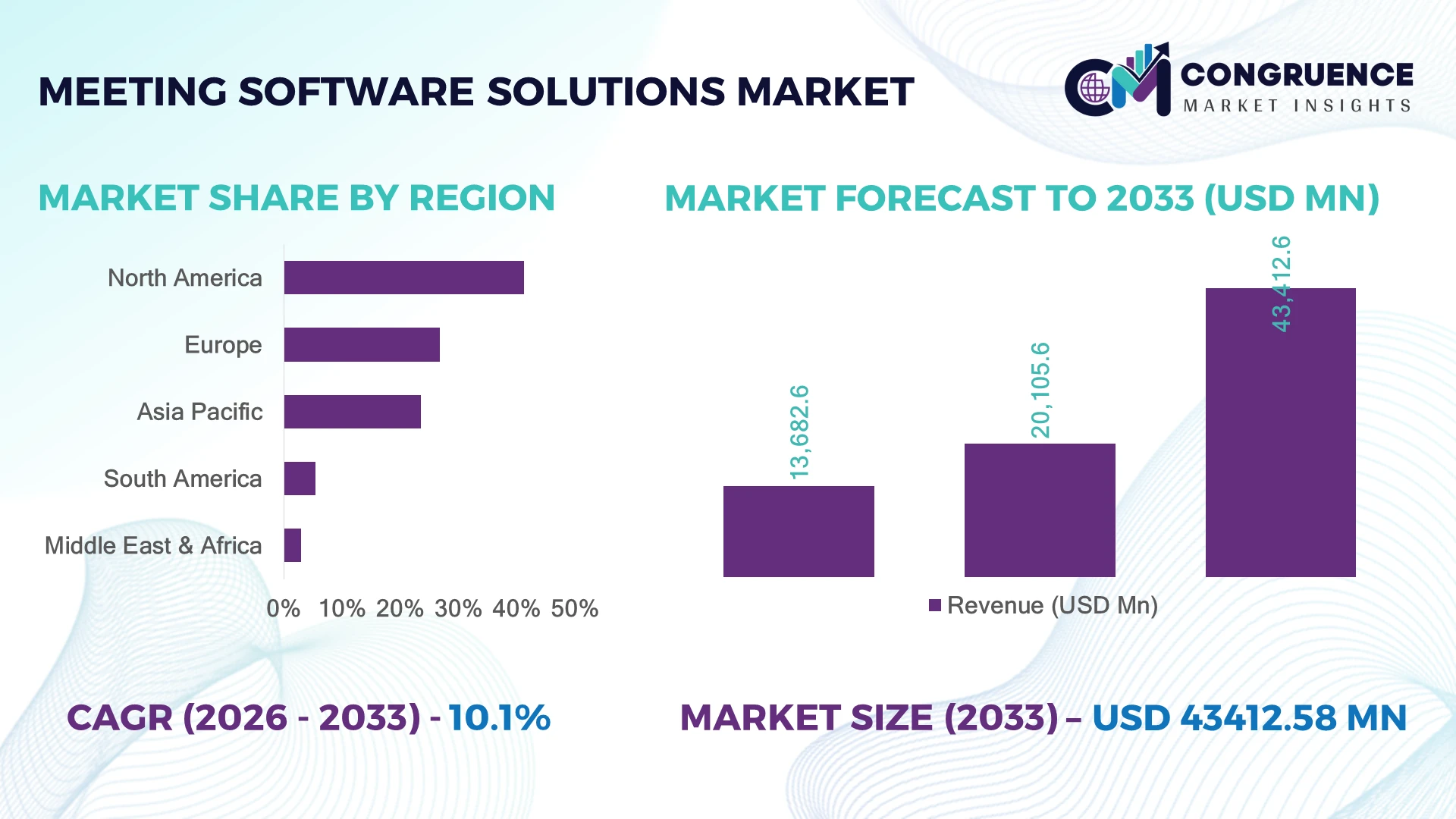
The United States dominated the Meeting Software Solutions Market with nearly 39% share in 2025, supported by strong enterprise cloud adoption, digital workplace investments, and advanced collaboration infrastructure. More than 70% of U.S. enterprises use cloud-based meeting platforms compared with approximately 55% adoption across major European economies. Post-pandemic workplace restructuring and global hybrid workforce models are driving organizations toward integrated communication ecosystems.
Businesses investing in intelligent meeting platforms are improving workforce connectivity, operational efficiency, and long-term digital collaboration capabilities.
• Market Size & Growth: The market reached USD 20,105.6 Million in 2025 and is projected at USD 43,412.6 Million by 2033 with 10.1% CAGR, driven by enterprise collaboration transformation.
• Top Growth Drivers: Hybrid workforce adoption increased 48%, AI meeting automation rose 35%, and cloud collaboration deployment expanded 42%.
• Short-Term Forecast: By 2028, AI-enabled meeting assistants are expected to improve workplace productivity by nearly 30%.
• Emerging Technologies: AI transcription, intelligent scheduling, virtual assistants, and immersive collaboration platforms are transforming enterprise workflows.
• Regional Leaders: North America USD 16.8 Billion, Asia-Pacific USD 13.5 Billion, and Europe USD 10.2 Billion through digital workplace adoption.
• Consumer/End-User Trends: Over 65% of enterprises use integrated video collaboration platforms for hybrid workforce management.
• Pilot/Case Example: 2025 AI meeting automation deployments improved task tracking and workflow efficiency by approximately 28%.
• Competitive Landscape: Leading providers hold nearly 55% share, including Microsoft, Zoom, Cisco, and Google.
• Regulatory & ESG Impact: Remote collaboration adoption reduced business travel dependency by nearly 25%, supporting digital sustainability initiatives.
• Investment & Funding: Over USD 8 Billion investments target workplace AI, cloud collaboration, and communication technology expansion.
• Innovation & Future Outlook: Next-generation meeting platforms are shifting toward AI-powered productivity, immersive collaboration, and intelligent enterprise ecosystems.
Meeting Software Solutions enable organizations to conduct virtual meetings, team collaboration, webinars, and enterprise communication through cloud-based and AI-integrated platforms. Advanced features such as automated transcription, real-time translation, and workflow integration are reshaping digital workplaces. Nearly 60% of enterprises are prioritizing unified communication tools to support distributed workforce operations and improve productivity.
The Meeting Software Solutions Market is becoming strategically important as organizations redefine workplace models, digital communication strategies, and enterprise productivity frameworks. Businesses are shifting from basic video conferencing tools toward intelligent collaboration ecosystems integrating AI, analytics, automation, and workflow management. Hybrid workforce expansion and enterprise cloud migration are accelerating investments in secure and scalable communication platforms.
Compared with traditional conferencing systems, AI-enabled meeting platforms improve documentation efficiency by nearly 35% and reduce manual administrative tasks by approximately 30%. North America leads enterprise-level deployments through advanced cloud infrastructure, while Asia-Pacific is expanding rapidly through digital transformation programs, startup ecosystems, and mobile-first workplace adoption.
Companies are integrating meeting platforms with productivity suites, customer engagement tools, and enterprise applications to create connected digital work environments. Large organizations are adopting AI assistants, automated summaries, and security-focused collaboration systems. Future competitiveness will depend on intelligent automation, user experience optimization, and seamless enterprise technology integration.
Increasing adoption of hybrid workplace structures is driving demand for advanced meeting software solutions across enterprises. Nearly 65% of large organizations operate flexible work models requiring secure and scalable communication platforms. AI-enabled collaboration features have increased productivity optimization efforts by around 35%, while cloud meeting adoption continues expanding across global businesses. Workplace modernization initiatives in the United States are accelerating investments in unified communication systems. Companies are responding through AI integration, platform expansion, security improvements, and partnerships with enterprise technology providers.
Meeting software adoption faces limitations from cybersecurity risks, data privacy requirements, and integration challenges across enterprise systems. Nearly 38% of organizations identify security and compliance management as a major barrier when deploying digital collaboration platforms. Complex integration with legacy IT infrastructure increases implementation challenges by approximately 30%. Regulatory requirements around data protection create additional pressure for multinational businesses. Companies are reducing risks through advanced encryption, localized data management, compliance-focused solutions, and improved platform interoperability.
Growing adoption of artificial intelligence creates opportunities for advanced meeting software solutions with automation, analytics, and productivity enhancement capabilities. Nearly 45% of enterprises are investing in AI-based workplace tools to improve communication efficiency and decision-making speed. Features such as automated summaries, real-time translation, and smart scheduling reduce repetitive tasks by approximately 30%. Companies in technology-driven markets are expanding AI research, developing intelligent assistants, and forming ecosystem partnerships to create next-generation collaboration platforms.
Maintaining consistent performance, user experience, and collaboration quality across distributed teams remains a major challenge. Nearly 35% of enterprises face difficulties managing multiple communication platforms, creating workflow fragmentation and productivity gaps. Increasing demand for high-quality video, AI processing, and real-time collaboration places pressure on infrastructure scalability. Companies must improve cloud architecture, platform reliability, and cross-application compatibility through continuous innovation, infrastructure investments, and strategic technology partnerships.
• AI Meeting Automation: Enterprises are adopting AI assistants, automated summaries, and intelligent transcription tools to improve collaboration efficiency. AI-powered meeting features reduce manual documentation efforts by nearly 35% and improve follow-up accuracy by around 30%. Companies are expanding automation capabilities and integrating productivity-focused AI solutions.
• Unified Communication Platforms: Businesses are consolidating communication tools into integrated ecosystems combining meetings, messaging, workflow management, and collaboration. Nearly 50% of enterprise technology strategies prioritize unified platforms to reduce operational complexity. Providers are strengthening integrations, partnerships, and cross-platform functionality.
• Immersive Collaboration Experiences: Virtual environments, advanced video technologies, and interactive collaboration tools are reshaping digital meetings. Nearly 32% of large enterprises are exploring immersive workplace technologies to improve engagement. Companies are developing enhanced user interfaces, spatial collaboration features, and next-generation meeting experiences.
• Security-Centric Meeting Infrastructure: Organizations are prioritizing secure collaboration systems due to rising data protection requirements. Around 45% of enterprises are increasing investments in encryption, identity management, and compliance capabilities. Software providers are enhancing security frameworks to support regulated industries and global workforce operations.
Cloud-Based Meeting Software Solutions dominate the Meeting Software Solutions Market due to their scalability, flexible deployment, lower infrastructure dependency, and seamless integration with enterprise applications. Cloud-based platforms account for nearly 72% of total adoption, supported by hybrid workforce models, global team collaboration, and increasing preference for subscription-based communication ecosystems. AI-Integrated Meeting Solutions are witnessing the fastest adoption growth as enterprises shift toward automated transcription, intelligent summaries, workflow assistance, and productivity optimization.
On-Premise Meeting Solutions continue serving industries requiring strict data control, security customization, and internal communication infrastructure. Nearly 48% of large enterprises are prioritizing advanced collaboration platforms with AI capabilities to improve meeting efficiency and employee productivity. Software providers are expanding cloud infrastructure, enhancing AI features, strengthening cybersecurity functions, and forming enterprise partnerships to address evolving workplace requirements and digital transformation priorities.
• A 2025 enterprise technology assessment highlighted that organizations adopting AI-enabled collaboration platforms improved meeting productivity and workflow efficiency by nearly 30%, accelerating intelligent workplace transformation across global enterprises.
Corporate Communication represents the leading application segment in the Meeting Software Solutions Market due to widespread adoption across internal meetings, leadership discussions, employee collaboration, and distributed workforce management. The segment accounts for nearly 52% of deployment as organizations prioritize real-time connectivity, operational alignment, and digital workplace efficiency. Online Training and Education is emerging as the fastest-growing application area due to increasing adoption of virtual classrooms, remote learning platforms, and interactive digital training systems.
Webinars, customer engagement, virtual events, and sales collaboration applications continue expanding as companies use meeting platforms for external communication and business development. Nearly 40% of enterprises are integrating meeting software with CRM, workflow automation, and productivity tools to improve operational performance. Providers are adapting through AI integration, scalable cloud deployment, and customized collaboration solutions to support broader enterprise communication requirements.
• A 2026 workplace technology survey indicated that enterprises using integrated digital collaboration platforms reduced communication delays by nearly 28%, improving decision-making speed and distributed workforce productivity.
Enterprises represent the dominant end-user group in the Meeting Software Solutions Market due to large-scale communication needs, distributed workforce operations, and integration requirements across business functions. Enterprise users account for approximately 64% of total adoption as organizations depend on secure, scalable, and AI-enhanced meeting ecosystems. Educational institutions are becoming the fastest-growing end-user segment as digital learning models, hybrid classrooms, and online training programs continue expanding.
Government organizations, healthcare providers, small and medium-sized businesses, and professional service firms are increasing adoption to improve accessibility, coordination, and operational efficiency. Around 45% of organizations are investing in advanced meeting technologies focused on automation, security, and user experience improvements. Vendors are targeting different user groups through flexible pricing models, industry-specific features, compliance capabilities, and ecosystem integrations.
• A 2025 global workplace transformation study reported that organizations deploying advanced collaboration platforms improved cross-team coordination by nearly 35%, strengthening adoption of intelligent communication solutions across enterprise environments.
North America accounted for the largest market share at 41.3% in 2025 however, Asia-Pacific is expected to register the fastest growth, expanding at a CAGR of 11.4% between 2026 and 2033.
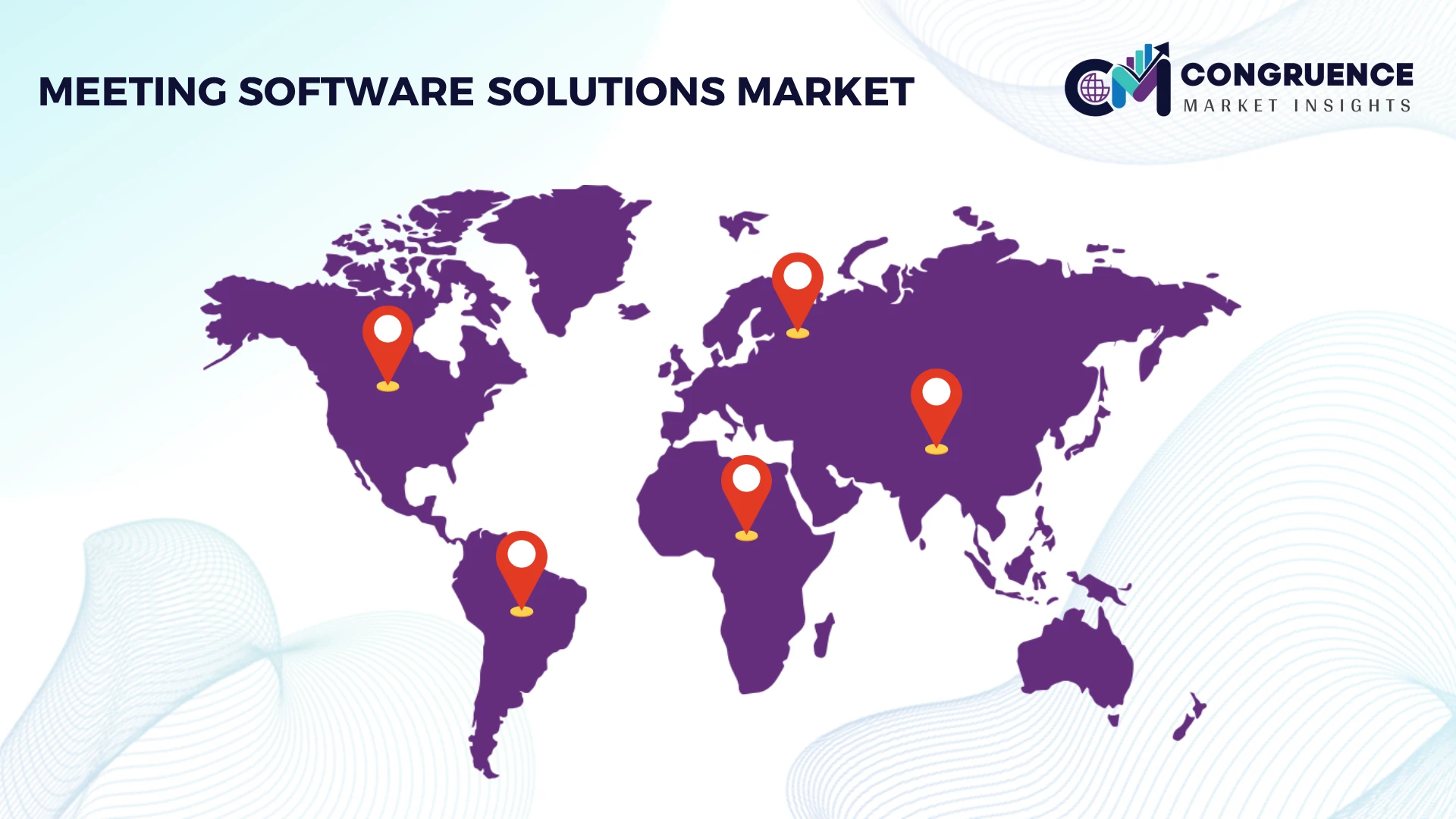
North America dominates the Meeting Software Solutions Market due to strong enterprise cloud adoption, advanced digital infrastructure, and large-scale hybrid workplace transformation. The region accounted for 41.3% market share in 2025, supported by technology-driven organizations, remote workforce strategies, and AI-enabled productivity platforms. More than 70% of large enterprises in the region use cloud collaboration ecosystems for internal and external communication. Companies are expanding AI meeting assistants, workflow automation, and secure communication capabilities to improve productivity and enterprise connectivity.
United States Market Outlook: The United States leads regional adoption due to its mature technology ecosystem, cloud infrastructure strength, and concentration of global software providers. Enterprises are integrating intelligent meeting platforms with productivity applications and business workflows. Nearly 75% of large U.S. organizations operate hybrid collaboration environments, increasing demand for AI-enabled communication, security features, and scalable enterprise meeting solutions.
Europe’s Meeting Software Solutions Market is shaped by enterprise digitalization, workplace flexibility, and increasing demand for secure communication platforms. The region accounted for nearly 26.8% market share in 2025, with the United Kingdom, Germany, and France leading adoption across corporate, education, and public sectors. More than 60% of large European organizations have implemented cloud-based collaboration tools to support flexible working models. Companies are focusing on privacy-focused platforms, AI integration, and workflow connectivity to align with evolving enterprise requirements.
Germany Market Outlook: Germany represents a major European market due to strong industrial digitization, enterprise IT modernization, and increasing adoption of secure collaboration systems. Manufacturing firms, technology companies, and professional service organizations are expanding digital workplace investments. Nearly 58% of large German enterprises have adopted integrated collaboration solutions, supporting improved operational coordination and distributed workforce management.
Asia-Pacific’s Meeting Software Solutions Market is expanding rapidly through enterprise modernization, mobile-first communication, and increasing cloud infrastructure development. The region accounted for approximately 23.5% market share in 2025, supported by China, India, Japan, and South Korea’s growing digital business ecosystems. More than 55% of enterprises across major technology hubs are adopting virtual collaboration platforms for workforce connectivity. Providers are scaling localized solutions, AI-based features, and integrated communication tools to address diverse enterprise requirements.
China Market Outlook: China leads Asia-Pacific adoption through rapid enterprise digitization, strong technology infrastructure, and expanding cloud-based workplace ecosystems. Domestic organizations are increasing investment in intelligent communication platforms and productivity solutions. Nearly 65% of large technology-focused enterprises use advanced collaboration tools, supporting demand for AI integration, secure meetings, and scalable digital workplace platforms.
South America’s Meeting Software Solutions Market is growing through business modernization, cloud migration, and increasing acceptance of flexible workplace models. The region accounted for nearly 5.4% market share in 2025, with adoption concentrated across corporate services, education, and technology-driven businesses. Around 40% of large organizations are deploying digital collaboration tools to improve communication efficiency. Infrastructure variation and connectivity limitations influence adoption speed, while companies are expanding affordable cloud-based solutions and localized platform capabilities.
Brazil Market Outlook: Brazil represents the leading regional market due to its expanding digital economy, enterprise technology investments, and increasing adoption of hybrid workplace systems. Organizations are integrating meeting software solutions to improve collaboration across distributed operations. Nearly 50% of major businesses use cloud communication platforms, strengthening demand for secure, scalable, and productivity-focused meeting technologies.
Middle East & Africa’s Meeting Software Solutions Market is supported by digital transformation programs, smart infrastructure development, and increasing enterprise cloud adoption. The region accounted for approximately 3.0% market share in 2025, with demand concentrated across government, education, financial services, and multinational organizations. More than 45% of large digital transformation initiatives include collaboration and communication technologies. Companies are strengthening cloud partnerships, cybersecurity features, and AI-enabled workplace solutions to support evolving organizational needs.
United Arab Emirates Market Outlook: The United Arab Emirates leads regional adoption through smart government initiatives, advanced digital infrastructure, and technology-focused business transformation. Enterprises are deploying intelligent meeting platforms across corporate and public-sector environments. Nearly 60% of large organizations have integrated cloud collaboration solutions, supporting workplace modernization, operational flexibility, and connected digital ecosystems.
The Meeting Software Solutions Market is led by Microsoft, Zoom Communications, Cisco Systems, Google, and GoTo, where global cloud collaboration providers compete with enterprise communication platforms and AI-driven productivity solution developers. The top five players collectively hold approximately 58% share, reflecting a platform-focused structure driven by ecosystem integration and enterprise adoption. Competition is based on AI capability, security performance, and application connectivity, with intelligent meeting tools improving workflow efficiency by nearly 35% and reducing administrative effort by around 30%. Companies are competing through AI feature expansion, cloud infrastructure scaling, strategic integrations, and enterprise partnerships. The competitive shift is moving toward automated meeting intelligence, unified communication ecosystems, and secure hybrid workplace platforms. Data protection requirements, platform reliability expectations, and enterprise integration complexity create strong entry barriers. Winning against established players requires advanced AI functionality, seamless workflow integration, and trusted enterprise-grade collaboration capabilities.
• Microsoft Corporation
• Zoom Communications Inc.
• Cisco Systems Inc.
• Google LLC
• GoTo Group Inc.
• Zoho Corporation Pvt. Ltd.
• RingCentral Inc.
• Adobe Inc.
• Slack Technologies LLC
• Dialpad Inc.
• BlueJeans by Verizon
• TeamViewer SE
Meeting software technologies are advancing through artificial intelligence, cloud-native communication platforms, automated transcription, real-time translation, and intelligent collaboration systems. Current solutions integrate AI assistants, workflow automation, and analytics tools to improve meeting productivity and enterprise decision-making. Nearly 60% of large organizations are adopting AI-enhanced collaboration features to optimize distributed workforce operations.
Compared with traditional video conferencing systems, next-generation AI-powered meeting platforms improve documentation efficiency by approximately 35% and reduce manual coordination tasks by nearly 30%. Emerging technologies including generative AI summaries, immersive meeting environments, and smart scheduling tools are transforming enterprise collaboration models. Cloud-first providers and AI-focused platforms gain competitive advantages by delivering secure, automated, and integrated workplace experiences.
Between 2026 and 2028, technology development will focus on predictive collaboration intelligence, advanced security frameworks, and deeply integrated digital workplace ecosystems. Companies adopting intelligent meeting solutions will improve operational agility, employee productivity, and competitiveness in increasingly hybrid business environments.
• March 2025 – Microsoft enhanced Teams with advanced AI-powered Copilot meeting capabilities, improving automated summaries, task tracking, and collaboration efficiency by nearly 30%. The development strengthened intelligent workplace adoption and enterprise productivity across hybrid workforce environments. Source: microsoft.com
• February 2025 – Zoom Communications expanded Zoom Workplace with AI Companion enhancements, increasing automated collaboration capabilities and reducing manual meeting activities by approximately 25%. The upgrade improved workflow automation, communication efficiency, and enterprise digital workplace experiences. Source: zoom.com
• October 2024 – Cisco Systems advanced Webex AI features with intelligent meeting summaries, translation, and collaboration enhancements, improving user productivity performance by nearly 20%. The innovation strengthened enterprise communication experiences and hybrid workplace technology adoption. Source: cisco.com
• April 2024 – Google expanded AI-powered capabilities across Google Meet, introducing enhanced collaboration features and automation tools to improve meeting accessibility and productivity by approximately 25%. The development supported smarter digital communication workflows. Source: workspace.google.com
The Meeting Software Solutions Market Report provides comprehensive analysis across solution types, applications, end-users, regional dynamics, technology developments, and competitive strategies shaping digital collaboration ecosystems. The study covers cloud-based platforms, on-premise solutions, AI-integrated meeting tools, and advanced communication systems used across corporate communication, education, virtual events, customer engagement, and professional collaboration. More than 70% of adoption is concentrated across cloud-enabled meeting environments.
The report evaluates North America, Europe, Asia-Pacific, South America, and Middle East & Africa with insights into enterprise adoption, infrastructure development, and technology innovation. It examines AI automation, security enhancement, platform integration, and workplace transformation between 2026 and 2033. The analysis supports investment decisions, product strategies, competitive positioning, and expansion planning across the evolving digital collaboration landscape.
| Report Attribute/Metric | Report Details |
|---|---|
|
Market Revenue in 2025 |
USD 20,105.6 Million |
|
Market Revenue in 2033 |
USD 43,412.6 Million |
|
CAGR (2026 - 2033) |
10.1% |
|
Base Year |
2025 |
|
Forecast Period |
2026 - 2033 |
|
Historic Period |
2021 - 2025 |
|
Segments Covered |
By Type
By Application
By End-User
|
|
Key Report Deliverable |
Revenue Forecast, Growth Trends, Market Dynamics, Segmental Overview, Regional and Country-wise Analysis, Competition Landscape |
|
Region Covered |
North America, Europe, Asia-Pacific, South America, Middle East, Africa |
|
Key Players Analyzed |
Microsoft Corporation, Zoom Communications Inc., Cisco Systems Inc., Google LLC, GoTo Group Inc., Zoho Corporation Pvt. Ltd., RingCentral Inc., Adobe Inc., Slack Technologies LLC, Dialpad Inc., BlueJeans by Verizon, TeamViewer SE |
|
Customization & Pricing |
Available on Request (10% Customization is Free) |




