
Reports
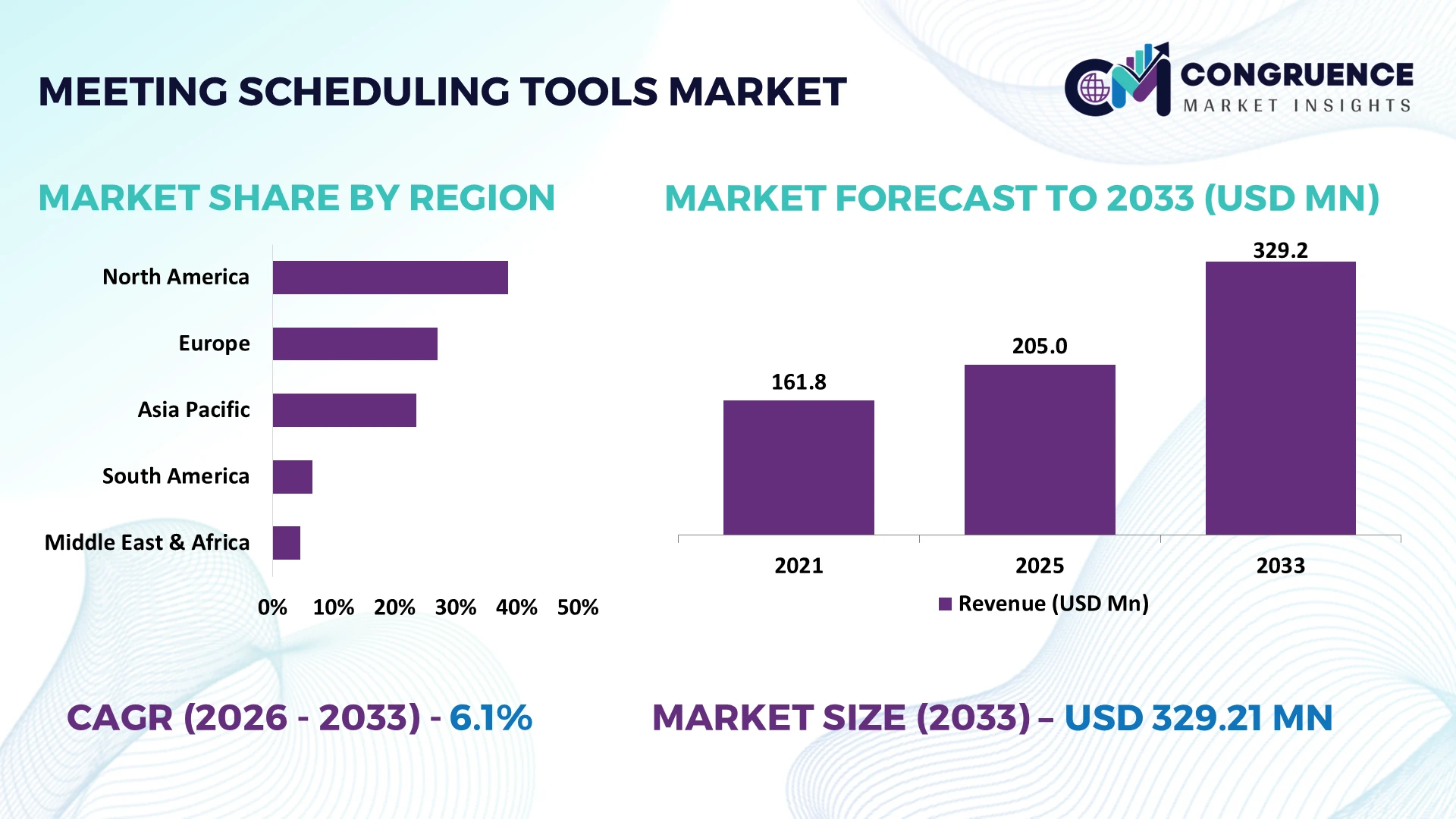
The Global Meeting Scheduling Tools Market was valued at USD 205.0 Million in 2025 and is anticipated to reach a value of USD 329.2 Million by 2033 expanding at a CAGR of 6.1% between 2026 and 2033. AI-powered calendar automation, hybrid workforce management, customer appointment digitization, and integration with enterprise collaboration platforms are accelerating market expansion.
The United States leads the meeting scheduling tools market, supported by advanced SaaS infrastructure, enterprise technology investments, and widespread hybrid working arrangements. Approximately 22.8% of employed Americans teleworked in August 2024, while India's adoption remains more concentrated within technology and business process outsourcing industries. Calendly serves over 20 million users globally, reinforcing U.S. leadership in automated scheduling innovation amid cross-border workforce expansion.
Strategic investment in intelligent scheduling, enterprise workflow integration, and industry-specific appointment management solutions will strengthen competitive positioning and customer retention.
Market Size & Growth: USD 205.0 Million in 2025, reaching USD 329.2 Million by 2033 at 6.1% CAGR, driven by intelligent calendar automation.
Top Growth Drivers: Hybrid workforce coordination (38%), workflow automation (34%), and customer appointment digitization (28%), based on indicative driver weightings.
Short-Term Forecast: By 2028, advanced scheduling deployments target a 25–35% reduction in administrative coordination time.
Emerging Technologies: Three core innovations include generative AI assistants, predictive availability management, and automated meeting prioritization.
Regional Leaders: Projected 2033 scenario: North America (USD 125.1 Million), Europe (USD 85.6 Million), and Asia Pacific (USD 82.3 Million), supported by enterprise digitization.
Consumer/End-User Trends: Approximately 22.8% of employed Americans teleworked in August 2024, strengthening digital scheduling requirements.
Pilot/Case Example: A representative 2025 automated appointment deployment targets a 30% reduction in manual booking activities.
Competitive Landscape: Calendly holds an indicative 24% market share, competing with Microsoft Bookings, Doodle, OnceHub, and Acuity Scheduling.
Regulatory & ESG Impact: GDPR noncompliance penalties reach 4% of annual global turnover, prioritizing secure calendar-data processing.
Investment & Funding: Calendly secured USD 350 Million in 2021, demonstrating investor confidence in scheduling automation.
Innovation & Future Outlook: Three strategic priorities include autonomous scheduling, contextual AI recommendations, and CRM-integrated appointment orchestration.
The global meeting scheduling tools market is experiencing rising adoption across healthcare, recruitment, education, professional services, and customer-facing sales operations. Intelligent booking interfaces, automated reminders, and real-time calendar synchronization are transforming appointment management. With 75% of surveyed knowledge workers using AI at work in 2024, scheduling platforms are increasingly evolving toward autonomous workflow orchestration, reshaping enterprise productivity strategies.
Meeting scheduling tools are becoming strategically important as enterprises prioritize workforce productivity, customer responsiveness, and operational coordination across geographically distributed teams. The transition from standalone calendar applications toward interconnected digital workplace ecosystems is transforming scheduling into a core business automation function. With 75% of surveyed knowledge workers using AI at work in 2024, intelligent scheduling capabilities are increasingly aligned with enterprise technology modernization priorities.
Unlike conventional email-based coordination, automated scheduling platforms can reduce administrative booking time by an estimated 25–40%, depending on workflow complexity. The United States demonstrates stronger enterprise SaaS integration, while India offers expanding deployment opportunities across IT services, recruitment, and outsourced customer support operations. Between 2026 and 2028, advanced deployments are expected to target automation of 40–50% of repetitive appointment coordination activities.
Healthcare providers deploying self-service appointment portals illustrate the operational value of automated availability management, booking confirmations, and rescheduling. Technology providers are expanding investments in CRM integration, conversational AI, and industry-specific scheduling interfaces while strengthening partnerships with enterprise software vendors. Competitive advantage increasingly depends on transforming scheduling from an administrative utility into an intelligent operational decision-making capability.
The institutionalization of hybrid working arrangements is accelerating adoption of meeting scheduling tools across technology, financial services, consulting, and professional services industries. Approximately 22.8% of employed Americans teleworked in August 2024, while 75% of surveyed knowledge workers globally reported using AI at work. Automated calendar synchronization and availability-based booking systems can reduce manual coordination time by an estimated 25–35%. Cross-border workforce expansion further increases demand for time-zone intelligent scheduling and centralized appointment management. Companies including Calendly and Microsoft are strengthening integrations with collaboration platforms, CRM systems, and productivity applications. Scheduling automation also improves sales conversion opportunities by reducing delays between customer inquiries and confirmed appointments.
Fragmented enterprise software environments and inconsistent calendar interoperability restrict seamless deployment of advanced meeting scheduling solutions. Organizations operating multiple calendar systems, CRM applications, and identity management platforms face additional configuration and maintenance requirements. In complex enterprise deployments, integration and customization can represent an estimated 20–30% of implementation expenditure, while recurring administrative overhead can account for another 10–15% of operating costs. European GDPR requirements introduce further compliance obligations, with serious violations attracting penalties of up to 4% of annual global turnover. Providers are mitigating these limitations through standardized APIs, configurable connectors, and bundled subscription offerings. Native integration with established productivity ecosystems increasingly determines customer acquisition economics and deployment profitability.
Agentic AI and industry-specific appointment orchestration represent significant opportunities for meeting scheduling software providers. With 75% of surveyed knowledge workers using AI in 2024, enterprise familiarity with intelligent assistants supports the transition toward autonomous scheduling agents. Advanced deployments targeting automated meeting prioritization, appointment routing, and contextual rescheduling offer potential administrative time savings of 30–40%. India's expanding digital healthcare and technology services ecosystems provide attractive opportunities for multilingual scheduling interfaces and mobile-first booking solutions. Providers are investing in natural language processing, predictive availability engines, and partnerships with healthcare management and CRM platforms. Vertical-specific scheduling products create stronger customer retention by embedding booking intelligence directly within revenue-generating and service-delivery workflows.
Maintaining secure, accurate, and scalable scheduling operations presents a long-term challenge as platforms gain deeper access to enterprise calendars, customer records, and confidential meeting information. Approximately 68% of breaches examined in the 2024 Verizon Data Breach Investigations Report involved a non-malicious human element, while 15% involved third-party exposure. Autonomous scheduling agents introduce additional execution risks through incorrect meeting prioritization, unauthorized calendar modifications, and contextual interpretation errors. The European Union's AI Act further reinforces governance expectations for applicable AI-enabled systems. Providers must invest in permission-based automation, continuous security monitoring, human approval mechanisms, and resilient cloud infrastructure. Reliable execution increasingly determines enterprise renewal rates as scheduling platforms assume greater operational responsibility.
Consolidation of Enterprise Scheduling Platforms: Enterprises are consolidating standalone booking applications into unified productivity ecosystems, targeting 15–25% reductions in software administration costs and 20–30% fewer redundant subscriptions. Microsoft and Google are expanding native scheduling functionality within existing productivity suites, intensifying competitive pressure on independent vendors to differentiate through specialized workflows and flexible integrations.
Strengthening Privacy-Centric Scheduling Infrastructure: European data protection requirements are accelerating adoption of consent management, configurable retention policies, and restricted calendar visibility. GDPR penalties reaching 4% of annual global turnover reinforce compliance priorities. Providers are expanding role-based access controls and regional hosting options, targeting 20–30% reductions in compliance-related administrative workloads while strengthening enterprise procurement eligibility.
Cloud-Based Meeting Scheduling Tools accounted for an estimated 78.5% of the market share in 2025, supported by flexible subscription models, real-time calendar synchronization, remote accessibility, and seamless integration with enterprise productivity platforms. Cloud-based solutions eliminate extensive local infrastructure requirements, enabling organizations to centralize appointment management across geographically distributed teams. Subscription-based deployments offer potential infrastructure and maintenance cost savings of 20–30% compared with internally managed scheduling systems, strengthening adoption among small businesses and multinational enterprises.
Cloud-Based Meeting Scheduling Tools also represent the fastest-growing segment as organizations increasingly prioritize scalable deployment, automatic software updates, and API-enabled workflow integration. On-Premises Meeting Scheduling Tools retain strategic relevance across government agencies, financial institutions, and security-sensitive enterprises requiring direct control over confidential calendar information. Organizations implementing standardized cloud integrations target 25–35% reductions in deployment and configuration time. Companies including Calendly, Microsoft, and Zoho are strengthening cloud infrastructure, enterprise security capabilities, and multilingual functionality. Investment priorities increasingly favor interconnected scheduling ecosystems over isolated calendar management applications.
Business Meeting Scheduling represented an estimated 42.5% of the market share in 2025, driven by extensive requirements for internal collaboration, external client engagement, project coordination, and executive calendar management. Corporate organizations increasingly deploy centralized scheduling platforms to streamline availability management and meeting confirmations across multiple departments. Automated booking workflows target 25–35% reductions in administrative coordination time, particularly across consulting, financial services, and technology companies managing distributed operations.
Customer Appointment Scheduling represents the fastest-growing application as businesses replace telephone-based reservations and email coordination with self-service digital booking interfaces. Sales and Marketing Scheduling is gaining importance through CRM-integrated appointment routing, prospect qualification, and automated follow-ups, targeting 15–25% improvements in lead response times. Recruitment and Interview Scheduling supports candidate coordination and interviewer availability management, while Other Applications address educational consultations, professional networking, and specialized appointment requirements. Companies including Calendly, Acuity Scheduling, and Chili Piper are expanding configurable booking workflows and industry-specific integrations. Demand is increasingly concentrated around applications directly influencing customer conversion, employee utilization, and service delivery efficiency.
Large Enterprises accounted for an estimated 58.5% of the market share in 2025, supported by extensive workforce networks, complex departmental coordination, and established investments in enterprise collaboration infrastructure. Multinational organizations require centralized scheduling platforms capable of managing multiple calendars, administrative permissions, customer appointments, and cross-border communication workflows. Integrated scheduling deployments target 20–30% reductions in administrative overhead while improving visibility into employee availability and meeting utilization across business functions.
Small and Medium Enterprises (SMEs) represent the fastest-growing end-user segment, supported by affordable subscription plans, simplified implementation, and increasing digitization of customer engagement processes. Unlike large enterprises prioritizing governance and customization, SMEs emphasize rapid deployment, transparent pricing, and immediate operational benefits. Self-service scheduling systems offer potential booking-related administrative time savings of 25–40%, particularly for consulting firms, recruitment agencies, and professional service providers. Companies including Calendly, Doodle, Zoho, and Microsoft are targeting differentiated customer requirements through tiered pricing, freemium subscriptions, and enterprise-level integrations. Competitive positioning increasingly depends on supporting smaller organizations without compromising scalability for complex corporate deployments.
North America accounted for the largest market share at 38.5% in 2025 however, Asia-Pacific is expected to register the fastest growth, expanding at a CAGR of 8.2% between 2026 and 2033.
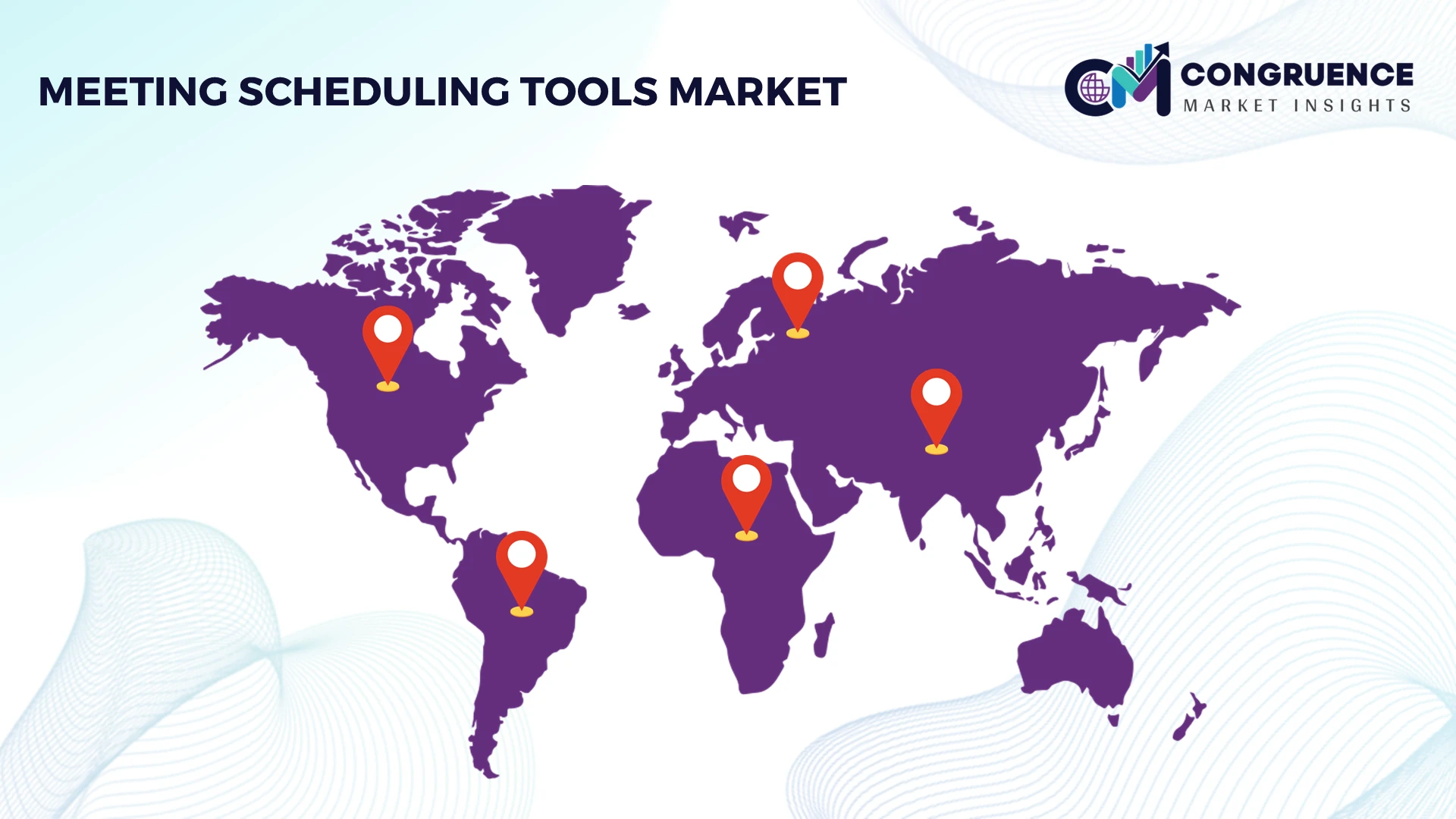
North America accounted for 38.5% of the global meeting scheduling tools market share in 2025, supported by established SaaS infrastructure, extensive enterprise digitization, and the presence of leading scheduling software providers. Organizations across healthcare, financial services, recruitment, and professional services are integrating automated appointment management into existing CRM and collaboration ecosystems. Calendly serves over 20 million users globally, demonstrating the international scalability of North American scheduling platforms. Enterprises are increasingly replacing fragmented booking applications with centralized systems incorporating automated reminders, meeting routing, and administrative controls. Canada's expanding technology services sector further supports adoption among distributed workforces and customer-facing businesses. Providers are strengthening enterprise security, application interoperability, and subscription customization to improve customer retention. Competitive differentiation increasingly depends on connecting scheduling functionality with broader business process automation and customer engagement workflows.
United States Market Outlook: The United States dominates regional demand through its established enterprise software ecosystem and extensive adoption of digital workplace technologies. Approximately 22.8% of employed Americans teleworked in August 2024, reinforcing requirements for coordinated calendar management. Healthcare organizations, recruitment agencies, and technology companies are increasingly deploying self-service booking interfaces, strengthening demand for specialized scheduling platforms with advanced CRM integration and administrative functionality.
Europe accounted for 27.0% of the global meeting scheduling tools market share in 2025, driven by enterprise modernization, cross-border workforce coordination, and increasing adoption of digital appointment management systems. Financial institutions, healthcare providers, educational organizations, and professional service companies are prioritizing scheduling platforms offering secure calendar synchronization and configurable data governance. GDPR requirements, carrying penalties of up to 4% of annual global turnover for serious violations, influence enterprise procurement decisions. Germany, the United Kingdom, and France represent significant deployment markets owing to their established corporate infrastructure and technology services industries. Scheduling providers are expanding multilingual interfaces, regional hosting capabilities, and privacy-focused integrations to accommodate country-specific operational requirements. European businesses increasingly evaluate scheduling solutions based on regulatory compliance, interoperability, and administrative efficiency rather than standalone booking functionality.
United Kingdom Market Outlook: The United Kingdom benefits from its established financial services, consulting, healthcare, and technology industries. Approximately 28% of working adults in Great Britain followed hybrid working arrangements during autumn 2024, supporting demand for flexible meeting coordination. London's professional services ecosystem creates significant opportunities for client-facing scheduling solutions incorporating automated appointment confirmations, resource allocation, and secure customer information management.
Asia-Pacific accounted for 23.5% of the global meeting scheduling tools market share in 2025, supported by expanding digital services industries, increasing cloud adoption, and the modernization of customer engagement processes. China, India, Japan, and Australia are experiencing growing deployment of scheduling platforms across technology services, education, healthcare, and financial institutions. China's internet user base exceeded 1.1 billion by the end of 2024, providing substantial infrastructure for digital appointment management. Japanese enterprises are adopting automated scheduling to address workforce constraints, while Australian businesses emphasize integration with established productivity applications. Providers are introducing mobile-first interfaces, multilingual booking capabilities, and affordable subscription models tailored to regional purchasing requirements. Integration with local communication platforms and enterprise software ecosystems is becoming essential for market penetration, particularly among small businesses transitioning from manual appointment coordination.
India Market Outlook: India represents a strategically significant expansion market owing to its extensive IT services, business process management, and digital healthcare ecosystems. The country's technology industry employed approximately 5.8 million professionals in FY2025, creating substantial requirements for distributed workforce coordination. Scheduling software providers are targeting recruitment agencies, outsourcing companies, educational institutions, and healthcare businesses through affordable subscriptions, localized interfaces, and automated customer appointment workflows.
South America accounted for 6.5% of the global meeting scheduling tools market share in 2025, supported by increasing digital entrepreneurship, expanding internet connectivity, and modernization of customer-facing business operations. Brazil, Argentina, and Colombia are emerging as important deployment markets across healthcare, beauty and wellness, professional services, and educational institutions. Brazil's internet penetration exceeded 85% in early 2025, strengthening the infrastructure required for online appointment management. Businesses are increasingly replacing telephone-based reservations with mobile-accessible booking interfaces and automated confirmation systems. However, uneven digital infrastructure, subscription affordability, and currency volatility constrain enterprise-wide deployment in smaller economies. Scheduling providers are responding through flexible pricing, localized payment integrations, and simplified onboarding processes. Integration with messaging applications represents a particularly important competitive advantage, enabling businesses to digitize appointment workflows without significantly changing established customer communication behavior.
Brazil Market Outlook: Brazil leads regional adoption through its extensive service-sector economy, digital payment infrastructure, and expanding small business ecosystem. The country's Pix instant payment system processed more than 60 billion transactions in 2024, demonstrating widespread acceptance of digital transactions. Scheduling providers are targeting healthcare clinics, personal care businesses, and independent professionals through integrated appointment booking, payment collection, and automated customer communication capabilities.
Middle East & Africa accounted for 4.5% of the global meeting scheduling tools market share in 2025, supported by government-led digital transformation, expanding cloud infrastructure, and modernization of enterprise service delivery. Saudi Arabia, the United Arab Emirates, and South Africa represent important adoption markets across healthcare, hospitality, financial services, and public administration. Microsoft's USD 1.5 billion investment in UAE-based G42 announced in 2024 demonstrates strengthening regional commitments to cloud computing and advanced digital technologies. Enterprises are increasingly introducing centralized appointment systems to improve service accessibility and administrative coordination. Infrastructure disparities and limited technology budgets remain deployment constraints across several African markets. Providers are expanding Arabic-language interfaces, mobile-compatible scheduling applications, and partnerships with local technology distributors. Integration with regional communication platforms and secure cloud environments is becoming increasingly important for enterprise customer acquisition.
United Arab Emirates Market Outlook: The United Arab Emirates benefits from advanced telecommunications infrastructure, extensive digital government initiatives, and concentrated investment in enterprise technology. Internet penetration reached approximately 99% in early 2025, supporting widespread accessibility of digital appointment services. Healthcare institutions, hospitality operators, financial organizations, and government agencies are strengthening automated booking capabilities to improve customer experience, resource utilization, and operational responsiveness.
The meeting scheduling tools market exhibits moderate concentration, with the five leading providers collectively holding an estimated 62.5% share. Calendly competes with Microsoft and Google across enterprise scheduling, while Doodle, Squarespace, and Zoho differentiate through specialized booking functionality, affordability, and ecosystem integration. Competition centers on calendar interoperability, subscription pricing, appointment routing, and workflow customization. Advanced scheduling deployments target 25–35% reductions in administrative coordination time, while standardized integrations offer potential implementation cost savings of 15–20%. Microsoft and Google leverage established productivity ecosystems, whereas Calendly strengthens CRM partnerships and enterprise automation capabilities. Specialized providers expand industry-specific booking interfaces and configurable customer engagement workflows. Competitive positioning is shifting from standalone appointment management toward integrated scheduling infrastructure supporting sales, recruitment, and service delivery. Established software ecosystems, security certification requirements, and customer switching costs create substantial entry barriers. Winning requires superior interoperability, reliable automation, competitive pricing, and demonstrable operational improvements across complex enterprise customer workflows.
Calendly LLC
Microsoft Corporation
Google LLC
Doodle AG
Squarespace, Inc. (Acuity Scheduling)
Zoho Corporation
OnceHub
Chili Piper, Inc.
YouCanBookMe Ltd.
Setmore
SimplyBook.me Ltd.
HubSpot, Inc.
Appointy
Reclaim.ai (Dropbox, Inc.)
Cloud-based scheduling infrastructure, real-time calendar synchronization, and automated booking interfaces underpin current meeting scheduling technology. Unlike conventional email-based coordination, integrated scheduling platforms target 25–35% reductions in administrative booking time and 15–20% improvements in resource utilization. API connectivity with Microsoft Outlook, Google Calendar, and enterprise CRM systems enables centralized availability management. Calendly's global user base exceeding 20 million demonstrates widespread acceptance of automated scheduling workflows across professional environments.
Emerging technologies include predictive availability engines, intelligent appointment routing, and natural language scheduling assistants. These capabilities target 20–30% faster customer appointment allocation and 15–25% reductions in repetitive coordination activities. Automated reminders and contextual rescheduling improve appointment continuity, particularly across healthcare, recruitment, and customer-facing sales operations. Specialized providers benefit from embedding scheduling intelligence within industry-specific workflows, while established productivity vendors leverage extensive application ecosystems.
Between 2026 and 2028, autonomous scheduling agents, contextual meeting prioritization, and permission-based calendar automation will reshape enterprise deployment strategies. Advanced implementations target automation of 40–50% of repetitive scheduling activities while reducing manual intervention requirements. Integration with conversational interfaces and enterprise resource management platforms will strengthen operational visibility. Technology investment priorities increasingly favor interoperable scheduling architecture, secure data processing, and measurable productivity improvements, enabling providers to differentiate through business outcomes rather than basic booking functionality.
The Meeting Scheduling Tools Market Report provides comprehensive analysis of market segmentation by type, application, end-user, and geographical region. The report covers cloud-based and on-premises scheduling solutions across business meeting scheduling, customer appointment scheduling, sales and marketing, recruitment, and other applications. End-user analysis encompasses large enterprises and small and medium enterprises, with regional coverage spanning North America, Europe, Asia-Pacific, South America, and the Middle East & Africa.
The report evaluates emerging technologies, including AI-powered scheduling assistants, predictive availability management, automated appointment routing, CRM integration, and secure calendar synchronization. Competitive analysis profiles 14 prominent market participants, examining product innovation, strategic partnerships, expansion initiatives, and enterprise deployment strategies. The report supports investment planning, market entry decisions, technology development, and competitive positioning while identifying evolving customer requirements and strategic business opportunities between 2026 and 2033.
| Report Attribute / Metric | Details |
|---|---|
| Market Revenue (2025) | USD 205.0 Million |
| Market Revenue (2033) | USD 329.2 Million |
| CAGR (2026–2033) | 6.1% |
| Base Year | 2025 |
| Forecast Period | 2026–2033 |
| Historic Period | 2021–2025 |
| Segments Covered |
By Type
By Application
By End-User
|
| Key Report Deliverables | Revenue Forecast; Market Trends; Growth Drivers & Restraints; Technology Insights; Segmentation Analysis; Regional Insights; Competitive Landscape; Regulatory & ESG Overview; Recent Developments |
| Regions Covered | North America; Europe; Asia-Pacific; South America; Middle East & Africa |
| Key Players Analyzed | Calendly LLC; Microsoft Corporation; Google LLC; Doodle AG; Squarespace, Inc. (Acuity Scheduling); Zoho Corporation; OnceHub; Chili Piper, Inc.; YouCanBookMe Ltd.; Setmore; SimplyBook.me Ltd.; HubSpot, Inc.; Appointy; Reclaim.ai (Dropbox, Inc.) |
| Customization & Pricing | Available on Request (10% Customization Free) |




