
Reports
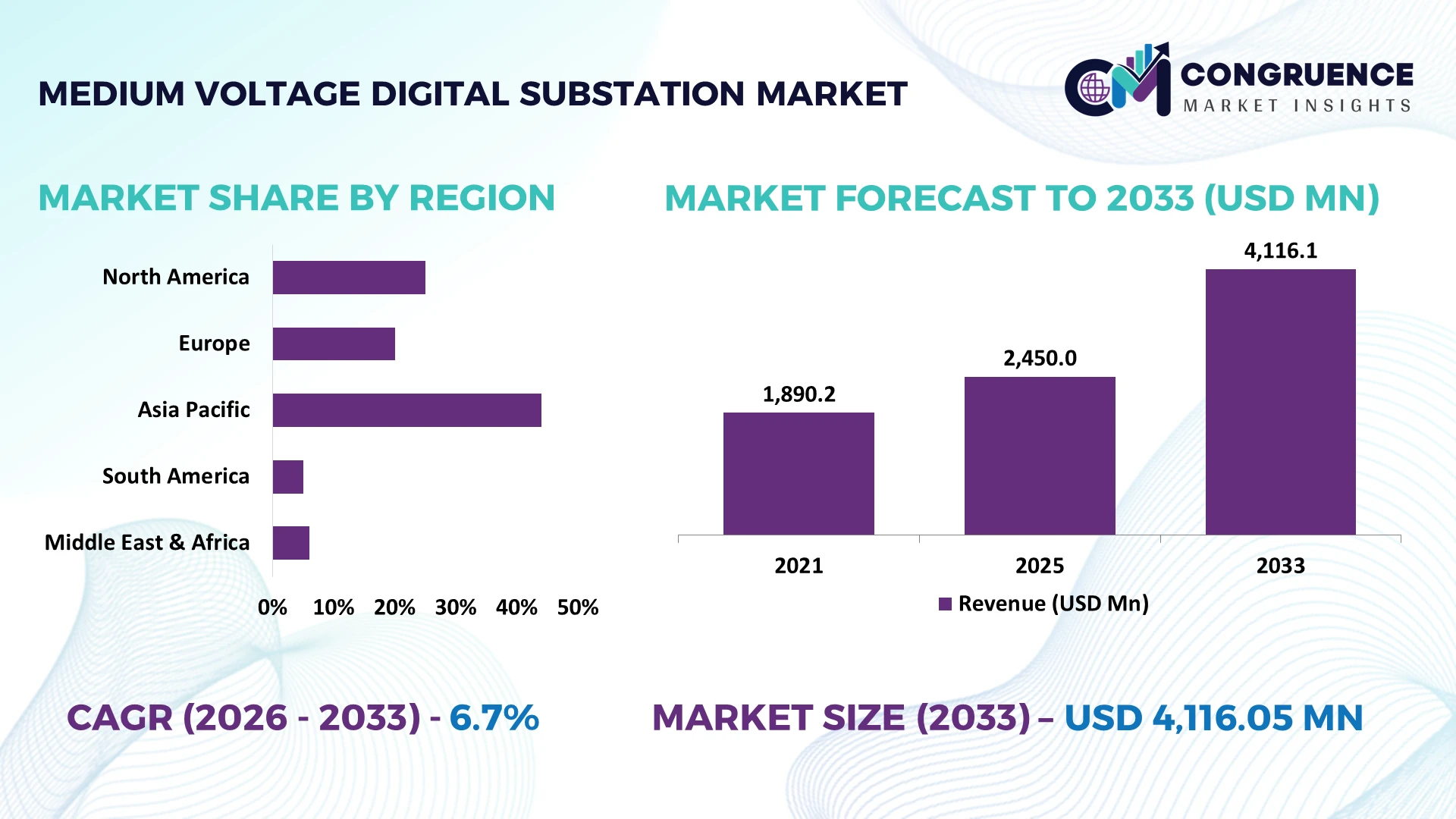
The Global Medium Voltage Digital Substation Market was valued at USD 2450 Million in 2025 and is anticipated to reach a value of USD 4116.05 Million by 2033 expanding at a CAGR of 6.7% between 2026 and 2033. Growth is driven by IEC 61850-based substation automation, replacement of conventional protection relays, renewable energy grid integration, and utility investments in real-time distribution network monitoring.
China dominates the medium voltage digital substation landscape through extensive distribution grid modernization, domestic switchgear manufacturing, and large-scale renewable energy integration. China's installed renewable power capacity exceeded 1,800 GW by the end of 2024, strengthening requirements for automated protection, digital communication, and intelligent voltage management. Compared with India, where the Revamped Distribution Sector Scheme targets substantial distribution infrastructure upgrades, China benefits from more extensive domestic production of intelligent electronic devices and grid automation equipment. State Grid Corporation of China's digital grid initiatives reinforce demand for IEC 61850-compatible substations and interoperable protection systems.
For equipment manufacturers and utilities, competitive advantage increasingly depends on interoperable automation platforms, cybersecurity capabilities, and lower lifecycle maintenance costs.
Market Size & Growth: USD 2,450 million in 2025, reaching USD 4,116.05 million by 2033 at 6.7% CAGR, supported by digital protection and distribution grid modernization.
Top Growth Drivers: China's renewable capacity increased 25% in 2024; India's distribution reforms target 12–15% AT&C losses; digital process-bus designs reduce copper cabling by up to 80%.
Short-Term Forecast: By 2028, India's RDSS modernization program targets completion of sanctioned smart metering works, improving distribution visibility and operational control.
Emerging Technologies: IEC 61850 process bus, AI-assisted fault diagnostics, and Ethernet-based protection networks enable faster fault identification and intelligent asset monitoring.
Regional Leaders: Asia-Pacific leads digital grid expansion, Europe prioritizes IEC 61850 interoperability, and North America advances automated feeder protection and utility cybersecurity.
Consumer/End-User Trends: India's 45 distribution utilities received smart metering approvals covering 19.79 crore consumers, strengthening integration requirements for digital substations.
Pilot/Case Example: ABB's digital substation architecture demonstrates up to 80% lower copper cabling requirements through fiber-optic process-bus integration.
Competitive Landscape: Siemens Energy, Hitachi Energy, Schneider Electric, ABB, and GE Vernova compete through protection platforms, digital switchgear, and grid automation systems.
Regulatory & ESG Impact: India's distribution reform framework targets AT&C losses of 12–15%, reinforcing investments in intelligent monitoring and network efficiency.
Investment & Funding: India's RDSS allocates INR 3.04 lakh crore toward distribution modernization, smart metering, and infrastructure upgrades.
Innovation & Future Outlook: By 2033, software-defined protection, digital twins, and interoperable intelligent electronic devices strengthen lifecycle asset management and decentralized grid operations.
The Medium Voltage Digital Substation Market is gaining strategic importance across electricity distribution utilities, renewable energy interconnection facilities, industrial substations, and data center power infrastructure. Digital switchgear, intelligent electronic devices, and fiber-optic communication networks are replacing conventional hardwired protection architectures. Advanced process-bus technology offers up to 80% reduction in copper cabling under suitable substation configurations, improving installation efficiency and equipment integration. India's distribution modernization initiatives and Europe's grid interoperability requirements reinforce investment in automated protection systems. Increasing adoption of predictive maintenance and cybersecurity-enabled control platforms establishes the foundation for evaluating long-term market opportunities and competitive positioning.
Medium voltage digital substations are becoming strategically important as electricity utilities prioritize network reliability, decentralized energy integration, and intelligent distribution infrastructure. China's renewable power capacity exceeded 1,800 GW in 2024, creating substantial requirements for automated feeder protection and voltage regulation. India's Revamped Distribution Sector Scheme targets aggregate technical and commercial losses of 12–15%, accelerating investments in intelligent monitoring infrastructure. These developments are shifting procurement priorities from standalone electrical equipment toward integrated digital protection, communication, and control platforms.
IEC 61850-based process-bus architectures replace conventional copper-intensive wiring with fiber-optic communication, reducing copper cabling requirements by up to 80% in suitable configurations. This improves installation flexibility and reduces secondary wiring complexity. China benefits from extensive domestic switchgear manufacturing and utility-scale deployment, while Germany emphasizes interoperability, cybersecurity, and renewable grid integration. Digital substations equipped with merging units and intelligent electronic devices enable centralized diagnostics, synchronized measurements, and remote equipment supervision, strengthening operational responsiveness.
Between 2026 and 2028, utilities will increasingly prioritize digital retrofit projects, automated fault isolation, and condition-based maintenance. Industrial facilities integrating solar generation and battery storage represent practical deployment opportunities for adaptive protection systems. Siemens Energy, Hitachi Energy, and Schneider Electric are strengthening digital grid portfolios through software development, automation partnerships, and integrated engineering capabilities. Suppliers combining interoperable protection technology with dependable lifecycle services will secure stronger competitive positioning.
Electricity distribution modernization is the principal driver of medium voltage digital substation deployment. China's renewable electricity capacity expanded approximately 25% during 2024, increasing requirements for bidirectional power flow management and automated feeder protection. India's distribution reforms target AT&C losses of 12–15%, while IEC 61850 process-bus systems can reduce conventional copper wiring requirements by up to 80%. These structural changes encourage utilities to replace electromechanical relays and hardwired control circuits with intelligent electronic devices, digital communication networks, and centralized monitoring platforms. Hitachi Energy, Siemens Energy, and Schneider Electric are expanding digital protection portfolios and integrated automation capabilities. The strategic advantage lies in improving network observability without proportionately increasing substation maintenance requirements.
Existing medium voltage substations frequently contain mixed-generation protection relays, proprietary communication protocols, and conventional instrument transformers, complicating digital retrofits. IEC 61850 process-bus architecture can eliminate up to 80% of copper cabling, but savings do not automatically offset expenditures on merging units, Ethernet switches, engineering software, and commissioning. India's distribution reform framework targets AT&C losses of 12–15%, highlighting financial pressures affecting utility modernization budgets. In Germany, regulated network operators must coordinate equipment upgrades with established protection schemes and cybersecurity requirements. Manufacturers are addressing these limitations through modular retrofit packages, protocol gateways, and standardized engineering tools. Suppliers offering staged modernization gain an advantage over vendors requiring complete substation replacement, particularly where existing switchgear remains operationally viable.
Software-configurable protection systems create opportunities beyond conventional digital switchgear replacement. China's renewable power installations exceeded 1,800 GW by the end of 2024, increasing demand for adaptive protection across distribution networks connecting solar, wind, and battery storage assets. Process-bus architectures offering up to 80% copper cabling reduction create additional opportunities for compact industrial substations and modular power distribution facilities. India's objective of reducing AT&C losses to 12–15% supports deployment of intelligent feeder monitoring and automated fault localization. Manufacturers are investing in edge analytics, virtualized protection functions, and interoperable automation software. Between 2026 and 2028, partnerships between relay manufacturers, industrial software developers, and system integrators will create differentiated opportunities in recurring diagnostic services and digital retrofit engineering.
Digital substations introduce execution challenges involving deterministic Ethernet communication, time synchronization, cybersecurity governance, and protection system validation. IEC 61850-9-2 sampled-value implementations commonly use 80 samples per electrical cycle, requiring dependable network performance and synchronized data delivery. At 50 Hz, this represents 4,000 samples per second for each measurement stream, increasing engineering requirements for communication infrastructure. Germany's implementation of the European NIS2 cybersecurity framework intensifies attention to operational technology security, incident reporting, and supply-chain accountability. Meanwhile, fiber-optic process-bus designs can reduce copper cabling by up to 80%, but introduce dependence on network configuration and digital diagnostics expertise. Siemens Energy, Hitachi Energy, and automation integrators must strengthen interoperability testing, cybersecurity engineering, and technician certification. Reliable multi-vendor integration will determine long-term deployment consistency and customer confidence.
Compact Sensor-Based Switchgear Deployment Accelerates: Utilities are incorporating low-power instrument transformers and embedded sensors into medium voltage switchgear, reducing secondary wiring and equipment footprints. Standard 24 kV and 36 kV configurations support compact installations, while sensor outputs enable continuous electrical measurements. ABB and Schneider Electric are integrating digital sensing into switchgear portfolios, improving installation flexibility and reducing dependence on conventional instrument transformers.
Digital Engineering Streamlines Substation Commissioning: IEC 61850 configuration workflows increasingly use standardized Substation Configuration Language files to coordinate protection settings, communication interfaces, and equipment testing. Ethernet networks operating at 100 Mbps or 1 Gbps support digital communication architectures. Siemens and Hitachi Energy are advancing engineering automation and virtual testing, reducing repetitive configuration work and improving commissioning consistency across multi-site utility programs.
SF6-Free Equipment Procurement Gains Momentum: European Regulation 2024/573 restricts fluorinated gas use in new medium voltage electrical switchgear, with relevant prohibitions beginning in 2026 for equipment rated up to 24 kV and in 2030 for higher ratings up to 52 kV. Siemens and Schneider Electric are expanding alternative insulation technologies, aligning digital switchgear procurement with environmental compliance and equipment lifecycle planning.
Secure Remote Maintenance Becomes Standardized: Digital substation operators are strengthening remote access controls, network segmentation, and event recording as protection systems become more interconnected. IEC 62351 security mechanisms complement IEC 61850 communication, while IEC 62443 provides industrial cybersecurity guidance. GE Vernova and Hitachi Energy are incorporating secure communication and remote diagnostic capabilities, helping utilities standardize maintenance workflows across geographically dispersed distribution assets.
Station Bus Substations represent the leading type in the Medium Voltage Digital Substation Market, supported by established IEC 61850 communication architectures and compatibility with conventional switchgear. Their commercial advantage comes from integrating protection relays, bay controllers, and supervisory systems without requiring complete replacement of primary electrical equipment. Utilities in Germany and Japan favor these architectures for brownfield modernization, where equipment availability and installation continuity influence procurement. The segment also benefits from standardized engineering interfaces and established maintenance practices.
Fully Digital Substations represent the strongest emerging technology direction, combining digital measurement, process-bus communication, and integrated automation. Process Bus Substations are gaining attention for fiber-optic sampled-value transmission, while Hybrid Digital Substations provide transitional architectures for facilities retaining conventional instrument transformers. The shift toward complete digitalization encourages Hitachi Energy, Siemens Energy, and ABB to develop interoperable merging units, intelligent sensors, and modular protection platforms. Process-bus designs can reduce copper cabling requirements by up to 80% in suitable installations, creating a measurable installation advantage over conventional hardwired arrangements. Suppliers offering flexible migration architectures are better positioned to capture modernization contracts.
Power Distribution represents the leading application for medium voltage digital substations because feeder automation, fault management, and network monitoring are concentrated within distribution infrastructure. Utilities operating 11 kV, 22 kV, and 33 kV networks increasingly deploy intelligent protection systems to improve switching coordination and operational visibility. India's distribution modernization programs reinforce demand for automated substations, while established European networks prioritize equipment refurbishment and remote supervision. Power Transmission remains relevant at medium voltage interfaces connecting substations, industrial networks, and localized transmission infrastructure. Grid Modernization supports replacement of aging secondary systems with interoperable digital communication platforms.
Renewable Energy Integration is emerging as the fastest-growing application opportunity, supported by expanding solar, wind, and energy storage connections. Global renewable capacity increased 15.1% during 2024, strengthening requirements for bidirectional protection and voltage management. Industrial Power Systems increasingly incorporate digital relays for critical process continuity. Schneider Electric, Siemens Energy, and GE Vernova are developing application-specific automation packages that combine protection, monitoring, and operational analytics. This differentiation strengthens supplier positioning across utility and industrial projects.
Electric Utilities dominate medium voltage digital substation procurement because distribution companies manage extensive feeder networks, switching stations, and transformer infrastructure requiring coordinated protection. Their purchasing priorities emphasize equipment reliability, standardized communication, remote operation, and maintenance continuity. India's electricity distribution modernization initiatives illustrate the scale of institutional procurement, particularly across 11 kV and 33 kV networks. Industrial Facilities represent another established customer group, with steel, chemical, and manufacturing plants prioritizing power quality and fault isolation. Railways and Transportation operators require specialized protection configurations for traction substations and electrified infrastructure.
Renewable Energy Operators represent the strongest emerging end-user opportunity as solar parks, wind installations, and battery storage facilities require increasingly sophisticated grid connection systems. Commercial Infrastructure buyers, particularly data center operators, prioritize redundant electrical distribution and continuous equipment monitoring. The International Energy Agency projects global data center electricity consumption to exceed 945 TWh by 2030, highlighting expanding power infrastructure requirements. Hitachi Energy, Schneider Electric, and Siemens Energy are responding with configurable protection solutions, remote diagnostics, and integrated service agreements. Competitive differentiation increasingly depends on matching equipment architecture to operational requirements.
Asia-Pacific accounted for the largest market share at approximately 42% in 2025 however, Middle East & Africa is expected to register the fastest growth, expanding at a CAGR of approximately 8.2% between 2026 and 2033.
Grid Resilience Investments Accelerate Digital Protection Modernization
North America represents an established medium voltage digital substation market, supported by utility distribution automation, industrial electrification, and replacement of aging electrical infrastructure. The United States dominates regional deployment through investments in feeder protection, automated switching, and advanced distribution management systems. Canada's electricity networks emphasize digital monitoring for remote substations, hydroelectric integration, and industrial power reliability. The US Department of Energy's Grid Resilience and Innovation Partnerships program provides up to USD 10.5 billion for grid resilience and modernization initiatives, creating procurement opportunities for digital substation equipment. Utilities increasingly specify IEC 61850-compatible intelligent electronic devices, remote terminal units, and secure communication networks. GE Vernova, Eaton, and Schneider Electric compete through integrated protection solutions and utility engineering partnerships. Equipment manufacturers offering standardized retrofit packages benefit from shorter installation windows and reduced operational disruption.
United States Market Outlook: The United States maintains a strong competitive position through established electrical equipment manufacturing, utility automation expertise, and expanding power requirements from data centers. The Department of Energy estimates that data centers consumed approximately 4.4% of national electricity in 2023, with consumption potentially reaching 6.7–12% by 2028. These requirements strengthen investment in resilient medium voltage distribution infrastructure, redundant protection systems, and intelligent power monitoring.
Regulatory Modernization Reshapes Digital Switchgear Procurement
Europe's medium voltage digital substation landscape is influenced by renewable electricity integration, distribution network reinforcement, and stricter equipment sustainability requirements. Germany, France, Italy, and the United Kingdom represent important deployment markets, supported by established electrical equipment manufacturers and regulated distribution operators. European Union Regulation 2024/573 introduces restrictions on fluorinated greenhouse gases in new electrical switchgear, with relevant requirements beginning in 2026 for equipment rated up to 24 kV. This policy accelerates procurement of alternative insulation technologies integrated with digital monitoring and protection capabilities. Siemens Energy, Schneider Electric, and Hitachi Energy are developing interoperable substation automation platforms suited to utility modernization programs. European distribution operators increasingly prioritize standardized communication protocols, equipment lifecycle management, and cybersecurity compliance. Manufacturers combining SF6-free switchgear with advanced digital control systems gain stronger positioning in regulated infrastructure tenders.
Germany Market Outlook: Germany benefits from established electrical engineering capabilities, sophisticated distribution networks, and extensive renewable energy deployment. Renewable electricity represented approximately 55% of gross electricity consumption in 2024, increasing requirements for intelligent voltage regulation and distributed generation monitoring. German manufacturers are advancing sensor-integrated switchgear, digital protection relays, and interoperable automation software. Network operators prioritize equipment reliability, grid stability, and compliance with evolving environmental standards.
Manufacturing Scale Supports Extensive Distribution Digitalization
Asia-Pacific leads the medium voltage digital substation market through extensive electricity distribution infrastructure, concentrated electrical equipment manufacturing, and accelerating industrial electrification. China dominates regional production and deployment, supported by domestic switchgear manufacturers, advanced protection equipment suppliers, and large-scale utility modernization programs. India is expanding distribution automation through government-supported infrastructure improvements, while Japan emphasizes intelligent substations for network resilience and industrial power quality. South Korea contributes advanced electronic components, automation systems, and digital communication technologies. China's installed renewable electricity capacity exceeded 1,800 GW by the end of 2024, increasing the operational importance of automated feeder management and distributed energy coordination. Hitachi Energy, Mitsubishi Electric, and domestic Chinese manufacturers are strengthening localized equipment production and digital engineering capabilities. Regional competitive advantage increasingly depends on manufacturing scale, component availability, and integration with established utility procurement networks.
China Market Outlook: China maintains a leading position through State Grid Corporation of China and China Southern Power Grid's extensive distribution infrastructure. National electricity consumption reached approximately 9.85 trillion kWh in 2024, demonstrating the scale of network operating requirements. Domestic manufacturers supply intelligent switchgear, digital protection equipment, and communication systems, supporting localized procurement and deployment. Investments in industrial electrification and renewable power transmission reinforce demand for automated medium voltage substations.
Distribution Concession Upgrades Strengthen Automation Investment
South America's medium voltage digital substation market is shaped by electricity distribution modernization, renewable generation expansion, and industrial power reliability requirements. Brazil represents the largest operational market, supported by extensive distribution concessions and investments in network automation. Chile emphasizes digital protection for renewable generation connections, while Colombia and Argentina prioritize modernization of aging distribution assets. Brazil's electricity generation mix contained approximately 88% renewable electricity in 2024, increasing requirements for coordinated protection across diverse generation sources. Distribution operators are introducing automated switching, intelligent feeder monitoring, and remote equipment diagnostics to improve service continuity. Siemens Energy, Schneider Electric, and regional engineering integrators compete through retrofit solutions and equipment servicing. Currency fluctuations, procurement financing, and uneven network infrastructure influence deployment schedules, favoring modular digital substation packages that limit upfront equipment replacement.
Brazil Market Outlook: Brazil benefits from an extensive regulated electricity distribution sector, established electrical equipment manufacturing, and substantial renewable generation resources. ANEEL's regulatory framework encourages improvements in distribution service quality and network performance. Major utilities, including CPFL Energia, Neoenergia, and Equatorial Energia, invest in automation and infrastructure reinforcement. Digital protection technologies support feeder fault identification, operational supervision, and equipment maintenance across geographically dispersed service territories.
Infrastructure Diversification Accelerates Intelligent Grid Deployment
The Middle East & Africa medium voltage digital substation market is influenced by large-scale electricity infrastructure investment, industrial diversification, and modernization of urban distribution networks. Saudi Arabia and the United Arab Emirates lead advanced grid automation adoption, while South Africa and Egypt prioritize network reliability and distribution infrastructure upgrades. Saudi Arabia's Vision 2030 industrial transformation encourages investments in intelligent electricity networks supporting manufacturing, transportation, and new urban developments. The UAE is integrating advanced protection technologies into utility networks serving industrial zones and expanding commercial infrastructure. South Africa faces distribution reliability challenges that reinforce demand for remote monitoring and automated fault management. Siemens Energy, Hitachi Energy, and Schneider Electric compete through utility partnerships, localized engineering services, and integrated automation platforms. Procurement success increasingly depends on technical support availability, environmental durability, and long-term equipment servicing capabilities.
Saudi Arabia Market Outlook: Saudi Arabia is strategically positioned through Saudi Electricity Company's distribution modernization initiatives and large-scale infrastructure development. The country's renewable energy strategy targets approximately 50% renewable electricity in its generation mix by 2030. Digital substations support power distribution requirements for NEOM, industrial manufacturing zones, and new urban infrastructure. Equipment suppliers are strengthening local engineering partnerships and automation capabilities to meet reliability and localization requirements.
The Medium Voltage Digital Substation Market features competition between integrated electrical equipment manufacturers and specialist automation suppliers. Siemens Energy, Hitachi Energy, Schneider Electric, ABB, and GE Vernova anchor the global competitive landscape, while Mitsubishi Electric and regional switchgear manufacturers compete through localized engineering and procurement relationships. The five leading groups collectively account for an estimated 45–55% of market activity, although standardized segment-specific disclosures remain limited. Competition centers on IEC 61850 interoperability, lifecycle support, cybersecurity, and installation economics. Fiber-optic process-bus designs can reduce copper wiring by up to 80%, while SF6-free switchgear addresses regulatory restrictions beginning in 2026 for relevant European voltage classes. Established manufacturers are integrating sensors, protection relays, software, and commissioning services; regional suppliers emphasize customization and faster replacement-part availability. Qualification testing, utility approval cycles, and specialist protection engineering create substantial entry barriers. Winning suppliers combine reliable multi-vendor integration, local service capacity, and demonstrable project-level cost advantages across projects.
Siemens Energy
Hitachi Energy
Schneider Electric
ABB
GE Vernova
Mitsubishi Electric
Eaton Corporation
Toshiba Energy Systems & Solutions
Hyosung Heavy Industries
LS ELECTRIC
NR Electric
Arteche Group
Schweitzer Engineering Laboratories (SEL)
Lucy Electric
IEC 61850 station-bus communication, intelligent electronic devices, and digital protection relays form the technological foundation of medium voltage digital substations. Ethernet-based automation replaces extensive point-to-point signaling with standardized communication between protection equipment and supervisory systems. Fiber-optic process-bus architectures can reduce secondary copper cabling by up to 80% compared with conventional hardwired designs. Station-bus configurations remain established in utility modernization, while integrated sensors and merging units improve equipment diagnostics and simplify secondary circuit engineering.
Emerging technologies include low-power instrument transformers, edge analytics, and virtualized protection functions. Digital current and voltage sensors eliminate conventional secondary wiring requirements, while condition-monitoring algorithms support earlier identification of insulation deterioration and switching abnormalities. IEC 61850-9-2 sampled-value systems commonly operate at 80 samples per electrical cycle, enabling synchronized measurement exchange. ABB, Siemens Energy, and Hitachi Energy benefit from integrating digital switchgear, automation software, and lifecycle engineering into unified equipment portfolios.
Between 2026 and 2028, software-defined protection, digital twins, and IEC 62351 cybersecurity mechanisms will influence procurement specifications. Virtual commissioning reduces dependence on physical testing environments, while interoperable automation architectures support phased equipment upgrades. Manufacturers offering validated communication interfaces and integrated cybersecurity capabilities gain advantages in utility qualification and industrial retrofit projects, where dependable protection performance determines investment decisions.
February 2024: GE Vernova launched GridBeats, featuring 5 software-defined grid automation solutions, including integrated digital substations. The portfolio supports centralized protection, autonomous grid control, and predictive maintenance, strengthening utility modernization capabilities. Source: ge.com.
November 2024: ABB implemented digital medium voltage switchgear and integrated monitoring solutions for a Chinese polycarbonate manufacturing facility with 180,000-ton production capacity. The deployment strengthened electrical reliability, equipment diagnostics, and operational continuity across industrial power distribution infrastructure. Source: abb.com.
April 2025: Schneider Electric introduced enhanced GenieEvo medium voltage switchgear in Britain and Ireland, increasing fault protection capacity from 25 kA to 31.5 kA. Digital monitoring and SF6-free insulation improve electrical resilience and support predictive maintenance. Source: se.com.
December 2025: Reuters reported Hitachi Energy's American manufacturing investments exceeding USD 1 billion, alongside expansion commitments from Siemens and GE Vernova. These investments address grid equipment shortages, strengthen domestic production capacity, and improve infrastructure procurement resilience. Source: reuters.com.
The Medium Voltage Digital Substation Market Report evaluates industry structure, technology adoption, competitive positioning, and investment opportunities between 2026 and 2033. Type segmentation covers Process Bus Substations, Station Bus Substations, Hybrid Digital Substations, and Fully Digital Substations. Application analysis examines Power Transmission, Power Distribution, Renewable Energy Integration, Industrial Power Systems, and Grid Modernization. End-user coverage includes Electric Utilities, Industrial Facilities, Renewable Energy Operators, Railways and Transportation, and Commercial Infrastructure. Regional assessment encompasses North America, Europe, Asia-Pacific, South America, and Middle East & Africa.
The report examines IEC 61850 automation, digital protection relays, intelligent sensors, software-defined substations, and cybersecurity architectures. Technology assessment considers process-bus configurations capable of reducing copper cabling by up to 80%. Competitive benchmarking evaluates supplier innovation, manufacturing localization, deployment capabilities, and partnerships, supporting procurement planning, geographic expansion, and long-term investment prioritization.
| Report Attribute/Metric | Report Details |
|---|---|
Market Revenue in 2025 | USD 2450 Million |
Market Revenue in 2033 | USD 4116.05 Million |
CAGR (2026 - 2033) | 6.7% |
Base Year | 2025 |
Forecast Period | 2026 - 2033 |
Historic Period | 2021 - 2025 |
Segments Covered | By Type
By Application
By End-User
|
Key Report Deliverable | Revenue Forecast, Growth Trends, Market Dynamics, Segmental Overview, Regional and Country-wise Analysis, Competition Landscape |
Region Covered | North America, Europe, Asia-Pacific, South America, Middle East, Africa |
Key Players Analyzed | Siemens Energy, Hitachi Energy, Schneider Electric, ABB, GE Vernova, Mitsubishi Electric, Eaton Corporation, Toshiba Energy Systems & Solutions, Hyosung Heavy Industries, LS ELECTRIC, NR Electric, Arteche Group, Schweitzer Engineering Laboratories (SEL), Lucy Electric |
Customization & Pricing | Available on Request (10% Customization is Free) |