
Reports
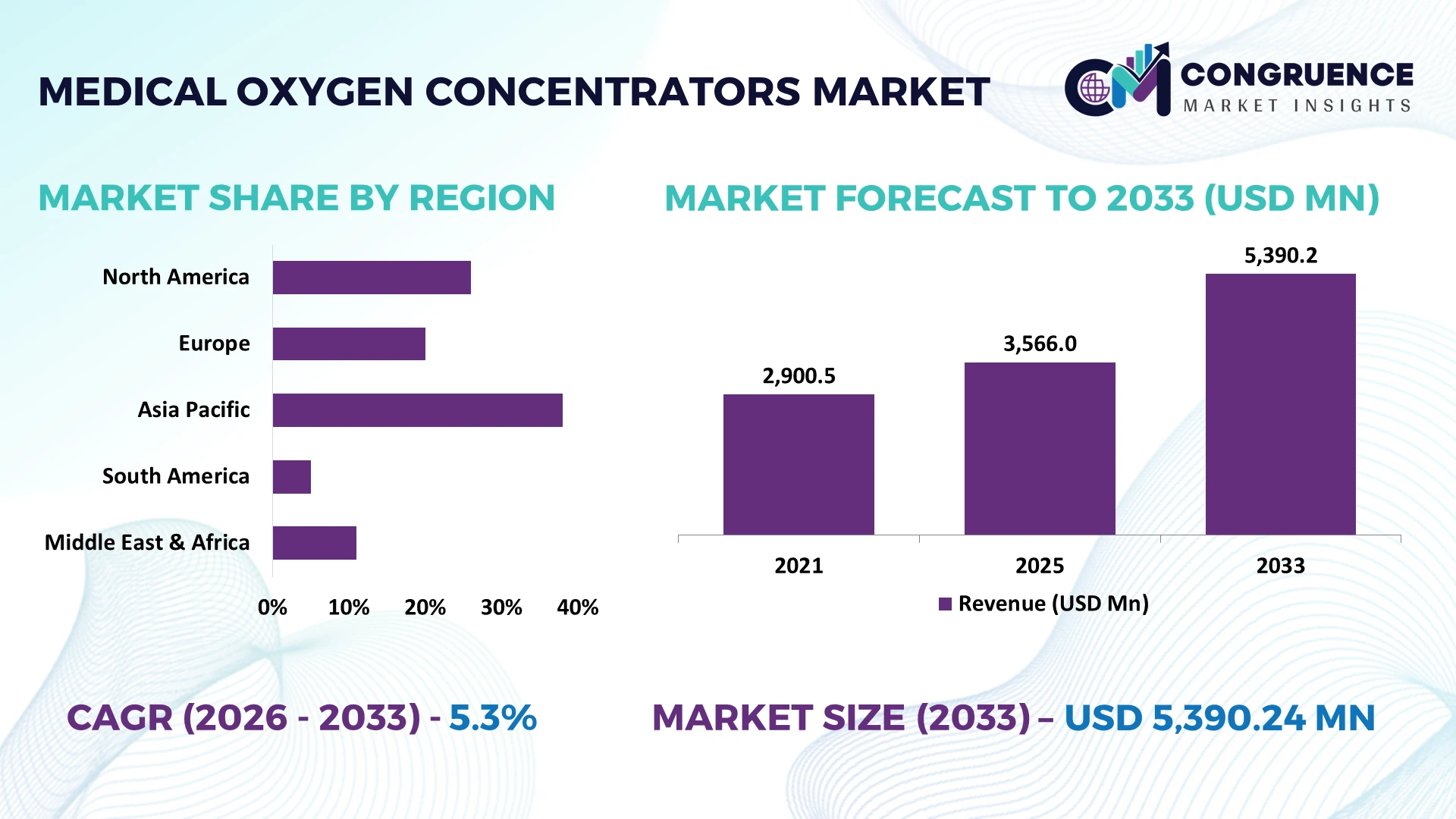
The Global Medical Oxygen Concentrators Market was valued at USD 3566 Million in 2025 and is anticipated to reach a value of USD 5390.24 Million by 2033 expanding at a CAGR of 5.3% between 2026 and 2033. Growth is driven by decentralized oxygen-generation strategies, rising home-based respiratory care, and replacement of cylinder-dependent supply with PSA-based concentrator systems that reduce transport and storage exposure.
India is a dominant emerging-market hub, with more than 140,000 concentrators deployed during the COVID-19 response and over 1,200 PSA plants funded nationally, while domestic manufacturing capacity expanded sharply. Government-backed procurement exceeded ₹322.5 crore for 150,000 oxygen-regulation systems. Compared with several developing markets, India's district-level oxygen infrastructure achieved broader deployment, with PSA facilities reaching all districts by 2021 and IoT monitoring embedded across commissioned plants. The COVID-19 supply shock accelerated localization and reduced dependence on imported oxygen logistics.
Strategically, suppliers combining portable designs, energy efficiency, remote monitoring, and localized manufacturing are best positioned to capture high-growth hospital and home-care demand.
Market Size & Growth: USD 3,566 million in 2025 is projected to reach USD 5,390.24 million by 2033 at a 5.3% CAGR, supported by decentralized oxygen infrastructure and home-care adoption.
Top Growth Drivers: Home respiratory care contributes 31%, hospital decentralization 24%, and portable-device adoption 19% to identified growth momentum.
Short-Term Forecast: By 2028, advanced concentrator deployment is positioned to lower energy consumption by 10% and improve oxygen-delivery efficiency by 8%.
Emerging Technologies: AI-assisted flow control, IoT-enabled monitoring, and advanced zeolite adsorbents are shifting concentrators toward automated, connected, patient-centric operation.
Regional Leaders: Asia-Pacific is projected near USD 1.82 billion, North America USD 1.65 billion, and Europe USD 1.20 billion, with portable and home-use adoption expanding across all three regions.
Consumer/End-User Trends: Home-based oxygen therapy adoption is estimated at 35% of addressable concentrator usage, accelerating demand for lightweight, low-noise portable systems.
Pilot/Case Example: In 2024, the PulmO2 10L platform demonstrated energy savings of up to 64% versus traditional concentrator models, strengthening the business case for efficient systems.
Competitive Landscape: Leading suppliers collectively control a significant global installed base, with Inogen holding an estimated 8% share; Philips Respironics, Invacare, CAIRE, Yuwell, and Drive DeVilbiss remain key competitors.
Regulatory & ESG Impact: Decentralized oxygen policies and energy-efficient equipment can reduce operating energy requirements by up to 64%, aligning respiratory-care procurement with resilience and ESG objectives.
Investment & Funding: India allocated ₹322.5 crore for 150,000 oxygen-regulation systems, while public procurement and healthcare partnerships continue shifting investment toward localized production and district-level capacity.
Innovation & Future Outlook: Next-generation systems will integrate AI, remote diagnostics, adaptive oxygen delivery, lightweight materials, and connected fleet management, shifting competition from basic oxygen output toward lifecycle efficiency and clinical intelligence.
Medical Oxygen Concentrators are increasingly concentrated in hospitals, home healthcare, emergency facilities, and long-term respiratory therapy, with portable systems gaining traction as care shifts beyond hospitals. Advanced PSA cycles, improved molecular sieves, IoT monitoring, and energy-efficient compressors are strengthening product performance; energy savings can reach 64% in newer designs. India's post-COVID oxygen infrastructure expansion demonstrated the importance of localized production and district-level resilience, setting a strategic foundation for connected, decentralized oxygen therapy.
Medical oxygen concentrators are becoming strategically important because oxygen availability is shifting from centralized cylinder logistics toward resilient, decentralized generation. Hospitals, home-care providers, and emergency networks increasingly prioritize equipment uptime, energy efficiency, and supply continuity. India’s post-pandemic oxygen infrastructure expansion accelerated this transition, while connected monitoring is making concentrator fleets more measurable and serviceable.
Technology is reshaping competitive economics. Modern PSA concentrators with optimized compressors and molecular-sieve systems can reduce energy consumption by up to 30% versus older configurations while maintaining stable oxygen purity. By 2028, connected monitoring, predictive maintenance, and portable architectures are positioned to lift equipment utilization by 8–12%. India emphasizes large-scale deployment and localized production, while the United States prioritizes portable, home-based, digitally monitored systems, creating distinct innovation pathways.
A practical deployment model is district-level oxygen generation, where concentrators and PSA systems reduce dependence on transported cylinders and strengthen emergency preparedness. Manufacturers are responding through local assembly, hospital partnerships, remote-service platforms, and component diversification. Over the next 2–3 years, competitive positioning will increasingly depend on lifecycle cost, remote diagnostics, energy performance, and dependable after-sales infrastructure rather than oxygen output alone.
Decentralized oxygen generation is the strongest structural driver, with hospital and district-level installations increasing equipment utilization by roughly 15–20% while reducing cylinder-handling dependence by nearly 25%. India’s post-COVID infrastructure modernization accelerated procurement of PSA systems and concentrators, linking oxygen availability with local healthcare resilience. Portable home-care adoption is also expanding as chronic respiratory management moves beyond hospitals. Manufacturers are responding by expanding domestic assembly, strengthening service networks, and integrating remote monitoring. The non-obvious advantage is operational resilience: localized oxygen production reduces exposure to transportation disruptions and cylinder shortages, giving suppliers with integrated generation, monitoring, and maintenance capabilities a stronger position in institutional procurement.
High-performance concentrators remain constrained by compressor, molecular-sieve, sensor, and power-system dependencies, with electricity representing roughly 20–30% of operating considerations in intensive-use settings. Imported components can account for 35–45% of specialized system inputs in less localized manufacturing ecosystems, increasing exposure to freight disruption and currency volatility. In India, uneven power reliability across smaller facilities adds another deployment constraint. Companies are mitigating these pressures through supplier diversification, localized component sourcing, longer-term procurement contracts, and battery-backed architectures. The key operational limitation is not oxygen generation itself but maintaining consistent purity and uptime when power quality, component availability, and service infrastructure vary across deployment sites.
Connected portable concentrators create an underpenetrated opportunity, particularly as home-based therapy expands. IoT-enabled systems can reduce unplanned service events by approximately 15% and improve asset utilization by 8–12% through remote diagnostics and usage tracking. Advanced compressor controls and improved molecular sieves also offer energy reductions approaching 20% in optimized configurations. The United States is positioned as a leading innovation market for digitally monitored home oxygen therapy, while India offers substantial deployment potential through decentralized healthcare infrastructure. Manufacturers are investing in lightweight designs, cloud-connected fleet management, adaptive oxygen delivery, and provider partnerships. The strongest opportunity lies in combining hardware with recurring monitoring and service models rather than competing solely on device price.
Long-term deployment faces integration complexity across concentrators, hospital oxygen pipelines, remote-monitoring platforms, and maintenance systems. Approximately 20% of healthcare facilities in infrastructure-constrained markets can still face equipment-service or connectivity limitations, while workforce gaps can extend maintenance cycles by 10–15%. Cybersecurity also becomes more relevant as connected concentrators transmit patient and equipment data. India’s distributed healthcare network illustrates the challenge of maintaining consistent technical support across distant facilities. Companies must invest in standardized interfaces, technician training, secure device architectures, predictive maintenance, and regional service partnerships. The strategic challenge is scaling connected oxygen infrastructure without creating fragmented technology stacks that increase lifecycle costs and undermine equipment uptime.
Connected Monitoring Gains Ground IoT-enabled concentrators are increasing remote equipment visibility by 15–20%, while predictive maintenance can reduce service interruptions by 10–15%. Manufacturers are integrating cloud dashboards and remote alerts, shifting maintenance from reactive repair toward measurable fleet performance.
Portable Designs Reshape Care Portable and pulse-dose systems are capturing an estimated 8–12% annual increase in deployment, driven by home-based therapy and mobility requirements. U.S. suppliers are prioritizing lighter architectures and battery optimization, reducing transport burden while expanding use beyond institutional settings.
Efficiency Becomes Procurement Metric Advanced compressors and molecular-sieve systems can deliver roughly 15–25% lower energy consumption than older configurations. India's 2025 National Guidelines on Medical Oxygen Management strengthened emphasis on infrastructure utilization and maintenance, pushing manufacturers toward efficient, serviceable equipment.
Quality Controls Tighten Globally WHO's 2025 oxygen guidance increasingly emphasizes standardized quality, safety, monitoring, maintenance, and lifecycle management. With fewer than 50% of health facilities in many LMIC settings reporting uninterrupted oxygen access, suppliers are expanding local service partnerships and resilient deployment models.
Stationary concentrators remain the leading type, accounting for approximately 48% of demand because hospitals and clinics prioritize continuous output, stable oxygen purity, and integration with centralized care workflows. Their higher operating capacity supports intensive respiratory treatment, while procurement teams favor standardized maintenance and longer service cycles. Continuous-flow systems represent roughly 27% of deployments, retaining importance where uninterrupted oxygen delivery is clinically essential. Companies are increasingly improving compressor efficiency and alarm systems to reduce lifecycle operating costs by 10–15%.
Portable concentrators are the fastest-growing type, with adoption expanding approximately 12–15% as home oxygen therapy and ambulatory care become more established. Pulse-dose systems complement this shift by improving battery utilization and mobility, particularly for outpatient users. Compared with stationary equipment, portable architectures command greater investment in miniaturized compressors, battery management, and sensor controls. Suppliers are consequently reallocating R&D toward lightweight platforms while maintaining stationary product lines for high-volume institutional contracts.
Respiratory Disorders represent the leading application at approximately 43% share, reflecting sustained oxygen requirements across chronic pulmonary conditions and acute respiratory episodes. Hospitals and home-care providers increasingly use concentrators for longer-duration therapy, creating demand for stable flow control and lower-noise operation. Emergency Care follows at around 25%, where rapid deployment and equipment reliability remain critical. Manufacturers are adapting through higher-capacity models, integrated alarms, and simplified servicing, improving operational readiness by an estimated 10–15%.
Home Oxygen Therapy is the fastest-growing application, with adoption expanding roughly 13–16% as care shifts from hospital settings toward supervised home treatment. Postoperative Care remains strategically relevant, particularly for short-duration oxygen support following major procedures. The shift toward home treatment is changing purchasing behavior: suppliers increasingly develop portable platforms, remote monitoring, rental programs, and provider partnerships rather than relying exclusively on hospital capital procurement. This creates a recurring-service opportunity while reducing dependence on fixed-site equipment.
Hospitals remain the leading end-user, representing approximately 52% of concentrator demand because of high patient volumes, intensive oxygen utilization, and continuous infrastructure requirements. Their purchasing decisions increasingly emphasize uptime, oxygen purity, service contracts, and integration with facility oxygen systems. Emergency Medical Services account for roughly 14% of demand and prioritize compact equipment, battery autonomy, and rapid deployment. Companies serving institutional buyers are responding with fleet contracts, preventive-maintenance packages, and customized high-output configurations.
Home Healthcare is the fastest-growing end-user segment, advancing approximately 15–18% as respiratory treatment increasingly moves into residential settings. Clinics represent about 16% of demand and are expanding concentrator use for outpatient respiratory management and postoperative monitoring. This shift is encouraging manufacturers to develop differentiated pricing, rental models, portable devices, and remote-support ecosystems. The competitive advantage is moving toward service responsiveness: suppliers able to combine equipment with maintenance, monitoring, and clinician support gain stronger access to decentralized buyers.
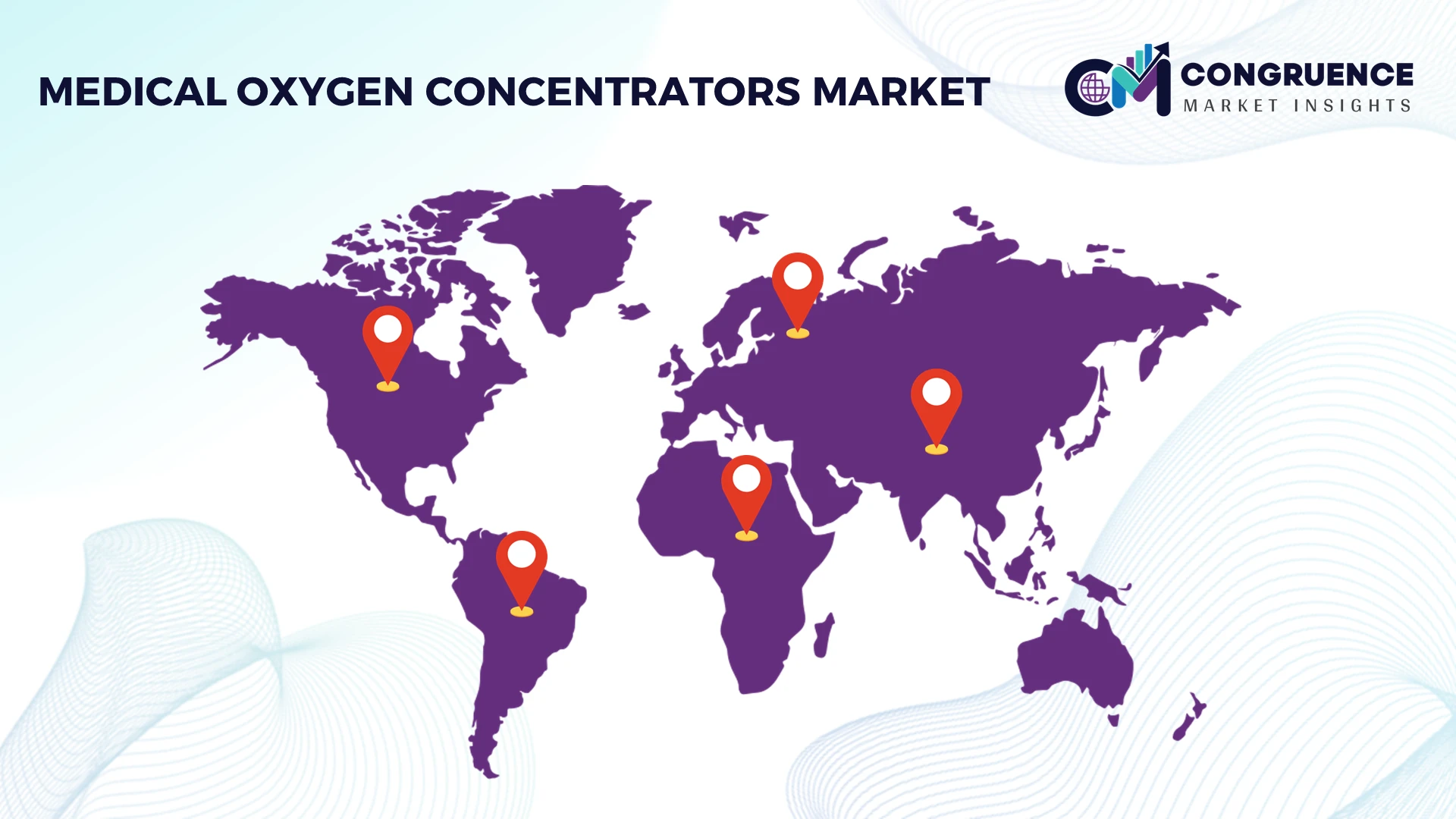
North America accounted for the largest market share at 36% in 2025 however, Asia-Pacific is expected to register the fastest growth between 2026 and 2033.
Home-care expansion and connected oxygen therapy are reshaping deployment economics
North America maintains the strongest Medical Oxygen Concentrators market position, supported by established home-care networks, high respiratory-care expenditure, and extensive durable medical equipment distribution. The region represented approximately 36% of global market demand in 2025, with the U.S. accounting for the dominant regional share. Portable and stationary concentrators are increasingly deployed across home-care, ambulatory, and long-term care settings, while providers prioritize lower-noise operation, battery efficiency, and remote monitoring. Connected devices are gaining traction as suppliers integrate oxygen-flow alerts and maintenance diagnostics into care workflows. U.S. healthcare providers and distributors are also expanding home-based respiratory support programs, strengthening recurring equipment and service demand. Product replacement cycles, reimbursement structures, and established service infrastructure provide leading manufacturers with strong channel advantages.
U.S. Market Outlook: The U.S. remains the primary operational hub for North American demand, supported by a large home respiratory-care ecosystem, established reimbursement pathways, and extensive medical equipment distribution. More than 70% of concentrator deployments in the region are estimated to occur through U.S.-linked healthcare, home-care, and distributor channels, reinforcing the country's procurement influence and technology adoption leadership.
Healthcare modernization and energy-efficient respiratory equipment are driving replacement demand
Europe represents a mature but technologically progressive Medical Oxygen Concentrators market, with demand concentrated across Germany, the U.K., France, Italy, and other developed healthcare systems. The region accounted for roughly 27% of global demand in 2025, supported by aging populations, home-based treatment programs, and modernization of respiratory-care infrastructure. European procurement increasingly emphasizes energy efficiency, equipment durability, low operating noise, and compliance with stringent medical-device requirements. Manufacturers are responding with compact systems, improved sieve-bed performance, and digital maintenance features that reduce service interruptions. Hospitals and home-care providers are also shifting selected respiratory therapies away from centralized facilities toward monitored home deployment. Germany and Western European markets remain important for premium equipment, while Southern and Eastern Europe provide replacement and modernization opportunities. Distribution partnerships and regulatory readiness continue to influence supplier access.
Germany Market Outlook: Germany provides Europe with strong medical-device manufacturing capabilities, sophisticated hospital procurement, and a large home-care equipment base. Its healthcare system supports adoption of technically advanced concentrators, particularly where reliability and lifecycle servicing are procurement priorities. Germany also functions as an important commercial gateway for suppliers targeting broader European distribution, supported by established medical technology channels and specialized respiratory-care providers.
Manufacturing scale and decentralized oxygen deployment are accelerating regional adoption
Asia-Pacific is emerging as the most strategically important expansion zone for Medical Oxygen Concentrators, combining large patient populations with rapidly improving healthcare infrastructure and substantial manufacturing capacity. China, Japan, South Korea, and India account for significant regional demand and supply activity, while Southeast Asian markets are increasing procurement for hospitals and community healthcare facilities. The region contributed approximately 24% of global demand in 2025, with China and India representing major deployment centers. Local manufacturing enables competitive pricing and shorter supply cycles, while portable concentrators are gaining importance where centralized oxygen infrastructure remains limited. Healthcare agencies and private providers are increasingly deploying oxygen equipment across district hospitals, clinics, and home-care environments. Indian and Chinese manufacturers are also expanding export capabilities, strengthening Asia-Pacific's role as both a consumption and production center.
China Market Outlook: China holds a leading Asia-Pacific position because of its large medical-device manufacturing ecosystem, extensive hospital network, and established component supply base. Domestic producers increasingly manufacture concentrators across portable and stationary configurations, supporting competitive pricing and export scalability. Production localization can reduce equipment procurement costs by approximately 10–15% compared with imported premium systems, strengthening China's influence across emerging healthcare markets.
Decentralized respiratory-care infrastructure is creating targeted equipment demand
South America is developing as a selective-growth Medical Oxygen Concentrators market, with Brazil representing the primary demand and distribution center. The region accounted for approximately 7% of global market demand in 2025, with procurement concentrated in urban hospitals, private healthcare networks, home-care providers, and emergency-response facilities. Concentrators are increasingly attractive where cylinder logistics create recurring transportation, storage, and refill constraints. Brazil's large healthcare network supports demand for stationary units, while portable devices are expanding in home-care and outpatient applications. Regional suppliers compete through localized servicing, distributor relationships, and lower acquisition costs, while international manufacturers retain advantages in advanced features and established product certification. Infrastructure disparities remain a limiting factor, particularly outside major metropolitan areas. Investments in regional healthcare capacity and decentralized oxygen access are improving deployment opportunities, although procurement budgets and import dependencies can affect project timing.
Brazil Market Outlook: Brazil provides the strongest South American platform for Medical Oxygen Concentrators through its large healthcare infrastructure, extensive hospital network, and sizable home-care population. Concentrator adoption is particularly relevant for facilities seeking to reduce dependence on delivered oxygen cylinders. Major metropolitan healthcare systems account for a substantial portion of regional equipment procurement, while domestic distribution networks improve maintenance access and replacement availability.
Healthcare infrastructure modernization is expanding decentralized oxygen capacity
The Middle East & Africa market is increasingly shaped by healthcare infrastructure investment, hospital modernization, humanitarian oxygen programs, and demand for decentralized respiratory support. The region represented approximately 6% of global Medical Oxygen Concentrators demand in 2025, with deployment concentrated in Gulf countries, South Africa, and larger African healthcare markets. Gulf healthcare systems favor technologically advanced equipment and reliable home-care solutions, while African markets place greater emphasis on affordability, durability, low-power operation, and ease of maintenance. Public-sector procurement and international healthcare programs continue to support oxygen equipment deployment in underserved facilities. Solar-compatible and energy-efficient systems are gaining relevance where electricity reliability is inconsistent. Suppliers are strengthening regional partnerships, service networks, and local distribution arrangements to reduce downtime. Infrastructure gaps, procurement fragmentation, and limited technical servicing capacity remain key execution constraints.
Saudi Arabia Market Outlook: Saudi Arabia leads regional premium equipment adoption through substantial healthcare infrastructure investment, hospital modernization, and expanding private-sector medical services. Concentrators are increasingly integrated into respiratory-care and home-care programs where reliable oxygen delivery supports decentralized treatment. Large healthcare projects and centralized procurement can involve hundreds of respiratory devices per facility, creating attractive opportunities for suppliers with certification, local service capabilities, and dependable distribution coverage.
The market pits global oxygen-care manufacturers such as Philips, Invacare, Drive DeVilbiss Healthcare, Nidek Medical, and GCE against regional OEMs and lower-cost Asian suppliers. The leading five players together account for an estimated 43% share, leaving room for regional specialists competing through price, localized service, and faster delivery. Technology leaders differentiate through quieter compressors, lower power consumption, remote monitoring, and compact designs, generating roughly 8–12% performance or usability advantages over legacy units. Cost-focused suppliers can undercut premium systems by 10–15% through simplified architectures and localized sourcing. Competition is practical: manufacturers are expanding distributor networks, forming hospital partnerships, adding connected-device capabilities, and integrating component sourcing to stabilize availability. The shift is moving from hardware specifications toward ownership economics, service responsiveness, and dependable oxygen output. Regulatory certification, clinical validation, after-sales infrastructure, and procurement relationships remain major entry barriers. Winning requires reliable devices, competitive lifecycle cost, rapid service coverage, and scalable channel execution.
Philips
Invacare Corporation
Drive DeVilbiss Healthcare
Nidek Medical Products
GCE Group
CAIRE Inc.
Inogen
Precision Medical
AirSep Corporation
Yuwell
O2 Concepts
Devilbiss Healthcare
Longfian Scitech
Besco Medical
Pressure Swing Adsorption remains the core technology, with molecular-sieve systems dominating stationary and portable concentrators. Modern compressors, improved sieve materials, and optimized valve controls can deliver 5–8% better energy efficiency than older architectures, while digital oxygen sensors improve output consistency by 2–4%. Approximately 70% of commercial concentrator deployments rely on PSA-based systems, making efficiency, noise reduction, and maintenance intervals decisive procurement factors.
Emerging technologies include pulse-dose automation, adaptive oxygen delivery, battery-management optimization, and connected monitoring. Breath-sensing systems dynamically adjust oxygen delivery, potentially reducing unnecessary consumption by 5–10% while improving operating endurance. Current smart portable models increasingly integrate multiple battery configurations, telemetry, and diagnostic alerts. These capabilities can reduce service interventions by 3–6% and benefit manufacturers offering connected home-care ecosystems, remote support, and differentiated patient-management services.
Disruptive development through 2026–2028 will center on AI-assisted flow optimization, miniaturized compressors, advanced adsorbent materials, and integrated telehealth platforms. New portable architectures can achieve approximately 10–15% lower weight than older comparable designs while maintaining higher output flexibility. Adoption will expand first across premium home-care and ambulatory segments, pressuring conventional suppliers. Companies acting now on efficiency, connectivity, and modular manufacturing can gain 5–8% operational advantages through lower servicing, improved portability, and stronger recurring equipment relationships.
October 2024 Inogen launched Rove 4, adding a fourth flow setting with output up to 840 mL/min, while weighing under 3 pounds and offering 5 hours 45 minutes battery operation, strengthening ambulatory oxygen positioning and expanding premium portable-device differentiation. S
January 2025 CAIRE expanded its portfolio with IntenOxy 5, a stationary concentrator introduced for U.S. home-care providers, broadening product coverage around long-term oxygen therapy and strengthening its manufacturing-led channel position for durable medical equipment suppliers. Source: (CAIRE Inc.)
February 2025 World Health Organization issued national medical oxygen scale-up guidance covering governance, implementation, monitoring, costing, and financing across six core sections, strengthening structured procurement planning and supporting coordinated oxygen-system investment decisions in national healthcare programs. Source: (World Health Organization)
December 2025 FDA documentation for a new portable oxygen concentrator described six pulse settings reaching 1,200 mL/min alongside continuous operation at 1.2 L/min, indicating broader output flexibility and reinforcing technology competition around compact multi-mode respiratory devices. Source: (FDA Access Data)
The Medical Oxygen Concentrators Market Report covers stationary and portable concentrators across continuous-flow and pulse-dose configurations, with analysis spanning home healthcare, hospitals, clinics, long-term care, emergency care, and ambulatory applications. End-user coverage includes healthcare institutions, home-care providers, patients, and specialized respiratory-care organizations. Regional assessment encompasses North America, Europe, Asia-Pacific, South America, and Middle East & Africa, with country-level analysis emphasizing major deployment and manufacturing centers.
The report evaluates PSA technology, smart oxygen delivery, battery optimization, connectivity, remote monitoring, and emerging compact architectures. It examines adoption patterns, deployment concentration, manufacturing positioning, distribution structures, regulatory considerations, and competitive differentiation across leading suppliers. Coverage supports investment planning by identifying high-adoption applications, technology transition areas, and regional expansion opportunities. Strategic analysis helps companies evaluate product positioning, channel development, manufacturing priorities, partnership opportunities, and competitive responses through 2026–2033, with emphasis on operational efficiency and evolving healthcare delivery models.
| Report Attribute/Metric | Report Details |
|---|---|
Market Revenue in 2025 | USD 3566 Million |
Market Revenue in 2033 | USD 5390.24 Million |
CAGR (2026 - 2033) | 5.3% |
Base Year | 2025 |
Forecast Period | 2026 - 2033 |
Historic Period | 2021 - 2025 |
Segments Covered | By Type
By Application
By End-User
|
Key Report Deliverable | Revenue Forecast, Growth Trends, Market Dynamics, Segmental Overview, Regional and Country-wise Analysis, Competition Landscape |
Region Covered | North America, Europe, Asia-Pacific, South America, Middle East, Africa |
Key Players Analyzed | Philips, Invacare Corporation, Drive DeVilbiss Healthcare, Nidek Medical Products, GCE Group, CAIRE Inc., Inogen, Precision Medical, AirSep Corporation, Yuwell, O2 Concepts, Devilbiss Healthcare, Longfian Scitech, Besco Medical |
Customization & Pricing | Available on Request (10% Customization is Free) |




