
Reports
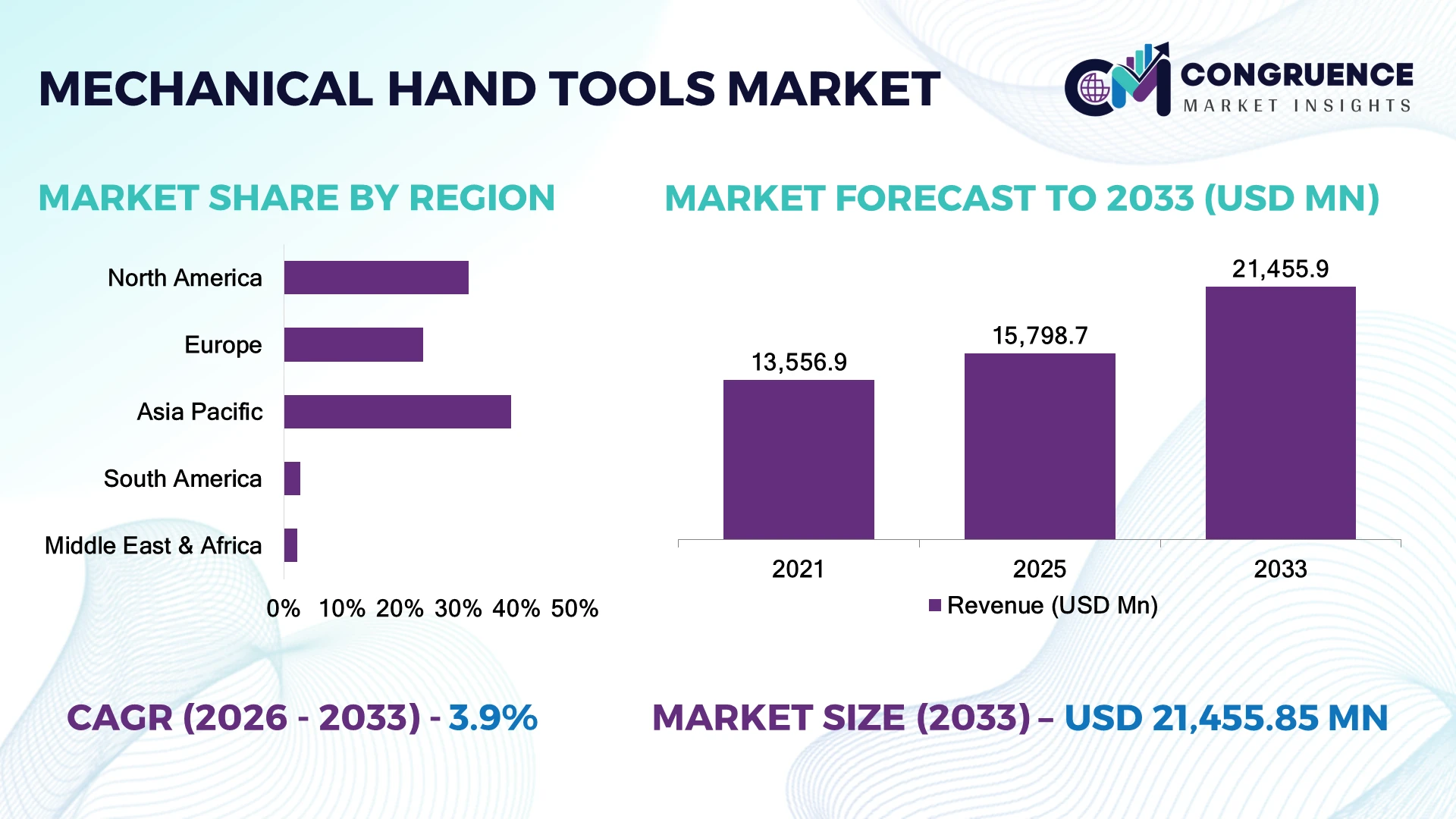
The Global Mechanical Hand Tools Market was valued at USD 15,798.7 Million in 2025 and is anticipated to reach a value of USD 21,455.9 Million by 2033 expanding at a CAGR of 3.9% between 2026 and 2033. Growth is being driven by infrastructure modernization, automotive repair intensity, industrial MRO activity, and manufacturers shifting toward ergonomic, lightweight, corrosion-resistant hand tools.
The United States remains the dominant country, representing an estimated 25% of global demand, supported by construction, automotive service, aerospace, and industrial maintenance. India is emerging faster, with its manufacturing and export push positioning it ahead of several mature markets; organized tool production and industrial procurement are expanding by roughly 8% annually. U.S. demand remains more premium-oriented, while Indian procurement is more price-performance driven.
Strategically, suppliers that combine durable metallurgy, ergonomic engineering, localized manufacturing, and resilient distribution will capture the strongest replacement and industrial-tool opportunities.
Market Size & Growth: USD 15.8 billion in 2025 to USD 21.5 billion by 2033 at 3.9% CAGR, supported by industrial maintenance and construction activity.
Top Growth Drivers: Construction 31%, automotive repair 24%, industrial MRO 19%.
Short-Term Forecast: By 2028, automated inventory and optimized tool distribution can reduce procurement costs 6%–9%.
Emerging Technologies: Advanced alloys, ergonomic polymers, precision forging and digital tool tracking are improving durability and workflow efficiency by 8%–15%.
Regional Leaders: Asia-Pacific approaches USD 7.7 billion, North America USD 6.2 billion, and Europe USD 4.6 billion by 2033, led by industrial and professional usage.
End-User Trends: Professional users account for roughly 68% of demand, while organized MRO procurement is expanding near 7%.
Pilot/Case Example: 2026 smart tool-crib deployments are targeting 10%–15% reductions in tool-search and replenishment time.
Competitive Landscape: Stanley Black & Decker leads premium branded positioning, competing with Snap-on, Bosch, Klein Tools and Apex Tool Group.
Regulatory & ESG Impact: Recycled steel and longer-life designs can reduce material intensity by 10%–20% across selected product lines.
Investment & Funding: Manufacturers are directing 3%–5% of sales toward automation, tooling upgrades, product development and supply-chain resilience.
Innovation & Future Outlook: 2026–2030 competition is shifting toward lightweight alloys, connected inventory, modular tool systems and ergonomically optimized designs.
Mechanical hand tools are increasingly concentrated in professional construction, automotive servicing, industrial maintenance, electrical work, and precision assembly. Demand is shifting toward tools that combine higher torque transfer, lower operator fatigue, corrosion resistance, and longer service intervals. In 2026, manufacturers are also responding to tariff exposure and sourcing volatility by increasing supplier diversification and regional production flexibility, strengthening the strategic importance of manufacturing localization.
Mechanical hand tools remain strategically important because they sit at the final execution point of construction, repair, assembly, and maintenance workflows where reliability directly affects labor productivity. In 2026, procurement decisions increasingly emphasize total cost of ownership rather than purchase price, particularly for industrial MRO and professional automotive users. Manufacturers are consequently prioritizing durable metallurgy, ergonomic geometry, standardized interfaces, and controlled quality.
Technology is reshaping the category without eliminating its mechanical core. Precision-forged tools using optimized alloy compositions can deliver approximately 10%–15% higher fatigue resistance than conventional designs, while ergonomic handle systems reduce operator strain by an estimated 8%–12%. North America remains weighted toward premium professional tools, whereas India and Southeast Asia combine rapid industrialization with stronger price-performance requirements.
Over the next 2–3 years, digital tool tracking, automated inventory cabinets, modular tool systems, and advanced surface treatments will gain greater industrial relevance. A connected MRO program can reduce misplaced-tool incidents by roughly 10%–15% while improving replenishment visibility. Companies are therefore investing in localized manufacturing, distributor partnerships, product redesign, and inventory technologies. Competitive advantage will increasingly depend on combining mechanical durability with measurable workflow productivity, supply resilience, and professional-grade ergonomics.
Industrial maintenance, construction modernization, and automotive servicing are strengthening demand for durable professional-grade hand tools, with these applications collectively representing an estimated 70% of global consumption. In the United States, replacement-oriented professional procurement accounts for nearly 60% of tool purchases, while India’s manufacturing expansion is increasing organized industrial-tool consumption by approximately 8%. Rising labor costs are also accelerating preference for ergonomic designs that reduce operator fatigue and improve task consistency. Supply-chain restructuring following recent tariff and logistics disruptions is encouraging manufacturers to localize forging, machining, and finishing operations. Leading suppliers are responding through regional production expansion, alloy optimization, distributor partnerships, and broader professional-tool portfolios. The strategic advantage is shifting from low purchase price toward longer service life and measurable productivity.
Steel, alloy, chromium, and specialty coating costs remain a structural constraint because raw materials can represent approximately 45%–60% of manufacturing cost for forged mechanical hand tools. Price movements of 8%–12% across key metal inputs can compress margins when distributor contracts limit immediate repricing. China-linked sourcing also exposes manufacturers to freight volatility, trade restrictions, and lead-time disruptions, while smaller producers often lack purchasing leverage. Premium tool manufacturers face an additional 10%–15% cost differential for advanced metallurgy and corrosion-resistant finishes. Companies are mitigating exposure through multi-country sourcing, longer-term metal contracts, regional forging capacity, and selective material substitution. The non-obvious pressure is that excessive cost reduction can shorten tool life, increasing warranty claims and weakening professional-brand positioning.
Digital tool-crib systems, RFID identification, modular storage, and usage analytics create an underpenetrated productivity opportunity across industrial MRO and large construction operations. Connected inventory deployment can reduce tool-search and replenishment time by roughly 10%–15%, while automated dispensing systems can lower inventory discrepancies by 15%–20%. India, Mexico, and Southeast Asia offer additional opportunities as manufacturing clusters expand and organized maintenance procurement replaces fragmented purchasing. Manufacturers are positioning beyond standalone tools through integrated storage, identification, and replenishment ecosystems. Advanced coatings and lightweight alloy designs also provide opportunities to reduce tool weight by 8%–12% without sacrificing torque performance. The strongest strategic opportunity lies in monetizing workflow efficiency around the tool rather than competing solely on unit price.
Long-term competitiveness increasingly depends on designing tools around workforce productivity as skilled maintenance labor becomes harder to retain. Ergonomic redesign can reduce repetitive hand strain by approximately 8%–12%, while inconsistent tool selection and improper torque application can reduce fastening performance by 10% or more. In aerospace, automotive, and precision assembly environments, manufacturers must also maintain tight dimensional tolerances across high-volume production. The challenge is scaling premium engineering without creating excessive SKU complexity; customized handles, torque profiles, and application-specific geometries can increase manufacturing complexity by 15%–20%. Companies are addressing this through modular platforms, automated inspection, digital product engineering, and partnerships with industrial users. The strategic risk is not tool availability but inconsistent human-tool interaction, making ergonomics and standardized application increasingly important.
Ergonomic Designs Gain Priority Professional buyers are shifting toward lighter handles, optimized grips, and reduced-vibration geometries, with ergonomic features estimated to influence 30%–35% of premium-tool purchases. Lightweight construction can reduce tool mass by 8%–12% while preserving required torque performance. Manufacturers are expanding ergonomic product families as workforce fatigue and productivity pressures become stronger procurement criteria.
Industrial Tool Cribs Digitize Large factories and MRO operations are adopting RFID-enabled cabinets, barcode tracking, and automated dispensing, reducing tool-search time by 10%–15% and inventory discrepancies by roughly 15%. The shift is particularly visible in automotive and aerospace facilities. Tool manufacturers are partnering with storage and software providers, turning individual tools into traceable assets within maintenance workflows.
Premium Finishes Expand Adoption Corrosion-resistant coatings, precision polishing, and advanced surface treatments are gaining traction as users seek longer service intervals. Premium treated tools can achieve approximately 10%–20% better resistance to wear and environmental degradation than conventional finishes. Manufacturers are increasing localized coating capacity and repositioning premium ranges toward professional users rather than competing solely through volume pricing.
Regional Sourcing Becomes Strategic Trade friction, freight volatility, and supplier concentration are prompting manufacturers to diversify forging and machining footprints. Companies are targeting 10%–20% reductions in single-country sourcing exposure through regional suppliers and dual-source contracts. The operational shift is significant because supply resilience is becoming a purchasing criterion alongside price, pushing established brands to redesign procurement networks and hold more localized inventory.
Wrenches are estimated to lead the mechanical hand tools market with approximately 27% share, supported by broad usage across automotive repair, industrial maintenance, plumbing, and construction. Their standardized interfaces, high torque capability, and compatibility with diverse fastening systems sustain mature replacement demand. Screwdrivers follow at roughly 21%, while pliers and hammers maintain important positions because of their versatility and relatively low acquisition cost. The leading categories benefit from established distribution networks and strong professional-brand recognition, keeping investment focused on metallurgy, grip engineering, and durability.
Precision-oriented screwdrivers and specialized pliers represent faster-moving opportunities, with adoption increasing around 7%–9% as technicians handle compact assemblies, electrical systems, and equipment requiring controlled access. Manufacturers are expanding multi-bit configurations, insulated designs, corrosion-resistant finishes, and application-specific geometries. The strategic implication is clear: mature wrench demand supports volume, while precision formats increasingly command innovation budgets and premium positioning.
Automotive repair is estimated to represent approximately 31% of mechanical hand tool demand, reflecting intensive fastening, disassembly, inspection, and maintenance requirements across workshops and service networks. Construction follows at about 27%, supported by structural installation, finishing, plumbing, and electrical work. Industrial maintenance represents roughly 23% and is becoming increasingly operationally important as factories prioritize equipment uptime and preventive maintenance. Automotive users favor high-durability ratchets, sockets, wrenches, and torque-oriented tools, whereas construction demand is more diversified across hammers, pliers, screwdrivers, cutters, and measuring tools.
Industrial maintenance is the faster-expanding application, with organized MRO procurement increasing by approximately 8%–10% as manufacturers standardize maintenance inventories and technician toolkits. Companies are responding with application-specific sets, modular storage systems, corrosion-resistant finishes, and distributor partnerships. Household and DIY applications remain strategically relevant, particularly in mature consumer markets, but professional applications command greater replacement frequency and higher average tool utilization. The business priority is therefore shifting toward specialized kits and workflow-linked tool portfolios rather than undifferentiated volume products.
Professional users are estimated to account for approximately 54% of mechanical hand tool demand, supported by contractors, automotive technicians, electricians, plumbers, and maintenance specialists who require dependable tools for repeated daily use. Industrial users represent roughly 29%, with factories and MRO organizations prioritizing standardized tool inventories, durability, and procurement efficiency. DIY consumers account for the remaining share but are becoming more relevant as home-improvement participation expands. Professional purchasing is driven primarily by service life and ergonomics, whereas DIY buying remains more price-sensitive and increasingly influenced by online product discovery.
Industrial end-users represent the faster-growing buyer group, with organized procurement and maintenance standardization increasing adoption by approximately 8%–10%. Manufacturers are responding with contract-based supply, customized tool kits, bulk packaging, and application-specific product engineering. Premium professional ranges increasingly emphasize lifetime durability, ergonomic handles, and corrosion resistance, while consumer lines emphasize versatility and accessible pricing. The strategic opportunity lies in moving industrial buyers toward ecosystem purchasing—tools, storage, identification, and replenishment—rather than competing solely on individual SKU pricing.
North America accounted for the largest market share at 31.8% in 2025 however, Asia-Pacific is expected to register the fastest growth, expanding at a CAGR of 5.1% between 2026 and 2033.
Premium Professional Tools and Industrial MRO Expansion
North America maintains the strongest demand concentration in the mechanical hand tools market, supported by automotive servicing, aerospace maintenance, construction, utilities, and industrial MRO operations. The region represents approximately 32% of global demand, with professional and industrial users accounting for nearly 70% of purchases. The United States dominates regional consumption through established distributor networks, large repair ecosystems, and high replacement frequency for premium tools. Increasing emphasis on ergonomics and workplace productivity is accelerating adoption of lightweight alloy tools, precision torque products, and corrosion-resistant finishes. Manufacturers are responding by expanding domestic and nearshore production, strengthening distributor partnerships, and introducing application-specific tool systems. Approximately 15%–20% of major professional procurement programs now emphasize lifecycle durability alongside upfront price, reinforcing premiumization as a key competitive lever.
United States Market Outlook: The United States remains the region's principal market, supported by its large automotive aftermarket, construction base, aerospace manufacturing ecosystem, and industrial maintenance expenditure. Professional users increasingly prioritize lifetime warranties, torque consistency, ergonomic handles, and corrosion resistance. Organized MRO procurement represents a significant purchasing channel, while digital inventory systems are improving tool availability and reducing stock discrepancies by approximately 10%–15%. Domestic and nearshore manufacturing investments are also strengthening supply resilience amid changing trade conditions.
Industrial Modernization and Sustainability-Led Tool Upgrades
Europe's mechanical hand tools demand is anchored by Germany, Italy, France, the United Kingdom, and Central European manufacturing clusters. Automotive production, machinery manufacturing, industrial maintenance, construction, and precision engineering sustain professional tool consumption, while stringent workplace requirements increase emphasis on ergonomic and application-specific designs. Approximately 60% of professional procurement increasingly evaluates durability and lifecycle performance alongside purchase cost. Germany remains the region's strongest industrial demand center, while Eastern European manufacturing expansion is creating additional tool requirements. Manufacturers are investing in precision forging, recyclable materials, low-emission production processes, and localized distribution to address sustainability expectations and supply-chain resilience. The shift toward longer service intervals is strengthening premium tool positioning and reducing the attractiveness of low-durability imports.
Germany Market Outlook: Germany provides Europe's strongest industrial base for mechanical hand tools through automotive manufacturing, machinery production, electrical equipment, and advanced engineering. Professional workshops and factory maintenance teams place greater emphasis on dimensional accuracy, fatigue resistance, and ergonomic performance than consumer buyers. Approximately 65% of industrial users prioritize tool durability in procurement decisions. Manufacturers benefit from dense industrial distribution networks and close relationships with OEMs, MRO providers, and specialized distributors, supporting demand for premium forged and precision-engineered tools.
Manufacturing Scale and Regional Production Localization
Asia-Pacific combines the world's largest manufacturing footprint with expanding construction, automotive assembly, electronics production, and industrial maintenance requirements. China remains the principal production hub, while India, Japan, South Korea, Vietnam, and Southeast Asian economies are strengthening domestic industrial consumption. The region is estimated to represent approximately 39% of global mechanical hand tool demand and a substantially higher share of manufacturing output. India is increasingly important as organized manufacturing and infrastructure investment expand procurement of professional-grade tools. Manufacturers are establishing localized forging, machining, finishing, and distribution capacity to reduce logistics exposure. Approximately 8%–10% annual growth in organized industrial tool procurement in emerging manufacturing hubs is shifting investment toward regional production and application-specific product portfolios.
China Market Outlook: China remains the most strategically significant country because of its integrated metalworking ecosystem, extensive tool manufacturing base, and large downstream automotive, construction, machinery, and electronics industries. Its manufacturing infrastructure enables high-volume forging, machining, surface treatment, and assembly at competitive costs. Export-oriented producers are increasingly upgrading from basic tools toward precision and professional-grade ranges. Approximately 40% of Asia-Pacific production capacity is concentrated in China-linked manufacturing networks, giving domestic suppliers substantial scale and supply-chain leverage.
Industrial Maintenance and Construction-Led Demand Expansion
South America's mechanical hand tools market is concentrated in Brazil, Argentina, Chile, Colombia, and Peru, with Brazil accounting for the largest consumption base because of its automotive, construction, mining, agricultural machinery, and industrial maintenance activities. Professional and industrial users represent approximately 65% of regional demand, creating stronger replacement cycles than household applications. Mining and heavy equipment maintenance in Chile and Peru supports demand for high-torque wrenches, impact-rated accessories, pliers, and specialized maintenance sets. Import dependence remains material, making currency volatility and freight costs important purchasing considerations. Distributors and manufacturers are responding through localized inventory, multi-country sourcing, and partnerships with industrial suppliers. Regional procurement is gradually shifting toward durable mid-premium products as users balance tool life against acquisition costs.
Brazil Market Outlook: Brazil is the region's largest strategic market, supported by automotive assembly, agricultural machinery, construction, mining services, and industrial maintenance. Its extensive industrial workforce generates recurring demand for wrenches, sockets, pliers, screwdrivers, and specialized repair tools. Approximately 60% of professional buyers prioritize durability and availability when selecting tools. Domestic distributors are strengthening regional warehouse coverage, while manufacturers are targeting Brazil with localized product configurations and bulk industrial procurement programs to reduce lead-time and import-related disruptions.
Infrastructure Investment and Industrial Maintenance Modernization
The Middle East & Africa market is being shaped by infrastructure construction, oil and gas maintenance, utilities, mining, transportation projects, and industrial diversification. Saudi Arabia and the United Arab Emirates represent major demand centers, while South Africa provides a substantial industrial and mining-driven tool base. Professional and industrial applications account for approximately 60% of regional consumption, with large infrastructure projects generating demand for heavy-duty wrenches, cutters, pliers, and specialized maintenance kits. Saudi industrial diversification is also expanding requirements beyond traditional energy operations. Manufacturers are strengthening distributor partnerships, regional warehousing, and application-specific product ranges. Approximately 10%–15% of procurement programs increasingly emphasize corrosion resistance and extended service life, particularly for demanding outdoor and industrial environments.
Saudi Arabia Market Outlook: Saudi Arabia is the region's most strategically significant market because infrastructure development, industrial diversification, energy projects, and large-scale construction programs create sustained requirements for professional mechanical hand tools. Industrial buyers increasingly favor durable products capable of operating in high-temperature and demanding environments. Approximately 15% of large project procurement increasingly incorporates lifecycle and maintenance considerations alongside initial price. Suppliers are positioning through local distributors, project-specific tool kits, regional inventory, and partnerships serving construction, energy, utilities, and industrial maintenance contractors.
Stanley Black & Decker competes with Snap-on and Apex Tool Group through broad portfolios, distribution scale, and professional branding, while Klein Tools and KNIPEX compete through trade specialization and precision. The top five players collectively hold an estimated 21% share, leaving substantial room for regional manufacturers. Competition centers on durability, price, ergonomics, availability, and customization; premium brands can command 15%–25% higher prices when service life and warranty support justify the differential. Product innovation increasingly targets 8%–12% improvements in weight, grip efficiency, corrosion resistance, or torque transfer. Leading companies are expanding regional manufacturing, strengthening distributor networks, introducing application-specific kits, and integrating storage or digital inventory systems. The competitive shift favors ecosystem selling over standalone tools, while Chinese and Taiwanese manufacturers intensify value-tier pricing pressure. Entry barriers remain strongest in metallurgy, certification, distribution access, and professional trust. Winning requires scalable manufacturing, dependable supply, differentiated ergonomics, and channel depth that converts product performance into measurable user productivity.
Stanley Black & Decker
Snap-on Incorporated
Apex Tool Group
Klein Tools
Robert Bosch GmbH
Makita Corporation
KNIPEX Group
Channellock, Inc.
Wiha Werkzeuge GmbH
Wera Werkzeuge GmbH
Hilti Corporation
Würth Group
TONE Co., Ltd.
Tajima Tool Corporation
Advanced metallurgy, precision forging, and computer-optimized handle geometry are reshaping professional mechanical hand tools. High-strength alloy steels and refined heat-treatment processes can improve fatigue resistance by 10%–15% while reducing tool weight by 8%–12%. Ergonomic grip systems increasingly use engineered polymers and textured surfaces to improve handling consistency and reduce operator strain by approximately 8%–10%. Adoption is strongest among automotive, aerospace, industrial MRO, and construction users where repetitive tool use directly affects productivity.
Digital tool management is becoming the most commercially disruptive layer. RFID-tagged tools, connected cabinets, barcode inventory, and automated replenishment can reduce search and stock-control time by 10%–15%, with adoption concentrated among large industrial maintenance organizations. Compared with conventional manual inventory processes, digitally controlled tool rooms improve availability visibility by approximately 15%–20%. Premium manufacturers benefit most because connected ecosystems increase customer retention and shift competition toward workflow performance rather than unit pricing.
From 2026 to 2028, material engineering, precision manufacturing, ergonomic analytics, and connected tool-control systems will increasingly converge. Manufacturers combining durable mechanical design with digital asset tracking can capture higher-value industrial contracts, while specialized brands retain advantages in precision applications. The critical technology priority is integration: tools must deliver measurable durability and productivity while fitting existing maintenance, procurement, and inventory workflows.
March 2025 Bosch launched more than 100 professional hand tools in India, including pliers, screwdrivers, ratchets, wrenches and hammers, expanding its professional portfolio. The move strengthened channel coverage and positioned Bosch for industrial, electrical, commercial and artisan procurement. Source: Bosch Media Service
September 2025 Stanley Black & Decker reported 22 products winning Pro Tool Innovation Awards, including precision screwdrivers and mechanics tool sets. The recognition strengthened differentiation and supported premium positioning through ergonomics, performance and application-specific design across trade channels. Source: Stanley Black & Decker
October 2025 Hilti expanded its Nuron platform with more than 60 heavy-duty products, extending cordless capabilities into breaking, concrete cutting, wood cutting and soil compaction. The expansion strengthened system-based customer retention and broadened cross-selling across professional construction workflows. Source: Construction Briefing
April 2026 Snap-on highlighted 4,700 franchise routes, including 3,400 in the United States, supporting approximately 1 million U.S. mechanics and technicians. The network reinforced premium distribution reach and strengthened recurring professional-tool purchasing relationships across global automotive service markets. Source: snap-on.com
The Mechanical Hand Tools Market Report covers product categories including wrenches, screwdrivers, pliers, hammers, cutters, ratchets, sockets, torque tools, and specialized hand tools. Analysis spans automotive repair, construction, industrial MRO, electrical work, manufacturing, aerospace maintenance, household use, and DIY applications. End-user assessment distinguishes professional technicians, industrial organizations, contractors, commercial workshops, and consumers, enabling comparison of purchasing intensity, replacement cycles, and premium-tool adoption.
The report evaluates North America, Europe, Asia-Pacific, South America, and Middle East & Africa, with country-level analysis for major industrial markets. Technology coverage includes advanced alloys, precision forging, ergonomic engineering, corrosion-resistant finishes, digital tool tracking, and connected inventory systems. Quantitative assessment incorporates segment shares, adoption patterns, procurement behavior, and competitive positioning to support supplier expansion, manufacturing localization, investment planning, portfolio optimization, and strategic decisions through 2033.
| Report Attribute/Metric | Report Details |
|---|---|
|
Market Revenue in 2025 |
USD 15,798.7 Million |
|
Market Revenue in 2033 |
USD 21,455.9 Million |
|
CAGR (2026 - 2033) |
3.9% |
|
Base Year |
2025 |
|
Forecast Period |
2026 - 2033 |
|
Historic Period |
2021 - 2025 |
|
Segments Covered |
By Type
By Application
By End-User
|
|
Key Report Deliverable |
Revenue Forecast, Growth Trends, Market Dynamics, Segmental Overview, Regional and Country-wise Analysis, Competition Landscape |
|
Region Covered |
North America, Europe, Asia-Pacific, South America, Middle East, Africa |
|
Key Players Analyzed |
Stanley Black & Decker, Snap-on Incorporated, Apex Tool Group, Klein Tools, Robert Bosch GmbH, Makita Corporation, KNIPEX Group, Channellock, Inc., Wiha Werkzeuge GmbH, Wera Werkzeuge GmbH, Hilti Corporation, Würth Group, TONE Co., Ltd., Tajima Tool Corporation |
|
Customization & Pricing |
Available on Request (10% Customization is Free) |




