
Reports
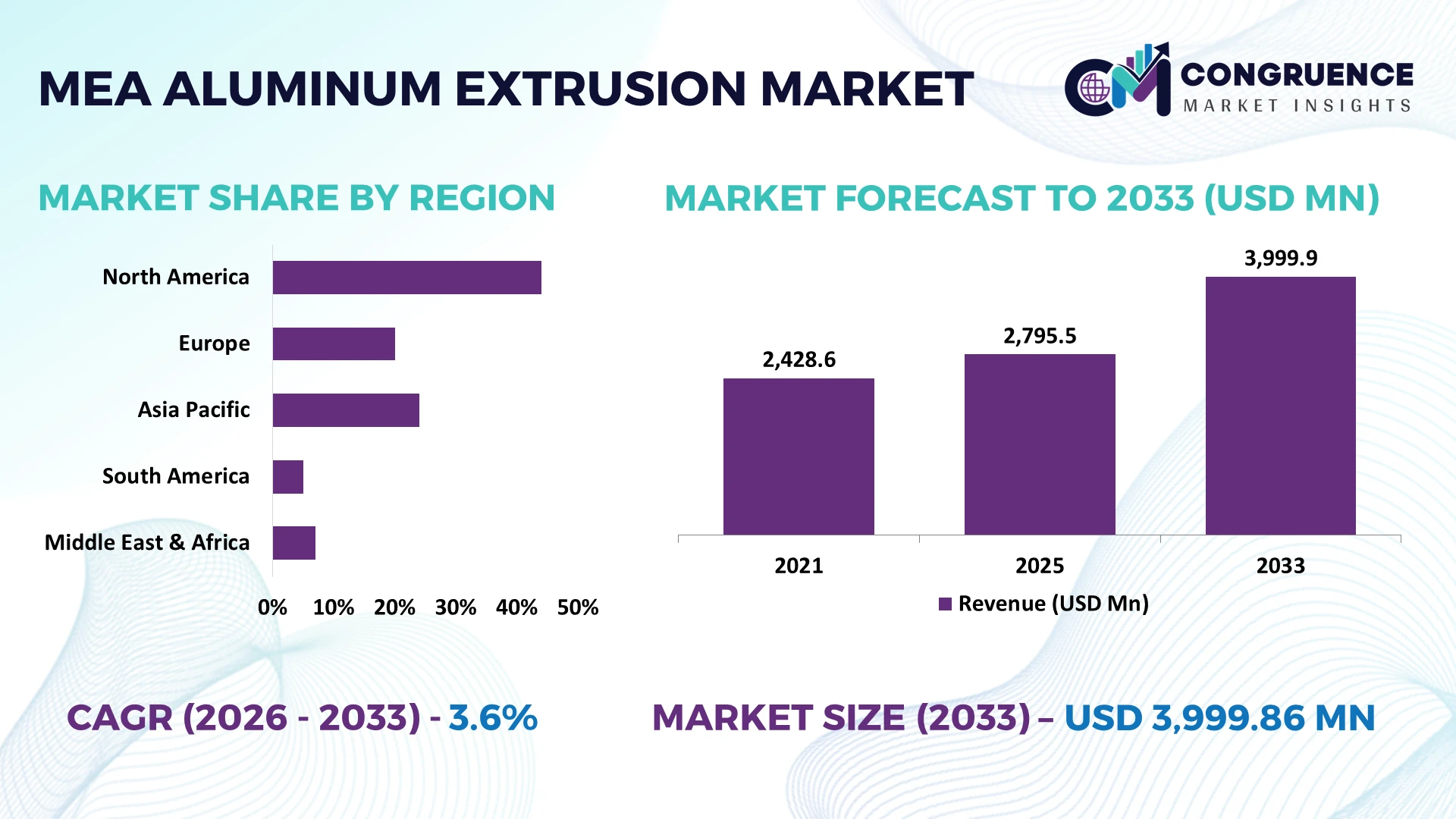
The Global MEA Aluminum Extrusion Market was valued at USD 2795.48 Million in 2025 and is anticipated to reach a value of USD 3999.86 Million by 2033 expanding at a CAGR of 3.58% between 2026 and 2033. Growth is driven by Saudi Vision 2030 localization of automotive and construction components, alongside rising use of lightweight extrusions in EV structures, solar mounting systems, façades, and high-performance building envelopes.
The UAE remains the dominant regional manufacturing base, with 210,000 tonnes of extrusion capacity in 2025, versus 180,000 tonnes in Saudi Arabia, giving the UAE about 39% of GCC extrusion capacity. Saudi Arabia is accelerating downstream localization, including a targeted 100,000–140,000-tonne annual supply-gap opportunity. The Strait of Hormuz disruptions in 2026 have further elevated the value of regional supply resilience and recycled-aluminum sourcing.
Strategically, producers should prioritize localized capacity, recycled feedstock, and precision profiles for automotive, renewable-energy, and advanced construction applications.
Market Size & Growth: USD 2,795.48 Million in 2025 to USD 3,999.86 Million by 2033 at 3.58% CAGR, supported by lightweight automotive profiles and advanced construction systems.
Top Growth Drivers: Automotive lightweighting 32%, construction modernization 28%, renewable-energy infrastructure 19%.
Short-Term Forecast: By 2028, automated extrusion lines target 8–12% lower processing costs and 10% higher throughput.
Emerging Technologies: AI process monitoring, robotic handling, 6000-series advanced alloys, and recycled-billet integration are reshaping high-precision extrusion.
Regional Leaders: GCC reaches USD 2.4B by 2033, Saudi Arabia USD 1.20B, while broader MEA reaches USD 3.48B; adoption is shifting toward localized, high-value profiles.
Consumer/End-User Trends: Construction remains dominant, with shapes representing 83.93% of MEA extrusion revenue in 2025.
Pilot/Case Example: A 2025 extrusion-process optimization model lifted daily production cycles from 2 to 4.36, representing a 117.6% increase in marginal daily profit.
Competitive Landscape: UAE leads GCC extrusion capacity at 39%, competing with Alupco, Gulf Extrusions, Hydro Extrusions, Bahrain Aluminum Extrusion, and QALEX.
Regulatory & ESG Impact: Recycled aluminum requires about 95% less electricity than primary production, strengthening low-carbon procurement strategies.
Investment & Funding: Saudi Arabia identifies SAR 190–230 million for localized automotive extrusion manufacturing, emphasizing EV supply-chain localization.
Innovation & Future Outlook: Next-generation facilities are shifting toward AI-enabled quality control, recycled billets, automated handling, and EV battery-frame profiles as geopolitical supply risks intensify.
The MEA Aluminum Extrusion Market is gaining traction across EV structures, architectural façades, solar mounting systems, battery frames, and industrial equipment, with Saudi Arabia increasingly prioritizing localized high-value extrusion production. Advanced automation and recycled-billet processing are strengthening productivity and carbon performance, while 39% of GCC extrusion capacity is concentrated in the UAE. The 2026 Strait of Hormuz disruption is accelerating supply-chain resilience and regional sourcing priorities, setting the stage for strategic capacity expansion.
The MEA Aluminum Extrusion Market is becoming strategically important because aluminum is moving from a construction input to a localization tool for automotive, renewable-energy, and advanced building supply chains. Saudi Arabia’s industrial diversification programs are pulling extrusion capacity closer to vehicle, solar, and infrastructure projects, while the UAE continues to anchor high-throughput manufacturing. This supply-chain restructuring is changing investment decisions from commodity volume toward value-added profiles.
Technology adoption is sharpening competitiveness. Automated extrusion lines with inline dimensional monitoring can reduce material and rework losses by about 8–12% versus conventional manual inspection, while robotic billet handling improves throughput consistency by roughly 10%. The UAE’s 210,000-tonne extrusion capacity versus about 180,000 tonnes in Saudi Arabia highlights a scale advantage, whereas Saudi projects increasingly emphasize downstream integration and local content.
Over the next 2–3 years, leading plants are positioned to raise automation penetration, recycled-billet utilization, and digital quality monitoring, particularly in automotive and solar applications. A practical deployment model combines automated handling with real-time temperature and profile control, enabling producers to stabilize output while lowering scrap. Companies are prioritizing localized capacity, technology partnerships, and long-term customer contracts. Competitive advantage will increasingly depend on integrated, low-carbon, precision extrusion rather than installed tonnage alone.
Saudi Arabia’s automotive and renewable-energy localization is the clearest structural driver, with roughly 32% of extrusion demand linked to lightweighting-intensive industrial and transport applications and solar-related profiles adding about 19% of incremental demand opportunities. Vision 2030 procurement is shifting buyers toward locally fabricated profiles, reducing import dependence and shortening lead times. UAE producers retain a scale advantage, while Saudi manufacturers are adding downstream fabrication and finishing. Companies are responding through billet-to-profile integration, automotive partnerships, and dedicated solar-profile lines. The non-obvious advantage is specification control: integrated producers can lock alloy, temper, machining, and surface-treatment requirements earlier, improving delivery reliability and protecting margins.
Aluminum billet and energy-cost volatility remains a material constraint, with primary aluminum production consuming around 95% more electricity than recycled aluminum, making feedstock mix strategically important. Smaller producers also face automation-capital requirements that can represent 8–12% of equipment budgets during line modernization. UAE plants generally have stronger industrial infrastructure, while some Saudi and North African operations face longer equipment and spare-parts lead times. Geopolitical disruption around Red Sea and Gulf logistics can further raise landed input costs. Companies are mitigating exposure through multi-origin billet contracts, recycled-content procurement, inventory buffers, and regional supplier agreements. The key operational issue is not extrusion capacity alone, but securing predictable low-cost feedstock and energy.
Saudi Arabia’s EV, solar, and building-efficiency programs create high-value opportunities for precision profiles, battery enclosures, thermal-management components, and lightweight structural systems. Automated inspection and process analytics can deliver 8–12% lower scrap and rework, while recycled-billet integration can cut production energy requirements by up to 95% versus primary aluminum routes. UAE manufacturers can leverage established export infrastructure; Saudi producers can capture more value through localized fabrication, machining, and finishing. The next opportunity is closed-loop aluminum supply, where manufacturers partner with automakers and construction firms to recover production scrap and return it into controlled alloy streams. Companies investing in digital alloy traceability and R&D for thin-wall profiles can differentiate on carbon intensity, consistency, and total delivered cost.
Scaling advanced extrusion requires more than press installation: plants must synchronize die design, billet chemistry, thermal control, finishing, robotics, and quality data across multiple production stages. Digital modernization can require 10–15% of a new-line investment envelope, while skilled operators remain critical for process tuning and die management. Saudi facilities expanding rapidly must also build local technical-service capabilities; UAE producers face pressure to maintain export-grade consistency across diverse customer specifications. Cybersecurity and machine interoperability become more material as connected PLC, MES, and inspection systems expand. Companies must therefore standardize industrial data architectures, develop technician pipelines, and use modular automation. Long-term competitiveness will depend on repeatable digital production, not isolated automation equipment.
Recycled Aluminum Gains Priority UAE and Saudi producers are increasing recycled-billet usage as energy intensity becomes a procurement factor. Recycling aluminum saves about 95% of the energy required for primary production, encouraging suppliers to establish closed-loop scrap contracts and low-carbon sourcing programs.
Solar Profiles Reshape Production Saudi Arabia added nearly 7 GW of solar PV capacity in 2025, almost four times the previous year’s additions. This is shifting extrusion schedules toward corrosion-resistant mounting profiles, with producers expanding dedicated tooling and automated cutting to improve material utilization by approximately 6–10%.
Inline Automation Expands Quality Control Extrusion plants are moving dimensional inspection, temperature sensing, and profile monitoring closer to production presses. Automated systems can reduce scrap and rework by approximately 8–12%, while exception-based inspection cuts manual quality checks by roughly 20%. UAE manufacturers are prioritizing connected production cells.
Engineered Profiles Gain Importance Automotive and industrial buyers are demanding tighter tolerances and more complex geometries rather than standard profiles. Advanced die design and automated handling can improve throughput consistency by around 10%, prompting Saudi manufacturers to invest in machining, finishing, and customer-specific tooling instead of relying solely on additional press capacity.
Mill-Finish Profiles remain the leading type, accounting for approximately 46% of demand because they offer scalable production, lower finishing costs, and broad compatibility with construction and industrial applications. Their mature tooling ecosystem supports high-volume orders, particularly in the UAE and Saudi Arabia. Anodized Profiles hold about 23%, benefiting from corrosion resistance and architectural appearance, while Powder-Coated Profiles represent nearly 19% and remain important for façades and customized building systems. Fabricated Extrusions account for approximately 12%, but their higher processing content creates stronger value per profile.
Powder-Coated Profiles represent the fastest-growing type, with adoption increasing by approximately 7–9% as project developers increasingly specify finished, color-consistent components. Companies are expanding coating capacity and integrating extrusion with cutting, drilling, and assembly operations. This shift reduces downstream handling by roughly 10% and supports faster project delivery. Mill-Finish remains the volume foundation, while Anodized and Fabricated Extrusions strengthen specialized architectural and industrial positioning. Investment priorities are therefore shifting toward integrated finishing and fabrication rather than press capacity alone.
Window & Door Systems represent the leading application at approximately 38% share, supported by established architectural specifications, replacement activity, and large residential and commercial projects. Curtain Walls account for nearly 24%, while Structural Components represent around 18% as engineered profiles gain wider use in façades and infrastructure. Heat Sinks remain a specialized application at approximately 8%, supported by thermal-management requirements. Solar Mounting Systems are the fastest-growing application, with adoption increasing about 10–12% as utility-scale renewable projects expand.
The application mix is shifting toward performance-specific extrusion rather than standardized architectural profiles. Solar Mounting Systems require corrosion resistance, lightweight construction, and dimensional consistency, encouraging manufacturers to dedicate tooling and automated fabrication lines. Window and Door Systems remain highly volume-sensitive, while Heat Sinks and Structural Components place greater emphasis on precision. Companies are responding through application-specific production cells, automated cutting, and integrated finishing. Saudi Arabia is becoming particularly important for solar-related extrusion, while UAE producers retain advantages in architectural exports and established fabrication networks.
Construction leads end-user demand with approximately 42% share because aluminum extrusion is extensively integrated into windows, doors, curtain walls, and structural systems. Automotive contributes nearly 20%, while Solar Energy accounts for about 17% and represents the fastest-changing buyer segment. Industrial Equipment contributes approximately 12%, followed by Electrical & Electronics at around 9%. Construction purchasing remains volume- and price-sensitive, whereas automotive and electronics buyers increasingly require engineered profiles with tighter tolerances.
Solar Energy adoption is increasing by approximately 10–12% as utility-scale projects expand, particularly in Saudi Arabia. Automotive buyers are also moving toward higher-specification components, encouraging manufacturers to establish dedicated tooling and machining partnerships. UAE producers are using established export and fabrication capabilities, while Saudi companies are prioritizing localized supply and customer-specific production. Companies are increasingly combining extrusion, finishing, machining, and quality control to secure longer-term contracts. The competitive shift is therefore moving from construction-heavy portfolios toward balanced exposure across mobility, renewable energy, and industrial applications.
Middle East & Africa accounted for the largest market share at 100% in 2025 however, Middle East & Africa is expected to register the fastest growth, expanding at a CAGR of 3.58% between 2026 and 2033.
Advanced downstream demand strengthens premium extrusion positioning
North American aluminum extrusion dynamics influence MEA suppliers through technology transfer, alloy specifications, and procurement benchmarks rather than direct regional consumption. Automotive lightweighting, data-center construction, and renewable infrastructure are increasing demand for precision profiles, with recycled-content requirements becoming more important in procurement. Automated presses and digital quality inspection can improve throughput consistency by roughly 8–12% compared with labor-intensive workflows. U.S. manufacturers are also expanding closed-loop scrap recovery, creating commercial pressure for MEA exporters to document alloy traceability and carbon intensity. The operational opportunity for MEA producers is supplying specialized profiles that meet North American-grade tolerances while maintaining shorter regional lead times. Companies with integrated extrusion, fabrication, and finishing capabilities are better positioned to capture cross-regional supply-chain contracts.
United States Market Outlook: The United States remains strategically important for advanced extrusion technology, automotive applications, and high-performance building systems. Its established manufacturing ecosystem supports precision requirements that increasingly influence international specifications. MEA producers targeting U.S.-linked supply chains benefit from adopting tighter quality-control standards, automated inspection, and documented recycled-content processes.
Decarbonization standards accelerate premium profile adoption
Europe’s aluminum extrusion landscape is increasingly shaped by carbon-accounting requirements, circular-material procurement, and industrial electrification. European buyers are prioritizing low-carbon aluminum and traceable material streams, creating a stronger premium for suppliers capable of documenting recycled content and production intensity. Secondary aluminum can require around 95% less energy than primary production, strengthening the business case for recycling partnerships. Automotive, rail, façades, and renewable-energy equipment remain important application channels. Germany, Italy, and France retain substantial downstream engineering capabilities, while European buyers increasingly evaluate suppliers on lifecycle performance alongside price. MEA exporters face tighter qualification requirements but can gain access through specialized profiles, recycled billet supply, and long-term contracts. Companies are therefore investing in certification, alloy development, and energy-efficient processing rather than competing solely through lower conversion costs.
Germany Market Outlook: Germany provides the strongest technology benchmark through automotive engineering, industrial automation, and precision manufacturing. Its advanced supplier ecosystem encourages tighter dimensional tolerances and automated quality assurance. MEA producers serving German-linked customers increasingly need digital traceability, consistent alloy chemistry, and documented environmental performance to secure long-term industrial contracts.
Manufacturing scale reshapes global extrusion economics
Asia-Pacific provides the strongest global manufacturing benchmark for aluminum extrusion, with China dominating primary aluminum and downstream processing capacity while India expands infrastructure-linked extrusion production. Large-scale plants increasingly use automated handling, high-speed presses, digital die management, and integrated finishing. China’s massive aluminum production ecosystem gives manufacturers substantial procurement and tooling advantages, while India’s infrastructure modernization supports domestic extrusion demand. Production scale enables high-volume suppliers to compete aggressively on conversion economics, creating pricing pressure for smaller MEA producers. At the same time, Asian manufacturers increasingly export engineered profiles rather than basic mill-finish products. Companies in MEA are responding by focusing on shorter lead times, customized fabrication, regional contracts, and application-specific profiles. The strategic gap is narrowing as Gulf producers adopt automation and integrated finishing to compete with Asian suppliers on consistency rather than volume.
China Market Outlook: China remains the dominant manufacturing benchmark because of its integrated aluminum ecosystem, extensive extrusion capacity, and mature tooling supply chain. Its large production base supports rapid customization and competitive processing costs. MEA manufacturers competing with Chinese suppliers need stronger localization, faster delivery, specialized alloys, and customer-specific fabrication capabilities.
Infrastructure investment expands engineered profile demand
South America represents a developing demand environment where construction modernization, transport infrastructure, renewable power, and industrial equipment support aluminum extrusion consumption. Brazil provides the strongest manufacturing base, combining domestic aluminum production with established automotive and construction supply chains. Solar deployment is creating additional demand for lightweight mounting profiles, while infrastructure projects increasingly require corrosion-resistant and fabricated extrusions. Automated fabrication can reduce manual processing requirements by approximately 15–20%, improving consistency for large project orders. However, logistics distances and uneven industrial infrastructure can increase delivery complexity and inventory requirements. Companies are responding through regional warehousing, distributor partnerships, localized finishing, and project-specific fabrication. The strongest competitive opportunity lies in supplying finished profiles rather than commodity extrusion, allowing producers to offset logistics costs through higher processing value and differentiated specifications.
Brazil Market Outlook: Brazil combines the region’s largest industrial base with established automotive, construction, and aluminum-processing capabilities. Its renewable-energy expansion is increasing demand for structural and solar-related profiles. Producers with domestic finishing, fabrication, and distribution networks gain an operational advantage by reducing import exposure and responding faster to project specifications.
Gulf industrial localization drives capacity integration
The Middle East & Africa market is being reshaped by Gulf industrial diversification, construction modernization, renewable-energy deployment, and downstream manufacturing localization. The UAE maintains approximately 210,000 tonnes of extrusion capacity, while Saudi Arabia is expanding domestic manufacturing around automotive, solar, construction, and industrial projects. Saudi localization programs are encouraging producers to integrate extrusion with machining, coating, and fabrication rather than selling semi-finished profiles. Renewable-energy projects are particularly important, with Saudi Arabia adding almost 7 GW of solar PV capacity during 2025. African markets remain more fragmented, with infrastructure gaps and financing constraints limiting large-scale modernization. Companies are therefore concentrating capital in Gulf manufacturing hubs while using partnerships and distributors to reach African customers. The strategic advantage is shifting toward integrated regional supply chains capable of delivering customized profiles with shorter lead times.
Saudi Arabia Market Outlook: Saudi Arabia has the strongest transformation momentum through industrial localization, automotive manufacturing, and utility-scale renewable projects. The country’s nearly 7 GW of solar additions in 2025 strengthen demand for mounting profiles and engineered structures. Manufacturers are prioritizing downstream fabrication, automated handling, and customer-specific tooling to capture greater local value.
Competition centers on global extrusion specialists such as Hydro Extrusions and regional leaders including Gulf Extrusions, Alupco, Bahrain Aluminum Extrusion, and QALEX, with Chinese suppliers competing primarily through scale and cost. The top five regional players collectively control an estimated 45–50% of organized extrusion capacity, leaving substantial room for specialized producers. Competition is shifting from basic price positioning toward customization, supply reliability, finishing capability, and recycled-content credentials. Automated lines can improve throughput by 8–12%, while integrated fabrication can reduce downstream handling costs by roughly 10–15%. UAE producers compete through established capacity and export logistics; Saudi players emphasize localization and industrial partnerships. Vertical integration is becoming a stronger differentiator as billet sourcing, extrusion, coating, machining, and delivery are consolidated. Entry barriers include press investment, tooling expertise, customer qualification, and reliable billet supply. Winning requires integrated production, rapid customization, dependable supply, and measurable quality performance.
Hydro Extrusions
Gulf Extrusions
Aluminum Products Company (ALUPCO)
Bahrain Aluminum Extrusion Company (BALEXCO)
Qatar Aluminium Extrusion Company (QALEX)
Emirates Extrusion Factory
Arabian Extrusion Factory
Aluminum Bahrain (ALBA)
Oman Aluminium Rolling Company
Emirates Global Aluminium
National Aluminium Products Company (NAPCO)
Egyptalum
Alumil
Exlabesa
Conventional hydraulic extrusion remains the production backbone, but automated billet handling, servo-controlled presses, and inline dimensional inspection are moving into UAE and Saudi facilities. Automated monitoring can improve process efficiency by 8–12% and reduce scrap by 2–4%. Gulf Extrusions’ 2025 production records, including 89.2% recovery and 2,119 kg/man-hour productivity, demonstrate the operational advantage of process optimization.
Emerging technology is centered on recycled-alloy processing, digital die management, and connected quality systems. Gulf Extrusions’ X-ECO uses 90–95% recycled content while requiring only about 5% of primary aluminum’s energy, creating a strong ESG and procurement advantage. Integrated MES, sensors, and predictive analytics can improve production consistency by 5–8%. Producers combining extrusion, fabrication, coating, and digital inspection gain stronger customization and delivery advantages.
By 2026–2028, AI-assisted process control, robotic material movement, and closed-loop recycling will increasingly define premium extrusion operations. Compared with manual inspection and conventional material handling, automated workflows can deliver roughly 10% higher throughput and 15–20% lower manual intervention. Saudi automotive and renewable-energy suppliers benefit most because tighter tolerances and traceability are becoming procurement requirements. Acting now enables producers to lock in efficiency, quality, and low-carbon differentiation before advanced capabilities become standard.
June 2025 Hydro Extrusions completed ASI Performance Standard recertification across 74 sites, strengthening responsible sourcing and production credentials. More than three-fourths also held Chain of Custody certification, improving low-carbon material traceability for customers and supporting premium sustainable extrusion procurement. Source: hydro.com
April 2025 Gulf Extrusions recorded 203 MT daily extrusion output with 89.2% recovery and 2,119 kg/man-hour productivity. The Dubai plant milestone demonstrated stronger process utilization, while Abu Dhabi fabrication reached 562.2 MT in March, reinforcing integrated production competitiveness. Source: gulfex.com
2025 ALUPCO operated nine extrusion lines across Dammam and Jeddah, with combined stated capacity of 85,000 tonnes annually. The Saudi producer’s integrated building-solution model strengthens domestic supply capability and supports localization under Vision 2030 through broader downstream product coverage. Source: alupco.com
March 2026 Al Taiseer Group announced a preliminary agreement to acquire Eastern Aluminium Extrusion Factory while investing in advanced production technologies. Saudi installed extrusion capacity was estimated at 350,000 MT annually, with utilization near 63%, highlighting consolidation potential. Source: gac.ae
The report covers Mill-Finish Profiles, Anodized Profiles, Powder-Coated Profiles, and Fabricated Extrusions across Window & Door Systems, Curtain Walls, Solar Mounting Systems, Heat Sinks, and Structural Components. End-user analysis includes Construction, Automotive, Solar Energy, Industrial Equipment, and Electrical & Electronics, with country-level assessment emphasizing Saudi Arabia, the UAE, Bahrain, Qatar, and Egypt.
Regional coverage spans North America, Europe, Asia-Pacific, South America, and Middle East & Africa to benchmark technology, supply-chain, and competitive positioning. The analysis evaluates automated extrusion, digital quality monitoring, recycled-alloy processing, advanced fabrication, and integrated finishing. It also tracks adoption patterns, capacity utilization, localization, sustainability requirements, and emerging precision-profile demand. These insights support investment planning, capacity expansion, partnership selection, technology deployment, competitive positioning, and strategic market decisions through 2026–2033.
| Report Attribute/Metric | Report Details |
|---|---|
Market Revenue in 2025 | USD 2795.48 Million |
Market Revenue in 2033 | USD 3999.86 Million |
CAGR (2026 - 2033) | 3.58% |
Base Year | 2025 |
Forecast Period | 2026 - 2033 |
Historic Period | 2021 - 2025 |
Segments Covered | By Type
By Application
By End-User
|
Key Report Deliverable | Revenue Forecast, Growth Trends, Market Dynamics, Segmental Overview, Regional and Country-wise Analysis, Competition Landscape |
Region Covered | North America, Europe, Asia-Pacific, South America, Middle East, Africa |
Key Players Analyzed | Hydro Extrusions, Gulf Extrusions, Aluminum Products Company (ALUPCO), Bahrain Aluminum Extrusion Company (BALEXCO), Qatar Aluminium Extrusion Company (QALEX), Emirates Extrusion Factory, Arabian Extrusion Factory, Aluminum Bahrain (ALBA), Oman Aluminium Rolling Company, Emirates Global Aluminium, National Aluminium Products Company (NAPCO), Egyptalum, Alumil, Exlabesa |
Customization & Pricing | Available on Request (10% Customization is Free) |




