
Reports
The Global Matrix Switches Market was valued at USD 2300 Million in 2025 and is anticipated to reach a value of USD 4894.5 Million by 2033 expanding at a CAGR of 9.9% between 2026 and 2033. Growth is supported by rising deployment of high-bandwidth AV-over-IP infrastructure, expanding control room modernization, and increasing integration of 4K/8K video routing across enterprise, defense, healthcare, and broadcast environments.
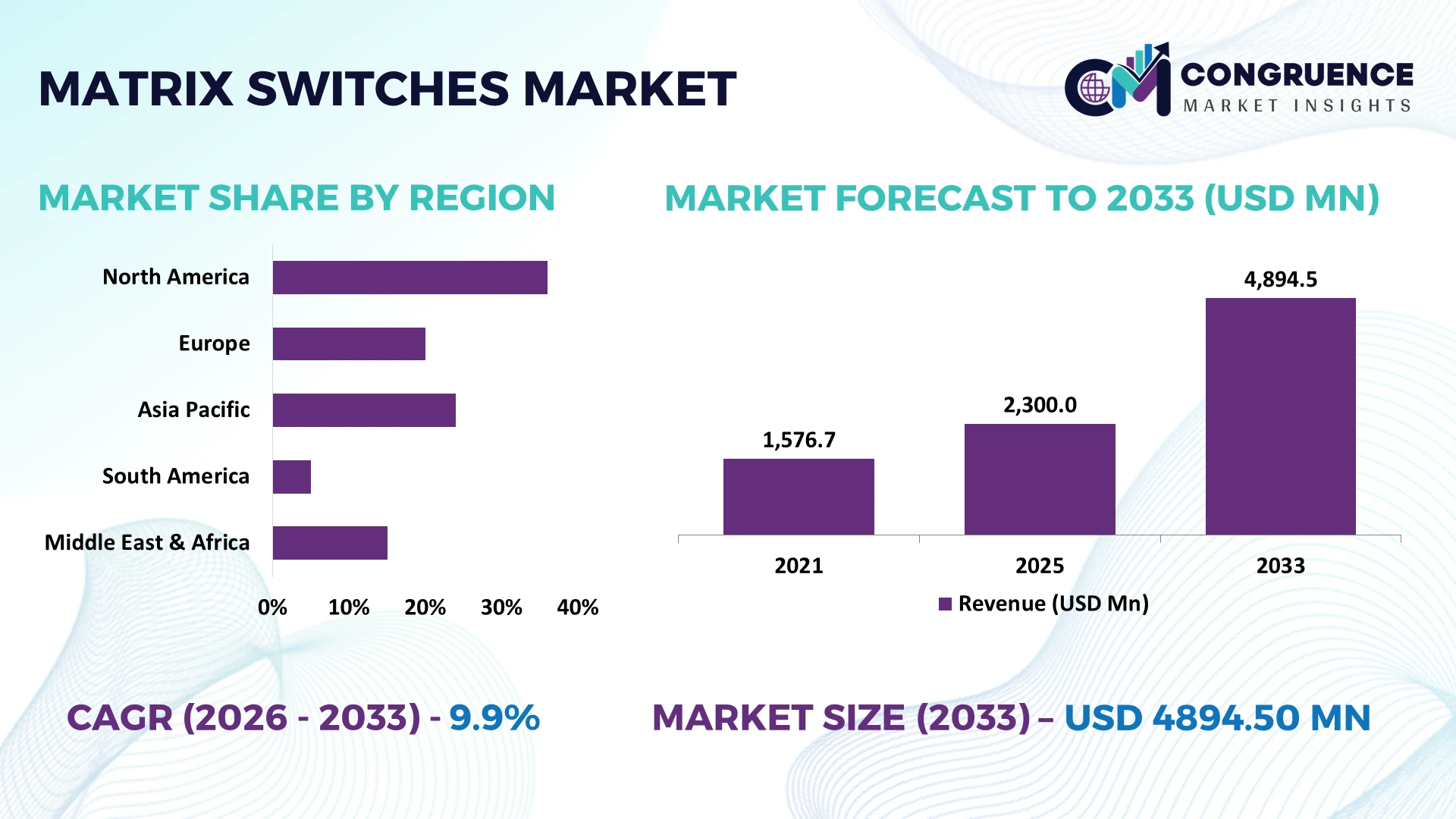
The United States remains the dominant market, accounting for approximately 34% of global demand, supported by large-scale digital infrastructure investments, defense command centers, and commercial AV deployments. China follows with nearly 24% market participation, driven by smart manufacturing and transportation projects, while ongoing semiconductor supply-chain diversification after recent geopolitical trade realignments has strengthened regional production resilience and accelerated adoption of advanced switching platforms.
Organizations investing in scalable, software-defined matrix switching architectures are positioned to strengthen operational flexibility while reducing long-term infrastructure complexity.
Market Size & Growth: USD 2300 Million in 2025 reaching USD 4894.5 Million by 2033 at 9.9% CAGR, supported by enterprise AV modernization and high-bandwidth digital infrastructure.
Top Growth Drivers: 41% enterprise AV upgrades, 36% smart facility expansion, and 29% broadcast infrastructure modernization accelerate global deployment.
Short-Term Forecast: By 2028, centralized routing platforms improve signal management efficiency by 32% while reducing maintenance costs by 21%.
Emerging Technologies: AI-assisted switching, AV-over-IP, and software-defined management platforms reduce configuration time by nearly 30%.
Regional Leaders: North America exceeds USD 1.6 Billion, Asia-Pacific approaches USD 1.4 Billion, and Europe surpasses USD 1.1 Billion through industrial automation and digital infrastructure expansion.
Consumer/End-User Trends: More than 58% of enterprise projects prioritize scalable multi-display switching for hybrid workplaces and mission-critical operations.
Pilot/Case Example: A 2026 control-room modernization program improved video routing efficiency by 35% and reduced operator response time by 24%.
Competitive Landscape: Leading suppliers collectively command nearly 48% market share, supported by diversified portfolios and continuous product innovation.
Regulatory & ESG Impact: Energy-efficient hardware lowers power consumption by approximately 18%, aligning with stricter sustainability procurement standards across public infrastructure.
Investment & Funding: Over USD 1.1 Billion in ecosystem investments supports manufacturing expansion, regional partnerships, and resilient supply-chain diversification.
Innovation & Future Outlook: Cloud-managed switching, cybersecurity-enhanced architectures, and edge-enabled control platforms strengthen next-generation digital connectivity across high-growth industries.
Matrix Switches Market demand continues expanding across corporate campuses, transportation hubs, healthcare facilities, and mission-critical control centers requiring seamless multi-source signal distribution. Manufacturers are introducing AI-enabled management software, lower-latency AV-over-IP platforms, and energy-efficient hardware, improving operational performance by nearly 28%. Ongoing supply-chain localization and stricter cybersecurity procurement requirements are accelerating technology upgrades, setting the foundation for the strategic market assessment that follows.
Matrix switches have become strategically important as enterprises prioritize centralized signal management, secure audiovisual distribution, and software-defined infrastructure across critical operations. Infrastructure modernization in transportation, defense, healthcare, and industrial automation is replacing isolated switching environments with scalable IP-enabled platforms. At the same time, supply-chain restructuring has encouraged manufacturers to diversify component sourcing beyond single-country dependence, improving procurement resilience while reducing production disruptions for advanced switching hardware.
Modern IP-based matrix switches reduce cabling requirements by nearly 35% and lower installation time by approximately 28% compared with conventional point-to-point switching systems, while enabling remote configuration and predictive diagnostics. The United States continues to lead high-value deployments across command centers and enterprise campuses, whereas China expands manufacturing-scale implementation through smart factories and digital industrial parks. Over the next two to three years, more than 45% of newly commissioned professional AV installations are expected to integrate network-managed switching platforms supporting unified control and higher operational flexibility.
A 2026 airport operations upgrade demonstrated how centralized matrix switching shortened incident response time by approximately 22% through synchronized display and communication management. Companies are expanding software capabilities, strengthening semiconductor partnerships, and investing in localized assembly to improve delivery reliability. Organizations that combine interoperable architectures with cybersecurity-focused innovation will establish stronger competitive positioning while creating sustainable operational advantages across mission-critical digital infrastructure.
The primary market driver is the rapid modernization of enterprise and mission-critical digital infrastructure requiring reliable multi-source signal distribution. Nearly 52% of new control room projects now specify IP-enabled matrix switching architectures, while deployment of 4K and 8K visualization systems has increased by approximately 37%. Government-backed smart transportation and public security initiatives in the United States are accelerating procurement of centralized switching solutions. In response, manufacturers are expanding software-defined product portfolios, increasing localized production, and forming technology partnerships with AV-over-IP ecosystem providers. This transition enables lower maintenance complexity, greater scalability, and faster deployment, strengthening long-term competitive differentiation for solution providers serving industrial and institutional customers.
Interoperability limitations between legacy AV equipment and next-generation network protocols continue to restrict seamless deployment. Around 31% of enterprise upgrade projects require additional interface hardware, increasing implementation costs, while specialized semiconductor components still experience procurement lead-time fluctuations of nearly 20% in selected product categories. Japan and South Korea remain critical suppliers for high-performance switching components, creating dependence on concentrated manufacturing ecosystems. Companies are mitigating these constraints through multi-source procurement contracts, regional assembly facilities, and standardized communication protocols. Organizations achieving greater hardware compatibility gain faster deployment cycles, improved project profitability, and reduced operational disruptions across complex installation environments.
The strongest opportunity lies in intelligent AV-over-IP ecosystems integrated with AI-driven monitoring and edge-based device management. More than 46% of enterprise customers now prioritize centralized software control, while predictive maintenance can reduce service interventions by approximately 24%. India's expanding smart campus initiatives and digital education infrastructure create new deployment opportunities beyond traditional broadcast applications. Companies are increasing R&D investment, developing cloud-managed switching platforms, and building strategic alliances with network equipment providers to deliver complete ecosystem solutions. The emerging shift toward subscription-based software management also creates recurring service opportunities while improving lifecycle value and operational visibility for enterprise customers.
Long-term market expansion depends on overcoming integration complexity across increasingly connected digital environments. Approximately 43% of enterprise installations involve multi-vendor ecosystems, while cybersecurity compliance requirements have expanded by nearly 30% for mission-critical facilities. Germany's industrial automation sector illustrates the growing challenge of maintaining secure interoperability across operational technology and enterprise IT networks. Companies must strengthen encrypted communication protocols, invest in cybersecurity engineering, and expand technical workforce capabilities to ensure reliable deployment. Successfully addressing integration consistency and lifecycle security will determine competitive leadership as organizations demand scalable, resilient, and centrally managed matrix switching infrastructure.
IP-Based Workflow Transition
Enterprises are accelerating migration toward IP-based matrix switching, with adoption increasing nearly 42% across new AV infrastructure projects and latency optimization improving by 25%. Large organizations in the United States are replacing isolated hardware setups with network-managed systems, while companies respond through software upgrades, cybersecurity integration, and platform partnerships.
AI-Driven System Management
AI-enabled monitoring is reshaping matrix switch operations, reducing configuration workload by approximately 30% and improving fault detection speed by 35%. Japanese and European enterprises are integrating automated diagnostics into control environments as labor shortages pressure technical teams. Manufacturers are expanding intelligent management tools to improve service efficiency and lifecycle performance.
Hybrid Workspace Expansion
Corporate hybrid environments are increasing demand for flexible display routing, with nearly 55% of large enterprises prioritizing centralized AV control solutions. The shift toward distributed workplaces after global workforce restructuring has increased investment in adaptable conference infrastructure. Companies are redesigning product portfolios around modular systems, remote administration, and simplified deployment models.
Secure Infrastructure Integration
Cybersecurity requirements are influencing matrix switching purchases, with approximately 38% of government and defense-related projects requiring enhanced encrypted communication features. Regulatory pressure around critical infrastructure protection is accelerating adoption of secure switching architectures. Vendors are strengthening compliance capabilities, regional supply chains, and integrated security features to support mission-critical deployments.
IP-Based matrix switches represent the leading segment, accounting for approximately 39% of market adoption due to superior scalability, remote management capability, and compatibility with modern network infrastructure. HDMI-based systems follow with nearly 32% share, maintaining strong demand in corporate AV and entertainment environments because of high-resolution support and broad device compatibility. VGA and AV-based solutions remain relevant in legacy installations but continue declining as organizations modernize infrastructure, with adoption decreasing by nearly 18% in new projects.
The fastest-growing segment is IP-Based technology, expanding as enterprises prioritize flexible routing, cloud management, and reduced cabling complexity. DisplayPort solutions are also gaining traction, particularly in high-performance visualization environments, with adoption rising around 22% in specialized applications. Companies are increasing investment in hybrid platforms that support multiple signal formats, allowing smoother migration from traditional systems while improving deployment efficiency and reducing replacement costs.
Control Rooms remain the dominant application segment, representing nearly 36% of matrix switch deployments due to continuous demand from security operations, transportation monitoring, and industrial command environments. Broadcasting follows with approximately 27% share, supported by high-resolution content production requirements and live event infrastructure. Digital signage, corporate AV, and education applications continue expanding as organizations require centralized communication systems and flexible display management.
The fastest-growing application is Corporate AV, where adoption is increasing by nearly 31% as companies upgrade hybrid meeting spaces and collaborative environments. Education institutions are also increasing deployments by approximately 24% through digital classroom modernization programs. Companies are adapting by developing simplified management interfaces, integrated automation features, and scalable solutions tailored for multi-location enterprises. Demand is increasingly shifting toward applications requiring real-time data visualization, operational continuity, and remote administration capabilities.
Enterprise users represent the largest end-user segment, contributing approximately 34% of matrix switch demand due to widespread adoption across corporate campuses, financial institutions, and technology companies. Media & Entertainment follows with nearly 29% share, driven by professional broadcasting, production studios, and live event requirements. Government and healthcare users maintain strong demand because of security, visualization, and operational reliability requirements.
Healthcare is emerging as the fastest-growing end-user category, with adoption increasing around 28% as hospitals implement advanced imaging environments and centralized information displays. Government deployments are also expanding by approximately 21% due to modernization of command and emergency response centers. Companies are targeting these segments through customized solutions, strategic partnerships, and specialized integration services. Future demand is shifting toward industries requiring secure, high-performance, and continuously available communication infrastructure.
North America accounted for the largest market share at 34% in 2025 however, Asia-Pacific is expected to register the fastest growth, expanding at a CAGR of 11.2% between 2026 and 2033.

Enterprise AV modernization and mission-critical infrastructure expansion
North America maintains the leading position in the matrix switches market due to strong adoption across defense, healthcare, corporate campuses, and broadcast facilities. The region contributes approximately 34% of global demand, supported by advanced digital infrastructure and high investment in control-room modernization. The United States represents the largest deployment hub, with more than 45% of regional installations concentrated in enterprise, government, and media applications. Growing adoption of AV-over-IP solutions and secure communication networks is encouraging manufacturers to expand software integration capabilities and regional service partnerships. Companies are prioritizing scalable switching platforms that support hybrid work environments, real-time monitoring, and long lifecycle management.
United States Market Outlook:
The United States remains the key innovation center, driven by defense modernization programs, enterprise technology upgrades, and advanced commercial AV deployments. More than 60% of large corporate facilities upgrading communication infrastructure are incorporating centralized signal management solutions. Strong cybersecurity requirements and domestic technology investments continue strengthening demand for advanced matrix switching systems.
Secure digital infrastructure and sustainable modernization shift
Europe demonstrates steady adoption of matrix switches through smart facilities, industrial automation, transportation networks, and professional AV environments. The region accounts for nearly 26% of global demand, supported by modernization programs across Germany, the United Kingdom, and France. Increasing emphasis on energy-efficient infrastructure and secure digital operations is influencing procurement decisions. Approximately 40% of new enterprise AV projects in major European economies prioritize network-managed switching solutions to improve flexibility and reduce operational complexity. Manufacturers are responding by developing lower-power hardware, interoperable platforms, and compliance-focused solutions aligned with evolving digital infrastructure standards.
Germany Market Outlook:
Germany leads European adoption due to its industrial automation ecosystem and advanced manufacturing base. Around 35% of large industrial facilities implementing digital control environments require sophisticated signal routing solutions. Investments in smart factories and secure operational technology networks are creating opportunities for matrix switch suppliers focused on high-reliability applications.
Manufacturing scale and smart infrastructure deployment acceleration
Asia-Pacific is emerging as the fastest-expanding market due to large-scale industrial digitization, smart city projects, and growing enterprise technology investments. The region represents approximately 24% of current demand, with China, Japan, South Korea, and India driving adoption. China contributes significant manufacturing capacity, while India is increasing infrastructure deployment through digital campuses and transportation modernization. More than 50% of newly developed smart facilities in major Asian economies integrate centralized audiovisual management systems. Companies are expanding regional production, strengthening supply-chain networks, and forming partnerships with local technology providers to improve delivery speed and customization capabilities.
China Market Outlook:
China remains the largest production and deployment base in Asia-Pacific, supported by electronics manufacturing strength and industrial automation initiatives. Over 45% of regional matrix switch hardware production is linked to Chinese manufacturing ecosystems. Expansion of smart factories, command centers, and digital infrastructure projects continues supporting domestic and export-oriented demand.
Infrastructure modernization and enterprise connectivity expansion
South America is gradually increasing matrix switch adoption through broadcasting upgrades, government modernization programs, and corporate technology investments. The region contributes approximately 8% of global demand, with Brazil and Argentina representing major deployment markets. Limited infrastructure maturity remains a challenge, but increasing investment in digital communication networks is improving adoption potential. Around 30% of new commercial AV installations in major urban centers now include centralized switching capabilities. Companies are addressing market limitations through regional partnerships, flexible pricing models, and localized support networks to improve accessibility for enterprises and public institutions.
Brazil Market Outlook:
Brazil represents the strongest market opportunity in South America due to its large enterprise base, media industry, and infrastructure modernization initiatives. Nearly 40% of professional AV investments in the country are concentrated in major metropolitan areas. Growth is supported by broadcasting expansion, corporate facilities upgrades, and government digital transformation projects.
Smart infrastructure investment and digital transformation momentum
Middle East & Africa is developing as a strategic market through large-scale infrastructure projects, smart city programs, and premium commercial developments. The region accounts for approximately 8% of global demand, with the United Arab Emirates and Saudi Arabia leading adoption. Advanced airports, hospitality developments, security centers, and government facilities are increasing requirements for reliable signal management systems. More than 35% of newly developed smart infrastructure projects in Gulf countries incorporate centralized audiovisual control environments. Companies are expanding through regional distributors, technology partnerships, and customized solutions designed for large-scale deployments.
United Arab Emirates Market Outlook:
The United Arab Emirates leads regional adoption through smart city initiatives, luxury commercial projects, and advanced transportation infrastructure. Dubai-based developments increasingly integrate centralized AV systems, with more than 50% of major technology-driven facilities requiring professional signal routing platforms. Strong investment in digital infrastructure supports continued demand for high-performance matrix switches.
The matrix switches market features competition between global technology leaders such as Black Box, Extron Electronics, and Kramer Electronics against specialized regional suppliers and cost-focused manufacturers from Asia. The top five players collectively hold approximately 45% market share, creating a moderately consolidated structure. Competition centers on switching performance, interoperability, customization, and supply reliability, with premium vendors improving deployment speed by 25% through software integration while cost-focused suppliers compete through 15–20% lower hardware pricing. Companies are expanding through AV-over-IP partnerships, localized manufacturing, cybersecurity upgrades, and vertical integration of control software. The market is shifting toward intelligent network-based switching as legacy hardware providers face pressure from IP platform innovators. High entry barriers include engineering expertise, enterprise certifications, and ecosystem compatibility requirements. Winning players will combine advanced technology, dependable supply chains, and tailored solutions that address complex enterprise deployment needs.
Extron Electronics
Kramer Electronics
Black Box
Crestron Electronics
Atlona
Lightware Visual Engineering
ZeeVee
Barco
tvONE
Aurora Multimedia
Datapath
IHSE
Gefen
Hall Technologies
Matrix switches are transitioning from traditional hardware-based routing toward IP-enabled, software-managed architectures. AV-over-IP platforms are gaining adoption across enterprise and control-room environments, with approximately 48% of new professional installations prioritizing network-based switching. Compared with legacy point-to-point systems, IP-based solutions reduce cabling complexity by nearly 35% and improve deployment flexibility by around 30%, giving organizations scalable infrastructure advantages.
Artificial intelligence and automation are becoming important integration layers, enabling predictive monitoring, automated configuration, and faster fault identification. AI-assisted management tools improve operational efficiency by approximately 25% and reduce manual troubleshooting requirements by nearly 20%. Technology innovators benefit most as enterprises increasingly demand intelligent platforms that combine switching, analytics, and centralized control capabilities.
Between 2026 and 2028, cybersecurity-enhanced switching, cloud-based management, and edge-connected architectures will influence competitive positioning. Secure IP switching platforms are expected to gain stronger adoption as government, healthcare, and financial organizations require protected communication networks. Companies investing in interoperable designs, remote management capabilities, and energy-efficient hardware will achieve stronger operational performance and maintain advantages over conventional switching providers.
November 2025 Extron Electronics launched the DTP3 CrossPoint configurable presentation matrix switcher lineup with HDMI, DTP3, Dante, DSP, and control integration across four configurations. The platform supports 4K/60 performance and improves deployment flexibility for professional AV environments.
March 2025 Extron Electronics introduced the UCS 504 collaboration switching system integrating USB-C, AV switching, and signal extension capabilities. The solution supports six USB room devices and extends signals up to 100 meters, strengthening hybrid workplace deployments and simplifying meeting-room infrastructure.
October 2025 Extron Electronics expanded compact matrix switching solutions with the DTP3 CrossPoint 42, featuring 4K/60 processing, USB-C connectivity, and CAT6A transmission up to 100 meters. The innovation targets meeting rooms and education spaces by reducing installation complexity.
December 2025 Extron Electronics supported London School of Economics’ theatre modernization using NAV Pro AV-over-IP and TouchLink Pro technologies. The project enhanced flexible AV control capabilities, demonstrating enterprise and education adoption of network-based switching platforms.
The Matrix Switches Market Report evaluates industry development across HDMI, DisplayPort, VGA, AV, and IP-Based switching technologies, covering applications including broadcasting, control rooms, digital signage, corporate AV, and education. The analysis examines demand patterns among media & entertainment, government, enterprise, healthcare, and educational end-users across North America, Europe, Asia-Pacific, South America, and Middle East & Africa.
The report provides strategic insights into AV-over-IP adoption, automation integration, cybersecurity-focused switching, and next-generation infrastructure modernization. It highlights segment positioning, competitive strategies, deployment trends, and technology transitions influencing market direction from 2026 to 2033. The study supports investment planning, expansion decisions, partnership strategies, and competitive positioning by identifying high-value opportunities and operational challenges across evolving matrix switching ecosystems.
| Report Attribute/Metric | Report Details |
|---|---|
Market Revenue in 2025 | USD 2300 Million |
Market Revenue in 2033 | USD 4894.5 Million |
CAGR (2026 - 2033) | 9.9% |
Base Year | 2025 |
Forecast Period | 2026 - 2033 |
Historic Period | 2021 - 2025 |
Segments Covered | By Type
By Application
By End-User
|
Key Report Deliverable | Revenue Forecast, Growth Trends, Market Dynamics, Segmental Overview, Regional and Country-wise Analysis, Competition Landscape |
Region Covered | North America, Europe, Asia-Pacific, South America, Middle East, Africa |
Key Players Analyzed | Extron Electronics, Kramer Electronics, Black Box, Crestron Electronics, Atlona, Lightware Visual Engineering, ZeeVee, Barco, tvONE, Aurora Multimedia, Datapath, IHSE, Gefen, Hall Technologies |
Customization & Pricing | Available on Request (10% Customization is Free) |




