
Reports
The Global Matcha Green Tea Powder Market was valued at USD 399.5 Million in 2025 and is anticipated to reach a value of USD 712.5 Million by 2033 expanding at a CAGR of 7.5% between 2026 and 2033. Rising functional beverage consumption, premium food innovation, expanding nutraceutical applications, and sustainable tea cultivation practices continue to accelerate market expansion across developed and emerging economies.
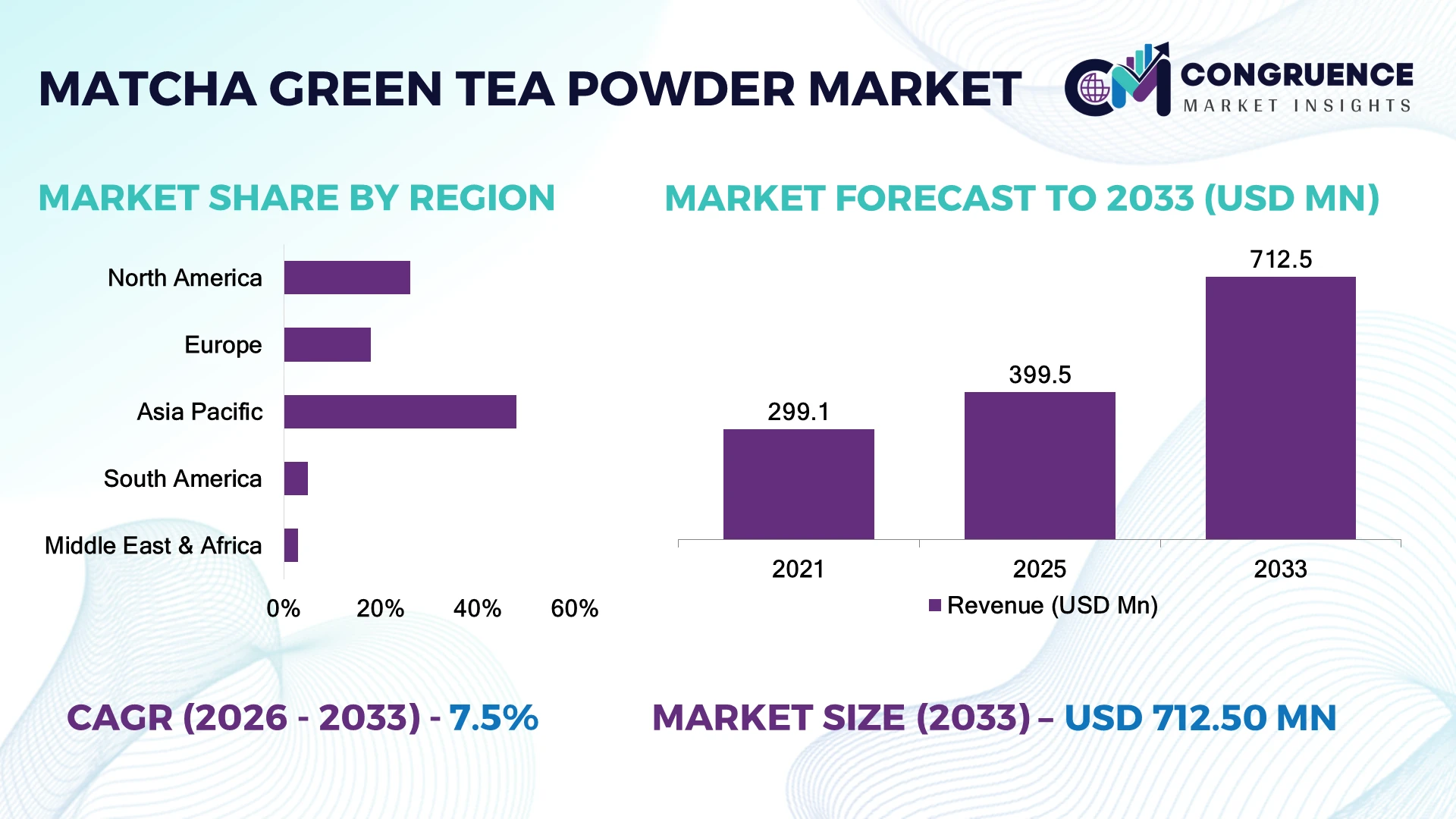
Japan remains the dominant producer, contributing nearly 45% of global ceremonial-grade matcha output through advanced cultivation and stone-grinding techniques, while China supplies more than 35% of export-oriented production with cost-efficient manufacturing. Japan records over 90% adoption of shaded cultivation for premium quality, whereas China continues expanding processing capacity to support global food, beverage, and cosmetic industries amid evolving Indo-Pacific agricultural trade dynamics.
Strategic investments in premium sourcing, certified production, and value-added applications are strengthening long-term competitive positioning across the global supply chain.
Market Size & Growth: USD 399.5 Million in 2025, projected to reach USD 712.5 Million by 2033 at 7.5% CAGR, supported by premium functional food innovation and sustainable cultivation.
Top Growth Drivers: Functional beverage demand (+32%), clean-label food adoption (+28%), and nutraceutical ingredient usage (+24%) continue accelerating market expansion.
Short-Term Forecast: By 2028, automated processing is expected to improve production efficiency by nearly 18% while reducing processing losses by around 12%.
Emerging Technologies: AI-powered quality inspection, automated stone milling, and precision agriculture improve consistency, traceability, and cultivation efficiency.
Regional Leaders: Asia-Pacific exceeds USD 320 Million with premium production leadership, North America surpasses USD 165 Million through health-focused consumption, while Europe approaches USD 120 Million driven by organic product adoption.
Consumer/End-User Trends: More than 48% of premium tea consumers actively prefer clean-label matcha products with verified origin certification.
Pilot/Case Example: In 2024, precision cultivation programs in Japan improved premium leaf quality by approximately 15% while lowering cultivation losses by 10%.
Competitive Landscape: Japan accounts for nearly 45% of premium production, with Aiya, Marukyu Koyamaen, ITO EN, Mizuba Tea Co., and DoMatcha among leading participants.
Regulatory & ESG Impact: Certified sustainable cultivation expanded by nearly 20% following stricter export quality and traceability standards across major importing countries.
Investment & Funding: More than USD 180 Million has supported production expansion, processing modernization, and strategic supply-chain partnerships.
Innovation & Future Outlook: High-grade culinary formulations, functional nutrition blends, and digital traceability platforms are reshaping premium product differentiation worldwide.
Matcha Green Tea Powder continues expanding across functional beverages, bakery, dairy alternatives, cosmetics, and nutritional supplements as manufacturers introduce cleaner formulations and premium ceremonial-grade products. AI-assisted quality grading and precision farming enhance consistency, while organic-certified production has increased by approximately 22% across leading exporters. Supply-chain diversification beyond traditional sourcing hubs is improving procurement resilience and supporting broader commercial adoption, setting the stage for deeper strategic market development.
The Matcha Green Tea Powder Market has become strategically important as food manufacturers, beverage brands, and nutraceutical companies compete through premium ingredient differentiation and transparent sourcing. Supply-chain restructuring following changing agricultural trade patterns has encouraged manufacturers to diversify procurement, strengthen long-term grower partnerships, and expand certified production. Premium product positioning increasingly depends on traceability, consistent quality, and sustainable cultivation standards.
Modern AI-enabled grading systems inspect leaf quality nearly 35% faster than conventional manual assessment while reducing quality variation by approximately 20%. Japan continues leading premium ceremonial-grade production through specialized cultivation expertise, whereas China rapidly expands industrial-scale processing for food and beverage manufacturing. North American brands focus on premium retail positioning, while European companies prioritize certified organic and clean-label formulations.
Companies are expanding processing facilities, investing in precision farming technologies, and establishing direct sourcing partnerships with tea growers. Beverage manufacturers are introducing ready-to-drink matcha products, while ingredient suppliers broaden applications across bakery, confectionery, and nutritional supplements. Over the next two to three years, digital traceability platforms, sustainable cultivation practices, and premium product innovation will strengthen competitive positioning, improve operational resilience, and reinforce long-term strategic value throughout the global supply chain.
Growing consumer preference for antioxidant-rich ingredients and functional nutrition continues accelerating commercial adoption across beverages, dairy alternatives, bakery products, and dietary supplements. More than 52% of new premium tea launches now emphasize clean-label positioning, while organic-certified cultivation has expanded by nearly 22% in leading producing countries. Japan continues investing in advanced shaded cultivation techniques to improve premium leaf quality, encouraging processors to expand export-focused capacity. Companies are strengthening partnerships with certified growers, introducing higher-value ceremonial and culinary grades, and investing in automated quality inspection systems. This integrated approach improves supply reliability, enhances product consistency, and creates stronger competitive differentiation within premium global food and beverage supply chains.
Dependence on specialized shaded tea cultivation creates significant exposure to weather variability, labor shortages, and agricultural cost inflation. Premium leaf production requires approximately 20–30 days of controlled shading before harvest, increasing cultivation costs compared with conventional green tea. Labor expenses have increased by nearly 15% across several producing regions, while climate variability continues affecting seasonal yields. Exporters are responding through diversified sourcing, multi-country procurement contracts, and expanded inventory planning to reduce supply disruptions. Companies are also investing in localized processing facilities and long-term grower agreements, helping stabilize procurement while protecting operational continuity despite fluctuating agricultural conditions.
Expanding applications across sports nutrition, functional confectionery, cosmetics, and ready-to-drink beverages create substantial commercial opportunities beyond traditional tea consumption. More than 30% of premium beverage launches now incorporate plant-based functional ingredients, while precision agriculture technologies improve cultivation efficiency by approximately 18%. Japan continues advancing automated processing and digital farm monitoring, enabling higher product consistency for export markets. Companies are increasing R&D investments, developing customized ingredient formulations, and forming partnerships with food manufacturers to broaden commercial applications. Digital traceability platforms and certified sustainable sourcing further strengthen premium positioning while unlocking demand from high-value institutional buyers and international retail chains.
Maintaining consistent ceremonial-grade quality while expanding global production remains a significant operational challenge. Premium cultivation requires strict environmental control, specialized processing expertise, and experienced labor, limiting rapid production scalability. Quality inspection standards vary across exporting countries, while more than 25% of international buyers now require advanced traceability and sustainability verification before procurement. Increasing compliance requirements add operational complexity for processors serving multiple export markets. Companies must invest in workforce training, automated grading technologies, standardized processing protocols, and digital quality management systems to maintain premium positioning, ensure international compliance, and strengthen long-term competitiveness across increasingly sophisticated global supply chains.
Premium Traceability Becomes Standard Demand for origin-certified and digitally traceable matcha continues accelerating as export buyers tighten procurement requirements. Nearly 42% of premium product launches now feature QR-enabled traceability, while certified organic acreage has expanded by approximately 18% across Japan. Stricter food safety compliance and supply-chain transparency requirements are encouraging processors to digitize inventory, standardize batch verification, and strengthen grower partnerships, reducing quality disputes and improving procurement efficiency for international food manufacturers.
Automation Reshapes Processing Operations Labor shortages and rising production costs are driving greater deployment of automated grading, milling, and packaging systems. Automated inspection has reduced manual quality assessment time by nearly 35%, while production consistency has improved by around 20%. Japanese processors are modernizing traditional facilities through AI-assisted quality control and sensor-based monitoring, allowing companies to expand premium output, lower operational waste, and improve export fulfillment without compromising ceremonial-grade standards.
Functional Product Portfolio Expansion Food and beverage manufacturers are rapidly integrating matcha into protein beverages, dairy alternatives, confectionery, and nutritional supplements. More than 30% of new functional beverage launches now include botanical ingredients, while ready-to-drink matcha introductions have increased by approximately 24% since 2024. Companies are expanding formulation partnerships with ingredient specialists and contract manufacturers, enabling faster commercialization, broader product differentiation, and improved manufacturing flexibility across premium consumer categories.
Supply Networks Become Diversified Procurement strategies are shifting beyond single-country sourcing as geopolitical trade uncertainty and climate variability influence agricultural planning. Approximately 27% of global buyers have diversified supplier portfolios during the past two years, while contract farming participation has grown by nearly 16%. Companies are strengthening long-term procurement agreements, investing in localized processing capacity, and restructuring logistics networks to improve supply continuity, reduce procurement risk, and maintain stable product availability during seasonal production fluctuations.
Ceremonial Grade Matcha remains the leading segment, accounting for approximately 46% of global demand due to its superior quality, vibrant color, fine texture, and premium positioning in traditional tea consumption. Strong consumer preference in Japan, North America, and specialty retail channels supports sustained demand, while premium cafés increasingly incorporate ceremonial-grade products into beverage menus. Culinary Grade Matcha represents the fastest-growing segment as food manufacturers expand applications across bakery, confectionery, dairy alternatives, and functional beverages. Its broader scalability and cost efficiency make it attractive for large-volume commercial production. Ingredient Grade and Classic Grade continue serving food processing and industrial formulation requirements where flavor consistency and affordability remain critical. Around 58% of commercial food manufacturers now prioritize culinary or ingredient-grade matcha for product development, while premium ceremonial products maintain high-value retail positioning. Companies are expanding dedicated production lines, investing in quality certification, and strengthening partnerships with growers to secure differentiated product portfolios while balancing premium and industrial demand.
Beverages remain the dominant application, representing approximately 43% of overall consumption as cafés, ready-to-drink manufacturers, and specialty tea brands continue expanding premium matcha offerings. Consumer preference for antioxidant-rich beverages and clean-label formulations continues supporting operational scale across retail and foodservice channels. Nutritional Supplements are emerging as the fastest-growing application as wellness-focused consumers increasingly incorporate matcha into daily nutrition routines. Manufacturers are introducing capsules, powdered blends, and functional drink mixes supported by standardized ingredient formulations. Food Products, including bakery, confectionery, dairy alternatives, and frozen desserts, continue expanding as manufacturers develop premium flavor profiles and natural color solutions. Cosmetics and Personal Care also strengthen their market position through antioxidant-based skincare formulations and botanical ingredient innovation. Approximately 36% of new functional food launches now feature plant-based ingredients, while automated ingredient blending has improved manufacturing consistency by nearly 17%. Companies continue expanding formulation capabilities, contract manufacturing partnerships, and premium ingredient sourcing to strengthen product differentiation across multiple commercial categories.
The Food and Beverage Industry accounts for approximately 61% of total market demand, supported by extensive deployment across cafés, beverage manufacturers, packaged foods, confectionery, and dairy alternatives. Large-scale production requirements, continuous product innovation, and premium branding strategies continue driving procurement volumes. The Nutraceutical Industry represents the fastest-growing end-user segment as functional nutrition products gain wider consumer acceptance. Companies increasingly integrate matcha into dietary supplements, protein formulations, and wellness beverages supported by standardized ingredient quality and clean-label positioning. The Cosmetics and Personal Care Industry continues expanding botanical ingredient adoption for antioxidant-focused skincare and personal wellness products, while Household and Retail Consumers remain an important purchasing segment through specialty stores and e-commerce platforms. Nearly 44% of premium product launches now target health-conscious consumers seeking multifunctional natural ingredients. Companies are strengthening customized formulation services, expanding strategic retail partnerships, and developing differentiated packaging formats to address evolving purchasing behavior across commercial and consumer markets.
Asia-Pacific accounted for the largest market share at 48.0% in 2025 however, North America is expected to register the fastest growth, expanding at a 8.3%between 2026 and 2033.
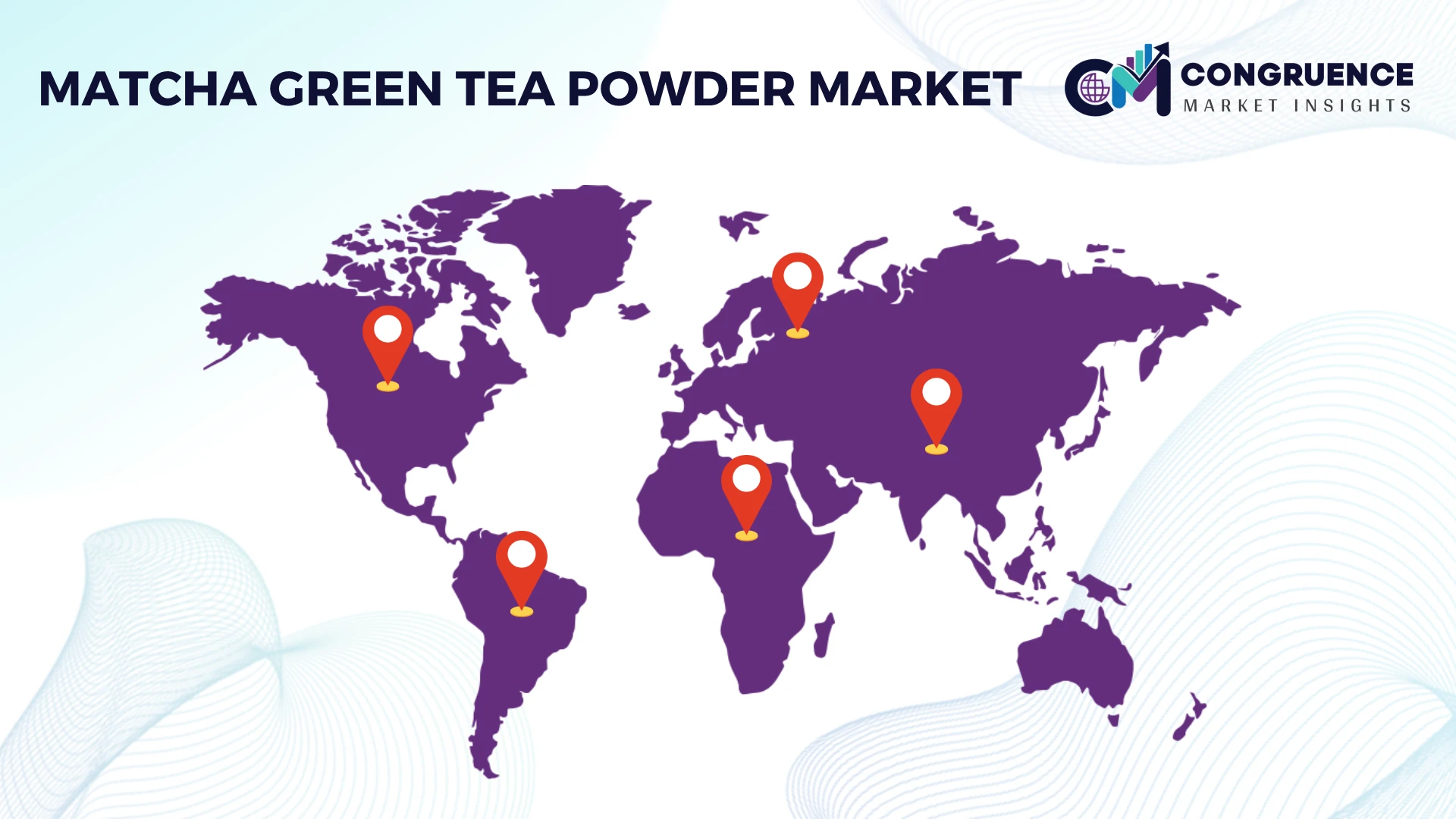
North America represents approximately 26% of the global market, supported by strong demand across functional beverages, specialty cafés, premium retail, and nutraceutical formulations. Health-focused consumer preferences continue accelerating the use of ceremonial and culinary-grade matcha in ready-to-drink beverages, protein blends, and bakery applications. More than 40% of premium tea product launches now incorporate clean-label positioning, while automated blending and packaging technologies continue improving manufacturing efficiency. Food manufacturers are expanding strategic sourcing partnerships with Japanese producers to strengthen supply reliability and maintain premium quality standards. Enterprise investment remains concentrated in branded consumer products, ingredient innovation, and digital retail expansion, enabling faster product commercialization and stronger competitive positioning.
United States Market Outlook: The United States remains the largest contributor within North America due to its advanced functional food industry, extensive specialty coffee networks, and expanding wellness product ecosystem. Nearly 65% of regional premium matcha consumption originates from the U.S., supported by rapid product diversification across beverages, nutritional supplements, and ready-to-drink formats. Domestic brands continue investing in direct sourcing agreements, premium certification, and omnichannel retail strategies while expanding partnerships with Japanese suppliers to strengthen long-term procurement resilience and product authenticity.
Europe accounts for nearly 18% of global demand as clean-label regulations, sustainability initiatives, and premium food innovation reshape purchasing behavior. Organic certification and traceability have become major procurement priorities across food manufacturers, cafés, and retail chains. Approximately 38% of premium green tea product introductions now emphasize certified sustainable sourcing, while plant-based food manufacturers increasingly integrate culinary-grade matcha into dairy alternatives and bakery products. Companies continue modernizing ingredient sourcing, expanding contract manufacturing capabilities, and strengthening distribution partnerships to improve operational flexibility while meeting evolving regulatory expectations and consumer quality standards.
Germany Market Outlook: Germany serves as the leading European market through its strong organic food industry, advanced retail infrastructure, and established functional nutrition sector. More than 30% of premium botanical ingredient imports are directed toward food and beverage manufacturing, while domestic processors continue expanding certified organic product portfolios. Enterprise investment focuses on sustainable sourcing partnerships, private-label development, and premium ingredient innovation to strengthen competitiveness across health-oriented consumer markets.
Asia-Pacific contributes approximately 48% of global market activity through its dominant cultivation, processing, and export infrastructure. Japan continues leading premium ceremonial-grade production, while China expands industrial-scale processing capacity for global food manufacturers. More than 80% of premium export volumes originate within the region, supported by specialized cultivation practices and integrated processing networks. Investments in automated grading, precision agriculture, and digital traceability continue improving production efficiency and export consistency. Companies are expanding processing facilities, strengthening grower partnerships, and increasing premium product differentiation to maintain international competitiveness.
Japan Market Outlook: Japan remains the strategic center of the global matcha industry through advanced shaded cultivation, traditional stone-grinding expertise, and internationally recognized quality standards. The country produces nearly 45% of premium ceremonial-grade matcha supplied worldwide and continues investing in automated quality inspection and sustainable cultivation practices. Leading processors are expanding export-focused operations while collaborating with food manufacturers to support premium beverages, confectionery, cosmetics, and nutraceutical product development across international markets.
South America represents approximately 5% of global demand as premium wellness products gain broader commercial acceptance across urban consumer markets. Functional beverages, nutritional supplements, and specialty cafés continue driving commercial adoption, while e-commerce platforms improve premium product accessibility. Import-oriented supply chains remain dominant, although regional distributors are expanding warehousing capacity and strategic sourcing partnerships to improve inventory stability. Approximately 21% of premium tea retailers have expanded botanical wellness product portfolios during the past two years, supporting broader commercialization despite logistics and import dependency challenges.
Brazil Market Outlook: Brazil leads the South American market through its large consumer base, expanding health food sector, and well-developed retail distribution network. Functional beverage manufacturers continue introducing matcha-based drinks and nutritional formulations, supported by increasing premium product availability across supermarkets and online channels. Companies are strengthening import partnerships, optimizing distribution infrastructure, and expanding private-label offerings to address rising consumer demand for natural wellness ingredients.
Middle East & Africa account for approximately 3% of global market activity, supported by premium food retail expansion, hospitality growth, and increasing wellness product consumption. International café chains, luxury retail outlets, and specialty beverage brands continue introducing premium matcha offerings to urban consumers. More than 18% of premium beverage menu expansions now include botanical functional ingredients, while modern retail infrastructure continues strengthening imported product availability. Companies are expanding regional distribution partnerships, investing in cold-chain logistics where required, and improving premium product positioning to capture growing demand from health-conscious consumers.
United Arab Emirates Market Outlook: The United Arab Emirates represents the region's most strategically significant market due to its premium retail ecosystem, international hospitality industry, and strong import infrastructure. Dubai serves as a major regional distribution hub for specialty food products, enabling efficient access to neighboring markets. Premium cafés, hotels, and wellness retailers continue expanding ceremonial-grade matcha offerings, while distributors strengthen partnerships with Japanese suppliers to improve product availability and reinforce premium brand positioning.
The market is led by premium Japanese producers including Aiya, ITO EN, Marukyu Koyamaen, and Matcha Maiden, competing against cost-focused Chinese manufacturers and rapidly expanding private-label ingredient suppliers. Global premium brands compete on authenticity, traceability, and quality, while regional processors challenge through price competitiveness and scalable supply. The top five players collectively account for approximately 42% of global market share, reflecting a moderately consolidated structure. Competition centers on certified sourcing, automated processing, export reliability, and customized formulations, with premium products typically commanding 25–40% higher pricing than standard grades. Automated quality inspection improves production consistency by nearly 20%, while vertically integrated sourcing reduces procurement volatility by around 15%. Companies continue expanding processing capacity, strengthening grower partnerships, introducing application-specific formulations, and investing in digital traceability platforms. The competitive landscape is shifting toward supply-chain control and premium differentiation as demand outpaces production. Limited access to high-quality tencha remains the primary entry barrier. Winning requires secure sourcing, premium quality consistency, operational efficiency, and trusted global distribution.
Aiya Co., Ltd.
ITO EN, Ltd.
Marukyu Koyamaen Co., Ltd.
Matcha Maiden Pty Ltd.
Encha LLC
DoMatcha
Mizuba Tea Co.
AOI Tea Company
Jade Leaf Matcha
The Matcha Reserve
Matchaeologist
Ikeda Tea World Co., Ltd.
AI-enabled optical grading, hyperspectral imaging, and automated stone-milling systems are transforming premium matcha production. AI-based quality inspection reduces manual evaluation time by approximately 35% while improving grading consistency by nearly 20%. More than 45% of large-scale premium processors have integrated digital quality monitoring into production workflows, improving traceability and reducing product variation. These technologies strengthen export compliance, enhance premium positioning, and reduce operational waste across high-value manufacturing lines.
Precision agriculture, IoT-enabled environmental monitoring, and drone-assisted crop management are improving shaded tea cultivation. Compared with conventional field monitoring, sensor-based cultivation increases resource efficiency by approximately 18% while lowering irrigation inputs by around 12%. Japanese producers benefit through improved leaf consistency and harvest planning, whereas emerging processors gain stronger production predictability. Digital farm management platforms are increasingly integrated with procurement systems to improve supply-chain visibility and inventory planning.
Between 2026 and 2028, blockchain-enabled traceability, predictive analytics, and robotic packaging are expected to become mainstream across export-focused operations. More than 55% of premium buyers increasingly prioritize verified origin and digital product authentication. Companies adopting integrated production technologies will achieve faster certification, stronger retailer confidence, and greater operational resilience, while traditional processors relying on manual systems risk slower market responsiveness and weaker premium differentiation.
January 2025 – ITO EN announced an expanded global partnership with Major League Baseball to strengthen international promotion of Japanese green tea products, supporting broader overseas brand visibility. The initiative targets multiple international markets through coordinated campaigns. Source: www.itoen-global.com
March 2025 – Marukyu Koyamaen introduced purchase limits across 5 directly managed stores after demand exceeded production capacity, prioritizing equitable product allocation and supply stability. The measure highlighted sustained pressure on premium matcha availability. Source: www.marukyu-koyamaen.co.jp
July 2025 – Marukyu Koyamaen reinforced anti-resale measures while maintaining one-item purchasing restrictions across 5 company-operated stores, protecting product availability and brand integrity during persistent supply shortages. Source: www.marukyu-koyamaen.co.jp
November 2025 – ITO EN confirmed expansion of production lines at its Matcha Studio facility in Shizuoka to strengthen stable supply and enhance quality-control operations for growing domestic and international demand. Production capacity expansion supports long-term operational resilience.
This report delivers comprehensive analysis of the global Matcha Green Tea Powder Market across product types, applications, end-users, competitive positioning, technology adoption, and regional performance. The assessment covers Ceremonial Grade, Culinary Grade, Ingredient Grade, and Classic Grade products across beverages, food products, cosmetics, nutritional supplements, and related commercial applications. More than 60% of demand originates from food and beverage manufacturing, while premium retail, nutraceuticals, and personal care continue expanding strategic opportunities.
The report evaluates market dynamics across North America, Europe, Asia-Pacific, South America, and the Middle East & Africa, highlighting production concentration, adoption trends, supply-chain developments, and enterprise strategies between 2026 and 2033. It examines digital traceability, AI-enabled quality inspection, precision agriculture, and automated processing technologies while profiling leading market participants. The analysis supports investment prioritization, geographic expansion, procurement planning, competitive benchmarking, partnership evaluation, and long-term product portfolio optimization through detailed segmentation and forward-looking strategic business intelligence.
| Report Attribute / Metric | Details |
|---|---|
| Market Revenue (2025) | USD 399.5 Million |
| Market Revenue (2033) | USD 712.5 Million |
| CAGR (2026–2033) | 7.5% |
| Base Year | 2025 |
| Forecast Period | 2026–2033 |
| Historic Period | 2021–2025 |
| Segments Covered |
By Type
By Application
By End-User
|
| Key Deliverables | Revenue Forecast; Market Trends; Growth Drivers & Restraints; Technology Insights; Segmentation Analysis; Regional Insights; Competitive Landscape; Regulatory & ESG Overview; Recent Developments |
| Regions Covered | North America; Europe; Asia-Pacific; South America; Middle East & Africa |
| Companies Profiled | Aiya Co., Ltd.; ITO EN, Ltd.; Marukyu Koyamaen Co., Ltd.; Matcha Maiden Pty Ltd.; Encha LLC; DoMatcha; Mizuba Tea Co.; AOI Tea Company; Jade Leaf Matcha; The Matcha Reserve; Matchaeologist; Ikeda Tea World Co., Ltd. |
| Customization & Pricing | Available on Request (10% Customization Free) |




