
Reports
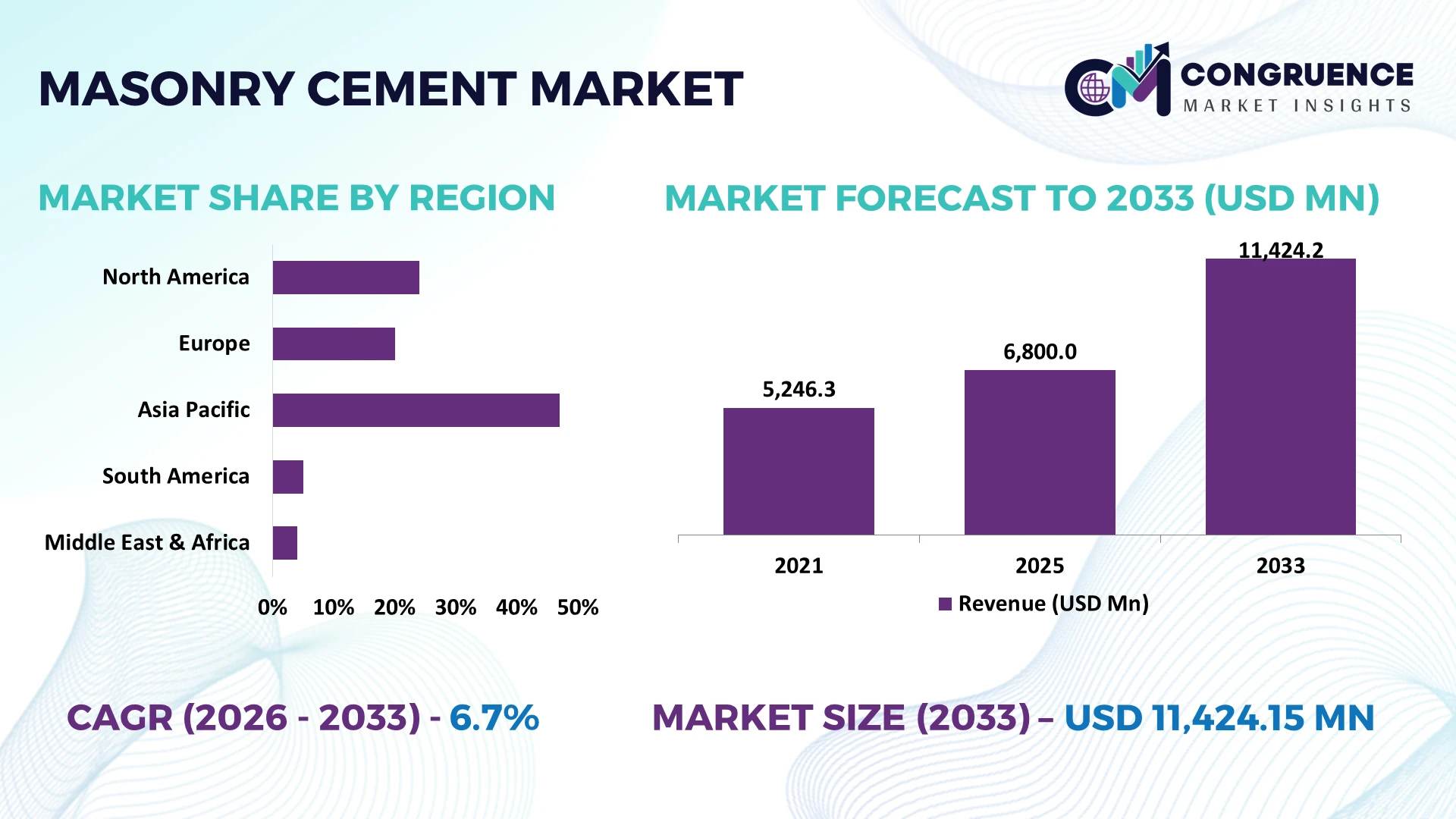
The Global Masonry Cement Market was valued at USD 6800 Million in 2025 and is anticipated to reach a value of USD 11424.15 Million by 2033 expanding at a CAGR of 6.7% between 2026 and 2033. Growth is driven by urban housing construction, concrete-block and brick masonry deployment, infrastructure rebuilding, and adoption of blended low-clinker cement formulations that reduce material intensity and embodied carbon.
China remains the dominant country, producing roughly 1.8 billion tonnes of cement annually and accounting for more than 40% of global cement output, supporting extensive masonry consumption across residential, commercial, and infrastructure construction. India produces about 450 million tonnes, but faster urban construction and infrastructure investment are expanding mortar demand. China's property-sector restructuring is shifting cement consumption from developer-led housing toward renovation, public infrastructure, and urban redevelopment.
Manufacturers with efficient grinding, supplementary cementitious material access, regional distribution, and application-specific mortar performance are best positioned as construction demand shifts toward lower-carbon, cost-controlled masonry systems.
Market Size & Growth: USD 6.8 billion in 2025 reaches USD 11.42 billion by 2033 at 6.7% CAGR, supported by urban construction, masonry-intensive housing, and blended-cement adoption.
Top Growth Drivers: Urban housing contributes approximately 35%, infrastructure construction 25%, and renovation activity 20% to incremental masonry cement demand.
Short-Term Forecast: By 2028, optimized grinding, alternative fuels, and automated batching are positioned to reduce production energy intensity by approximately 8–12%.
Emerging Technologies: AI kiln optimization, calcined-clay blending, automated quality control, and carbon-mineralized additives can lower clinker requirements by approximately 15–30%.
Regional Leaders: By 2033, modeled Asia-Pacific demand approaches USD 6.0 billion, North America USD 2.0 billion, and Europe USD 1.7 billion, with blended formulations gaining penetration.
Consumer/End-User Trends: Residential and commercial building collectively represent approximately 65% of masonry cement consumption, emphasizing workability, bond strength, water retention, and contractor productivity.
Pilot/Case Example: Limestone-calcined-clay cement applications can reduce clinker content by approximately 40% versus conventional Portland cement formulations while maintaining construction-grade performance.
Competitive Landscape: Holcim holds an estimated 8–10% global cement-sector position, competing with Heidelberg Materials, Cemex, UltraTech Cement, and China National Building Material across regional masonry applications.
Regulatory & ESG Impact: Cement production generates roughly 7–8% of global CO₂ emissions, accelerating clinker substitution, alternative fuels, renewable electricity, and carbon-efficient grinding investment.
Investment & Funding: Cement producers are directing USD 100 million-plus individual projects toward calcined clay, alternative fuels, grinding upgrades, carbon capture, and lower-emission product platforms.
Innovation & Future Outlook: Advanced masonry formulations targeting 20–40% clinker substitution will shift competition toward locally available supplementary materials, automated quality control, and verified embodied-carbon performance.
Masonry Cement Market demand is concentrated in brickwork, concrete-block construction, plastering, rendering, residential housing, commercial buildings, and urban infrastructure. Blended formulations using limestone, calcined clay, and supplementary cementitious materials can reduce clinker requirements by 20–40% while maintaining mortar performance. Tightening construction-carbon policies and changing fly-ash availability are making local raw-material integration increasingly important, setting up the market’s strategic transition.
Masonry cement is becoming strategically important as producers reposition from volume-led cement supply toward application-specific, lower-clinker products that improve mortar workability while reducing carbon intensity. Infrastructure modernization, urban housing programs, and tighter embodied-carbon requirements are changing procurement priorities across India, the U.S., and Europe. The supply chain is also restructuring as declining fly-ash availability increases reliance on limestone, calcined clay, slag, and other supplementary cementitious materials.
Modern blended masonry formulations can lower clinker content by roughly 20–40% versus conventional Portland-rich mixes while reducing embodied emissions by approximately 15–30%, depending on binder composition. India combines rapid construction deployment with expanding grinding capacity, whereas Europe is moving faster on carbon-performance specifications and alternative binders. Over the next 2–3 years, producers are expected to increase low-clinker product penetration, automated quality control, and local raw-material substitution to protect margins.
A practical example is a regional grinding plant integrating calcined clay and limestone into masonry cement while using digital dosing to stabilize setting time and mortar consistency. Producers are redirecting capital toward blending lines, alternative-material partnerships, and decentralized grinding. Competitive advantage will increasingly depend on controlling supplementary-material supply, maintaining contractor performance, and delivering measurable carbon and cost benefits without sacrificing masonry productivity.
Urban housing and infrastructure construction remain the strongest structural demand engine for masonry cement because brick, block, plaster, and render applications consume high volumes of workable mortar. India’s urban population is already above 35% and continues rising, while national infrastructure programs are increasing cement-intensive residential and transport construction. Masonry applications can account for 20–30% of cement consumption within low- and mid-rise building projects, depending on construction method. At the same time, blended formulations can reduce clinker use by roughly 20–40%, improving cost and carbon performance. Producers are expanding grinding capacity, dealer networks, and application-specific product lines in high-growth states such as Uttar Pradesh, Maharashtra, and Gujarat. The strategic insight is clear: localized masonry cement capacity can capture contractor demand while avoiding the logistics penalty of transporting lower-value bulk cement over long distances.
Masonry cement economics remain exposed to coal, petcoke, electricity, gypsum, slag, and supplementary-material volatility. Thermal energy can represent roughly 25–30% of cement manufacturing costs, while logistics can account for another 20–25% in fragmented distribution markets. Declining coal-fired power generation in parts of Europe is tightening conventional fly-ash availability, forcing producers to qualify alternative pozzolans or calcined clay. In India, long-haul movement of limestone and clinker can materially erode margin where plants lack nearby grinding or blending infrastructure. Companies are reducing exposure through captive renewable power, waste-heat recovery, multi-fuel kilns, long-term slag contracts, and regional grinding hubs. A key operational insight is that low-clinker products do not automatically lower cost unless supplementary materials are locally available, consistently processed, and compatible with established mortar performance specifications.
Calcined clay represents a major opportunity because it expands the pool of supplementary materials beyond constrained fly ash and slag. Limestone-calcined-clay systems can reduce clinker content by around 40% and lower CO₂ intensity by approximately 20–30% while maintaining strength development suitable for masonry applications. India, Brazil, and parts of Africa hold significant kaolinitic clay resources, creating localized production opportunities near growing construction markets. Digital grinding controls and automated blending can additionally improve fineness consistency by roughly 5–10%, helping stabilize mortar workability across variable raw materials. Producers are investing in calcination units, mineral characterization, laboratory capability, and partnerships with clay suppliers. The non-obvious opportunity is geographic: regions without steel mills or coal-power fly ash can become competitive low-carbon cement hubs by converting abundant clay into a strategic binder input.
The long-term challenge is maintaining uniform mortar behavior as producers increase alternative-material content across different plants and raw-material sources. Calcined clay reactivity can vary by more than 20% depending on mineralogy and thermal treatment, while changes in fineness or sulfate balance can materially affect water demand, setting time, and early strength. Contractors also expect consistent workability across brick, concrete block, and plaster applications, making formulation errors operationally visible at job sites. Europe’s tightening carbon requirements and India’s rapid capacity additions are increasing pressure to scale lower-clinker products without compromising performance. Manufacturers must invest in mineralogical testing, automated dosing, predictive quality control, and contractor training. The strategic risk is deployment inconsistency: producers that cannot control raw-material variability will face higher complaint rates, slower specification acceptance, and weaker brand credibility despite achieving lower embodied carbon.
Blended Formulations Gain Specification Share: Cement producers are increasing limestone and supplementary-material content as customers demand lower-carbon masonry products without changing jobsite practices. Global clinker-to-binder ratios remain near 0.63, while commercial low-carbon formulations have demonstrated clinker factors near 53%. Producers are modifying grinding, proportioning, and quality-control workflows, allowing contractors to retain conventional mixing equipment while manufacturers lower material intensity and strengthen specification competitiveness.
Digital Quality Control Moves Upstream: Plants are deploying online analyzers, automated dosing, predictive maintenance, and AI-assisted process control to stabilize masonry cement consistency. Automated optimization can reduce specific energy consumption by roughly 5–10% and process variability by 10–15%. Manufacturers are connecting quarry chemistry, grinding parameters, and laboratory results, enabling faster corrective adjustments and reducing off-specification material before it reaches mortar producers.
Alternative Fuels Reshape Plant Economics: Fuel diversification is accelerating as coal and petcoke volatility increases thermal-cost exposure. Modern plants achieving alternative-fuel substitution above 40% can materially reduce fossil-fuel dependence, while advanced European facilities exceed 60% in selected operations. Producers are investing in waste preprocessing, kiln feeding systems, and local municipal partnerships, turning fuel procurement into an increasingly important competitive capability alongside clinker production.
Carbon Ratings Influence Product Positioning: Carbon transparency is moving from sustainability reporting into cement procurement following introduction of standardized AA-to-G performance classifications. Cement manufacturing contributes roughly 7% of global CO₂ emissions, intensifying demand for quantified product footprints. Producers are expanding environmental-product declarations, low-clinker portfolios, and verified carbon accounting. The non-obvious shift is commercial: comparable carbon metrics increasingly allow masonry products to compete on embodied performance alongside strength, workability, and price.
Portland Cement Blends account for approximately 39% of Masonry Cement Market demand, supported by broad manufacturing availability, established specifications, scalable grinding infrastructure, and compatibility with brick, block, plaster, and general mortar applications. Their ability to incorporate limestone and supplementary cementitious materials provides manufacturers with formulation flexibility while preserving familiar contractor handling. Masonry Cement Type N represents roughly 24%, reflecting its moderate strength, high workability, and suitability for above-grade walls, veneers, partitions, and general-purpose masonry where extreme structural loading is unnecessary.
Masonry Cement Type S is the fastest-growing type, benefiting from higher bond strength and expanding use in foundations, retaining walls, exterior masonry, and structures exposed to elevated lateral loads. Type S mortar typically targets compressive strength around 1,800 psi versus approximately 750 psi for Type N. Type M remains strategically important for heavy-load and below-grade applications, while Plastic Cement maintains specialized demand in plaster and stucco work. Producers are expanding performance-specific portfolios and automated blending to improve consistency across these grades.
Block Masonry leads application demand with an estimated 31% share because concrete masonry units require substantial mortar volumes across residential, commercial, institutional, and infrastructure-related construction. Standardized block dimensions and repetitive laying patterns favor factory-controlled masonry cement delivering predictable water retention and workability. Brick Masonry follows at approximately 27%, maintaining substantial utilization in façades, housing, boundary walls, and architectural construction. Mortar Production remains strategically important as centralized batching reduces onsite proportioning variability and improves formulation consistency.
Stucco & Plaster represents the fastest-growing application as renovation, façade refurbishment, and mechanized application strengthen material consumption. Mechanized plastering can improve application productivity by approximately 20–30% versus labor-intensive placement where project scale supports continuous spraying. Stone Masonry remains smaller but commands performance-sensitive demand across restoration, landscaping, and premium architectural projects. Cement manufacturers are responding with application-specific grades, controlled air entrainment, improved water-retention chemistry, and packaged mortar systems designed to increase contractor productivity and reduce field variability.
Residential Construction represents approximately 41% of masonry cement demand because low- and mid-rise housing consumes substantial mortar across block walls, brick façades, partitions, plaster, and exterior finishes. Commercial Construction accounts for roughly 24%, with offices, schools, retail buildings, healthcare facilities, and hospitality projects requiring greater specification consistency and scheduling reliability. Contractors remain influential buyers because material workability, setting behavior, bag handling, and application productivity directly affect labor economics and project completion schedules.
Infrastructure Projects represent the fastest-growing end-user segment as urban transit facilities, stations, public buildings, utility structures, retaining systems, and associated masonry works expand. Precast Manufacturers form a smaller but technically important channel where controlled dosing and repeatable performance support factory production. Manufacturers are targeting infrastructure contractors through bulk agreements and certified performance grades while offering residential distributors packaged formulations adapted to local construction practices. Investment priorities are consequently separating between high-volume dealer networks and specification-led institutional procurement.
Asia-Pacific accounted for the largest market share at 52% in 2025 however, Asia-Pacific is expected to register the fastest growth, expanding at a CAGR of 7.5% between 2026 and 2033.
Renovation and Infrastructure Reshape Cement Demand
North America accounts for approximately 18% of Masonry Cement Market demand, supported by residential renovation, commercial construction, concrete masonry systems, and public infrastructure. The United States produces roughly 90 million tonnes of Portland and masonry cement annually, with Texas, Missouri, California, and Florida forming major production clusters. Demand is shifting toward factory-controlled masonry formulations that reduce onsite proportioning and improve mortar consistency. Infrastructure modernization and domestic manufacturing investment are also supporting block masonry across industrial and logistics facilities. Producers are upgrading grinding circuits, automated quality controls, alternative-fuel systems, and supplementary cementitious material handling. U.S. cement plants increasingly operate near high utilization levels, making debottlenecking and terminal optimization commercially important. Canada contributes demand through urban housing and institutional construction, while colder climatic conditions strengthen requirements for predictable setting behavior, durability, and specification-controlled masonry systems.
United States Market Outlook: The United States remains the strategic regional center through its extensive cement manufacturing, ready-mix, concrete-block, distribution, and contractor infrastructure. Texas alone contributes more than 15% of domestic cement production capacity. Federal infrastructure spending and manufacturing construction are strengthening specification-led demand, while producers are expanding blended products, terminal capacity, alternative fuels, and application-focused technical services to protect regional supply reliability.
Carbon Regulation Accelerates Binder Reformulation
Europe accounts for approximately 15% of global Masonry Cement Market demand, with Germany, Spain, Italy, France, and Poland maintaining substantial cement and masonry-product infrastructure. EU carbon policy is accelerating clinker reduction, alternative-fuel substitution, and supplementary-material integration across masonry formulations. European cement plants increasingly achieve alternative-fuel substitution above 50%, while leading installations exceed 70%, materially reducing fossil-fuel dependence. Renovation is particularly important because approximately 85% of EU buildings were constructed before 2000, supporting plaster, façade, repair, and masonry refurbishment demand. Producers are modernizing grinding, calcination, waste-fuel preparation, and digital process-control systems while increasing environmental-product documentation. Carbon pricing is also altering product economics, rewarding formulations that deliver comparable workability with less clinker. The operational shift therefore favors technically optimized masonry products over conventional composition-based competition, particularly in specification-driven commercial and public construction.
Germany Market Outlook: Germany combines advanced cement production, dry-mortar manufacturing, masonry systems, and highly standardized construction practices. Alternative fuels already replace well above 60% of conventional thermal fuels across German cement production, providing an operational platform for lower-emission masonry binders. Producers are emphasizing limestone-rich formulations, recycled mineral inputs, digital quality management, and performance documentation as building renovation becomes increasingly important to construction-material demand.
Indian Construction Expands Regional Consumption Base
Asia-Pacific represents approximately 52% of global Masonry Cement Market demand, reflecting unmatched cement production scale and extensive brick-and-block construction across China, India, Indonesia, Vietnam, and the Philippines. China manufactures around 1.8 billion tonnes of cement annually, while India produces approximately 450 million tonnes and continues adding integrated and grinding capacity. China’s property restructuring is redirecting material demand toward infrastructure, urban renewal, and public projects, whereas India’s housing, transport, industrial-corridor, and urban-development programs sustain broader construction deployment. Producers are expanding regional grinding units, blended-cement portfolios, automated dispatch, and limestone-calcined-clay capabilities. India’s relatively high availability of limestone and suitable clay creates a strategic pathway for lower-clinker masonry formulations. The region’s scale advantage increasingly depends on localized distribution because cement economics deteriorate rapidly when low-value bulk material travels long distances from manufacturing plants.
India Market Outlook: India provides the strongest incremental deployment opportunity through urbanization, housing construction, highways, industrial facilities, and public infrastructure. Installed cement capacity exceeds 600 million tonnes annually, providing extensive infrastructure for application-specific masonry products. UltraTech, Shree Cement, Dalmia Bharat, and other producers are expanding grinding capacity, renewable power, waste-heat recovery, and blended formulations, strengthening supply coverage across rapidly urbanizing states.
Brazil Anchors Localized Masonry Consumption
South America accounts for approximately 8% of Masonry Cement Market demand, led by Brazil’s extensive residential masonry, concrete-block, mortar, and infrastructure ecosystem. Brazil consumes more than 60 million tonnes of cement annually, with bagged cement remaining strategically important because self-build housing and smaller contractors represent substantial distribution channels. São Paulo, Minas Gerais, Paraná, and other densely populated states concentrate production and construction activity. Producers are increasing alternative fuels, blended cement, digital dispatch, and regional distribution to control logistics costs across long transport distances. Argentina and Colombia provide additional masonry demand, although macroeconomic volatility and infrastructure financing constrain investment consistency. Brazil’s biomass and industrial-residue availability creates opportunities for lower-fossil-fuel manufacturing, while supplementary materials support clinker reduction. Competitive positioning depends heavily on dealer access because fragmented construction purchasing differs materially from specification-led European procurement.
Brazil Market Outlook: Brazil combines approximately 90 million tonnes of installed cement capacity with a highly developed concrete, mortar, masonry-block, and retail distribution ecosystem. Housing construction remains particularly important for bagged products. Domestic producers are strengthening alternative-fuel substitution, regional grinding, logistics optimization, and lower-clinker formulations, using localized production networks to manage freight exposure across Brazil’s geographically dispersed construction markets.
Infrastructure Investment Expands Production Networks
Middle East & Africa represents approximately 7% of global Masonry Cement Market demand, with Saudi Arabia, Egypt, the UAE, Nigeria, and South Africa providing major construction and manufacturing centers. Saudi Arabia’s giga-project pipeline is intensifying requirements for cementitious materials across residential districts, hospitality assets, commercial buildings, and supporting infrastructure. Egypt operates more than 80 million tonnes of cement production capacity, while Nigeria has developed substantial integrated capacity around domestic limestone resources. Producers are expanding terminals, grinding facilities, alternative-fuel systems, and regional distribution networks to serve fast-moving construction corridors. High temperatures increase requirements for controlled setting and water retention in masonry applications, making formulation performance operationally important. Infrastructure deficits remain a constraint in parts of Africa, where transport costs can represent more than 20% of delivered cement economics. Localized manufacturing therefore provides a significant competitive advantage.
Saudi Arabia Market Outlook: Saudi Arabia provides the strongest regional project-driven demand environment as Vision 2030 construction expands Riyadh, NEOM, Red Sea tourism destinations, and associated infrastructure. Domestic cement capacity above 70 million tonnes provides substantial supply capability. Producers are aligning grinding, distribution, and product specifications with large contractor requirements while improving fuel efficiency and supplementary-material utilization to strengthen project-level competitiveness.
Holcim, Heidelberg Materials, Cemex, UltraTech Cement, and CNBM compete through scale, distribution, formulation technology, and vertically integrated raw-material supply, while regional producers challenge them through lower logistics costs and contractor relationships. The top five hold approximately 27% combined share, leaving regional positioning decisive. Integrated producers can reduce delivered logistics costs by 10–20% through nearby grinding and terminals, while digital process optimization lowers energy intensity by roughly 5–10%. Low-clinker formulations provide 20–40% clinker substitution, creating another differentiation layer. Players are expanding grinding capacity, securing limestone and supplementary materials, integrating renewable energy, and partnering with construction-material distributors. Competition is shifting from commodity cement volume toward application-specific performance, carbon intensity, and supply reliability. Quarry access, kiln capital requirements, permitting, distribution infrastructure, and technical certification remain substantial entry barriers. Winning against established suppliers requires localized production, dependable dealer coverage, consistent mortar performance, competitive delivered costs, and scalable lower-carbon formulations backed by contractor-level technical support and service.
Holcim Ltd.
Heidelberg Materials AG
CEMEX S.A.B. de C.V.
UltraTech Cement Limited
China National Building Material Company
Anhui Conch Cement Company Limited
CRH plc
Votorantim Cimentos
Buzzi S.p.A.
Shree Cement Limited
Taiheiyo Cement Corporation
Titan Cement International
Dangote Cement Plc
Vicat S.A.
Current masonry cement technology centers on high-efficiency vertical roller mills, automated proportioning, online analyzers, and predictive process controls. Digital grinding optimization can reduce specific energy consumption by 5–10%, while automated raw-material dosing cuts composition variability by approximately 10–15%. Compared with legacy ball-mill workflows, modern vertical grinding systems deliver roughly 20–30% lower electricity consumption, improving production economics while maintaining controlled fineness and mortar consistency.
Emerging technologies combine calcined clay, limestone optimization, alternative fuels, waste-heat recovery, and AI-assisted quality management. Calcined-clay formulations can lower clinker requirements by 30–40%, while advanced plants achieve alternative-fuel substitution exceeding 60%. Deployment is expanding as integrated producers retrofit kilns and grinding units with real-time chemistry monitoring. These systems stabilize workability, compressive strength, air entrainment, and setting behavior while reducing exposure to fossil-fuel and supplementary-material volatility.
Disruptive technologies include electrified calcination, carbon capture, recycled cementitious materials, and mineralization. Industrial CCS now captures approximately 50% of process emissions at advanced cement facilities, demonstrating commercial-scale deployment. Between 2026 and 2028, automated blending and lower-clinker binders will penetrate more masonry portfolios. Integrated producers controlling limestone, alternative materials, digital quality systems, and distribution gain the strongest advantage because technology increasingly determines energy cost, formulation consistency, carbon performance, and specification competitiveness.
December 2024 Heidelberg Materials completed mechanical construction of Brevik CCS in Norway after 1.2 million technical work-hours. Designed to capture 400,000 tonnes of CO₂ annually, the facility established an industrial blueprint for substantially lower-carbon cement production. Source: heidelbergmaterials.com
April 2025 GCCA launched its global Low Carbon Ratings system for cement and concrete, introducing an AA-to-G classification based on product carbon footprints. The standardized 7-level framework strengthens transparent procurement and competitive differentiation for lower-carbon cement formulations. Source: gccassociation.org
October 2025 UltraTech Cement approved 22.8 MTPA of additional capacity through greenfield and brownfield projects, committing ₹10,255 crore. The expansion strengthens localized cement availability and distribution scale across India’s housing, infrastructure, and masonry-intensive construction markets. Source: ultratechcement.com
April 2026 UltraTech Cement commissioned three Indian grinding units totaling 8.7 MTPA, lifting domestic grey-cement capacity to 200.1 MTPA. Facilities in Uttar Pradesh, Jharkhand, and Andhra Pradesh strengthen regional supply responsiveness across major construction corridors. Source: ultratechcement.com
The Masonry Cement Market report evaluates Portland Cement Blends, Masonry Cement Types N, S, and M, and Plastic Cement across Brick Masonry, Block Masonry, Stone Masonry, Stucco & Plaster, and Mortar Production. End-user coverage includes Residential Construction, Commercial Construction, Infrastructure Projects, Contractors, and Precast Manufacturers. Portland blends represent approximately 39% of type demand, while residential construction accounts for roughly 41% of end-user consumption.
Regional assessment covers North America, Europe, Asia-Pacific, South America, and Middle East & Africa, including country-level production capacity, distribution infrastructure, raw-material availability, and construction deployment. Technology coverage examines vertical grinding, automated blending, calcined clay, alternative fuels, waste-heat recovery, digital quality control, carbon capture, and recycled cementitious inputs. The 2026–2033 analysis supports capacity investment, plant modernization, geographic expansion, supplier positioning, lower-clinker portfolio development, and competitive decisions across increasingly performance- and carbon-sensitive masonry applications.
| Report Attribute/Metric | Report Details |
|---|---|
Market Revenue in 2025 | USD 6800 Million |
Market Revenue in 2033 | USD 11424.15 Million |
CAGR (2026 - 2033) | 6.7% |
Base Year | 2025 |
Forecast Period | 2026 - 2033 |
Historic Period | 2021 - 2025 |
Segments Covered | By Type
By Application
By End-User
|
Key Report Deliverable | Revenue Forecast, Growth Trends, Market Dynamics, Segmental Overview, Regional and Country-wise Analysis, Competition Landscape |
Region Covered | North America, Europe, Asia-Pacific, South America, Middle East, Africa |
Key Players Analyzed | Holcim Ltd., Heidelberg Materials AG, CEMEX S.A.B. de C.V., UltraTech Cement Limited, China National Building Material Company, Anhui Conch Cement Company Limited, CRH plc, Votorantim Cimentos, Buzzi S.p.A., Shree Cement Limited, Taiheiyo Cement Corporation, Titan Cement International, Dangote Cement Plc, Vicat S.A. |
Customization & Pricing | Available on Request (10% Customization is Free) |




