
Reports
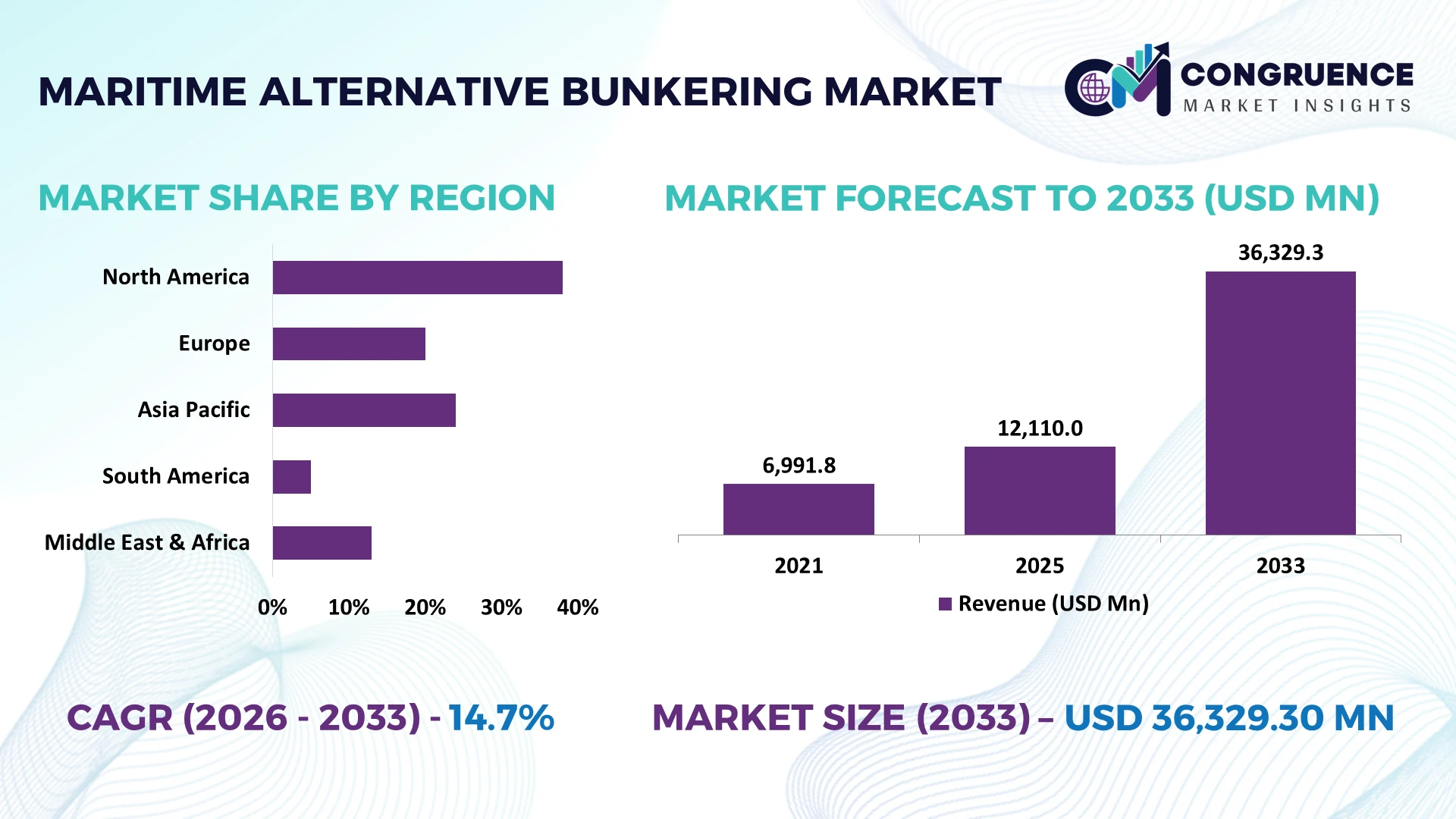
The Global Maritime Alternative Bunkering Market was valued at USD 12110 Million in 2025 and is anticipated to reach a value of USD 36329.3 Million by 2033 expanding at a CAGR of 14.72% between 2026 and 2033. Growth is driven by IMO decarbonization requirements, expanding LNG dual-fuel fleets, methanol-ready vessel orders, and investments in ammonia-compatible bunkering infrastructure.
Singapore dominates the global maritime alternative bunkering landscape, supported by its position as the world's largest bunkering hub. The port supplied approximately 54.92 million tonnes of marine fuel in 2024, including 0.46 million tonnes of LNG and 1,626 tonnes of methanol. Singapore's alternative-fuel infrastructure benefits from coordinated port investment, container shipping operations, and fuel supplier partnerships. Compared with Rotterdam's approximately 0.94 million cubic metres of LNG bunkered in 2024, Singapore demonstrates stronger overall marine fuel throughput, while Rotterdam maintains substantial European alternative-fuel capabilities.
Strategic implication: Maritime fuel suppliers should prioritize high-volume Asian bunkering corridors and European dual-fuel infrastructure, aligning investments with 2030 IMO emissions targets and expanding zero-emission fuel readiness.
Market Size & Growth: USD 12,110 million in 2025, reaching USD 36,329.3 million by 2033 at 14.72% CAGR, driven by LNG and methanol bunkering infrastructure expansion.
Top Growth Drivers: Singapore's biofuel bunkering growth of 69%, LNG bunkering growth of 319%, and Rotterdam's LNG volume increase of 52% demonstrate accelerating fuel diversification.
Short-Term Forecast: By 2027, a modeled 15% improvement in digital bunkering documentation efficiency supports faster vessel turnaround and reduced administrative costs.
Emerging Technologies: AI-powered fuel scheduling, automated bunker delivery verification, and ammonia-compatible transfer systems strengthen advanced marine fuel logistics across 3 technology categories.
Regional Leaders: Indicative 2033 allocations place Asia-Pacific at USD 16.35 billion, Europe at USD 10.90 billion, and North America at USD 5.45 billion, supported respectively by LNG, methanol, and biofuel adoption.
Consumer/End-User Trends: Alternative-fuel vessels represented 38% of global newbuilding gross tonnage ordered in 2025, demonstrating sustained fleet modernization commitments.
Pilot/Case Example: Singapore's 2024 ammonia bunkering demonstration transferred approximately 9.74 tonnes, establishing operational experience for alternative marine fuel handling.
Competitive Landscape: Shell, TotalEnergies, Hanwha Ocean, Wärtsilä, and Hanwha Shipping compete across LNG supply, bunkering infrastructure, and vessel technologies; supplier market shares remain fragmented.
Regulatory & ESG Impact: FuelEU Maritime introduced a 2% greenhouse gas intensity reduction requirement in 2025, accelerating cleaner bunker fuel procurement.
Investment & Funding: Singapore's Tuas Port expansion targets 65 million TEU annual capacity, supporting long-term investment in automated port and fuel supply infrastructure.
Innovation & Future Outlook: By 2030, a 6% FuelEU Maritime intensity reduction requirement reinforces investment in green methanol, renewable LNG, and ammonia-ready bunkering networks.
The Maritime Alternative Bunkering Market is transitioning toward integrated multi-fuel supply networks serving container carriers, LNG-powered tankers, cruise operators, and short-sea shipping fleets. Singapore's alternative bunker fuel sales reached 1.35 million tonnes in 2024, representing approximately 2.5% of total bunker sales and demonstrating substantial conversion potential. Innovations in cryogenic LNG transfer, methanol-compatible storage, digital bunker documentation, and ammonia safety systems are reshaping port infrastructure. European emissions regulations and Asia-Pacific shipping corridor investments are accelerating supplier partnerships, establishing fuel availability, infrastructure interoperability, and lifecycle emissions performance as critical strategic differentiators.
The Maritime Alternative Bunkering Market is becoming strategically important as shipping operators restructure fuel procurement, port infrastructure, and fleet investment around decarbonization requirements. FuelEU Maritime mandates a 2% reduction in greenhouse gas intensity from 2025, increasing to 6% by 2030. This regulatory transition encourages long-term fuel supply agreements, diversified bunkering networks, and investment in dual-fuel vessels. Ports securing reliable alternative fuel availability gain competitive advantages in vessel routing and cargo handling.
Technology modernization strengthens operational performance. Digital mass flow metering improves fuel delivery transparency compared with conventional manual measurement, while automated documentation offers modeled administrative processing savings of 15–25%. Singapore handled approximately 1.35 million tonnes of alternative bunker fuels in 2024, demonstrating substantial deployment capacity. Rotterdam emphasizes LNG and methanol infrastructure integration, whereas Japan prioritizes ammonia propulsion research and demonstration projects. During 2026–2028, automated bunkering verification and standardized fuel transfer procedures will become increasingly important for operational reliability.
Singapore's ammonia bunkering demonstration in 2024, involving approximately 9.74 tonnes, illustrates practical progress toward emerging fuel adoption. Shell, TotalEnergies, and maritime technology suppliers are strengthening fuel partnerships, infrastructure readiness, and safety engineering capabilities. Competitive positioning increasingly depends on integrated fuel availability, dependable delivery operations, and verifiable lifecycle emissions performance.
Stricter vessel emissions requirements are accelerating alternative marine fuel adoption and bunkering infrastructure modernization. FuelEU Maritime requires a 2% reduction in onboard energy greenhouse gas intensity from 2025, increasing to 6% by 2030. The IMO's revised greenhouse gas strategy targets at least a 20% reduction in international shipping emissions by 2030 compared with 2008. These regulatory milestones encourage shipowners to adopt LNG, methanol, and biofuel-compatible propulsion systems. Singapore's alternative bunker fuel sales reached approximately 1.35 million tonnes in 2024, highlighting measurable commercial adoption. Shell, TotalEnergies, and bunker suppliers are expanding fuel delivery capabilities and long-term procurement partnerships. Reliable fuel availability increasingly determines vessel deployment flexibility and port competitiveness.
Alternative marine fuels face structural cost disadvantages arising from limited production capacity, specialized storage requirements, and fragmented distribution networks. Green methanol can cost 100–300% more than conventional fossil-derived marine fuels, depending on feedstock and production technology. Ammonia contains approximately 54% less energy per unit volume than conventional marine fuel oil, increasing onboard storage requirements. Singapore's alternative fuel sales represented only 2.5% of total bunker volumes in 2024, illustrating the continuing dominance of conventional fuels. Limited renewable fuel availability in India and inconsistent supply arrangements across major ports complicate vessel scheduling and procurement. Shipping companies are mitigating exposure through diversified fuel contracts, dual-fuel propulsion systems, and partnerships with renewable fuel producers to stabilize operating economics.
Green shipping corridors create opportunities for integrated fuel production, storage, and vessel refueling services. FuelEU Maritime establishes a 6% greenhouse gas intensity reduction requirement by 2030, while its renewable fuels framework introduces a 2% renewable fuels of non-biological origin target from 2034, subject to regulatory conditions. Advanced digital bunkering platforms offer modeled documentation processing improvements of 15–25%, supporting faster fuel reconciliation and reduced administrative workloads. India's green hydrogen initiatives create opportunities to connect renewable hydrogen production with future ammonia and methanol supply chains. Ports can capture additional service demand through shared storage facilities, automated transfer monitoring, and certified fuel traceability. Technology providers and energy companies are pursuing integrated supply partnerships that combine fuel certification, digital monitoring, and port logistics.
Scaling alternative bunkering requires harmonized safety procedures, specialized workforce capabilities, and reliable integration between vessels and port infrastructure. Ammonia's approximately 54% lower volumetric energy density than conventional marine fuel oil complicates vessel storage design and fuel handling arrangements. The IMO's 2050 net-zero ambition intensifies pressure to develop operationally viable zero-emission fuel pathways, while the 2030 emissions reduction checkpoint requires at least 20% progress against 2008 levels. Singapore's ammonia demonstration transferred approximately 9.74 tonnes in 2024, highlighting the difference between controlled trials and commercial-scale bunkering operations. Operators must address toxic exposure risks, emergency response coordination, and digital control system cybersecurity. Equipment manufacturers, classification societies, and port authorities are developing standardized transfer protocols, workforce training, and integrated safety verification systems to improve deployment consistency.
Biofuel Blending Gains Commercial Traction: Singapore's biofuel bunker sales reached approximately 0.88 million tonnes in 2024, increasing 69% year over year. Blended marine fuels enable existing vessels to reduce lifecycle emissions without extensive propulsion modifications. B30 blends contain 30% biofuel, offering operational flexibility for conventional engines subject to fuel compatibility requirements. Bunker suppliers are strengthening feedstock traceability, fuel quality testing, and blending partnerships to support consistent deliveries and reduce compliance uncertainty.
LNG Bunkering Moves Toward Scale: Singapore's LNG bunker deliveries reached approximately 0.46 million tonnes in 2024, representing 319% annual growth. Rotterdam recorded approximately 0.94 million cubic metres of LNG bunkering during the same period. Operators increasingly coordinate dedicated bunker vessels with scheduled container ship arrivals, improving delivery reliability and reducing berth disruption. Shell and TotalEnergies are strengthening LNG supply coordination and vessel-to-vessel transfer capabilities to serve established shipping corridors.
Methanol Handling Becomes Operationally Standardized: Methanol bunkering requires dedicated containment, compatible transfer equipment, and enhanced crew training. Singapore recorded 1,626 tonnes of methanol bunker sales in 2024, while Rotterdam's methanol bunkering activity exceeded 40,000 tonnes. The difference highlights how port-specific vessel deployment shapes early fuel demand. Shipping companies and terminal operators are developing standardized connection systems, contamination controls, and emergency response procedures to improve fuel handling consistency.
Digital Fuel Verification Reshapes Transactions: Singapore introduced mandatory digital bunkering documentation for conventional marine fuel deliveries from April 2025. Electronic bunker delivery notes replace paper-intensive workflows, enabling faster transaction reconciliation and improved auditability. Modeled administrative processing savings of 15–25% strengthen the business case for digital adoption. Suppliers are integrating mass flow meter data, electronic documentation, and automated validation platforms, reducing manual discrepancies while improving operational transparency across vessel supply chains.
LNG represents the leading established alternative marine fuel, supported by mature cryogenic storage systems, dedicated bunkering vessels, and commercial dual-fuel propulsion technology. An indicative global market allocation places LNG at approximately 55%, followed by biofuels at 25%, methanol at 15%, ammonia at 4%, and hydrogen at 1%. These modeled shares reflect relative commercial maturity rather than verified global bunkering volumes. LNG's infrastructure advantages enable shipping companies to secure predictable fuel delivery across established trading routes. Singapore recorded 571,400 tonnes of LNG bunker sales in 2025, increasing approximately 24% annually.
Biofuels represent the fastest-growing commercially deployed segment in Singapore, with blended fuel sales increasing approximately 54% during 2025. Compatibility with existing marine engines supports rapid adoption without substantial vessel retrofitting. Methanol is strengthening its position through dual-fuel container ship deployment, while ammonia attracts investment in specialized storage and safety systems. Hydrogen remains concentrated in smaller vessel applications because of storage and energy density constraints. Suppliers are prioritizing flexible bunkering infrastructure and renewable fuel partnerships to accommodate evolving fleet requirements.
Container Shipping represents the largest application segment, with an indicative 50% share of global alternative bunkering demand, followed by Tanker Shipping at 25%, Passenger and Cruise Shipping at 15%, and Bulk Carriers at 10%. These modeled allocations reflect vessel investment patterns and fuel infrastructure accessibility. Container operators benefit from scheduled port rotations, concentrated fuel procurement, and established relationships with bunkering suppliers. In 2025, container vessels accounted for approximately 68% of alternative-fuel ship orders, demonstrating strong investment concentration. Maersk, CMA CGM, and other container operators are integrating LNG and methanol-compatible vessels into international service networks.
Passenger and Cruise Shipping represents an important emerging application, supported by LNG-powered cruise vessels and stricter emissions requirements at destination ports. Tanker Shipping maintains opportunities for LNG integration through established energy transportation networks, although investment remains sensitive to vessel economics. Bulk Carriers face slower adoption because of irregular trading routes and fuel availability constraints. Operators are responding through fleet modernization, dedicated bunkering agreements, and route-specific fuel planning to improve operational predictability and emissions performance.
Commercial Shipping Operators represent the dominant end-user category, with an indicative 45% share of alternative bunkering demand. Shipowners and Fleet Operators account for approximately 30%, Port and Bunkering Companies 20%, and Offshore Vessel Operators 5%, based on a modeled demand allocation. Commercial operators dominate through frequent international voyages, consolidated fuel purchasing, and extensive vessel deployment networks. Their long-term procurement contracts support predictable bunkering volumes and encourage infrastructure investment. Singapore's alternative bunker fuel deliveries reached approximately 1.95 million tonnes in 2025, reflecting expanding commercial fuel adoption.
Port and Bunkering Companies represent the fastest-growing infrastructure-focused end-user segment, supported by investments in LNG transfer vessels, methanol handling systems, and multi-fuel terminals. Shipowners and Fleet Operators increasingly prioritize propulsion flexibility and lifecycle emissions compliance when ordering vessels. Offshore Vessel Operators remain more specialized, with fuel decisions influenced by operating locations and vessel endurance requirements. Shell, TotalEnergies, and marine technology providers are strengthening supply agreements and integrated service capabilities, positioning themselves around fuel availability, delivery reliability, and customer-specific infrastructure requirements.
Asia-Pacific accounted for the largest market share at an estimated 45% in 2025 however, Middle East & Africa is expected to register the fastest growth, expanding at a projected CAGR of 17.8% between 2026 and 2033.
LNG Infrastructure Expansion and Coastal Fleet Modernization
North America accounted for an estimated 15% of the global Maritime Alternative Bunkering Market in 2025, supported by LNG production capacity, established marine fuel distribution networks, and growing interest in low-emission coastal shipping. The United States leads regional infrastructure development, particularly along the Gulf Coast, where LNG export terminals and marine logistics operations provide opportunities for integrated bunkering services. Canada's Vancouver maritime corridor supports renewable marine fuel deployment and cleaner vessel operations. The Port of Los Angeles and Port of Long Beach are advancing emissions reduction initiatives, encouraging shipping companies to evaluate alternative propulsion technologies. LNG-powered vessels remain commercially significant because of existing fuel supply capabilities, while renewable diesel and biofuel blends offer near-term fleet compatibility. Suppliers are strengthening terminal partnerships and fuel logistics coordination to reduce delivery costs and improve vessel turnaround efficiency.
United States Market Outlook: The United States benefits from extensive natural gas production, Gulf Coast liquefaction infrastructure, and established maritime engineering capabilities. The Port of Houston handles more than 300 million tonnes of annual cargo, supporting substantial marine fuel logistics activity. LNG suppliers and shipping operators are exploring dedicated bunkering arrangements, while California's port emissions policies encourage cleaner marine fuel adoption. Domestic fuel availability strengthens procurement flexibility and supports investment in specialized bunkering vessels.
Regulatory Compliance Accelerates Multi-Fuel Port Modernization
Europe represented an estimated 30% of global Maritime Alternative Bunkering Market activity in 2025, supported by established port infrastructure and stringent maritime emissions regulations. FuelEU Maritime introduced a 2% greenhouse gas intensity reduction requirement in 2025, encouraging shipowners to integrate lower-emission fuels into vessel operations. Rotterdam, Antwerp-Bruges, Hamburg, and Gothenburg are strengthening LNG, methanol, and renewable marine fuel capabilities. Rotterdam's LNG bunkering volumes reached approximately 0.94 million cubic metres in 2024, demonstrating established commercial deployment. European operators increasingly prioritize certified fuel traceability, lifecycle emissions accounting, and compatibility with dual-fuel propulsion systems. The EU Emissions Trading System also increases the financial importance of fuel selection and emissions management. Port authorities and energy suppliers are coordinating storage investments, safety procedures, and bunker vessel availability to improve service reliability across major shipping corridors.
Netherlands Market Outlook: The Netherlands maintains a strategic advantage through Rotterdam's integrated refining, petrochemical, logistics, and marine fuel infrastructure. The port handled approximately 435.8 million tonnes of cargo in 2024, providing substantial demand concentration for alternative bunkering services. Dutch maritime companies are advancing methanol handling, LNG transfer capabilities, and digital fuel documentation. Established pipeline connections and industrial partnerships support efficient fuel distribution, while port-led decarbonization initiatives encourage investments in renewable methanol and low-emission shipping services.
Singapore and China Strengthen Bunkering Leadership
Asia-Pacific held an estimated 45% share of the global Maritime Alternative Bunkering Market in 2025, reflecting extensive commercial shipping activity, shipbuilding capacity, and concentrated marine fuel demand. Singapore anchors international bunkering operations, while China and South Korea contribute advanced vessel construction and alternative propulsion technologies. Singapore's total bunker sales reached approximately 56.77 million tonnes in 2025, including 1.95 million tonnes of alternative fuels. China's major shipyards are expanding LNG and methanol dual-fuel vessel construction, supporting demand for compatible port infrastructure. South Korea's shipbuilders are developing ammonia-ready propulsion systems and advanced fuel containment technologies. Japan emphasizes ammonia handling research and maritime safety engineering. These developments encourage closer integration between shipyards, fuel producers, terminal operators, and shipping companies, strengthening supply-chain coordination and accelerating commercial deployment across major container shipping routes.
Singapore Market Outlook: Singapore remains the region's most influential alternative bunkering hub through its maritime connectivity, regulatory coordination, and established fuel supplier ecosystem. Alternative fuels represented approximately 3.4% of total bunker sales in 2025, highlighting continued adoption potential. The Maritime and Port Authority is advancing digital bunkering documentation, methanol operational standards, and ammonia safety assessments. Tuas Port's planned annual capacity of 65 million TEUs strengthens the long-term case for integrated fuel logistics and automated marine services.
Renewable Feedstocks Support Marine Fuel Diversification
South America accounted for an estimated 4% of global Maritime Alternative Bunkering Market activity in 2025, reflecting early-stage infrastructure development and expanding interest in renewable marine fuels. Brazil leads regional opportunities through its established biofuel industry, major export terminals, and extensive coastal shipping network. Santos, Paranaguá, and Rio de Janeiro provide potential demand centers for biofuel blending and future methanol bunkering services. Brazil's biodiesel blending mandate reached 15% for road diesel in 2025, demonstrating domestic renewable fuel production capabilities, although marine fuel specifications require separate certification. Chile is developing renewable hydrogen and green ammonia projects, creating opportunities for future maritime fuel supply chains. Limited dedicated bunkering vessels and uneven terminal readiness constrain deployment. Energy producers and port operators are evaluating partnerships that connect renewable feedstock production with marine fuel distribution infrastructure.
Brazil Market Outlook: Brazil offers a competitive advantage through agricultural feedstocks, established biodiesel production, and large maritime export volumes. The Port of Santos handled approximately 179.8 million tonnes of cargo in 2024, supporting concentrated demand for marine fuel services. Brazilian energy companies are exploring renewable fuel integration, while port operators assess storage and blending requirements. Domestic feedstock availability supports localized supply strategies, reducing dependence on imported alternative marine fuels and creating opportunities for certified biofuel bunkering.
Green Fuel Investments Reshape Maritime Energy Hubs
Middle East & Africa represented an estimated 6% of global Maritime Alternative Bunkering Market activity in 2025, supported by strategic shipping corridors, energy infrastructure investments, and emerging renewable fuel projects. The United Arab Emirates, Saudi Arabia, Oman, and South Africa are developing capabilities linked to LNG, green ammonia, and renewable hydrogen. Oman's Duqm and Sohar industrial zones offer opportunities to integrate renewable fuel production with maritime logistics. Saudi Arabia's NEOM green hydrogen project targets approximately 600 tonnes of hydrogen production daily, supporting future ammonia export supply chains. The UAE's Fujairah bunkering hub benefits from established fuel storage and international vessel traffic. Infrastructure developers are increasingly evaluating multi-fuel terminal designs and long-term fuel offtake agreements. Commercial progress depends on converting large-scale energy investments into certified marine fuel availability and dependable vessel delivery services.
United Arab Emirates Market Outlook: The UAE maintains a strong position through Fujairah's marine fuel distribution infrastructure, Jebel Ali's container shipping connectivity, and integrated energy logistics. Jebel Ali Port has annual container handling capacity exceeding 19 million TEUs, supporting extensive international vessel activity. ADNOC and maritime infrastructure partners are advancing lower-carbon fuel technologies and alternative energy supply chains. Existing storage terminals, shipping services, and industrial connectivity provide a foundation for LNG and future ammonia bunkering development.
Shell, TotalEnergies, and Hanwha Ocean compete through integrated fuel supply, infrastructure access, and vessel technology, while Peninsula, Hanwa, and Titan focus on flexible bunker distribution and specialized delivery services. The five largest suppliers hold an indicative combined 35% share, reflecting fragmented regional contracting rather than consolidated global control. LNG remains commercially established, with Singapore recording 571,400 tonnes of deliveries in 2025, while alternative fuels represented approximately 3.4% of its total bunker volumes. Rotterdam's methanol and LNG capabilities strengthen European competition for dual-fuel vessel calls. Suppliers differentiate through pricing transparency, certified fuel quality, turnaround reliability, and storage access. Shell and TotalEnergies pursue long-term offtake partnerships; specialized operators expand bunker vessel fleets and digital delivery verification. A modeled 15% reduction in documentation processing time offers a measurable service advantage. Capital-intensive terminals, safety certification, and uncertain renewable feedstock availability restrict entry. Winning requires dependable multi-fuel coverage, traceable emissions credentials, and competitive delivery economics.
Shell plc
TotalEnergies SE
Hanwa Co., Ltd.
Peninsula Petroleum Limited
Titan Clean Fuels B.V.
Hanwha Ocean Co., Ltd.
Mitsui O.S.K. Lines, Ltd.
NYK Line (Nippon Yusen Kabushiki Kaisha)
Hanseatic Energy Hub GmbH
Gasum Oy
Pavilion Energy Pte. Ltd.
Monjasa Holding A/S
Hanwha Shipping Co., Ltd.
Current maritime bunkering technologies combine cryogenic LNG transfer systems, mass flow meters, and electronic bunker delivery notes. Singapore's alternative fuel deliveries represented approximately 3.4% of total bunker volumes in 2025, indicating expanding infrastructure utilization. Digital documentation offers an illustrative 15–25% reduction in administrative processing time compared with manual workflows. Automated flow measurement improves transaction accuracy, supporting faster reconciliation and reducing commercial disputes. Established fuel suppliers benefit from integrating metering, storage monitoring, and vessel scheduling into centralized operating platforms.
Emerging technologies include methanol-compatible transfer equipment, ammonia leak detection, and AI-assisted bunkering optimization. Methanol contains approximately 50% less energy per litre than conventional marine fuel oil, requiring revised storage and delivery planning. Ammonia handling systems integrate continuous gas detection, emergency shutdown valves, and remotely operated transfer controls. These technologies improve hazardous fuel management while enabling ports to serve increasingly diverse propulsion configurations. Equipment manufacturers gain competitive advantages through standardized modular systems.
Disruptive developments during 2026–2028 will center on digital fuel passports, predictive transfer monitoring, and automated lifecycle emissions verification. Scenario modeling indicates 10–20% faster documentation reconciliation through integrated digital platforms. Blockchain-enabled custody records strengthen fuel traceability, while predictive maintenance reduces equipment downtime. Ports adopting interoperable systems gain stronger fleet servicing capabilities and operational resilience.
October 2024: TotalEnergies signed a charter agreement with Ibaizabal for an LNG bunkering vessel featuring 18,600 cubic metres of capacity. The expansion strengthens marine fuel distribution infrastructure and supports scalable LNG delivery across international shipping networks. Source: totalenergies.com
February 2025: TotalEnergies Marine Fuels completed LNG bunkering for Silversea's Silver Nova at Singapore Cruise Centre, marking the terminal's first cruise vessel LNG refueling operation. The milestone expands alternative fuel accessibility for passenger shipping and strengthens Singapore's cruise infrastructure. Source: seatrade-cruise.com
March 2025: Titan Clean Fuels partnered with Mitsui O.S.K. Lines to deliver 500 tonnes of bio-LNG and 400 tonnes of conventional LNG to Celeste Ace in Zeebrugge, establishing certified renewable fuel supply capabilities for vehicle carriers. Source: titan-cleanfuels.com
November 2025: Singapore's Maritime and Port Authority selected Global Energy Trading, Golden Island, and PetroChina International for 3 methanol bunkering licences beginning January 2026. Five-year authorizations strengthen supplier readiness, certified fuel distribution, and commercial methanol bunkering infrastructure. Source: mpa.gov.sg
The Maritime Alternative Bunkering Market Report examines fuel infrastructure, technology deployment, procurement strategies, and competitive developments across 2026–2033. Type coverage includes LNG, Biofuels, Methanol, Ammonia, and Hydrogen. Applications encompass Container Shipping, Bulk Carriers, Tanker Shipping, and Passenger and Cruise Shipping. End-user analysis evaluates Commercial Shipping Operators, Port and Bunkering Companies, Shipowners and Fleet Operators, and Offshore Vessel Operators. LNG's indicative 55% segment share establishes a benchmark for evaluating emerging fuel adoption and infrastructure diversification.
Regional coverage includes North America, Europe, Asia-Pacific, South America, and Middle East & Africa, emphasizing Singapore, Rotterdam, Fujairah, and major American maritime hubs. The report evaluates cryogenic transfer systems, digital bunkering platforms, automated metering, and ammonia safety technologies. Strategic analysis supports terminal investment decisions, supplier partnerships, fleet conversion planning, competitive benchmarking, and emerging green shipping corridor opportunities.
| Report Attribute/Metric | Report Details |
|---|---|
Market Revenue in 2025 | USD 12110 Million |
Market Revenue in 2033 | USD 36329.3 Million |
CAGR (2026 - 2033) | 14.72% |
Base Year | 2025 |
Forecast Period | 2026 - 2033 |
Historic Period | 2021 - 2025 |
Segments Covered | By Type
By Application
By End-User
|
Key Report Deliverable | Revenue Forecast, Growth Trends, Market Dynamics, Segmental Overview, Regional and Country-wise Analysis, Competition Landscape |
Region Covered | North America, Europe, Asia-Pacific, South America, Middle East, Africa |
Key Players Analyzed | Shell plc, TotalEnergies SE, Hanwa Co., Ltd., Peninsula Petroleum Limited, Titan Clean Fuels B.V., Hanwha Ocean Co., Ltd., Mitsui O.S.K. Lines, Ltd., NYK Line (Nippon Yusen Kabushiki Kaisha), Hanseatic Energy Hub GmbH, Gasum Oy, Pavilion Energy Pte. Ltd., Monjasa Holding A/S, Hanwha Shipping Co., Ltd. |
Customization & Pricing | Available on Request (10% Customization is Free) |




