
Reports
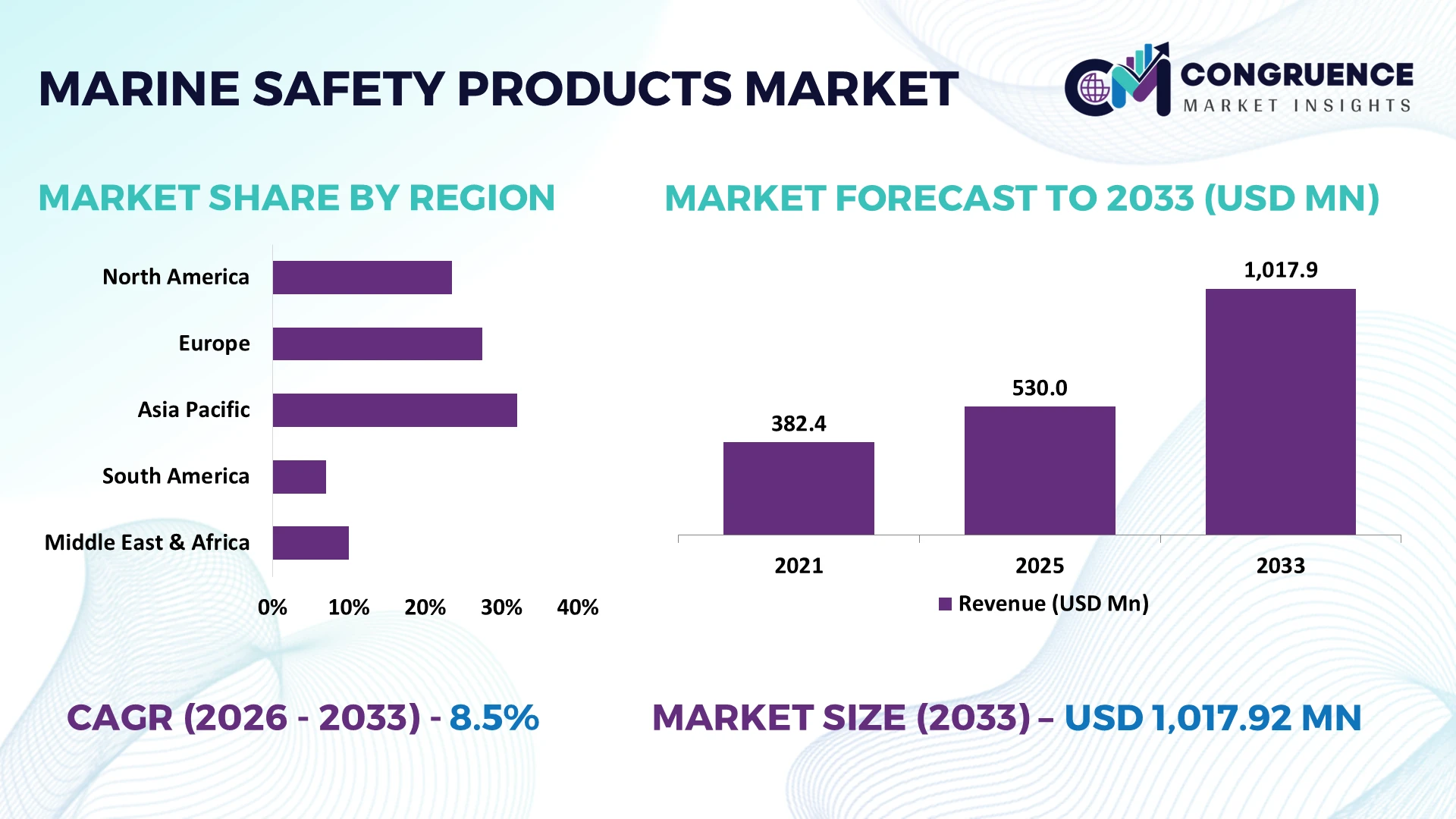
The Global Marine Safety Products Market was valued at USD 530.0 Million in 2025 and is anticipated to reach a value of USD 1,017.9 Million by 2033 expanding at a CAGR of 8.5% between 2026 and 2033. Growth is driven by flag-state compliance, electronic distress-signaling adoption, offshore fleet modernization, and replacement of aging lifesaving equipment.
China represents a dominant marine manufacturing hub, supported by approximately 55 million compensated gross tons of new-vessel deliveries in 2025 and extensive shipbuilding capacity across commercial and offshore fleets. Its scale contrasts with Europe, where stringent safety requirements and established shipping networks sustain equipment replacement. Digital distress systems, connected monitoring, and advanced survival equipment are increasingly integrated into new vessels, strengthening technology-led procurement.
The strategic priority is shifting toward certified, connected safety portfolios that combine regulatory compliance, rapid emergency response, and lifecycle service efficiency.
Market Size & Growth: USD 530.0 Million in 2025 and USD 1,017.9 Million by 2033 at a CAGR of 8.5%, supported by regulatory replacement cycles and vessel modernization.
Top Growth Drivers: Regulatory compliance 32%, fleet modernization 27%, and electronic distress signaling 21% are driving procurement expansion.
Short-Term Forecast: By 2028, connected safety-equipment adoption is expected to increase 18%, while digital inspection processes reduce servicing time by 10%.
Emerging Technologies: GPS-enabled beacons, AIS-SART systems, satellite distress communication, AI monitoring, and lightweight composite equipment are reshaping marine safety systems.
Regional Leaders: Asia Pacific is projected to reach approximately USD 518 Million, Europe USD 386 Million, and North America USD 153 Million, supported by shipbuilding, compliance, and fleet renewal.
Consumer/End-User Trends: Professional marine operators represent approximately 70% of purchasing activity, with fleet buyers increasingly prioritizing certified and standardized safety equipment.
Pilot/Case Example: In 2024, connected vessel-safety monitoring deployments reduced inspection and equipment-checking time by approximately 22% through centralized digital diagnostics.
Competitive Landscape: Survitec Group leads with approximately 12% share, followed by VIKING Life-Saving Equipment, Hansen Protection, Ocean Safety, and Dräger.
Regulatory & ESG Impact: SOLAS-driven equipment requirements affect more than 90% of internationally operating commercial vessels, while lightweight recyclable materials are reducing equipment weight and material consumption.
Investment & Funding: Approximately USD 420 Million is being directed toward marine safety technology, production expansion, connected monitoring, and strategic partnerships.
Innovation & Future Outlook: Next-generation EPIRBs, AIS-enabled rescue devices, smart life jackets, and predictive equipment monitoring are shifting competition toward connected safety ecosystems and lifecycle services.
Demand is concentrating around commercial shipping, offshore installations, recreational boating, and defense applications, where certified lifesaving equipment remains operationally essential. Electronic positioning beacons, AIS-enabled rescue devices, lightweight flotation systems, and connected inspection technologies are increasing product functionality, while digital procurement is expanding access across emerging maritime markets. More than 90% of internationally operating commercial vessels remain subject to SOLAS-based safety requirements, reinforcing compliance-led purchasing and aftermarket replacement demand.
Marine safety products are becoming strategically important as vessel operators shift from standalone emergency equipment toward integrated safety systems covering prevention, detection, communication, evacuation, and rescue. This transition is strengthening competition around certification capability, fleet-wide standardization, aftermarket servicing, and digital monitoring rather than product availability alone. Regulatory enforcement and vessel modernization are simultaneously restructuring procurement priorities.
Technology is creating measurable operational advantages. Connected inspection systems can reduce equipment-checking time by approximately 20–25% compared with manual inspection routines, while GPS- and AIS-enabled devices provide more precise location information during emergency response. Europe emphasizes regulatory sophistication and aftermarket servicing, whereas China, South Korea, and Japan benefit from large-scale newbuild activity and shipyard integration.
Over the next 2–3 years, connected monitoring adoption is expected to rise by approximately 15–20% among modern commercial fleets. Companies are responding by expanding certified product portfolios, partnering with shipyards and fleet-management providers, and investing in digital service platforms. The strongest competitive positioning will come from combining compliant hardware, connected diagnostics, and reliable global servicing into a single operational safety ecosystem.
Mandatory lifesaving-equipment requirements remain a structural purchasing trigger, with regulatory compliance accounting for approximately 32% of market demand influence. Commercial operators increasingly replace aging equipment during scheduled inspections rather than waiting for equipment failure, improving replacement predictability. China’s shipbuilding expansion is reinforcing this trend because new vessels require complete certified safety inventories before commissioning. Electronic distress signaling is also gaining traction, with adoption estimated to increase by approximately 21% as operators replace conventional equipment with GPS- and AIS-enabled systems. Companies are responding through fleet-level contracts, certification expansion, and partnerships with shipyards. The non-obvious advantage is that suppliers with inspection and servicing networks capture recurring aftermarket revenue in addition to initial equipment sales.
Certification requirements and specialized component costs constrain procurement flexibility, particularly for smaller vessel operators. Certified equipment can carry a 15–20% premium over basic non-certified alternatives because testing, traceability, and periodic servicing increase total ownership costs. Imported electronics and specialized materials also expose manufacturers to approximately 8–12% procurement-cost volatility during periods of shipping disruption or component shortages. European operators face particularly strict conformity requirements, increasing documentation and approval workloads. Companies are reducing exposure through regional sourcing, multi-year supplier agreements, and localized assembly. The key operational constraint is not product availability but maintaining certification consistency across alternative suppliers without increasing inspection complexity or creating compatibility problems.
Connected marine safety systems are opening a high-value opportunity as fleet operators integrate emergency equipment with vessel monitoring platforms. Digital inspection adoption is expected to increase approximately 18% by 2028, while remote diagnostics can reduce routine inspection time by around 20%. India, Southeast Asia, and the Middle East offer additional opportunities as port infrastructure and commercial fleets modernize. Manufacturers are developing smart life jackets, connected EPIRBs, AIS-enabled rescue devices, and cloud-based inspection platforms through technology partnerships. A less obvious opportunity lies in aftermarket analytics: equipment-condition data can help operators optimize replacement schedules instead of following uniform replacement cycles, reducing unnecessary inventory while improving readiness.
The transition toward connected safety equipment introduces integration challenges across vessels using different communication protocols, legacy navigation systems, and equipment generations. Approximately 25% of existing marine fleets still operate with significant legacy equipment, creating compatibility requirements during digital upgrades. Cybersecurity exposure is also increasing as safety devices become connected to onboard networks and remote monitoring platforms. Workforce capability presents another constraint, particularly where crews require additional training for digital diagnostics and electronic distress systems. Companies must invest in interoperable communication architectures, cybersecurity controls, technical training, and standardized interfaces. The strategic challenge is maintaining emergency-system reliability while adding connectivity; digital functionality must strengthen safety operations without creating a new failure point during critical events
Connected Safety Equipment Adoption: Smart life jackets, GPS-enabled beacons, AIS-SART devices, and electronic distress systems are moving into mainstream fleet procurement, with signaling-device demand projected to expand around 7.2% annually and digital monitoring adoption rising approximately 18% by 2028. Companies are integrating connected diagnostics into safety portfolios to improve equipment visibility and reduce inspection workload.
Electronic Distress Signaling Transition: Operators are replacing conventional distress equipment with EPIRBs, PLBs, AIS transponders, and satellite-enabled systems, while electronic signaling adoption is increasing approximately 15% across technology-focused fleets. The shift reduces dependence on manual emergency procedures and improves location accuracy. Manufacturers are expanding interoperable product ranges as IMO work on VDES and digital maritime systems progresses toward implementation.
Offshore Safety Deployment Expands: Offshore installations accounted for 24.3% of application demand in 2025 and represent the fastest-growing application at approximately 7.4% annual expansion. Offshore wind, FPSO activity, and remote-energy operations are increasing requirements for immersion suits, evacuation systems, harnesses, and specialized rescue equipment. Suppliers are strengthening offshore service networks and forming partnerships with energy operators.
Digital Compliance Workflows Scale: Fleet operators are shifting from paper-based inspection records toward centralized digital compliance platforms, with remote monitoring capable of reducing routine inspection time by approximately 20–25%. IMO’s 2025–2026 digitalization initiatives are accelerating interoperability and standardized data practices. Companies are responding by linking equipment servicing, certification records, maintenance alerts, and fleet-management systems into unified safety workflows.
Life Jackets remained the leading product type with approximately 34.2% market share in 2025, reflecting mandatory carriage requirements across commercial vessels, offshore operations, and recreational boating. Life Rafts followed at 24.7%, supported by stringent certification and fleet replacement requirements. Safety Harnesses represented 16.8%, while Signaling Devices accounted for 14.3%. The remaining product categories represented 10.0%. Companies are increasingly shifting product development toward lighter inflatable designs, automatic inflation, integrated location technology, and improved ergonomics. Life Rafts retain strategic importance because of their high certification barriers, while Safety Harnesses benefit from offshore wind and elevated-work requirements.
Signaling Devices represent the fastest-changing product category, with growth of approximately 7.2% driven by electronic distress communication and digital positioning. Their transition from conventional signaling toward EPIRB, PLB, and AIS-enabled systems is redirecting investment toward electronics, connectivity, and software integration.
Commercial Vessels accounted for approximately 42.6% of the market in 2025, making them the largest application because container ships, tankers, bulk carriers, ferries, and passenger vessels require comprehensive certified lifesaving equipment. Recreational Boats represented 22.1%, while Offshore Installations accounted for 24.3%; Others represented 11.0%. Commercial procurement is driven by newbuild outfitting, periodic replacement, inspection, and certification, giving suppliers a more predictable purchasing cycle than consumer-oriented applications. Companies are therefore prioritizing fleet contracts, shipyard partnerships, and global servicing capabilities.
Offshore Installations are the fastest-growing application, supported by approximately 7.4% annual expansion as offshore wind, oil and gas platforms, FPSOs, and service vessels require specialized evacuation and survival equipment. This segment is increasingly equipment-intensive because workers operate in remote environments where rescue access is constrained. Offshore operators are increasing procurement of immersion suits, marine evacuation systems, fall protection, and emergency signaling technologies.
The Shipping Industry represented approximately 39.7% of marine safety product demand in 2025, making it the largest end-user group because commercial fleets require continuous compliance, scheduled inspections, replacement equipment, and newbuild outfitting. Oil & Gas Industry followed with 26.8%, while Recreational Boating represented 23.8% and Others accounted for 9.7%. Shipping operators increasingly prefer standardized equipment across fleets because common product platforms simplify crew training, spare-parts management, inspection documentation, and service contracts. Companies are responding with integrated procurement packages and international servicing agreements.
Recreational Boating is showing the strongest technology-led shift, with approximately 7.1% annual expansion as consumers move toward inflatable PFDs, GPS-enabled devices, and premium connected safety equipment. Oil and gas operators are simultaneously prioritizing higher-performance harnesses, survival suits, and evacuation systems for offshore personnel.
Asia Pacific accounted for the largest market share at 32.0% in 2025 however, South America is expected to register the fastest growth, expanding at a CAGR of 9.2% between 2026 and 2033.
North America accounted for approximately 23.5% of the global market in 2025, supported by the United States’ large commercial fleet, offshore energy operations, cruise activity, and extensive recreational boating base. Demand is increasingly concentrated around certified life-saving appliances, electronic distress systems, immersion protection, and fleet inspection programs. The U.S. Coast Guard recorded 3,887 recreational boating incidents in 2024, including 556 fatalities, reinforcing operational attention toward wearable flotation and emergency equipment. Commercial operators are also moving toward centralized maintenance records and digitally supported inspections. Manufacturers are responding through distributor expansion, connected-device integration, and long-term servicing contracts. The region’s strategic advantage lies in combining strong regulatory enforcement with a mature aftermarket, creating recurring replacement demand beyond new-vessel installations.
United States Market Outlook: The United States remains the principal market within North America because of its extensive commercial, offshore, defense, and recreational vessel base. The U.S. Coast Guard’s national safety infrastructure supports continuous equipment oversight, while recreational boating alone generates thousands of reported incidents annually. Manufacturers are therefore emphasizing certified life jackets, emergency beacons, rescue equipment, and digitally trackable inspection systems. The 2026 National Recreational Boating Safety Survey is inviting more than 50,000 households, indicating the scale of ongoing safety-data collection and education activity.
Europe represented approximately 27.5% of the global market in 2025, supported by a highly regulated maritime operating environment, established ship-management companies, passenger shipping, offshore activity, and specialized marine-equipment manufacturing. EU Member State fleets represent around 18% of global merchant fleet tonnage, while they account for more than half of global RoPax and high-speed craft tonnage, creating concentrated requirements for life-saving systems and passenger protection equipment. European operators increasingly prioritize certified, durable, and serviceable products with traceable maintenance histories. Manufacturers are responding through local service networks, product certification upgrades, and partnerships with vessel operators. Recent revisions to life-saving appliance testing requirements are also increasing attention to standardized evaluation and maintenance procedures, strengthening demand for compliance-oriented suppliers.
Norway Market Outlook: Norway holds a strategically important position because of its concentration of commercial shipping, offshore energy operations, maritime technology companies, and specialized vessel fleets. Its offshore operating environment creates sustained requirements for immersion suits, life rafts, evacuation systems, harnesses, and advanced rescue equipment. Companies operating from Norway increasingly combine equipment supply with inspection, servicing, and digital fleet-management capabilities, strengthening recurring aftermarket demand and supporting premium safety-product adoption.
Asia Pacific accounted for approximately 32.0% of the global market in 2025, making it the largest regional market, with demand concentrated across China, Japan, South Korea, Singapore, India, and Southeast Asian shipping hubs. Large shipbuilding programs generate substantial new-vessel outfitting requirements, while expanding port infrastructure increases demand for certified emergency and personal protective equipment. China and South Korea remain particularly important for shipyard-linked procurement, while Singapore serves as a major maritime service and fleet-management hub. Companies are increasingly establishing regional manufacturing, localization, and shipyard partnerships to shorten delivery cycles and reduce component dependence. The strategic advantage is scale: suppliers integrated directly into newbuild programs can secure equipment packages before vessels enter operational service, while aftermarket networks capture subsequent inspection and replacement demand.
China Market Outlook: China is the region’s most significant manufacturing and shipbuilding market, supporting large-scale procurement of life jackets, life rafts, rescue equipment, signaling systems, and evacuation products. Its extensive shipyard ecosystem enables suppliers to integrate safety equipment during vessel construction rather than relying only on aftermarket sales. Manufacturers are expanding domestic production and supplier networks to serve newbuild demand while improving delivery speed. This integration gives China a strong position in marine safety equipment manufacturing and supports continued adoption of standardized, certified systems.
South America accounted for approximately 7.0% of the global market in 2025, with Brazil representing the principal demand center because of its extensive coastline, commercial ports, offshore energy activity, inland waterways, and growing naval-industrial base. Brazil’s ports handled approximately 1.4 billion tons of cargo in 2025, increasing 6.1% from the previous year, while containerized cargo increased 7.2%. These operating volumes support demand for life-saving appliances, emergency signaling equipment, protective systems, and vessel-specific safety inventories. Port modernization is also strengthening procurement requirements. Companies are responding by expanding distributor coverage, localizing selected production, and partnering with shipyards and port operators. The region’s constraint is uneven infrastructure outside major maritime hubs, making service-network density as important as product availability for suppliers seeking scalable market penetration.
Brazil Market Outlook: Brazil represents the strongest country-level opportunity in South America, supported by expanding port infrastructure, offshore energy activity, commercial shipping, and renewed shipbuilding investment. The country’s maritime development programs approved R$31.8 billion in financing projects during 2025, covering vessel construction, waterways, and related infrastructure. More than R$3.85 billion was directed specifically toward naval and aquaviary activities, strengthening the domestic ecosystem for marine equipment suppliers and safety-product manufacturers.
The Middle East & Africa accounted for approximately 10.0% of the global market in 2025, supported by major ports, offshore oil and gas operations, vessel traffic through the Arabian Gulf, Red Sea, and Suez corridor, and infrastructure modernization. Demand is concentrated around commercial vessels, offshore platforms, port-service fleets, and high-risk industrial marine operations. Gulf economies are investing in larger logistics hubs and automated terminal infrastructure, increasing requirements for certified evacuation systems, personal flotation equipment, rescue boats, and emergency signaling products. Companies are responding through regional distributors, local service partnerships, and stocking hubs near major ports. The region’s non-obvious advantage is its concentration of high-value offshore and logistics operations, where safety-equipment downtime can disrupt expensive assets and therefore supports premium products with rapid servicing capability.
United Arab Emirates Market Outlook: The United Arab Emirates is a strategically important market because Dubai and Abu Dhabi combine major container terminals, offshore energy activity, ship-management services, and maritime logistics infrastructure. Port operators are increasingly emphasizing operational continuity, digital monitoring, and standardized safety procedures. Suppliers are positioning around rapid-response servicing, certified life-saving equipment, and integrated fleet-support contracts. The country’s role as a regional logistics and maritime-services hub also enables manufacturers to use the UAE as a distribution base for neighboring Gulf and African markets.
Survitec and VIKING Life-Saving Equipment compete as global integrated safety providers, while Hansen Protection, Ocean Safety, Marine Rescue Technologies, and regional OEMs compete through specialized products and localized servicing. The top five players collectively account for approximately 35% of the market, leaving substantial share to fragmented regional suppliers. Competition centers on technology, certification, service coverage, customization, and delivery speed, with connected equipment representing roughly 15% of purchasing preferences and customized fleet solutions influencing nearly 20% of procurement decisions. Survitec is strengthening vertical integration and regional servicing, while VIKING combines manufacturing expansion with global service partnerships. Specialized suppliers differentiate through immersion protection, signaling technology, and rescue equipment. The competitive structure is shifting toward integrated product-plus-service contracts as shipowners seek fewer suppliers and simplified compliance management. High certification requirements, testing infrastructure, global servicing capability, and established shipyard relationships remain significant entry barriers. Winning requires certified technology, dependable supply, rapid servicing, broad geographic coverage, and increasingly integrated lifecycle solutions.
Survitec Group
VIKING Life-Saving Equipment
Hansen Protection
Ocean Safety
Marine Rescue Technologies
Crewsaver
Dräger
Baltic Safety Products
Mullion
Spinlock
Lalizas
Seago Yachting
SECUMAR
Plastimo
Marine safety technology is shifting from passive equipment toward connected emergency systems. GPS-enabled EPIRBs, AIS-SART devices, PLBs, digital monitoring, and smart flotation equipment are gaining adoption, with connected safety-device usage approaching 15% of technology-focused fleet procurement. These systems improve location accuracy, equipment visibility, and emergency-response coordination, giving digitally integrated suppliers a stronger position in fleet contracts.
Advanced materials are also changing equipment performance. Lightweight composites, high-strength fabrics, and improved buoyancy materials can reduce equipment weight by approximately 10–15% while maintaining required protection levels. Compared with conventional manual inspection processes, digital inspection and remote-monitoring platforms can reduce routine checking time by approximately 20–25%. VIKING, Survitec, and specialized technology suppliers benefit as shipowners increasingly value lifecycle efficiency alongside certification.
Between 2026 and 2028, the strongest technology shift will involve integration of safety equipment with vessel-management and compliance platforms. Adoption of connected inspection workflows is expected to increase approximately 18%, supporting automated maintenance alerts, digital certification records, and inventory visibility. Suppliers that combine hardware, software, servicing, and analytics will gain an advantage over equipment-only vendors, while interoperable systems will become increasingly important for mixed-age fleets.
March 2024 — Survitec secured a contract with Babcock to supply survival technology for five Type 31 frigates, including four 100-person and four 25-person liferafts per vessel. The multiyear program strengthens Survitec’s naval-market position through 2028. Source: survitecgroup.com
April 2025 — VIKING launched the YouSafe Cyclone immersion suit designed specifically for women working on offshore wind crew-transfer vessels, developed with Ørsted, Siemens, and Vestas. The initiative addresses a workforce target of one-third women by 2030 and expands specialized offshore PPE. Source: viking-life.com
May 2025 — Survitec expanded its Fujairah service station by 1,350 square metres, adding liferaft servicing, exchange capabilities, lifeboat inspection, and marine fire-safety services. The expansion strengthens turnaround capacity near major Gulf shipping routes and consolidates multiple compliance services. Source: survitecgroup.com
June 2025 — VIKING expanded its Undertun ferry evacuation system with a 203-person liferaft and push-button activation. Testing demonstrated evacuation of 203 passengers within 17 minutes and 40 seconds, strengthening the system’s suitability for larger commuter ferries with limited crews. Source: viking-life.com
The Marine Safety Products Market report covers Life Jackets, Life Rafts, Safety Harnesses, Signaling Devices, and other marine safety equipment across Commercial Vessels, Recreational Boats, Offshore Installations, and other applications. End-user coverage includes the Shipping Industry, Oil & Gas Industry, Recreational Boating, and other purchasing groups, enabling assessment of demand concentration, replacement cycles, deployment intensity, and technology adoption.
The report evaluates North America, Europe, Asia-Pacific, South America, and the Middle East & Africa, with country-level analysis of shipbuilding, offshore activity, port infrastructure, regulatory compliance, and service networks. Technology coverage includes electronic distress signaling, connected monitoring, advanced materials, digital inspection, and integrated evacuation systems. Competitive analysis covers 10+ profiled companies and supports investment planning, market-entry assessment, expansion priorities, partnership decisions, product positioning, and strategic planning through 2033.
| Report Attribute / Metric | Details |
|---|---|
| Market Revenue (2025) | USD 530.0 Million |
| Market Revenue (2033) | USD 1,017.9 Million |
| CAGR (2026–2033) | 8.5% |
| Base Year | 2025 |
| Forecast Period | 2026–2033 |
| Historic Period | 2021–2025 |
| Segments Covered |
By Type
By Application
By End-User
|
| Key Deliverables | Revenue Forecast; Market Trends; Growth Drivers & Restraints; Technology Insights; Segmentation Analysis; Regional Insights; Competitive Landscape; Regulatory & ESG Overview; Recent Developments |
| Regions Covered | North America; Europe; Asia Pacific; South America; Middle East & Africa |
| Companies Profiled | Survitec Group; VIKING Life-Saving Equipment; Hansen Protection; Ocean Safety; Marine Rescue Technologies; Crewsaver; Dräger; Baltic Safety Products; Mullion; Spinlock; Lalizas; Seago Yachting; SECUMAR; Plastimo |
| Customization & Pricing | Available on Request (10% Customization Free) |




