
Reports
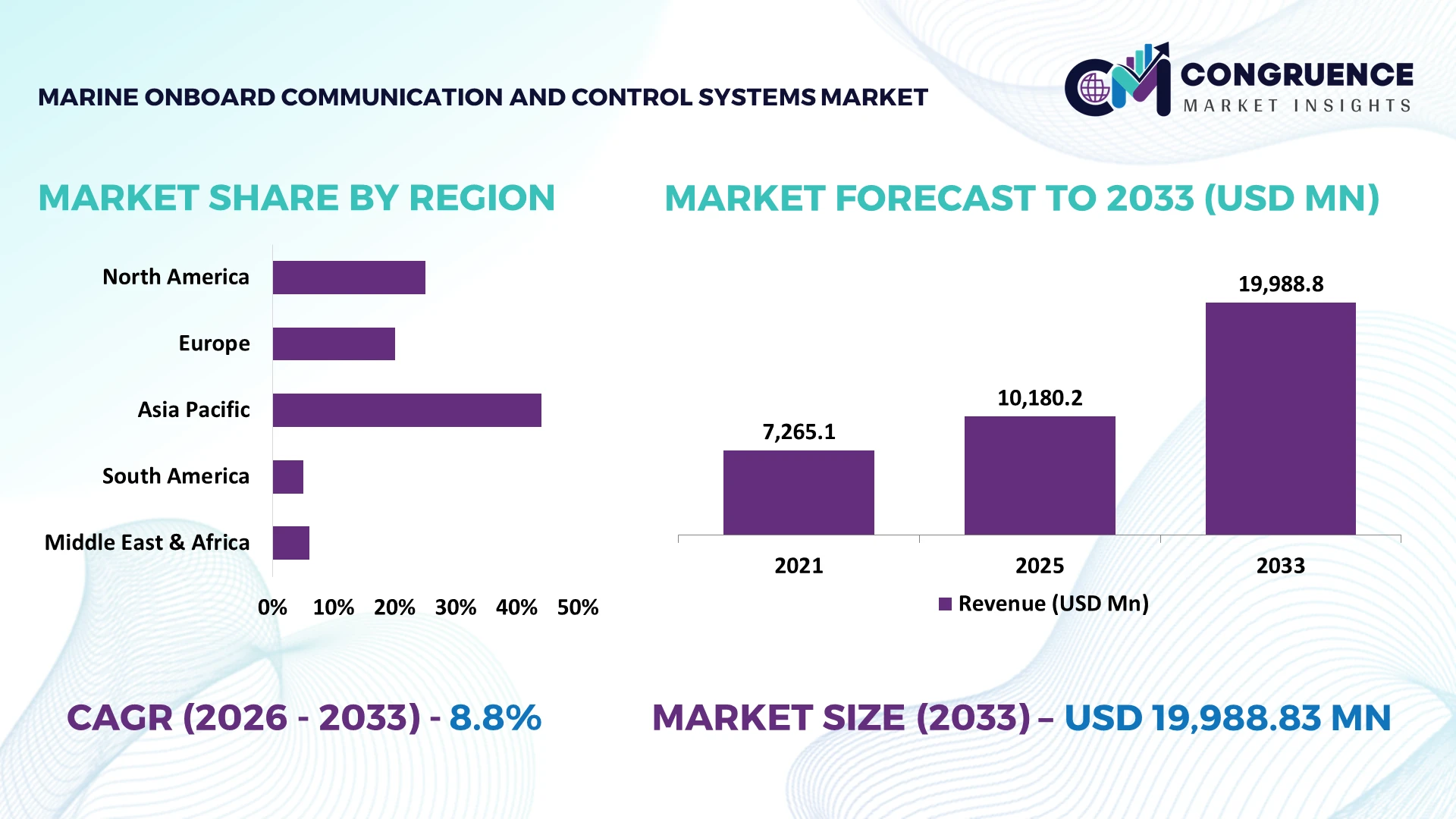
The Global Marine Onboard Communication and Control Systems Market was valued at USD 10180.19 Million in 2025 and is anticipated to reach a value of USD 19988.83 Million by 2033 expanding at a CAGR of 8.8% between 2026 and 2033. Growth is driven by integrated bridge modernization, maritime satellite connectivity, autonomous vessel development, and shipboard automation required for safer navigation and energy-efficient fleet operations.
China holds a dominant position in marine equipment demand through its extensive commercial shipbuilding infrastructure and expanding naval modernization programs. Chinese shipyards accounted for approximately 55.7% of global shipbuilding completions by deadweight tonnage in 2024, compared with South Korea's approximately 28.4%. Major shipbuilding centers, including Shanghai, Jiangsu, and Guangzhou, integrate advanced navigation, vessel automation, and onboard communication infrastructure into newbuild programs. China's expanding maritime industrial capacity strengthens domestic equipment integration, while South Korean shipyards emphasize high-value LNG carriers and digitally connected vessels.
Strategically, equipment suppliers securing shipyard integration partnerships and interoperable automation platforms gain stronger access to long-term fleet modernization programs.
Market Size & Growth: USD 10,180.19 million in 2025, projected to reach USD 19,988.83 million by 2033 at 8.8% CAGR, driven by vessel automation and digital bridge upgrades.
Top Growth Drivers: China's 55.7% shipbuilding output share, the IMO's 40% carbon-intensity reduction ambition, and expanding satellite connectivity underpin equipment demand.
Short-Term Forecast: By 2028, vessel operators face a two-system integration priority: onboard automation and shore-based fleet monitoring, improving operational visibility.
Emerging Technologies: Three technologies reshape vessel operations: AI-assisted navigation, low-Earth-orbit satellite communications, and integrated propulsion control.
Regional Leaders: Asia-Pacific leads shipbuilding integration, Europe specializes in advanced automation, and North America emphasizes naval modernization across three major demand centers.
End-User Trends: Starlink reported connectivity across more than 150,000 vessels in 2025, demonstrating growing maritime broadband deployment.
Pilot/Case Example: In 2025, Royal Caribbean's Star of the Seas deployed a satellite community gateway supporting 10 Gbps symmetrical throughput.
Competitive Landscape: Wärtsilä, Kongsberg Maritime, ABB, Furuno Electric, and Northrop Grumman compete across integrated vessel automation, navigation, and communications.
Regulatory & ESG Impact: IMO's 2030 strategy targets at least 20% lower shipping emissions, increasing the importance of digital energy monitoring.
Investment & Funding: China's shipbuilding orderbook increased 49.7% during 2024, strengthening future demand for integrated onboard electronic systems.
Innovation & Future Outlook: By 2033, advanced maritime systems increasingly combine autonomous navigation, satellite connectivity, and real-time machinery diagnostics.
The Marine Onboard Communication and Control Systems Market serves commercial shipping, naval fleets, offshore energy vessels, and passenger transportation operators requiring reliable navigation, machinery automation, and ship-to-shore connectivity. Integrated bridge systems increasingly combine radar, electronic chart displays, satellite communications, and propulsion monitoring within coordinated operational platforms. Starlink's reported deployment across more than 150,000 vessels in 2025 illustrates the growing importance of high-bandwidth maritime connectivity. Shipbuilders are also integrating digital energy management to support operational efficiency and emissions reporting. These developments establish the strategic importance of interoperable control architectures, cybersecurity, and lifecycle equipment modernization.
Marine onboard communication and control systems are becoming strategic assets as shipowners modernize navigation, propulsion management, and vessel connectivity to improve operational reliability. The International Maritime Organization's 2023 strategy targets at least a 20% reduction in annual greenhouse gas emissions by 2030 compared with 2008. This regulatory direction strengthens investment in integrated bridge systems, automated machinery monitoring, and voyage optimization. Shipbuilders are increasingly specifying connected equipment during vessel construction rather than installing independent systems after delivery.
Integrated vessel control platforms consolidate navigation, engine monitoring, and operational data previously managed through separate interfaces. Digital voyage optimization can deliver fuel savings of approximately 2–5% under suitable operating conditions compared with conventional route planning. China dominates commercial shipbuilding volume, while Norway specializes in advanced maritime automation and autonomous vessel development. Norwegian electric ferry operations demonstrate how coordinated propulsion monitoring, shore connectivity, and energy management support efficient vessel operations.
Between 2026 and 2028, shipowners will prioritize satellite-enabled remote diagnostics, standardized equipment interfaces, and cybersecurity protection for connected control networks. Kongsberg Maritime, Wärtsilä, and ABB are strengthening digital service capabilities and shipyard integration partnerships. Competitive positioning increasingly depends on delivering interoperable systems that reduce operating costs, simplify maintenance, and support regulatory compliance throughout vessel lifecycles.
Commercial shipbuilding activity and vessel modernization requirements are accelerating demand for integrated marine communication and control infrastructure. Chinese shipyards accounted for approximately 55.7% of global shipbuilding completions by deadweight tonnage in 2024, compared with South Korea's approximately 28.4%. The IMO's 2030 greenhouse gas strategy targets at least a 20% emissions reduction, strengthening demand for energy monitoring and voyage optimization systems. Shipbuilders in Shanghai, Jiangsu, and Busan are integrating electronic navigation, propulsion automation, and satellite communications during construction. Equipment suppliers including Kongsberg Maritime, Wärtsilä, and ABB are expanding integrated bridge solutions and digital vessel services. Early-stage system integration reduces commissioning complexity and strengthens long-term equipment servicing opportunities.
Legacy vessel architectures and specialized electronic equipment requirements constrain onboard system modernization. Shipowners operating older fleets face incompatible communication protocols, proprietary automation interfaces, and limited installation windows. China's approximately 55.7% share of global shipbuilding completions illustrates manufacturing concentration, while South Korea's roughly 28.4% contribution highlights dependence on major Asian shipbuilding supply chains. Maritime control systems also require equipment qualification, electromagnetic compatibility testing, and classification society approvals before deployment. Semiconductor availability and specialized marine electronics procurement affect retrofit scheduling and installation costs. Equipment manufacturers are responding through modular communication gateways, standardized interfaces, and regional service partnerships. Suppliers offering retrofit-compatible platforms gain an advantage by reducing vessel downtime and avoiding complete control system replacement.
Expanding maritime broadband infrastructure creates opportunities for remote diagnostics, predictive maintenance, and shore-based vessel performance management. Starlink reported connectivity across more than 150,000 vessels in 2025, demonstrating substantial adoption of high-bandwidth maritime communications. Digital voyage optimization can reduce fuel consumption by approximately 2–5% under suitable operating conditions, while the IMO's 2030 strategy establishes a minimum 20% emissions reduction ambition. Norwegian offshore operators and Singapore-based fleet managers are integrating satellite communications with machinery monitoring and operational analytics. Technology suppliers are developing cloud-connected control platforms, automated fault diagnostics, and equipment performance services. The strongest opportunity lies in converting onboard operational data into actionable maintenance decisions without requiring permanent specialist personnel aboard every vessel.
Connected vessel architectures increase cybersecurity exposure and complicate operational assurance across navigation, propulsion, and ship-to-shore networks. Maritime systems must maintain reliable operation despite intermittent connectivity, software updates, and increasingly complex automation interfaces. The IMO's 2030 emissions strategy targets at least 20% lower greenhouse gas emissions, while its longer-term ambition reaches net-zero emissions around 2050, increasing dependence on accurate digital monitoring. Norway's autonomous vessel initiatives demonstrate the technical complexity of coordinating sensors, communications, and collision avoidance systems. Equipment suppliers must invest in network segmentation, secure remote access, software validation, and redundancy engineering. Long-term competitiveness depends on maintaining deterministic control performance and operational safety while integrating continuously evolving digital technologies.
Integrated Bridge Workstations Replace Fragmented Displays: Shipbuilders are consolidating radar, electronic charts, and conning information into coordinated operator interfaces. SOLAS Chapter V requires approved navigation equipment according to vessel classification, while ECDIS carriage requirements apply to specified vessel categories. Suppliers are introducing multifunction displays and standardized bridge layouts, reducing duplicated controls and improving situational awareness during congested port approaches.
Digital Maritime Safety Communications Advance: Maritime operators are upgrading GMDSS installations following modernization amendments effective January 2024. The framework recognizes additional satellite service arrangements and updated communications requirements across four operational sea areas. Equipment manufacturers are expanding compatible distress communication terminals, digital selective calling interfaces, and integrated safety alert management, improving emergency communications reliability and simplifying compliance-oriented equipment replacement.
Shipboard Network Segmentation Gains Procurement Priority: Classification requirements introduced through IACS UR E26 and E27 apply to relevant newbuilding contracts signed from July 2024. These two requirements address vessel-level cyber resilience and onboard system security. Marine electronics suppliers are introducing segmented operational networks, authenticated maintenance access, and documented software inventories, strengthening equipment acceptance and reducing integration disputes during shipyard commissioning.
Remote Vessel Inspections Reshape Maintenance Workflows: Operators are connecting onboard diagnostic records with classification society inspection platforms to support condition-based surveys. The IMO's Carbon Intensity Indicator framework uses annual operational performance ratings across five categories, from A to E. Automation vendors are integrating machinery logs, equipment alarms, and energy records, improving maintenance documentation and reducing manual reporting workloads.
Communication Systems represent a leading type within the Marine Onboard Communication and Control Systems Market, supported by mandatory maritime safety communications, operational coordination, and ship-to-shore information exchange. Commercial vessels require radio communications, satellite terminals, and digital distress alerting equipment according to applicable operating areas and vessel classifications. Modern maritime broadband installations extend communication capabilities beyond mandatory safety requirements. Navigation Systems maintain substantial demand through radar, electronic chart displays, positioning equipment, and collision avoidance support. Suppliers including Furuno Electric, JRC, and Kongsberg Maritime are expanding integrated communication interfaces and navigation equipment compatibility to simplify vessel installation and maintenance.
Integrated Bridge Systems represent an important modernization segment as shipowners consolidate navigation information and operational controls into coordinated workstations. Monitoring and Control Systems support propulsion management, machinery alarms, and automated equipment supervision. IACS introduced two unified cyber resilience requirements, E26 and E27, applicable to relevant newbuilding contracts from July 2024. This regulatory shift encourages suppliers to develop secure interfaces and standardized network architectures. Procurement increasingly favors interoperable systems that reduce commissioning complexity and simplify lifecycle maintenance.
Commercial Shipping represents the leading application within the Marine Onboard Communication and Control Systems Market because cargo vessels, tankers, container ships, and passenger vessels require continuous navigation, operational communication, and machinery monitoring. Global shipping transports more than 80% of international merchandise trade by volume, supporting extensive demand for reliable onboard systems. Commercial operators prioritize electronic navigation, satellite communications, and centralized equipment supervision to maintain voyage continuity. Naval Operations require specialized encrypted communications, tactical navigation, and mission-critical control architectures. Equipment manufacturers are developing commercial fleet integration packages alongside defense-specific communication and automation systems to address different operational requirements.
Offshore Operations represent an advanced application segment because support vessels and offshore service fleets require dynamic positioning, redundant communications, and precise machinery control. Fishing Vessels increasingly adopt digital navigation, vessel monitoring, and satellite safety communications, particularly where fisheries management regulations require tracking. The IMO's greenhouse gas strategy targets at least a 20% reduction in shipping emissions by 2030, reinforcing commercial demand for energy monitoring and voyage performance data. Suppliers are expanding modular control platforms and service partnerships to support different vessel operating profiles.
Shipping Companies represent the leading end-user category within the Marine Onboard Communication and Control Systems Market, supported by extensive commercial vessel fleets and recurring equipment modernization requirements. Operators purchase communication terminals, navigation systems, and automation upgrades to maintain safety compliance and operational reliability. The IMO's 2030 greenhouse gas strategy targets at least a 20% reduction in shipping emissions, increasing demand for onboard performance monitoring. Naval Forces represent another significant buyer group, prioritizing secure communications, resilient navigation, and mission-critical system redundancy. Suppliers including Kongsberg Maritime, Wärtsilä, and Northrop Grumman are developing specialized integration capabilities and long-term support arrangements aligned with commercial and defense procurement requirements.
Shipbuilders influence technology selection through newbuilding specifications and integrated equipment procurement. Chinese shipyards accounted for approximately 55.7% of global shipbuilding completions by deadweight tonnage in 2024, emphasizing the importance of manufacturing partnerships. Offshore Operators require advanced control architectures for specialized vessels operating in demanding environments. Equipment manufacturers are strengthening shipyard relationships, configurable automation platforms, and regional service networks. Competitive positioning increasingly depends on lifecycle support, installation compatibility, and reliable equipment performance.
Asia-Pacific accounted for the largest market share at an estimated 42% in 2025 however, Asia-Pacific is expected to register the fastest growth, expanding at a CAGR of an estimated 10.2% between 2026 and 2033.
Naval Modernization Strengthens Advanced Maritime Systems Integration
North America's marine onboard communication and control systems market is characterized by naval fleet modernization, commercial vessel electronics upgrades, and advanced maritime cybersecurity requirements. The United States dominates regional procurement through naval shipbuilding, defense electronics integration, and offshore vessel operations. Canada contributes through Arctic maritime infrastructure, coast guard modernization, and commercial fleet communications. The U.S. Navy's fiscal 2025 shipbuilding plan included six battle force vessels, supporting procurement of integrated navigation, secure communications, and machinery control equipment. Defense contractors including Northrop Grumman, L3Harris Technologies, and General Dynamics supply mission-critical maritime electronics and combat system integration capabilities. Commercial operators increasingly deploy digital bridge systems and satellite communications for vessel performance monitoring. Regional competition emphasizes cybersecurity compliance, equipment interoperability, and long-term maintenance contracts across defense and commercial applications.
United States Market Outlook: The United States benefits from established naval shipbuilding infrastructure, specialized maritime electronics manufacturing, and advanced defense technology integration. Huntington Ingalls Industries and General Dynamics Electric Boat support major naval construction programs requiring sophisticated communications and control architectures. The U.S. Coast Guard's offshore patrol cutter modernization also strengthens demand for integrated navigation and surveillance systems. Domestic suppliers maintain advantages through defense qualification, secure software development, and lifecycle technical support.
Maritime Automation Leadership Supports High-Value Vessel Integration
Europe maintains a strong competitive position through specialized marine automation engineering, advanced shipbuilding, and integrated vessel control technologies. Norway, Germany, Finland, and the Netherlands represent important development centers for digital navigation, propulsion automation, and maritime communication equipment. European suppliers including Kongsberg Maritime, Wärtsilä, and ABB provide integrated bridge systems, dynamic positioning technology, and machinery control platforms for commercial and specialized vessels. Norway's Yara Birkeland project demonstrates the deployment of battery-electric propulsion and automated navigation in commercial maritime operations. European Union maritime emissions requirements are strengthening demand for onboard energy measurement and voyage performance reporting. Shipowners are integrating automation platforms with classification-approved cybersecurity architectures and remote equipment monitoring. Competitive differentiation increasingly depends on system reliability, software integration capabilities, and compliance with evolving maritime safety requirements.
Norway Market Outlook: Norway represents a leading maritime automation innovation center, supported by offshore engineering expertise and specialized vessel technology development. Kongsberg Maritime supplies integrated navigation, dynamic positioning, and vessel automation systems across international fleets. Norwegian operators are advancing battery-electric ferries, autonomous vessel demonstrations, and remote operational monitoring. The Yara Birkeland project illustrates the country's capabilities in combining electric propulsion, sensor integration, and automated vessel control.
Shipbuilding Concentration Drives Integrated Equipment Procurement
Asia-Pacific dominates marine onboard communication and control systems demand through concentrated commercial shipbuilding activity, large merchant fleets, and expanding naval modernization programs. China, South Korea, and Japan represent the principal shipbuilding centers, while Singapore provides maritime technology integration and fleet management services. Chinese shipyards accounted for approximately 55.7% of global shipbuilding completions by deadweight tonnage in 2024, compared with South Korea's approximately 28.4%. This production concentration creates substantial demand for navigation electronics, onboard automation, satellite communications, and integrated bridge systems. South Korean shipbuilders emphasize advanced equipment integration for LNG carriers and high-value commercial vessels, while Japanese manufacturers specialize in navigation and communication electronics. Suppliers are strengthening shipyard partnerships and regional technical support networks. Procurement competitiveness increasingly depends on delivery schedules, equipment standardization, and installation efficiency.
China Market Outlook: China maintains extensive commercial shipbuilding capacity across Shanghai, Jiangsu, Zhejiang, and Guangdong, supported by domestic marine equipment manufacturing and large shipyard groups. The China State Shipbuilding Corporation coordinates major vessel construction and technology development programs. Chinese shipyards are expanding digitally integrated production systems and onboard equipment procurement. Domestic manufacturers benefit from proximity to vessel construction facilities, while international suppliers compete through specialized navigation, automation, and communications technologies.
Offshore Energy Operations Sustain Specialized Maritime Equipment Demand
South America's marine onboard communication and control systems market is influenced by offshore oil and gas activity, commercial shipping, fishing fleets, and port infrastructure modernization. Brazil represents the principal demand center through offshore production operations and maritime support vessel activity. Petrobras' offshore development programs require reliable vessel positioning, satellite communications, and machinery monitoring across deepwater operations. Chile contributes through maritime transport, aquaculture support vessels, and extensive coastal navigation requirements. Argentina and Colombia support additional demand through commercial shipping and offshore service activities. Equipment suppliers are expanding maintenance partnerships and retrofit services to address aging vessel electronics. Import dependence and specialized technical service availability constrain procurement flexibility. Regional operators increasingly prioritize modular communication systems and interoperable control platforms that reduce installation downtime and simplify maintenance across geographically dispersed fleets.
Brazil Market Outlook: Brazil's offshore energy industry creates sustained requirements for dynamic positioning systems, navigation electronics, and vessel communication infrastructure. Petrobras operates extensive deepwater production assets, including pre-salt developments requiring specialized offshore support vessels. The country's maritime equipment demand is concentrated around Rio de Janeiro and associated offshore logistics centers. Equipment providers are strengthening local engineering partnerships and maintenance capabilities to support operational reliability and classification compliance.
Port Modernization and Offshore Fleets Accelerate Digital Integration
The Middle East & Africa marine onboard communication and control systems market is shaped by strategic shipping corridors, offshore energy operations, naval modernization, and commercial port development. Saudi Arabia and the United Arab Emirates represent important maritime investment centers, while South Africa contributes through commercial ports and regional shipping services. Saudi Arabia's maritime industrial development includes the King Salman International Complex for Maritime Industries and Services, designed to expand shipbuilding and vessel maintenance capabilities. The UAE supports advanced port operations and offshore vessel services through established maritime logistics infrastructure. Operators increasingly integrate satellite communications, navigation electronics, and centralized machinery monitoring to support demanding operational environments. Equipment suppliers are strengthening regional service networks and shipyard partnerships. Competitive positioning depends on equipment reliability, local technical support, and compatibility with international maritime safety requirements.
Saudi Arabia Market Outlook: Saudi Arabia is expanding maritime industrial capacity through Vision 2030 initiatives, offshore energy development, and specialized shipbuilding infrastructure. The King Salman International Complex supports vessel construction, maintenance, and marine equipment integration. Saudi Aramco's offshore operations require reliable communication, navigation, and vessel control systems across support fleets. International technology suppliers are developing local partnerships to strengthen equipment servicing, installation capabilities, and maritime workforce development.
Kongsberg Maritime, Wärtsilä, ABB, Furuno Electric, and Northrop Grumman compete across vessel automation, navigation electronics, integrated bridge systems, and secure maritime communications. Kongsberg and Wärtsilä challenge ABB in propulsion control and digital vessel integration, while Furuno emphasizes navigation equipment and Northrop Grumman serves defense requirements. The combined market share of these five suppliers is not independently established across comparable product categories. Competition reflects Asia-Pacific shipbuilding concentration, with China accounting for approximately 55.7% of global completions and South Korea representing 28.4% in 2024. Suppliers pursue shipyard partnerships, modular automation, satellite integration, and lifecycle service contracts. Cybersecurity requirements introduced in July 2024 are shifting procurement toward secure network architectures. Classification approvals, installed equipment compatibility, and specialist engineering capabilities restrict market entry. Winning suppliers must combine competitive delivery schedules, interoperable control platforms, certified cybersecurity, and dependable regional maintenance support to secure long-term shipbuilding and retrofit contracts worldwide.
Kongsberg Gruppen ASA
Wärtsilä Corporation
ABB Ltd.
Furuno Electric Co., Ltd.
Northrop Grumman Corporation
L3Harris Technologies, Inc.
Thales Group
Japan Radio Co., Ltd.
Garmin Ltd.
Saab AB
Raymarine
Intellian Technologies, Inc.
Marine onboard systems increasingly integrate electronic chart displays, radar, satellite communications, propulsion automation, and centralized machinery monitoring. Integrated bridge architectures consolidate navigation information and equipment alarms, reducing fragmented operator workflows. Digital voyage optimization can deliver approximately 2–5% fuel savings under suitable operating conditions compared with conventional route planning. Shipowners benefit from improved route coordination, while equipment manufacturers strengthen recurring maintenance opportunities through standardized software interfaces and remote diagnostics capabilities.
Emerging technologies include low-Earth-orbit satellite connectivity, AI-assisted navigation, digital twins, and condition-based equipment monitoring. Modern broadband networks support higher-capacity ship-to-shore data exchange than legacy narrowband maritime communications, enabling more frequent operational reporting. Cybersecurity requirements under IACS UR E26 and E27 apply to relevant newbuilding contracts from July 2024, encouraging secure network segmentation and authenticated maintenance access. Kongsberg Maritime, Wärtsilä, and ABB are expanding integrated automation capabilities to support connected vessel operations.
Between 2026 and 2028, suppliers will prioritize autonomous navigation assistance, predictive machinery diagnostics, and interoperable onboard communication networks. Hybrid satellite architectures will improve connectivity resilience across remote operating areas, while edge computing supports local decision-making during communication interruptions. Shipbuilders integrating navigation, propulsion, and monitoring systems during construction gain commissioning advantages. Competitive differentiation increasingly depends on reliable software integration, cyber resilience, and measurable vessel operating efficiency.
May 2025: Wärtsilä secured an integrated electric propulsion and automation contract for three San Francisco Bay ferries. Each vessel features two 625-kilowatt motors, supporting coordinated energy management, zero-emission operation, and modernization of high-speed passenger transportation. Source: wartsila.com.
May 2024: Kongsberg partnered with Norwegian ferry operator Torghatten to introduce autonomous navigation on the Flakk–Rørvik route. The project covers a four-mile crossing and integrates automatic docking, collision avoidance, and situational awareness, reducing bridge workload. Source: maritime-executive.com.
July 2025: Wärtsilä completed the divestment of its Automation, Navigation and Control Systems business to Solix Group. The transaction transferred an established maritime technology portfolio, restructuring ownership of integrated navigation and vessel automation capabilities. Source: wartsila.com.
April 2025: Wärtsilä ANCS completed its first NACOS Connect remote monitoring pilot aboard Princess Cruises' Sun Princess. The installation enables multiple shore-based users to view live automation interfaces, improving technical support, incident response, and operational oversight. Source: wartsila.com.
The Marine Onboard Communication and Control Systems Market Report evaluates industry developments from 2026 to 2033 across four equipment types: Communication Systems, Navigation Systems, Monitoring and Control Systems, and Integrated Bridge Systems. Application coverage includes Commercial Shipping, Naval Operations, Offshore Operations, and Fishing Vessels. End-user analysis examines Shipping Companies, Naval Forces, Offshore Operators, and Shipbuilders. Technology assessment covers satellite communications, integrated navigation, vessel automation, digital diagnostics, and cybersecurity architecture.
Regional analysis encompasses North America, Europe, Asia-Pacific, South America, and the Middle East & Africa, examining shipbuilding concentration, fleet modernization, regulatory requirements, and maritime infrastructure investment. Competitive assessment evaluates equipment integration capabilities, supplier partnerships, lifecycle services, and technical differentiation. The report supports investment planning, geographical expansion, shipyard procurement strategy, and competitive positioning through 2033.
| Report Attribute/Metric | Report Details |
|---|---|
Market Revenue in 2025 | USD 10180.19 Million |
Market Revenue in 2033 | USD 19988.83 Million |
CAGR (2026 - 2033) | 8.8% |
Base Year | 2025 |
Forecast Period | 2026 - 2033 |
Historic Period | 2021 - 2025 |
Segments Covered | By Type
By Application
By End-User
|
Key Report Deliverable | Revenue Forecast, Growth Trends, Market Dynamics, Segmental Overview, Regional and Country-wise Analysis, Competition Landscape |
Region Covered | North America, Europe, Asia-Pacific, South America, Middle East, Africa |
Key Players Analyzed | Kongsberg Gruppen ASA, Wärtsilä Corporation, ABB Ltd., Furuno Electric Co., Ltd., Northrop Grumman Corporation, L3Harris Technologies, Inc., Thales Group, Japan Radio Co., Ltd., Garmin Ltd., Saab AB, Raymarine, Intellian Technologies, Inc. |
Customization & Pricing | Available on Request (10% Customization is Free) |




