
Reports
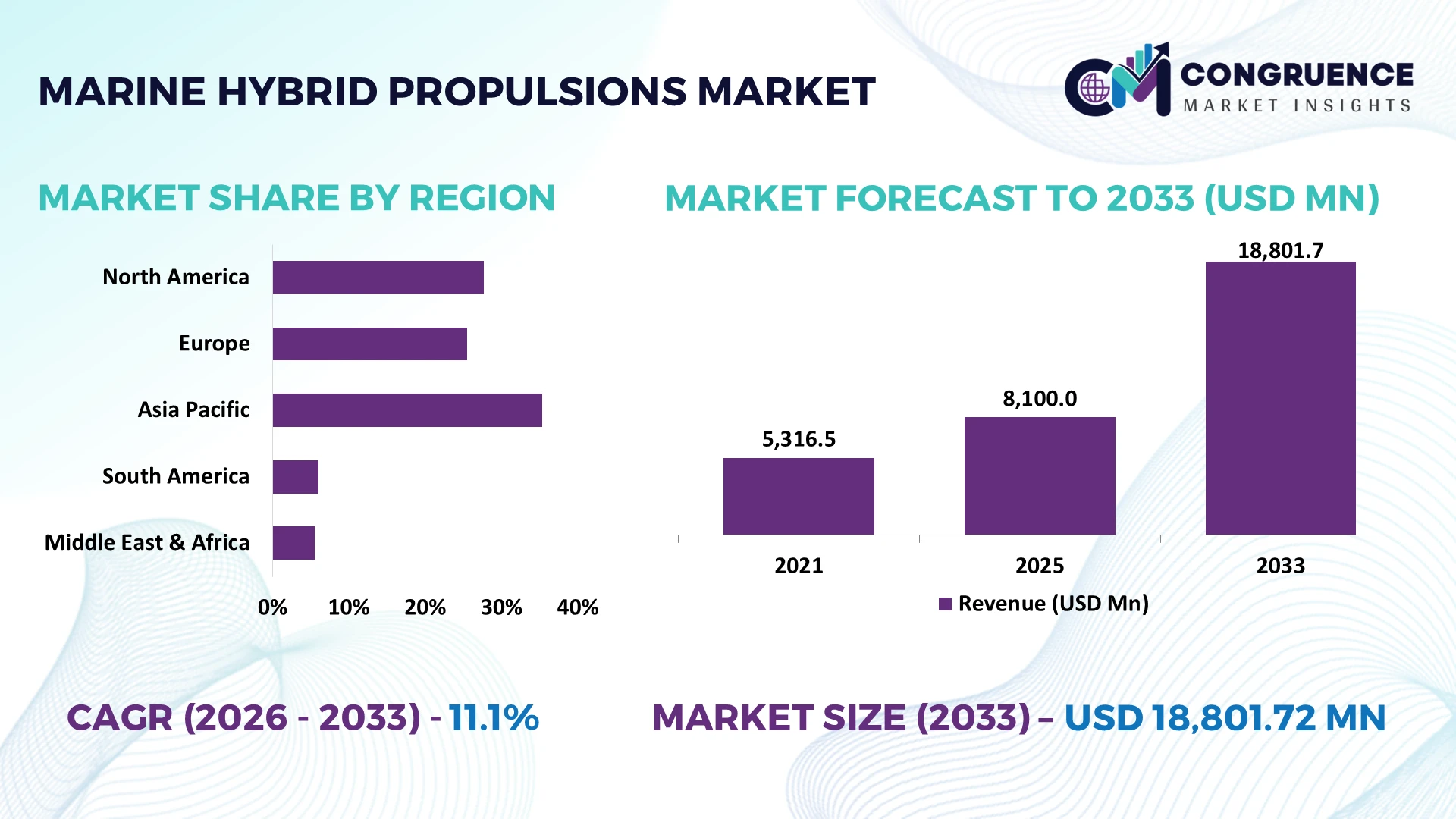
The Global Marine Hybrid Propulsions Market was valued at USD 8,100.0 Million in 2025 and is anticipated to reach a value of USD 18,801.7 Million by 2033 expanding at a CAGR of 11.1% between 2026 and 2033. Market growth is driven by maritime decarbonization mandates, increasing electrification of commercial vessels, rising marine fuel expenditure, and accelerated integration of battery-assisted propulsion systems.
China dominates marine propulsion manufacturing capacity, accounting for approximately 55% of global shipbuilding output in 2024, compared with South Korea's approximately 28%. Its shipbuilding ecosystem supports hybrid propulsion integration across commercial shipping, passenger ferries, and offshore support vessels. Investments in marine battery manufacturing, electric propulsion infrastructure, and domestic shipyard modernization reinforce China's competitive position amid tightening International Maritime Organization emission requirements.
Strategic investments in modular propulsion architectures, battery integration capabilities, and shipyard partnerships will determine long-term competitive positioning.
Market Size & Growth: USD 8,100.0 Million in 2025, reaching USD 18,801.7 Million by 2033 at 11.1% CAGR, driven by maritime electrification.
Top Growth Drivers: Fuel savings of 15–30%, emission reductions of 20–30%, and the IMO's 40% carbon-intensity reduction target.
Short-Term Forecast: By 2028, optimized hybrid propulsion configurations target 15–25% lower fuel consumption.
Emerging Technologies: Three transformative technologies include AI-enabled energy management, lithium-ion battery storage, and integrated electric propulsion.
Regional Leaders: Illustrative 2033 projections place Europe at USD 6,768.6 Million, Asia Pacific at USD 6,392.6 Million, and North America at USD 3,760.3 Million, supported by ferry electrification, shipbuilding, and offshore modernization, respectively.
Consumer/End-User Trends: Commercial vessel operators prioritize hybrid configurations delivering 15–30% fuel savings.
Pilot/Case Example: Norway's 2015 Ampere electric ferry demonstrated approximately 95% emission reductions compared with conventional diesel operations.
Competitive Landscape: Wärtsilä is a leading participant alongside ABB, Siemens Energy, Rolls-Royce Power Systems, and Kongsberg Maritime; individual market shares remain undisclosed.
Regulatory & ESG Impact: FuelEU Maritime mandates a 6% reduction in onboard energy greenhouse gas intensity by 2030.
Investment & Funding: The European Union's Zero Emission Waterborne Transport partnership mobilizes approximately USD 3.5 billion in planned public-private investment.
Innovation & Future Outlook: Advanced battery systems, fuel cells, and intelligent power management target 20–30% operational efficiency improvements in suitable applications.
The Marine Hybrid Propulsions Market is witnessing accelerated deployment across passenger ferries, offshore support vessels, tugboats, and short-sea cargo ships. Advanced energy management platforms, modular battery packs, and variable-speed generators enable fuel savings of approximately 15–30% under suitable operating conditions. Expanding maritime electrification corridors and European emission regulations are reshaping vessel procurement strategies, reinforcing the strategic importance of integrated propulsion technologies.
Marine hybrid propulsion is becoming a strategic differentiator in vessel manufacturing, fleet modernization, and maritime infrastructure investment as shipowners prioritize lifecycle operating costs alongside regulatory compliance. FuelEU Maritime and the inclusion of shipping within the European Union Emissions Trading System are accelerating procurement shifts toward low-emission propulsion architectures. Shipbuilders are increasingly integrating battery storage, electric motors, and intelligent power distribution during initial vessel design.
Compared with conventional diesel propulsion, optimized hybrid configurations reduce fuel consumption by approximately 15–30% across suitable duty cycles through peak shaving, generator load optimization, and battery-assisted maneuvering. China and South Korea benefit from large-scale shipbuilding infrastructure, while Norway leads specialized maritime electrification deployment. Between 2026 and 2028, hybrid vessel designs are expected to increasingly target fuel savings exceeding 20% in variable-load operations.
Norway's hybrid offshore support vessels demonstrate how battery storage reduces unnecessary generator operation during dynamic positioning. Wärtsilä, ABB, and Kongsberg Maritime are strengthening integrated propulsion portfolios through shipyard collaborations, digital energy management, and modular electrification technologies. Competitive advantage increasingly depends on delivering measurable lifecycle savings, retrofit compatibility, and scalable propulsion architectures adaptable to emerging marine fuels.
Stringent maritime emission regulations are accelerating the replacement of conventional diesel propulsion with battery-assisted and integrated hybrid power systems. The International Maritime Organization targets a 40% reduction in shipping carbon intensity by 2030 compared with 2008 levels, while FuelEU Maritime mandates a 6% reduction in onboard energy greenhouse gas intensity by 2030. Hybrid propulsion configurations deliver approximately 15–30% fuel savings in suitable variable-load vessel operations. Norway, Germany, and China are incorporating energy-efficient propulsion architectures into ferry, offshore, and commercial vessel programs. Wärtsilä and ABB are expanding integrated electrification portfolios and shipyard partnerships. Optimized generator loading additionally reduces engine operating hours, strengthening maintenance economics and fleet profitability.
Elevated acquisition costs for marine-grade batteries, power converters, electric motors, and specialized cooling systems restrict hybrid propulsion deployment among capital-constrained vessel operators. Battery pack prices declined approximately 20% globally in 2024; however, maritime installations require additional expenditure on certification, thermal protection, and system integration. China controls more than 75% of global battery cell manufacturing capacity, creating concentrated supply-chain exposure for international shipbuilders. These dependencies increase procurement uncertainty and complicate investment planning, particularly for smaller commercial fleets. Propulsion manufacturers are mitigating exposure through diversified battery sourcing, standardized power modules, and long-term supplier agreements. Vessel-specific engineering requirements nevertheless limit the extent to which falling battery prices translate into installation savings.
Fuel cell-assisted hybrid propulsion and modular retrofit architectures are creating commercial opportunities beyond new vessel construction. The International Maritime Organization targets zero or near-zero greenhouse gas emission technologies and fuels representing at least 5%, striving for 10%, of international shipping energy consumption by 2030. FuelEU Maritime's 14.5% greenhouse gas intensity reduction requirement by 2035 further strengthens demand for adaptable propulsion platforms. Japan and South Korea are advancing hydrogen and ammonia-related marine propulsion research, while Norway supports fuel cell demonstration projects. Equipment manufacturers are investing in fuel-flexible power management, modular battery integration, and retrofit partnerships. Designing propulsion systems independently of specific fuel technologies creates recurring upgrade opportunities throughout vessel operating lifecycles.
Maintaining consistent propulsion efficiency across changing vessel loads, battery degradation, and demanding maritime environments represents a significant long-term execution challenge. Lithium-ion battery systems commonly use approximately 80% remaining capacity as an end-of-life benchmark, while operating strategies frequently maintain charging levels within a 20–80% range to limit degradation. These constraints complicate energy storage sizing, particularly for offshore vessels requiring continuous dynamic positioning and redundant power availability. International Association of Classification Societies cybersecurity requirements for applicable new vessels further increase integration complexity. ABB, Kongsberg Maritime, and other propulsion specialists are developing predictive diagnostics, intelligent load balancing, and standardized control architectures. Competitive scalability depends on maintaining verified performance without compromising vessel safety or operational availability.
Intelligent Vessel Energy Management: Hybrid vessels are adopting real-time load forecasting, automated generator scheduling, and digital propulsion monitoring. Optimized power distribution targets 10–20% lower fuel consumption and 15–25% fewer generator operating hours under suitable duty cycles. ABB and Wärtsilä are expanding integrated automation platforms to improve energy utilization and reduce maintenance interruptions.
Battery Packaging and Thermal Optimization: Marine battery manufacturers are transitioning toward compact, liquid-cooled energy storage architectures. Global lithium-ion battery pack prices declined approximately 20% in 2024, while selected marine battery platforms support charging rates of 1–3C. Corvus Energy and other suppliers are standardizing battery modules, reducing installation complexity and improving onboard space utilization.
Shore Charging Infrastructure Expansion: Ferry operators are integrating automated charging systems into scheduled port turnaround activities. High-capacity maritime charging installations increasingly operate at 1–5 MW, with selected ferry routes supporting charging windows of 10–20 minutes. Norwegian operators and equipment suppliers are coordinating vessel schedules with grid capacity, minimizing oversized onboard battery requirements.
Integrated Propulsion Procurement Models: Shipyards are shifting from component-level procurement toward consolidated propulsion packages incorporating electrical distribution, automation, and condition monitoring. China's approximately 55% and South Korea's 28% shares of global shipbuilding output in 2024 reinforce procurement concentration. Kongsberg Maritime and Siemens Energy are strengthening integrated engineering partnerships to simplify commissioning and reduce supplier coordination requirements.
Parallel Hybrid Propulsion accounted for approximately 55.9% of the market share in 2025, supported by its compatibility with conventional mechanical drivetrains, flexible operating configurations, and relatively straightforward installation requirements. Its ability to combine combustion engines with electric motors supports fuel savings of approximately 15–25% across suitable vessel operating profiles. Diesel-Electric Hybrid propulsion maintains substantial adoption across offshore vessels and passenger ships, where independent generator operation improves load management and power distribution.
Series Hybrid Propulsion is positioned as a high-growth segment as shipbuilders increasingly adopt electrically driven propulsion architectures that eliminate direct mechanical connections between engines and propeller shafts. Fuel Cell Hybrid systems represent an emerging segment focused on low-emission maritime operations. Wärtsilä, ABB, and Kongsberg Maritime are expanding modular propulsion architectures and intelligent power management capabilities. With retrofit installations accounting for approximately 65% of the broader market in 2025, manufacturers are prioritizing systems compatible with existing vessel infrastructure, reducing integration costs and expanding fleet modernization opportunities.
Commercial Shipping represents the leading application, with an indicative market share of approximately 35% in 2025, supported by extensive fleet operations, fuel expenditure optimization, and growing environmental compliance requirements. Hybrid propulsion enables commercial vessels with variable operating loads to achieve approximately 15–25% fuel savings under suitable conditions. Offshore applications also maintain substantial demand, particularly across platform supply vessels and dynamically positioned ships requiring reliable power distribution during fluctuating operational loads.
Passenger Transport is positioned as a high-growth application, driven by scheduled ferry operations, predictable routes, and expanding maritime charging infrastructure. These operating characteristics support greater battery utilization without compromising service continuity. Defense applications prioritize propulsion redundancy, acoustic performance, and operational endurance, while Recreational / Leisure applications emphasize quieter operation and improved onboard comfort. ABB, Wärtsilä, and Siemens Energy are developing application-specific propulsion configurations, integrated energy management systems, and scalable electrical architectures. Investment priorities are increasingly shifting toward vessels with repetitive operating cycles, where propulsion electrification delivers measurable lifecycle cost advantages.
Commercial Operators constitute the dominant end-user segment, with an indicative market share of approximately 65% in 2025, reflecting extensive procurement across cargo shipping, passenger transportation, offshore services, and port operations. Fleet owners prioritize propulsion reliability, fuel expenditure reduction, and maintenance optimization, with suitable hybrid configurations targeting operational fuel savings of 15–30%. Standardized propulsion packages enable operators to replicate successful installations across multiple vessels, improving procurement efficiency and reducing fleet-level engineering requirements.
Private Vessel Owners represent an emerging high-growth buyer group as yacht manufacturers increasingly integrate hybrid propulsion into premium vessel designs, emphasizing quiet cruising, reduced vibration, and improved energy autonomy. Naval Defense Organizations maintain strategically important demand for resilient electrical distribution, propulsion redundancy, and reduced acoustic signatures. Compared with commercial operators, defense customers require more extensive customization and qualification. Rolls-Royce Power Systems, ABB, and Caterpillar are targeting differentiated procurement requirements through configurable propulsion packages, shipyard partnerships, and lifecycle maintenance services. Long-term competitive advantage increasingly depends on application-specific engineering and performance assurance rather than standalone equipment pricing.
Asia Pacific accounted for the largest market share at 35.3% in 2025 however, Europe is expected to register the fastest growth, expanding at a CAGR of 13.2% between 2026 and 2033.

North America accounted for approximately 27.7% of the global market share in 2025, supported by commercial fleet modernization, advanced marine engineering capabilities, and increasing electrification across coastal transportation networks. Hybrid propulsion adoption is concentrated across passenger ferries, harbor tugboats, offshore support vessels, and naval auxiliary ships. The United States and Canada are expanding investments in shore-side electrical infrastructure and energy-efficient vessel configurations to reduce operational fuel expenditure. Washington State Ferries' electrification program targets the conversion of six existing diesel ferries and the construction of 16 new hybrid-electric vessels by 2040. Established propulsion manufacturers are strengthening partnerships with domestic shipyards to integrate modular energy storage, electric drivetrains, and intelligent power distribution systems. Fleet operators increasingly prioritize propulsion solutions that deliver operational flexibility without requiring complete replacement of existing vessel infrastructure.
United States Market Outlook: The United States benefits from established naval shipbuilding capabilities, commercial maritime infrastructure, and specialized propulsion engineering expertise. The Environmental Protection Agency's USD 3 billion Clean Ports Program supports zero-emission port equipment and infrastructure development, strengthening the ecosystem for maritime electrification. Domestic manufacturers are prioritizing integrated propulsion packages, battery management technologies, and lifecycle maintenance services across commercial and government-operated fleets.
Europe accounted for approximately 25.5% of the global market share in 2025, supported by established maritime electrification infrastructure, stringent environmental regulations, and advanced propulsion technology manufacturing. Norway, Germany, Finland, and Denmark are driving hybrid propulsion deployment across passenger ferries, offshore service vessels, and short-sea shipping fleets. FuelEU Maritime requires a 2% reduction in onboard energy greenhouse gas intensity from 2025, increasing to 6% by 2030. These requirements are encouraging shipowners to integrate battery-assisted propulsion, automated energy management, and flexible electrical distribution systems into fleet modernization programs. Wärtsilä, ABB, and Kongsberg Maritime are strengthening shipyard collaborations and expanding integrated propulsion portfolios. Europe's established classification, certification, and maritime engineering ecosystem reduces commercialization barriers, enabling manufacturers to validate advanced propulsion configurations before expanding deployment across international shipping markets.
Norway Market Outlook: Norway maintains a strategic advantage through its established maritime battery ecosystem, advanced offshore engineering capabilities, and electrified ferry networks. More than 80 electric and hybrid-electric ferries have entered Norwegian maritime operations, demonstrating the commercial viability of alternative propulsion technologies. Domestic companies are leveraging operational experience to develop scalable energy management platforms, marine battery systems, and specialized propulsion solutions for international offshore and coastal transportation markets.
Asia Pacific accounted for approximately 35.3% of the global market share in 2025, supported by extensive shipbuilding infrastructure, competitive manufacturing capabilities, and expanding investment in low-emission vessel technologies. China, South Korea, and Japan collectively represented approximately 95% of global shipbuilding output in 2024, providing a substantial manufacturing platform for hybrid propulsion integration. Regional shipyards are incorporating electric motors, battery storage, and advanced power conversion systems into commercial vessel designs to meet international environmental requirements. South Korean and Japanese manufacturers are developing integrated propulsion architectures compatible with alternative marine fuels and electrified auxiliary systems. Expanding domestic battery manufacturing capabilities further strengthen component availability and procurement efficiency. Equipment suppliers are establishing localized engineering partnerships and production facilities, positioning themselves to capture large-volume vessel contracts while reducing dependence on imported propulsion components.
China Market Outlook: China benefits from vertically integrated shipbuilding, battery manufacturing, and industrial electronics supply chains. Its domestic shipbuilding industry secured approximately 74% of global new ship orders in 2024, creating significant opportunities for integrating hybrid propulsion during initial vessel construction. Chinese manufacturers are expanding marine-grade battery production, electric propulsion engineering, and standardized power management systems to strengthen competitiveness across domestic and export-oriented vessel programs.
South America accounted for approximately 6.0% of the global market share in 2025, with demand concentrated across offshore oil and gas operations, inland waterways, commercial ports, and coastal transportation services. Brazil represents the principal deployment center, supported by extensive offshore exploration activities and specialized marine service requirements. Petrobras announced contracts for 12 new platform supply vessels in 2024, incorporating hybrid propulsion configurations designed to improve operational efficiency and reduce emissions. Argentina and Chile offer additional opportunities across port service vessels, fisheries, and coastal transportation networks. However, limited marine charging infrastructure and dependence on imported electrical propulsion components constrain widespread adoption. International propulsion manufacturers are targeting localized maintenance partnerships, modular retrofit packages, and application-specific engineering services. Offshore vessels with variable power requirements offer particularly attractive opportunities for achieving measurable fuel and maintenance savings.
Brazil Market Outlook: Brazil's extensive deepwater petroleum operations create sustained demand for reliable, energy-efficient offshore support vessels. Petrobras' 2025–2029 business plan allocated approximately USD 77.3 billion toward exploration and production activities, supporting associated maritime service requirements. Domestic shipyards and international propulsion suppliers are strengthening engineering collaborations to deliver battery-assisted vessel configurations capable of improving dynamic positioning efficiency, operational redundancy, and long-term fleet economics.
Middle East & Africa accounted for approximately 5.5% of the global market share in 2025, supported by expanding port infrastructure, offshore energy operations, and maritime logistics modernization. The United Arab Emirates, Saudi Arabia, and South Africa represent strategically important markets for hybrid propulsion deployment across harbor tugboats, offshore support vessels, and specialized commercial fleets. Saudi Arabia's International Maritime Industries shipyard is designed to support the construction of more than 40 vessels annually at full operational capacity, creating opportunities for advanced propulsion integration. Regional port operators are evaluating battery-assisted vessel configurations to reduce fuel expenditure during repetitive maneuvering and standby operations. Nevertheless, limited charging infrastructure and specialized technical workforce availability restrict deployment scalability. International manufacturers are developing regional service networks, shipyard partnerships, and climate-adapted propulsion technologies to address demanding maritime operating conditions.
United Arab Emirates Market Outlook: The United Arab Emirates benefits from advanced port infrastructure, established maritime logistics networks, and growing investment in sustainable vessel technologies. In 2024, AD Ports Group announced plans to introduce a fully electric harbor tug equipped with a battery capacity of approximately 5.2 MWh. Such electrification initiatives strengthen supporting infrastructure and technical capabilities, creating favorable conditions for hybrid propulsion deployment across harbor services and offshore maritime operations.
Wärtsilä, ABB, Kongsberg Maritime, Caterpillar, and Rolls-Royce Power Systems compete through integrated propulsion architectures, while specialized electrical equipment manufacturers challenge established suppliers through modular designs and application-specific customization. The market exhibits moderate concentration, with the five leading players collectively holding an indicative 40% share, pending independent verification. Competition centers on lifecycle expenditure, battery integration, engineering reliability, and aftermarket service availability. Optimized hybrid configurations deliver 15–30% fuel savings, while selected operating profiles support approximately 20% reductions in emissions. Wärtsilä and ABB are expanding intelligent energy management portfolios, whereas Caterpillar and Rolls-Royce emphasize drivetrain compatibility and established service networks. Kongsberg Maritime strengthens competitiveness through integrated vessel automation and shipyard partnerships. Competitive differentiation is shifting from standalone propulsion equipment toward software-controlled energy ecosystems. Marine certification, specialized engineering expertise, and extensive service infrastructure create substantial entry barriers. Winning requires validated operational savings, flexible system integration, dependable component sourcing, and comprehensive lifecycle support across diverse fleets.
Parallel and series hybrid propulsion architectures are transforming vessel power management through coordinated operation of combustion engines, electric motors, and marine battery systems. Compared with conventional diesel propulsion, optimized hybrid configurations deliver 15–30% fuel savings under suitable operating conditions. Variable-speed generators and intelligent load distribution further improve operational efficiency by approximately 10–15%, particularly across offshore support vessels, harbor tugboats, and passenger ferries. Integrated propulsion suppliers benefit from established shipyard relationships and engineering capabilities.
Emerging technologies include high-density lithium-ion batteries, silicon carbide power converters, and AI-enabled energy management platforms. Advanced power electronics target conversion efficiencies exceeding 97%, reducing electrical losses and cooling requirements. More than 1,000 battery-equipped vessels were operational globally in 2025, demonstrating commercial acceptance of maritime energy storage. Predictive diagnostics and automated generator scheduling strengthen equipment availability while reducing unnecessary engine operating hours and maintenance expenditure.
Between 2026 and 2028, fuel cell-assisted propulsion, modular direct-current distribution networks, and digital twin technologies will increasingly influence vessel design priorities. Battery-supported peak shaving targets approximately 20% reductions in generator operating hours across suitable duty cycles. Manufacturers offering interoperable propulsion platforms and fuel-flexible architectures gain competitive advantages through simplified retrofitting, reduced engineering complexity, and scalable deployment. Early technology integration strengthens fleet modernization economics and competitiveness.
January 2026: ABB secured a contract to supply propulsion, power, and control systems for four hybrid-electric BC Ferries vessels, each designed to accommodate 70 MWh of battery storage, enabling future fully electric operations and strengthening large-scale commercial ferry electrification capabilities. Source: abb.com
August 2025: Wärtsilä announced its selection as electrical integrator for Wasaline's Aurora Botnia ferry battery expansion, increasing installed capacity from 2.2 MWh to 12.6 MWh. The project strengthens battery-assisted maritime operations and demonstrates the scalability of existing hybrid propulsion installations. Source: wartsila.com
April 2025: Kongsberg Maritime secured an equipment contract for DOF's new offshore support vessel featuring two 1 MWh battery packs and integrated DC electrical distribution. The propulsion configuration targets fuel savings of up to 35%, improving offshore vessel operating economics. Source: kongsbergmaritime.com
October 2025: ZF showcased its new 3300 Hybrid Module, supporting conventional engine output of up to 1,940 kW and electric motor options of 150, 200, or 300 kW. Its compact architecture simplifies installation, maintenance, and integration across vessel platforms. Source: zf.com
The Marine Hybrid Propulsions Market Report provides comprehensive analysis across propulsion types, applications, end-users, and five major geographical regions. Type segmentation covers Parallel Hybrid Propulsion, Series Hybrid Propulsion, Diesel-Electric Hybrid, and Fuel Cell Hybrid systems. Application coverage includes Commercial Shipping, Offshore, Passenger Transport, Defense, and Recreational / Leisure, while end-user analysis encompasses Commercial Operators, Private Vessel Owners, and Naval Defense Organizations. Technological assessment examines marine battery systems, intelligent energy management, electric drivetrains, and advanced power conversion architectures.
The report evaluates regional deployment patterns across North America, Europe, Asia Pacific, South America, and Middle East & Africa, alongside competitive strategies of 14 prominent industry participants. It examines regulatory developments, fleet modernization, retrofit opportunities, infrastructure availability, and emerging fuel cell integration, supporting investment planning, geographical expansion, technology selection, and competitive positioning between 2026 and 2033.
| Report Attribute / Metric | Details |
|---|---|
| Market Revenue (2025) | USD 8,100.0 Million |
| Market Revenue (2033) | USD 18,801.7 Million |
| CAGR (2026–2033) | 11.1% |
| Base Year | 2025 |
| Forecast Period | 2026–2033 |
| Historic Period | 2021–2025 |
| Segments Covered |
By Type
By Application
By End-User
|
| Key Report Deliverables | Revenue Forecast; Market Trends; Growth Drivers & Restraints; Technology Insights; Segmentation Analysis; Regional Insights; Competitive Landscape; Regulatory & ESG Overview; Recent Developments |
| Regions Covered | North America; Europe; Asia-Pacific; South America; Middle East & Africa |
| Key Players Analyzed | Wärtsilä Corporation; ABB Ltd.; Kongsberg Maritime; Caterpillar Inc.; Rolls-Royce Power Systems AG; Siemens Energy AG; MAN Energy Solutions (Everllence); Cummins Inc.; ZF Friedrichshafen AG; Danfoss A/S; Yanmar Holdings Co., Ltd.; Mitsubishi Heavy Industries, Ltd.; Volvo Penta; BAE Systems plc |
| Customization & Pricing | Available on Request (10% Customization Free) |




