
Reports
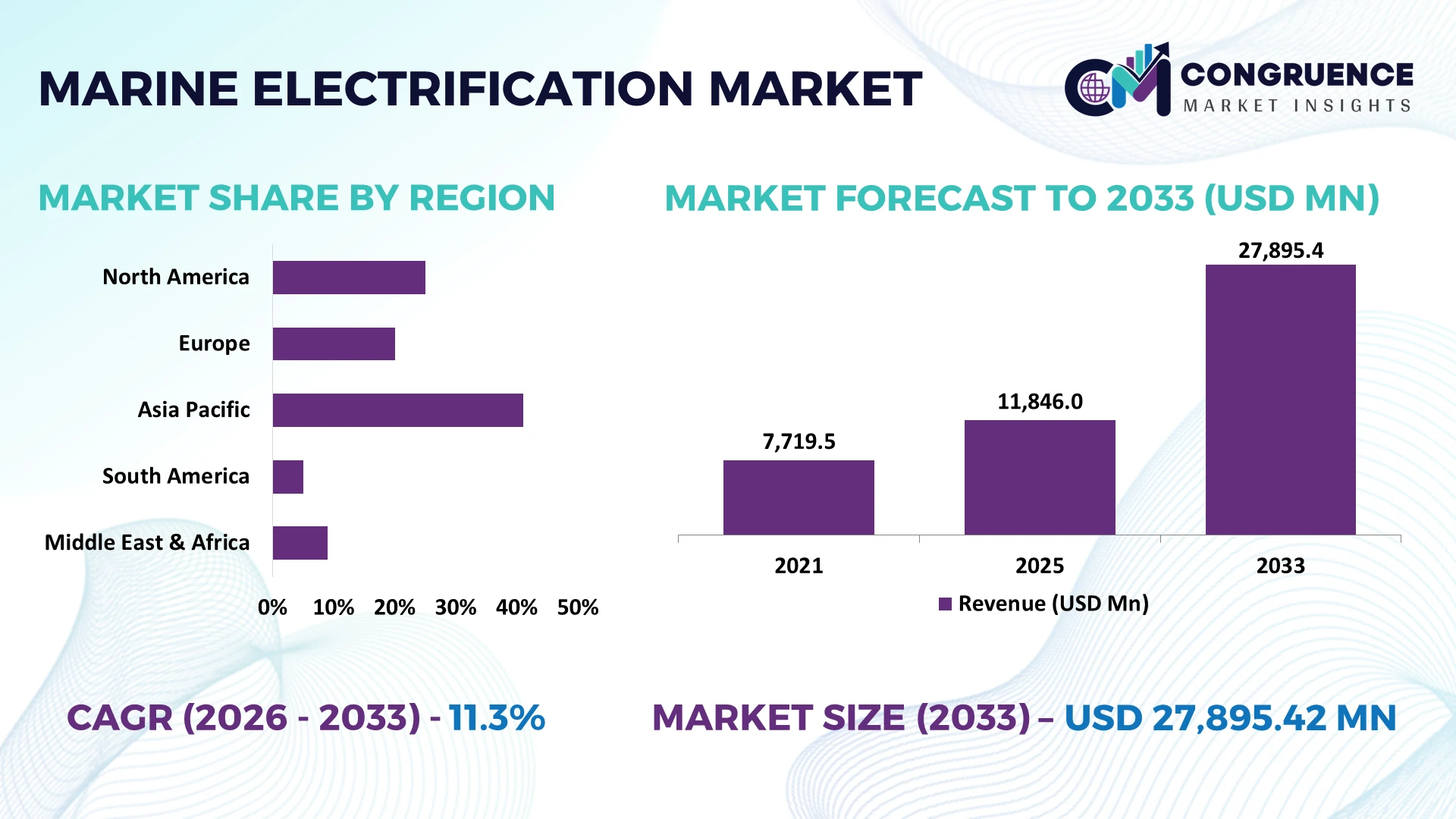
The Global Marine Electrification Market was valued at USD 11846 Million in 2025 and is anticipated to reach a value of USD 27895.42 Million by 2033 expanding at a CAGR of 11.3% between 2026 and 2033.
Growth is driven by battery-electric ferry procurement, hybrid propulsion retrofits, mandatory shore-power connections, and maritime fuel-intensity reduction requirements.
Norway leads commercial electric ferry deployment, operating nearly 90 electric ferries in early 2025, representing approximately 33% of the estimated 270 electric ferries worldwide. Its national road-ferry operations recorded an approximately 50% reduction in direct CO₂ emissions between 2015 and 2025, from 300,000 to 149,000 tonnes. In comparison, the United States is advancing large-scale fleet modernization through Washington State's USD 6 billion ferry electrification program. Norway's established charging infrastructure and electric propulsion expertise strengthen its competitive advantage in European maritime decarbonization.
Strategically, marine technology suppliers should prioritize scalable battery systems, standardized shore-power integration, and hybrid vessel conversion contracts to secure long-term fleet electrification opportunities.
Market Size & Growth: Valued at USD 11846 Million in 2025, projected to USD 27895.42 Million by 2033 at 11.3% CAGR, driven by IMO Net-Zero Framework and port shore-power mandates.
Top Growth Drivers: IMO Net-Zero Framework entry into force in 2027, port shore-power infrastructure expansion, and battery cost reduction to USD 100 per kWh .
Short-Term Forecast: By 2027, IMO Net-Zero Framework implementation begins for vessels over 5,000 gross tonnage, mandating fuel standard compliance and GHG pricing mechanisms .
Emerging Technologies: Solid-state batteries for extended range, hydrogen fuel cell efficiency breakthroughs, and intelligent energy management systems optimizing multi-energy synergy .
Regional Leaders: Norway at 39% European share with battery-electric ferries at 52% application dominance, U.S. fastest-growing through EPA Clean Ports Program, and China targeting green inland vessel mass production by 2030 .
Consumer/End-User Trends: Ferries command 52% of European application share; harbor tugs represent second-largest segment at 23% as port operators electrify workboat fleets .
Pilot/Case Example: Germany’s Frisia E-I launched April 2025 as first fully electric seagoing vessel under German flag, operating eight daily crossings with 150-passenger capacity between Norddeich and Norderney .
Competitive Landscape: ABB, Wärtsilä, Siemens Energy, GE Vernova, and Danfoss lead; Echandia, Corvus Energy, and Leclanché compete on marine-qualified battery systems .
Regulatory & ESG Impact: IMO Net-Zero Framework approved April 2025 combines mandatory fuel standard and GHG pricing, entering force 2027 for 85% of international shipping emissions .
Investment & Funding: Japan approved 16 zero-emission ship projects involving over ¥120 billion in production equipment investment; Canada Infrastructure Bank financing four zero-emission BC Ferries expected by 2027 .
Innovation & Future Outlook: Battery-as-a-service and leasing models expand accessibility; modular, standards-aligned designs enable component swapping and protect asset value .
Marine electrification is transforming passenger ferries, offshore support vessels, harbor craft, and coastal shipping through high-capacity batteries, intelligent power management, and automated charging infrastructure. Advanced propulsion integration enables operators to reduce diesel dependence while improving energy utilization across scheduled maritime routes. Norway's national road-ferry operations demonstrate the operational impact, with annual direct carbon emissions declining by approximately 151,000 tonnes over a decade. Meanwhile, European shore-power requirements are strengthening demand for port electrical infrastructure, high-voltage distribution systems, and vessel charging compatibility. These developments establish clear priorities for technology investment, supplier differentiation, and maritime fleet modernization strategies.
Marine electrification is becoming a strategic priority for shipbuilders, port authorities, and fleet operators as emissions regulations reshape vessel procurement and propulsion investment. FuelEU Maritime introduced a 2% greenhouse-gas intensity reduction requirement in 2025, increasing to 6% by 2030. This regulatory transition is accelerating demand for integrated battery propulsion, shore-power connectivity, and intelligent vessel energy management. Manufacturers are restructuring supply chains around marine-certified batteries, high-voltage converters, and standardized charging interfaces to strengthen project delivery capabilities.
Battery-electric propulsion delivers substantial operational advantages over conventional diesel systems. Electric motors typically achieve 90–95% conversion efficiency, compared with approximately 35–45% thermal efficiency for marine diesel engines. Norway leads scheduled electric ferry deployment, while China combines large-scale shipbuilding capacity with expanding electric inland-waterway transportation. The distinction favors suppliers capable of adapting propulsion architectures to different vessel sizes, operating distances, and charging requirements.
Between 2026 and 2028, investment priorities will increasingly center on high-capacity energy storage, automated charging, and predictive battery diagnostics. Washington State's ferry modernization program targets up to 16 hybrid-electric vessels and 16 charging terminals. Equipment manufacturers are strengthening partnerships with shipyards, utilities, and battery integrators to coordinate vessel delivery with port infrastructure. Competitive advantage will depend on integrated lifecycle performance rather than propulsion hardware alone.
Maritime decarbonization regulations are accelerating the replacement of conventional propulsion systems with battery-electric and hybrid-electric architectures. The International Maritime Organization's revised greenhouse-gas strategy targets at least 20% emissions reduction by 2030 and 70% by 2040, compared with 2008 levels. Additionally, FuelEU Maritime establishes a 14.5% reduction requirement for greenhouse-gas intensity by 2035. These targets are influencing shipowners' fleet procurement decisions, particularly for passenger ferries and short-sea shipping. In Denmark, maritime operators are integrating battery propulsion with automated charging to reduce fossil-fuel dependence on scheduled routes. Wärtsilä, ABB, and Corvus Energy are expanding integrated propulsion solutions, strengthening supplier opportunities in vessel retrofits, onboard electrical distribution, and marine energy storage.
Marine electrification faces structural cost pressures from concentrated battery manufacturing, specialized electrical equipment, and vessel conversion requirements. China accounted for approximately 80% of global battery cell production in 2024, creating significant procurement exposure for international shipbuilders. Lithium iron phosphate batteries represented nearly half of the global electric vehicle battery market, intensifying competition for established cell supply chains. Meanwhile, battery pack prices declined approximately 20% during 2024, although marine-certified systems require additional thermal management, fire protection, and classification compliance. These requirements increase capital commitments and complicate project economics for smaller operators. Shipbuilders are responding through multiyear procurement agreements, localized system integration, and standardized battery modules. Securing certified components remains critical to protecting delivery schedules and operating margins.
Next-generation marine energy storage presents opportunities beyond conventional passenger ferry electrification, particularly in offshore support vessels, coastal cargo transportation, and hybrid workboats. Lithium iron phosphate battery pack prices declined approximately 20% in 2024, improving the economics of higher-capacity propulsion installations. Electric motors operating at 90–95% efficiency also create opportunities for optimized power distribution and regenerative energy recovery. In Sweden, advanced battery integration and intelligent energy management are expanding the operational potential of electrically assisted RoPax vessels. Between 2026 and 2028, predictive battery analytics, automated charging coordination, and modular power electronics will support more flexible vessel deployment. Technology suppliers are prioritizing software integration, charging partnerships, and scalable propulsion platforms to capture retrofit opportunities across specialized commercial fleets.
Scaling marine electrification requires coordinated management of battery degradation, high-voltage safety, propulsion controls, and vessel-specific operating conditions. Electric propulsion motors can achieve 90–95% efficiency, but maintaining this advantage across variable loads requires sophisticated power management and thermal regulation. Battery systems must also operate within controlled charge ranges, commonly around 20–80% during routine cycling, depending on chemistry and operating requirements. The European Union's 2030 shore-power requirements introduce additional operational complexity through vessel-port communication, grid synchronization, and electrical safety coordination. In Finland, hybrid vessel operators are integrating larger battery installations with existing propulsion systems, increasing software validation and maintenance requirements. Manufacturers must strengthen digital diagnostics, cybersecurity protection, crew training, and classification-approved system engineering to ensure consistent fleet availability and lifecycle performance.
• Plug-In Vessel Configurations Gain Traction: Approximately 35% of battery-equipped vessels use plug-in hybrid or fully electric configurations, while the remaining 65% primarily employ onboard battery-assisted arrangements. This distinction is reshaping equipment procurement toward charging-compatible propulsion architectures. Operators are coordinating battery specifications with terminal power availability, while system integrators are developing standardized electrical interfaces. The commercial advantage lies in matching vessel charging capability to actual route schedules rather than maximizing installed battery capacity.
• Larger Vessel Contracts Reshape Procurement: Alternative-fuel vessel orders reached 151 ships during the first half of 2025, compared with 179 during the corresponding 2024 period. However, contracted gross tonnage increased 78%, indicating a shift toward larger vessels. Shipbuilders are adapting electrical distribution architectures, converter ratings, and auxiliary power systems for higher-capacity installations. Equipment manufacturers benefit from greater integration requirements per vessel, even when overall shipbuilding order volumes fluctuate.
• Shore Electricity Becomes Grid Planning Priority: European maritime infrastructure planning increasingly addresses the 90% qualifying port-call coverage requirement for 2030. Passenger vessels above 5,000 gross tonnes fall within the relevant regulatory framework. Port operators are coordinating grid connections, frequency conversion, and berth electrification with utilities and terminal contractors. This creates demand for power-quality engineering and electrical load forecasting, making grid capacity a determining factor in terminal investment sequencing.
• Hybrid Fleets Expand Battery Deployment: DNV recorded 1,072 battery-equipped vessels operating worldwide in 2025, alongside 440 additional vessels on order. This represents an order pipeline equivalent to approximately 41% of the operating fleet. Most installations support hybrid operation rather than exclusively battery-powered sailing. Marine technology companies are expanding battery monitoring, power-management integration, and lifecycle maintenance services to support increasingly diverse vessel duty cycles.
Hybrid-Electric Systems occupy a leading position in the installed battery-equipped vessel fleet, combining diesel engines, electric motors, and energy storage to accommodate changing operating loads. A 2026 assessment of battery-equipped vessels identified approximately 35% as plug-in hybrid or fully electric, leaving around 65% in other battery-assisted configurations. This deployment distribution demonstrates the continued importance of hybrid integration, although it does not represent market revenue share. Hybrid-Electric Systems provide flexibility for vessels operating beyond fixed charging routes, while Battery-Electric Systems are increasingly competitive in short-distance transport. Wärtsilä and ABB are developing integrated propulsion architectures that support both operating models.
Shore Power Systems are positioned for substantial infrastructure deployment as European regulations require coverage of 90% of qualifying port calls by 2030. Electric Propulsion Systems and Power Conversion Systems remain essential for motor control and voltage management. Energy Storage Systems benefit from modular battery development, while Fuel Cell Systems provide an alternative for longer-duration applications. Marine equipment suppliers are strengthening certification capabilities and integrated electrical engineering services to capture these distinct procurement requirements.
Propulsion represents a central application for marine electrification because vessel operators increasingly combine electric motors, batteries, and integrated power distribution to improve energy utilization. Modern electric motors commonly achieve 90–95% efficiency, compared with approximately 35–45% thermal efficiency for conventional diesel engines. This technical advantage supports electric propulsion adoption in ferries, harbor vessels, and offshore support operations. Onboard Power Generation and Auxiliary Power Systems address electrical demand from navigation, accommodation, and vessel equipment, while Energy Storage and Management coordinates power availability across operating conditions. Manufacturers are integrating advanced motor drives and battery management platforms to improve electrical system performance.
Shore-to-Ship Power and Marine Charging Infrastructure are emerging as important deployment areas because qualifying European ports must provide shore electricity for at least 90% of relevant vessel calls by 2030. Port Equipment Electrification extends electrical infrastructure investment into terminal machinery and cargo-handling operations. Shore-connected applications are attracting stronger infrastructure planning as operators coordinate grid upgrades, charging interfaces, and berth utilization. ABB and other electrical technology suppliers are expanding integrated power distribution and automation solutions to support these requirements.
Passenger Vessels represent one of the most established end-user categories for marine electrification, supported by predictable routes, frequent terminal access, and established battery charging infrastructure. A 2026 assessment of battery-powered vessels identified ferries, passenger ships, and offshore service vessels as the dominant deployment categories between 2022 and 2025. This concentration reflects operating conditions that favor electrified propulsion over long-distance conventional shipping. Commercial Shipping is increasingly adopting hybrid electrical architectures, while Offshore Support Vessels benefit from battery-assisted power management during dynamic positioning and variable-load operations. Manufacturers are adapting propulsion configurations to vessel operating profiles and charging availability.
Port Authorities are becoming increasingly influential purchasers as European shore-power regulations establish a 90% qualifying port-call coverage requirement. Shipbuilding and Repair Yards are investing in electrical integration expertise, while Naval and Defense operators prioritize resilient onboard power distribution. Fishing Fleets represent a smaller emerging buyer category, particularly for hybrid auxiliary systems. Across these groups, suppliers are expanding modular product portfolios, certification services, and technical partnerships to address different operating requirements and procurement cycles.
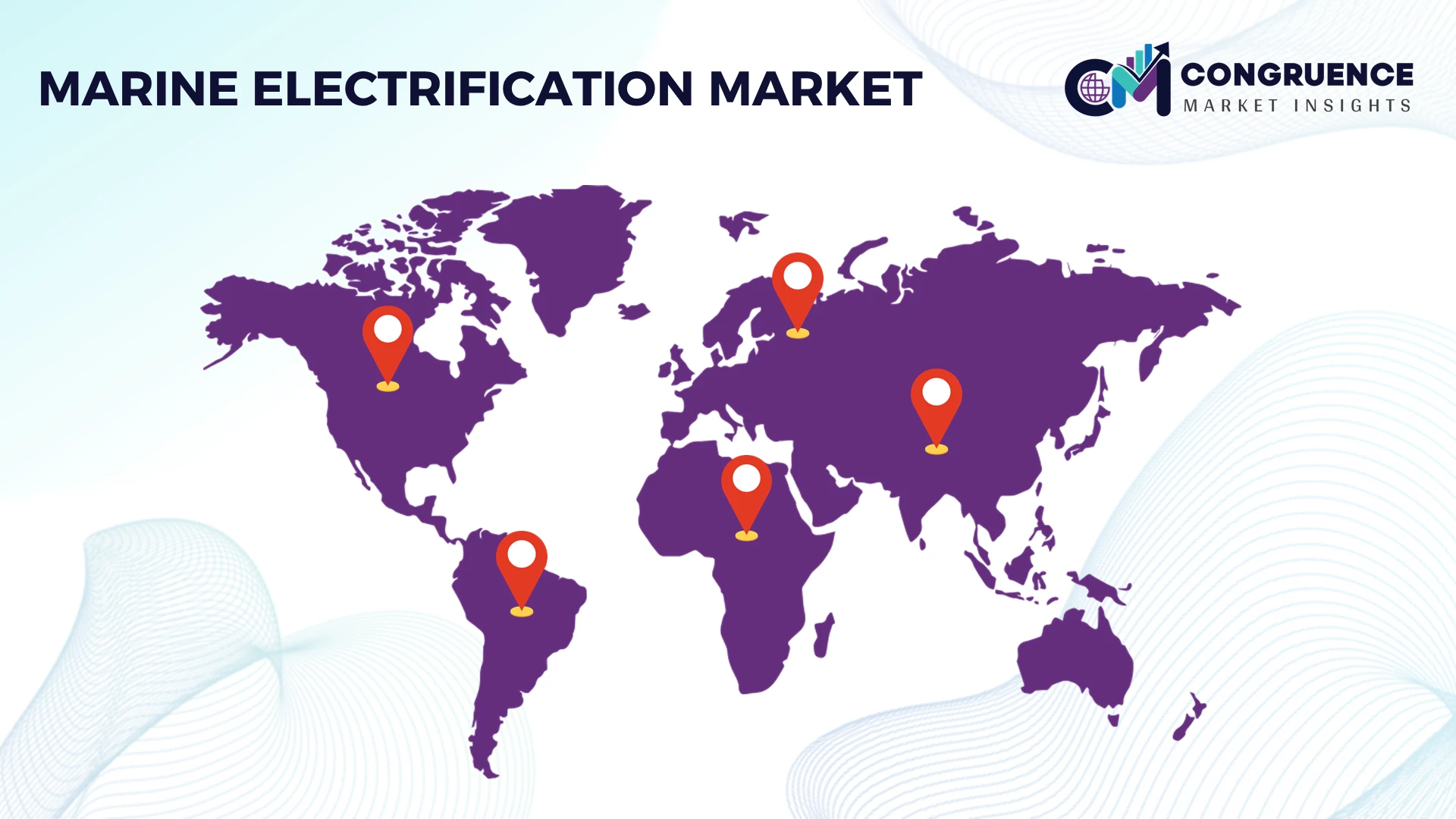
Europe accounted for the largest market share at approximately 38% in 2025 however, Asia-Pacific is expected to register the fastest growth, expanding at a CAGR of 13.5% between 2026 and 2033.
Ferry Fleet Modernization Accelerates Electrical Infrastructure Investment
North America's marine electrification market is shaped by public ferry procurement, shipyard modernization, and commercial harbor vessel electrification. The United States is concentrating investment on hybrid-electric propulsion systems, particularly in Washington, New York, and California. Washington State's ferry electrification program targets up to 16 hybrid-electric vessels and 16 charging terminals, creating substantial demand for power conversion equipment, high-voltage switchboards, and integrated energy management. California's harbor craft emissions regulations are also influencing propulsion replacement decisions and battery-assisted vessel development. Canada is advancing electrification through provincial ferry networks, with British Columbia and Ontario supporting battery-hybrid vessel adoption. These developments are strengthening partnerships among shipyards, utilities, and propulsion technology suppliers. However, limited domestic marine battery manufacturing and lengthy grid interconnection processes continue to influence procurement schedules, equipment sourcing, and project delivery economics.
United States Market Outlook: The United States benefits from established maritime engineering capabilities and expanding public investment in fleet decarbonization. The California Air Resources Board's Commercial Harbor Craft Regulation establishes phased compliance requirements beginning in 2023, with additional requirements extending through 2035. Domestic shipyards are strengthening electrical integration capabilities to serve ferry operators, harbor vessel owners, and specialized commercial fleets.
Electric Ferry Leadership Strengthens Maritime Technology Integration
Europe maintains a leading position in operational marine electrification through established electric ferry networks, advanced propulsion engineering, and increasingly stringent maritime environmental requirements. Norway, Denmark, Sweden, and Finland represent important deployment and technology development centers, supported by companies including Wärtsilä, ABB, and Corvus Energy. European maritime operators are incorporating battery systems into ferries, offshore vessels, and short-sea transportation, while port authorities expand high-voltage shore-power infrastructure. FuelEU Maritime introduced a 2% greenhouse-gas intensity reduction requirement in 2025, with progressively stricter thresholds shaping vessel procurement. The region also benefits from integrated shipbuilding, classification, and electrical engineering capabilities that support marine-certified system deployment. Growing demand for standardized charging interfaces and battery lifecycle services is strengthening competitive opportunities for established equipment manufacturers and specialized system integrators.
Norway Market Outlook: Norway operates one of the world's most developed electric ferry ecosystems, with nearly 90 battery-electric ferries operating in early 2025. Its hydropower-dominated electricity supply provides favorable conditions for low-emission vessel charging. Norwegian maritime technology companies are advancing automated charging, battery monitoring, and integrated propulsion systems, supporting equipment exports and international electrification projects.
Shipbuilding Scale Supports Industrial Electrification Expansion
Asia-Pacific combines extensive shipbuilding capacity with concentrated battery manufacturing and expanding domestic maritime transportation networks. China, South Korea, and Japan are important production centers for commercial vessels, electrical equipment, and advanced propulsion components. China accounted for approximately 55.7% of global shipbuilding completions by deadweight tonnage in 2024, providing substantial manufacturing capacity for electric and hybrid vessel integration. The region's battery supply chain supports procurement of lithium iron phosphate cells, power electronics, and modular energy storage systems. South Korean shipbuilders are developing integrated electrical architectures for advanced commercial vessels, while Japanese manufacturers emphasize propulsion efficiency and marine power management. Investment is increasingly directed toward electric inland cargo vessels, battery-supported harbor operations, and electrical integration facilities. Regional suppliers benefit from manufacturing scale and proximity to component production.
China Market Outlook: China leads global battery manufacturing, accounting for approximately 80% of worldwide battery cell production in 2024. Its Yangtze River transport corridor supports electric inland-waterway vessel deployment, while domestic manufacturers develop high-capacity batteries and charging systems. China's combined strengths in shipbuilding, electrical equipment production, and battery supply enable vertically integrated marine electrification projects.
Port Decarbonization Creates New Electrification Demand
South America's marine electrification market is developing through harbor vessel modernization, coastal shipping upgrades, and renewable electricity integration at major ports. Brazil and Chile are important markets for battery-assisted marine propulsion, supported by commercial shipping activity and industrial port infrastructure. Brazil's coastline extends approximately 7,400 kilometers, creating opportunities for electrification across harbor craft, coastal transportation, and port service vessels. Chile's maritime sector is exploring battery-powered propulsion for short-distance passenger transport and specialized port operations. Regional shipyards are increasingly evaluating hybrid powertrains, electrical retrofits, and energy-efficient auxiliary systems. However, limited high-capacity charging infrastructure and dependence on imported marine-certified components constrain deployment scale. Equipment suppliers are responding through localized engineering partnerships, modular propulsion configurations, and collaboration with port operators to improve installation economics and operational reliability.
Brazil Market Outlook: Brazil's established shipbuilding and offshore energy industries provide a foundation for marine electrification adoption. The Port of Santos handles more than 170 million tonnes of cargo annually, creating significant potential for electric harbor equipment and vessel auxiliary systems. Domestic maritime engineering companies are evaluating hybrid propulsion integration and port electrical upgrades to reduce operational fuel consumption.
Smart Port Investment Advances Maritime Electrification Infrastructure
The Middle East & Africa marine electrification market is supported by port modernization, integrated logistics development, and investment in energy-efficient maritime transportation. The United Arab Emirates and Saudi Arabia are advancing port infrastructure modernization, while South Africa represents an important market for harbor equipment electrification. Dubai's Roads and Transport Authority has introduced a 20-passenger electric abra manufactured using 3D printing technology, demonstrating the integration of alternative manufacturing methods with electric marine propulsion. Saudi Arabia's Vision 2030 infrastructure strategy is encouraging modernization of maritime logistics and industrial port facilities. Electrification opportunities are concentrated in harbor craft, passenger transport, and auxiliary vessel power systems. Regional equipment suppliers are developing partnerships with international propulsion manufacturers and infrastructure contractors to address charging compatibility, technical servicing, and marine electrical integration requirements.
United Arab Emirates Market Outlook: The UAE benefits from advanced port infrastructure, maritime logistics capabilities, and investment in smart transportation. Dubai's electric abra initiative demonstrates practical deployment of battery-powered passenger vessels within urban waterways. Jebel Ali Port's integrated logistics infrastructure provides opportunities for shore-power systems, electric terminal equipment, and intelligent energy management, supporting broader maritime electrification initiatives.
ABB, Wärtsilä, Siemens Energy, GE Vernova, and Danfoss anchor the marine electrification market, with the top five players commanding approximately 45–50% of global revenue through integrated propulsion, power distribution, and energy management portfolios. Competition bifurcates between established marine equipment giants competing on system integration depth and vessel-type certification breadth, and specialized battery system suppliers including Corvus Energy, Echandia, and Leclanché competing on marine-qualified energy density and safety certification. The basis of competition centers on class society approvals and lifecycle service networks rather than component pricing: marine-qualified battery systems command significant premiums over industrial equivalents due to DNV and Lloyd's Register certification requirements. Players compete through port infrastructure partnerships, shipyard co-development agreements, and vertical integration into charging infrastructure. The competitive shift is toward modular, standards-aligned designs enabling component swapping across multi-vendor ecosystems, while Asian shipbuilders accelerate domestic supply chain development. Entry barriers center on marine certification timelines and shipyard qualification relationships.
ABB
Wärtsilä
Siemens Energy
GE Vernova
Danfoss
Corvus Energy
Echandia
Leclanché
Kongsberg Maritime
Rolls-Royce Power Systems
MAN Energy Solutions
Caterpillar Marine
Nidec Industrial Solutions
Yaskawa Electric
Current marine electrification technologies combine lithium-ion batteries, permanent-magnet motors, and integrated power management systems to improve vessel energy efficiency. Electric motors achieve approximately 90–95% conversion efficiency, compared with 35–45% for conventional marine diesel engines, delivering a 50-percentage-point improvement at the propulsion conversion stage. Lithium iron phosphate batteries strengthen thermal stability and operational durability, while automated charging supports predictable ferry schedules. Norway's deployment of nearly 90 electric ferries demonstrates commercial adoption. Manufacturers including ABB and Wärtsilä are integrating propulsion controls with battery management platforms to reduce generator operating hours and maintenance requirements.
Emerging technologies include silicon carbide power converters, predictive battery diagnostics, and high-capacity modular energy storage. Silicon carbide switching devices reduce conversion losses through improved semiconductor efficiency, while digital battery monitoring supports optimized charging and thermal management. Wasaline's Aurora Botnia battery expansion from 2.2 MWh to 12.6 MWh represents approximately 473% greater installed capacity. Corvus Energy and other marine battery suppliers are developing scalable systems that simplify integration across different vessel configurations and strengthen equipment lifecycle performance.
Between 2026 and 2028, megawatt-scale charging, digital twins, and advanced hybrid control architectures will reshape maritime operations. Automated energy scheduling will become increasingly important for port-vessel coordination, enabling suppliers to differentiate through system reliability, interoperability, and predictive maintenance capabilities.
December 2025: ABB and HDF Energy signed a joint-development agreement to produce high-power fuel cell units for large vessels, targeting pilot installations in 2028–2029 and serial production from 2030. The collaboration positions megawatt-scale hydrogen fuel cells as replacements for diesel auxiliary gensets. Source: maritimepropulsion.com
November 2025: Wärtsilä secured its sixth repeat order from Aasen Shipping for an integrated hybrid propulsion system featuring 620kWh battery capacity and a future-fuel-ready Wärtsilä 25 engine. The 9,500 DWT bulk carrier demonstrates operator confidence in hybrid systems for decarbonization and fuel savings. Source: wartsila.com
December 2025: BYD Energy Storage signed a memorandum of understanding with Corvus Energy to develop advanced marine battery solutions, combining BYD’s LFP production scale with Corvus’s maritime systems expertise. The partnership accelerates cost-effective energy storage deployment across ferries, offshore vessels, and short-sea shipping. Source: world-energy.org
January 2026: Fleetzero raised USD 43 million Series A led by Obvious Ventures with Maersk Growth participation, opening a Houston facility with 300 MWh annual marine battery production capacity. The funding scales hybrid and electric propulsion systems while advancing vessel autonomy development. Source: workboat.com
The Marine Electrification Market Report evaluates industry performance across seven technology types, including Battery-Electric Systems, Hybrid-Electric Systems, Shore Power Systems, Electric Propulsion Systems, Power Conversion Systems, Energy Storage Systems, and Fuel Cell Systems. Application coverage includes propulsion, onboard power generation, auxiliary power, charging infrastructure, and port equipment electrification. The analysis examines seven end-user categories, including commercial shipping, passenger vessels, offshore support vessels, defense fleets, fishing operations, port authorities, and shipyards. It assesses deployment patterns across North America, Europe, Asia-Pacific, South America, and the Middle East & Africa.
The report evaluates competitive positioning, procurement strategies, infrastructure readiness, and technology adoption between 2026 and 2033. Quantitative indicators include electric motor efficiencies of 90–95% and marine battery installations exceeding 40 MWh. Strategic coverage supports investment prioritization, geographic expansion, supplier selection, and advanced propulsion development.
| Report Attribute/Metric | Report Details |
|---|---|
Market Revenue in 2025 | USD 11846 Million |
Market Revenue in 2033 | USD 27895.42 Million |
CAGR (2026 - 2033) | 11.3% |
Base Year | 2025 |
Forecast Period | 2026 - 2033 |
Historic Period | 2021 - 2025 |
Segments Covered | By Type
By Application
By End-User
|
Key Report Deliverable | Revenue Forecast, Growth Trends, Market Dynamics, Segmental Overview, Regional and Country-wise Analysis, Competition Landscape |
Region Covered | North America, Europe, Asia-Pacific, South America, Middle East, Africa |
Key Players Analyzed | ABB, Wärtsilä, Siemens Energy, GE Vernova, Danfoss, Corvus Energy, Echandia, Leclanché, Kongsberg Maritime, Rolls-Royce Power Systems, MAN Energy Solutions, Caterpillar Marine, Nidec Industrial Solutions, Yaskawa Electric |
Customization & Pricing | Available on Request (10% Customization is Free) |




