
Reports
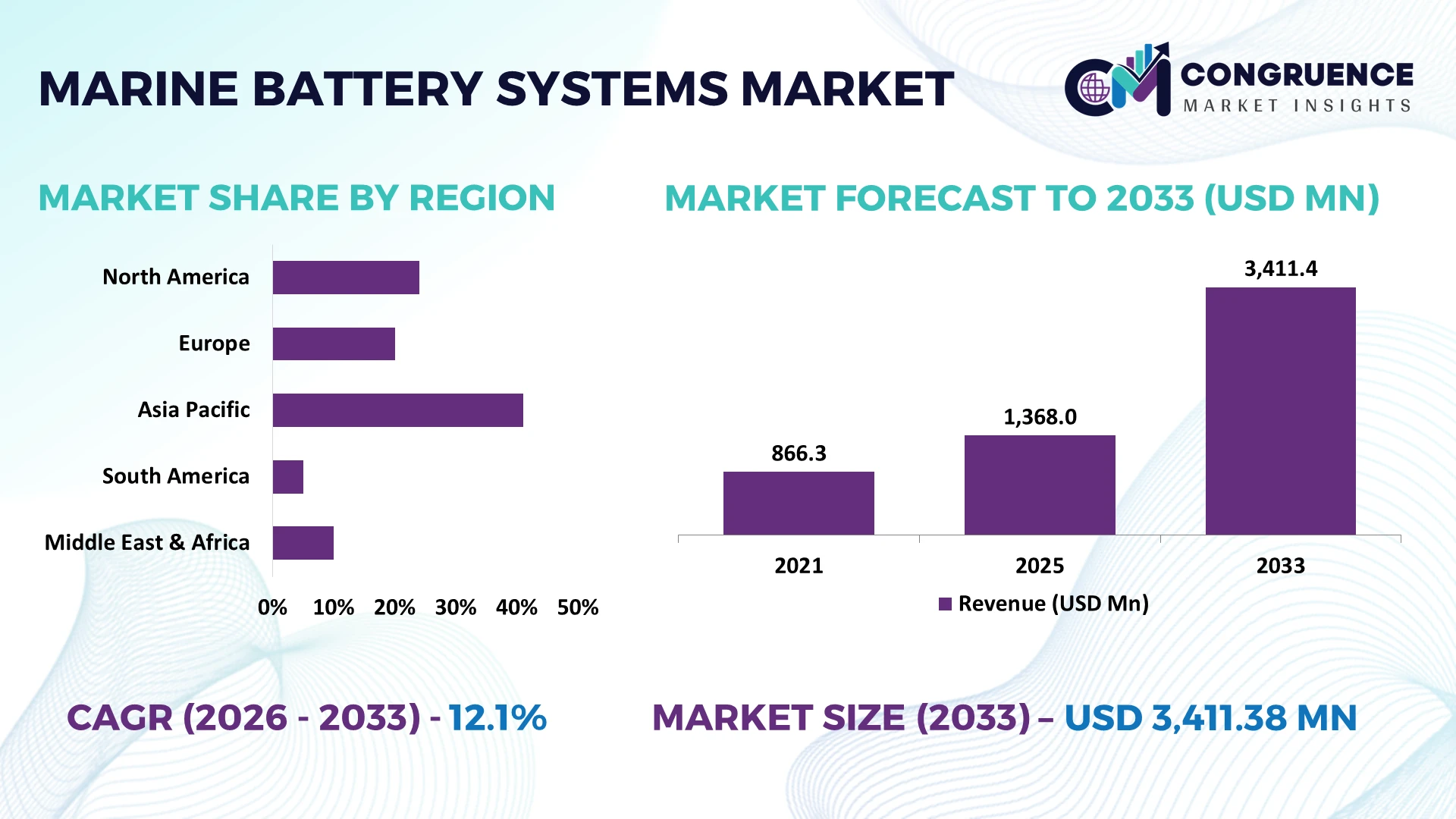
The Global Marine Battery Systems Market was valued at USD 1368 Million in 2025 and is anticipated to reach a value of USD 3411.38 Million by 2033 expanding at a CAGR of 12.1% between 2026 and 2033. Growth is driven by battery-electric ferry procurement, hybrid propulsion retrofits, lithium iron phosphate battery adoption, and maritime emissions compliance requirements.
Norway leads operational marine battery deployment, supported by its extensive electric ferry network and established maritime energy storage ecosystem. Nearly 90 electric ferries were operating nationally in early 2025, representing approximately one-third of an estimated 270 electric ferries worldwide. In comparison, China accounted for approximately 80% of global battery cell production in 2024, providing a substantial manufacturing advantage. Norway's maritime sector is integrating high-capacity lithium-ion batteries, automated charging, and intelligent energy management across passenger transport and offshore support operations.
Strategically, marine battery manufacturers should prioritize certified modular storage systems, long-term shipyard partnerships, and battery lifecycle services to strengthen competitive positioning.
Market Size & Growth: Valued at USD 1368 Million in 2025, projected to USD 3411.38 Million by 2033 at 12.1% CAGR, driven by IMO Net-Zero Framework and port electrification mandates.
Top Growth Drivers: IMO Net-Zero Framework entering force 2027 covering 85% of shipping emissions, battery cost reduction, and port shore-power infrastructure expansion .
Short-Term Forecast: By 2027, LTO battery systems achieving over 20,000 charge cycles and 25-minute fast charging replace earlier-generation NMC installations as retrofit economics prove viable .
Emerging Technologies: Cobalt-free LFP cells with 15-year design lifetime, 1C charge/discharge rates for energy and power modes, and fourth-generation battery management systems with industry-leading cybersecurity standards .
Regional Leaders: Europe at USD 0.85 billion and 40.40% share in 2026, North America at USD 0.46 billion and 22.10% share, and Asia-Pacific at USD 0.53 billion with China leading supply expansion .
Consumer/End-User Trends: Commercial vessels command 62.87% of application share; greater than 250 Ah capacity segment holds 43.94% share driven by high-capacity commercial vessel demand .
Pilot/Case Example: Echandia secured India’s first fully electric tugboat battery system (4.4 MWh, 15-year lifetime) for Deendayal Port under India’s Green Tug Transition Program .
Competitive Landscape: Corvus Energy leads with nearly 40% share and 1,300+ projects; EST-Floattech, Akasol, Echandia, and Leclanché compete on marine-qualified systems .
Regulatory & ESG Impact: IMO Net-Zero Framework approved April 2025 combines fuel standard and GHG pricing mechanisms entering force 2027 for vessels over 5,000 GT .
Investment & Funding: BYD-Corvus strategic MoU (December 2025) combines LFP manufacturing scale with marine integration; Echandia secured multiple ferry and icebreaker orders across Denmark, Canada, and India .
Innovation & Future Outlook: Solid-state battery architectures, fuel cell hybrids, and modular retrofit platforms expand operational envelopes for long-range coastal shipping and offshore support fleets .
Marine battery systems are becoming essential components of electric ferries, hybrid offshore support vessels, cruise ships, and short-sea cargo fleets. Demand increasingly centers on lithium iron phosphate batteries, modular energy storage, and intelligent battery management systems that improve charging control and onboard power reliability. Advanced installations are expanding into larger vessels, with Aurora Botnia's upgraded storage capacity increasing approximately 473% over its previous configuration. Meanwhile, China's concentrated battery manufacturing ecosystem is influencing procurement strategies and component sourcing. These developments are shifting competitive priorities toward marine certification, integrated propulsion compatibility, and long-term battery performance management.
Marine battery systems are becoming strategically important as shipowners shift investment from conventional engine capacity toward integrated electrical energy storage. FuelEU Maritime introduced a 2% greenhouse-gas intensity reduction requirement in 2025, increasing to 6% by 2030, reinforcing the commercial importance of battery-assisted propulsion. Shipbuilders are consequently restructuring procurement around marine-certified lithium-ion modules, battery management systems, and high-voltage electrical integration. This transition favors suppliers capable of delivering complete energy storage solutions rather than standalone battery components.
Lithium-ion battery systems typically achieve 90–95% round-trip efficiency, compared with approximately 70–85% for conventional lead-acid batteries, improving onboard energy utilization. Norway leads commercial electric ferry deployment, while China dominates battery cell manufacturing and supports large-scale marine battery production. These contrasting strengths are influencing technology partnerships, component sourcing, and vessel electrification strategies.
Between 2026 and 2028, modular battery architectures, predictive thermal management, and automated charging will shape fleet investment priorities. Wasaline's Aurora Botnia battery upgrade expands installed capacity from 2.2 MWh to 12.6 MWh, demonstrating demand for larger onboard storage installations. Corvus Energy, ABB, and Wärtsilä are strengthening system integration capabilities to support complex vessel requirements. Competitive advantage increasingly depends on certified performance, charging compatibility, and long-term battery reliability.
Maritime emissions regulations are accelerating battery integration across ferries, offshore support vessels, and commercial shipping fleets. FuelEU Maritime requires a 2% reduction in greenhouse-gas intensity during 2025, increasing to 6% by 2030 and 14.5% by 2035. These progressively stricter requirements are influencing vessel procurement and hybrid propulsion investment, particularly where operators can combine battery charging with lower-emission electricity. In Norway, electric ferry procurement has established a commercial pathway for high-capacity marine energy storage. Corvus Energy and other battery manufacturers are expanding modular lithium-ion systems, while propulsion integrators develop compatible power conversion equipment. The strategic advantage lies in delivering certified battery packages that reduce onboard generator dependence without compromising operational flexibility.
Marine battery manufacturers face procurement exposure from concentrated cell production, specialized safety certification, and limited domestic component availability. China accounted for approximately 80% of global battery cell manufacturing in 2024, creating substantial geographic supply dependence. Lithium iron phosphate batteries represented nearly 50% of the global electric vehicle battery market, increasing competition for standardized cell formats. Although average lithium-ion battery pack prices declined approximately 20% during 2024, marine installations require additional fire suppression, thermal containment, and classification-approved enclosures. These requirements increase integration expenditure and limit cost advantages for smaller vessel operators. Manufacturers are responding through multiyear supply agreements, localized module assembly, and diversified cell sourcing to improve procurement resilience and project profitability.
Advanced battery management technologies are creating opportunities for energy storage upgrades across existing commercial vessels. Lithium-ion systems achieve approximately 90–95% round-trip efficiency, compared with 70–85% for conventional lead-acid batteries, supporting more effective onboard energy recovery and storage. Meanwhile, lithium iron phosphate chemistry accounted for nearly 50% of electric vehicle battery demand in 2024, indicating manufacturing scale that marine suppliers can leverage. In Finland, high-capacity battery retrofits demonstrate growing opportunities for modular energy storage integration without complete propulsion replacement. Between 2026 and 2028, predictive diagnostics, automated state-of-health monitoring, and adaptive charging controls will strengthen battery lifecycle management. Suppliers are expanding software development and shipyard partnerships to capture retrofit contracts and recurring technical service opportunities.
Long-term marine battery deployment requires consistent performance under vibration, saltwater exposure, variable charging cycles, and demanding vessel operating conditions. Lithium-ion systems typically operate at 90–95% round-trip efficiency, but sustained performance depends on thermal regulation and battery management accuracy. Marine battery installations frequently use controlled charging windows around 20–80% state of charge, reducing usable energy availability relative to nominal capacity. European shore-power requirements targeting 90% of qualifying port calls by 2030 add operational complexity through vessel-grid synchronization and high-voltage interface management. Shipbuilders must coordinate battery certification, electrical protection, cybersecurity, and crew training throughout vessel lifecycles. Manufacturers are strengthening digital diagnostics, redundancy engineering, and maintenance partnerships to improve system availability and protect long-term operational competitiveness.
• High-Capacity Battery Installations Gain Momentum: Marine operators are installing larger battery systems to extend electric sailing distances and improve propulsion flexibility. Wasaline's Aurora Botnia upgrade increases battery capacity from 2.2 MWh to 12.6 MWh, representing approximately 473% additional storage. Marine battery manufacturers are redesigning modular battery racks, thermal management systems, and high-voltage connections. Larger installations are also changing vessel weight distribution and equipment-room planning, making early collaboration between shipyards and battery integrators essential for controlling retrofit costs.
• Battery Vessel Orderbooks Strengthen Production Planning: DNV reported 1,072 battery-equipped vessels operating worldwide in 2025, with another 440 vessels on order. The orderbook represented approximately 41% of the operating fleet, demonstrating a substantial equipment delivery pipeline. Battery suppliers are expanding production scheduling, marine certification capabilities, and installation partnerships. Shipbuilders increasingly favor standardized battery modules that reduce engineering customization and support predictable delivery timelines across multiple vessel classes.
• Battery Chemistry Diversification Reshapes Procurement: Lithium iron phosphate batteries accounted for nearly 50% of global electric vehicle battery demand in 2024, reflecting increasing manufacturing maturity. Average lithium-ion battery pack prices declined approximately 20% during the same year. Marine system manufacturers are evaluating chemistry-specific thermal controls, battery enclosures, and charging strategies to improve procurement flexibility. This shift strengthens the commercial importance of battery system engineering rather than cell sourcing alone.
• Battery Lifecycle Services Become Competitive Differentiators: Marine battery installations increasingly require continuous state-of-health monitoring, predictive maintenance, and digital performance reporting. Lithium-ion batteries commonly deliver 90–95% round-trip efficiency, while controlled operating windows of 20–80% state of charge support battery preservation in selected applications. Suppliers are expanding remote diagnostics and service agreements to reduce unplanned downtime. The shift creates recurring technical service opportunities while improving fleet operators' ability to forecast replacement schedules.
Lithium-Ion Batteries represent the leading technology segment, supported by high energy density, established manufacturing scale, and compatibility with electric and hybrid propulsion systems. Their round-trip efficiency typically reaches 90–95%, compared with approximately 70–85% for Lead-Acid Batteries. This performance difference supports lower energy losses and improved battery utilization in commercial vessels. Lithium-ion systems also offer substantial weight advantages, making them suitable for passenger ferries and offshore support vessels. Corvus Energy, Saft, and Leclanché are strengthening marine-certified lithium-ion portfolios through modular battery architectures and advanced thermal management systems.
Sodium-Ion Batteries represent an emerging technology with potential for accelerated adoption as manufacturers pursue alternative material supply chains. Nickel-Cadmium Batteries retain relevance in specialized applications requiring established durability and operational reliability. Fuel Cell Hybrid Systems are developing for vessels requiring extended endurance beyond conventional battery-only operating profiles. In 2024, lithium iron phosphate batteries represented nearly 50% of global electric vehicle battery demand, strengthening the manufacturing ecosystem available to marine battery suppliers. Competitive investment is increasingly focused on system certification, battery management software, and application-specific integration.
Hybrid Propulsion represents a major established application of marine battery systems, particularly in offshore support vessels, commercial shipping, and passenger transport. Battery-assisted propulsion enables operators to reduce generator operation during variable-load conditions while maintaining conventional engine backup. Lithium-ion battery systems typically achieve 90–95% round-trip efficiency, supporting effective energy recovery and onboard power management. Electric Propulsion is increasingly important for scheduled ferry operations where charging infrastructure supports predictable routes. Manufacturers are developing integrated battery modules, propulsion controls, and automated energy management platforms to accommodate different vessel duty cycles.
Peak Shaving and Energy Storage applications are gaining importance as vessel operators seek to manage short-duration electrical loads without operating additional generators. Auxiliary Power supports onboard equipment and accommodation loads, while Emergency Backup Power remains essential for operational resilience. Shore Power Storage is developing alongside port electrical infrastructure modernization, particularly where grid capacity limits direct charging availability. European regulations require shore-power coverage for at least 90% of qualifying port calls by 2030, creating demand for compatible electrical storage solutions. Suppliers are expanding integrated battery and power conversion platforms to support these applications.
Passenger Ferries represent a leading end-user category, supported by fixed operating routes, predictable charging intervals, and established electric propulsion infrastructure. Norway operated nearly 90 electric ferries in early 2025, accounting for approximately one-third of an estimated 270 electric ferries worldwide. Commercial Shipping represents another important buyer group, particularly for short-sea cargo vessels and hybrid propulsion installations. Offshore Support Vessels utilize batteries for dynamic positioning support and variable-load management, strengthening demand for high-power energy storage systems. Battery manufacturers are developing modular configurations tailored to ferry schedules, commercial vessel operating requirements, and offshore duty cycles.
Port Operators are emerging as important customers for battery storage supporting charging infrastructure and electrical load balancing. Recreational Boats are adopting compact lithium-ion systems, while Naval and Defense buyers prioritize reliability, electrical redundancy, and system resilience. Fishing Vessels represent a developing market for hybrid auxiliary power and propulsion support. Global lithium-ion battery pack prices declined approximately 20% in 2024, improving component procurement conditions for smaller installations. Suppliers are expanding application-specific battery platforms, distributor networks, and service partnerships to address increasingly diverse customer requirements.
Europe accounted for the largest market share at approximately 38% in 2025 however, Asia-Pacific is expected to register the fastest growth, expanding at a CAGR of approximately 14.2% between 2026 and 2033.
Hybrid Ferry Modernization Strengthens Marine Energy Storage Deployment
North America's marine battery systems market is supported by hybrid-electric ferry procurement, offshore vessel modernization, and growing investment in maritime energy storage infrastructure. The United States and Canada are expanding battery integration across passenger transportation, harbor operations, and specialized commercial fleets. Washington State's ferry electrification program targets 16 hybrid-electric vessels and 16 terminal charging installations, establishing substantial demand for marine-certified lithium-ion batteries and integrated power management systems. Canadian operators are advancing electric ferry adoption through provincial transportation networks, with British Columbia investing in battery-powered passenger vessels. Marine technology suppliers are strengthening partnerships with shipyards and electrical engineering contractors to support modular battery installations, thermal management, and high-voltage integration. Regional procurement increasingly emphasizes lifecycle reliability, standardized battery architecture, and domestic technical support capabilities, strengthening opportunities for specialized marine energy storage manufacturers.
United States Market Outlook: The United States benefits from established maritime engineering capabilities and increasing investment in low-emission commercial vessels. Washington State Ferries operates the largest ferry system in the country, serving approximately 19 million passengers annually in recent operating years. Domestic shipyards are developing battery integration capabilities, while California's commercial harbor craft regulations encourage hybrid propulsion upgrades and marine energy storage adoption.
Established Electric Ferry Networks Drive Battery Technology Leadership
Europe represents the most established regional market for marine battery systems, supported by extensive electric ferry operations, advanced battery engineering, and maritime emissions regulations. Norway, Finland, Sweden, and Denmark are major centers for battery-electric vessel deployment and marine energy storage innovation. Norway operated nearly 90 electric ferries in early 2025, demonstrating commercial-scale adoption of high-capacity lithium-ion battery systems. European manufacturers, including Corvus Energy, Leclanché, and Saft, are developing marine-certified storage solutions with integrated thermal management, advanced battery monitoring, and modular installation capabilities. FuelEU Maritime introduced a 2% greenhouse-gas intensity reduction requirement in 2025, influencing battery integration decisions across commercial shipping. Regional shipyards are expanding electrical retrofit capabilities, while technology suppliers strengthen partnerships with propulsion integrators and classification organizations. These developments reinforce Europe's competitive advantage in certified marine battery engineering and lifecycle services.
Norway Market Outlook: Norway benefits from established battery-electric ferry infrastructure and a mature maritime technology ecosystem. Corvus Energy operates battery manufacturing and engineering facilities in Bergen, supporting domestic and international vessel electrification projects. The country's hydropower-dominated electricity system, supplying approximately 90% of national electricity generation in typical years, strengthens the operational emissions advantages of marine battery charging.
Battery Manufacturing Scale Accelerates Maritime Electrification Integration
Asia-Pacific combines extensive battery cell manufacturing with large-scale shipbuilding and expanding electric vessel deployment. China, South Korea, and Japan are important industrial centers for lithium-ion batteries, propulsion equipment, and advanced marine electrical systems. China accounted for approximately 80% of global battery cell production in 2024, providing a substantial manufacturing advantage for marine energy storage procurement. South Korean shipbuilders are integrating battery-assisted propulsion into advanced commercial vessels, while Japanese manufacturers emphasize high-reliability electrical systems and energy management technologies. The region's manufacturing ecosystem supports lithium iron phosphate battery production, power conversion equipment, and modular energy storage assembly. Shipyards are strengthening relationships with battery suppliers to reduce procurement complexity and improve electrical integration efficiency. China's expanding electric inland-waterway transport sector is creating additional demand for high-capacity battery installations and standardized charging-compatible vessel designs.
China Market Outlook: China benefits from vertically integrated battery manufacturing, extensive shipbuilding infrastructure, and expanding domestic electric vessel programs. Chinese shipyards accounted for approximately 55.7% of global shipbuilding completions by deadweight tonnage in 2024. The Yangtze River transportation corridor is supporting battery-powered inland cargo vessels, while domestic manufacturers develop modular lithium iron phosphate systems and high-voltage marine energy storage equipment.
Port Electrification Creates Demand for Modular Battery Systems
South America's marine battery systems market is developing through harbor vessel modernization, coastal shipping upgrades, and renewable energy integration at maritime terminals. Brazil and Chile represent important adoption centers, supported by commercial shipping operations, offshore energy activity, and specialized passenger transportation. Brazil's coastline extends approximately 7,400 kilometers, creating opportunities for battery-assisted coastal vessels, harbor craft, and marine auxiliary power systems. Chile's maritime operators are evaluating electric propulsion and hybrid energy storage for short-distance transport, particularly in southern coastal communities. Regional shipyards are strengthening electrical engineering capabilities to support lithium-ion battery integration, battery management systems, and modular energy storage installations. However, limited marine-certified battery manufacturing and uneven charging infrastructure constrain deployment scale. Suppliers are responding through imported battery modules, localized system integration partnerships, and application-specific engineering services to improve project economics.
Brazil Market Outlook: Brazil's offshore oil and gas sector provides an established industrial base for marine battery adoption. Petrobras operates across deepwater production areas requiring specialized offshore support vessels and dependable onboard electrical systems. Battery-assisted propulsion and peak-shaving applications can reduce generator loading during dynamic positioning. Domestic maritime contractors are strengthening electrical retrofit capabilities and evaluating partnerships with international battery suppliers.
Smart Maritime Infrastructure Encourages Battery Storage Integration
The Middle East & Africa marine battery systems market is influenced by port modernization, offshore vessel operations, and investment in energy-efficient maritime transportation. The United Arab Emirates, Saudi Arabia, and South Africa represent important industrial and logistics centers for marine electrical infrastructure. Saudi Arabia's maritime development strategy includes the King Salman International Complex for Maritime Industries and Services, designed to strengthen domestic shipbuilding and maintenance capabilities. Dubai's Roads and Transport Authority has introduced a 20-passenger electric abra, demonstrating battery propulsion integration in urban water transportation. Regional demand is concentrated in harbor craft, specialized passenger vessels, and auxiliary energy storage applications. Marine equipment suppliers are developing partnerships with port authorities, shipyards, and electrical contractors to improve battery installation capabilities. Local technical servicing and high-temperature battery cooling remain important procurement considerations for maritime operators.
United Arab Emirates Market Outlook: The UAE benefits from established maritime logistics infrastructure, advanced port operations, and investment in intelligent transportation systems. Dubai's electric passenger vessel initiatives support demand for compact lithium-ion battery systems and automated energy management. Jebel Ali Port's industrial ecosystem provides opportunities for battery-assisted harbor vessels, electrical auxiliary systems, and specialized marine energy storage integration.
Corvus Energy, Echandia, Leclanché, EST-Floattech, and Akasol anchor the marine battery systems market, with the top five players commanding approximately 55–60% of global revenue through marine-qualified certification depth and vessel-type integration experience. Competition bifurcates between established marine battery specialists competing on class certification breadth and lifecycle service guarantees, and industrial battery giants including BYD, CATL, and EVE Battery entering through manufacturing scale partnerships. The basis of competition centers on class society approvals and 15-year design lifetime validation rather than cell-level pricing: marine-qualified systems command substantial premiums over industrial equivalents due to DNV and Lloyd's Register certification requirements. Players compete through shipyard co-development agreements, cell manufacturing partnerships—exemplified by BYD-Corvus MoU—and retrofit capability for aging tonnage. The competitive shift is toward cobalt-free LFP platforms with modular architectures enabling component swapping. Entry barriers center on marine certification timelines exceeding 12 months and shipyard qualification relationships.
Corvus Energy
Echandia
Leclanché
EST-Floattech
Akasol
BYD Energy Storage
CATL
EVE Battery
Siemens Energy
Wärtsilä
ABB
Nidec Industrial Solutions
Spear Power Systems
Toshiba Infrastructure Systems
Current marine battery systems integrate lithium-ion cells, liquid cooling, and advanced battery management software to support electric propulsion and hybrid vessel operations. Lithium-ion technology delivers approximately 90–95% round-trip efficiency, compared with 70–85% for conventional lead-acid batteries, providing up to 25 percentage points higher energy efficiency. Marine-certified systems incorporate thermal monitoring, redundant protection circuits, and automated power distribution. More than 1,000 battery-equipped vessels operate globally, demonstrating commercial deployment. Corvus Energy and Saft benefit from growing demand for modular battery installations, particularly among ferry operators requiring reliable charging performance and reduced generator runtime.
Emerging technologies include lithium iron phosphate chemistry, silicon carbide converters, and predictive battery diagnostics. Global lithium-ion battery pack prices declined 20% during 2024, improving component procurement economics. Silicon carbide power electronics reduce switching losses, while intelligent thermal controls improve battery operating consistency. High-capacity installations demonstrate technological progress: Aurora Botnia's storage expansion from 2.2 MWh to 12.6 MWh increases installed capacity approximately 473%. Suppliers are strengthening software integration, battery enclosure engineering, and charging compatibility to differentiate marine energy storage products.
Between 2026 and 2028, solid-state battery research, automated charging optimization, and digital lifecycle monitoring will influence next-generation marine battery procurement. Manufacturers prioritizing certified modular platforms will strengthen competitiveness through improved integration flexibility and maintenance predictability.
December 2025: BYD Energy Storage signed a strategic memorandum of understanding with Corvus Energy to develop advanced marine battery solutions, combining BYD’s LFP manufacturing scale with Corvus’s maritime integration expertise. Corvus serves as ESS System Partner, leveraging 1,300+ projects and more than 50% of the world’s zero-emission vessels. Source: corvusenergy.com
June 2025: Leclanché commenced serial production of the Navius MRS-3 marine rack system at its Swiss facility, achieving DNV, Lloyd’s Register, and Bureau Veritas certifications. The liquid-cooled system delivers 13% higher energy capacity than its predecessor, with 8.7 kWh per module and modular scalability across ferry and offshore vessel types. Source: leclanche.com
November 2025: Echandia secured an order to supply a 3.2 MWh LTO battery system for E/F Ellen in Denmark, replacing the vessel’s original 4.3 MWh NMC system. The new system delivers over 20,000 charge cycles and 25-minute fast charging, proving retrofit economics for upgrading first-generation marine batteries. Source: maritimt.com
October 2025: Corvus Energy secured a $60 million growth capital injection from Morgan Stanley Investment Management, Just Climate, and J. Lauritzen. The funding accelerates production capacity expansion across Norway, Canada, and US manufacturing sites, with 1,300 MWh of installed capacity and over one million operating hours across delivered projects. Source: corvusenergy.com
The Marine Battery Systems Market Report examines five battery technology categories: Lithium-Ion Batteries, Lead-Acid Batteries, Nickel-Cadmium Batteries, Sodium-Ion Batteries, and Fuel Cell Hybrid Systems. Application analysis covers seven areas, including electric propulsion, hybrid propulsion, auxiliary power, emergency backup, energy storage, peak shaving, and shore power storage. Seven end-user categories are evaluated, spanning commercial shipping, passenger ferries, recreational boats, offshore support vessels, naval and defense operations, fishing vessels, and port operators. Geographic coverage includes North America, Europe, Asia-Pacific, South America, and the Middle East & Africa.
The report assesses technology adoption, manufacturing capabilities, regulatory requirements, and competitive positioning between 2026 and 2033. Quantitative indicators include lithium-ion round-trip efficiency of 90–95% and commercial marine installations exceeding 40 MWh. Strategic analysis supports procurement planning, technology investment, regional expansion, supplier partnerships, and emerging battery chemistry commercialization.
| Report Attribute/Metric | Report Details |
|---|---|
Market Revenue in 2025 | USD 1368 Million |
Market Revenue in 2033 | USD 3411.38 Million |
CAGR (2026 - 2033) | 12.1% |
Base Year | 2025 |
Forecast Period | 2026 - 2033 |
Historic Period | 2021 - 2025 |
Segments Covered | By Type
By Application
By End-User
|
Key Report Deliverable | Revenue Forecast, Growth Trends, Market Dynamics, Segmental Overview, Regional and Country-wise Analysis, Competition Landscape |
Region Covered | North America, Europe, Asia-Pacific, South America, Middle East, Africa |
Key Players Analyzed | Corvus Energy, Echandia, Leclanché, EST-Floattech, Akasol, BYD Energy Storage, CATL, EVE Battery, Siemens Energy, Wärtsilä, ABB, Nidec Industrial Solutions, Spear Power Systems, Toshiba Infrastructure Systems |
Customization & Pricing | Available on Request (10% Customization is Free) |




