
Reports
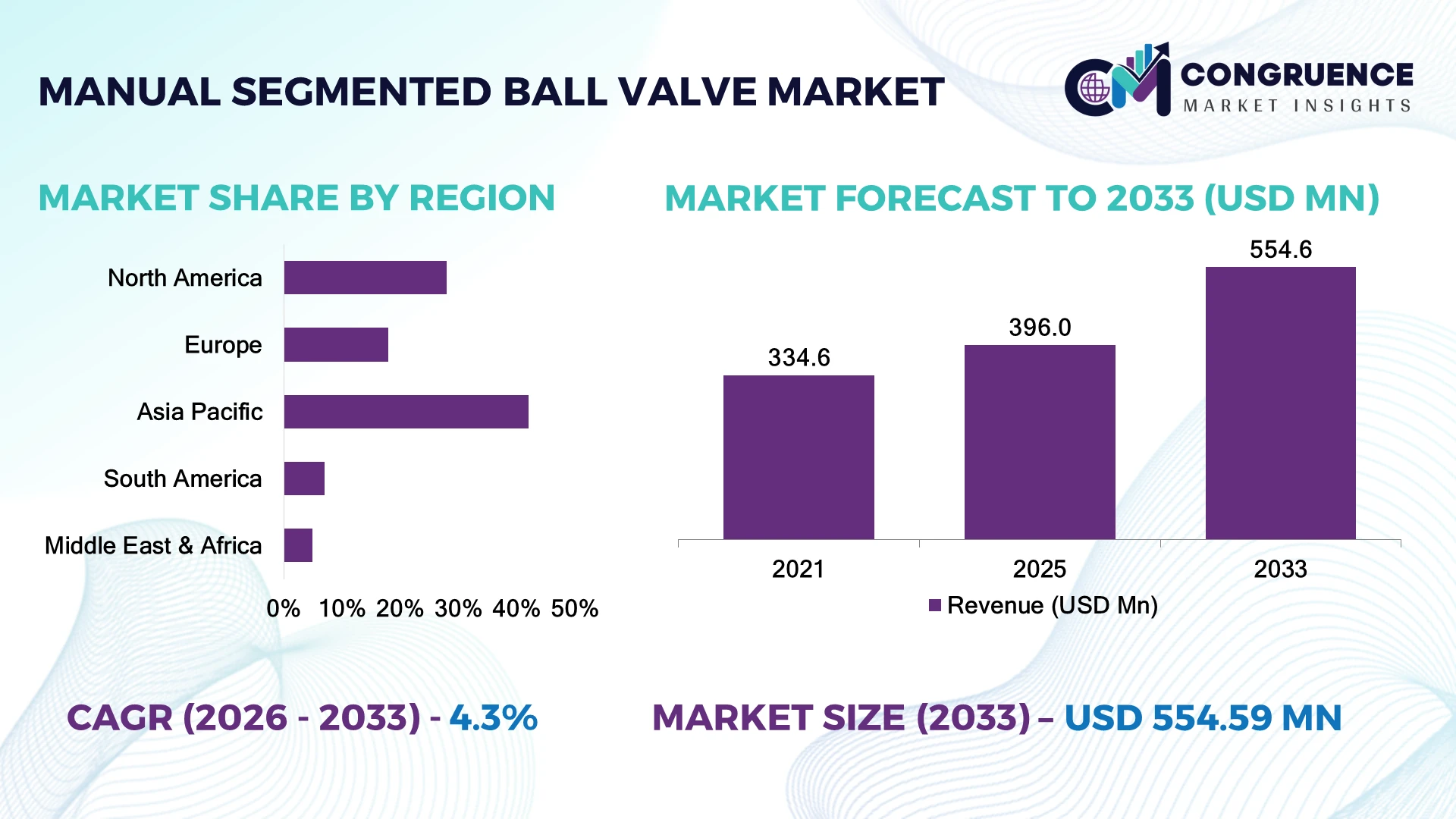
The Global Manual Segmented Ball Valve Market was valued at USD 396.0 Million in 2025 and is anticipated to reach a value of USD 554.6 Million by 2033 expanding at a CAGR of 4.3% between 2026 and 2033. Growth is driven by increasing deployment of precision flow-control systems in oil & gas, chemical processing, and water infrastructure projects requiring high-cycle reliability and lower maintenance downtime.
China dominates the market with approximately 32% share, supported by large-scale industrial automation investments, petrochemical expansion, and water treatment upgrades under infrastructure modernization initiatives. The country operates over 1,000 major chemical and refining facilities, while the United States accounts for nearly 24% share with advanced valve adoption across energy and processing industries. China’s manufacturing capacity exceeds U.S. production volumes by over 25%, strengthening regional supply-chain influence.
Strategic investments in smart industrial control systems and localized valve production will define competitive positioning.
Market Size & Growth: USD 396.0 Million (2025) to USD 554.6 Million (2033) at 4.3% CAGR, driven by industrial automation and precision flow management.
Top Growth Drivers: Chemical processing adoption 28%, water infrastructure upgrades 22%, energy modernization projects 18%.
Short-Term Forecast: By 2028, automated monitoring integration improves operational efficiency by 15% and reduces maintenance cycles by 12%.
Emerging Technologies: AI-based predictive maintenance, smart actuators, and advanced corrosion-resistant alloys are reshaping valve performance.
Regional Leaders: Asia-Pacific reaches USD 215 Million with industrial expansion; North America USD 145 Million with digital controls; Europe USD 110 Million with sustainability-driven upgrades.
Consumer/End-User Trends: Over 35% of industrial users prioritize low-maintenance segmented valves for process optimization.
Pilot/Case Example: 2024 refinery modernization projects using advanced segmented valves achieved 18% reduction in flow-control downtime.
Competitive Landscape: Leading manufacturers hold approximately 35% combined share, including Emerson Electric, Flowserve Corporation, Metso, SAMSON AG, and IMI plc.
Regulatory & ESG Impact: Energy-efficiency regulations reduce industrial process losses by up to 10%, increasing demand for optimized flow systems.
Investment & Funding: Over USD 2 billion industrial valve and automation investments focus on smart manufacturing and supply-chain localization.
Innovation & Future Outlook: Next-generation valves integrate sensors, remote diagnostics, and digital twins to strengthen industrial reliability.
Manual segmented ball valves are gaining importance across chemical plants, oil terminals, wastewater facilities, and process industries due to improved throttling accuracy and compact design. Recent product innovations focus on low-friction sealing, advanced alloys, and hybrid control integration, with more than 30% of new industrial valve installations incorporating digital monitoring capabilities. Supply-chain restructuring following global manufacturing shifts is encouraging localized production hubs in India and Southeast Asia. These developments are creating a stronger foundation for strategic industrial investments.
The Manual Segmented Ball Valve Market is becoming strategically important as industries prioritize process efficiency, equipment reliability, and modernization of aging infrastructure. Energy transition projects, refinery upgrades, and stricter operational standards are accelerating adoption of advanced flow-control solutions. Global supply-chain restructuring has encouraged manufacturers to diversify production beyond traditional hubs, with India, Vietnam, and Mexico expanding industrial component capabilities.
Modern segmented ball valves provide measurable operational advantages compared with conventional rotary valves, delivering up to 20% better throttling accuracy and reducing maintenance requirements by nearly 15% through improved sealing technologies. North America emphasizes digital integration and replacement of aging assets, while Asia-Pacific focuses on large-scale industrial deployment and manufacturing expansion.
In practical applications, chemical processing facilities in China and the Middle East are adopting corrosion-resistant segmented valves to improve uptime in demanding environments. Companies are increasing investments in R&D partnerships, localized manufacturing, and smart valve platforms to strengthen competitiveness. Over the next 2–3 years, suppliers with advanced materials, reliable supply networks, and integrated monitoring capabilities will gain stronger market positioning and long-term industrial relevance.
Growing industrial automation is accelerating demand for manual segmented ball valves that provide accurate throttling and reliable control in complex processes. Chemical and energy facilities account for more than 45% of advanced valve deployments, while predictive maintenance adoption has increased equipment monitoring efficiency by approximately 20%. The expansion of petrochemical projects in China, India, and Saudi Arabia is creating stronger demand for durable flow-control systems. Companies are responding through improved alloy development, regional manufacturing expansion, and partnerships with automation providers. A key strategic shift is the integration of precision valve designs into digitally managed industrial environments, improving operational consistency and reducing unplanned shutdowns.
Material volatility and dependency on specialized alloys remain key limitations for segmented ball valve manufacturers. Stainless steel and corrosion-resistant materials represent nearly 40% of valve production costs, while supply disruptions have increased procurement cycles by approximately 15% in some industrial markets. European manufacturers face additional pressure from energy-cost fluctuations and stricter compliance requirements. These constraints affect production margins and project delivery schedules. Companies are reducing exposure through supplier diversification, regional sourcing strategies, and long-term material contracts. A notable operational challenge is balancing advanced material performance with cost competitiveness in price-sensitive industrial sectors.
Digital transformation creates new opportunities through sensor-enabled valve monitoring, remote diagnostics, and predictive maintenance solutions. Smart industrial equipment adoption is increasing by nearly 25% annually across major manufacturing hubs, creating demand for connected flow-control products. India’s expanding chemical and water treatment infrastructure presents significant untapped opportunities, supported by industrial modernization programs. Manufacturers are investing in IoT-enabled valve platforms, software partnerships, and localized production facilities. A unique opportunity lies in combining manual segmented valve reliability with digital monitoring capabilities, allowing operators to achieve higher efficiency without complete system replacement.
Long-term adoption faces challenges related to system integration, technical expertise, and evolving industrial standards. Approximately 30% of process industries report difficulties in upgrading legacy control systems with modern valve technologies, while skilled maintenance workforce shortages affect deployment efficiency across emerging markets. Facilities operating older infrastructure require customized engineering solutions, increasing installation complexity and project timelines. Companies must address these barriers through workforce training, engineering partnerships, and modular valve designs. The strategic challenge is creating scalable solutions that maintain reliability across diverse industrial environments while supporting future digitalization requirements.
Smart Valve Monitoring Expansion Industrial users are increasingly adopting sensor-enabled segmented ball valves, with digital monitoring penetration reaching nearly 30% in new process installations and reducing inspection cycles by 15%. Chemical plants in Germany and Japan are integrating remote diagnostics to improve workflow visibility. Companies are responding through partnerships with automation providers and developing connected valve platforms for predictive maintenance.
Advanced Material Adoption Rising Manufacturers are shifting toward corrosion-resistant alloys and improved sealing technologies, with advanced materials improving operational lifespan by approximately 20% and reducing replacement frequency by 12%. Supply-chain pressure on stainless steel availability has accelerated localized sourcing strategies in India and Mexico. Companies are restructuring procurement networks and investing in material innovation to maintain cost efficiency.
Low-Maintenance Design Preference Industrial operators are prioritizing compact segmented valve designs that lower maintenance requirements by nearly 18% and improve process reliability across high-cycle applications. Refineries and wastewater facilities are replacing older control components with optimized valve configurations. Companies are expanding product portfolios with durable designs focused on faster installation, reduced downtime, and simplified servicing.
Digital Industrial Integration Growth Process industries are increasing integration between valve systems and plant control networks, with automation adoption improving operational efficiency by around 25% in modern facilities. Regulatory pressure for improved energy management and operational transparency is accelerating adoption in the European Union and North America. Companies are investing in software compatibility, modular systems, and integrated control solutions to strengthen industrial performance.
The standard manual segmented ball valve segment leads the market with approximately 55% share due to its broad deployment across chemical processing, oil & gas, and water management facilities. Its dominance is supported by simple operation, lower maintenance requirements, and compatibility with existing industrial pipelines. High-performance variants account for nearly 30% adoption in demanding applications requiring improved sealing and pressure handling capabilities. Companies are focusing on enhanced materials and precision manufacturing to strengthen product durability. The advanced segmented valve category is the fastest-growing type, expanding as industries prioritize improved flow control and longer service intervals. Adoption is increasing by nearly 15% annually in specialized processing environments, while traditional valve designs remain important for cost-sensitive applications. Manufacturers are increasing investment in corrosion-resistant coatings, customized configurations, and industrial partnerships to capture emerging demand.
Oil & gas applications represent the leading segment with approximately 38% market share, driven by extensive pipeline networks, refining operations, and flow-control requirements. Chemical processing follows with nearly 27% adoption due to increasing demand for precise handling of aggressive fluids. Water treatment is emerging as the fastest-growing application, supported by infrastructure modernization programs and rising investment in efficient water management systems. Industrial users are increasingly deploying segmented ball valves in automated process environments, with nearly 20% improvement in operational control reported through upgraded valve systems. Pharmaceutical and food processing applications are also expanding due to hygiene-focused designs and stricter process standards. Companies are adapting through application-specific engineering, local service networks, and integrated maintenance solutions.
Oil & gas companies remain the largest end-user group with approximately 40% share due to large-scale pipeline, refinery, and processing requirements. Chemical manufacturers represent nearly 25% of demand, supported by expansion of specialty chemical production and increased process complexity. Water utilities are the fastest-growing end-user segment as infrastructure upgrades and sustainability programs accelerate equipment replacement. Industrial facilities adopting modern segmented ball valves report maintenance efficiency improvements of nearly 15% and reduced operational interruptions through better flow regulation. Small and medium manufacturing enterprises are gradually increasing adoption as compact valve solutions become more accessible. Companies are targeting these segments through customized product offerings, distributor partnerships, and localized technical support.
Asia-Pacific accounted for the largest market share at 42% in 2025 however, Middle East & Africa is expected to register the fastest growth, expanding at a CAGR of 5.1% between 2026 and 2033.
North America holds approximately 28% of the global market, supported by advanced refining, chemical processing, and water infrastructure networks across the United States and Canada. The region has strong adoption of precision flow-control systems, with more than 35% of industrial facilities prioritizing equipment upgrades to improve operational reliability. Increasing investments in shale processing, LNG infrastructure, and wastewater modernization are supporting deployment growth. U.S. manufacturers maintain a strong production position through advanced machining capabilities and automation integration. Companies are expanding smart valve compatibility, service networks, and industrial partnerships to improve lifecycle performance and reduce maintenance requirements.
United States Market Outlook: The United States remains the dominant North American market due to its extensive energy and industrial processing base. More than 500 major refining and petrochemical facilities utilize advanced flow-control equipment, creating consistent demand for durable segmented valve solutions. Investments in infrastructure renewal and digital plant upgrades are accelerating adoption among large industrial operators.
Europe accounts for nearly 18% of the global market, supported by chemical manufacturing, pharmaceutical production, and energy-efficiency initiatives. Germany, France, and Italy represent major deployment centers due to established industrial automation ecosystems. Nearly 30% of European process industries are upgrading legacy control equipment to improve efficiency and comply with stricter operational standards. The European Union’s focus on industrial decarbonization and energy optimization is encouraging adoption of reliable flow-control technologies. Companies are strengthening regional manufacturing, investing in advanced sealing materials, and forming technology partnerships to address evolving industrial requirements.
Germany Market Outlook: Germany leads European demand through its strong engineering sector, chemical production capacity, and industrial automation leadership. The country operates more than 3,000 chemical production facilities, creating significant requirements for precision valve systems. Manufacturers are focusing on high-performance materials and digital integration to support Industry 4.0-driven industrial operations.
Asia-Pacific represents approximately 42% of global demand, driven by large-scale manufacturing, chemical production, and infrastructure development in China, India, Japan, and South Korea. China contributes the largest regional share through extensive petrochemical capacity and industrial equipment manufacturing networks. More than 40% of new industrial projects in the region incorporate advanced flow-control components to improve process efficiency. Expanding water treatment facilities and energy infrastructure are further supporting adoption. Companies are increasing local production capacity, strengthening supplier networks, and developing cost-efficient valve solutions to serve rapidly expanding industrial markets.
China Market Outlook: China remains the leading Asia-Pacific market due to its extensive manufacturing ecosystem and industrial infrastructure investments. The country operates over 1,000 large-scale chemical and refining facilities, supporting continuous demand for segmented ball valves. Domestic manufacturers are improving product quality through automation, material innovation, and export-focused production strategies.
South America accounts for nearly 7% of market demand, with Brazil, Argentina, and Chile representing key industrial deployment markets. Growth is supported by oil production, mining operations, water management projects, and industrial modernization initiatives. Brazil’s energy sector accounts for a significant portion of regional valve demand, while mining operations require durable flow-control solutions for challenging environments. Nearly 20% of industrial operators are increasing investment in equipment replacement programs to improve reliability. Companies are responding through regional distribution partnerships, localized maintenance services, and customized valve solutions suited for mining and energy applications.
Brazil Market Outlook: Brazil dominates South American demand due to its extensive oil, gas, mining, and water infrastructure sectors. The country operates more than 200 major industrial processing facilities requiring reliable valve systems. Increasing investment in offshore energy projects and industrial upgrades is strengthening demand for advanced flow-control equipment.
Middle East & Africa represents approximately 5% of the global market but shows strong strategic importance due to oil, gas, desalination, and industrial expansion projects. Countries such as Saudi Arabia, the UAE, and Qatar are investing heavily in energy diversification and processing infrastructure. More than 25% of new industrial projects in Gulf countries incorporate upgraded flow-control systems to improve operational reliability. Large-scale refinery expansions and water infrastructure programs are increasing demand for durable valve technologies. Companies are establishing regional service centers, expanding partnerships, and improving corrosion-resistant product offerings to address harsh operating conditions.
Saudi Arabia Market Outlook: Saudi Arabia is the leading market in the region due to its extensive petroleum infrastructure and industrial diversification programs. The country’s energy sector includes more than 100 major processing facilities, creating continuous demand for high-performance segmented ball valves. Investments in petrochemical expansion and water infrastructure are supporting long-term equipment modernization.
The Manual Segmented Ball Valve Market features competition between global flow-control leaders such as Emerson, Flowserve, Metso, and SAMSON against regional manufacturers and specialized valve suppliers. The top five players collectively account for approximately 35% of market share, creating a moderately consolidated structure. Competition centers on product reliability, customization, pricing, supply-chain efficiency, and digital integration. Technology-focused players achieve differentiation through smart monitoring compatibility, improving operational efficiency by nearly 15%, while cost-focused manufacturers compete through localized production strategies reducing delivery timelines by around 20%. Companies are expanding through regional facilities, automation partnerships, and advanced material development. The competitive landscape is shifting toward connected valve solutions, corrosion-resistant designs, and supply-chain localization. High certification requirements, engineering expertise, and customer qualification processes remain major entry barriers. Winning players will combine technical innovation, responsive manufacturing, and strong industrial partnerships to outperform established competitors.
Flowserve Corporation
Metso
SAMSON AG
IMI plc
KSB SE & Co. KGaA
Velan Inc.
Bray International
Valmet
KITZ Corporation
CIRCOR International
Pentair
Manual segmented ball valve technology is advancing through improved sealing materials, corrosion-resistant alloys, and precision machining methods. Advanced coatings increase service life by nearly 20%, while optimized designs reduce friction losses by approximately 15% compared with older valve configurations. Adoption of digitally compatible valve systems is reaching around 30% in modern industrial facilities as operators seek better monitoring and maintenance planning.
Automation integration is becoming a key differentiator, with smart sensors, remote diagnostics, and predictive maintenance platforms improving operational visibility. Compared with traditional inspection-based systems, connected monitoring solutions reduce maintenance response time by nearly 25%. Large industrial operators benefit through lower downtime, while technology-focused manufacturers gain competitive advantages through integrated control capabilities.
Between 2026 and 2028, hybrid valve solutions combining manual reliability with digital intelligence will expand across chemical, energy, and water applications. Companies investing in advanced materials, modular designs, and industrial connectivity will strengthen market positions. The competitive advantage will shift toward suppliers capable of delivering durable valves with measurable efficiency improvements and compatibility with next-generation industrial automation ecosystems.
January 2026 Emerson Electric introduced Fisher™ ValveLink™ Pro Software for advanced valve diagnostics and digital controller management. The solution improves configuration and troubleshooting efficiency for FIELDVUE™ digital valve controllers, strengthening predictive maintenance capabilities. Source: www.emerson.com
February 2026 Flowserve Corporation announced the acquisition of Trillium Flow Technologies’ Valves Division for $490 million to expand its engineered valve portfolio. The transaction strengthens Flowserve’s nuclear, power, and critical infrastructure capabilities while expanding its global installed base. Source: www.flowserve.com
September 2025 Metso expanded its slurry handling portfolio through the acquisition of Q&R Industrial Hoses in Australia. The integration increased in-house manufacturing capability for industrial rubber components and improved end-to-end flow-control solution delivery. Source: www.metso.com
April 2026 Emerson Electric expanded its Fisher™ valve portfolio with the SVX Steam Conditioning Valve for power applications. The product enhances pressure and temperature control performance in combined-cycle plants, supporting improved reliability and operational efficiency.
The Manual Segmented Ball Valve Market Report covers comprehensive analysis across valve types, applications, end-users, regional markets, and emerging industrial opportunities. The study evaluates product categories, including standard and advanced segmented valve designs, while analyzing adoption across oil & gas, chemical processing, water treatment, and industrial manufacturing sectors. Regional coverage includes North America, Europe, Asia-Pacific, South America, and Middle East & Africa.
The report examines technology trends such as advanced materials, digital monitoring integration, and industrial automation compatibility. It provides strategic insights into competitive positioning, deployment patterns, investment priorities, and expansion opportunities. With analysis of leading manufacturers, supply-chain developments, and application-specific demand shifts, the report supports decision-making for companies planning market entry, partnerships, operational improvements, and long-term positioning from 2026 to 2033.
| Report Attribute / Metric | Details |
|---|---|
| Market Revenue (2025) | USD 396.0 Million |
| Market Revenue (2033) | USD 554.6 Million |
| CAGR (2026–2033) | 4.3% |
| Base Year | 2025 |
| Forecast Period | 2026–2033 |
| Historic Period | 2021–2025 |
| Segments Covered |
By Type
By Application
By End-User
|
| Key Deliverables | Revenue Forecast; Market Trends; Growth Drivers & Restraints; Technology Insights; Segmentation Analysis; Regional Insights; Competitive Landscape; Regulatory & ESG Overview; Recent Developments |
| Regions Covered | North America; Europe; Asia-Pacific; South America; Middle East & Africa |
| Companies Profiled | Emerson Electric; Flowserve Corporation; Metso; SAMSON AG; IMI plc; KSB SE & Co. KGaA; Velan Inc.; Bray International; Valmet; KITZ Corporation; CIRCOR International; Pentair |
| Customization & Pricing | Available on Request (10% Customization Free) |




