
Reports
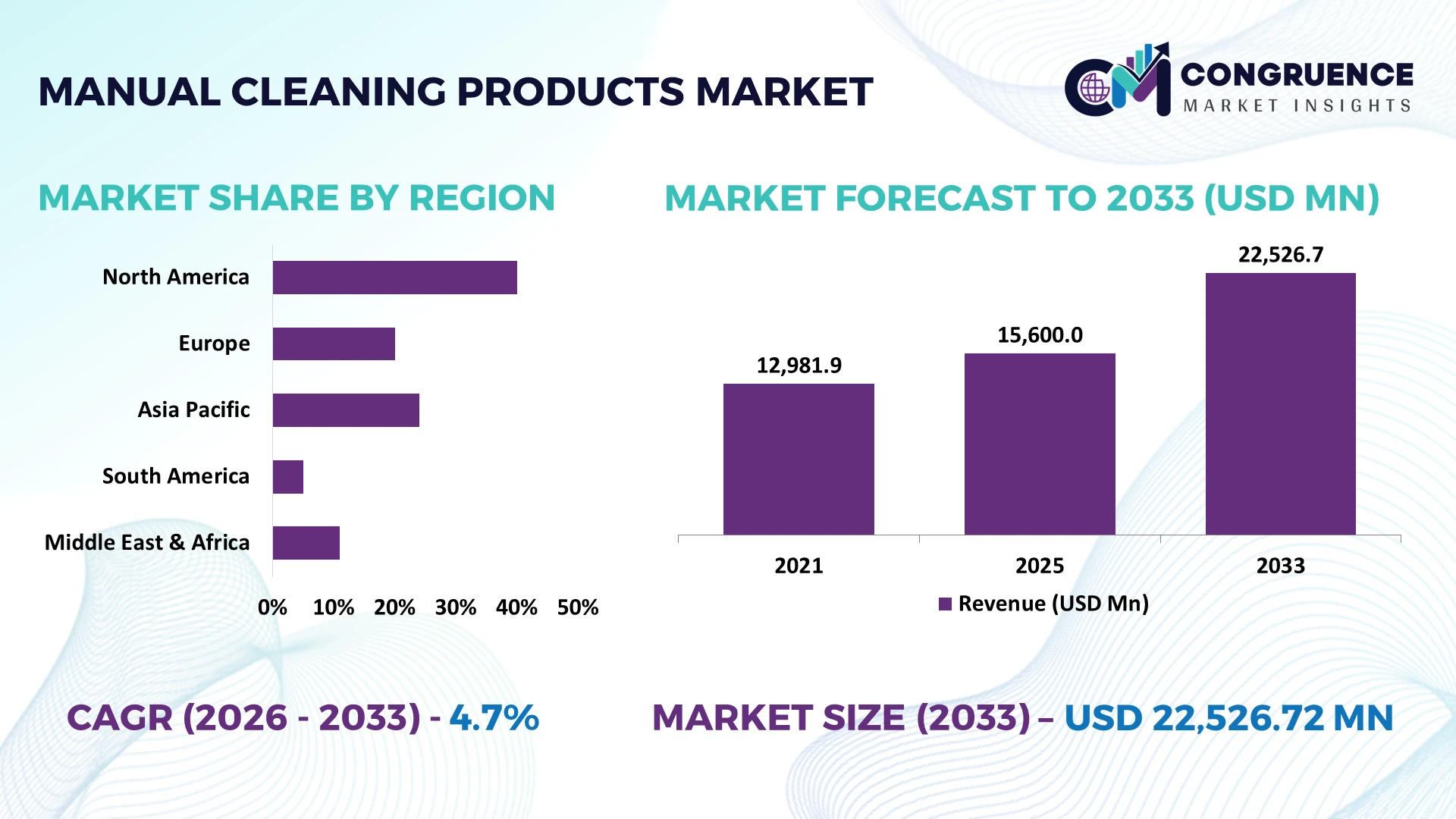
The Global Manual Cleaning Products Market was valued at USD 15600 Million in 2025 and is anticipated to reach a value of USD 22526.72 Million by 2033 expanding at a CAGR of 4.7% between 2026 and 2033. Growth is driven by stricter institutional hygiene protocols, rapid microfiber replacement of conventional cotton systems, ergonomic tool redesign, refillable formats, and high-frequency replacement across healthcare, hospitality, foodservice, education, and commercial facilities.
The United States accounts for approximately 24% of global manual cleaning products demand, supported by more than 6 million commercial buildings and intensive cleaning requirements across hospitals, hotels, schools, offices, and foodservice facilities. China remains the primary manufacturing hub for brushes, mops, sponges, cloths, and molded cleaning accessories, while India and Vietnam are gaining procurement relevance. U.S.–China trade friction and freight disruptions are accelerating dual-sourcing strategies, with institutional buyers increasingly adopting microfiber systems capable of reducing water and chemical consumption by 15–30% compared with conventional cleaning methods.
Strategically, suppliers should prioritize professional microfiber platforms, ergonomic modular tools, durable replaceable components, and diversified Asian manufacturing to capture recurring institutional demand while improving procurement resilience and product-level margins.
Market Size & Growth: USD 15.6 billion in 2025 is projected to reach USD 22.53 billion by 2033 at 4.7% CAGR, supported by institutional hygiene standardization, recurring replacement cycles, and professional microfiber conversion.
Top Growth Drivers: Professional facility-cleaning requirements contribute approximately 31% of demand momentum, household replacement cycles 27%, and microfiber, ergonomic, and reusable product upgrades approximately 22%.
Short-Term Forecast: By 2028, broader microfiber deployment, standardized cleaning carts, and optimized dosing workflows are positioned to reduce water consumption by 15–25% and improve labor productivity by approximately 10–15%.
Emerging Technologies: Advanced split-fiber microfiber, antimicrobial materials, ergonomic telescopic handles, color-coded cleaning systems, and modular replaceable heads are improving contamination control, durability, worker productivity, and consumable utilization.
Regional Leaders: North America is projected near USD 7.2 billion, Asia-Pacific USD 6.8 billion, and Europe USD 6.1 billion by 2033, with professional microfiber, reusable systems, and recycled-material tools gaining adoption.
Consumer/End-User Trends: Commercial and institutional users represent approximately 45% of demand, with healthcare, hospitality, education, foodservice, and office facilities generating higher replacement frequencies than low-intensity household applications.
Pilot/Case Example: Professional microfiber programs can reduce cleaning-water requirements by approximately 20–30% versus conventional cotton-mop workflows while lowering chemical usage and improving repeatable surface coverage across large facilities.
Competitive Landscape: 3M maintains a strong branded position alongside Rubbermaid Commercial Products, Vileda Professional, Libman, and Freudenberg, with leading suppliers collectively representing approximately 25–30% of organized professional demand.
Regulatory & ESG Impact: European waste and packaging requirements are accelerating reusable cleaning formats, concentrated refills, and recycled polymers, enabling selected product systems to reduce disposable plastic and packaging requirements by approximately 20–30%.
Investment & Funding: Major cleaning-product and equipment groups continue allocating hundreds of millions of USD toward automated production, recycled polymers, microfiber engineering, capacity optimization, and geographically diversified sourcing networks.
Innovation & Future Outlook: Modular handles, washable microfiber heads, replaceable components, and recycled-plastic bodies can extend usable product life by approximately 15–25%, shifting purchasing economics toward durability, lifecycle cost, and standardized professional systems.
The Manual Cleaning Products Market is transitioning from basic disposable implements toward engineered microfiber cloths, reusable mop systems, ergonomic brushes, modular handles, and application-specific professional cleaning tools. Institutional users increasingly prioritize products capable of reducing water and chemical consumption by 15–30% while improving worker productivity and contamination control. Healthcare, hospitality, foodservice, education, and commercial facilities remain high-frequency demand centers because cleaning tools require systematic replacement under intensive operating conditions. At the same time, U.S.–China sourcing pressures are encouraging procurement diversification toward India, Vietnam, and other Asian manufacturing hubs. Recycled polymers, washable components, color-coded hygiene systems, and lifecycle-based purchasing are consequently reshaping product development, procurement economics, and supplier differentiation, establishing a stronger foundation for strategic market assessment.
Manual cleaning products are becoming strategically important as healthcare, hospitality, foodservice, education, and commercial facilities standardize cleaning workflows around productivity, cross-contamination control, and lifecycle cost. Commercial and institutional users represent approximately 45% of demand, giving professional-grade microfiber, color-coded tools, and modular systems disproportionate competitive importance. Procurement is also shifting toward multi-country sourcing as buyers reduce dependence on concentrated Chinese manufacturing.
Technology is changing cleaning economics without eliminating manual labor. Microfiber systems can reduce water and chemical consumption by roughly 20–30% compared with conventional cotton-mop workflows, while ergonomic handles and pre-portioned systems improve task productivity by approximately 10–15%. The United States leads professional-system adoption, Europe emphasizes reusable and circular designs, while China retains manufacturing scale and India gains sourcing relevance.
Through 2028, facilities will expand washable microfiber, replaceable-head tools, recycled polymers, and standardized color-coded systems. Hospitals provide a practical model, separating cleaning tools by contamination zone to improve process consistency. Suppliers are responding through material R&D, automated manufacturing, distributor partnerships, and Asian sourcing diversification. Competitive leadership will depend on combining measurable cleaning productivity with durable products, procurement resilience, and lower lifecycle resource consumption.
Healthcare, hospitality, foodservice, education, and commercial facilities are strengthening demand for standardized manual cleaning systems because cleaning frequency and contamination-control requirements exceed household usage. Institutional and commercial buyers account for approximately 45% of market demand, while microfiber systems can lower water consumption by 20–30% and reduce cleaning chemical requirements by roughly 10–20% compared with conventional cotton-based workflows. Healthcare facilities increasingly deploy color-coded cloths, mop heads, and brushes to separate high-risk cleaning zones and reduce cross-contamination. This operational shift increases recurring replacement demand while favoring professional products over commodity alternatives. Suppliers are expanding microfiber ranges, ergonomic handles, modular carts, and application-specific cleaning heads. The strategic advantage increasingly comes from selling standardized cleaning systems rather than individual low-margin implements.
Manual cleaning products remain highly exposed to polypropylene, polyester, nylon, natural rubber, steel, and packaging-material costs, creating margin pressure in price-sensitive brushes, mops, sponges, and household accessories. Raw materials can represent approximately 40–60% of manufacturing cost for basic plastic-intensive products, while freight and packaging can contribute another 10–15% to landed costs in import-dependent channels. China's dominant position in global household-goods manufacturing creates additional concentration exposure when tariffs, container disruption, or currency movements affect procurement. Retailers simultaneously resist sharp price increases because basic cleaning implements have low switching barriers. Manufacturers are responding by lightweighting molded components, increasing recycled-polymer content, qualifying suppliers in India and Vietnam, and negotiating longer material contracts. Maintaining specification consistency across alternative factories is therefore becoming as important as achieving lower unit costs.
The strongest value-creation opportunity lies in converting buyers from disposable cleaning implements toward modular, washable, and replaceable-component systems. High-quality microfiber heads can withstand hundreds of laundering cycles, while optimized systems can reduce water consumption by 20–30% and lower chemical usage by approximately 10–20%. European circular-product policies strengthen the commercial case for recycled polymers, replaceable heads, concentrated cleaning workflows, and designs that separate components at end of life. India also provides an attractive combination of expanding institutional infrastructure and manufacturing capability for suppliers seeking localized production. Companies are investing in microfiber engineering, recycled resin formulations, ergonomic platforms, and distributor training. A non-obvious advantage is SKU consolidation: standardized handles compatible with multiple heads can reduce facility inventories while creating recurring attachment sales for manufacturers.
The industry's long-term challenge is achieving consistent cleaning outcomes across labor-intensive workflows where tool performance depends heavily on training, maintenance, laundering, and replacement discipline. Labor can account for more than 80% of professional cleaning expenditure, making even a 5–10% productivity gap materially more important than small differences in tool acquisition cost. High employee turnover in commercial cleaning also weakens standardized implementation, while incorrectly washed microfiber can lose soil-removal effectiveness and shorten usable life. Hospitals, hotels, and foodservice facilities additionally require different contamination-control protocols, complicating enterprise-wide product standardization. Suppliers must therefore combine ergonomic products with visual coding, simplified attachment mechanisms, training programs, and usage guidance. Companies that integrate tools with standardized workflows and distributor-led training will achieve stronger retention than manufacturers competing primarily on unit price.
Ergonomic Tools Redesign Workflows: Commercial cleaners are shifting toward telescopic handles, lighter frames, and improved grip geometries as labor represents more than 80% of professional cleaning costs. Ergonomic systems can improve task productivity by 10–15% while reducing repetitive bending and handling. U.S. facility-service providers increasingly standardize adjustable tools across crews, prompting manufacturers to redesign professional portfolios around worker comfort, interchangeable components, and faster task transitions.
Color Coding Becomes Operational Standard: Healthcare and food-service operators are expanding color-coded cloths, brushes, gloves, and cleaning accessories to separate contamination zones. Four- and five-color systems increasingly distinguish washrooms, kitchens, patient areas, and general surfaces, while standardized workflows can reduce tool-selection errors by 15–20%. Suppliers are scaling coordinated product families and distributor training, converting color compatibility into an enterprise procurement requirement rather than an individual product feature.
Private Labels Strengthen Procurement Control: Large retailers and commercial distributors are increasing private-label cleaning ranges to control specifications and purchasing economics, with private labels exceeding 20% of sales across several mature consumer-goods categories. Manufacturers are responding with contract production, automated molding, standardized packaging, and retailer-specific product configurations. The non-obvious impact is supplier polarization: producers combining scale, compliance documentation, and rapid SKU customization gain volume while undifferentiated branded products face tighter shelf competition.
Packaging Rules Accelerate Redesign: European packaging regulation is pushing suppliers toward recyclable mono-material packs, lower packaging weight, and reduced unnecessary plastic. Packaging optimization programs increasingly target 10–20% material reductions, while recycled content is moving into handles, buckets, and brush bodies. Manufacturers are redesigning packs alongside products, qualifying recycled resins, and consolidating packaging formats, improving transport density while preparing professional and household ranges for tighter circularity requirements.
Microfiber Cloths hold approximately 31% of manual cleaning products demand, benefiting from broad applicability across household, healthcare, hospitality, food-service, and commercial environments. Their scalability comes from reusable construction, high surface coverage, and compatibility with wet, dry, and chemical-assisted cleaning. Cleaning Brushes represent a mature category at roughly 23%, supported by task-specific designs for kitchens, bathrooms, floors, and equipment. Sponges & Scouring Pads retain strong kitchen and hard-surface penetration, while Squeegees remain specialized around glass, wet floors, and professional window cleaning.
Cleaning Gloves are the fastest-growing type as occupational hygiene and chemical-handling requirements increase protective-equipment usage across institutional workflows. Professional buyers increasingly specify reusable nitrile, latex, and chemical-resistant designs rather than basic household gloves. Suppliers are expanding microfiber grades, antimicrobial treatments, ergonomic brush geometries, abrasive-pad formulations, and glove thickness options. Investment is consequently moving toward performance differentiation and application-specific systems, with microfiber suppliers benefiting from recurring laundering and replacement cycles rather than purely disposable consumption.
Surface Cleaning represents approximately 32% of application demand because countertops, furniture, fixtures, workstations, and high-touch surfaces require frequent manual intervention across homes and institutions. Microfiber cloths and task-specific brushes dominate these workflows because they combine rapid deployment with controlled moisture application. Floor Cleaning follows at approximately 24%, supported by repetitive maintenance across commercial buildings, hospitals, hotels, and food-service facilities. Kitchen Cleaning remains highly consumable because grease, food residues, and hygiene requirements drive frequent replacement of pads, brushes, gloves, and cloths.
Bathroom Cleaning is the fastest-growing application as commercial operators strengthen sanitation frequency and zone-specific cleaning protocols. Glass Cleaning remains comparatively specialized but supports professional demand for squeegees and streak-control microfiber. Companies are responding by developing color-coded application ranges, abrasive grades, dedicated bathroom brushes, and surface-specific microfiber constructions. Procurement is shifting from general-purpose products toward defined task systems, improving cleaning consistency while allowing suppliers to capture higher-value institutional contracts through standardized application bundles.
Households account for approximately 55% of manual cleaning products demand because brushes, cloths, sponges, gloves, and squeegees remain recurring necessities across kitchens, bathrooms, floors, windows, and general surfaces. Purchase frequency is supported by low unit costs and broad supermarket and e-commerce availability. Commercial Facilities represent approximately 18%, but purchasing behavior differs substantially: facility managers prioritize durability, standardized specifications, labor productivity, and bulk procurement rather than individual-product convenience. Hospitality and Food Service generate higher replacement intensity because cleaning tools operate across multiple shifts and contamination-sensitive areas.
Healthcare Facilities are the fastest-growing end-user segment as infection-control procedures increase deployment of color-coded microfiber, dedicated brushes, protective gloves, and zone-separated cleaning inventories. Suppliers are targeting hospitals through professional distributors, standardized cleaning systems, staff-training support, and contract pricing. Hospitality operators increasingly purchase ergonomic tools designed for repetitive room turnover, while food-service customers prioritize heat, grease, and chemical resistance. Competitive positioning therefore increasingly depends on end-user-specific product architecture rather than universal cleaning-product portfolios.
North America accounted for the largest market share at 34% in 2025 however, Asia-Pacific is expected to register the fastest growth, expanding at a CAGR of 5.8% between 2026 and 2033.
Professional Cleaning Systems Drive Standardization
North America represents approximately 34% of global manual cleaning products demand, supported by extensive commercial real estate, healthcare infrastructure, hospitality operations, foodservice establishments, and professional facility-management networks. The region is shifting from commodity brushes and cotton cleaning materials toward microfiber systems, ergonomic handles, color-coded tools, and standardized cleaning carts. The United States has more than 6 million commercial buildings, creating substantial recurring demand for professional cleaning consumables and implements. Labor represents more than 80% of professional cleaning expenditure in many facility workflows, making productivity-focused tools commercially important. Distributors are consequently expanding private-label and professional-grade ranges, while manufacturers invest in lightweight polymers, washable textiles, replaceable heads, and automated molding. Institutional procurement increasingly evaluates lifecycle cost and labor efficiency alongside acquisition price.
United States Market Outlook: The United States combines large-scale institutional infrastructure with mature janitorial distribution and professional facility-management networks. Nearly 6,100 hospitals and millions of commercial properties create recurring procurement requirements for microfiber cloths, brushes, gloves, pads, and squeegees. Suppliers increasingly differentiate through ergonomic systems, standardized color coding, bulk contracts, and distributor-supported training rather than basic product availability.
Circularity Reconfigures Product and Packaging Design
Europe accounts for approximately 27% of global manual cleaning products demand, with Germany, the United Kingdom, France, Italy, and the Netherlands supporting substantial professional-cleaning consumption. Regulatory pressure is reshaping product architecture as manufacturers reduce virgin plastic, simplify packaging, increase recycled polymer content, and develop washable cleaning components. EU packaging rules reinforce design strategies targeting 10–20% material reductions across selected formats, while institutional procurement increasingly evaluates durability and end-of-life characteristics. Professional microfiber systems are well established in hospitals, hospitality properties, offices, and public buildings, creating demand for standardized handles and interchangeable cleaning heads. Manufacturers are responding through recycled-resin qualification, mono-material packaging, microfiber engineering, and local distribution partnerships. The strategic shift favors suppliers capable of combining professional performance with documented material efficiency and regulatory readiness.
Germany Market Outlook: Germany provides a strategically important professional-cleaning market supported by dense healthcare, hospitality, manufacturing, retail, and commercial infrastructure. More than 1,800 hospitals create significant institutional cleaning intensity, while strict workplace and environmental standards strengthen demand for ergonomic equipment and reusable systems. German buyers increasingly prioritize durability, replaceable components, material documentation, and professional distributor support.
Manufacturing Depth Supports Product Diversification
Asia-Pacific represents approximately 26% of global manual cleaning products demand while providing the industry's deepest manufacturing ecosystem for plastic handles, brushes, synthetic fibers, sponges, gloves, molded accessories, and packaging. China retains substantial export-oriented production capacity, but India, Vietnam, Indonesia, and Malaysia are gaining procurement allocations as international buyers diversify sourcing. India's urbanization and expansion of hospitals, hotels, shopping centers, airports, and organized foodservice are simultaneously strengthening domestic professional-cleaning demand. Manufacturers are investing in automated injection molding, microfiber conversion, recycled-plastic processing, and high-volume private-label production. Rising labor costs in coastal Chinese manufacturing hubs are also encouraging productivity investment and geographic diversification. Asia-Pacific therefore increasingly functions as both a production platform and a scalable consumption market rather than solely an export manufacturing base.
China Market Outlook: China remains the pivotal supply-chain hub because established industrial clusters integrate plastics processing, synthetic textiles, brush manufacturing, tooling, packaging, and export logistics. Automation is increasing across injection molding and textile conversion as factories manage labor and quality pressures. International buyers nevertheless increasingly require dual sourcing, pushing Chinese producers toward faster customization, recycled-material capabilities, quality certification, and higher-value professional products.
Institutional Formalization Expands Professional Demand
South America represents approximately 6% of global manual cleaning products demand, with Brazil providing the largest consumption and manufacturing base. Demand is increasingly shaped by professionalization across hospitals, shopping centers, hotels, food-processing facilities, offices, and outsourced facility services. Brazil's population exceeding 200 million provides significant household scale, while its established plastics and consumer-products industries support localized manufacture of brushes, sponges, gloves, and molded cleaning accessories. Professional buyers are gradually replacing generalized tools with microfiber textiles, ergonomic handles, and color-coded systems. However, currency volatility, imported synthetic-material costs, fragmented distribution, and uneven procurement standards constrain premium product penetration. Suppliers are responding through local production, distributor partnerships, simplified product architectures, and tiered pricing designed to balance professional performance with cost sensitivity.
Brazil Market Outlook: Brazil combines consumer scale with established plastics, textile, retail, hospitality, and institutional-service industries, making it the region's principal manual cleaning products market. More than 7,000 hospitals reinforce professional sanitation requirements, while domestic manufacturing supports cost-effective brushes, sponges, gloves, and plastic accessories. Premium suppliers compete through microfiber performance, ergonomics, institutional contracts, and localized distribution.
Hospitality Infrastructure Intensifies Cleaning Deployment
Middle East & Africa represents approximately 7% of global manual cleaning products demand, with purchasing concentrated around Gulf hospitality, healthcare, airports, shopping complexes, commercial property, and South African institutional infrastructure. Saudi Arabia and the UAE are particularly important because hotel construction, tourism development, airports, and large mixed-use projects require standardized facility-management operations. Saudi Arabia's Vision 2030 tourism pipeline is expanding requirements for commercial microfiber systems, cleaning gloves, floor tools, brushes, and glass-cleaning equipment. The UAE's dense hotel and commercial-property footprint favors professional distributor channels and high-frequency replacement products. South Africa provides a broader household and institutional market but faces stronger price sensitivity. Suppliers are expanding through regional distributors, hospitality contracts, private-label programs, and climate-resistant product specifications suited to intensive commercial environments.
Saudi Arabia Market Outlook: Saudi Arabia offers the strongest infrastructure-led opportunity as tourism, healthcare, hospitality, airports, entertainment venues, and large mixed-use developments expand under Vision 2030. The Kingdom targets 150 million annual tourist visits by 2030, increasing facility-cleaning intensity across accommodation and visitor infrastructure. Suppliers are positioning through local distributors, institutional contracts, standardized cleaning systems, and professional hospitality-focused assortments.
The Manual Cleaning Products Market pits diversified leaders 3M, Freudenberg, Newell Brands, and Unger against professional cleaning specialists and cost-focused private-label manufacturers. The top five suppliers collectively hold approximately 25–30% of organized branded demand, reflecting fragmentation across household and institutional channels. Competition centers on durability, microfiber performance, ergonomics, price, and distributor reach. Advanced microfiber systems can reduce water usage by 20–30%, while ergonomic designs improve task productivity by roughly 10–15%. Global suppliers compete through material innovation, professional distributor partnerships, automated molding, and standardized product platforms; private-label producers counter with 10–20% price advantages and rapid SKU customization. Competitive emphasis is shifting from standalone brushes and cloths toward interoperable handles, replaceable heads, color-coded systems, and recycled materials. Supplier qualification, polymer and textile expertise, tooling scale, and institutional distribution create meaningful entry barriers. Winning requires lifecycle-cost advantages, reliable multi-country sourcing, application-specific engineering, consistent quality, and strong professional-channel execution across cleaning workflows.
3M
Freudenberg
Newell Brands
Libman Company
Unger Enterprises
Carlisle Companies
Ettore Products
Full Circle Home
Weiman Products
Gala
Scotch-Brite
Casabella
Vikan
Hillbrush
Current technology centers on split-fiber microfiber, ergonomic polymers, color-coded tool systems, and improved abrasive structures. Compared with conventional cotton cloths and string mops, microfiber can reduce water and chemical use by about 20–30% while improving soil capture and drying speed. Professional adoption is strongest in healthcare, hospitality, and food-service workflows, where standardized tools improve consistency, lower consumable use, and support faster task completion across large facilities.
Emerging technologies include recycled-polymer handles, antimicrobial materials, modular attachments, digital tool tracking, and advanced textile engineering. Automated molding and fiber conversion can improve manufacturing throughput by roughly 10–15%, while reusable microfiber products can extend service life by more than 20% versus basic disposable alternatives. Integration with color-coded cleaning protocols and digital training strengthens compliance, benefiting suppliers that combine tools, process guidance, and professional distribution at scale.
Disruptive development is moving toward mono-material components, sensor-enabled cleaning verification, and data-linked inventory systems. Between 2026 and 2028, wider deployment of automated production, recyclable plastics, and standardized attachment platforms should reduce material waste by 8–12% and simplify SKU complexity. Manufacturers that invest now in durable platforms, digital workflow compatibility, and lower-impact materials will gain procurement advantages, stronger institutional retention, and better lifecycle economics across multi-site professional cleaning networks.
May 2024 Libman introduced the Rinse ’n Wring Mop System with dual-chamber wringing, washable microfiber pads, and a 360-degree swivel head, improving hard-floor versatility while reducing reliance on disposable pads and strengthening Libman’s reusable household-cleaning proposition for consumers. Source: libman.com
April 2025 Unger’s HydroPower Nano won a Sanitary Maintenance Distributor Choice Award after delivering 10% lower wastewater use and resin life up to four times longer, strengthening professional window-cleaning economics and distributor confidence in hybrid pure-water systems globally. Source: cleanlink.com
October 2025 Vikan launched a facilities-cleaning concept combining 3 elements—training, dedicated tools, and pre-configured trolleys—with application-specific microfiber systems, helping facility managers standardize workflows, accelerate cleaner training, and improve productivity across offices, restrooms, stairways, and institutional sites at scale. Source: vikan.com
March 2026 3M launched Brite by Scotch-Brite across Target, Walmart, and Amazon, introducing 5 core cleaning-tool formats including refillable scrubbers and replacement heads; the rollout expands design-led household cleaning while extending product lifecycles through reusable, replaceable components globally. Source: 3m.com
The report covers Manual Cleaning Products across Microfiber Cloths, Cleaning Brushes, Sponges & Scouring Pads, Squeegees, and Cleaning Gloves, with applications spanning Surface Cleaning, Glass Cleaning, Floor Cleaning, Kitchen Cleaning, and Bathroom Cleaning. End-user analysis includes Households, Commercial Facilities, Hospitality, Healthcare Facilities, and Food Service, supported by regional assessment across North America, Europe, Asia-Pacific, South America, and Middle East & Africa.
Strategic coverage evaluates microfiber engineering, ergonomic tool systems, recycled polymers, modular attachments, abrasive technologies, color-coded hygiene protocols, and emerging digitally assisted cleaning workflows. Households represent roughly 55% of end-user demand, while institutional buyers increasingly emphasize lifecycle cost, reusable components, and standardized procurement. The report supports 2026–2033 investment planning, sourcing diversification, regional expansion, technology partnerships, product positioning, and competitive benchmarking, while identifying niche opportunities in healthcare sanitation, professional window cleaning, sustainable tools, and high-frequency commercial replacement cycles.
| Report Attribute/Metric | Report Details |
|---|---|
Market Revenue in 2025 | USD 15600 Million |
Market Revenue in 2033 | USD 22526.72 Million |
CAGR (2026 - 2033) | 4.7% |
Base Year | 2025 |
Forecast Period | 2026 - 2033 |
Historic Period | 2021 - 2025 |
Segments Covered | By Type
By Application
By End-User
|
Key Report Deliverable | Revenue Forecast, Growth Trends, Market Dynamics, Segmental Overview, Regional and Country-wise Analysis, Competition Landscape |
Region Covered | North America, Europe, Asia-Pacific, South America, Middle East, Africa |
Key Players Analyzed | 3M, Freudenberg, Newell Brands, Libman Company, Unger Enterprises, Carlisle Companies, Ettore Products, Full Circle Home, Weiman Products, Gala, Scotch-Brite, Casabella, Vikan, Hillbrush |
Customization & Pricing | Available on Request (10% Customization is Free) |




