
Reports
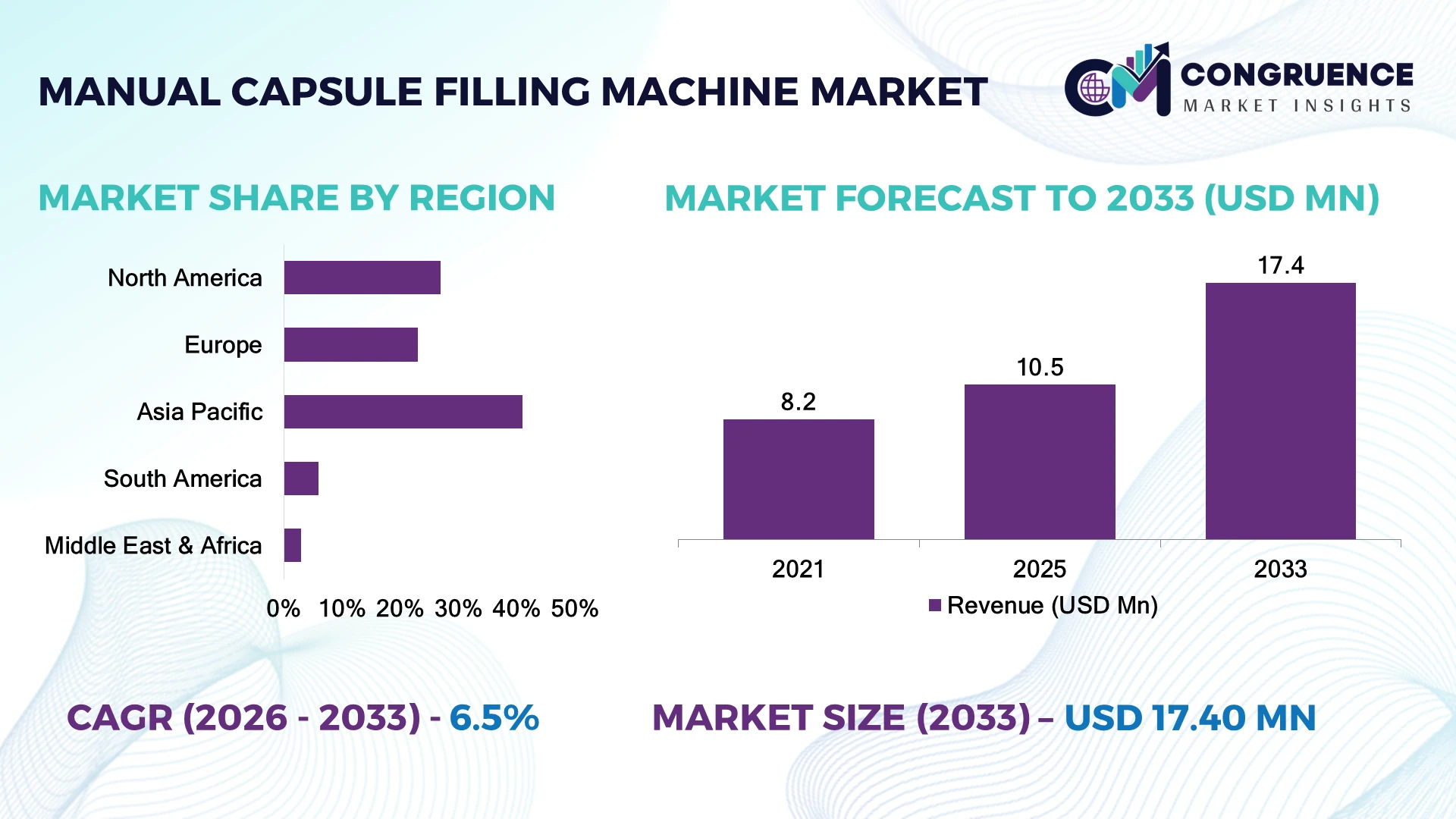
The Global Manual Capsule Filling Machine Market was valued at USD 10.5 Million in 2025 and is anticipated to reach a value of USD 17.4 Million by 2033 expanding at a CAGR of 6.52% between 2026 and 2033. Growth is driven by the rapid expansion of nutraceutical manufacturing, small-batch pharmaceutical production, and rising demand for customized capsule formulations across compounding facilities.
India dominates the market landscape with an estimated 24% share of global manual capsule filling machine installations, supported by more than 3,000 pharmaceutical manufacturing units and strong nutraceutical exports. Domestic adoption has increased by approximately 18% over the last three years as small-scale producers expand capacity. Compared with Germany, where automation penetration exceeds 60%, India continues to rely heavily on cost-efficient manual systems for pilot-scale and specialty production. The country's pharmaceutical sector contributes over 20% of the global generic medicine supply, reinforcing equipment demand across production hubs.
Strategic implication manufacturers focusing on affordable precision, modular designs, and compliance-ready systems are best positioned to capture expanding specialty capsule production requirements.
Market Size & Growth: USD 10.5 Million in 2025 reaching USD 17.4 Million by 2033, supported by rising nutraceutical manufacturing and localized capsule production expansion.
Top Growth Drivers: Nutraceutical production growth (+22%), customized formulations (+18%), and contract manufacturing expansion (+15%) continue accelerating equipment demand.
Short-Term Forecast: By 2028, capsule filling cycle efficiency is projected to improve by nearly 20% through ergonomic design enhancements.
Emerging Technologies: Semi-automated calibration, precision dosing systems, and digital quality monitoring improve filling accuracy by over 12%.
Regional Leaders: Asia Pacific (~USD 7.1 Million), North America (~USD 3.5 Million), and Europe (~USD 2.9 Million) lead adoption through pharmaceutical capacity expansion.
Consumer/End-User Trends: More than 55% of small nutraceutical manufacturers prefer manual systems for flexible low-volume production.
Pilot/Case Example: In 2024, a contract nutraceutical facility improved capsule output by 25% after deploying upgraded multi-size manual filling stations.
Competitive Landscape: Leading manufacturers collectively account for approximately 38% market share, including CapsulCN, IPharmachine, LFA Machines, Torpac, and Capsule Connection.
Regulatory & ESG Impact: GMP-focused production upgrades reduced product rejection rates by nearly 14% across audited facilities.
Investment & Funding: More than USD 45 Million has been directed toward pharmaceutical equipment modernization and regional manufacturing expansion initiatives.
Innovation & Future Outlook: Tool-free changeovers, modular platforms, and precision capsule alignment systems are reshaping competitive differentiation.
Manual capsule filling machines remain essential for nutraceutical startups, compounding pharmacies, research laboratories, and specialty pharmaceutical manufacturers requiring flexible batch production. Recent innovations focus on improved alignment mechanisms, faster changeover configurations, and enhanced dosing consistency. More than 40% of small-volume capsule producers prioritize equipment versatility over production speed. Ongoing pharmaceutical supply-chain localization initiatives are further encouraging investment in compact, operator-friendly capsule filling solutions, setting the stage for broader strategic developments.
The manual capsule filling machine market is becoming increasingly important as pharmaceutical and nutraceutical manufacturers seek greater production flexibility, localized manufacturing capabilities, and cost-efficient batch processing. Rising demand for personalized supplements, clinical trial formulations, and specialty therapeutics is strengthening the role of manual equipment within decentralized production environments. Regulatory emphasis on traceability and quality assurance is also influencing equipment selection and operational standards.
Modern manual capsule filling platforms deliver measurable productivity advantages over legacy equipment. Advanced alignment systems and precision dosing components improve filling accuracy by approximately 15% while reducing material waste by nearly 10%. India and China continue to lead deployment volumes due to extensive pharmaceutical manufacturing networks, whereas Germany and Switzerland emphasize precision engineering and quality-focused applications. Over the next two to three years, adoption of modular production systems is expected to increase by more than 20% among small and medium-scale operators.
A practical example is the growing use of multi-size capsule filling platforms in nutraceutical contract manufacturing facilities, enabling rapid product transitions without extensive tooling changes. Companies are expanding distributor networks, investing in compliance-oriented product upgrades, and forming regional partnerships to strengthen market access. Organizations that combine operational simplicity, dosing precision, and regulatory readiness will secure stronger competitive positioning as specialized capsule production becomes increasingly important.
The rapid growth of nutraceutical production and customized healthcare products is accelerating demand for manual capsule filling equipment. More than 55% of emerging supplement brands operate with small-batch manufacturing models, while customized formulation demand has increased by approximately 18% over recent years. India's pharmaceutical and nutraceutical clusters continue expanding production capacity, creating sustained equipment requirements for pilot-scale and specialty manufacturing. This demand directly improves equipment utilization and supports procurement activity among contract manufacturers. In response, manufacturers are introducing interchangeable capsule-size systems, ergonomic designs, and higher-precision filling platforms. A notable strategic insight is that many specialty producers prioritize formulation flexibility over throughput, making manual systems a preferred investment despite broader automation trends.
Manual capsule filling operations remain highly dependent on skilled operators, creating consistency challenges across production environments. Filling accuracy can vary by 8–12% depending on operator experience, while labor costs have increased by more than 15% in several pharmaceutical manufacturing hubs. Supply-chain disruptions affecting capsule shells and pharmaceutical excipients have also created operational bottlenecks for smaller manufacturers. These factors directly influence production scalability and quality assurance performance. To reduce risk exposure, companies are localizing supplier networks, implementing operator training programs, and adopting standardized quality-control procedures. A key operational insight is that workforce dependency often becomes a greater production constraint than equipment availability during periods of elevated product demand.
The expansion of personalized nutrition, clinical research, and specialty therapeutics creates significant opportunities for manual capsule filling equipment suppliers. More than 30% of newly launched nutraceutical products now target niche health categories requiring flexible production volumes. Small-batch manufacturing demand has expanded by approximately 20% as companies pursue faster product commercialization strategies. In countries such as India and Brazil, local manufacturing incentives are encouraging investment in compact pharmaceutical processing infrastructure. Equipment suppliers are responding through modular platforms, quick-change tooling systems, and precision filling enhancements. A unique strategic opportunity lies in serving research laboratories and formulation development centers where production adaptability often delivers greater value than high-volume automation.
Maintaining consistent product quality across geographically distributed production facilities remains a major long-term challenge. Quality audit observations related to process consistency account for nearly 25% of operational compliance findings in small-scale pharmaceutical facilities. Equipment calibration deviations can influence capsule weight variation by approximately 5–8%, affecting product uniformity requirements. As manufacturers expand into new markets, differing regulatory expectations increase validation complexity and operational costs. Companies must invest in advanced operator training, standardized documentation systems, and enhanced process verification procedures to maintain competitiveness. A critical strategic insight is that future market leaders will differentiate through reproducible quality performance and compliance integration rather than equipment functionality alone.
Precision-Oriented Manual Filling Designs Manual capsule filling systems are increasingly incorporating precision alignment plates and improved tamping mechanisms, reducing capsule weight variation by 10–15% and improving batch consistency by nearly 12%. Small pharmaceutical manufacturers in India and Italy are upgrading legacy units to support stricter quality-control workflows. This shift is lowering product rejection rates while enabling more efficient production scheduling. Equipment suppliers are responding with redesigned platforms, enhanced calibration systems, and expanded operator-support programs.
Flexible Small-Batch Production Expansion Demand for customized nutraceuticals and specialty formulations has increased small-batch manufacturing activity by more than 20%, with over 50% of emerging supplement brands prioritizing production flexibility. Contract manufacturers are restructuring workflows around shorter production cycles and faster product transitions. The trend improves inventory efficiency and reduces excess stock exposure. Manufacturers are introducing modular tooling configurations and multi-capsule-size compatibility to address increasingly fragmented production requirements.
Workforce Efficiency Optimization Initiatives Rising labor costs and operator shortages have encouraged facilities to improve workflow productivity. Enhanced ergonomic designs have reduced operator fatigue by approximately 18%, while optimized filling processes have improved output efficiency by nearly 14%. Pharmaceutical processors are standardizing operating procedures and increasing workforce training investments. Equipment vendors are supporting adoption through simplified maintenance requirements, improved workstation layouts, and user-focused design enhancements.
Localized Equipment Procurement Strategies Ongoing pharmaceutical supply-chain restructuring has increased domestic equipment sourcing activity by nearly 16% across several manufacturing hubs. Companies are reducing procurement lead times by more than 20% through regional supplier partnerships and localized component sourcing. This transition improves operational resilience and spare-parts availability while minimizing production disruptions. Manufacturers are expanding distribution networks, strengthening local service capabilities, and establishing regional assembly partnerships to support evolving procurement priorities.
The market is segmented into Single Head Manual Capsule Filling Machines, Double Head Manual Capsule Filling Machines, and Multi-Station Manual Capsule Filling Machines. Single Head Manual Capsule Filling Machines lead the market with an estimated 48% share due to their low acquisition cost, ease of operation, and suitability for research laboratories, compounding pharmacies, and startup nutraceutical manufacturers. Their straightforward maintenance requirements and compact footprint continue to support widespread deployment. Double Head systems account for a significant share of installations, offering approximately 25–30% higher throughput than single-head alternatives while maintaining operational simplicity. Multi-Station Manual Capsule Filling Machines represent the fastest-growing segment, supported by increasing demand for higher-volume specialty production and contract manufacturing applications. Adoption has increased by nearly 18% over the past few years as producers seek greater batch efficiency without transitioning to fully automated systems. Manufacturers are investing in modular designs, quick-change tooling, and enhanced alignment mechanisms. The shift toward higher-capacity manual platforms reflects growing emphasis on balancing productivity improvements with controlled capital expenditure and flexible production capabilities.
The market is segmented into Pharmaceutical Manufacturing, Nutraceutical Manufacturing, Research Laboratories, Compounding Pharmacies, and Educational & Training Institutions. Nutraceutical Manufacturing holds the largest share at approximately 42%, driven by expanding dietary supplement portfolios, personalized wellness products, and increasing demand for small-batch production. More than 55% of emerging supplement brands continue to rely on manual filling systems during early commercialization phases due to operational flexibility and lower production complexity. Research Laboratories represent the fastest-growing application segment, with adoption increasing by approximately 17% as formulation testing, clinical development, and pilot-scale manufacturing activities expand. Pharmaceutical Manufacturing remains a key application area where manual systems support specialty products and limited-volume formulations. Compounding Pharmacies continue benefiting from personalized medicine trends, while Educational & Training Institutions utilize these systems for technical instruction and pharmaceutical process training. Companies are responding through product customization, enhanced dosing accuracy, and broader support services tailored to specialized operational requirements.
The market is segmented into Pharmaceutical Companies, Nutraceutical Companies, Contract Manufacturing Organizations (CMOs), Research & Academic Institutions, and Compounding Pharmacies. Nutraceutical Companies represent the largest end-user group with an estimated 38% market share, supported by rapid product launches, diversified supplement portfolios, and strong demand for flexible production systems. Many operators prioritize manual equipment because it enables economical manufacturing of niche formulations while supporting frequent product modifications. Contract Manufacturing Organizations are the fastest-growing end-user segment, with deployment activity increasing by nearly 19% as outsourcing strategies continue expanding. Pharmaceutical Companies remain important buyers for pilot-scale and specialty production operations, while Research & Academic Institutions support demand through formulation development activities. Compounding Pharmacies continue increasing equipment adoption to address personalized medication requirements. Suppliers are targeting these segments through application-specific product configurations, expanded service agreements, localized technical support, and strategic distribution partnerships. Future demand is increasingly shifting toward organizations requiring flexible, lower-volume manufacturing capabilities and rapid product adaptation.
Asia-Pacific accounted for the largest market share at 41% in 2025 however, Middle East & Africa is expected to register the fastest growth, expanding at a CAGR of 7.4% between 2026 and 2033.
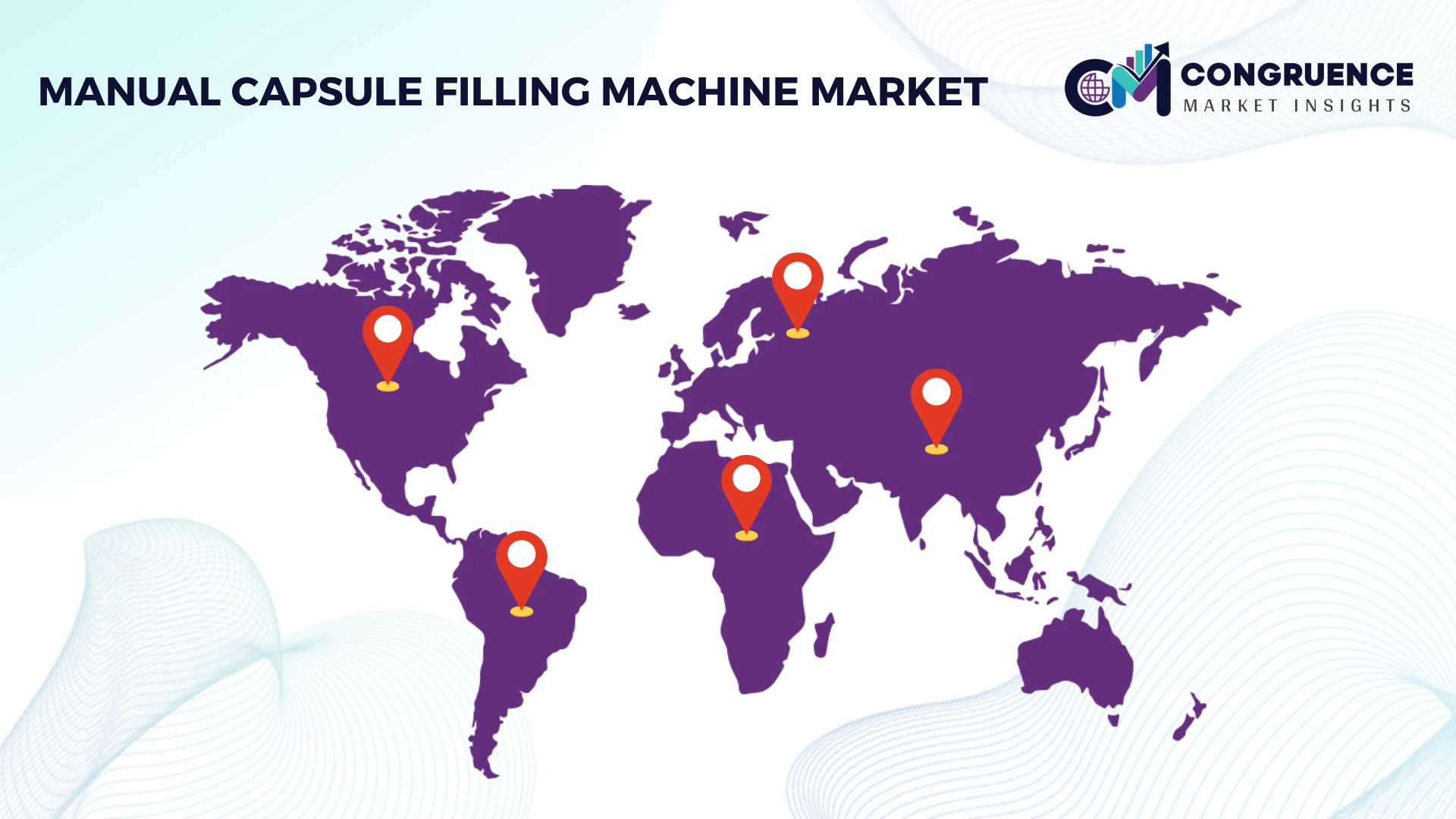
North America represents approximately 27% of the global manual capsule filling machine market, supported by a mature pharmaceutical ecosystem, expanding nutraceutical production, and increasing demand for customized formulations. The region continues to maintain strong deployment levels across compounding pharmacies, research laboratories, and specialty supplement manufacturers. Rising demand for personalized healthcare products has increased small-batch manufacturing activity by nearly 18% over the past few years. Companies are integrating precision-oriented manual filling systems to improve dosage consistency and reduce material waste. Contract manufacturing organizations are also expanding operational capabilities to support shorter product development cycles. Investment in laboratory-scale production infrastructure and formulation development facilities remains a key factor supporting equipment adoption across pharmaceutical innovation clusters.
United States Market Outlook: The United States remains the largest market within North America due to its extensive pharmaceutical manufacturing base, advanced nutraceutical industry, and strong research infrastructure. More than 60% of regional manual capsule filling machine deployments are concentrated within pharmaceutical laboratories, supplement manufacturers, and compounding facilities. Growing demand for customized supplements and clinical trial formulations continues to support equipment utilization. Companies are investing in precision filling technologies and workflow optimization to enhance production consistency while maintaining flexibility for specialized product portfolios.
Europe accounts for approximately 23% of global market activity, supported by stringent pharmaceutical quality standards, established nutraceutical industries, and strong manufacturing expertise. The region is characterized by growing investment in precision production processes and compliance-focused manufacturing environments. Demand remains concentrated within specialty pharmaceutical production, research institutions, and contract manufacturing operations. Enhanced quality-control requirements have encouraged adoption of improved manual capsule filling systems capable of delivering greater dosing consistency. Manufacturers are increasingly focusing on modular equipment designs that support multiple capsule sizes and rapid product changeovers. Operational modernization initiatives across pharmaceutical production facilities continue strengthening deployment of advanced manual filling platforms throughout the region.
Germany Market Outlook: Germany serves as the leading market in Europe due to its strong pharmaceutical manufacturing capacity, engineering expertise, and highly regulated production environment. Approximately 30% of regional pharmaceutical equipment investments are directed toward process optimization and quality improvement initiatives. Research institutions and specialty pharmaceutical manufacturers continue deploying advanced manual capsule filling systems for formulation development and pilot-scale production. The country's emphasis on precision engineering supports demand for high-accuracy equipment capable of meeting strict operational and compliance requirements.
Asia-Pacific leads the global market with approximately 41% share, driven by extensive pharmaceutical manufacturing capacity, expanding nutraceutical industries, and cost-efficient production ecosystems. The region serves as a major hub for generic medicine manufacturing and dietary supplement production, creating sustained demand for manual capsule filling equipment. More than 45% of new installations are linked to small and medium-sized pharmaceutical enterprises seeking flexible production solutions. Growing export-oriented manufacturing activity and increasing healthcare product consumption continue supporting equipment deployment. Manufacturers are expanding regional distribution networks and strengthening after-sales service capabilities to capture growing demand across industrial pharmaceutical clusters.
India Market Outlook: India represents the most influential market in Asia-Pacific, supported by over 3,000 pharmaceutical manufacturing facilities and a rapidly expanding nutraceutical sector. The country contributes significantly to global generic medicine production and maintains strong demand for flexible capsule manufacturing equipment. Adoption of manual capsule filling systems has increased by approximately 18% within specialty pharmaceutical and supplement production facilities. Domestic manufacturers continue expanding production capacity while investing in compliance-focused manufacturing infrastructure to support growing domestic and international demand.
South America accounts for roughly 6% of global market demand, supported by increasing pharmaceutical localization efforts and growing dietary supplement consumption. Demand is primarily concentrated within small-scale pharmaceutical producers, contract manufacturers, and emerging nutraceutical companies. Regional operators are increasingly investing in flexible production technologies to support diverse product portfolios and changing consumer preferences. Equipment deployment has expanded by nearly 12% across selected manufacturing clusters as local production capabilities strengthen. However, infrastructure limitations and supply-chain inefficiencies continue affecting procurement timelines and operational scalability. Companies are responding through localized sourcing strategies and strategic distribution partnerships to improve equipment availability and technical support.
Brazil Market Outlook: Brazil remains the dominant market in South America due to its large pharmaceutical sector, expanding healthcare industry, and growing supplement manufacturing activity. The country accounts for a substantial share of regional production capacity and continues attracting investment in localized healthcare manufacturing. Demand for manual capsule filling equipment is increasing among nutraceutical producers and specialty pharmaceutical companies seeking flexible production capabilities. Companies are strengthening domestic supply networks and investing in operational modernization initiatives to improve manufacturing efficiency and product quality.
Middle East & Africa represents approximately 3% of global market activity but is emerging as an important growth center due to pharmaceutical localization programs and healthcare infrastructure investments. Governments across key markets are prioritizing domestic medicine production and reducing dependence on imported healthcare products. Manufacturing facility development has increased by nearly 15% in several strategic healthcare zones, supporting demand for flexible production equipment. Manual capsule filling systems are gaining traction among emerging pharmaceutical manufacturers due to their lower operational complexity and suitability for small-volume production. Regional distributors are expanding technical support capabilities while forming partnerships to strengthen market penetration and service coverage.
Saudi Arabia Market Outlook: Saudi Arabia is the leading market within the Middle East & Africa region due to substantial healthcare investments, pharmaceutical manufacturing expansion, and industrial diversification initiatives. The country continues developing domestic pharmaceutical production capabilities to support healthcare self-sufficiency objectives. Pharmaceutical facility expansion projects have increased equipment procurement activity, particularly among manufacturers focused on specialty formulations and localized medicine production. Companies are investing in workforce development, production infrastructure, and quality-focused manufacturing practices to enhance competitiveness and support long-term industry growth.
The competitive landscape is shaped by CapsulCN, IPharmachine, Capsule Connection, Torpac, LFA Machines, and several regional equipment manufacturers competing across pharmaceutical, nutraceutical, and laboratory applications. Global suppliers compete against regional cost-focused manufacturers, while engineering-driven brands compete directly with value-oriented suppliers on precision, durability, and operational flexibility. The top five players collectively account for approximately 42% of market activity, reflecting a moderately fragmented structure. Competition is increasingly centered on filling accuracy, operator productivity, customization capability, and after-sales support rather than basic equipment availability. Advanced platform providers deliver up to 15% higher filling consistency, while modular configurations reduce product changeover time by nearly 20%. Regional manufacturers continue gaining traction through pricing advantages of 10–18% and localized service networks. Companies are expanding distributor partnerships, enhancing multi-size compatibility, and introducing ergonomic production designs. The competitive shift is moving toward application-specific solutions and service differentiation. Regulatory compliance requirements and product validation remain key entry barriers. Winning requires precision, responsiveness, customization, and strong customer support execution.
IPharmachine
Capsule Connection LLC
Torpac Inc.
LFA Machines
Adinath International
SaintyCo
Qualicaps Co., Ltd.
ACG Engineering
Vanguard Pharmaceutical Machinery, Inc.
AIPAK Pharmaceutical Machinery
Zhejiang Future Machinery Co., Ltd.
Rich Packing Machinery Co., Ltd.
Shanghai Develop Machinery Co., Ltd.
Manual capsule filling technology is evolving from basic mechanical platforms toward precision-oriented systems focused on consistency, flexibility, and operator efficiency. Modern alignment plates, calibrated tamping assemblies, and advanced capsule separation mechanisms improve filling accuracy by 10–15% compared with conventional designs. More than 55% of newly deployed systems now incorporate interchangeable tooling configurations that support multiple capsule sizes without extensive setup changes. These improvements reduce operational interruptions and improve batch repeatability for nutraceutical and specialty pharmaceutical manufacturers.
Emerging technologies include modular workstation architecture, precision dosing enhancements, and digital quality-control integration. Facilities adopting upgraded manual filling platforms report up to 12% lower material wastage and approximately 18% faster product changeovers. Compared with older fixed-format systems, modern modular equipment improves workflow flexibility by nearly 20%. Research laboratories, contract manufacturers, and customized supplement producers benefit most because they require frequent formulation transitions and smaller production runs. Companies are increasingly integrating operator guidance systems and standardized calibration tools to improve production consistency.
Between 2026 and 2028, competitive differentiation will increasingly depend on ergonomic automation support, rapid tooling interchangeability, and precision filling control. Adoption of hybrid manual-digital workflow solutions is expected to exceed 30% among specialized production facilities. Businesses that modernize equipment early will secure stronger operational efficiency, lower compliance risk, and greater responsiveness to evolving formulation requirements.
October 2025 – ACG announced a phased investment to establish its first U.S. hard-shell capsule manufacturing facility in Atlanta. The project includes creation of more than 200 jobs and strengthens North American supply-chain resilience, improving customer lead times and regional service capabilities. Source: www.prnewswire.com
August 2025 – ACG highlighted deployment of its Personalized Capsule Machine (PCM), enabling on-demand supplement capsule production using individual biomarker inputs. The system supports real-time personalization workflows and strengthens the transition toward customized healthcare manufacturing models. Source: www.acg-world.com
September 2025 – ACG showcased advanced encapsulation machinery, inspection systems, and process optimization technologies at Pharma Pro&Pack 2025. The initiative expanded visibility of integrated manufacturing solutions and reinforced the company's position in pharmaceutical equipment modernization programs. Source: www.prnewswire.com
February 2026 – ACG Packaging Materials' Shirwal facility joined the World Economic Forum Global Lighthouse Network, becoming the first pharmaceutical packaging operation recognized under the program. The milestone highlights advanced manufacturing practices and operational excellence supporting broader pharmaceutical production ecosystems.
The report provides comprehensive analysis of manual capsule filling machine deployment across pharmaceutical manufacturing, nutraceutical production, research laboratories, compounding pharmacies, and educational institutions. It evaluates key product categories including single-head, double-head, and multi-station manual capsule filling systems while assessing adoption trends, operational efficiency improvements, and evolving production requirements. Regional coverage spans North America, Europe, Asia-Pacific, South America, and the Middle East & Africa, representing more than 95% of global industry activity.
The study examines competitive positioning, technology adoption patterns, distribution strategies, manufacturing capabilities, and customer purchasing behavior across major industry participants. More than 40% of market demand originates from flexible small-batch production environments, while increasing deployment within research and specialty formulation applications is reshaping investment priorities. The report supports expansion planning, product development, partnership evaluation, procurement decisions, and competitive benchmarking by identifying operational trends, emerging application areas, technology transitions, and strategic opportunities expected to influence market direction between 2026 and 2033.
| Report Attribute / Metric | Details |
|---|---|
| Market Revenue (2025) | USD 10.5 Million |
| Market Revenue (2033) | USD 17.4 Million |
| CAGR (2026–2033) | 6.52% |
| Base Year | 2025 |
| Forecast Period | 2026–2033 |
| Historic Period | 2021–2025 |
| Segments Covered |
By Type
By Application
By End-User
|
| Key Deliverables | Revenue Forecast; Market Trends; Growth Drivers & Restraints; Technology Insights; Segmentation Analysis; Regional Insights; Competitive Landscape; Regulatory & ESG Overview; Recent Developments |
| Regions Covered | North America; Europe; Asia-Pacific; South America; Middle East & Africa |
| Companies Profiled | CapsulCN International Co., Ltd.; IPharmachine; Capsule Connection LLC; Torpac Inc.; LFA Machines; Adinath International; SaintyCo; Qualicaps Co., Ltd.; ACG Engineering; Vanguard Pharmaceutical Machinery, Inc.; AIPAK Pharmaceutical Machinery; Zhejiang Future Machinery Co., Ltd.; Rich Packing Machinery Co., Ltd.; Shanghai Develop Machinery Co., Ltd. |
| Customization & Pricing | Available on Request (10% Customization Free) |




