
Reports
The Global Manned Security Services Market was valued at USD 9,528.2 Million in 2025 and is anticipated to reach a value of USD 25,891.5 Million by 2033 expanding at a CAGR of 13.31% between 2026 and 2033. Growth is propelled by tightening regulatory compliance mandates across public infrastructure and the rapid integration of AI-assisted surveillance into guarding workflows to offset chronic labor shortages.
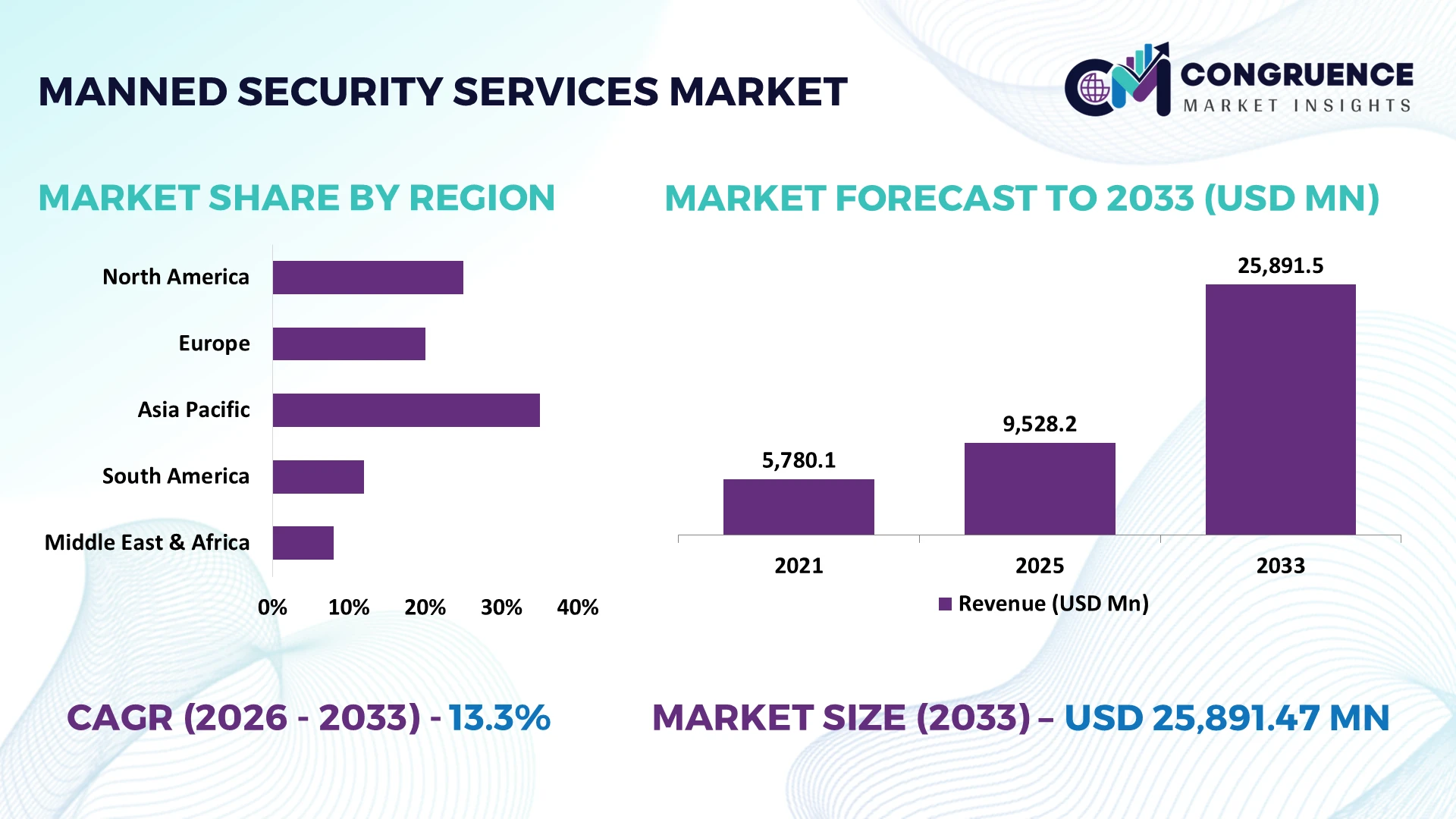
India anchors Asia-Pacific dominance, commanding an estimated 38% of regional manned guarding volume, with over 5 million personnel deployed across 6,000+ licensed agencies, supported by corporate GCC expansion and infrastructure investment exceeding USD 1.4 trillion in national capex. The United Kingdom operates at a markedly higher technology adoption threshold, with integrated guarding-plus-analytics contracts representing approximately 22% of commercial security spend versus India's 7%.
This divergence signals a clear strategic imperative: operators must balance India's scale-driven labor economics against UK-style technology-augmented margin defense to sustain competitive positioning across heterogeneous regulatory and cost environments.
Market Size & Growth: Valued at USD 9,528.2 Million in 2025 and forecast to reach USD 25,891.5 Million by 2033 at 13.31% CAGR, driven by enterprise shift toward integrated guarding-plus-technology service models.
Top Growth Drivers: Regulatory compliance mandates (38%), urbanization and infrastructure development (31%), and technology-enabled service premiumization (24%) collectively reshape procurement priorities across global markets.
Short-Term Forecast: By 2027, AI-assisted patrol routing and incident reporting reduce per-site guarding costs by 12–15% while elevating incident response efficiency by 20%.
Emerging Technologies: AI video analytics, biometric access integration, and drone-assisted perimeter patrol converge into hybrid guarding platforms, with 34% of large enterprise contracts specifying technology-augmented delivery.
Regional Leaders: Asia-Pacific leads with USD 3,620 Million in 2025, India driving 38% of regional volume; North America at USD 2,410 Million with 41% executive protection adoption among S&P 500 firms; Europe at USD 1,890 Million prioritizing GDPR-compliant surveillance.
Consumer/End-User Trends: Corporate executive protection adoption surged to 40% among S&P 500 firms in 2025, up from 19% in 2019, with median protection costs rising 178%.
Pilot/Case Example: India's 2025 Labour Code implementation mandated 50% wage-to-allowance structuring, driving compliant agencies to deploy automated payroll systems and reducing compliance overhead by 18% within six months.
Competitive Landscape: The fragmented market features regional leaders holding 5–12% shares; SIS Limited commands approximately 5% of India's organized market while pursuing APS Group acquisition to consolidate headcount toward 350,000.
Regulatory & ESG Impact: India's Social Security Code extension to contract guards increased gratuity eligibility from five years to one, elevating workforce retention potential by 25% while raising agency benefit liabilities 14–18%.
Investment & Funding: SIS Limited committed INR 600–650 crore (USD 72–78 Million) to acquire APS Group, signaling aggressive consolidation as organized players target the 65% unorganized market share.
Innovation & Future Outlook: Hybrid human-AI guarding pods, predictive deployment analytics, and outcome-based security contracts represent the next competitive frontier, shifting value from headcount volume to incident prevention efficacy.
The Manned Security Services Market is experiencing structural demand expansion across corporate campuses, critical infrastructure, and residential gated communities, with technology integration becoming the primary differentiation vector. AI-enabled video analytics and integrated command platforms now feature in 34% of large enterprise contracts, improving incident detection rates by approximately 28% while reducing false alarms. A notable operational shift is the migration toward outcome-based contracts in India's organized sector, where compliance-driven consolidation is pushing smaller agencies out of high-value commercial tenders. This technology-labor convergence fundamentally redefines competitive advantage, setting the stage for strategic consolidation and capability investment.
The Manned Security Services Market has transitioned from a labor-arbitrage business to a strategic capability layer for enterprise risk management, driven by regulatory restructuring and digital adoption. India's 2025 Labour Codes eliminated wage arbitrage by mandating 50% basic-plus-DA structuring and universalized social security coverage, forcing agencies to compete on compliance discipline and technology efficiency rather than cost undercutting. This regulatory reset coincides with infrastructure modernization across Asia-Pacific and the Middle East, where integrated guarding commands premium pricing.
Technology comparison reveals decisive operational advantages: AI-assisted patrol management reduces per-site supervision costs by 12–15% compared to legacy manual reporting, while biometric access integration cuts unauthorized entry incidents by 31% in commercial deployments. Regionally, India's labor-intensive model sustains scale with 5+ million guards but yields lower margins, whereas UK operators leverage analytics-integrated guarding to command 18–22% price premiums on corporate contracts. Near-term outlook through 2027 indicates organized players will capture 40% of India's market, up from 35%, as compliance enforcement accelerates.
A practical deployment example is SIS Limited's APS Group acquisition, structured as 51% initial stake with performance-linked residual purchase, directly targeting headcount scale and geographic density. Companies are recalibrating investment priorities toward workforce management platforms and compliance automation, with partnerships focused on technology vendors rather than pure labor subcontracting. Strategic positioning now demands dual capability: scale-efficient labor deployment in price-sensitive markets and technology-augmented service delivery in premium segments, where operational advantage translates directly into contract renewal rates and margin resilience.
Regulatory enforcement and enterprise risk escalation are restructuring procurement from headcount-based to outcome-accountable models. India's Labour Code implementation affecting 5+ million guards mandates 50% wage structuring and extends gratuity eligibility to one year, eliminating informal cost advantages and favoring compliant operators. Simultaneously, executive protection adoption among S&P 500 firms reached 40% in 2025, with median costs rising 178% since 2019, signaling enterprise willingness to pay for integrated risk mitigation. Companies are responding by deploying automated payroll systems and AI-assisted reporting to absorb compliance overhead, while pursuing acquisitions such as SIS Limited's INR 600–650 crore APS Group buyout to consolidate scale and negotiate better technology vendor terms. The strategic insight: compliance is no longer a cost center but a competitive moat against 65% unorganized market share.
Structural workforce challenges constrain margin expansion and service consistency across key markets. The U.S. security guard workforce experienced 89% annual churn in 2024, nearly double the 66% private-sector average, driving continuous recruitment and training expenditure. India's organized security sector faces similar pressure, with labor constituting 75–80% of manned guarding input costs and minimum wage revisions compressing margins for MSME operators holding 40–45% market share. These dynamics directly limit scalability for smaller agencies unable to absorb benefit liability increases of 14–18% under new social security mandates. Companies are mitigating through multi-year contract indexing, localized recruitment hubs to reduce turnover, and technology substitution for repetitive patrol functions. The operational reality: agencies without workforce analytics and retention infrastructure will face accelerating contract attrition as clients demand service continuity guarantees.
The convergence of AI analytics with human guarding creates untapped margin expansion in commercial and industrial segments. Approximately 34% of large enterprise contracts now specify technology-augmented delivery, yet only 7% of Indian guarding contracts incorporate analytics-based outcome metrics, revealing a substantial adoption gap. AI-assisted patrol routing reduces supervision costs by 12–15% while improving incident documentation accuracy by 28%, enabling agencies to offer incident-reduction guarantees rather than headcount-based pricing. India's GCC office leasing boom and infrastructure pipeline exceeding INR 111 lakh crore create concentrated demand hubs for hybrid pod deployment in technology parks and logistics corridors. Companies are positioning through partnerships with video analytics vendors and R&D investment in integrated command platforms. The non-obvious opportunity: residential gated communities represent an underserved segment for subscription-based hybrid guarding, where technology offsets guard ratio reductions while maintaining perceived security value.
Scaling technology-augmented guarding models faces execution barriers that threaten deployment consistency and long-term competitiveness. The U.S. security workforce is projected to remain flat through 2034, yet employers must replace 89% annual churn, creating a perpetual training burden that competes with technology upskilling investment. In India, inconsistent data privacy standards across states slow biometric and video analytics rollout, with compliance variation adding 8–12% to deployment lead times for multi-state contracts. These integration hurdles directly impact service reliability: agencies deploying hybrid models without adequate technician support report 15–20% higher client escalation rates during transition periods. Companies must solve this through dedicated technology operations centers, standardized deployment playbooks, and partnerships with system integrators rather than attempting in-house capability development across all service lines. The strategic imperative: workforce transformation pipelines must precede or parallel technology deployment, not follow it.
Hybrid Guarding Contracts Accelerate: Enterprise buyers in the UK and U.S. are shifting 18–22% of commercial guarding spend toward integrated contracts that bundle on-site personnel with remote video analytics, reducing per-site supervision overhead by 12–15% while improving incident documentation accuracy by 28%. Operators are responding by restructuring service catalogs to price technology layers separately from headcount, enabling margin recovery without triggering client resistance to base guard rate increases.
Compliance Automation Replaces Manual Payroll: India's 2025 Labour Code mandate for 50% wage-to-allowance structuring pushed compliant agencies to deploy automated payroll and benefits platforms across 5+ million guard records, cutting compliance overhead by 18% within six months. Smaller operators holding 40–45% market share face technology investment thresholds that favor consolidation, accelerating acquisition pipelines among organized players targeting regulatory-ready workforces.
Executive Protection Demand Reshapes Premium Tier: Adoption of corporate executive protection among S&P 500 firms climbed to 40% in 2025, with median protection costs rising 178% since 2019, creating a premium service tier that commands pricing power independent of standard guarding contracts. Security providers are responding through specialized close-protection training academies and partnerships with risk intelligence platforms, differentiating offerings beyond static guard deployment.
Biometric Access Integration Becomes Baseline: Commercial deployments incorporating biometric access control alongside manned guarding report 31% reduction in unauthorized entry incidents, driving specification of integrated access-guard workflows in 34% of large enterprise tenders. The non-obvious shift: clients now evaluate guarding proposals on data integration capability rather than guard-to-gate ratios, forcing agencies to develop vendor-agnostic technology stacks or risk disqualification from high-value contracts.
The Service segment commands approximately 70% of global manned security consumption value, reflecting the inherently labor-intensive nature of guarding operations where personnel deployment, supervision, and training constitute the core deliverable . Scalability advantages accrue to operators managing large guard pools across multiple sites, as service contracts generate recurring billing cycles with embedded margin from workforce scheduling efficiency. The Equipment segment, while smaller at roughly 30%, is gaining strategic relevance as integrated guarding models require handheld reporting devices, body-worn cameras, and communication infrastructure bundled into service proposals.
Fastest-growing demand concentrates in technology-augmented service delivery, where hybrid contracts incorporating analytics dashboards and incident management software command 18–22% price premiums over traditional guarding in UK and U.S. commercial markets. Companies are responding by acquiring technology vendors or forming system integrator partnerships rather than developing in-house platforms, prioritizing deployment speed over proprietary development. Investment priorities are shifting toward workforce management software and client-facing reporting portals that differentiate service quality in competitive tenders.
Commercial buildings represent approximately 50% of global manned security application demand, concentrated in corporate campuses, retail centers, and mixed-use developments where access control and visible deterrence remain operational priorities . Demand intensity correlates with footfall volume and asset value density, making commercial sites the primary testing ground for hybrid guarding models that combine static posts with analytics-assisted patrol routing. The residential segment follows as a stable volume contributor, though margin compression from price-sensitive homeowner associations limits technology investment.
Fastest-growing application demand emerges in government and institutional facilities, where regulatory compliance requirements and critical infrastructure protection mandates drive specification of documented patrol verification and incident reporting workflows. Industrial applications, while mature, are undergoing workflow transformation through integration of guarding personnel with automated perimeter detection systems, reducing false alarm response costs by 20–25% in pilot deployments. Companies are targeting commercial real estate portfolios with bundled service-plus-technology contracts, while residential markets favor standardized low-cost deployment models.
Commercial buildings and corporate offices constitute the leading end-user segment at approximately 50% of application share, driven by high tenant density, asset value concentration, and operational requirements for visitor management and access control integration . Demand concentration reflects the willingness of corporate occupiers to invest in visible security presence as both risk mitigation and brand protection, supporting premium pricing for technology-enabled guarding contracts. Industrial and manufacturing facilities represent the fastest-growing end-user group, as supply chain security concerns and insurance requirements push warehouse and logistics operators toward documented guarding protocols with digital audit trails.
Government and institutional buyers, while volume-constrained by procurement cycles, specify the most rigorous compliance and reporting standards, creating high-barrier contract environments that favor established operators with compliance infrastructure. Residential end-users remain price-sensitive but represent stable volume, particularly in gated communities across India and the Middle East where guard-to-unit ratios are contractually specified. Companies are differentiating commercial offerings through tenant experience integration—visitor pre-registration and vehicle recognition—while industrial expansion targets logistics corridors with standardized guarding-plus-patrol packages.
Asia-Pacific accounted for the largest market share at 35% in 2025 however, North America is expected to register the fastest growth, expanding at a CAGR of 5.1% between 2026 and 2033.
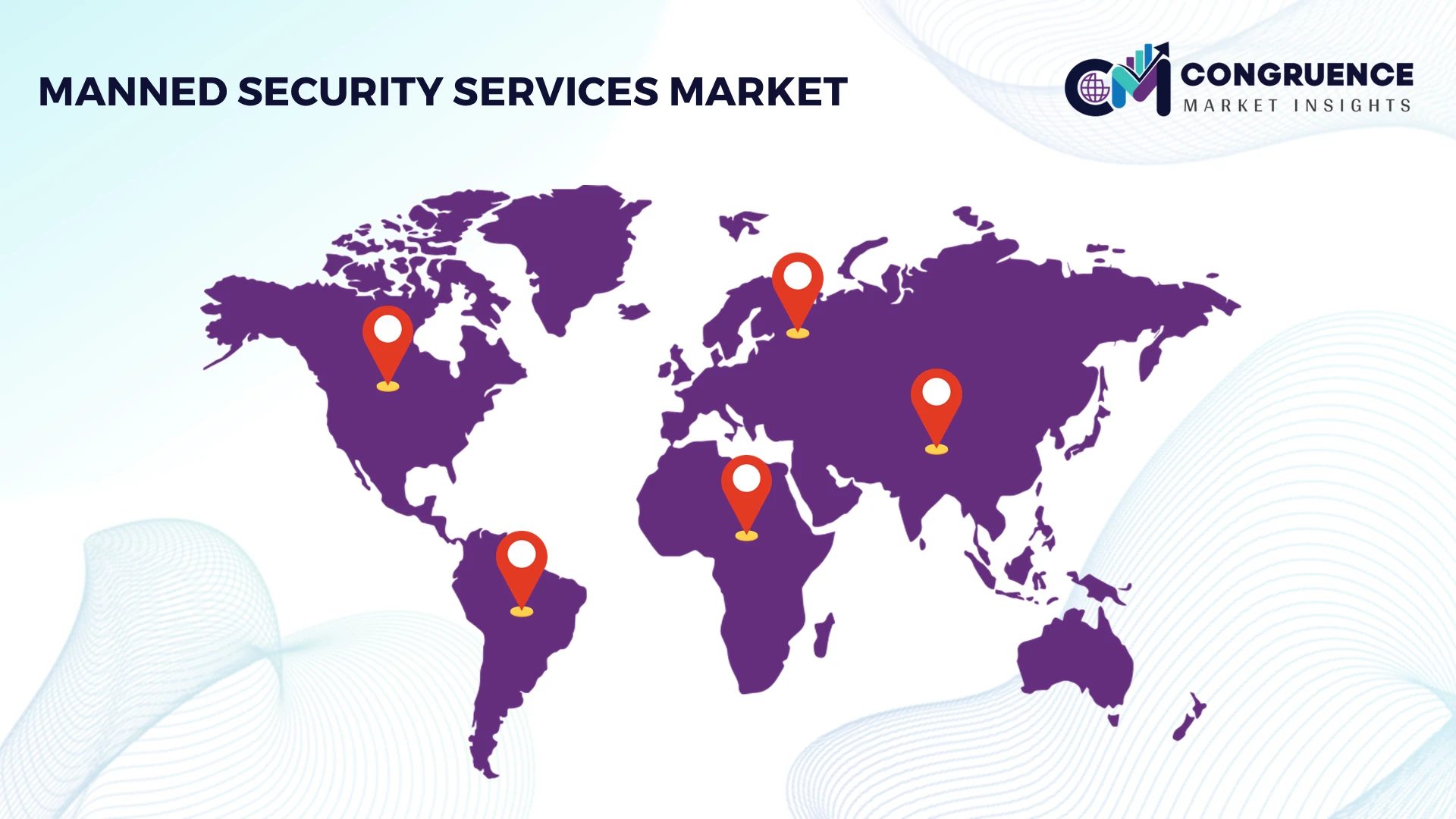
North America commands approximately 25% of global manned security demand, anchored by high-value commercial real estate portfolios and corporate campus deployments where integrated guarding-plus-analytics contracts command 18–22% price premiums. Regional operators are restructuring service catalogs to separate technology layers from headcount pricing, enabling margin defense as U.S. guard workforce churn reached 89% annually in 2024. Allied Universal and Securitas dominate enterprise tender pipelines, with partnerships focused on video analytics vendors rather than proprietary platform development. Investment momentum concentrates in workforce management software and client-facing incident reporting portals that differentiate service quality in competitive renewals.
United States Market Outlook: The U.S. accounts for the overwhelming majority of regional volume, with executive protection adoption among S&P 500 firms reaching 40% in 2025 and median protection costs rising 178% since 2019. Commercial office and retail deployments represent the highest concentration of hybrid guarding contracts, where biometric access integration reduces unauthorized entry incidents by 31%.
Europe represents approximately 20% of global manned security consumption, with the UK and Germany driving procurement toward documented patrol verification and privacy-compliant surveillance workflows. GDPR enforcement has accelerated adoption of data-minimization protocols in video analytics deployments, adding 8–12% to implementation lead times for multi-country contracts. UK operators command 18–22% price premiums on analytics-integrated corporate guarding, while German industrial facilities prioritize documented audit trails for insurance compliance. Mitie and ICTS Europe lead regional consolidation, targeting technology-augmented contracts in critical infrastructure and logistics corridors.
United Kingdom Market Outlook: The UK anchors Europe's premium guarding segment, where integrated security contracts represent 22% of commercial spend versus 7% in India. Corporate occupiers in London's financial district specify hybrid guarding models with remote monitoring integration, driving operator investment in command center infrastructure and analytics-trained guard upskilling programs.
Asia-Pacific dominates global manned security with approximately 35% share, anchored by India's 5+ million guard workforce and 6,000+ licensed agencies serving corporate GCC expansion and infrastructure projects. India's 2025 Labour Code implementation eliminated wage arbitrage by mandating 50% basic-plus-DA structuring, pushing compliant operators toward automated payroll platforms that reduced compliance overhead by 18% within six months. China and Southeast Asian markets contribute volume through industrial estate and logistics facility deployments, though technology adoption remains concentrated in multinational corporate contracts rather than domestic commercial real estate.
India Market Outlook: India drives regional volume with 38% of Asia-Pacific manned guarding deployment, supported by national capex exceeding USD 1.4 trillion and GCC office leasing expansion. SIS Limited's INR 600–650 crore APS Group acquisition targets headcount consolidation toward 350,000 guards, positioning the operator to capture compliance-ready commercial tenders as organized players pursue the 65% unorganized market.
South America represents a smaller share of 12% of global manned security demand, with Brazil and Mexico driving volume through residential gated community deployments and industrial facility guarding. Technology adoption remains constrained by inconsistent telecommunications infrastructure and price-sensitive buyer segments, limiting hybrid guarding model penetration to multinational corporate contracts in São Paulo and Mexico City. Regional operators prioritize workforce scheduling efficiency and basic access control integration rather than advanced analytics deployment, reflecting capital expenditure constraints among domestic security firms.
Brazil Market Outlook: Brazil anchors regional demand through São Paulo's corporate campus and residential condominium segments, where guard-to-unit ratios remain contractually specified. Local operators face margin pressure from labor cost indexing and benefit liability requirements, driving gradual adoption of automated payroll systems to reduce administrative overhead.
The Middle East & Africa region captures strategic 8% manned security demand through Saudi Arabia's giga-project developments and UAE's commercial real estate expansion, where commercial facilities account for 40.92% of manned security revenue. Riyadh and Dubai anchor premium deployment concentration, with integrated guarding-plus-surveillance contracts specified in NEOM, Qiddiya, and Expo City legacy infrastructure. Regional operators benefit from government-mandated localization requirements, though workforce skill gaps constrain analytics-trained guard availability. South Africa contributes industrial and mining sector demand with documented patrol verification protocols.
Saudi Arabia Market Outlook: Saudi Arabia's giga-project pipeline and commercial facility expansion drive premium guarding demand, with commercial end-users representing 40.92% of national manned security revenue. Vision 2030 infrastructure investment supports operator expansion into integrated security contracts, though localization mandates require workforce training investment to meet technology-augmented deployment standards.
The global manned security market pits global scale leaders—G4S, Securitas, and Allied Universal—against regional specialists such as SIS in India and Prosegur in Latin America, with technology integrators increasingly encroaching on traditional guarding contracts. Combined, the top five players hold approximately 25–30% of global share, confirming a fragmented structure where consolidation remains the primary competitive lever . Competition hinges on price discipline in labor-intensive contracts (60–75% of cost base), technology integration capability commanding 18–22% premiums, and compliance infrastructure under tightening wage regulations. Allied Universal completed seven acquisitions totaling $695 million in 2025, while SIS pursued A P Securitas to add 37,500 guards, demonstrating acquisition-driven scale competition . The decisive competitive shift is hybrid guarding-plus-analytics positioning, where operators without workforce automation and client-facing reporting platforms face exclusion from high-value commercial tenders. The entry barrier is compliance infrastructure and technology vendor partnerships, not headcount alone. Winning requires simultaneous scale efficiency in price-sensitive markets and demonstrable technology-augmented service quality in premium segments—operators achieving both will consolidate share; those optimizing only one dimension will face margin erosion.
G4S
Securitas
Allied Universal
SIS Limited
TOPSGRUP
Prosegur
OCS Group
ICTS Europe
Transguard
Control Risks
Andrews International
Beijing Baoan
Axis Security
Covenant
Current deployment centers on AI-assisted video analytics integrated with on-site guarding, reducing false alarm response costs by 20–25% and improving incident documentation accuracy by 28% in commercial deployments. Adoption remains concentrated in UK and U.S. enterprise contracts, where 22% of commercial security spend specifies analytics-integrated delivery, versus 7% in India .
Emerging integration combines biometric access control with guard patrol management platforms, cutting unauthorized entry incidents by 31% in commercial facilities. Cloud-based command platforms—exemplified by Sonitrol's CORE offering acquired by Securitas—enable remote supervision of multiple sites, reducing per-site management overhead by 12–15% . Operators without vendor-agnostic technology stacks face disqualification from enterprise tenders.
Disruptive trajectory (2026–2028) points toward predictive deployment analytics that optimize guard-to-incident ratios in real time. Competitive beneficiaries will be operators pairing workforce management software with client-facing dashboards, converting guarding from headcount billing to outcome-accountable service. The strategic imperative: technology adoption must precede contract renegotiation cycles, not follow them.
April 2025 — Allied Universal acquired Pinnacle Security, expanding southeast U.S. guarding and executive protection coverage; the deal aligns with a 2025 acquisition program totaling seven transactions and approximately $695 million in aggregate annual revenue, accelerating geographic density and service capability consolidation . Source: ausnewsroom.aus.com
May 2025 — G4S secured the principal security contract for Sizewell C nuclear power station, deploying up to 350 personnel at peak with approximately 300 Enhanced Security Officers and 300 apprenticeships over the contract life, anchoring long-duration critical infrastructure guarding revenue in the UK . Source: securityworldmarket.com
September 2025 — SIS Limited agreed to acquire 51% of A P Securitas for INR 73.40 crore, adding 37,500+ guards and 1,000+ clients with FY25 revenue of INR 1,119 crore, directly expanding India market share under Labour Code compliance restructuring . Source: bseindia.com
December 2025 — Securitas Technology acquired Sonitrol Ft. Lauderdale and Level 5 Security Group, expanding Florida service coverage and integrating Sonitrol's cloud-based audio verification platform into remote guarding workflows, strengthening hybrid technology-plus-personnel delivery in North America . Source: securitastechnology.com
This report delivers a structured examination of the global manned security services market across service types (guarding, patrol, executive protection, remote monitoring), applications (commercial, residential, industrial, government), and end-user segments, with regional coverage spanning Asia-Pacific, North America, Europe, South America, and Middle East & Africa. Segment distribution analysis identifies commercial buildings as the dominant application at approximately 50% of demand, while industrial and logistics facilities represent the fastest-adoption segment for technology-augmented guarding models .
The scope encompasses competitive positioning among global leaders and regional specialists, technology integration trends including AI analytics and biometric access, and regulatory developments reshaping workforce compliance and contract structures across key markets. Coverage supports investment planning by mapping consolidation activity, expansion priorities, and partnership patterns among major operators. Strategic insights address deployment economics, compliance infrastructure requirements, and hybrid service model adoption thresholds, enabling stakeholders to align expansion strategy and competitive positioning with shifting procurement criteria through 2033.
| Report Attribute / Metric | Details |
|---|---|
| Market Revenue (2025) | USD 9,528.2 Million |
| Market Revenue (2033) | USD 25,891.5 Million |
| CAGR (2026–2033) | 13.31% |
| Base Year | 2025 |
| Forecast Period | 2026–2033 |
| Historic Period | 2021–2025 |
| Segments Covered |
By Type
By Application
By End-User
|
| Key Deliverables | Revenue Forecast; Market Trends; Growth Drivers & Restraints; Technology Insights; Segmentation Analysis; Regional Insights; Competitive Landscape; Regulatory & ESG Overview; Recent Developments |
| Regions Covered | Asia-Pacific (35%); North America (25%); Europe (20%); Middle East & Africa (~13%); South America (remaining share) |
| Companies Profiled | G4S; Securitas; Allied Universal; SIS Limited; TOPSGRUP; Prosegur; OCS Group; ICTS Europe; Transguard; Control Risks; Andrews International; Beijing Baoan; Axis Security; Covenant |
| Customization & Pricing | Available on Request (10% Customization Free) |




