
Reports
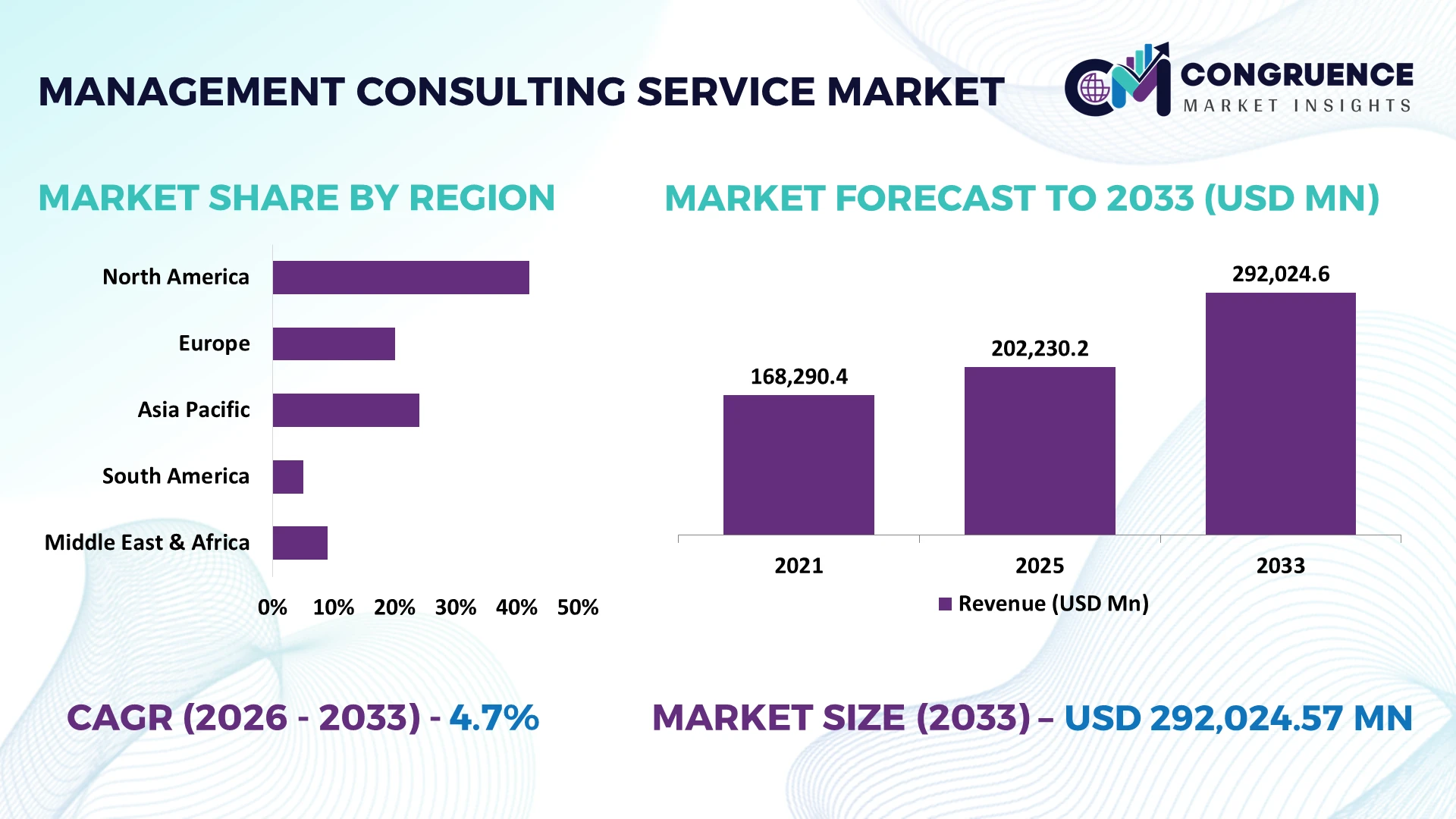
The Global Management Consulting Service Market was valued at USD 202230.17 Million in 2025 and is anticipated to reach a value of USD 292024.57 Million by 2033 expanding at a CAGR of 4.7% between 2026 and 2033. Market growth is driven by enterprise AI implementation, cybersecurity transformation, operational restructuring, regulatory compliance requirements, and supply chain modernization.
The United States represents a major center for global management consulting services, supported by established advisory firms, multinational corporations, and substantial enterprise technology investment. Financial services, healthcare, manufacturing, and technology generate demand for strategic consulting and operational transformation. Global enterprise research conducted in 2025 found that 88% of surveyed respondents reported organizational AI adoption, while only 7% reported fully scaled implementation. Compared with the United Kingdom, where consulting firms increasingly emphasize AI and digital transformation, the United States benefits from its extensive multinational corporate headquarters and technology ecosystem.
Strategically, consulting providers should prioritize measurable AI implementation outcomes, industry specialization, and enterprise transformation capabilities to strengthen competitive positioning.
Market Size & Growth: USD 202230.17 million in 2025, reaching USD 292024.57 million by 2033 at 4.7% CAGR, supported by enterprise digital transformation.
Top Growth Drivers: UK consulting survey respondents identified AI services at 66%, digital technology at 59%, and cost reduction at 46% as leading growth areas.
Short Term Forecast: By 2026, UK consulting industry survey participants projected 8.7% sector growth, reflecting demand for specialized advisory capabilities.
Emerging Technologies: AI agents, predictive analytics, and intelligent automation are reshaping consulting delivery; 88% of surveyed organizations reported AI adoption in 2025.
Regional Leaders: North America, Europe, and Asia Pacific represent important consulting regions, with digital transformation, regulatory advisory, and industrial modernization shaping their respective opportunities.
Consumer/End User Trends: Only 7% of surveyed organizations reported fully scaled AI implementation, highlighting substantial demand for execution focused consulting.
Pilot/Case Example: In 2025, Accenture reported USD 5.9 billion in generative AI bookings, demonstrating enterprise demand for advanced implementation services.
Competitive Landscape: Accenture, Deloitte, McKinsey, Boston Consulting Group, and PwC compete through technology expertise, industry specialization, and international delivery networks.
Regulatory & ESG Impact: The European Union AI Act introduces phased compliance obligations, strengthening demand for AI governance, risk assessment, and regulatory advisory.
Investment & Funding: Accenture invested USD 3.3 billion in acquisitions, research, development, and workforce training during fiscal 2025.
Innovation & Future Outlook: Agentic AI and integrated transformation platforms are changing delivery models; Accenture recorded 47 million employee training hours in fiscal 2025.
The global management consulting service market is experiencing structural changes as enterprises shift from strategic recommendations toward measurable transformation outcomes. Financial institutions prioritize regulatory technology and cybersecurity, while manufacturers increasingly require supply chain resilience and intelligent operations consulting. AI powered diagnostic platforms, automated research tools, and predictive analytics are transforming advisory delivery. However, with only 7% of surveyed organizations reporting fully scaled AI deployment in 2025, implementation remains a significant commercial opportunity. Consulting providers are consequently expanding industry specific capabilities, strengthening technology partnerships, and integrating execution support into traditional advisory engagements. These developments establish the foundation for examining strategic market opportunities.
Management consulting services are gaining strategic importance as multinational enterprises restructure supply chains, modernize infrastructure, and adapt investment strategies to geopolitical uncertainty. The World Trade Organization's 2025 trade outlook projected a 0.2% contraction in global merchandise trade under prevailing conditions, highlighting the importance of supply chain diversification. Consulting firms are expanding their involvement in industrial restructuring, procurement optimization, and international market entry. These developments position strategic advisory services as an essential component of corporate investment decisions.
Technology is simultaneously transforming consulting economics. Research involving professional consultants found that access to advanced generative AI improved task completion speed by more than 25% and work quality by over 40% for suitable assignments compared with conventional approaches. The United States maintains an extensive strategy consulting ecosystem, while India offers established technology delivery capabilities and expanding global capability centers. These differences support international consulting partnerships combining strategic expertise with specialized engineering resources.
Between 2026 and 2028, consulting firms are expected to prioritize integrated transformation programs, proprietary analytical platforms, and performance linked contracts. Manufacturers relocating production provide practical opportunities for consulting teams to redesign supplier networks, evaluate alternative locations, and improve procurement resilience. Providers are strengthening industry expertise and developing implementation capabilities to capture these assignments. Competitive differentiation increasingly depends on combining strategic recommendations with measurable execution outcomes.
Regulatory modernization and corporate restructuring are strengthening demand for specialized management consulting services. The European Union's Corporate Sustainability Reporting Directive initially expanded reporting requirements to approximately 50,000 companies, although subsequent legislative changes have narrowed its scope. Separately, the EU AI Act introduces phased compliance obligations affecting organizations developing and deploying artificial intelligence. These regulatory developments require companies to reassess governance frameworks, reporting infrastructure, and operational responsibilities. German manufacturers and financial institutions face particular demand for regulatory interpretation and organizational restructuring expertise. Consulting providers are expanding regulatory advisory practices, recruiting compliance specialists, and developing integrated reporting solutions. Combining regulatory interpretation with operational redesign enables consultants to deliver broader transformation engagements.
Corporate procurement discipline restricts consulting engagement sizes as clients prioritize measurable financial outcomes and internal delivery capabilities. The United Kingdom's Management Consultancies Association reported that consulting industry growth slowed to 2.5% in 2024, reflecting challenging market conditions. Separately, the UK government announced plans to reduce consultancy spending by 50% during the 2024 election period, illustrating public sector procurement pressure. These developments expose consulting providers to contract renegotiations, reduced discretionary assignments, and intensified pricing competition. Firms are responding through standardized advisory packages, flexible staffing arrangements, and outcome linked commercial agreements. Developing reusable analytical frameworks also reduces delivery expenses, allowing providers to protect profitability without relying exclusively on higher consulting fees.
Industrial transformation creates consulting opportunities extending beyond conventional corporate strategy assignments. India's Production Linked Incentive initiatives cover 14 industrial sectors, generating requirements for investment planning, manufacturing localization, and supplier development. Meanwhile, India's semiconductor development program supports domestic electronics manufacturing and advanced industrial capabilities. These initiatives create opportunities for consulting providers specializing in industrial feasibility studies, capital allocation, technology transfer, and operational transformation. Consulting firms are expanding engineering advisory practices and establishing partnerships with industrial technology specialists. Integrating investment strategy with factory implementation and supplier qualification offers an opportunity to secure longer consulting engagements while addressing the operational requirements of emerging manufacturing ecosystems.
Maintaining consistent transformation outcomes presents a significant challenge as consulting assignments become increasingly technical and multidisciplinary. The World Economic Forum's Future of Jobs Report 2025 estimates that 39% of existing worker skills will change or become outdated between 2025 and 2030. Additionally, 63% of surveyed employers identify skills gaps as a major barrier to business transformation. These workforce pressures complicate consulting delivery across cybersecurity, advanced analytics, industrial automation, and enterprise architecture. Consulting providers must invest in continuous professional development, specialist recruitment, and technical delivery partnerships. Establishing multidisciplinary teams and standardized project governance is essential for managing complex transformation programs, reducing implementation failures, and maintaining consistent service quality across international engagements.
Shift Toward Outcome Based Consulting: Consulting clients increasingly prioritize measurable operational improvements over traditional advisory deliverables. In 2025, large enterprises represented 71.35% of global consulting demand, while onsite engagements accounted for 60.85%. Remote consulting is expanding through digital collaboration platforms and standardized analytical frameworks. Providers are restructuring delivery contracts around performance milestones, implementation accountability, and measurable productivity improvements.
Expansion of Hybrid Consulting Delivery: Consulting firms are integrating centralized analytical capabilities with localized client engagement. India's large enterprises represented 77.62% of domestic consulting demand in one 2025 market assessment, while the country hosted more than 1,580 global capability centers. International providers are expanding distributed delivery teams, combining offshore analytical operations with onsite industry specialists to improve resource utilization and project execution flexibility.
Growing Emphasis on Data Sovereignty: Enterprise technology procurement increasingly incorporates national data residency and technology ownership requirements. A 2026 international enterprise survey found that 77% of respondents considered vendor country of origin, while nearly 60% primarily developed AI infrastructure using domestic vendors. Consulting providers are adapting technology assessment methodologies, establishing localized infrastructure partnerships, and incorporating jurisdiction specific data governance into procurement advisory services.
Transition Toward Integrated Delivery Models: Consulting engagements increasingly combine organizational restructuring, process redesign, and technology implementation. Enterprise research published in 2026 found that 34% of surveyed organizations were fundamentally transforming business processes, while another 30% were redesigning selected workflows. Consulting firms are establishing multidisciplinary delivery teams and integrating organizational change specialists with technology consultants to improve implementation continuity and reduce departmental coordination barriers.
Operations Consulting represents the leading service category, accounting for an estimated 29.15% of the global management consulting services market in 2025 under one published market classification. Its position reflects sustained demand for procurement optimization, productivity improvement, organizational restructuring, and operational performance management. Manufacturing companies and multinational enterprises increasingly require consulting services that connect strategic objectives with measurable operational performance. Strategy Consulting remains important for corporate restructuring and investment planning, while Financial Consulting supports capital allocation and financial transformation. Risk Consulting addresses enterprise resilience and governance requirements.
Technology Consulting represents a rapidly expanding category as organizations modernize enterprise infrastructure and integrate advanced analytical capabilities. Digital Transformation Consulting, classified separately in some market assessments, is projected to record particularly strong expansion, although its growth cannot be directly equated with Technology Consulting under every segmentation framework. HR Consulting increasingly incorporates workforce analytics and organizational redesign, while Marketing Consulting emphasizes customer intelligence and commercial performance optimization. Providers are expanding specialized technology practices while combining operational expertise with enterprise implementation capabilities.
Business Strategy remains an established application within the global management consulting services market, supported by corporate restructuring, investment planning, market entry assessment, and organizational portfolio management. A directly comparable global market share for Business Strategy under the specified application classification is not independently established. Cost Optimization and Process Improvement maintain substantial operational relevance as enterprises evaluate procurement efficiency, workforce productivity, and resource allocation. M&A Advisory supports transaction planning and organizational integration, while Risk Management addresses enterprise governance and operational exposure.
Digital Transformation represents a major expansion area as companies modernize information systems, restructure workflows, and introduce intelligent enterprise applications. Gartner's July 2025 forecast projected worldwide information technology spending growth of 7.9%, indicating substantial investment activity across enterprise technology categories. Change Management is becoming increasingly integrated with implementation programs as organizations adapt operating procedures and employee responsibilities. Consulting providers are developing integrated delivery frameworks combining strategic planning, technology deployment, and operational performance measurement. This approach strengthens engagement continuity while addressing increasingly interconnected corporate transformation requirements.
BFSI represents the leading end-user category, accounting for an estimated 23.85% of global management consulting demand in 2025 under a published financial services classification. Banking and insurance organizations require specialized advisory capabilities covering regulatory compliance, operational restructuring, technology modernization, and enterprise risk management. Manufacturing represents another established buyer group, particularly for procurement transformation and operational efficiency programs. IT & Telecom companies increasingly emphasize infrastructure modernization and organizational productivity, while Government organizations require administrative modernization and public service delivery improvements.
Healthcare represents a rapidly expanding end-user category as providers modernize clinical infrastructure, optimize operational workflows, and strengthen information management capabilities. Published market assessments identify healthcare and life sciences as a particularly strong expansion segment, although pharmaceutical activities extend beyond the specified Healthcare classification. Retail consulting increasingly emphasizes inventory optimization and customer analytics, while Energy & Utilities organizations prioritize infrastructure investment planning and asset management. Consulting providers are expanding sector specific delivery teams, developing specialized analytical frameworks, and establishing technology partnerships to address increasingly complex industry requirements.
North America accounted for the largest market share at 33.5% in 2025; however, Asia-Pacific is expected to register the fastest growth, with a published CAGR forecast of 10.55% through 2031.
Enterprise Technology Modernization and Strategic Consulting Leadership
North America accounted for 33.5% of the global management consulting services market in 2025, supported by extensive corporate headquarters, sophisticated financial institutions, and established advisory infrastructure. The United States dominates regional consulting activity, while Canada contributes through financial services, energy, healthcare, and infrastructure modernization. Enterprise clients increasingly prioritize organizational productivity, technology investment optimization, and complex transaction management. Financial institutions generate specialized requirements for operational risk assessment, regulatory reporting, and cybersecurity governance. Manufacturing companies are also restructuring procurement networks as production localization changes international supplier relationships. Consulting providers are responding by integrating strategy specialists with engineering teams and developing industry specific implementation frameworks. Large corporate transformation programs favor firms capable of coordinating multiple business functions while maintaining consistent delivery standards across international operations.
United States Market Outlook: The United States accounted for 78.13% of North American management consulting services demand in a separate 2025 regional assessment. Its extensive financial services industry, private equity ecosystem, and technology infrastructure support sophisticated consulting requirements. Corporate investment in semiconductor manufacturing and domestic industrial capacity creates additional assignments involving capital planning, supplier qualification, and operational restructuring.
Regulatory Modernization and Industrial Restructuring
Europe represented 29.5% of the global management consulting services market in 2025, reflecting its established industrial base and extensive corporate advisory infrastructure. Germany, the United Kingdom, and France generate substantial demand through manufacturing, financial services, technology, and public administration. Industrial restructuring and changing international trade relationships are influencing consulting procurement priorities. The European Union's AI Act introduces phased regulatory obligations, creating requirements for technology governance, organizational accountability, and compliance management. European manufacturers are also reassessing production economics as energy costs and international competition influence investment decisions. Consulting providers are expanding regulatory advisory capabilities and developing integrated industrial transformation services. Companies combining regulatory interpretation with operational implementation are positioned to address complex corporate requirements across multiple European jurisdictions.
Germany Market Outlook: Germany maintains an established industrial consulting ecosystem supported by automotive manufacturing, mechanical engineering, chemicals, and industrial technology. Its extensive network of medium sized manufacturers creates requirements for procurement optimization, organizational restructuring, and international production planning. Consulting providers increasingly integrate engineering expertise with strategic advisory services to address industrial competitiveness and changing supply chain configurations.
Manufacturing Transformation and Enterprise Modernization
Asia-Pacific accounted for 26.1% of the global management consulting services market in 2025, supported by industrial investment, enterprise modernization, and expanding multinational operations. China generates substantial consulting requirements through manufacturing restructuring, industrial technology development, and international supply chain management. Japan contributes demand through corporate governance modernization, workforce transformation, and industrial productivity initiatives. Australia maintains established advisory requirements across financial services, mining, and public infrastructure. India strengthens the regional consulting ecosystem through its extensive technology services capabilities and expanding multinational corporate operations. Consulting firms are developing localized delivery models to accommodate differences in industrial regulations, procurement practices, and technology infrastructure. Increasing coordination between international advisory networks and domestic implementation specialists is reshaping regional service delivery and enterprise transformation programs.
China Market Outlook: China represents a substantial management consulting market through its extensive manufacturing ecosystem, industrial investment programs, and multinational corporate presence. Its manufacturing sector accounts for more than one quarter of national economic output, creating requirements for production optimization and industrial restructuring. Consulting providers are expanding capabilities in domestic supply chain development, international market entry, and advanced manufacturing transformation.
Corporate Restructuring and Infrastructure Investment
South America, classified within Latin America in the underlying regional assessment, forms part of a broader market representing 6.1% of global management consulting services demand in 2025. Brazil remains a major consulting center, supported by financial institutions, manufacturing enterprises, agricultural businesses, and infrastructure operators. Chile generates specialized advisory requirements through mining investment, energy development, and transportation modernization. Argentina presents opportunities involving financial restructuring, operational efficiency, and corporate investment planning. Economic volatility and infrastructure limitations influence consulting procurement decisions, encouraging companies to prioritize measurable operational improvements. International consulting providers are strengthening domestic industry expertise and collaborating with regional specialists to navigate regulatory and commercial requirements. Infrastructure project advisory and industrial productivity consulting remain important service categories for companies pursuing operational modernization.
Brazil Market Outlook: Brazil benefits from a diversified industrial economy, extensive agricultural operations, and established financial institutions. Its banking industry supports consulting demand involving digital operations, organizational restructuring, and risk management. Agricultural exporters require specialized logistics and procurement advisory services, while infrastructure investment creates opportunities for project management and operational performance consulting. Domestic regulatory expertise remains important for international providers.
Economic Diversification and Infrastructure Transformation
The Middle East and Africa accounted for 4.8% of the global management consulting services market in 2025, supported by infrastructure development, institutional modernization, and economic diversification initiatives. Saudi Arabia and the United Arab Emirates generate significant consulting requirements through national investment programs, infrastructure expansion, and public administration transformation. South Africa contributes demand through financial services, mining, energy infrastructure, and corporate restructuring. Saudi Arabia's Vision 2030 establishes extensive economic diversification objectives that require strategic planning, organizational development, and project implementation expertise. Consulting providers are strengthening domestic delivery capabilities and establishing partnerships with engineering and technology specialists. Differences in institutional capacity and procurement requirements encourage firms to develop country specific operating models. Integrated project management and investment advisory capabilities remain important competitive differentiators.
Saudi Arabia Market Outlook: Saudi Arabia represents a significant consulting market through its economic diversification initiatives and large infrastructure investment programs. Vision 2030 targets an increase in the private sector's contribution to GDP to 65%, creating requirements for investment strategy, organizational transformation, and industrial development consulting. International advisory firms are expanding localized expertise to support institutional modernization and complex project execution.
The global management consulting service market features competition between multinational advisory firms, specialized strategy consultancies, and technology consulting providers. Accenture, Deloitte, McKinsey & Company, Boston Consulting Group, and PwC maintain established international operations, although their combined market share cannot be reliably quantified using inconsistent consulting service classifications. Competition increasingly centers on technology integration, industry specialization, implementation efficiency, and measurable client outcomes. Accenture and Deloitte emphasize integrated technology transformation, while McKinsey and Boston Consulting Group compete through corporate strategy and organizational restructuring expertise. Specialized consulting firms differentiate through industry knowledge, customized advisory frameworks, and flexible delivery models. Established providers are expanding artificial intelligence capabilities, acquiring specialized consulting practices, and strengthening technology partnerships. Automation is transforming traditional research processes, intensifying pricing pressure and accelerating consulting delivery. Established client relationships, specialized talent requirements, and international delivery infrastructure create significant entry barriers. Competitive success increasingly depends on proprietary technology, execution capabilities, and demonstrable operational improvements.
Accenture
Deloitte
McKinsey & Company
Boston Consulting Group
PwC
EY
KPMG
Bain & Company
Oliver Wyman
Kearney
Roland Berger
Capgemini
IBM Consulting
Arthur D. Little
Generative artificial intelligence, predictive analytics, and cloud based consulting platforms are transforming advisory research, strategic modeling, and enterprise decision support. Specialized AI systems integrate proprietary knowledge repositories with automated document analysis, improving research accuracy and reducing manual processing. Professional services research found that 49% of general AI users required substantial output rework, compared with 29% using specialized tools. Domain specific applications therefore offer consulting providers measurable quality advantages while improving analytical consistency across complex engagements.
Emerging technologies include agentic AI, digital twins, and intelligent workflow orchestration. Advanced consulting platforms integrate enterprise resource planning systems, operational datasets, and simulation models to accelerate strategic decision making. Experimental research involving consultants demonstrated that generative AI improved task completion speed by more than 25% compared with conventional methods. Specialized AI adoption remains below 40% among surveyed financial, legal, and accounting professionals, indicating substantial deployment potential.
Between 2026 and 2028, consulting providers will increasingly integrate autonomous analytical agents, secure enterprise knowledge systems, and continuous performance monitoring. Firms developing proprietary industry models gain advantages through reusable intellectual property and differentiated implementation capabilities. Combining automated analysis with experienced consultants strengthens delivery capacity, allowing organizations to prioritize complex strategic assignments over repetitive research activities.
February 2026: EY India launched its EY.ai Generative Studio to accelerate enterprise adoption of agentic artificial intelligence. The platform supports deployment up to 10 times faster, strengthening consulting capabilities in secure automation, enterprise integration, and scalable digital transformation programs.
December 2025: Accenture expanded its partnership with Anthropic, establishing a dedicated business group focused on enterprise artificial intelligence implementation. The collaboration includes training approximately 30,000 professionals, strengthening specialized consulting delivery and accelerating adoption across highly regulated industries and corporate operations.
October 2025: Capgemini completed its acquisition of WNS for $3.3 billion, expanding its intelligent operations capabilities. The transaction combines consulting expertise with business process services, strengthening its ability to deliver integrated transformation programs and deploy autonomous enterprise workflows internationally.
June 2026: Boston Consulting Group published its global AI workforce research involving 11,749 workers across 14 markets. Findings showed that 42% of regular frontline AI users saved at least one working day weekly, highlighting opportunities for organizational transformation consulting.
The Management Consulting Service Market Report evaluates industry structure, competitive positioning, technology integration, and enterprise consulting demand between 2026 and 2033. Service segmentation covers Strategy Consulting, Operations Consulting, Financial Consulting, HR Consulting, Technology Consulting, Risk Consulting, and Marketing Consulting. Application analysis examines Business Strategy, Digital Transformation, Cost Optimization, Process Improvement, M&A Advisory, Risk Management, and Change Management. End-user coverage includes BFSI, Healthcare, IT & Telecom, Manufacturing, Retail, Government, and Energy & Utilities.
Geographical analysis examines North America, Europe, Asia-Pacific, South America, and the Middle East & Africa, emphasizing country specific investment priorities and enterprise modernization requirements. Technology coverage includes generative AI, autonomous analytical agents, predictive modeling, and cloud consulting platforms. Competitive assessment evaluates multinational advisory networks, specialized consulting providers, technology partnerships, and evolving delivery models to support investment planning, international expansion, and strategic positioning.
| Report Attribute/Metric | Report Details |
|---|---|
Market Revenue in 2025 | USD 202230.17 Million |
Market Revenue in 2033 | USD 292024.57 Million |
CAGR (2026 - 2033) | 4.7% |
Base Year | 2025 |
Forecast Period | 2026 - 2033 |
Historic Period | 2021 - 2025 |
Segments Covered | By Type
By Application
By End-User
|
Key Report Deliverable | Revenue Forecast, Growth Trends, Market Dynamics, Segmental Overview, Regional and Country-wise Analysis, Competition Landscape |
Region Covered | North America, Europe, Asia-Pacific, South America, Middle East, Africa |
Key Players Analyzed | Accenture, Deloitte, McKinsey & Company, Boston Consulting Group, PwC, EY, KPMG, Bain & Company, Oliver Wyman, Kearney, Roland Berger, Capgemini, IBM Consulting, Arthur D. Little |
Customization & Pricing | Available on Request (10% Customization is Free) |




