
Reports
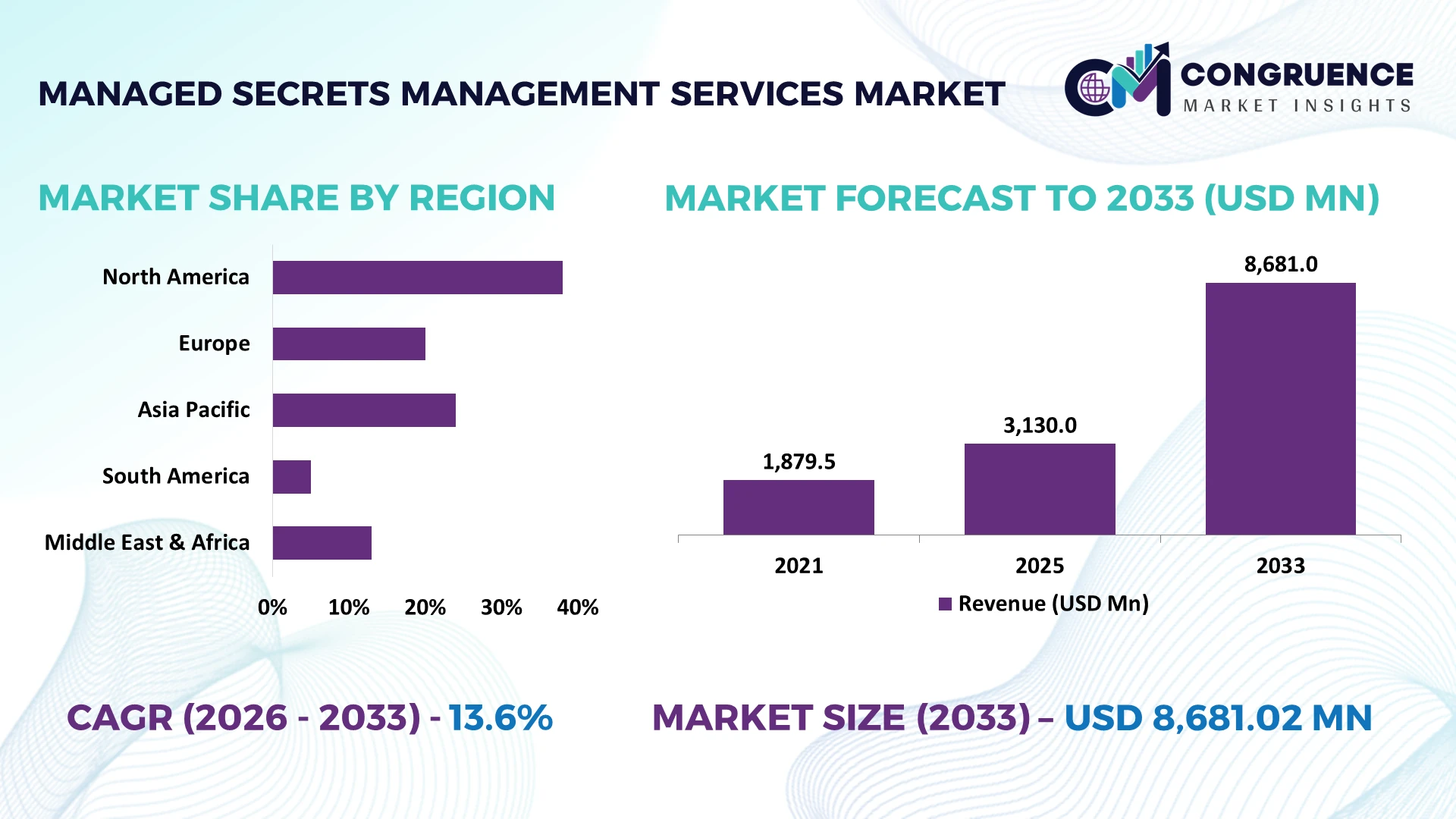
The Global Managed Secrets Management Services Market was valued at USD 3130 Million in 2025 and is anticipated to reach a value of USD 8681.02 Million by 2033 expanding at a CAGR of 13.6% between 2026 and 2033. Growth is driven by automated credential rotation, machine identity proliferation, cloud application integration, and the replacement of hardcoded secrets with centrally governed authentication services.
The United States leads the managed secrets management services ecosystem through hyperscale cloud infrastructure, cybersecurity investment, and enterprise identity security innovation. AWS operates 39 geographic cloud regions globally, supporting distributed secrets management deployments. GitGuardian's 2025 research identified 23.8 million new secrets exposed in public GitHub repositories during 2024, a 25% annual increase. American providers including AWS, Microsoft, and HashiCorp serve banking, healthcare, and technology enterprises. Compared with Germany, the United States maintains greater hyperscale infrastructure reach, while German deployments emphasize European data sovereignty requirements.
Strategically, providers combining automated credential rotation with 2 critical capabilities, workload identity federation and continuous secret discovery, gain stronger enterprise security positioning.
Market Size & Growth: USD 3,130 million in 2025, reaching USD 8,681.02 million by 2033 at 13.6% CAGR, driven by machine identity security automation.
Top Growth Drivers: Secret exposure increased 25%, 70% of organizations operate hybrid clouds, and 84% report cloud spending management challenges.
Short Term Forecast: By 2028, automated credential rotation targets 30% lower administration effort, representing an illustrative operational improvement scenario.
Emerging Technologies: Workload identity federation, dynamic credentials, and AI assisted secret discovery represent 3 important security technology developments.
Regional Leaders: North America, Europe, and Asia Pacific lead deployment; regional USD allocations require independently validated market share estimates.
Consumer & End User Trends: GitGuardian identified 23.8 million newly exposed secrets in public GitHub repositories during 2024, strengthening enterprise remediation priorities.
Pilot/Case Example: In 2025, GitGuardian documented a 25% increase in newly detected secrets, highlighting the importance of automated discovery and remediation.
Competitive Landscape: AWS, Microsoft, Google, IBM, and CyberArk compete; managed secrets service specific market shares remain undisclosed.
Regulatory & ESG Impact: NIS2 covers 18 critical sectors, strengthening access governance, credential protection, and cybersecurity accountability requirements.
Investment & Funding: CyberArk's acquisition of Venafi, valued at approximately USD 1.54 billion in 2024, strengthened machine identity security capabilities.
Innovation & Future Outlook: Passwordless workload authentication and ephemeral credentials reshape enterprise security across 2026–2033, reducing dependence on persistent secrets.
The Managed Secrets Management Services Market supports organizations securing API keys, database passwords, application credentials, encryption tokens, and machine identities across distributed digital infrastructure. Financial institutions, healthcare providers, software developers, and government agencies prioritize centralized secrets storage, automated credential rotation, and granular access controls. GitGuardian's 2025 research identified a 25% annual increase in newly exposed secrets, reinforcing the operational risks associated with unmanaged application credentials. Emerging solutions integrate Kubernetes secret delivery, cloud identity federation, and automated exposure detection. These developments are reshaping security procurement toward continuous credential governance and establishing the foundation for strategic market evaluation.
Managed secrets management services are becoming strategically essential as enterprises replace persistent application credentials with centrally governed machine identities. GitGuardian identified 23.8 million newly exposed secrets in public GitHub repositories during 2024, a 25% increase, demonstrating the security consequences of decentralized credential administration. The transition toward cloud native applications and automated software delivery is shifting cybersecurity investment from password storage toward continuous discovery, access authorization, and credential lifecycle management. Europe's NIS2 framework further strengthens accountability for authentication security across critical infrastructure.
Modern secrets platforms automate credential issuance, expiration, and rotation, replacing manual procedures that require individual administrator intervention. An illustrative deployment targeting 30% lower credential administration effort demonstrates potential efficiency advantages, although actual improvements depend on integration maturity. United States technology providers emphasize hyperscale cloud integration, while German enterprises prioritize sovereign credential storage and regulatory compliance. This contrast creates differentiated procurement requirements for managed vaults, workload authentication, and controlled secrets distribution.
Between 2026 and 2028, enterprises will prioritize ephemeral credentials, Kubernetes workload identity, and automated exposure remediation. A multinational bank can replace embedded database passwords with dynamically issued credentials that expire after application sessions. AWS, CyberArk, and HashiCorp are strengthening automation capabilities and identity security integrations. Competitive advantage increasingly depends on reducing credential persistence, maintaining application availability, and delivering verifiable access governance across distributed infrastructure.
Machine identity proliferation is strengthening demand for managed secrets management services across cloud applications, automated development pipelines, and enterprise infrastructure. GitGuardian's 2025 research identified a 25% annual increase in newly exposed secrets, while Flexera reported 70% hybrid cloud adoption and 84% of organizations experiencing cloud spending management challenges. These conditions increase the difficulty of protecting application credentials across distributed systems. United States software enterprises are replacing hardcoded API keys and database passwords with centralized vaults, automated rotation, and workload identity federation. AWS, Microsoft, and CyberArk are expanding managed secrets capabilities and application integrations. Providers offering automated credential discovery alongside secure issuance strengthen procurement positioning by reducing manual administration and limiting persistent authentication exposure.
Managed secrets management adoption faces structural limitations from proprietary application interfaces, cloud provider dependency, and the expense of integrating legacy authentication systems. Flexera's 2025 research identified 84% of organizations struggling with cloud spending management, while 70% operated hybrid environments, increasing credential administration complexity. GitGuardian also recorded a 25% annual increase in newly exposed secrets, illustrating the continuing burden of unmanaged credentials. German financial institutions must evaluate data residency, third party technology risk, and encryption governance when outsourcing secrets storage. Migrating embedded credentials from legacy applications requires software modifications and controlled testing, increasing implementation costs. Providers are addressing these constraints through standardized authentication interfaces, customer controlled encryption, regional hosting, and phased migration services that reduce disruption.
Ephemeral authentication creates opportunities for managed secrets providers to replace persistent credentials with dynamically issued access tokens and identity based authorization. GitGuardian identified 23.8 million newly exposed secrets during 2024, representing a 25% annual increase, while Flexera reported 70% hybrid cloud adoption. These conditions strengthen demand for credential architectures that minimize stored authentication material. India's expanding financial technology and software services ecosystems provide opportunities for managed workload identity platforms supporting automated application deployment. Providers are investing in Kubernetes integration, federated identity standards, and short duration credential issuance. An important commercial opportunity lies in eliminating unnecessary secret storage rather than simply improving vault capacity. Suppliers delivering passwordless workload authentication can reduce credential rotation burdens while strengthening enterprise security controls.
Maintaining application availability during automated credential rotation presents a major long term execution challenge for managed secrets providers. GitGuardian's 2025 research identified a 25% increase in newly exposed secrets, while Flexera reported 70% hybrid cloud adoption and 84% cloud spending management challenges. Distributed applications often depend on interconnected credentials, making poorly coordinated rotation capable of interrupting production services. United States financial institutions must synchronize database authentication, application deployments, and emergency credential recovery across multiple operating environments. Security teams also require continuous visibility into machine identities and access privileges. Providers must invest in dependency mapping, staged rotation, resilient vault architecture, and automated recovery testing. Competitive sustainability depends on preventing credential exposure without introducing authentication failures or operational downtime.
Secret Scanning Moves Into Development Workflows: Software teams increasingly embed credential detection within code repositories, pull requests, and continuous integration pipelines. GitGuardian identified 23.8 million newly exposed secrets in 2024, representing a 25% annual increase. GitHub and GitGuardian are expanding automated detection and remediation integrations, enabling developers to identify compromised credentials before production deployment and reducing the security burden of retrospective repository investigations.
Nonhuman Identity Inventories Gain Procurement Priority: Enterprises are consolidating visibility across service accounts, application identities, and automated workloads. CyberArk's 2025 identity security research identified machine identities outnumbering human identities by approximately 82 to 1. Organizations are connecting identity inventories with secrets vaults and privileged access controls. Security providers are expanding identity discovery capabilities, allowing administrators to identify ownership gaps and prioritize unmanaged credentials across enterprise infrastructure.
Certificate Validity Reductions Reshape Operations: The CA/Browser Forum approved a transition from 398 day maximum public TLS certificate validity toward 47 days by 2029, with the first reduction scheduled for March 2026. Certificate management providers are expanding automated issuance, renewal, and inventory capabilities. Shorter certificate lifetimes increase operational workload for manual processes, strengthening demand for integrated credential and certificate administration platforms.
Secrets Governance Becomes Audit Integrated: Financial institutions are incorporating credential access records, vault administration, and privileged identity monitoring into continuous compliance workflows. The European Union's Digital Operational Resilience Act became applicable in January 2025, while NIS2 covers 18 critical sectors. CyberArk, IBM, and cloud security providers are expanding audit integrations and policy reporting, reducing fragmented evidence collection and improving accountability for sensitive application credentials.
Cloud Based services represent the leading segment, with an indicative market share of approximately 50% to 55%, supported by scalable credential storage, managed infrastructure, and integration with enterprise cloud applications. AWS Secrets Manager, Azure Key Vault, and Google Secret Manager provide centralized credential administration, automated access controls, and integration with native cloud services. Their subscription delivery models reduce the infrastructure maintenance burden for enterprises operating distributed applications. On Premises services remain important for financial institutions, government agencies, and organizations requiring direct control over sensitive authentication infrastructure. These deployments support restricted network environments and dedicated security administration, although infrastructure ownership increases operational responsibility.
Hybrid services represent the fastest advancing segment as enterprises combine cloud application scalability with locally controlled credential storage. Flexera's 2025 research identified 70% hybrid cloud adoption, reinforcing demand for consistent authentication policies across different operating environments. Providers are expanding external vault integrations, workload identity federation, and centralized secrets monitoring. Investment priorities increasingly favor platforms that maintain credential portability while supporting regional compliance requirements and uninterrupted application access.
API Key Management represents the leading application, with an indicative market share of approximately 30% to 35%, supported by extensive application integration, cloud service connectivity, and automated software development. Enterprises require secure API credential storage, access authorization, and exposure monitoring across interconnected digital platforms. Password Management remains relevant for protecting application service accounts and administrative credentials, while Database Credential Management supports controlled authentication to sensitive enterprise information systems. Certificate Management addresses digital identity verification, certificate renewal, and encrypted communication requirements. Providers are integrating credential discovery, policy enforcement, and automated access administration to reduce security gaps across application environments.
DevOps Security represents the fastest advancing application as organizations integrate secrets protection directly into software delivery workflows. GitGuardian's 2025 research identified 23.8 million newly exposed secrets during 2024, illustrating the operational consequences of inadequate repository protection. Managed security providers are expanding code scanning integrations, deployment pipeline controls, and automated remediation capabilities. Competitive differentiation increasingly depends on preventing credential exposure before production deployment rather than relying exclusively on post incident credential replacement.
BFSI represents the leading end user segment, with an indicative market share of approximately 30% to 35%, supported by extensive digital transaction infrastructure, regulatory requirements, and sensitive authentication systems. Banks, payment processors, and financial technology companies require centralized secrets storage, privileged access monitoring, and automated credential rotation across interconnected applications. IT and Telecommunications companies represent another significant buyer category because of large software environments, distributed network infrastructure, and extensive machine identity requirements. Government organizations prioritize controlled credential custody, secure administrative access, and documented security governance. Providers are developing sector specific policy templates, dedicated vault configurations, and enterprise identity integrations to address institutional procurement requirements.
Healthcare represents the fastest advancing end user category as hospitals, insurers, and digital health platforms expand connected applications and protect sensitive clinical information. Retail enterprises also require secrets management for payment systems, customer applications, and commerce infrastructure. Managed service providers are strengthening healthcare compliance integrations, scalable subscription packages, and automated credential lifecycle controls. Competitive positioning increasingly depends on minimizing authentication disruption while supporting sector specific security obligations.
North America accounted for the largest estimated market share at 38% in 2025 however, Asia Pacific is expected to register the fastest growth, expanding at an estimated CAGR of 16.1% between 2026 and 2033.
Cloud Native Security Strengthens Enterprise Credential Governance
North America represents an estimated 38% of the global Managed Secrets Management Services Market, supported by hyperscale cloud infrastructure, advanced cybersecurity capabilities, and enterprise software development activity. The United States hosts AWS, Microsoft, Google, CyberArk, and HashiCorp, supporting managed credential protection across banking, healthcare, government, and technology enterprises. GitGuardian's 2025 research identified 23.8 million newly exposed secrets in public GitHub repositories during 2024, reinforcing the importance of automated credential discovery. Canadian enterprises increasingly integrate managed vaults with cloud applications and identity security platforms. Providers are expanding dynamic credential issuance, automated rotation, and developer security integrations to address distributed authentication requirements. Enterprise procurement increasingly favors platforms combining centralized credential governance with scalable application integration. Competitive differentiation depends on reducing persistent secrets while maintaining reliable access across complex infrastructure environments.
United States Market Outlook: The United States maintains technological leadership through extensive cloud infrastructure, cybersecurity investment, and software development ecosystems. NIST cybersecurity guidance supports secure identity and access management practices, influencing enterprise authentication architecture. American financial institutions and technology companies increasingly deploy managed secrets vaults, automated credential rotation, and workload identity federation. AWS operates 39 geographic cloud regions globally, supporting distributed application infrastructure and associated credential management requirements.
Digital Sovereignty Requirements Reshape Credential Security Procurement
Europe accounts for an estimated 27% of global Managed Secrets Management Services Market activity, supported by cybersecurity regulation, enterprise cloud modernization, and data protection requirements. Germany, France, and the United Kingdom represent important deployment environments through their financial institutions, industrial enterprises, and established technology infrastructure. The Digital Operational Resilience Act became applicable in January 2025, strengthening operational security expectations for financial entities. The NIS2 Directive covers 18 critical sectors, reinforcing cybersecurity governance and secure access management requirements. Enterprises increasingly prioritize controlled secrets storage, privileged access auditing, and regional credential infrastructure. Providers are expanding sovereign cloud partnerships, dedicated vault environments, and integrations with enterprise identity platforms. Procurement decisions increasingly emphasize credential custody, operational resilience, and compliance documentation, particularly where sensitive authentication information crosses organizational or jurisdictional boundaries.
Germany Market Outlook: Germany maintains a strategically important position through its industrial manufacturing base, financial institutions, and enterprise cybersecurity requirements. The Federal Office for Information Security promotes national cybersecurity standards and secure digital infrastructure practices. German organizations prioritize controlled credential storage, application authentication governance, and compliance with European data protection obligations. Providers offering regional hosting, interoperable vault interfaces, and documented recovery procedures strengthen their positioning in regulated enterprise procurement.
Digital Infrastructure Expansion Accelerates Credential Security Modernization
Asia Pacific represents an estimated 24% of global Managed Secrets Management Services Market demand, supported by cloud infrastructure expansion, financial technology development, and enterprise cybersecurity modernization. China, India, Japan, Singapore, and Australia contribute through digital banking, telecommunications, and software services activity. India's expanding digital payment infrastructure increases requirements for secure API credentials and automated application authentication. Japan emphasizes enterprise resilience and controlled access to sensitive information systems, while Singapore maintains advanced financial technology infrastructure and cybersecurity governance. Regional providers are expanding cloud secrets integration, workload identity capabilities, and automated credential monitoring. Enterprises increasingly require consistent authentication controls across distributed development environments and cloud applications. Competitive differentiation centers on localized compliance support, scalable credential administration, and reliable integration with enterprise identity infrastructure.
India Market Outlook: India benefits from its extensive software development ecosystem, expanding cloud infrastructure, and growing digital financial services. The Reserve Bank of India's technology risk management requirements influence cybersecurity procurement across financial institutions. India's Unified Payments Interface processed more than 20 billion monthly transactions during 2025, illustrating the scale of digital infrastructure requiring secure application authentication. Managed secrets providers are targeting banking, payment technology, and enterprise software organizations through automated API credential protection and developer security integrations.
Financial Technology Expansion Strengthens Application Credential Protection
South America represents an estimated 6% of global Managed Secrets Management Services Market activity, with Brazil leading regional demand through financial technology expansion, enterprise cloud adoption, and digital commerce infrastructure. Brazil's Pix instant payment system supports extensive transaction activity, increasing the operational importance of protecting application credentials and interconnected financial services. The country's General Personal Data Protection Law strengthens enterprise attention to sensitive information governance. Argentina, Chile, and Colombia contribute additional demand through software development and financial services modernization. However, specialized cybersecurity workforce availability, integration expenses, and uneven cloud infrastructure maturity influence managed secrets deployment. Providers are developing partnerships with regional cloud operators, cybersecurity integrators, and enterprise software vendors. Subscription based credential management offers organizations centralized security capabilities without requiring extensive internal vault infrastructure maintenance.
Brazil Market Outlook: Brazil maintains a strong regional position through its digital banking ecosystem, financial technology companies, and expanding cloud services infrastructure. The Central Bank of Brazil reported more than 170 million individual Pix users by 2025, demonstrating extensive participation in digital financial services. Financial institutions require secure API authentication, controlled database credentials, and automated secrets rotation to protect transaction systems. Providers are expanding local integration partnerships and managed identity security offerings.
Government Digitization Strengthens Managed Identity Security Investment
The Middle East and Africa represent an estimated 5% of global Managed Secrets Management Services Market activity, supported by government digital transformation, cloud infrastructure investment, and financial services modernization. Saudi Arabia and the United Arab Emirates maintain significant deployment opportunities through national technology initiatives and expanding enterprise cloud adoption. Saudi Arabia's Vision 2030 program supports digital infrastructure modernization, strengthening requirements for secure application authentication and controlled credential access. The United Arab Emirates emphasizes cloud security and regulated data processing across government and financial institutions. South Africa contributes through banking, telecommunications, and enterprise technology services. Regional providers are expanding partnerships with hyperscale cloud operators, cybersecurity integrators, and managed identity security specialists. Procurement increasingly prioritizes automated credential governance, regional hosting capabilities, and reliable application authentication across sensitive operating environments.
United Arab Emirates Market Outlook: The United Arab Emirates benefits from established digital government infrastructure, expanding hyperscale cloud availability, and advanced financial services technology adoption. AWS operates its Middle East UAE region, providing local cloud infrastructure supporting enterprise application deployment. Government organizations and financial institutions increasingly require secure credential storage, automated access governance, and integration with cloud identity platforms. Providers combining managed secrets services with regional infrastructure and compliance capabilities strengthen institutional procurement positioning.
AWS, Microsoft, and Google compete through cloud integrated secrets management, while CyberArk and HashiCorp differentiate through enterprise identity governance and infrastructure portability. The leading five providers hold an indicative combined market share of 50% to 55%, reflecting hyperscale distribution and established security relationships. GitGuardian identified a 25% annual increase in exposed secrets, while Flexera reported 70% hybrid cloud adoption and 84% cloud spending management challenges, shaping enterprise procurement priorities. Hyperscalers compete through native integrations and consumption pricing; independent specialists emphasize credential discovery, privileged access controls, and multicloud compatibility. Providers are expanding workload identity federation, automated rotation, and developer security partnerships. Competition increasingly shifts from static vault storage toward continuous machine identity governance. Proprietary interfaces, application migration complexity, and enterprise security certification requirements constrain market entry. Winning requires reliable credential availability, interoperable authentication controls, measurable exposure reduction, and competitive subscription economics across distributed application environments and regulated institutional customers worldwide.
Amazon Web Services, Inc.
Microsoft Corporation
Google LLC
CyberArk Software Ltd.
IBM Corporation
HashiCorp, Inc.
GitGuardian SAS
Akeyless Security Ltd.
Delinea, Inc.
BeyondTrust Corporation
1Password
Keeper Security, Inc.
Fortanix Inc.
Infisical, Inc.
Current managed secrets platforms combine encrypted vaults, role based access controls, automated credential rotation, and cloud identity integration. AWS Secrets Manager, Azure Key Vault, and CyberArk support centralized administration across enterprise applications. GitGuardian's 2025 research found secrets in 35% of scanned private repositories, demonstrating deployment gaps despite established security tooling. Modern vault integration reduces credential duplication, while automated policy enforcement strengthens auditability and limits unauthorized access across production systems.
Emerging technologies emphasize dynamic database credentials, workload identity federation, and automated exposure remediation. GitGuardian reported that 70% of secrets leaked in 2022 remained valid in 2025, highlighting persistent lifecycle weaknesses. Compared with conventional 24 hour credentials, one hour ephemeral tokens reduce the potential credential validity window by approximately 96%, assuming identical access permissions. This architectural improvement limits exposure duration without requiring continuous manual password replacement. Providers integrating Kubernetes authentication and developer workflows gain operational advantages.
Between 2026 and 2028, disruptive innovation will center on credentialless AI agent access, automated identity verification, and continuous secrets discovery. Infisical's Agent Vault demonstrates emerging approaches that prevent agents from directly receiving underlying credentials. GitGuardian found 5.1% of public repositories using secrets managers still exposed secrets, reinforcing the need for detection beyond vault deployment. Enterprises should prioritize interoperable authentication, resilient credential delivery, and measurable remediation performance to strengthen security competitiveness.
October 2024: CyberArk completed its Venafi acquisition, combining secrets management with machine identity lifecycle protection. Its regulatory filing recorded $1.66 billion in total consideration. The transaction strengthens enterprise certificate governance and expands integrated authentication security capabilities across infrastructures. Source: sec.gov
February 2025: IBM completed its acquisition of HashiCorp, integrating Vault secrets management with hybrid cloud automation. IBM reported that nearly 75% of enterprises use hybrid cloud, reinforcing demand for consistent credential governance across increasingly complex distributed enterprise infrastructure environments. Source: newsroom.ibm.com
March 2025: GitGuardian published its Secrets Sprawl research, identifying 23.8 million newly exposed credentials in public GitHub repositories during 2024. The findings intensified enterprise attention on automated secret detection, credential revocation, and developer security workflows across software environments. Source: blog.gitguardian.com
October 2026: Infisical secured $40 million in Series B funding to expand security infrastructure for AI agents, certificates, and privileged access. Serving more than 1,300 organizations, the company is accelerating credentialless agent access development and enterprise deployment. Source: infisical.com
The Managed Secrets Management Services Market Report evaluates industry developments between 2026 and 2033 across Cloud Based, On Premises, and Hybrid deployment models. Application coverage includes API Key Management, Password Management, Certificate Management, Database Credential Management, and DevOps Security. End user analysis examines BFSI, IT and Telecommunications, Healthcare, Government, and Retail. Geographic assessment covers North America, Europe, Asia Pacific, South America, and the Middle East and Africa, comparing infrastructure readiness, regulatory requirements, and enterprise adoption patterns.
Technology coverage includes automated credential rotation, dynamic secrets, workload identity federation, encrypted vaults, and AI agent authentication. GitGuardian's finding that 35% of scanned private repositories contained secrets highlights the importance of integrated discovery and remediation. Competitive analysis evaluates hyperscale providers, independent security specialists, and emerging platforms, supporting investment allocation, geographic expansion, vendor selection, and long term enterprise security planning.
| Report Attribute/Metric | Report Details |
|---|---|
Market Revenue in 2025 | USD 3130 Million |
Market Revenue in 2033 | USD 8681.02 Million |
CAGR (2026 - 2033) | 13.6% |
Base Year | 2025 |
Forecast Period | 2026 - 2033 |
Historic Period | 2021 - 2025 |
Segments Covered | By Type
By Application
By End-User
|
Key Report Deliverable | Revenue Forecast, Growth Trends, Market Dynamics, Segmental Overview, Regional and Country-wise Analysis, Competition Landscape |
Region Covered | North America, Europe, Asia-Pacific, South America, Middle East, Africa |
Key Players Analyzed | Amazon Web Services, Inc., Microsoft Corporation, Google LLC, CyberArk Software Ltd., IBM Corporation, HashiCorp, Inc., GitGuardian SAS, Akeyless Security Ltd., Delinea, Inc., BeyondTrust Corporation, 1Password, Keeper Security, Inc., Fortanix Inc., Infisical, Inc. |
Customization & Pricing | Available on Request (10% Customization is Free) |




