
Reports
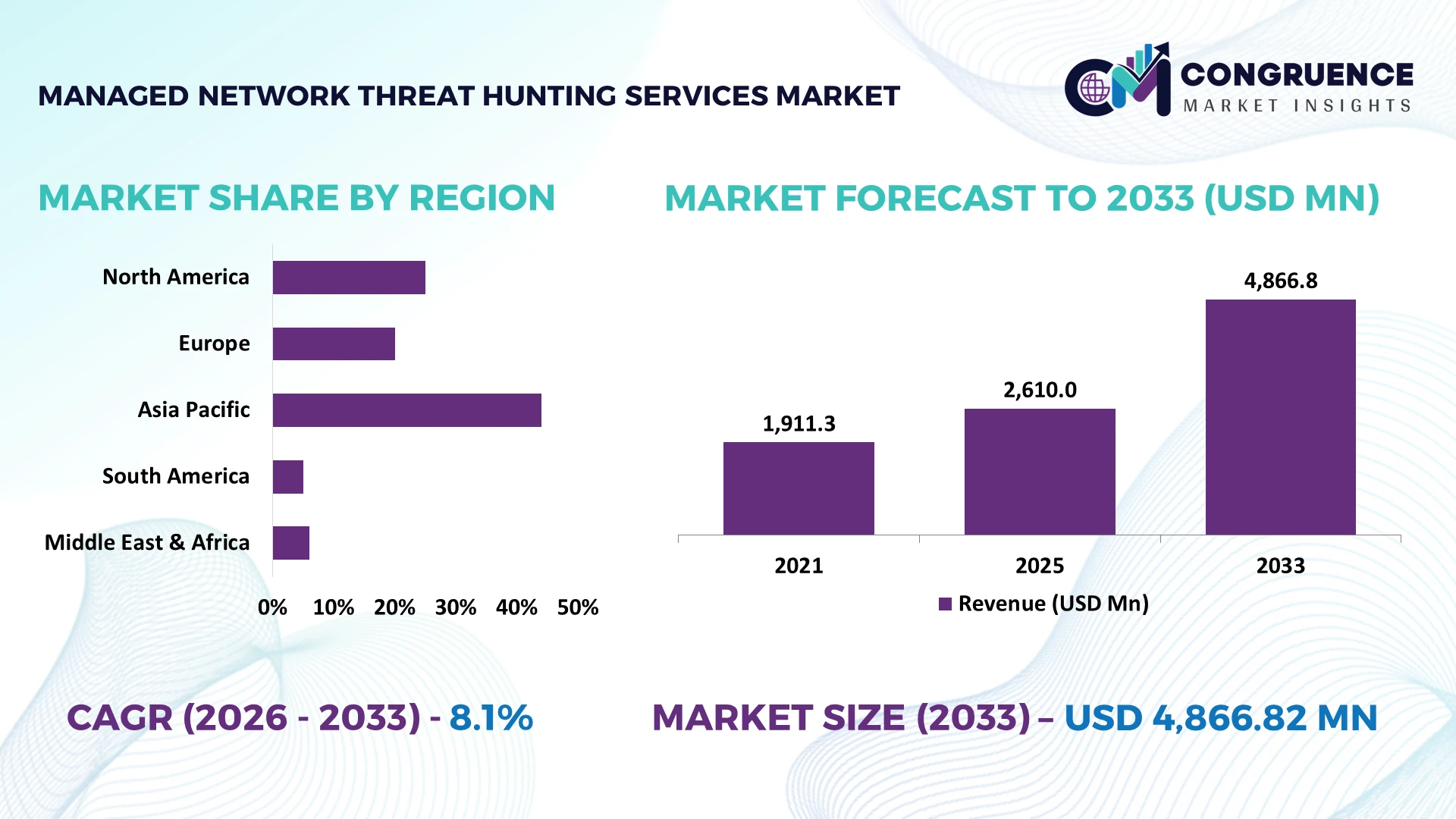
The Global Managed Network Threat Hunting Services Market was valued at USD 2610 Million in 2025 and is anticipated to reach a value of USD 4866.82 Million by 2033 expanding at a CAGR of 8.1% between 2026 and 2033. Growth is driven by escalating ransomware intrusion attempts, expanding cloud-network attack surfaces, and enterprise adoption of AI-assisted threat detection, behavioral analytics, and continuous managed security operations.
The United States dominates the managed network threat hunting services landscape, supported by extensive cybersecurity infrastructure, federal security modernization, and substantial enterprise security expenditure. The country accounted for approximately 70% of global private cybersecurity funding in 2024, reinforcing its innovation leadership. Financial institutions, defense contractors, healthcare providers, and technology enterprises anchor demand for advanced threat hunting services. Compared with India, where managed security outsourcing emphasizes scalable delivery, US enterprises prioritize specialized detection engineering, threat intelligence integration, and compliance with federal cybersecurity requirements.
Strategically, providers combining automated network telemetry analysis, experienced threat hunters, and rapid incident containment are positioned to capture high-value enterprise contracts.
Market Size & Growth: The market expands from USD 2,610 million in 2025 to USD 4,866.82 million by 2033, registering 8.1% CAGR, supported by continuous network monitoring and outsourced threat hunting operations.
Top Growth Drivers: Exploitation accounts for 32% of investigated intrusion entry points, 82% of detections involve malware-free activity, and AI-enabled adversary operations increased 89%, intensifying proactive detection requirements.
Short-Term Forecast: By 2028, security operations prioritize faster incident containment; extensive AI security automation already demonstrates approximately 34% lower breach costs than operations without automation.
Emerging Technologies: AI-driven network detection and response, automated attack-path reconstruction, and identity analytics strengthen visibility across 3 critical environments: cloud, endpoints, and enterprise networks.
Regional Leaders: North America leads premium managed detection adoption, Europe emphasizes regulated infrastructure monitoring, and Asia-Pacific expands outsourced security operations. Regional revenue forecasts require validated market allocations.
Consumer/End-User Trends: High-technology companies represented 17% of investigated incidents in 2025, followed by financial services at 14.6%, supporting specialized enterprise threat hunting contracts.
Pilot/Case Example: IBM's 2025 global security research found USD 1.9 million lower average breach costs among organizations extensively deploying security AI and automation.
Competitive Landscape: CrowdStrike, Palo Alto Networks, Microsoft, IBM, and Google Cloud compete through threat intelligence, managed detection platforms, and automated response capabilities.
Regulatory & ESG Impact: The EU's NIS2 framework strengthens cybersecurity obligations across 18 critical sectors, reinforcing incident reporting, supply-chain oversight, and security governance.
Investment & Funding: Global cybersecurity investment increasingly targets AI-assisted security operations; IBM's 2025 research identifies USD 1.9 million in potential breach-cost differentiation.
Innovation & Future Outlook: Next-generation autonomous threat hunting addresses 29-minute average adversary breakout times, accelerating investment in continuous telemetry correlation and machine-speed response.
Managed network threat hunting services are becoming central to enterprise cybersecurity strategies across banking, telecommunications, healthcare, government, and critical infrastructure. Advanced network detection and response platforms integrate behavioral analytics, encrypted traffic inspection, and threat intelligence to identify lateral movement and compromised identities. Mandiant's 2026 findings show that internal detection accounted for 52% of investigated incidents, demonstrating the operational importance of stronger security visibility. Europe's NIS2 cybersecurity requirements are also reinforcing demand for continuous monitoring and incident reporting. These developments establish the foundation for evaluating strategic investment priorities, service differentiation, and enterprise adoption patterns.
Managed network threat hunting services are becoming strategically essential as enterprises shift cybersecurity spending from reactive incident response toward continuous adversary detection and proactive network defense. The transition toward hybrid cloud infrastructure, zero-trust architectures, and interconnected operational technology is reshaping security outsourcing priorities. With attackers increasingly exploiting valid credentials and legitimate administrative tools, organizations are investing in managed threat hunting capabilities that identify malicious behavior beyond conventional signature-based security controls.
AI-assisted threat investigation provides a measurable operational advantage over legacy manual workflows. Organizations extensively using security AI and automation have recorded approximately 34% lower breach costs compared with those operating without such capabilities. The United States leads advanced threat hunting innovation through cloud-native security platforms and established managed detection ecosystems, while India strengthens delivery capacity through cybersecurity service centers in Bengaluru, Hyderabad, and Pune. Financial institutions increasingly combine network traffic analytics, endpoint telemetry, and identity monitoring to investigate suspicious lateral movement across distributed environments.
Between 2026 and 2028, enterprise security investments will increasingly prioritize automated investigation workflows, measurable detection coverage, and faster containment. Managed security providers are strengthening partnerships with cloud infrastructure vendors and integrating threat intelligence into unified security operations platforms. Organizations that establish interoperable detection architectures and specialized hunting expertise will secure stronger operational resilience, differentiated service capabilities, and sustainable competitive positioning.
Rising exploitation of enterprise network vulnerabilities is accelerating investment in managed threat hunting services. Vulnerability exploitation accounted for 20% of investigated breaches in 2025, representing a 34% annual increase, while ransomware appeared in 44% of breaches. Attackers increasingly target VPN gateways, exposed firewalls, and unpatched network appliances, making perimeter-focused security insufficient. In the United States, financial institutions and critical infrastructure operators are strengthening continuous network traffic inspection and proactive compromise assessment. Cybersecurity providers are expanding managed detection and response capabilities through AI-driven behavioral analytics, threat intelligence partnerships, and automated investigation platforms. The strategic advantage lies in identifying post-exploitation activity before attackers establish persistence across interconnected enterprise environments.
Limited cybersecurity budgets and fragmented enterprise security infrastructure constrain managed network threat hunting deployment. In 2025, 36% of surveyed cybersecurity professionals reported organizational budget cuts, while 33% indicated insufficient resources to staff security teams adequately. Another 29% identified difficulty affording appropriately skilled personnel. In India, enterprises integrating legacy network monitoring tools with cloud-native detection platforms face additional expenditure on telemetry normalization, secure data retention, and security information management. These requirements increase implementation complexity and weaken service profitability when contracts lack predictable data-processing allowances. Providers are responding through modular subscription contracts, selective telemetry ingestion, and integration partnerships with established security platform vendors. Standardized deployment architecture offers a practical route to reducing onboarding costs.
AI-native threat hunting presents a significant opportunity to commercialize continuous investigation across distributed cloud environments. Approximately 63% of surveyed organizations lacked comprehensive AI governance policies in 2025, while 97% of organizations reporting AI-related security incidents lacked appropriate AI access controls. These gaps create demand for specialized monitoring of machine identities, cloud workloads, and unauthorized AI applications. In India, only 37% of surveyed organizations reported implementing AI access controls, highlighting an underserved security segment. Providers are developing autonomous investigation agents, cloud detection engineering services, and managed identity threat hunting capabilities. Partnerships with hyperscale cloud platforms and AI infrastructure developers enable specialized offerings that combine continuous asset discovery with policy enforcement and investigation-ready telemetry.
Maintaining consistent threat hunting quality across complex enterprise environments remains a major execution challenge. In 2025, 95% of surveyed cybersecurity professionals identified at least one organizational skills requirement, while 59% reported critical or significant skills deficiencies. Furthermore, 26% experienced cybersecurity process oversights associated with capability shortages. In India, demand for AI security, cloud investigation, and detection engineering expertise is intensifying competition for specialized analysts. Managed service providers must simultaneously maintain detection accuracy, minimize false positives, and support geographically distributed customer environments. Scaling analyst capacity without standardized investigation playbooks creates inconsistent service performance. Companies are investing in simulation-based training, automated alert enrichment, and specialist partnerships to maintain reliable detection outcomes as customer infrastructure becomes increasingly heterogeneous.
Continuous Exposure Validation Replaces Periodic Assessments: Enterprises are shifting from scheduled vulnerability reviews toward continuous exposure validation across internet-facing assets. Verizon's 2025 investigations identified third-party involvement in 30% of breaches, twice the previous proportion, while vulnerability exploitation represented 20% of initial access activity. Security providers are integrating external attack surface management with managed hunting workflows, allowing customers to prioritize exploitable network paths and reduce unnecessary investigation of low-risk vulnerabilities.
Identity Telemetry Reshapes Hunting Workflows: Attackers increasingly operate through legitimate credentials rather than conventional malicious executables. CrowdStrike's 2025 threat intelligence identified malware-free activity in 79% of detections, while average adversary breakout time declined to 48 minutes. Enterprises are correlating identity authentication events, privileged access changes, and network session behavior. Managed security companies are restructuring investigation playbooks around credential misuse, reducing dependence on malware signatures and improving visibility into lateral movement.
Regulatory Reporting Accelerates Evidence Automation: European enterprises are adapting security operations to NIS2 reporting obligations, including 24-hour early warnings and 72-hour incident notifications. These requirements are transforming threat hunting documentation from analyst-generated reports into continuously maintained evidence records. Managed service providers are embedding investigation timelines, asset attribution, and automated case management into security platforms. This operational change improves regulatory readiness while reducing manual reporting workloads and strengthening audit traceability across multinational networks.
Security Platform Consolidation Changes Procurement: Enterprises are replacing disconnected monitoring products with integrated security operations platforms. IBM's 2025 research found that organizations using security AI and automation extensively experienced approximately 34% lower breach costs, while the global average breach lifecycle reached 241 days. Vendors are combining network detection, endpoint telemetry, and security orchestration through platform partnerships. Procurement increasingly favors interoperable services that reduce duplicate alerts and simplify investigation ownership.
Managed Detection and Response represents the leading service type within the global Managed Network Threat Hunting Services Market, supported by integrated monitoring, investigation, and containment capabilities. Its commercial advantage comes from consolidating multiple security functions into unified service contracts rather than requiring enterprises to maintain separate investigation teams. Network-Based Threat Hunting remains important for identifying lateral movement, suspicious communications, and unauthorized network connections. These established services benefit financial institutions and government agencies operating complex hybrid infrastructures. IBM's 2025 research found that 32% of surveyed organizations extensively used security AI and automation, demonstrating the growing importance of automated security operations.
AI-Driven Threat Hunting is emerging as the fastest-growing type as providers integrate machine learning, behavioral correlation, and automated investigation into existing detection platforms. Cloud-Based Threat Hunting is strengthening its position through workload monitoring, cloud activity analysis, and distributed infrastructure visibility. Extensive security AI adoption reduced breach investigation and containment lifecycles by approximately 80 days in IBM's research. Providers are consequently prioritizing AI-enabled investigation engines, cloud telemetry partnerships, and integrated response orchestration to improve analyst productivity.
Threat Detection is the leading application within the Managed Network Threat Hunting Services Market because enterprises prioritize identifying unauthorized access before attackers compromise sensitive systems. Continuous network telemetry inspection, behavioral anomaly detection, and threat intelligence correlation support security operations across distributed infrastructure. Verizon's 2025 investigations identified vulnerability exploitation in approximately 20% of breaches, highlighting the importance of monitoring exposed enterprise assets. Malware Detection remains a foundational application, particularly for identifying malicious payloads, command-and-control communications, and compromised endpoints. Network Traffic Analysis provides additional visibility into suspicious connections, encrypted traffic metadata, and abnormal data transfers.
Incident Response is emerging as the fastest-growing application as organizations integrate threat investigation with automated containment and recovery workflows. IBM's 2025 findings showed that extensive security AI and automation shortened breach lifecycles by 80 days compared with organizations without these capabilities. Providers are expanding incident response retainers, integrating security orchestration platforms, and deploying automated containment playbooks. Investment priorities increasingly favor services that connect threat discovery with verified remediation, reducing operational disruption and improving security team accountability.
Banking and Financial Services represents a major established buyer group in the Managed Network Threat Hunting Services Market, supported by continuous transaction processing, sensitive financial information, and stringent cybersecurity supervision. Financial institutions require persistent monitoring of payment infrastructure, interbank connections, privileged identities, and third-party network access. Verizon documented 3,336 security incidents involving financial organizations in its 2025 investigations, reinforcing the importance of specialized managed security operations. Government and Defense organizations prioritize classified network protection and threat intelligence integration, while IT and Telecommunications operators require extensive visibility across interconnected digital infrastructure and customer-facing systems.
Manufacturing is emerging as a particularly attractive expansion segment because connected production systems introduce security exposures beyond traditional enterprise networks. Espionage-motivated manufacturing breaches increased from 3% to 20%, creating opportunities for specialized industrial network hunting. Healthcare remains an important buyer category as hospitals strengthen medical device monitoring and patient information protection. Providers are developing sector-specific detection rules, industrial protocol analysis, and flexible managed security contracts. Competitive positioning increasingly depends on matching investigation capabilities to industry-specific infrastructure and operational continuity requirements.
North America accounted for the largest market share at approximately 39% in 2025 however, Asia-Pacific is expected to register the fastest growth, expanding at a CAGR of approximately 10.2% between 2026 and 2033.
Advanced Security Operations and Enterprise Detection Modernization
North America maintains a leading position in managed network threat hunting services, supported by mature cybersecurity procurement, extensive cloud infrastructure, and concentrated enterprise security operations. The United States and Canada have established managed detection ecosystems serving financial institutions, healthcare networks, defense contractors, and telecommunications operators. American enterprises increasingly integrate network detection and response with extended detection platforms, enabling investigation across distributed infrastructure. The US federal zero-trust modernization agenda strengthens requirements for continuous asset visibility, identity verification, and threat intelligence integration. Canada's financial sector also supports specialized threat hunting through operational resilience requirements and third-party security oversight. Managed security providers are expanding regional security operations centers, developing industry-specific detection engineering, and strengthening hyperscaler partnerships. Competitive differentiation increasingly depends on investigation accuracy, containment speed, and measurable service-level performance rather than basic monitoring coverage.
United States Market Outlook: The United States benefits from established cybersecurity technology developers, major cloud infrastructure providers, and substantial federal security modernization programs. The Cybersecurity and Infrastructure Security Agency's continuous diagnostics initiatives support advanced enterprise visibility. Federal agencies operate under zero-trust implementation requirements spanning five foundational security pillars. Domestic providers are strengthening managed threat hunting offerings through cloud telemetry integration, adversary simulation, and automated incident investigation capabilities.
Regulatory Harmonization Reshapes Managed Security Procurement
Europe's managed network threat hunting services landscape is increasingly shaped by regulatory convergence, critical infrastructure protection, and cross-border incident coordination. Germany, France, the United Kingdom, and the Netherlands represent important enterprise deployment centers, supported by established financial systems, industrial networks, and telecommunications infrastructure. The NIS2 Directive expands cybersecurity obligations across 18 critical sectors, strengthening demand for continuous monitoring, security governance, and documented incident investigations. Financial institutions are also adapting operational resilience arrangements under the Digital Operational Resilience Act, including third-party technology risk management. European managed security providers are developing sovereign security operations capabilities, regional data-processing arrangements, and multilingual incident response teams. Partnerships between telecommunications operators and specialist cybersecurity vendors are improving enterprise service delivery. Providers offering auditable investigation workflows and jurisdiction-specific compliance support gain a procurement advantage among regulated organizations.
Germany Market Outlook: Germany's extensive automotive, machinery, chemical, and industrial automation sectors create substantial demand for network threat hunting across interconnected production environments. The country's NIS2 implementation expands cybersecurity responsibilities for affected enterprises, while the Federal Office for Information Security strengthens national cyber resilience coordination. Germany's Industry 4.0 ecosystem also encourages integration of industrial network monitoring, operational technology visibility, and enterprise security analytics, supporting specialized managed detection contracts.
Cloud Expansion and Security Outsourcing Acceleration
Asia-Pacific is emerging as a high-growth deployment environment for managed network threat hunting services, supported by rapid cloud migration, digital payment infrastructure, and expanding enterprise connectivity. India, China, Japan, Australia, and Singapore represent distinct adoption centers, combining large digital economies with increasingly sophisticated cybersecurity requirements. India's extensive IT services ecosystem supports scalable managed security operations, while Japan emphasizes protection of industrial networks and critical infrastructure. Singapore's Cybersecurity Act establishes oversight of designated critical information infrastructure, encouraging continuous security assessment and incident readiness. Australian enterprises are strengthening threat monitoring following major data breaches and critical infrastructure security reforms. Regional providers are investing in multilingual investigation teams, localized security operations centers, and cloud-native threat analytics. Competitive advantages increasingly depend on affordable continuous monitoring, regional threat intelligence, and integration with existing enterprise security platforms.
India Market Outlook: India offers substantial managed threat hunting delivery capacity through cybersecurity engineering clusters in Bengaluru, Hyderabad, Pune, and Noida. The country's Digital Personal Data Protection framework strengthens enterprise attention to information security governance. CERT-In requires specified cybersecurity incidents to be reported within six hours, creating operational incentives for faster detection and escalation. Indian service providers are expanding security automation, managed network analytics, and specialized investigation capabilities for banking, technology, and telecommunications customers.
Financial Digitization Strengthens Outsourced Threat Monitoring
South America's managed network threat hunting services market is developing around financial technology adoption, telecommunications modernization, and protection of increasingly interconnected enterprise systems. Brazil represents the region's principal cybersecurity demand center, supported by large banking institutions, digital payment platforms, and enterprise cloud deployments. Colombia, Chile, and Argentina contribute additional demand through financial services modernization and government digital infrastructure programs. Brazil's Pix instant payment infrastructure processes billions of transactions monthly, increasing the importance of continuous fraud-related network monitoring and identity compromise investigation. Regional enterprises increasingly favor outsourced security operations because specialized investigation expertise remains concentrated among established service providers. Cybersecurity companies are strengthening local partnerships, expanding Portuguese- and Spanish-language investigation capabilities, and introducing modular managed detection contracts. Deployment limitations include uneven enterprise security maturity and differences in network telemetry availability across customer environments.
Brazil Market Outlook: Brazil's financial technology ecosystem and extensive banking infrastructure support demand for advanced threat hunting services. The Central Bank of Brazil's Pix system recorded more than 6 billion transactions in a single month during 2025, demonstrating the scale of digital payment activity requiring resilient security infrastructure. Domestic financial institutions are integrating transaction security analytics with network monitoring, while managed security providers strengthen local incident response capabilities and cloud security partnerships.
National Cybersecurity Investment Accelerates Security Modernization
The Middle East & Africa market is increasingly influenced by sovereign digital infrastructure investment, critical energy asset protection, and modernization of government cybersecurity operations. Saudi Arabia and the United Arab Emirates lead major cybersecurity infrastructure initiatives, while South Africa supports enterprise demand through established banking, telecommunications, and technology services ecosystems. Saudi Arabia's Vision 2030 digital transformation programs are expanding interconnected government and industrial infrastructure, increasing the importance of continuous network monitoring. The UAE's cloud infrastructure expansion supports demand for managed threat detection across financial institutions and public services. Energy operators are also prioritizing visibility across industrial control systems and remote operational networks. Cybersecurity providers are establishing localized security operations capabilities, partnering with cloud infrastructure operators, and developing sector-specific threat intelligence services. Data sovereignty requirements increasingly influence service architecture and procurement decisions.
Saudi Arabia Market Outlook: Saudi Arabia's government digitalization, financial technology expansion, and energy infrastructure modernization support advanced managed network threat hunting deployment. The National Cybersecurity Authority's Essential Cybersecurity Controls establish 114 controls across five domains, reinforcing structured security governance and monitoring practices. Domestic enterprises are strengthening security operations center capabilities, integrating industrial network telemetry, and expanding partnerships with international cybersecurity technology providers to improve detection coverage across critical infrastructure assets.
Microsoft, CrowdStrike, Palo Alto Networks, IBM, and Google Cloud compete through integrated detection platforms, proprietary threat intelligence, and enterprise security partnerships. These leading providers collectively command an estimated 35–40% of managed threat hunting activity, while specialist vendors compete through customized investigation services. Technology differentiation centers on detection accuracy, containment speed, and telemetry integration. Extensive security automation delivers approximately 34% lower breach costs, while advanced investigation workflows shorten breach lifecycles by 80 days. CrowdStrike emphasizes endpoint intelligence, Palo Alto Networks advances integrated security operations, and Microsoft leverages cloud identity visibility. IBM strengthens consulting-led threat management, while Google Cloud expands intelligence-driven detection capabilities. Platform consolidation increasingly favors vendors controlling network, endpoint, and cloud telemetry within unified architectures. Integration complexity, specialized analyst shortages, and customer data residency requirements restrict market entry. Competitive success requires measurable detection performance, interoperable technology, specialized threat intelligence, and scalable incident response capabilities across regulated enterprise environments worldwide.
Microsoft Corporation
CrowdStrike Holdings, Inc.
Palo Alto Networks, Inc.
International Business Machines Corporation (IBM)
Google Cloud (Alphabet Inc.)
Cisco Systems, Inc.
Fortinet, Inc.
Rapid7, Inc.
Arctic Wolf Networks, Inc.
Secureworks
SentinelOne, Inc.
Trend Micro Incorporated
Check Point Software Technologies Ltd.
WithSecure Corporation
Network detection and response platforms increasingly combine deep packet inspection, behavioral analytics, and security information event management to identify suspicious enterprise activity. Cloud-native telemetry pipelines support continuous analysis across distributed infrastructure, while extended detection platforms correlate network sessions with endpoint and identity events. Organizations extensively deploying security AI and automation report approximately 34% lower breach costs than enterprises without these capabilities. Modern detection architectures prioritize encrypted traffic metadata, automated alert enrichment, and contextual investigation, reducing dependence on conventional signature-based monitoring. Integration with security orchestration platforms strengthens investigation consistency and accelerates containment across hybrid environments.
Emerging technologies include generative AI investigation assistants, graph-based attack reconstruction, and autonomous threat hunting agents. Machine learning models identify abnormal authentication patterns, lateral movement, and command-and-control communications without relying exclusively on known malicious signatures. Compared with legacy manual investigation workflows, extensive security automation has demonstrated approximately 33% shorter breach lifecycles. Adoption is strengthening among financial institutions and cloud-intensive enterprises seeking continuous visibility. Providers combining proprietary threat intelligence with automated investigation engines gain operational advantages through improved analyst productivity and faster incident prioritization.
Between 2026 and 2028, autonomous investigation workflows will increasingly integrate identity security, cloud workload telemetry, and network analytics. Competitive differentiation will depend on explainable detections, reliable automation, and measurable containment performance across complex enterprise infrastructure.
April 2025: Palo Alto Networks introduced Cortex XSIAM 3.0, expanding proactive exposure management and automated security operations. Customers achieved 98% faster incident resolution, strengthening enterprise demand for integrated threat hunting and reducing dependence on fragmented monitoring tools. Source: paloaltonetworks.com.
August 2025: Microsoft expanded Defender Experts coverage to hybrid and multicloud servers, introducing continuous expert-led protection across cloud workloads. The 24/7 service strengthens managed threat investigation, improves visibility across distributed infrastructure, and extends enterprise security operations beyond conventional endpoint monitoring. Source: microsoft.com.
September 2025: CrowdStrike introduced Falcon Complete Hub, centralizing managed detection insights and prioritized response actions. Addressing adversary breakout times averaging 48 minutes, the platform improves investigation visibility, accelerates security decisions, and strengthens coordination between enterprise analysts and managed responders. Source: crowdstrike.com.
November 2025: SentinelOne launched Wayfinder Threat Detection and Response alongside Google Cloud, combining agentic AI with intelligence-led managed hunting. Four service offerings extend investigation and incident readiness capabilities, strengthening enterprise protection across endpoints, identities, and cloud workloads. Source: sentinelone.com.
The Managed Network Threat Hunting Services Market Report examines industry developments between 2026 and 2033, covering Network-Based Threat Hunting, Cloud-Based Threat Hunting, Managed Detection and Response, and AI-Driven Threat Hunting. Application analysis evaluates Threat Detection, Incident Response, Malware Detection, and Network Traffic Analysis. End-user coverage includes Banking and Financial Services, Healthcare, Government and Defense, IT and Telecommunications, and Manufacturing. The report assesses enterprise security adoption, outsourcing models, detection capabilities, and technology integration across different deployment environments.
Geographical coverage encompasses North America, Europe, Asia-Pacific, South America, and the Middle East & Africa. Technology assessment examines behavioral analytics, automated investigation, threat intelligence correlation, and cloud-native security operations. Competitive analysis evaluates 14 influential providers, their service differentiation, strategic partnerships, and expansion priorities. These insights support investment allocation, market entry planning, enterprise procurement decisions, and competitive positioning.
| Report Attribute/Metric | Report Details |
|---|---|
Market Revenue in 2025 | USD 2610 Million |
Market Revenue in 2033 | USD 4866.82 Million |
CAGR (2026 - 2033) | 8.1% |
Base Year | 2025 |
Forecast Period | 2026 - 2033 |
Historic Period | 2021 - 2025 |
Segments Covered | By Type
By Application
By End-User
|
Key Report Deliverable | Revenue Forecast, Growth Trends, Market Dynamics, Segmental Overview, Regional and Country-wise Analysis, Competition Landscape |
Region Covered | North America, Europe, Asia-Pacific, South America, Middle East, Africa |
Key Players Analyzed | Microsoft Corporation, CrowdStrike Holdings, Inc., Palo Alto Networks, Inc., International Business Machines Corporation (IBM), Google Cloud (Alphabet Inc.), Cisco Systems, Inc., Fortinet, Inc., Rapid7, Inc., Arctic Wolf Networks, Inc., Secureworks, SentinelOne, Inc., Trend Micro Incorporated, Check Point Software Technologies Ltd., WithSecure Corporation |
Customization & Pricing | Available on Request (10% Customization is Free) |




