Global Managed Mobile Help Desk Services Market Report Overview
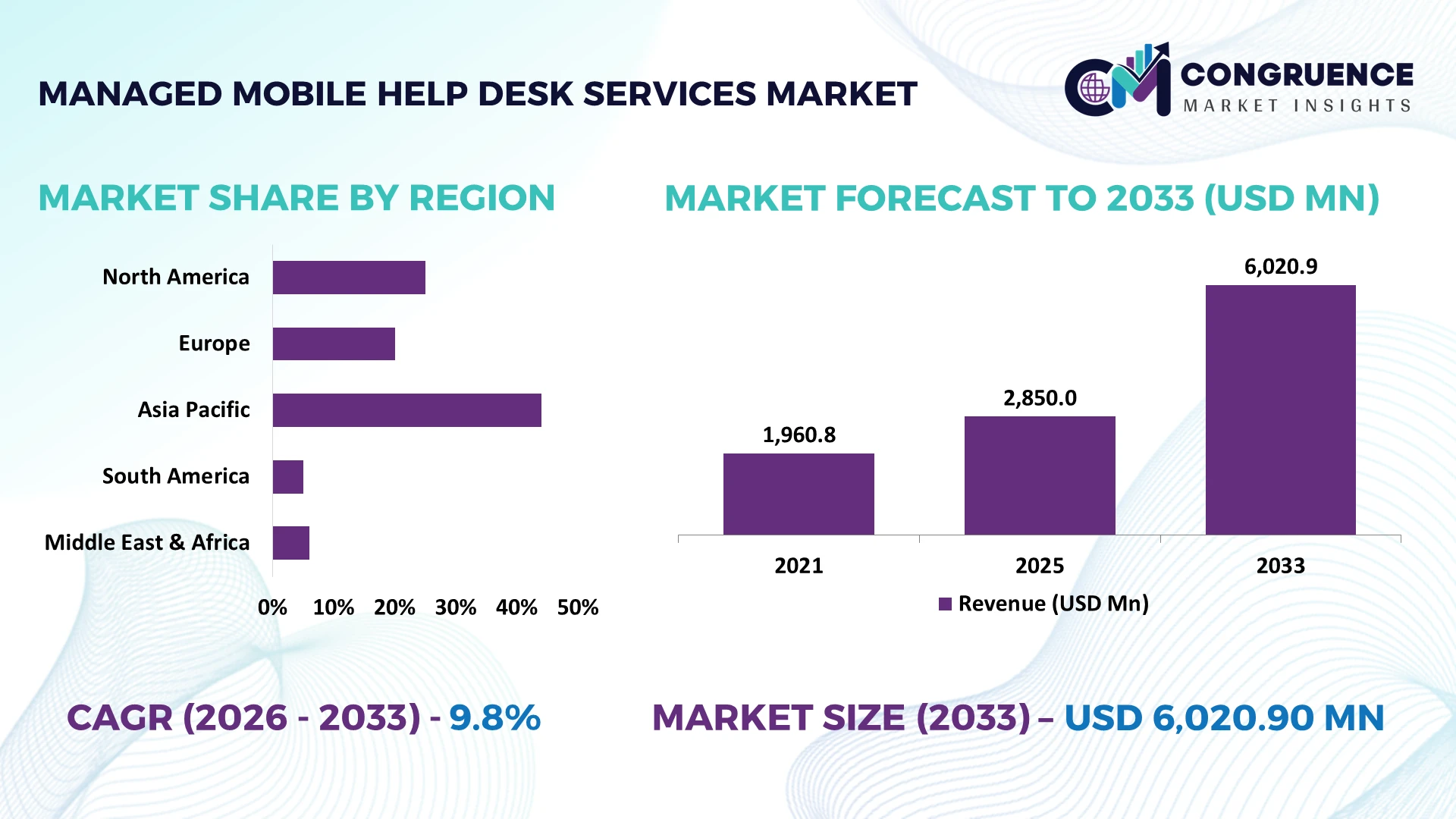
The Global Managed Mobile Help Desk Services Market was valued at USD 2850 Million in 2025 and is anticipated to reach a value of USD 6020.9 Million by 2033 expanding at a CAGR of 9.8% between 2026 and 2033. Growth is driven by enterprise mobility management, AI-powered IT support automation, zero-trust mobile security, and the expansion of managed endpoint services across distributed workforces.
The United States dominates the managed mobile help desk services landscape, supported by extensive enterprise mobility deployments, advanced cloud infrastructure, and substantial cybersecurity investments. Its position is reinforced by federal zero-trust initiatives and widespread adoption of Microsoft Intune, automated device provisioning, and mobile endpoint monitoring. Healthcare, banking, retail, and technology enterprises represent major service users. Compared with India, where mobile IT support outsourcing emphasizes cost optimization, US enterprises prioritize integrated security, compliance, and 24/7 service availability across geographically distributed operations.
Strategically, providers should prioritize US enterprise contracts and India's scalable delivery infrastructure, targeting 24/7 support coverage and measurable reductions in mobile incident resolution times.
Key Highlights of the Global Managed Mobile Help Desk Services Market
-
Market Size & Growth: USD 2,850 million in 2025, reaching USD 6,020.9 million by 2033 at 9.8% CAGR, driven by AI-enabled mobile IT support outsourcing.
-
Top Growth Drivers: Enterprise AI integration attracts 81% leadership interest, 46% report automated business workflows, and 45% prioritize digital labor expansion.
-
Short-Term Forecast: By 2027, advanced service desks target 25% lower ticket handling costs through automated triage and remote remediation.
-
Emerging Technologies: Three innovations reshape managed mobility services: generative AI copilots, predictive endpoint analytics, and zero-touch mobile provisioning.
-
Regional Leaders: Illustrative 2033 allocation: North America USD 2,408.4 million, Europe USD 1,625.6 million, and Asia-Pacific USD 1,505.2 million, emphasizing automation, compliance, and outsourced support respectively.
-
Consumer/End-User Trends: 69% of surveyed leaders regularly use generative AI, strengthening enterprise expectations for intelligent self-service support.
-
Pilot/Case Example: A 2026 published enterprise ITSM case study documented 40% faster incident resolution and 30% fewer manual interventions following generative AI implementation.
-
Competitive Landscape: IBM, Microsoft, Kyndryl, HCLTech, and Unisys compete through integrated 24/7 support, endpoint security, and service automation.
-
Regulatory & ESG Impact: GDPR and zero-trust requirements reinforce secure workflows; providers should target 100% audit logging of privileged mobile support actions.
-
Investment & Funding: Microsoft's 2025 ecosystem recorded over 3 million customer-created AI agents, highlighting investment momentum toward enterprise automation platforms.
-
Innovation & Future Outlook: By 2028, autonomous troubleshooting and predictive device maintenance will prioritize first-contact resolution and reduced technician intervention.
Managed Mobile Help Desk Services increasingly support enterprise smartphones, tablets, rugged devices, and distributed employee endpoints across banking, healthcare, logistics, and retail. Innovations in AI-assisted ticket classification, unified endpoint management, and automated device enrollment are reshaping service delivery. Microsoft's management of more than 1 million corporate devices demonstrates the operational scale of cloud-native endpoint support. India's expanding AI capabilities and European data protection requirements further influence delivery models, encouraging providers to combine offshore technical expertise with localized compliance. These developments establish automation maturity and security integration as critical strategic differentiators.
What Is the Strategic Relevance and Future Pathways of the Managed Mobile Help Desk Services Market?
Managed Mobile Help Desk Services are becoming strategically important as enterprises shift from fragmented device troubleshooting toward integrated digital workplace management. Rising smartphone dependency, hybrid workforce expansion, and zero trust security requirements are reshaping IT outsourcing decisions. Microsoft's management ecosystem supports millions of enterprise endpoints, demonstrating the operational importance of centralized device administration. Companies increasingly prioritize managed mobility providers capable of combining technical assistance, endpoint security, and automated incident resolution within unified service delivery frameworks.
AI powered service desks offer measurable advantages over legacy ticketing systems, with modeled deployments targeting 25–35% faster incident classification and 15–20% lower handling costs. The United States emphasizes intelligent automation and cybersecurity integration, while India leverages established IT outsourcing capabilities and multilingual technical support infrastructure. Germany prioritizes GDPR compliant device management and controlled enterprise data access. During 2026–2028, advanced deployments are expected to increase automated ticket resolution, remote remediation, and first contact support effectiveness.
A practical deployment involves integrating Microsoft Intune with ServiceNow workflows to automate device enrollment, compliance verification, and incident escalation. Providers including Kyndryl, HCLTech, and IBM are strengthening automation capabilities and ecosystem partnerships to support enterprise mobility transformation. Competitive advantage increasingly depends on secure service orchestration, measurable resolution efficiency, and scalable multinational delivery.
Managed Mobile Help Desk Services Market Dynamics
DRIVER:
Enterprise Mobility Expansion and AI Powered IT Support
Enterprise mobility expansion is accelerating managed mobile help desk adoption as organizations consolidate smartphone administration, remote troubleshooting, and endpoint security. Microsoft's 2024 Work Trend Index reported that 75% of knowledge workers used AI at work, while 78% of AI users brought their own AI tools. These findings highlight growing pressure on enterprise IT departments to standardize digital support and control unmanaged applications. In the United States, federal zero trust modernization initiatives reinforce identity verification and endpoint compliance requirements. Managed service providers are responding by integrating Microsoft Intune, ServiceNow, and AI assisted incident management. The strategic advantage lies in reducing technician workload while improving device visibility, support consistency, and policy enforcement.
RESTRAINT:
Platform Fragmentation and Compliance Costs
Platform fragmentation creates immediate cost and interoperability barriers for managed mobile help desk providers supporting heterogeneous enterprise environments. Apple's iOS and Google's Android collectively account for virtually 100% of smartphone operating systems, yet their distinct management frameworks require separate provisioning, security, and troubleshooting procedures. IBM's 2024 breach research identified a 10% annual increase in average breach costs, intensifying pressure for secure remote assistance. Germany's GDPR enforcement further complicates cross-border access to employee device information. Providers must maintain platform-specific technical expertise, compliant data handling, and integrated endpoint management infrastructure. Companies are reducing operational exposure through standardized service catalogs, regional support operations, contractual security controls, and unified endpoint management partnerships.
OPPORTUNITY:
Autonomous Support and Emerging Enterprise Mobility
Autonomous mobile support creates opportunities to move beyond conventional ticket handling into predictive endpoint maintenance and outcome-based managed services. Microsoft's 2024 research found that 75% of knowledge workers already used AI, while 46% of surveyed leaders reported using agents to automate business processes in its 2025 Work Trend Index. These adoption signals support enterprise investment in conversational troubleshooting, intelligent knowledge retrieval, and automated device recovery. India offers an attractive delivery base for multilingual support, while Southeast Asian manufacturing operations require dependable management of rugged mobile terminals. Providers are developing AI copilots, remote diagnostics, and device lifecycle partnerships. Illustrative deployment targets include 30% fewer technician escalations and 20% faster issue resolution, creating differentiated service contracts.
CHALLENGE:
Cybersecurity Resilience and Multinational Service Execution
Maintaining consistent service quality across distributed enterprises presents a substantial execution challenge as mobile endpoints, identity systems, and AI agents become increasingly interconnected. Verizon's 2025 Data Breach Investigations Report identified third-party involvement in 30% of breaches, doubling the previous year's proportion, while vulnerability exploitation accounted for 20% of initial access. These findings underscore the security implications of outsourced support privileges and interconnected management platforms. US healthcare organizations face particularly demanding requirements for secure authentication, auditability, and uninterrupted clinical mobility. Providers must strengthen privileged access management, continuous technician training, and incident response coordination. Investment in zero trust architectures, automated quality assurance, and resilient delivery centers will determine long-term service reliability and competitive differentiation.
Managed Mobile Help Desk Services Market Latest Trends
-
Experience Level Agreements Replace Traditional SLAs: Enterprise buyers are shifting toward employee experience metrics rather than ticket closure alone. Illustrative service contracts target 90% user satisfaction, 85% first-contact resolution, and 20% fewer reopened incidents. Providers are integrating sentiment analytics, experience monitoring, and automated feedback collection into service workflows. This shift strengthens contract retention by connecting technical performance with workforce productivity.
-
eSIM Lifecycle Support Gains Enterprise Priority: Corporate smartphone fleets increasingly require remote subscription activation, carrier migration, and device replacement coordination. Apple's eSIM-focused iPhone transition in the United States has accelerated operational changes. Enterprise deployment programs target 30% faster activation and 15% fewer provisioning escalations. Managed service providers are expanding telecom partnerships and integrating carrier APIs to simplify international employee onboarding and device lifecycle administration.
-
Multilingual Service Delivery Becomes Standardized: Global enterprises are restructuring mobile support around language coverage and regional operating hours. Illustrative service models target 95% language routing accuracy, 25% shorter translation handling time, and 20% fewer cross-team transfers. Providers are deploying real-time translation, localized knowledge bases, and follow-the-sun staffing models, particularly across India and European delivery centers, improving service consistency without proportionate workforce expansion.
-
Device Circularity Reshapes Support Contracts: Corporate sustainability policies are extending managed mobility contracts into repair coordination, refurbishment, and asset recovery. Enterprise programs increasingly target 20% longer device lifecycles, 15% fewer premature replacements, and 90% asset recovery documentation. Providers are partnering with authorized repair networks and logistics specialists to integrate warranty tracking, spare-device pools, and certified data erasure into support operations.
Segmentation Analysis
By Type
Remote Help Desk Services Lead Scalable Delivery
Remote Help Desk Services represent the leading segment, with an indicative 38% market share in 2025, supported by centralized ticket management, remote diagnostics, and lower infrastructure requirements. Enterprises in the United States and India increasingly consolidate mobile support through cloud-based service desks, allowing technicians to resolve device incidents without physical intervention. Managed Device Support follows with an estimated 27% share, reflecting demand for continuous device monitoring, software maintenance, warranty coordination, and lifecycle administration. Remote service delivery also supports standardized response procedures and multilingual technical assistance across distributed employee populations.
Unified Endpoint Support represents the fastest-growing type, supported by enterprise migration toward consolidated smartphone, tablet, and workstation management. Its indicative 23% share reflects increasing adoption of integrated endpoint administration and security orchestration. On-Site Mobile Support accounts for the remaining estimated 12%, serving manufacturing facilities, healthcare campuses, and environments requiring physical hardware intervention. Providers are strengthening unified endpoint management partnerships while maintaining specialized field service networks. Investment priorities increasingly favor integrated support platforms that combine centralized visibility with selective local technical assistance.
- Gartner's 2025 technology outlook emphasized the growing importance of hybrid computing and integrated security platforms. This direction reinforces Unified Endpoint Support adoption as enterprises consolidate device administration, identity controls, and technical assistance within coordinated management environments.
By Application
Mobile Troubleshooting Dominates Service Demand
Mobile Device Troubleshooting leads application demand with an indicative 35% market share in 2025, reflecting frequent connectivity failures, operating system errors, application crashes, and device performance incidents. Enterprises depend on rapid troubleshooting to maintain workforce productivity, particularly across retail operations, field services, and distributed corporate offices. Application Support holds an estimated 26% share, supported by growing reliance on mobile productivity applications, enterprise collaboration platforms, and industry-specific software. Providers are expanding application knowledge repositories, remote diagnostic capabilities, and standardized incident classification to improve service consistency and reduce unnecessary escalations.
Security and Access Support represents the fastest-growing application, with an estimated 21% share, driven by stronger authentication requirements, mobile identity verification, and enterprise access governance. Device Configuration and Management accounts for the remaining indicative 18%, covering enrollment, operating system updates, policy deployment, and device replacement preparation. US financial institutions increasingly prioritize secure mobile access, while Indian outsourcing providers emphasize efficient application troubleshooting. Service companies are integrating identity management, mobile device management, and automated compliance verification. Competitive differentiation increasingly depends on resolving access failures without compromising security controls or employee productivity.
- Verizon's 2025 Data Breach Investigations Report found that third-party involvement appeared in 30% of breaches. This finding strengthens the business case for tightly controlled Security and Access Support, particularly where outsourced technicians manage enterprise mobile identities.
By End-User
IT and Telecommunications Maintain Market Leadership
IT and Telecommunications represents the leading end-user segment, holding an indicative 30% market share in 2025, supported by extensive mobile endpoint deployments, distributed technical workforces, and continuous network service requirements. Telecommunications operators and technology enterprises depend on centralized incident management to support employees, field engineers, and customer-facing personnel. Banking and Financial Services follows with an estimated 24% share, reflecting strict authentication requirements, secure mobile application access, and compliance-sensitive support workflows. Providers are developing industry-specific service catalogs, dedicated escalation teams, and identity-integrated support systems to strengthen service reliability and enterprise contract retention.
Healthcare Organizations represent the fastest-growing end-user category, with an indicative 20% share, supported by mobile clinical workflows, connected care coordination, and expanding tablet deployments. Retail and E-Commerce accounts for an estimated 15%, emphasizing handheld inventory terminals, mobile payment devices, and seasonal workforce onboarding. Manufacturing Enterprises represents the remaining 11%, requiring support for rugged devices and industrial mobility applications. Managed service providers are expanding healthcare partnerships, developing sector-specific troubleshooting procedures, and offering flexible support contracts. Future competitive positioning depends on aligning service availability, technical specialization, and security requirements with each industry's operational criticality.
- The American Hospital Association's 2025 healthcare technology discussions emphasized digital transformation and connected clinical operations. These priorities reinforce demand for reliable mobile support as healthcare organizations integrate electronic records, mobile communication, and bedside technology into clinical workflows.
Region-Wise Market Insights
North America accounted for the largest market share at an estimated 40% in 2025 however, Asia-Pacific is expected to register the fastest growth, expanding at a CAGR of an estimated 12.5% between 2026 and 2033.
North America Managed Mobile Help Desk Services Market
Enterprise Mobility Modernization and Integrated Support Leadership
North America holds an estimated 40% share of the global Managed Mobile Help Desk Services Market in 2025, supported by enterprise mobility integration, mature IT outsourcing infrastructure, and extensive cloud adoption. The United States dominates regional deployment activity, particularly across financial services, healthcare, telecommunications, and technology enterprises. Canada's expanding digital workplace ecosystem reinforces demand for bilingual technical support and centralized endpoint administration. Microsoft's enterprise management ecosystem supports large-scale device enrollment, compliance monitoring, and remote troubleshooting across distributed organizations. The US federal zero-trust strategy continues influencing enterprise authentication and device access policies. Managed service providers are increasingly integrating IT service management platforms with mobile device management systems, targeting illustrative improvements of 20–30% in ticket handling efficiency. Regional procurement increasingly favors integrated security, measurable service performance, and consistent employee support experiences.
United States Market Outlook: The United States benefits from concentrated enterprise technology investment, established managed service providers, and sophisticated cybersecurity infrastructure. The federal government's zero-trust modernization framework has accelerated secure endpoint management practices. Large enterprises increasingly deploy automated service desks alongside Microsoft Intune and ServiceNow, supporting continuous mobile device monitoring, identity verification, and standardized support across geographically distributed employees.
Europe Managed Mobile Help Desk Services Market
Regulatory Compliance Accelerates Secure Mobility Integration
Europe represents an estimated 27% of global market activity in 2025, with Germany, the United Kingdom, and France supporting substantial enterprise mobility deployments. GDPR requirements shape service delivery through controlled device access, secure incident documentation, and regulated employee information handling. The EU's NIS2 framework further increases cybersecurity governance expectations for organizations operating critical digital infrastructure. Germany's industrial enterprises prioritize managed support for production mobility applications, while British financial institutions emphasize identity protection and remote access governance. European providers increasingly integrate unified endpoint management with localized service delivery and multilingual technical assistance. Illustrative enterprise modernization programs target 25% faster compliance incident processing and 15% fewer manual device configuration activities. Regional competitive differentiation increasingly depends on data residency capabilities, audit readiness, and integration with established enterprise security architectures.
Germany Market Outlook: Germany's manufacturing concentration and industrial digitalization programs support specialized managed mobile help desk adoption. Automotive manufacturers, engineering companies, and industrial technology suppliers increasingly depend on rugged mobile devices and secure workforce applications. Germany's Industry 4.0 ecosystem encourages integrated device administration, while GDPR compliance strengthens demand for locally governed technical support and documented access controls across industrial facilities.
Asia-Pacific Managed Mobile Help Desk Services Market
Outsourcing Scale and Enterprise Digitization Leadership
Asia-Pacific accounts for an estimated 25% of global market demand in 2025, supported by India's IT services ecosystem, China's industrial digitization, and Japan's enterprise infrastructure modernization. India provides extensive multilingual technical support capabilities through established delivery centers in Bengaluru, Hyderabad, Pune, and Chennai. China's manufacturing enterprises increasingly require mobile support for warehouse terminals, production monitoring devices, and logistics applications. Japan emphasizes reliable enterprise mobility operations, standardized incident handling, and secure device lifecycle management. India's technology outsourcing industry supports global service desk operations through integrated IT service management and remote endpoint administration. Regional providers are developing automated multilingual assistance and centralized troubleshooting platforms, with illustrative efficiency targets of 20–30% lower handling effort. Competitive positioning increasingly reflects technical workforce availability, delivery flexibility, and enterprise platform integration.
India Market Outlook: India holds a strategic position through its established IT outsourcing infrastructure and expanding enterprise technology capabilities. NASSCOM reported that India's technology sector employed approximately 5.8 million people in FY2025, highlighting the country's substantial technical workforce. Bengaluru, Hyderabad, and Pune support managed mobility operations, while global delivery centers provide continuous troubleshooting, multilingual assistance, and enterprise endpoint administration for international customers.
South America Managed Mobile Help Desk Services Market
Enterprise Cloud Migration Strengthens Mobile Support Demand
South America represents an estimated 5% of global Managed Mobile Help Desk Services Market activity in 2025, with Brazil leading enterprise adoption and Chile and Colombia supporting specialized digital workplace deployments. Brazilian banking institutions, telecommunications operators, and retail chains increasingly require centralized support for mobile applications, payment terminals, and employee smartphones. Expanding cloud infrastructure strengthens remote device administration and incident management capabilities. Brazil's LGPD data protection framework encourages stronger controls over employee information and mobile access privileges. Managed service providers are integrating local language support with international IT service management platforms, targeting illustrative reductions of 15–20% in repetitive troubleshooting workloads. Uneven connectivity outside major metropolitan areas and fragmented enterprise technology environments constrain standardized delivery. Providers are responding through localized technical teams, telecom partnerships, and hybrid remote support arrangements.
Brazil Market Outlook: Brazil benefits from substantial banking technology adoption, established telecommunications infrastructure, and concentrated enterprise activity in São Paulo. The country's PIX instant payment system processed more than 60 billion transactions during 2024, illustrating the operational importance of dependable digital infrastructure. Financial institutions and retailers increasingly prioritize mobile application troubleshooting, secure authentication assistance, and continuous support for transaction-dependent workforce devices.
Middle East & Africa Managed Mobile Help Desk Services Market
Government Digital Investment Accelerates Managed Mobility Deployment
The Middle East & Africa represents an estimated 3% of global market activity in 2025, with the United Arab Emirates, Saudi Arabia, and South Africa supporting enterprise mobility modernization. Saudi Arabia's Vision 2030 transformation agenda encourages digital infrastructure investment across government services, healthcare, logistics, and industrial operations. UAE enterprises increasingly deploy cloud-managed smartphones and centralized service desks to support multinational workforces. South African financial institutions prioritize secure mobile banking operations and distributed employee support. Managed service providers are expanding partnerships with telecommunications operators, cybersecurity specialists, and cloud infrastructure companies. Illustrative deployment programs target 20% faster incident escalation and 15% lower manual provisioning workloads. Uneven technical workforce availability and infrastructure maturity across African markets encourage hybrid support models combining centralized remote assistance with country-specific technical delivery capabilities.
Saudi Arabia Market Outlook: Saudi Arabia benefits from government-backed digital transformation, expanding cloud infrastructure, and substantial enterprise modernization initiatives. The Kingdom's Vision 2030 program supports technology adoption across public administration, healthcare, energy, and logistics. National cybersecurity requirements strengthen demand for controlled endpoint access, secure mobile device administration, and locally compliant support operations. Enterprise buyers increasingly favor providers combining international technical capabilities with domestic delivery partnerships.
Market Competition Landscape
The Managed Mobile Help Desk Services Market features competition between global technology service leaders IBM, Kyndryl, Accenture, and HCLTech and established outsourcing specialists such as Unisys and DXC Technology. The five largest providers collectively represent an indicative 35% market share, reflecting fragmented enterprise contracts and regional delivery specialization. Global providers emphasize integrated endpoint management, cybersecurity orchestration, and multinational service coverage, while regional specialists compete through localized language support and flexible pricing. Illustrative automation programs target 25% faster incident resolution, 20% lower handling costs, and 15% fewer technician escalations. IBM and Accenture emphasize AI-enabled service workflows, while HCLTech and Kyndryl strengthen cloud management partnerships and enterprise delivery capabilities. Competition is shifting toward outcome-based contracts combining device lifecycle administration, security controls, and employee experience monitoring. Integration complexity, certified technical expertise, and compliance obligations create substantial entry barriers. Winning requires scalable automation, measurable service quality, and differentiated industry expertise across multinational enterprise environments.
Companies Profiled in the Managed Mobile Help Desk Services Market Report
-
IBM Corporation
-
Kyndryl Holdings, Inc.
-
Accenture plc
-
HCL Technologies Limited (HCLTech)
-
DXC Technology Company
-
Unisys Corporation
-
Tata Consultancy Services Limited (TCS)
-
Infosys Limited
-
Wipro Limited
-
Cognizant Technology Solutions Corporation
-
Capgemini SE
-
NTT DATA Group Corporation
-
Fujitsu Limited
-
Atos SE
Technology Insights for the Managed Mobile Help Desk Services Market
Unified endpoint management and AI assisted service desks are transforming enterprise mobile support through centralized diagnostics, automated ticket classification, and policy enforcement. Microsoft Intune, ServiceNow, and cloud ITSM platforms enable remote device provisioning, compliance monitoring, and incident routing. Illustrative deployments target 20% faster ticket processing and 15% lower administrative workloads. Compared with legacy manual ticketing, intelligent workflow automation can deliver a modeled 30% improvement in incident classification efficiency. Enterprises managing thousands of mobile endpoints benefit from standardized troubleshooting and reduced technician dependency across distributed workplaces.
Emerging technologies include predictive endpoint analytics, conversational AI copilots, and zero touch provisioning. Predictive monitoring supports proactive identification of battery degradation, application instability, and connectivity failures, targeting 25% fewer recurring incidents. AI copilots integrate enterprise knowledge bases with contextual device information, enabling modeled 20% faster first contact resolution. Microsoft's 2025 Work Trend Index reported 81% of leaders expecting AI agents to integrate into organizational strategies, indicating strong enterprise adoption intentions. Providers combining endpoint telemetry with automated remediation gain competitive advantages through improved service consistency.
Between 2026 and 2028, agentic AI and autonomous remediation will reshape mobile support operations. Service providers investing in secure orchestration, human oversight, and integrated identity controls will strengthen contract differentiation, scalability, and operational resilience.
Recent Developments in the Global Managed Mobile Help Desk Services Market
-
May 2024: Kyndryl launched Interactive AI for Service Desk, combining conversational AI, speech recognition, and human assistance. The solution can resolve up to 70% of employee IT queries digitally, reducing technician intervention and improving enterprise support scalability. Source: kyndryl.com
-
April 2025: HCLTech published a service desk hyperautomation deployment for a global technology enterprise, achieving a 70% reduction in requests requiring human agents. The implementation streamlined employee support, reduced manual workloads, and improved service capacity across distributed operations. Source: hcltech.com
-
November 2025: Gartner published its outsourced digital workplace services assessment, evaluating 18 providers, including Accenture, Kyndryl, HCLTech, and Unisys. The research emphasized workplace experience, innovation, and value-based contracts, strengthening enterprise procurement decisions and competitive differentiation among managed support providers. Source: gartner.com
-
December 2025: Unisys announced its first-place rankings across three service categories in Gartner's assessment. Its digital workplace portfolio supports over 10 million managed devices, reinforcing competitive positioning in global service desk delivery, endpoint administration, and enterprise mobility lifecycle management. Source: unisys.com
Scope of the Managed Mobile Help Desk Services Market Report
The Managed Mobile Help Desk Services Market Report examines industry performance, competitive dynamics, and enterprise adoption patterns between 2026 and 2033. Coverage includes Remote Help Desk Services, On-Site Mobile Support, Managed Device Support, and Unified Endpoint Support. Application analysis evaluates Mobile Device Troubleshooting, Application Support, Device Configuration and Management, and Security and Access Support. End-user assessment covers IT and Telecommunications, Banking and Financial Services, Healthcare Organizations, Retail and E-Commerce, and Manufacturing Enterprises, highlighting an indicative 38% share for remote support services.
Regional coverage spans North America, Europe, Asia-Pacific, South America, and the Middle East & Africa, with emphasis on deployment concentration, regulatory requirements, and outsourcing infrastructure. Technology assessment addresses AI copilots, automated remediation, predictive analytics, and endpoint security integration. Competitive benchmarking supports investment prioritization, geographic expansion, partnership selection, and differentiated service development.
Managed Mobile Help Desk Services Market Report Summary
| Report Attribute/Metric | Report Details |
|---|
Market Revenue in 2025 | USD 2850 Million |
Market Revenue in 2033 | USD 6020.9 Million |
CAGR (2026 - 2033) | 9.8% |
Base Year | 2025 |
Forecast Period | 2026 - 2033 |
Historic Period | 2021 - 2025 |
Segments Covered | By TypeRemote Help Desk Services
By ApplicationMobile Device Troubleshooting Device Configuration and Management Security and Access Support
By End-UserIT and Telecommunications Banking and Financial Services Manufacturing Enterprises
|
Key Report Deliverable | Revenue Forecast, Growth Trends, Market Dynamics, Segmental Overview, Regional and Country-wise Analysis, Competition Landscape |
Region Covered | North America, Europe, Asia-Pacific, South America, Middle East, Africa |
Key Players Analyzed | IBM Corporation, Kyndryl Holdings, Inc., Accenture plc, HCL Technologies Limited (HCLTech), DXC Technology Company, Unisys Corporation, Tata Consultancy Services Limited (TCS), Infosys Limited, Wipro Limited, Cognizant Technology Solutions Corporation, Capgemini SE, NTT DATA Group Corporation, Fujitsu Limited, Atos SE |
Customization & Pricing | Available on Request (10% Customization is Free) |





