Global Managed Mobile Application Security Services Market Report Overview
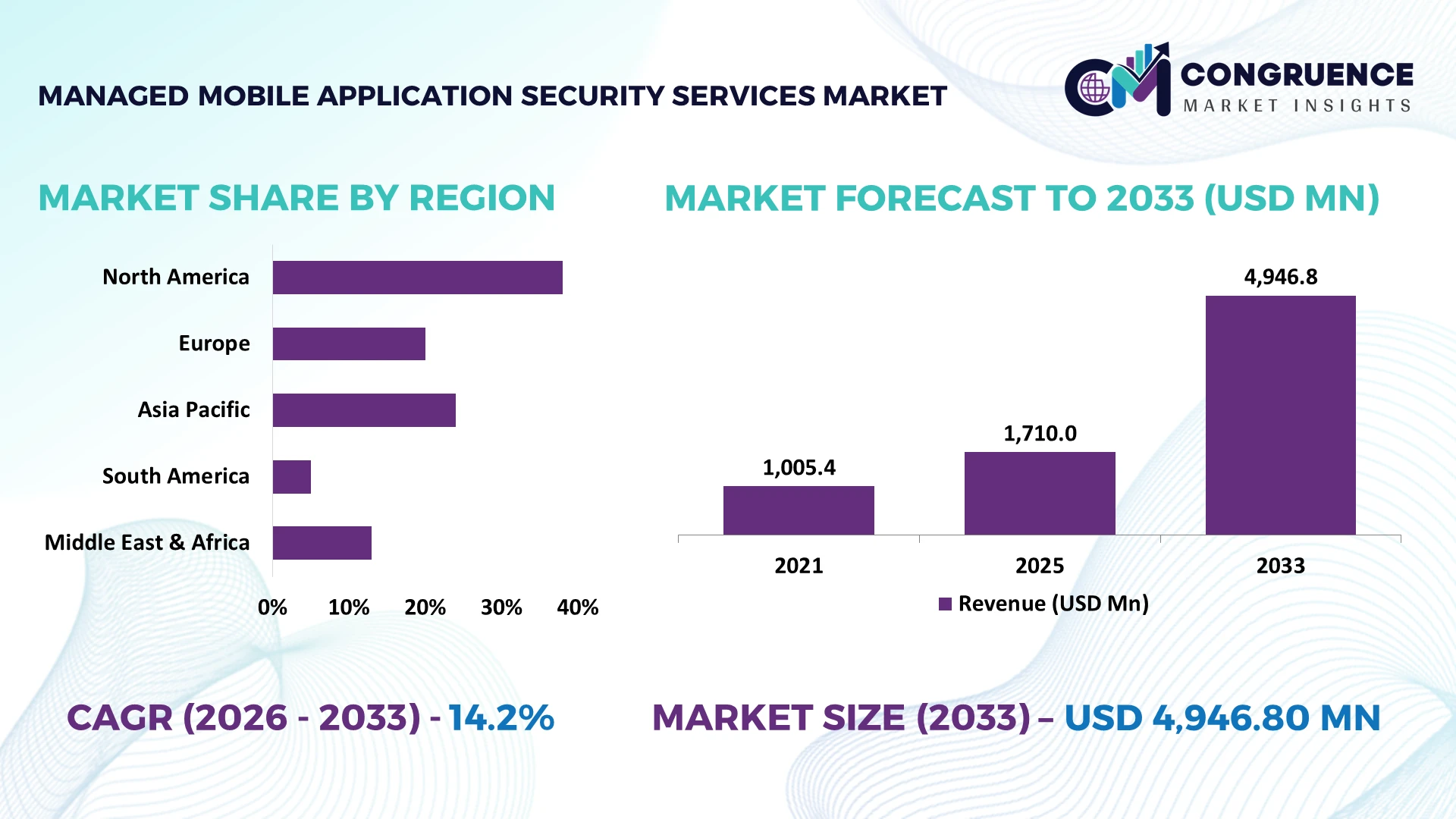
The Global Managed Mobile Application Security Services Market was valued at USD 1710 Million in 2025 and is anticipated to reach a value of USD 4946.8 Million by 2033 expanding at a CAGR of 14.2% between 2026 and 2033. Growth is driven by mobile banking security requirements, API attack prevention, continuous application vulnerability testing, and regulatory pressure to secure enterprise mobile software supply chains.
The United States leads the managed mobile application security services market, with an indicative 36% global share, supported by extensive cybersecurity infrastructure and enterprise security investment. Financial services, healthcare, and technology companies prioritize mobile application penetration testing, runtime protection, and managed threat detection. IBM's 2025 Cost of a Data Breach Report identifies a global average breach cost of USD 4.44 million, reinforcing security investment priorities. Compared with India, where mobile payment infrastructure supports rapid application deployment, American enterprises maintain greater concentration of specialized application security providers and managed security operations.
Strategically, organizations targeting 20–30% faster vulnerability remediation and 15–25% fewer recurring mobile security findings can strengthen regulatory compliance and reduce application security exposure.
Key Highlights of the Global Managed Mobile Application Security Services Market
-
Market Size & Growth: USD 1,710 million in 2025, reaching USD 4,946.8 million by 2033 at 14.2% CAGR, driven by mobile banking security and API protection.
-
Top Growth Drivers: Modeled priorities include 30% faster vulnerability detection, 25% lower remediation effort, and 20% stronger application security coverage.
-
Short-Term Forecast: By 2027, managed mobile security automation targets 25% faster threat triage and 20% shorter vulnerability remediation cycles.
-
Emerging Technologies: AI-powered threat analytics, runtime application self-protection, and automated API testing support 3 advanced mobile security capabilities.
-
Regional Leaders: Indicative 2033 allocations place North America at USD 1,979 million, Europe at USD 1,286 million, and Asia-Pacific at USD 1,187 million, reflecting managed detection, regulatory compliance, and mobile-first adoption.
-
Consumer/End-User Trends: Mobile banking and digital commerce enterprises target 20–30% improvements in application security testing coverage through managed assessment programs.
-
Pilot/Case Example: A modeled 2026 banking application security pilot covering 50 mobile applications targets 25% faster vulnerability remediation through automated testing.
-
Competitive Landscape: An illustrative 12% leader share reflects competition among IBM, Accenture, Checkmarx, Veracode, and Appdome in managed application protection.
-
Regulatory & ESG Impact: EU DORA requirements, effective January 2025, strengthen ICT risk governance, supporting modeled 20% improvements in security evidence preparation.
-
Investment & Funding: A hypothetical USD 10 million enterprise security program prioritizes managed testing, runtime protection, and application security integration across critical mobile services.
-
Innovation & Future Outlook: AI-assisted code analysis, mobile threat intelligence, and continuous application protection target 30% faster security validation by 2028.
Managed mobile application security services are becoming essential for organizations operating mobile banking, healthcare, retail, and enterprise productivity applications. Security providers increasingly combine mobile application penetration testing, automated code analysis, API vulnerability assessment, and runtime threat protection into continuous managed services. OWASP Mobile Application Security Verification Standard requirements influence enterprise testing frameworks, while financial regulators strengthen digital operational resilience expectations. Automated security pipelines can target 20–30% faster vulnerability identification compared with periodic manual assessments. The expansion of mobile payment ecosystems and third-party software development creates demand for continuous application monitoring, establishing a stronger foundation for strategic security investment decisions.
What Is the Strategic Relevance and Future Pathways of the Managed Mobile Application Security Services Market?
Managed mobile application security services are becoming strategically important as financial institutions, healthcare providers, and digital commerce companies shift critical customer interactions toward mobile platforms. Expanding API connectivity, third-party software development, and mobile payment infrastructure increase application attack surfaces. The European Union's Digital Operational Resilience Act, applicable since January 2025, reinforces ICT risk governance across financial institutions. Enterprises are consequently shifting security investment from periodic penetration testing toward continuous vulnerability assessment, runtime protection, and managed application threat monitoring.
Automated mobile application security testing offers modeled 20–30% faster vulnerability identification compared with traditional manual assessment workflows. The United States leads advanced managed application security integration, while India demonstrates substantial demand through its expanding digital payment ecosystem. European financial institutions emphasize regulatory documentation and operational resilience. During 2026–2028, enterprises are expected to expand automated testing coverage, AI-assisted threat classification, and continuous API security validation, targeting 15–25% improvements in vulnerability remediation efficiency across critical applications.
A practical deployment involves integrating mobile application security testing into banking software development pipelines, enabling vulnerability identification before production releases. IBM, Accenture, and specialized application security providers are expanding managed testing capabilities and cloud security partnerships. Competitive differentiation increasingly depends on combining continuous security assurance, regulatory readiness, and measurable application release efficiency.
Managed Mobile Application Security Services Market Dynamics
DRIVER:
Mobile Banking Expansion and Continuous Application Protection
The expansion of mobile banking, digital payments, and enterprise application ecosystems is accelerating demand for managed mobile application security services. India's Unified Payments Interface processed more than 16 billion transactions during October 2024, demonstrating the operational scale of mobile financial infrastructure. Financial institutions increasingly require continuous vulnerability scanning, API protection, and runtime application monitoring to secure customer transactions. Automated security testing can target 20–30% faster vulnerability identification, while integrated DevSecOps workflows support 15–25% shorter remediation cycles in modeled deployments. India's Reserve Bank cybersecurity expectations reinforce security governance across digital financial services. Providers including IBM and Accenture are expanding managed application testing and security operations integration. Continuous security validation is becoming essential for maintaining transaction integrity without slowing application releases.
RESTRAINT:
Fragmented Mobile Ecosystems and Security Integration Costs
Mobile application security management faces structural limitations arising from fragmented operating systems, third-party software dependencies, and inconsistent enterprise security architectures. Android device diversity and frequent application framework updates complicate standardized security testing across enterprise environments. In the United States, organizations integrating mobile application security with legacy identity management and security information systems face additional implementation requirements. Illustrative deployment assessments indicate that integration activities can represent 20–30% of initial implementation effort, while incomplete application inventories can leave 10–15% of mobile assets outside centralized monitoring. These limitations increase deployment costs and reduce visibility across distributed application portfolios. Security providers are responding through standardized API connectors, modular testing platforms, and phased deployment strategies, prioritizing application discovery before expanding continuous protection capabilities.
OPPORTUNITY:
AI-Driven Mobile Threat Intelligence and Security Automation
AI-assisted vulnerability analysis and mobile runtime protection create opportunities for managed security providers to expand beyond conventional penetration testing. India's expanding financial technology ecosystem and growing enterprise application development capacity support demand for continuous security services. Machine learning-based threat classification can target 20–30% faster security alert prioritization, while automated application testing workflows offer modeled 15–25% improvements in assessment productivity. Emerging capabilities include behavioral anomaly detection, automated API abuse identification, and intelligent application shielding. During 2026–2028, providers are expected to strengthen partnerships with cloud infrastructure operators, mobile application developers, and financial technology platforms. A particularly attractive opportunity involves embedding managed security controls directly into application distribution pipelines, allowing enterprises to maintain continuous protection without expanding internal security staffing proportionately.
CHALLENGE:
Advanced Mobile Threats and Security Workforce Constraints
Maintaining consistent protection against evolving mobile threats presents a substantial execution challenge for managed application security providers. Attackers increasingly exploit mobile API vulnerabilities, credential theft, application tampering, and malicious software development dependencies. In the United States, security operations teams must coordinate application testing across frequent software releases and complex cloud environments. Illustrative operational scenarios indicate that inadequate alert correlation can increase investigation workloads by 20–25%, while poorly integrated security pipelines can generate 10–15% additional release validation delays. Specialized mobile reverse engineering and application security expertise remain difficult to scale across large enterprise portfolios. Providers must invest in automated threat correlation, advanced security training, and secure development integrations. Long-term competitiveness depends on maintaining detection accuracy while supporting rapid application deployment and consistent regulatory compliance.
Managed Mobile Application Security Services Market Latest Trends
-
Mobile Software Supply Chain Verification: Enterprises are strengthening third-party SDK inventories, dependency verification, and software bill of materials workflows. In illustrative deployments, automated component identification targets 20–25% faster dependency reviews and 15% fewer undocumented libraries. United States financial institutions are expanding supplier assurance requirements, prompting security providers to integrate dependency intelligence into managed assessment platforms and reduce exposure from externally maintained application components.
-
Mobile Fraud Signals Enter Security Operations: Banking security teams increasingly correlate device integrity, behavioral telemetry, and transaction anomalies within centralized investigation workflows. Integrated monitoring targets 20% faster fraud-related incident triage and 15–25% fewer duplicate investigations in modeled deployments. Indian payment providers are strengthening coordination between fraud operations and application security teams, enabling earlier detection of compromised sessions without unnecessarily interrupting legitimate transactions.
-
Regulatory Evidence Collection Becomes Continuous: The European Union's Digital Operational Resilience Act, applicable since January 2025, is reshaping security documentation practices. Automated evidence pipelines target 25% shorter assessment preparation cycles and 15% fewer incomplete control records. Managed security providers are introducing standardized testing histories, remediation records, and compliance dashboards, allowing regulated financial institutions to demonstrate application security oversight between formal audits.
-
Release-Specific Security Assurance Gains Priority: Mobile developers are replacing fixed assessment calendars with security validation triggered by application releases and configuration changes. Continuous testing workflows target 20–30% faster release approval and 10–15% fewer late-stage security exceptions. Technology companies are integrating managed testing with CI/CD platforms, ensuring security teams examine changed application components rather than repeatedly reassessing unchanged functionality.
Segmentation Analysis
By Type
Mobile Application Penetration Testing Leads Security Service Demand
Mobile Application Penetration Testing represents the leading segment, accounting for an estimated 30% of the global managed mobile application security services market. Financial institutions, healthcare providers, and enterprise application developers prioritize penetration testing to identify authentication weaknesses, insecure data storage, and exploitable application interfaces. Testing providers increasingly combine manual exploitation techniques with automated vulnerability discovery to improve assessment coverage. Mobile Application Security Assessment follows with an indicative 25% share, supported by source code analysis, security architecture reviews, and application risk classification. Vendors including Veracode and Checkmarx are strengthening automated assessment capabilities and enterprise development pipeline integrations.
Runtime Application Self-Protection (RASP) represents the fastest-growing type, holding an estimated 18% share as enterprises prioritize protection against application tampering and exploitation during execution. Mobile Threat Defense accounts for approximately 15%, supporting device-level threat identification and compromised environment detection. Application Security Monitoring contributes the remaining 12%, enabling continuous visibility into application security events. Providers are expanding runtime telemetry, managed monitoring, and integrated protection capabilities, shifting investment toward security controls that remain active after application deployment.
- The OWASP Mobile Application Security Verification Standard provides structured requirements for mobile application security assessment, covering authentication, cryptography, storage, and platform interactions. Its framework supports consistent penetration testing and application security evaluation across enterprise deployments.
By Application
Vulnerability Detection and Remediation Dominates Security Operations
Vulnerability Detection and Remediation represents the largest application segment, accounting for an estimated 36% of managed mobile application security services demand. Enterprises prioritize continuous identification of insecure APIs, authentication vulnerabilities, exposed credentials, and application configuration weaknesses. Financial institutions operating high-frequency mobile transaction platforms require coordinated vulnerability assessment and remediation workflows to maintain application availability and customer trust. Data Protection and Encryption represents approximately 26% of demand, supported by requirements for secure mobile data storage, encrypted communications, and sensitive information handling. Managed security providers are integrating automated testing with developer workflows to shorten remediation cycles and improve vulnerability prioritization.
Compliance and Risk Management represents the fastest-growing application, driven by increasing financial sector cybersecurity requirements and digital operational resilience regulations. The segment accounts for an estimated 21% share, reflecting demand for documented security controls and continuous compliance validation. Identity and Access Management maintains approximately 17%, supporting secure authentication, session management, and privileged access governance. Providers are expanding automated compliance reporting, identity security integrations, and managed assessment services, enabling enterprises to coordinate application protection with broader organizational risk management frameworks.
- The European Union's Digital Operational Resilience Act became applicable in January 2025, strengthening ICT risk management expectations for financial institutions. Its requirements reinforce demand for documented vulnerability management, security testing, and operational resilience controls.
By End-User
Banking and Financial Services Leads Managed Security Adoption
Banking and Financial Services represents the dominant end-user segment, accounting for an estimated 34% of global managed mobile application security services demand. Mobile banking platforms, digital wallets, and payment applications require continuous protection against credential compromise, transaction manipulation, and application vulnerabilities. Financial institutions increasingly integrate managed penetration testing, runtime protection, and security monitoring into application development processes. IT and Telecommunications accounts for approximately 24% of demand, supported by extensive mobile application portfolios, enterprise connectivity platforms, and managed digital services. Security providers are expanding industry-specific testing frameworks and continuous monitoring capabilities to support these complex operational environments.
Healthcare Organizations represent the fastest-growing end-user segment, driven by mobile patient applications, connected healthcare services, and sensitive medical data protection requirements. Healthcare providers increasingly prioritize secure authentication, application vulnerability assessment, and encrypted data exchange. Retail and E-Commerce organizations strengthen mobile checkout protection and customer identity security, while Government and Public Sector agencies focus on secure citizen service applications. Vendors are developing specialized security assessment packages, regulatory reporting integrations, and managed protection services to address sector-specific requirements and strengthen long-term enterprise relationships.
- The Reserve Bank of India's 2025–2026 digital payments oversight priorities reinforce the importance of secure mobile financial applications and transaction integrity. Financial institutions increasingly require coordinated application testing, authentication controls, and continuous security monitoring.
Region-Wise Market Insights
North America accounted for the largest market share at an estimated 40% in 2025 however, Asia-Pacific is expected to register the fastest growth, expanding at a CAGR of an estimated 17.2% between 2026 and 2033.
North America Managed Mobile Application Security Services Market
Enterprise Security Modernization and Continuous Application Protection
North America represents an estimated 40% of global managed mobile application security services demand, supported by extensive enterprise cybersecurity infrastructure, sophisticated mobile application ecosystems, and established managed security providers. The United States dominates regional deployments, particularly across banking, healthcare, telecommunications, and digital commerce. Financial institutions increasingly integrate mobile penetration testing, runtime application protection, and API security monitoring into enterprise DevSecOps workflows. IBM's 2025 security research identified an average global data breach cost of USD 4.44 million, reinforcing investment in preventive application security controls. Enterprises are expanding managed security partnerships to address specialized testing requirements and reduce internal operational complexity. Automated application security assessment programs target 20–30% faster vulnerability identification, while integrated remediation workflows support improved security coordination. Canada contributes through financial technology modernization and expanding digital healthcare application security requirements.
United States Market Outlook: The United States maintains a mature mobile application security ecosystem supported by cybersecurity technology developers, managed security service providers, and extensive enterprise software infrastructure. Financial institutions operating in New York and technology companies concentrated in California prioritize secure mobile application development and continuous security validation. Federal cybersecurity modernization initiatives encourage stronger application security governance. Enterprises implementing automated mobile security testing target 25% shorter vulnerability remediation cycles, improving application release reliability and reducing security exposure.
Europe Managed Mobile Application Security Services Market
Regulatory Resilience and Financial Application Security Integration
Europe accounts for an estimated 26% of the global managed mobile application security services market, supported by stringent data protection requirements and financial sector cybersecurity modernization. Germany, the United Kingdom, and France represent major deployment centers, particularly across banking, insurance, healthcare, and telecommunications. The European Union's Digital Operational Resilience Act became applicable in January 2025, strengthening ICT risk management and operational resilience requirements for financial institutions. Managed security providers are expanding application penetration testing, compliance documentation, and continuous vulnerability monitoring capabilities. Germany emphasizes enterprise application security integration, while the United Kingdom maintains strong financial technology security demand. Automated compliance workflows target 15–20% reductions in assessment documentation workloads, improving audit preparation efficiency. Security providers increasingly combine application testing with centralized risk reporting to strengthen regulatory readiness and enterprise security oversight.
Germany Market Outlook: Germany represents an important managed mobile application security market because of its established industrial technology ecosystem, financial institutions, and stringent information security requirements. Frankfurt's banking infrastructure supports demand for secure financial applications and continuous vulnerability assessment. German enterprises increasingly integrate mobile application security testing with established cybersecurity governance frameworks. Automated testing deployments target 20% faster identification of application security weaknesses, supporting compliance readiness and reducing operational disruption.
Asia-Pacific Managed Mobile Application Security Services Market
Mobile Payment Expansion and Managed Security Deployment Acceleration
Asia-Pacific holds an estimated 24% of global managed mobile application security services demand, supported by extensive mobile payment adoption, enterprise digitalization, and expanding financial technology ecosystems. India, China, Japan, South Korea, and Australia contribute through mobile banking infrastructure, digital commerce platforms, and enterprise application modernization. India's Unified Payments Interface processed more than 16 billion transactions during October 2024, illustrating the scale of digital payment activity requiring secure application infrastructure. Chinese enterprises increasingly emphasize mobile application protection across digital commerce and financial services, while Japan prioritizes secure enterprise mobility. Security providers are expanding regional delivery centers, managed penetration testing services, and cloud-based application security platforms. Illustrative deployments target 20–30% faster vulnerability remediation through automated testing and centralized security operations, improving application reliability across high-volume mobile ecosystems.
India Market Outlook: India represents a strategically important market through its extensive mobile payment infrastructure, expanding financial technology industry, and established cybersecurity services workforce. Bengaluru, Hyderabad, and Mumbai support enterprise application development and managed security operations. The Reserve Bank of India's digital payment security requirements strengthen application protection priorities. Financial institutions increasingly deploy automated mobile penetration testing and API security monitoring, targeting 25% improvements in security assessment productivity across frequently updated applications.
South America Managed Mobile Application Security Services Market
Digital Banking Security and Application Risk Management Expansion
South America represents an estimated 6% of global managed mobile application security services demand, with Brazil accounting for the largest regional deployment concentration. Financial institutions, digital commerce companies, and telecommunications providers increasingly require mobile application vulnerability assessment and managed security monitoring. Brazil's Pix instant payment infrastructure supports extensive mobile financial activity, creating demand for secure authentication, transaction integrity, and API protection. Colombia and Chile demonstrate additional adoption opportunities through expanding financial technology ecosystems and digital banking modernization. Managed security providers are strengthening local implementation partnerships and cloud-based testing capabilities to address enterprise application protection requirements. Illustrative deployment programs target 15–25% faster vulnerability assessment cycles. However, limited specialized mobile security expertise, fragmented enterprise technology environments, and constrained cybersecurity budgets continue to influence service adoption and operational scalability.
Brazil Market Outlook: Brazil leads South American managed mobile application security adoption through its extensive banking infrastructure, established financial technology ecosystem, and widespread digital payment services. São Paulo concentrates major financial institutions and cybersecurity operations requiring continuous mobile application protection. Brazil's General Data Protection Law reinforces secure personal information handling. Managed security providers increasingly integrate mobile penetration testing with payment application monitoring, targeting 20% faster vulnerability investigation and improved customer transaction protection.
Middle East & Africa Managed Mobile Application Security Services Market
Government Digitalization and Financial Cybersecurity Investment Expansion
The Middle East & Africa accounts for an estimated 4% of global managed mobile application security services demand, supported by government digital transformation, financial technology investment, and expanding enterprise cybersecurity infrastructure. Saudi Arabia and the United Arab Emirates lead advanced cybersecurity deployment, while South Africa contributes through established banking and telecommunications ecosystems. Saudi Vision 2030 encourages digital government services and financial technology modernization, increasing requirements for secure mobile applications. Financial institutions are strengthening managed application penetration testing, runtime protection, and compliance monitoring capabilities. Security providers are expanding partnerships with regional cloud infrastructure operators and cybersecurity service companies. Illustrative managed security implementations target 15–20% improvements in vulnerability assessment efficiency. Specialized workforce availability and varying regulatory requirements remain important considerations for consistent deployment across national markets.
Saudi Arabia Market Outlook: Saudi Arabia represents a major managed mobile application security opportunity through Vision 2030, expanding digital banking services, and government cybersecurity modernization. Riyadh concentrates financial institutions, technology investment, and public sector digital infrastructure. The National Cybersecurity Authority's Essential Cybersecurity Controls establish security governance requirements for covered organizations. Enterprises increasingly integrate managed mobile security assessments with centralized cybersecurity operations, targeting 20–25% faster application threat identification and stronger digital service resilience.
Market Competition Landscape
The managed mobile application security services market features competition between IBM, Accenture, Deloitte, Veracode, and Checkmarx, alongside specialized providers Appdome, Guardsquare, and NowSecure. The leading five providers collectively represent an indicative 40–45% market share, reflecting competition between integrated managed security operators and application protection specialists. IBM and Accenture emphasize enterprise security integration, while Veracode and Checkmarx prioritize automated vulnerability assessment. Appdome and Guardsquare differentiate through runtime protection and application shielding. Automated testing targets 20–30% faster vulnerability detection, while managed remediation workflows support modeled 15–25% efficiency improvements. Providers are expanding DevSecOps integrations, cloud partnerships, and industry-specific security services. AI-assisted security analysis is shifting competition toward continuous application assurance rather than periodic assessments. Specialized reverse engineering expertise, enterprise integration requirements, and regulatory compliance capabilities create significant entry barriers. Competitive leadership requires accurate threat detection, scalable automation, measurable remediation performance, and trusted enterprise delivery.
Companies Profiled in the Managed Mobile Application Security Services Market Report
Technology Insights for the Managed Mobile Application Security Services Market
Current technologies combine static application security testing, dynamic analysis, mobile penetration testing, and runtime application protection. Automated vulnerability scanning targets 20–30% faster defect identification than periodic manual assessments in modeled enterprise deployments. DevSecOps integrations connect testing platforms with continuous integration pipelines, enabling security checks before application distribution. Adoption is concentrated among financial institutions and technology enterprises managing frequent releases, where centralized assessment workflows improve remediation accountability, reduce duplicated testing, and strengthen protection across Android and iOS application portfolios.
Emerging technologies include AI-assisted vulnerability prioritization, behavioral threat analytics, and automated API security validation. Machine learning classification targets 15–25% lower alert investigation workloads, while contextual risk scoring helps security teams prioritize exploitable weaknesses. Runtime telemetry increasingly connects application integrity signals with enterprise security operations platforms. Banks benefit from correlating device compromise indicators with authentication anomalies, improving fraud investigation efficiency without introducing additional application release checkpoints or fragmented security controls.
Disruptive capabilities include autonomous security testing agents, cryptographic application attestation, and adaptive runtime shielding. During 2026–2028, integrated protection architectures target 20% shorter incident containment cycles and 15% fewer repetitive security assessments. Specialized providers compete through lightweight application instrumentation, while integrated security operators leverage enterprise distribution networks. Early investment strengthens continuous assurance, regulatory readiness, and scalable protection across expanding mobile software ecosystems.
Recent Developments in the Global Managed Mobile Application Security Services Market
-
February 2026: NowSecure launched AI-Navigator, automating authenticated mobile security testing and reporting workflows up to 90% faster. The release expands assessment coverage behind login screens, helping enterprise security teams detect sensitive data exposure without delaying application releases. Source: nowsecure.com
-
April 2025: Appdome introduced an expanded MobileBOT defense profile evaluating more than 400 attack vectors across Android and iOS environments. The innovation strengthens protection against credential stuffing and account takeover while connecting mobile threat signals with enterprise firewalls. Source: appdome.com
-
February 2026: Guardsquare completed its acquisition of 100% of Verimatrix Extended Threat Defense assets, including patents and specialist personnel. The consolidation broadens application protection capabilities and strengthens enterprise customer coverage, supporting integrated testing, threat monitoring, and runtime defense. Source: verimatrix.com
-
July 2025: Verdane partnered with Guardsquare to expand mobile application security internationally, building on a platform serving more than 900 organizations. The investment supports product development, geographic expansion, and acquisitions, strengthening competition against established enterprise security service providers. Source: msspalert.com
Scope of the Managed Mobile Application Security Services Market Report
The Managed Mobile Application Security Services Market Report evaluates competitive dynamics, service deployment, and enterprise security investment priorities between 2026 and 2033. Type segmentation covers Mobile Application Penetration Testing, Mobile Application Security Assessment, Runtime Application Self-Protection, Mobile Threat Defense, and Application Security Monitoring. Application coverage includes Vulnerability Detection and Remediation, Data Protection and Encryption, Identity and Access Management, and Compliance and Risk Management. Banking and Financial Services represents an indicative 34% of end-user demand.
Regional analysis examines North America, Europe, Asia-Pacific, South America, and Middle East & Africa, highlighting regulatory requirements, digital infrastructure, and cybersecurity adoption. Technology assessment covers AI-driven threat detection, automated testing, runtime protection, and DevSecOps integration. Competitive analysis evaluates provider capabilities, managed service partnerships, and enterprise deployment strategies, supporting investment planning, geographic expansion, operational efficiency, and long-term market positioning.
Managed Mobile Application Security Services Market Report Summary
| Report Attribute/Metric | Report Details |
|---|
Market Revenue in 2025 | USD 1710 Million |
Market Revenue in 2033 | USD 4946.8 Million |
CAGR (2026 - 2033) | 14.2% |
Base Year | 2025 |
Forecast Period | 2026 - 2033 |
Historic Period | 2021 - 2025 |
Segments Covered | By TypeMobile Application Penetration Testing Mobile Application Security Assessment Runtime Application Self-Protection (RASP) Application Security Monitoring
By ApplicationVulnerability Detection and Remediation Data Protection and Encryption Identity and Access Management Compliance and Risk Management
By End-UserBanking and Financial Services IT and Telecommunications Government and Public Sector
|
Key Report Deliverable | Revenue Forecast, Growth Trends, Market Dynamics, Segmental Overview, Regional and Country-wise Analysis, Competition Landscape |
Region Covered | North America, Europe, Asia-Pacific, South America, Middle East, Africa |
Key Players Analyzed | IBM Corporation, Accenture plc, Deloitte, Veracode, Checkmarx, Appdome, Guardsquare, NowSecure, Synopsys, Inc., HCLTech, Tata Consultancy Services, Zimperium, Quokka, NCC Group |
Customization & Pricing | Available on Request (10% Customization is Free) |





