
Reports
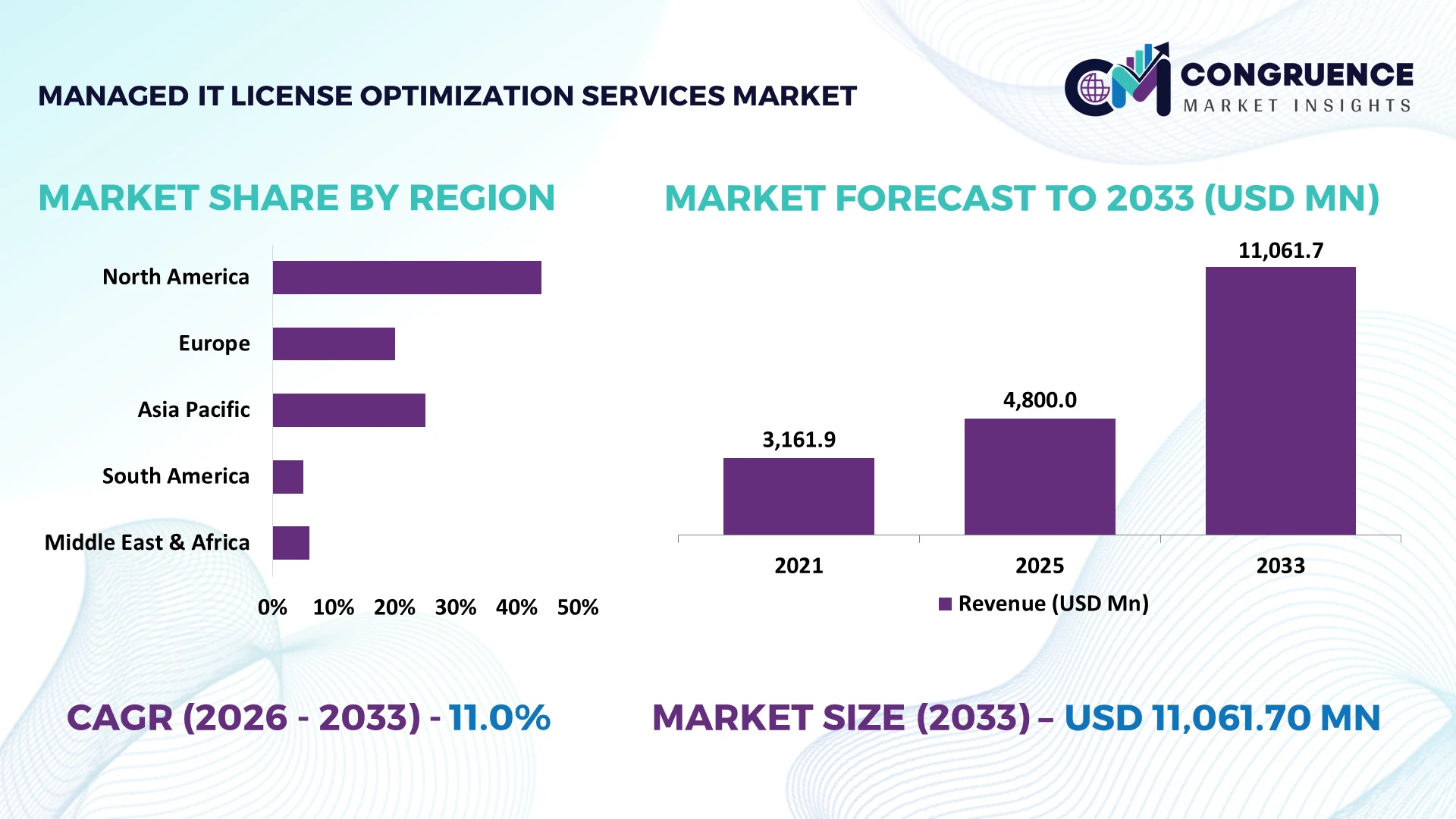
The Global Managed IT License Optimization Services Market was valued at USD 4800 Million in 2025 and is anticipated to reach a value of USD 11061.7 Million by 2033 expanding at a CAGR of 11% between 2026 and 2033. Growth is driven by SaaS subscription proliferation, cloud consumption optimization, automated software entitlement reconciliation, vendor licensing complexity, and AI-powered software asset management.
The United States leads the Managed IT License Optimization Services Market, with an indicative 38% global share in 2025, supported by extensive enterprise software portfolios and advanced SaaS management infrastructure. Banking, healthcare, technology, and government organizations prioritize automated license discovery, subscription rationalization, and audit readiness. Flexera's 2025 State of the Cloud Report identified managing cloud spending as a leading challenge for 84% of surveyed organizations. Compared with Germany, where software governance emphasizes GDPR compliance and contractual accountability, US enterprises prioritize multicloud optimization and automated license utilization analytics.
Strategically, providers should prioritize US enterprise SaaS portfolios and European compliance-driven contracts, targeting 20% lower unused license expenditure and 95% software entitlement reconciliation accuracy.
Market Size & Growth: USD 4,800 million in 2025, reaching USD 11,061.7 million by 2033 at 11% CAGR, driven by enterprise SaaS portfolio expansion.
Top Growth Drivers: Illustrative adoption scenarios indicate 35% SaaS management expansion, 30% cloud licensing automation, and 25% greater audit compliance demand.
Short-Term Forecast: By 2027, optimized enterprise licensing programs target 20% lower unused subscriptions and 30% faster entitlement reconciliation.
Emerging Technologies: AI license analytics, automated SaaS discovery, and FinOps integration support 95% entitlement accuracy targets across enterprise software portfolios.
Regional Leaders: Illustrative 2033 allocations place North America at USD 4,424.7 million, Europe at USD 3,097.3 million, and Asia-Pacific at USD 2,765.4 million, emphasizing automation, governance, and cloud adoption.
Consumer/End-User Trends: Enterprise software governance programs target 85% automated subscription visibility, strengthening utilization monitoring across distributed workplaces.
Pilot/Case Example: A modeled 2026 SaaS rationalization deployment targets 25% fewer inactive licenses through automated user activity analysis.
Competitive Landscape: Flexera holds an indicative 9% share, competing with IBM, ServiceNow, Snow Software, and USU through integrated optimization capabilities.
Regulatory & ESG Impact: GDPR accountability strengthens software access governance; enterprise programs target 95% documented entitlement compliance.
Investment & Funding: Flexera acquired Snow Software in 2024, consolidating 2 established software asset management portfolios and expanding enterprise optimization capabilities.
Innovation & Future Outlook: By 2028, AI-driven license reclamation and autonomous contract analytics target 30% faster software renewal decisions.
The Managed IT License Optimization Services Market is evolving toward continuous software entitlement intelligence, automated subscription governance, and consumption-based licensing optimization. Financial institutions, healthcare networks, technology enterprises, and multinational corporations increasingly require centralized oversight of SaaS subscriptions, cloud software commitments, and hybrid infrastructure licenses. Innovations in AI-assisted license reconciliation, automated usage analytics, and FinOps integration improve renewal planning and reduce unnecessary software allocation. Flexera's 2025 cloud research identified managing cloud spending as a challenge for 84% of surveyed organizations, emphasizing the importance of financial accountability. Growing complexity in vendor licensing agreements strengthens demand for specialized managed optimization services and establishes a foundation for strategic investment decisions.
Managed IT License Optimization Services are becoming strategically important as enterprises confront expanding SaaS portfolios, consumption-based software contracts, and increasingly complex vendor licensing conditions. The shift from perpetual licenses toward recurring subscriptions is changing procurement accountability and software investment planning. Flexera's 2025 cloud research identified managing cloud spending as a challenge for 84% of surveyed organizations, reinforcing the importance of centralized entitlement governance. Companies are prioritizing continuous utilization monitoring, automated reclamation, and contractual compliance to reduce unnecessary software commitments.
AI-enabled software asset management platforms provide measurable advantages over spreadsheet-based license administration. Illustrative enterprise deployments target 30% faster entitlement reconciliation and 20% lower inactive subscription expenditure. The United States emphasizes multicloud cost intelligence and automated SaaS governance, while Germany prioritizes contractual compliance and software usage accountability. Between 2026 and 2028, managed optimization programs increasingly target 95% entitlement accuracy and improved integration between procurement, identity management, and financial operations.
A practical deployment connects ServiceNow Software Asset Management with Microsoft 365 usage analytics, identifying inactive subscriptions before renewal. Flexera, IBM, and USU are strengthening automation capabilities and enterprise integration partnerships. Competitive advantage increasingly depends on verifiable savings, audit readiness, and continuous software consumption intelligence.
Enterprise SaaS proliferation is accelerating managed license optimization as organizations consolidate software discovery, subscription administration, entitlement reconciliation, and renewal management. Flexera's 2025 State of the Cloud Report identified managing cloud spending as a challenge for 84% of surveyed organizations, demonstrating widespread financial governance pressure. Illustrative enterprise programs target 95% license inventory accuracy and 25% faster subscription reconciliation through automated discovery. Microsoft's expansion of cloud subscription and consumption-based licensing models reinforces the need for continuous usage monitoring. US financial institutions and technology enterprises increasingly integrate software asset management with procurement and identity platforms. Flexera, ServiceNow, and IBM are strengthening optimization capabilities and integration ecosystems. Centralized license intelligence reduces duplicate subscriptions, improves contractual accountability, and supports more disciplined software procurement decisions.
Fragmented licensing rules and restricted software usage data constrain optimization effectiveness across hybrid enterprise environments. Subscription contracts, processor-based licensing, and cloud consumption entitlements require different reconciliation methods, increasing administrative complexity. Illustrative assessments indicate that organizations targeting 95% entitlement accuracy must resolve discrepancies affecting at least 5% of recorded license positions. Programs also target 20% fewer manual reconciliation exceptions through standardized vendor data integration. Oracle and Microsoft licensing structures create additional verification requirements for US enterprises operating virtualized infrastructure. Incomplete usage telemetry and inconsistent contract records increase audit exposure and delay procurement decisions. Providers are responding through specialized licensing expertise, standardized contract repositories, and vendor-specific connectors. Reliable entitlement evidence remains essential for scalable managed optimization.
AI-powered license reclamation creates opportunities to extend managed optimization beyond compliance into continuous software consumption governance. Predictive analytics can identify underutilized subscriptions, recommend license reassignment, and evaluate renewal alternatives using employee activity and contractual data. Illustrative enterprise programs target 25% fewer inactive subscriptions and 30% faster renewal assessments through automated usage intelligence. India's expanding technology services ecosystem offers opportunities for centralized software governance across multinational delivery centers. Emerging FinOps practices increasingly connect cloud spending, software entitlements, and departmental accountability. Flexera, ServiceNow, and specialized SaaS management providers are expanding analytics capabilities and procurement integrations. The strategic opportunity lies in converting fragmented subscription records into actionable consumption intelligence, enabling enterprises to align licensing commitments with actual operational requirements.
Maintaining accurate software entitlement positions across multicloud environments presents a persistent execution challenge. Flexera's 2025 cloud research identified managing cloud spending as a challenge for 84% of surveyed organizations, underscoring difficulties in coordinating consumption visibility and financial controls. Illustrative managed optimization programs target 95% entitlement accuracy and 30% faster reconciliation despite frequent subscription changes. US enterprises operating Microsoft Azure, AWS, and SaaS applications must reconcile vendor-specific licensing metrics, employee access changes, and contractual restrictions. Inconsistent APIs, incomplete telemetry, and rapidly changing licensing policies complicate continuous compliance monitoring. Providers must invest in specialized licensing expertise, secure data integrations, and automated entitlement validation. Long-term competitiveness depends on maintaining auditable software positions while scaling optimization across complex enterprise environments.
Software Renewal Calendars Become Centralized: Enterprises are consolidating renewal dates, cancellation windows, and contractual notice periods into unified governance dashboards. Illustrative deployments target 95% renewal visibility, 25% fewer missed cancellation deadlines, and 20% faster approval workflows. Providers are integrating procurement calendars with finance systems, reducing automatic renewals and improving negotiating leverage before enterprise software commitments become binding.
AI Software Entitlements Require Separate Controls: Microsoft 365 Copilot and other enterprise AI subscriptions introduce additional licensing tiers and eligibility requirements. Managed service providers are separating AI feature entitlements from conventional productivity subscriptions. Illustrative programs target 90% assignment accuracy, 20% fewer unnecessary premium allocations, and 15% faster access verification. This distinction helps enterprises avoid paying for capabilities employees cannot activate.
Identity Changes Trigger License Reviews: Employee transfers, contractor departures, and organizational restructuring are increasingly linked to subscription reassignment workflows. Illustrative deployments target 95% synchronization between identity records and software entitlements, 30% faster deprovisioning, and 20% fewer orphaned accounts. Providers are expanding identity management integrations, strengthening access governance while reducing manual intervention during workforce transitions.
Vendor Audit Evidence Becomes Continuous: Software publishers increasingly require detailed deployment and usage evidence during contractual reviews. Enterprises are maintaining standardized entitlement histories rather than assembling records retrospectively. Illustrative managed programs target 98% documentation completeness, 25% faster audit preparation, and 15% fewer unresolved licensing discrepancies. Providers are investing in automated evidence repositories and specialized publisher licensing expertise to improve audit defensibility.
Software Asset Management represents the leading segment, with an indicative 31% market share in 2025, supported by enterprise requirements for centralized entitlement records, software discovery, procurement integration, and contractual governance. Large organizations increasingly consolidate fragmented license administration activities within managed service agreements to strengthen audit readiness and software utilization visibility. License Compliance Management accounts for an estimated 24%, reflecting demand for accurate entitlement reconciliation and publisher-specific licensing expertise. Software License Assessment holds an indicative 18%, supporting inventory validation, contract reviews, and baseline software position analysis. Providers are strengthening platform integration and automated reconciliation capabilities to improve service scalability.
Cloud Subscription Optimization represents the fastest-growing type, with an estimated 17% share, driven by expanding SaaS portfolios, consumption-based licensing, and multicloud software commitments. License Usage Optimization accounts for the remaining indicative 10%, focusing on inactive subscriptions and inefficient license allocation. US technology enterprises prioritize integrated cloud subscription governance, while German organizations emphasize contractual compliance and auditable entitlement records. Flexera, ServiceNow, and USU are expanding analytics capabilities and software publisher integrations. Investment priorities increasingly favor continuous subscription intelligence over periodic license inventory assessments.
License Cost Reduction leads application demand with an indicative 33% market share in 2025, reflecting enterprise pressure to eliminate unused subscriptions, duplicate software purchases, and inefficient licensing commitments. Large organizations increasingly prioritize automated utilization analysis and contractual reconciliation to strengthen software spending accountability. Software Compliance Auditing represents an estimated 24%, supported by publisher verification requirements and the complexity of hybrid software licensing. License Renewal Management accounts for an indicative 18%, addressing contract expiration schedules, renewal negotiations, and subscription continuity. Providers are integrating software discovery platforms with procurement and finance systems to improve license allocation decisions and reduce administrative effort.
SaaS Usage Optimization represents the fastest-growing application, holding an estimated 16% share as enterprises expand cloud productivity, collaboration, and specialized software subscriptions. Vendor Contract Management accounts for the remaining indicative 9%, supporting licensing negotiations and contractual obligation tracking. US enterprises emphasize automated SaaS utilization intelligence, while German financial institutions prioritize software entitlement documentation and contractual compliance. Managed service providers are expanding automated usage reporting, renewal analytics, and procurement integration capabilities. Competitive differentiation increasingly depends on demonstrating measurable subscription efficiency while maintaining defensible licensing positions.
IT and Telecommunications represents the leading end-user segment, with an indicative 30% market share in 2025, supported by extensive software portfolios, distributed infrastructure, and frequent subscription changes. Technology enterprises and telecommunications operators require continuous license reconciliation across development environments, enterprise applications, and cloud platforms. Banking and Financial Services follows with an estimated 25%, reflecting strict compliance requirements, complex software contracts, and extensive employee application access. Providers are developing industry-specific optimization agreements, automated entitlement monitoring, and software publisher advisory capabilities to strengthen contractual accountability across these established enterprise customer groups.
Healthcare Organizations represent the fastest-growing end-user category, holding an indicative 19% share as hospitals and healthcare networks modernize clinical software infrastructure and expand cloud application deployment. Government and Public Sector accounts for an estimated 15%, emphasizing procurement transparency and software compliance governance. Manufacturing Enterprises represents the remaining 11%, requiring optimization across engineering applications, industrial software, and enterprise management platforms. Providers are expanding healthcare software expertise, public procurement partnerships, and specialized licensing advisory services. Future competitive positioning increasingly depends on industry-specific entitlement knowledge, secure integration capabilities, and measurable software utilization improvements.
North America accounted for the largest market share at an estimated 40% in 2025 however, Asia-Pacific is expected to register the fastest growth, expanding at a CAGR of an estimated 13.5% between 2026 and 2033.
Enterprise SaaS Governance and Automated License Intelligence
North America represents an estimated 40% of global Managed IT License Optimization Services Market activity in 2025, supported by extensive enterprise software portfolios, advanced cloud infrastructure, and established software asset management practices. The United States dominates deployment across financial institutions, healthcare networks, technology companies, and government agencies. Canadian enterprises increasingly integrate subscription management with procurement and financial governance systems. Flexera's 2025 State of the Cloud Report identified managing cloud spending as a challenge for 84% of surveyed organizations, reinforcing the importance of software consumption visibility. Providers are integrating automated entitlement reconciliation, SaaS discovery, and renewal analytics with enterprise service management platforms. Illustrative optimization programs target 95% license inventory accuracy and 25% faster reconciliation. Regional differentiation increasingly depends on software publisher expertise, multicloud integration capabilities, and measurable subscription utilization improvements.
United States Market Outlook: The United States benefits from concentrated enterprise software purchasing, established SaaS ecosystems, and advanced cloud governance capabilities. Technology companies, financial institutions, and healthcare organizations require continuous oversight of Microsoft, Oracle, SAP, and cloud software entitlements. US enterprises increasingly connect identity management systems with license allocation workflows, targeting an illustrative 20% reduction in inactive subscriptions. Automated contract intelligence strengthens renewal negotiations and audit readiness.
Contractual Compliance and Software Governance Modernization
Europe accounts for an estimated 28% of global market activity in 2025, with Germany, the United Kingdom, and France supporting extensive enterprise software optimization requirements. European financial institutions, manufacturers, and public organizations prioritize contractual accountability, software entitlement documentation, and secure subscription administration. GDPR requirements reinforce disciplined handling of employee usage data collected through software management platforms. Germany's industrial software environment creates complex licensing requirements across engineering applications, enterprise resource planning systems, and virtualized infrastructure. Managed service providers increasingly integrate automated discovery with contractual reconciliation and procurement governance. Illustrative enterprise programs target 95% entitlement accuracy and 20% faster audit preparation. The EU's Digital Operational Resilience Act, applicable from January 2025, strengthens technology risk governance within financial services. Providers differentiate through publisher-specific expertise, secure usage analytics, and auditable licensing documentation.
Germany Market Outlook: Germany benefits from extensive industrial software deployment across automotive manufacturing, engineering, chemicals, and enterprise technology operations. SAP environments, engineering design applications, and hybrid infrastructure create substantial entitlement management requirements. German enterprises prioritize verifiable software usage records and disciplined procurement controls. Illustrative optimization programs target 25% faster contract reconciliation through integrated discovery and entitlement repositories, strengthening compliance and purchasing efficiency.
Cloud Adoption and Enterprise Software Portfolio Expansion
Asia-Pacific represents an estimated 24% of global Managed IT License Optimization Services Market activity in 2025, supported by expanding enterprise cloud adoption, technology outsourcing infrastructure, and software-intensive manufacturing operations. India, China, Japan, and Australia contribute distinct demand patterns. Indian technology service providers manage complex multinational software environments, while Japanese enterprises emphasize contractual compliance and structured license administration. Australian organizations increasingly integrate SaaS governance with cloud financial management. China's expanding enterprise software ecosystem strengthens demand for domestic vendor licensing expertise and centralized subscription oversight. Illustrative regional modernization programs target 30% faster entitlement reconciliation and 20% fewer inactive software allocations. Providers are expanding cloud platform integrations, multilingual contract administration, and regional service delivery capabilities. Competitive advantage increasingly depends on localized licensing expertise, automated usage analytics, and scalable enterprise software governance.
India Market Outlook: India benefits from a substantial technology services workforce and extensive enterprise software management operations in Bengaluru, Hyderabad, Pune, and Chennai. IT outsourcing companies support global software entitlement reconciliation, subscription administration, and contract analytics. India's Digital Personal Data Protection Act strengthens attention to responsible handling of employee and enterprise information. Providers increasingly combine software asset management expertise with cloud financial operations, supporting multinational license optimization programs.
Enterprise Subscription Rationalization and Cloud Governance
South America accounts for an estimated 5% of global market activity in 2025, with Brazil leading enterprise license optimization demand and Chile and Colombia supporting specialized deployments. Brazilian financial institutions, telecommunications operators, and technology enterprises increasingly require centralized software entitlement monitoring across distributed operations. Cloud migration and SaaS procurement expansion create greater complexity in renewal scheduling, subscription allocation, and contractual compliance. Brazil's General Data Protection Law reinforces controls over employee usage information processed through license management systems. Illustrative enterprise programs target 20% fewer inactive subscriptions and 25% faster renewal assessments. Managed service providers are expanding partnerships with local cloud integrators, procurement specialists, and software licensing advisers. Fragmented enterprise purchasing records and limited integration between financial and technology systems constrain optimization consistency, encouraging standardized software discovery and contract management practices.
Brazil Market Outlook: Brazil benefits from concentrated banking technology infrastructure, extensive telecommunications networks, and growing enterprise cloud adoption. São Paulo supports substantial software procurement and managed technology operations. Brazilian organizations increasingly require centralized oversight of Microsoft, Oracle, and SaaS subscriptions. The country's data protection framework reinforces secure handling of software usage information. Automated renewal tracking and entitlement reconciliation improve procurement accountability across large enterprise environments.
Digital Transformation Investment Strengthens Software Governance
The Middle East & Africa represents an estimated 3% of global Managed IT License Optimization Services Market activity in 2025, with Saudi Arabia, the United Arab Emirates, and South Africa supporting enterprise software modernization. Saudi Arabia's Vision 2030 initiatives encourage technology investment across government services, healthcare, energy, and industrial operations. UAE financial institutions and multinational enterprises increasingly require centralized SaaS subscription oversight and contractual governance. South African technology and financial services organizations emphasize software entitlement accuracy and procurement accountability. Managed service providers are expanding regional cloud partnerships, licensing advisory capabilities, and automated subscription monitoring platforms. Illustrative enterprise programs target 95% entitlement accuracy and 20% faster license reconciliation. Differences in cloud infrastructure maturity, procurement practices, and specialist licensing expertise encourage localized delivery models and investment in regional software governance capabilities.
Saudi Arabia Market Outlook: Saudi Arabia benefits from government-backed digital modernization and expanding enterprise cloud infrastructure. Vision 2030 supports technology deployment across public administration, healthcare, energy, and logistics. Organizations increasingly require centralized management of cloud subscriptions, enterprise software contracts, and access entitlements. Regional managed service providers are strengthening partnerships with global technology vendors and developing specialized licensing expertise to improve procurement controls and contractual compliance.
Flexera, ServiceNow, IBM, USU, and Crayon compete across managed license optimization, combining software discovery, entitlement reconciliation, and procurement intelligence. Their combined global share is an indicative 34%, reflecting fragmented enterprise contracts rather than a verified industry concentration measure. Flexera and USU emphasize publisher-specific licensing expertise, while ServiceNow integrates optimization with enterprise workflows; IBM and Crayon compete through advisory delivery and cloud consumption management. Illustrative client programs target 20% lower inactive subscription allocations, 25% faster audit preparation, and 95% entitlement record accuracy. Flexera's acquisition of Snow Software intensified platform consolidation, while cloud-focused specialists expand integrations with identity, billing, and financial operations systems. Vendor licensing changes and restricted usage telemetry increase the cost of maintaining reliable optimization rules, creating barriers for smaller entrants. Winning requires defensible compliance evidence, cross-vendor technical expertise, automated renewal intelligence, and measurable savings tied directly to customer software consumption and contractual obligations.
Flexera Software LLC
ServiceNow, Inc.
IBM Corporation
USU Software AG
Crayon Group Holding ASA
SoftwareOne Holding AG
Anglepoint Group, Inc.
SHI International Corp.
CDW Corporation
Insight Enterprises, Inc.
Accenture plc
HCL Technologies Limited (HCLTech)
DXC Technology Company
Tata Consultancy Services Limited (TCS)
Automated software discovery, entitlement reconciliation, and SaaS management platforms are transforming enterprise license governance. Modern solutions integrate procurement records, identity directories, software usage telemetry, and vendor contracts to establish accurate licensing positions. Illustrative deployments target 95% entitlement accuracy and 25% faster reconciliation. Compared with spreadsheet-based administration, automated software asset management delivers a modeled 30% improvement in license processing efficiency. Enterprises integrating ServiceNow, Flexera, and cloud billing systems gain centralized subscription visibility, reducing duplicate allocations and improving contractual accountability across distributed software environments.
Emerging technologies include AI-powered license analytics, predictive renewal intelligence, and FinOps-integrated consumption monitoring. Machine learning identifies inactive subscriptions and licensing anomalies, supporting illustrative targets of 20% lower unused allocations and 25% faster contract reviews. Enterprise deployment momentum favors integrated SaaS discovery and identity-based license provisioning, with advanced programs targeting 85% automated subscription visibility. Flexera and USU compete through publisher-specific entitlement expertise, while ServiceNow emphasizes workflow automation and enterprise platform integration.
Between 2026 and 2028, agentic optimization, autonomous license reclamation, and intelligent contract interpretation will reshape managed services. Providers combining secure AI workflows with auditable licensing evidence will strengthen renewal negotiations, reduce compliance exposure, and differentiate enterprise offerings through measurable software utilization improvements and faster procurement decisions across complex multinational operations.
February 2024: Flexera completed its acquisition of Snow Software, combining 2 established technology intelligence portfolios. The transaction expanded integrated software asset management, SaaS governance, and FinOps capabilities, strengthening enterprise visibility across hybrid infrastructure and creating broader opportunities for licensing optimization. Source: flexera.com
January 2025: USU launched its next-generation IT Asset Management portfolio, introducing a unified, use-case-driven framework spanning on-premises and cloud environments. The platform consolidated software asset management capabilities to improve application usage analysis, license compliance, audit preparation, and enterprise technology governance. Source: usu.com
July 2025: SoftwareOne completed its acquisition of Crayon, combining operations across more than 70 countries and approximately 13,000 employees. The transaction expanded global software licensing advisory capacity, strengthened hyperscaler partnerships, and consolidated enterprise cloud optimization expertise under one organization. Source: softwareone.com
March 2026: ServiceNow documented Software Asset Management enhancements in its Australia release, introducing AI-assisted contract extraction, entitlement reconciliation, and Microsoft 365 license assignment automation. Its 3 licensing tiers support differentiated automation capabilities, strengthening enterprise subscription governance and reducing manual administration. Source: servicenow.com
The Managed IT License Optimization Services Market Report evaluates enterprise licensing governance, software consumption intelligence, and competitive positioning between 2026 and 2033. Type segmentation covers Software License Assessment, License Compliance Management, License Usage Optimization, Software Asset Management, and Cloud Subscription Optimization. Application analysis examines License Cost Reduction, Software Compliance Auditing, License Renewal Management, SaaS Usage Optimization, and Vendor Contract Management. End-user coverage includes IT and telecommunications, banking, healthcare, government, and manufacturing. Indicative segmentation identifies Software Asset Management as the leading type with a 31% share.
Regional analysis covers North America, Europe, Asia-Pacific, South America, and the Middle East & Africa. Technology assessment examines AI-powered entitlement reconciliation, SaaS discovery, predictive renewal analytics, and FinOps integration. Competitive benchmarking evaluates vendor capabilities, compliance expertise, and subscription optimization performance, supporting investment planning, geographic expansion, differentiated service development, and long-term enterprise software governance.
| Report Attribute/Metric | Report Details |
|---|---|
Market Revenue in 2025 | USD 4800 Million |
Market Revenue in 2033 | USD 11061.7 Million |
CAGR (2026 - 2033) | 11% |
Base Year | 2025 |
Forecast Period | 2026 - 2033 |
Historic Period | 2021 - 2025 |
Segments Covered | By Type
By Application
By End-User
|
Key Report Deliverable | Revenue Forecast, Growth Trends, Market Dynamics, Segmental Overview, Regional and Country-wise Analysis, Competition Landscape |
Region Covered | North America, Europe, Asia-Pacific, South America, Middle East, Africa |
Key Players Analyzed | Flexera Software LLC, ServiceNow, Inc., IBM Corporation, USU Software AG, Crayon Group Holding ASA, SoftwareOne Holding AG, Anglepoint Group, Inc., SHI International Corp., CDW Corporation, Insight Enterprises, Inc., Accenture plc, HCL Technologies Limited (HCLTech), DXC Technology Company, Tata Consultancy Services Limited (TCS) |
Customization & Pricing | Available on Request (10% Customization is Free) |




