
Reports
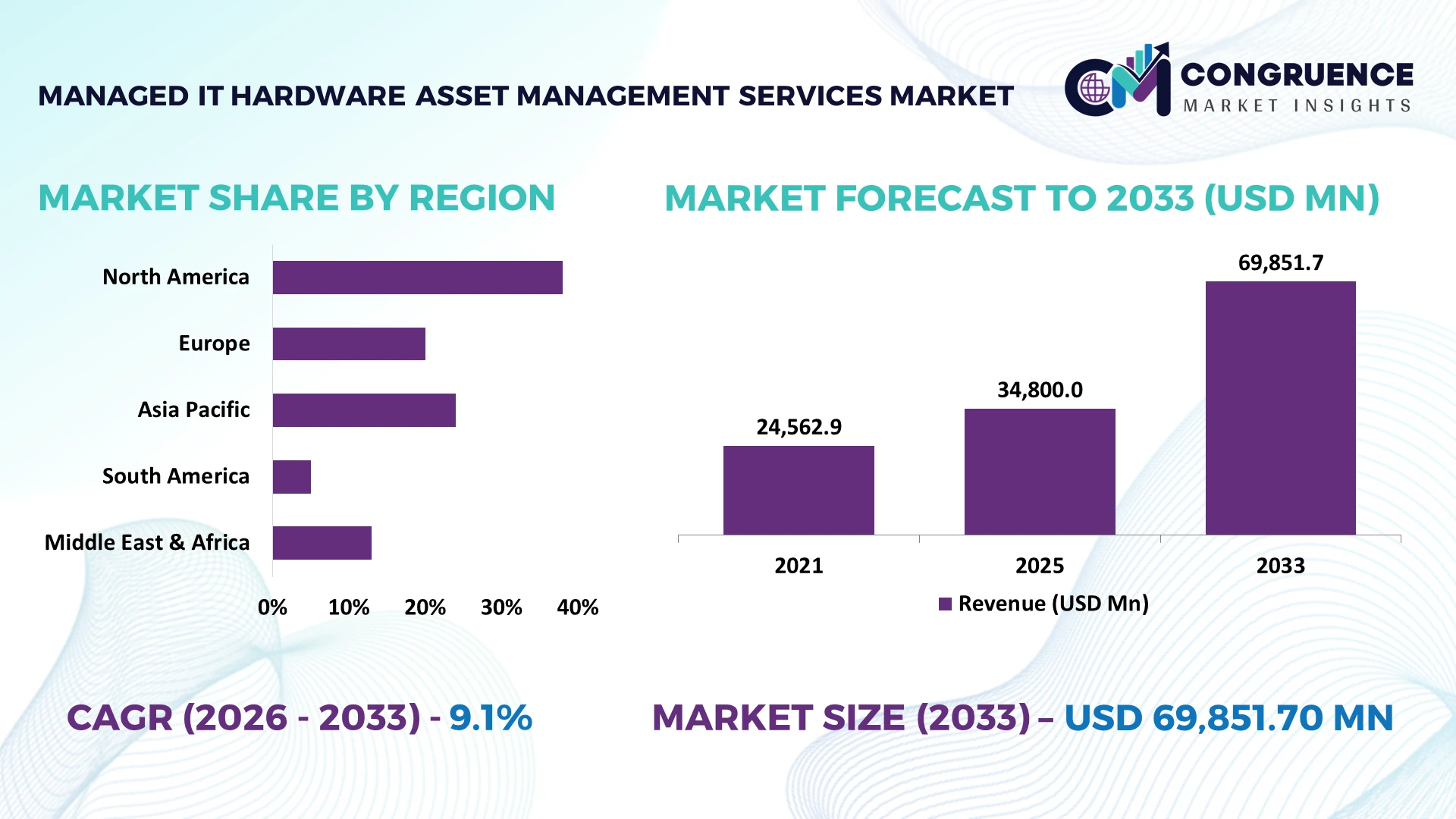
The Global Managed IT Hardware Asset Management Services Market was valued at USD 34800 Million in 2025 and is anticipated to reach a value of USD 69851.7 Million by 2033 expanding at a CAGR of 9.1% between 2026 and 2033. Growth is driven by automated hardware discovery, enterprise device lifecycle outsourcing, AI-powered asset intelligence, regulatory e-waste compliance, and increasing demand for secure IT asset disposition.
The United States leads the managed IT hardware asset management services landscape, with an indicative 36% market share in 2025, supported by extensive enterprise hardware fleets and established IT outsourcing infrastructure. Banking, healthcare, government, and technology enterprises prioritize automated inventory tracking, device lifecycle management, and secure asset disposal. The US CHIPS and Science Act authorized approximately USD 52.7 billion for semiconductor initiatives, strengthening domestic technology supply chains. Compared with India, where cost-efficient refurbishment and asset recovery are expanding, US enterprises emphasize compliance, predictive asset analytics, and certified disposal.
Strategically, providers should prioritize US enterprise lifecycle contracts and India's refurbishment capabilities, targeting 20% lower replacement costs and 95% hardware inventory accuracy through integrated asset intelligence.
Market Size & Growth: USD 34,800 million in 2025, reaching USD 69,851.7 million by 2033 at 9.1% CAGR, driven by outsourced hardware lifecycle management.
Top Growth Drivers: Illustrative adoption scenarios show 35% automated asset discovery expansion, 25% stronger lifecycle outsourcing penetration, and 20% greater refurbishment utilization.
Short-Term Forecast: By 2027, optimized enterprise programs target 20% lower hardware replacement costs and 30% faster inventory reconciliation.
Emerging Technologies: AI asset analytics, RFID tracking, and digital product passports enable 95% inventory accuracy targets across distributed hardware fleets.
Regional Leaders: Illustrative 2033 allocation: North America USD 27,940.7 million, Europe USD 19,558.5 million, and Asia-Pacific USD 17,462.9 million, emphasizing automation, circularity, and refurbishment.
Consumer/End-User Trends: Enterprise lifecycle programs increasingly target 80% automated asset visibility and standardized device recovery across distributed workplaces.
Pilot/Case Example: A modeled 2026 enterprise asset discovery deployment targets 30% faster reconciliation through automated configuration database integration.
Competitive Landscape: IBM holds an indicative 7% share, competing with Kyndryl, Accenture, HCLTech, and DXC Technology through integrated lifecycle services.
Regulatory & ESG Impact: EU circular economy requirements reinforce certified asset disposition; enterprise programs target 90% hardware recovery and documented data sanitization.
Investment & Funding: The US CHIPS and Science Act authorized approximately USD 52.7 billion for semiconductor initiatives, strengthening domestic hardware supply chains.
Innovation & Future Outlook: By 2028, predictive refresh planning and automated disposition workflows target 25% fewer premature device replacements.
The Managed IT Hardware Asset Management Services Market is shifting toward integrated device lifecycle governance, automated inventory intelligence, and circular hardware utilization. Financial institutions, healthcare networks, government agencies, and multinational technology enterprises require centralized tracking of laptops, servers, networking equipment, and employee endpoints. Innovations in RFID identification, AI-assisted asset discovery, and automated configuration management improve asset visibility and replacement planning. The Global E-waste Monitor 2024 reported 62 million tonnes of electronic waste generated worldwide in 2022, with 22.3% formally collected and recycled. This recovery gap strengthens demand for certified disposition, refurbishment partnerships, and traceable hardware lifecycle services, establishing a foundation for strategic investment decisions.
Managed IT Hardware Asset Management Services are becoming strategically important as enterprises prioritize hardware lifecycle visibility, capital efficiency, and regulatory compliance. Supply chain restructuring, semiconductor availability, and expanding electronic waste obligations are transforming asset procurement and disposition strategies. The Global E-waste Monitor 2024 documented 62 million tonnes of electronic waste generated worldwide in 2022, with only 22.3% formally collected and recycled. This recovery gap strengthens demand for traceable asset management, certified refurbishment, and secure disposal services.
AI-enabled asset discovery, RFID tracking, and integrated configuration databases offer measurable advantages over spreadsheet-based inventory systems. Illustrative deployments target 30% faster reconciliation and 20% fewer inventory discrepancies. The United States emphasizes automated asset intelligence and certified disposition, while Germany prioritizes circular economy compliance and India expands refurbishment capabilities. Between 2026 and 2028, enterprise programs increasingly target 95% inventory accuracy and longer hardware replacement cycles.
A practical deployment integrates ServiceNow Hardware Asset Management with automated endpoint discovery and certified disposition workflows, connecting procurement records with retirement verification. IBM, Kyndryl, and HCLTech are strengthening infrastructure management capabilities and ecosystem partnerships. Competitive advantage increasingly depends on lifecycle transparency, recoverable asset value, and secure multinational service execution.
Enterprise hardware lifecycle automation is accelerating managed asset services adoption as organizations consolidate procurement, inventory monitoring, maintenance, and disposition activities. The Global E-waste Monitor 2024 recorded 62 million tonnes of electronic waste in 2022, with formal recycling covering only 22.3%, reinforcing the importance of structured recovery systems. Illustrative enterprise modernization programs target 95% inventory accuracy and 25% faster asset reconciliation through automated discovery. The United States' CHIPS and Science Act is strengthening domestic semiconductor infrastructure, increasing attention to hardware supply chain resilience. IBM, Kyndryl, and HCLTech are expanding asset intelligence capabilities and integration partnerships. Centralized lifecycle visibility enables enterprises to reduce unnecessary procurement, improve utilization, and strengthen accountability across distributed technology estates.
Hardware supply volatility and fragmented inventory systems constrain managed asset service efficiency, particularly for enterprises operating mixed equipment fleets. The Global E-waste Monitor 2024 identified a 22.3% formal recycling rate, highlighting limited recovery infrastructure and inconsistent downstream processing capabilities. Illustrative asset management assessments indicate that organizations targeting 95% inventory accuracy must address reconciliation gaps of 5% or more across distributed records. Semiconductor supply concentration and changing export restrictions create procurement uncertainty for US technology enterprises and European manufacturers. Providers face higher logistics coordination costs, inconsistent asset identification, and delayed replacement scheduling. Companies are responding through diversified refurbishment partnerships, standardized asset tagging, and contractual inventory verification. Integrated procurement records and regional processing networks reduce exposure to supply disruptions.
Circular hardware management creates opportunities for providers to expand beyond inventory administration into refurbishment, predictive replacement planning, and asset recovery optimization. Global electronic waste generation reached 62 million tonnes in 2022, while only 22.3% entered documented formal recycling channels, demonstrating substantial potential for structured recovery services. Illustrative enterprise programs target 20% longer device utilization and 25% fewer premature replacements through predictive lifecycle analytics. India's expanding electronics refurbishment ecosystem offers opportunities for localized processing and certified equipment recovery. Emerging digital product passport frameworks in Europe strengthen demand for traceable component histories and standardized asset documentation. Providers are investing in AI-enabled condition assessment, reverse logistics partnerships, and certified data sanitization, positioning lifecycle intelligence as a differentiated enterprise service capability.
Maintaining secure, consistent asset disposition across multinational enterprise environments presents a substantial long-term execution challenge. The Global E-waste Monitor 2024 reported that electronic waste generation increased approximately 82% between 2010 and 2022, while only 22.3% was formally collected and recycled in 2022. These figures highlight growing pressure on processing capacity, traceability, and recovery governance. US financial institutions and healthcare organizations require verifiable data destruction, documented chain of custody, and compliance with sensitive information handling requirements. Providers must coordinate certified processors, logistics networks, and enterprise asset databases across jurisdictions. Investment in automated sanitization verification, technician certification, and tamper-resistant tracking systems is essential. Long-term competitiveness depends on preventing data exposure while maintaining auditable hardware recovery and consistent multinational execution.
Hardware Ownership Records Become Transactional: Enterprises are connecting purchase orders, serial numbers, and custody transfers within unified asset registers. Illustrative programs target 98% ownership record completeness, 30% fewer reconciliation exceptions, and 20% faster transfer approvals. Providers are integrating procurement systems with barcode scanning and employee offboarding workflows, reducing disputed asset ownership and strengthening accountability across distributed US corporate offices.
Windows Migration Reshapes Hardware Audits: Microsoft's October 2025 Windows 10 support deadline accelerated enterprise hardware compatibility assessments. Managed service providers are identifying devices unsuitable for Windows 11 and coordinating replacement schedules. Illustrative programs target 100% compatibility screening, 25% fewer emergency purchases, and 15% shorter migration preparation cycles. Hardware specialists are expanding assessment partnerships and standardized reporting to prevent unnecessary replacements and operational disruption.
Warranty Intelligence Changes Maintenance Economics: Enterprise hardware managers are consolidating manufacturer warranty records, repair histories, and service entitlements. Illustrative programs target 95% warranty record completeness, 20% fewer uncovered repair incidents, and 15% faster maintenance authorization. Providers are connecting OEM service portals with asset management platforms, enabling organizations to recover contractual benefits previously lost through fragmented documentation and inconsistent equipment identification.
Asset Recovery Logistics Become Regionalized: Multinational enterprises are reorganizing equipment collection around local processing hubs to reduce cross-border shipment complexity. Illustrative delivery models target 25% shorter collection cycles, 20% fewer logistics handoffs, and 95% chain-of-custody documentation. Providers are expanding certified collection partnerships in Germany and India, improving return visibility while limiting transportation delays and administrative processing costs.
Asset Lifecycle Management represents the leading segment, with an indicative 32% market share in 2025, supported by enterprise requirements for procurement coordination, deployment administration, maintenance scheduling, and retirement governance. Large organizations increasingly consolidate hardware lifecycle activities within managed service agreements to improve operational accountability and equipment utilization. Hardware Discovery and Inventory holds an estimated 24% share, reflecting demand for accurate device identification, ownership records, and centralized asset repositories. Hardware Maintenance and Support represents an indicative 19%, serving enterprises requiring continuous equipment availability, warranty administration, and technical service coordination. Providers are strengthening lifecycle management platforms and integrating asset information with enterprise service management systems.
IT Asset Disposal Management represents the fastest-growing type, with an estimated 15% share, driven by secure data destruction requirements, electronic waste regulations, and corporate equipment recovery programs. Hardware Procurement Management accounts for the remaining indicative 10%, supporting supplier coordination, purchasing controls, and equipment standardization. US enterprises emphasize integrated lifecycle governance, while German organizations prioritize certified disposal and regulatory compliance. IBM, Kyndryl, and HCLTech are expanding asset management partnerships and automated service capabilities. Investment priorities increasingly favor traceable hardware disposition and comprehensive lifecycle visibility over isolated inventory administration.
Asset Tracking and Monitoring leads application demand with an indicative 34% market share in 2025, reflecting enterprise dependence on accurate hardware identification, location monitoring, and custody documentation. Large organizations increasingly require centralized visibility across laptops, servers, networking equipment, and distributed employee devices. Cost and Utilization Optimization accounts for an estimated 23%, supported by efforts to reduce idle equipment, duplicate purchases, and unnecessary replacements. License and Warranty Management represents an indicative 18%, reflecting the importance of manufacturer entitlements, repair coverage, and contractual maintenance obligations. Providers are integrating asset discovery platforms, procurement records, and automated inventory reconciliation to strengthen operational efficiency.
Compliance and Risk Management represents the fastest-growing application, holding an estimated 15% share as organizations strengthen data sanitization verification, equipment traceability, and environmental reporting. IT Hardware Refresh Planning accounts for the remaining indicative 10%, supporting compatibility assessments and structured replacement schedules. US financial institutions emphasize auditable asset controls, while German manufacturers prioritize equipment traceability and regulatory documentation. Managed service providers are expanding compliance reporting, lifecycle analytics, and automated hardware governance capabilities. Competitive differentiation increasingly depends on connecting asset visibility with financial accountability and verified regulatory performance.
IT and Telecommunications represents the leading end-user segment, with an indicative 30% market share in 2025, supported by extensive server infrastructure, networking equipment, employee devices, and frequent technology replacement requirements. Telecommunications operators and technology enterprises require centralized hardware tracking to maintain service availability and coordinate distributed equipment inventories. Banking and Financial Services follows with an estimated 24%, reflecting strict data protection requirements, extensive endpoint deployments, and documented asset custody obligations. Providers are developing industry-specific lifecycle agreements, automated inventory controls, and secure hardware disposition services to strengthen operational accountability across these established enterprise customer groups.
Government and Public Sector represents the fastest-growing end-user category, holding an indicative 19% share as public institutions modernize technology infrastructure and strengthen procurement transparency. Healthcare Organizations account for an estimated 15%, emphasizing medical workstation availability, equipment traceability, and secure data handling. Manufacturing Enterprises represents the remaining 12%, requiring lifecycle management for industrial computing equipment and production network hardware. Providers are expanding government procurement partnerships, certified disposal networks, and specialized maintenance capabilities. Future competitive positioning increasingly depends on regulatory expertise, transparent asset ownership records, and scalable equipment recovery infrastructure.
North America accounted for the largest market share at an estimated 40% in 2025 however, Asia-Pacific is expected to register the fastest growth, expanding at a CAGR of an estimated 11.8% between 2026 and 2033.
Enterprise Asset Intelligence and Lifecycle Governance Leadership
North America accounts for an estimated 40% of the global Managed IT Hardware Asset Management Services Market in 2025, supported by extensive enterprise hardware inventories, established IT outsourcing infrastructure, and advanced asset discovery platforms. The United States dominates regional deployment across financial institutions, healthcare networks, technology enterprises, and government agencies. Canada's expanding technology infrastructure strengthens demand for centralized equipment tracking and secure hardware disposition. The US CHIPS and Science Act authorized approximately USD 52.7 billion for semiconductor initiatives, reinforcing domestic technology supply chain development. Managed service providers increasingly integrate automated asset discovery, configuration databases, and certified disposition workflows. Illustrative enterprise modernization programs target 95% inventory accuracy and 25% faster reconciliation. Regional competitive differentiation increasingly depends on comprehensive lifecycle visibility, auditable equipment custody, and integrated procurement management capabilities.
United States Market Outlook: The United States benefits from concentrated enterprise technology infrastructure, sophisticated IT asset management platforms, and established hardware recovery networks. Federal agencies and financial institutions prioritize secure equipment retirement and documented data destruction. NIST SP 800-88 provides recognized media sanitization guidance, supporting standardized disposal procedures. Large enterprises increasingly integrate automated asset discovery with procurement records and lifecycle analytics to improve equipment utilization and replacement planning.
Circular Economy Compliance Reshapes Hardware Lifecycle Management
Europe represents an estimated 28% of global market activity in 2025, with Germany, the United Kingdom, and France supporting substantial enterprise hardware lifecycle operations. The EU's Waste Electrical and Electronic Equipment framework strengthens requirements for equipment collection, recovery, and environmentally responsible disposal. Germany's industrial enterprises emphasize traceable asset inventories and certified refurbishment, while British financial institutions prioritize secure data sanitization and equipment custody documentation. European providers increasingly integrate asset lifecycle platforms with environmental reporting and reverse logistics networks. The EU's Right to Repair Directive, adopted in 2024, strengthens the policy environment supporting equipment repair and longer product utilization. Illustrative enterprise programs target 20% longer device lifecycles and 15% fewer premature replacements. Competitive differentiation increasingly reflects certified processing capabilities, transparent recovery documentation, and integration with corporate sustainability governance.
Germany Market Outlook: Germany benefits from established industrial infrastructure, advanced equipment management practices, and extensive recycling capabilities. Automotive manufacturers, engineering companies, and technology enterprises require structured hardware tracking across distributed facilities. Germany's Electrical and Electronic Equipment Act reinforces regulated collection and disposal procedures. Enterprise lifecycle programs increasingly prioritize certified refurbishment, secure data erasure, and traceable equipment recovery, strengthening demand for specialized managed asset services.
Electronics Manufacturing Scale and Refurbishment Expansion
Asia-Pacific holds an estimated 24% share of global market demand in 2025, supported by China's electronics manufacturing capacity, India's expanding technology outsourcing infrastructure, and Japan's established enterprise equipment management practices. China dominates regional hardware production networks, strengthening demand for procurement coordination, component traceability, and inventory administration. India supports enterprise asset lifecycle outsourcing through established technology service centers and expanding refurbishment operations. Japan emphasizes equipment reliability, structured replacement planning, and certified electronics recovery. India's E-Waste Management Rules, 2022, implemented from April 2023, established extended producer responsibility requirements for regulated electronic equipment. Providers increasingly integrate digital asset tracking with reverse logistics and authorized recycling partnerships. Illustrative enterprise programs target 25% faster asset reconciliation and 20% lower replacement expenditure. Regional competitiveness increasingly depends on processing capacity, logistics integration, and reliable equipment recovery documentation.
India Market Outlook: India benefits from extensive IT services infrastructure, expanding enterprise hardware deployment, and growing electronics refurbishment capabilities. Bengaluru, Hyderabad, Pune, and Chennai support technology asset administration and outsourced lifecycle operations. India's electronic waste regulations establish recycling obligations through extended producer responsibility mechanisms. Managed service providers increasingly combine inventory intelligence, certified disposal partnerships, and equipment recovery services to support multinational enterprises and domestic technology operators.
Enterprise Hardware Recovery and Inventory Modernization
South America represents an estimated 5% of global Managed IT Hardware Asset Management Services Market activity in 2025, with Brazil leading regional demand and Chile and Colombia supporting specialized enterprise deployments. Brazilian banking institutions, telecommunications operators, and technology enterprises increasingly require centralized hardware inventories, warranty administration, and secure equipment disposition. Brazil's National Solid Waste Policy establishes a regulatory foundation for reverse logistics and electronic waste management. Enterprise modernization initiatives increasingly connect asset identification with procurement systems and certified processing networks. Illustrative programs target 20% faster inventory reconciliation and 15% fewer untracked equipment transfers. Providers are expanding partnerships with local logistics specialists, refurbishment operators, and technology distributors. Uneven collection infrastructure outside major metropolitan areas and fragmented enterprise asset records constrain service scalability, encouraging localized processing and standardized documentation practices.
Brazil Market Outlook: Brazil benefits from substantial enterprise technology deployment, established telecommunications networks, and concentrated financial services operations in São Paulo. The country's electronic waste reverse logistics framework encourages formal equipment collection and environmentally responsible processing. Banking institutions increasingly prioritize secure hardware retirement, documented custody transfers, and centralized asset inventories. Localized refurbishment partnerships strengthen equipment recovery capabilities while reducing cross-border logistics dependence.
Digital Infrastructure Investment Strengthens Asset Governance
The Middle East & Africa accounts for an estimated 3% of global market activity in 2025, with Saudi Arabia, the United Arab Emirates, and South Africa supporting enterprise hardware management modernization. Saudi Arabia's Vision 2030 initiatives encourage technology infrastructure expansion across government services, healthcare, energy, and industrial operations. UAE enterprises increasingly require centralized equipment tracking and lifecycle administration across multinational facilities. South African financial institutions emphasize hardware inventory governance, secure data sanitization, and equipment recovery. Managed service providers are developing partnerships with technology distributors, certified recycling operators, and regional logistics companies. Illustrative modernization programs target 95% inventory accuracy and 20% faster equipment reconciliation. Differences in recycling infrastructure, technical expertise, and regulatory maturity encourage localized service delivery and selective investment in certified processing capabilities.
Saudi Arabia Market Outlook: Saudi Arabia benefits from substantial government-backed digital transformation initiatives and expanding enterprise technology infrastructure. Vision 2030 encourages modernization across public administration, healthcare, energy, and logistics. Large organizations increasingly require centralized hardware procurement records, secure equipment retirement, and documented asset custody. Partnerships between international technology providers and domestic service operators strengthen lifecycle management capabilities and support localized compliance requirements.
The Managed IT Hardware Asset Management Services Market features competition between global technology service providers IBM, Kyndryl, Accenture, and HCLTech and specialized lifecycle operators such as Iron Mountain and Sims Lifecycle Services. The five largest providers collectively represent an indicative 35% market share, reflecting fragmented enterprise contracts and regional processing specialization. Global providers compete through integrated asset intelligence, procurement administration, and multinational service delivery, while specialists emphasize certified disposition, refurbishment expertise, and recovery logistics. Illustrative enterprise programs target 95% inventory accuracy, 25% faster reconciliation, and 20% lower replacement expenditure. IBM and Kyndryl strengthen infrastructure lifecycle integration, while Iron Mountain and Sims Lifecycle Services emphasize secure processing networks and equipment recovery capabilities. Competition increasingly favors end-to-end lifecycle contracts combining asset discovery, maintenance coordination, and verified disposition. Certified processing infrastructure, regulatory compliance, and secure data sanitization create entry barriers. Winning requires transparent asset governance, scalable recovery networks, and measurable lifecycle efficiency.
IBM Corporation
Kyndryl Holdings, Inc.
Accenture plc
HCL Technologies Limited (HCLTech)
DXC Technology Company
Tata Consultancy Services Limited (TCS)
Infosys Limited
Wipro Limited
Iron Mountain Incorporated
Sims Limited (Sims Lifecycle Services)
Dell Technologies Inc.
Hewlett Packard Enterprise Company
NTT DATA Group Corporation
Capgemini SE
Automated asset discovery, RFID identification, and integrated configuration management databases are transforming enterprise hardware governance. Modern platforms synchronize serial numbers, ownership records, warranty entitlements, and deployment locations across distributed infrastructure. Illustrative implementations target 95% inventory accuracy and 25% faster reconciliation. Compared with spreadsheet based tracking, automated discovery delivers a modeled 30% improvement in inventory processing efficiency. Enterprise deployments increasingly connect procurement platforms with IT service management systems, enabling consistent equipment accountability. Providers offering integrated lifecycle visibility gain advantages over fragmented inventory administrators through faster audits and reduced manual verification.
Emerging technologies include AI powered replacement forecasting, digital product passports, and automated condition assessment. Predictive analytics target 20% fewer premature hardware replacements, while intelligent warranty management supports 15% faster maintenance authorization. Deployment momentum is strongest among multinational enterprises integrating endpoint telemetry with asset registers. Illustrative modernization programs prioritize 80% automated device visibility across managed fleets. IBM, Kyndryl, and HCLTech compete through lifecycle integration, while specialized recovery providers emphasize traceable refurbishment and certified sanitization capabilities.
Between 2026 and 2028, autonomous asset reconciliation, cryptographically verified custody records, and component level tracking will reshape service delivery. Providers integrating predictive planning with secure recovery workflows will strengthen contractual differentiation, equipment utilization, and multinational compliance execution.
January 2024: Iron Mountain completed its acquisition of Regency Technologies for an initial purchase price of USD 200 million, expanding its US IT asset disposition network. The transaction strengthened secure hardware processing, refurbishment capacity, and enterprise lifecycle service coverage. Source: investors.ironmountain.com
August 2024: Dell Technologies introduced Environmental Impact Reports within its Asset Recovery Services offering, providing customers with measurable environmental information about retired equipment. The reporting enhancement strengthened enterprise hardware disposition transparency and supported circular economy commitments, complementing Dell's 2030 sustainability objectives. Source: sustainabilitymag.com
February 2025: Hewlett Packard Enterprise disclosed that its technology renewal centers and partners processed approximately 3.4 million end-of-use assets during 2024, refurbishing 83% for reuse. The results demonstrated scalable equipment recovery and strengthened enterprise hardware lifecycle investment efficiency. Source: sec.gov
August 2025: Sims Limited reported that Sims Lifecycle Services increased processed repurposed units by 44.3% during fiscal 2025, driven by hyperscaler demand and memory component recovery. This operational expansion strengthened data center asset disposition capacity and equipment remarketing activity. Source: simsltd.com
The Managed IT Hardware Asset Management Services Market Report examines industry structure, enterprise adoption, technology integration, and competitive positioning from 2026 to 2033. Type segmentation covers Hardware Discovery and Inventory, Asset Lifecycle Management, Hardware Procurement Management, Hardware Maintenance and Support, and IT Asset Disposal Management. Application analysis evaluates asset tracking, warranty administration, utilization optimization, compliance governance, and refresh planning. End-user coverage includes IT and telecommunications, banking, healthcare, government, and manufacturing. Indicative segmentation identifies Asset Lifecycle Management as the leading type with a 32% share.
Regional analysis covers North America, Europe, Asia-Pacific, South America, and the Middle East & Africa. The report evaluates RFID tracking, AI asset intelligence, predictive maintenance, certified sanitization, and circular hardware recovery. Competitive benchmarking supports investment prioritization, geographic expansion, service differentiation, and long-term enterprise lifecycle planning.
| Report Attribute/Metric | Report Details |
|---|---|
Market Revenue in 2025 | USD 34800 Million |
Market Revenue in 2033 | USD 69851.7 Million |
CAGR (2026 - 2033) | 9.1% |
Base Year | 2025 |
Forecast Period | 2026 - 2033 |
Historic Period | 2021 - 2025 |
Segments Covered | By Type
By Application
By End-User
|
Key Report Deliverable | Revenue Forecast, Growth Trends, Market Dynamics, Segmental Overview, Regional and Country-wise Analysis, Competition Landscape |
Region Covered | North America, Europe, Asia-Pacific, South America, Middle East, Africa |
Key Players Analyzed | IBM Corporation, Kyndryl Holdings, Inc., Accenture plc, HCL Technologies Limited (HCLTech), DXC Technology Company, Tata Consultancy Services Limited (TCS), Infosys Limited, Wipro Limited, Iron Mountain Incorporated, Sims Limited (Sims Lifecycle Services), Dell Technologies Inc., Hewlett Packard Enterprise Company, NTT DATA Group Corporation, Capgemini SE |
Customization & Pricing | Available on Request (10% Customization is Free) |




