Global Managed IT Asset Lifecycle Services Market Report Overview
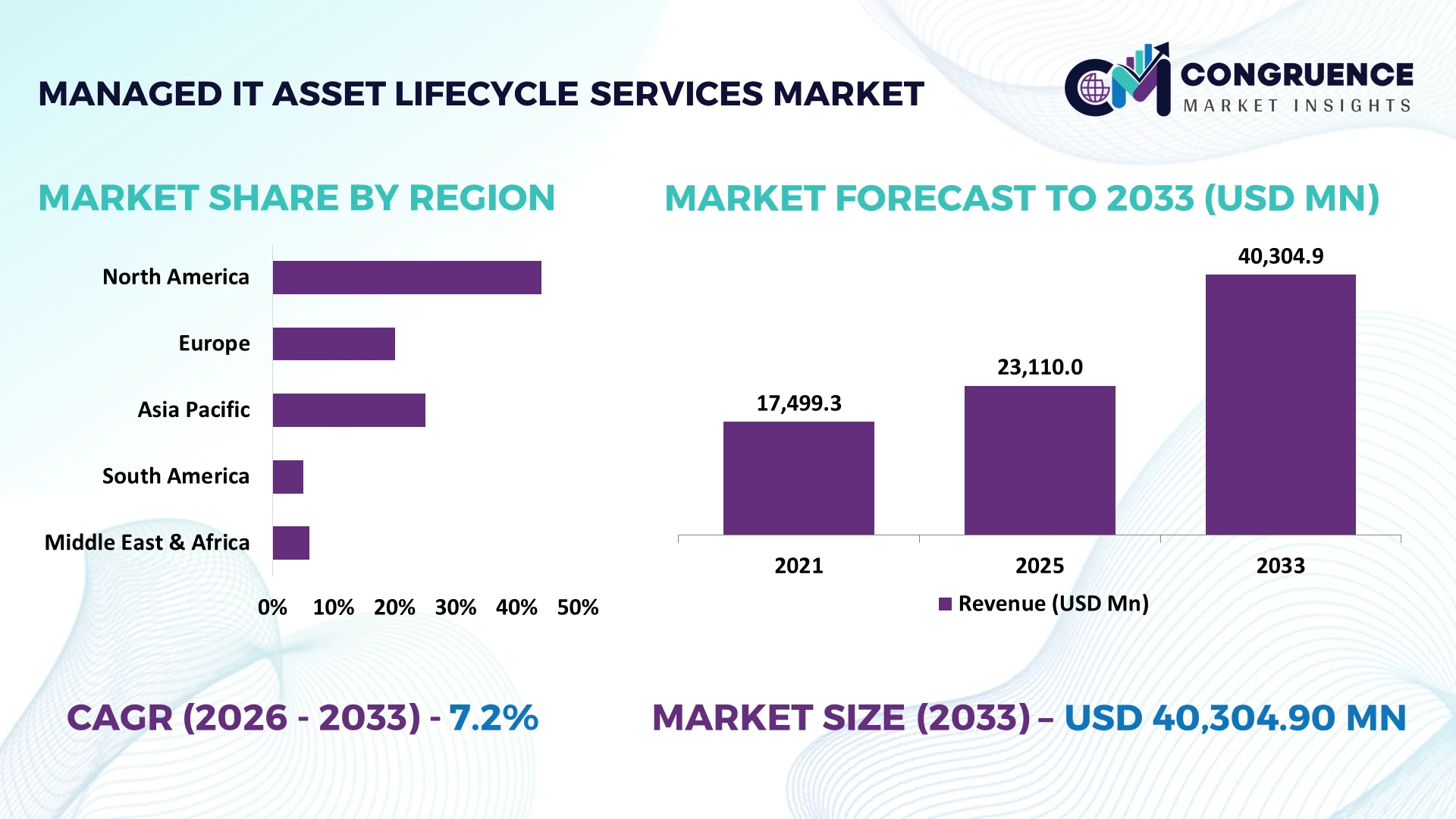
The Global Managed IT Asset Lifecycle Services Market was valued at USD 23110 Million in 2025 and is anticipated to reach a value of USD 40304.9 Million by 2033 expanding at a CAGR of 7.2% between 2026 and 2033. Growth is driven by enterprise hardware refresh cycles, automated IT asset discovery, secure data-bearing device retirement, and expanding compliance requirements for electronic waste management and certified IT asset disposition.
The United States leads the managed IT asset lifecycle services market, with an indicative 38% global share, supported by enterprise technology procurement and established IT asset disposition infrastructure. Financial institutions, healthcare providers, technology companies, and government agencies prioritize automated inventory tracking, secure data sanitization, and certified equipment recycling. NIST SP 800-88 provides a recognized framework for media sanitization. Compared with India, where IT asset management services benefit from expanding technology operations, American enterprises demonstrate greater concentration of large-scale lifecycle outsourcing and certified disposition programs.
Strategically, enterprises targeting 20–30% faster asset reconciliation and 15–25% lower equipment retirement costs can strengthen compliance, improve asset recovery, and reduce technology ownership expenses.
Key Highlights of the Global Managed IT Asset Lifecycle Services Market
-
Market Size & Growth: USD 23,110 million in 2025, reaching USD 40,304.9 million by 2033 at 7.2% CAGR, supported by enterprise hardware refresh cycles.
-
Top Growth Drivers: Illustrative priorities include 30% faster asset discovery, 25% lower retirement processing effort, and 20% improved equipment recovery.
-
Short-Term Forecast: By 2027, automated lifecycle workflows target 25% faster asset reconciliation and 20% fewer inventory discrepancies.
-
Emerging Technologies: AI-based asset analytics, RFID tracking, and automated data sanitization support 3 advanced lifecycle management capabilities.
-
Regional Leaders: Indicative 2033 allocations place North America at USD 16,122 million, Europe at USD 10,882 million, and Asia-Pacific at USD 9,270 million, reflecting outsourcing, recycling compliance, and enterprise modernization.
-
Consumer/End-User Trends: Enterprise buyers target 20–30% lower manual inventory workloads through centralized asset tracking and managed retirement programs.
-
Pilot/Case Example: A modeled 2026 lifecycle program covering 10,000 devices targets 25% faster reconciliation through RFID-enabled inventory automation.
-
Competitive Landscape: An illustrative 12% leader share reflects competition among Dell Technologies, HPE, IBM, Iron Mountain, and SHI International.
-
Regulatory & ESG Impact: EU WEEE requirements encourage certified electronics recovery, with optimized programs targeting 15–20% higher reuse and recycling efficiency.
-
Investment & Funding: A hypothetical USD 25 million enterprise modernization program prioritizes automated asset discovery, secure disposition, and lifecycle analytics.
-
Innovation & Future Outlook: Digital product passports, predictive replacement analytics, and circular IT services target 30% faster asset lifecycle decisions by 2028.
Managed IT asset lifecycle services integrate technology procurement, inventory tracking, maintenance coordination, equipment redeployment, and secure asset disposition into centralized enterprise workflows. Financial institutions, healthcare organizations, technology companies, and public agencies increasingly require traceable hardware ownership records and documented data destruction. AI-assisted asset discovery, RFID identification, and automated lifecycle analytics strengthen inventory accuracy and replacement planning. The European Union's electronic waste regulations reinforce certified recycling and equipment recovery practices. Enterprises implementing integrated lifecycle management can target 20–30% reductions in manual asset reconciliation effort, creating stronger operational foundations for procurement optimization, regulatory compliance, and long-term technology investment decisions.
What Is the Strategic Relevance and Future Pathways of the Managed IT Asset Lifecycle Services Market?
Managed IT asset lifecycle services are becoming strategically important as enterprises confront accelerated hardware replacement, fragmented device inventories, and stricter data disposal requirements. The transition toward hybrid workplaces and AI-enabled computing increases the complexity of tracking laptops, servers, storage equipment, and networking assets. Europe's Waste Electrical and Electronic Equipment framework reinforces responsible equipment collection and treatment, encouraging enterprises to integrate procurement, maintenance, redeployment, and certified disposition within coordinated lifecycle contracts. Providers are consequently expanding secure logistics, asset recovery, and technology refresh services.
Compared with spreadsheet-based inventory management, RFID-enabled tracking and automated discovery can target 20–30% faster asset reconciliation in modeled enterprise deployments. The United States leads large-scale lifecycle outsourcing, while Germany emphasizes certified recycling and circular technology procurement. India benefits from expanding enterprise IT operations and refurbishment capabilities. Between 2026 and 2028, organizations are expected to increase automated asset identification and predictive replacement planning, targeting 15–25% reductions in manual lifecycle administration.
A practical deployment involves tracking 10,000 enterprise devices through procurement, assignment, maintenance, and retirement using integrated asset management software. Dell Technologies, Iron Mountain, and SHI International are strengthening lifecycle service portfolios and disposition partnerships. Competitive advantage increasingly depends on verifiable asset custody, efficient equipment recovery, and measurable reductions in technology ownership complexity.
Managed IT Asset Lifecycle Services Market Dynamics
DRIVER:
Enterprise Hardware Refresh and Automated Asset Governance
Enterprise hardware modernization is accelerating demand for managed IT asset lifecycle services as organizations replace aging devices and strengthen asset governance. Microsoft's October 2025 end of support for Windows 10 created a significant replacement and upgrade decision point for enterprise computing fleets. Financial institutions, healthcare providers, and technology companies in the United States increasingly require coordinated procurement, device deployment, maintenance, and retirement services. Illustrative lifecycle programs target 20–30% faster inventory reconciliation, 15–25% lower administrative processing effort, and 20% improved equipment redeployment efficiency. Dell Technologies, SHI International, and Iron Mountain are strengthening device lifecycle management, secure logistics, and certified disposition capabilities. Integrated asset records also reduce procurement duplication, enabling enterprises to redirect usable equipment before authorizing additional hardware purchases.
RESTRAINT:
Fragmented Asset Records and Disposition Infrastructure Costs
Inconsistent asset inventories, fragmented enterprise software environments, and specialized equipment disposal requirements constrain managed lifecycle service adoption. Organizations operating multiple procurement systems frequently lack standardized asset identifiers, complicating reconciliation between financial records, endpoint management platforms, and physical inventories. In India, geographically dispersed enterprise facilities create additional reverse logistics and certified recycling coordination requirements. Illustrative implementation assessments indicate that inventory normalization can account for 20–30% of onboarding effort, while specialized secure transportation and disposition processes can increase retirement handling costs by 15–20%. These constraints reduce service profitability and delay enterprise outsourcing decisions. Providers are responding through standardized asset tagging, regional recycling partnerships, and phased inventory integration. Accurate initial asset classification remains essential for controlling downstream processing expenditure.
OPPORTUNITY:
Circular IT Services and Predictive Equipment Redeployment
Circular technology procurement and predictive asset analytics create opportunities for managed IT lifecycle providers to expand beyond conventional equipment retirement. European enterprises increasingly prioritize refurbishment, redeployment, and documented material recovery under sustainability and electronic waste management frameworks. AI-assisted replacement planning can target 15–25% fewer premature device retirements, while automated refurbishment classification supports modeled 20% improvements in reusable equipment identification. Digital product passport initiatives are encouraging stronger product traceability and lifecycle documentation. Providers including Iron Mountain and Dell Technologies are strengthening asset recovery, refurbishment, and certified disposition ecosystems. A differentiated opportunity involves combining device condition analytics with procurement planning, allowing enterprises to redirect functional equipment toward lower-intensity workloads before purchasing replacements. This approach strengthens equipment utilization and reduces avoidable disposal activity.
CHALLENGE:
Secure Data Erasure and Global Chain-of-Custody Assurance
Maintaining verifiable data security across geographically distributed asset retirement operations presents a significant long-term execution challenge. Enterprises must coordinate device collection, transportation, data sanitization, refurbishment, and recycling while preserving auditable custody records. NIST SP 800-88 provides established media sanitization guidance, increasing the importance of documented procedures and verification. In the United States, healthcare and financial institutions face particularly demanding information protection requirements. Illustrative operating scenarios indicate that incomplete custody documentation can increase audit preparation workloads by 20–25%, while inconsistent sanitization verification can extend equipment processing cycles by 15–20%. Lifecycle providers must invest in automated erasure certification, serialized tracking, and qualified downstream processing partners. Competitive resilience depends on proving secure disposition at scale without compromising processing efficiency or equipment recovery value.
Managed IT Asset Lifecycle Services Market Latest Trends
-
Endpoint Ownership Records Become Unified: Enterprises are connecting procurement records, endpoint management platforms, and financial asset registers through standardized device identifiers. Modeled integration programs target 25% fewer duplicate records and 20% faster ownership verification. Following Windows 10 support termination in October 2025, Dell Technologies and SHI International are strengthening inventory synchronization and deployment services to improve replacement planning across distributed enterprise fleets.
-
Device Recovery Logistics Shift Locally: Enterprises are redesigning collection networks around regional consolidation centers instead of centralized international processing. Illustrative logistics programs target 15–20% shorter collection cycles and 10–15% lower transportation handling costs. Iron Mountain and specialized disposition providers are expanding certified processing partnerships, helping customers reduce cross-border shipment complexity while maintaining consistent equipment tracking and recovery procedures.
-
Software Entitlement Reconciliation Gains Precision: Subscription-based enterprise software licensing is increasing the importance of connecting application usage telemetry with contractual entitlements. Automated reconciliation targets 20–25% faster license reviews and 15% fewer unnecessary renewals in modeled deployments. IBM and enterprise asset management specialists are integrating usage analytics with procurement workflows, enabling organizations to identify unused subscriptions before renewal commitments become unavoidable.
-
Asset Condition Scoring Improves Maintenance: Managed lifecycle providers are incorporating device health telemetry, battery condition, and warranty status into equipment maintenance decisions. Illustrative monitoring programs target 20% fewer unexpected endpoint failures and 15–25% faster maintenance prioritization. Technology service providers are expanding predictive diagnostics and automated service scheduling, allowing enterprises to distinguish repairable equipment from assets requiring replacement without relying exclusively on equipment age.
Segmentation Analysis
By Type
IT Hardware Asset Management Leads Lifecycle Service Demand
IT Hardware Asset Management represents the leading segment, accounting for an estimated 34% of global managed IT asset lifecycle services demand. Enterprises prioritize hardware inventory accuracy, procurement coordination, warranty administration, and equipment redeployment across distributed workplaces. Financial institutions and technology companies increasingly require centralized visibility into laptops, servers, storage devices, and networking equipment. Software Asset Management follows with an indicative 25% share, supported by subscription governance, license compliance, and software utilization monitoring. Providers including IBM, Dell Technologies, and SHI International are strengthening integrated asset management platforms to connect procurement records, equipment ownership, and lifecycle administration.
Cloud Asset Management represents the fastest-growing type, accounting for an estimated 18% share as enterprises expand hybrid cloud operations and require stronger visibility into virtualized resources. Network Asset Management supports infrastructure configuration records, equipment maintenance, and replacement planning, while IT Asset Disposal Services addresses secure data sanitization, certified recycling, and equipment recovery. Providers are expanding automated discovery, cloud resource analytics, and certified disposition partnerships. Investment priorities increasingly favor integrated lifecycle platforms that connect physical and digital assets, reducing administrative fragmentation and improving technology expenditure accountability.
- The International Telecommunication Union's Global E-waste Monitor 2024 documented 62 million tonnes of electronic waste generated worldwide in 2022, with only 22.3% formally collected and recycled. These findings reinforce demand for structured hardware retirement and certified disposition services.
By Application
Asset Tracking and Monitoring Dominates Lifecycle Operations
Asset Tracking and Monitoring represents the largest application segment, accounting for an estimated 30% of global managed IT asset lifecycle services demand. Enterprises require continuous visibility into equipment ownership, location, operational condition, and assignment status across geographically distributed facilities. Financial institutions, healthcare organizations, and technology companies increasingly integrate RFID identification, automated discovery, and centralized asset registers to improve inventory accuracy. Asset Procurement and Deployment accounts for an estimated 25%, supported by enterprise hardware refresh programs, standardized device configuration, and coordinated employee onboarding. Managed providers are expanding procurement integration and automated inventory reconciliation capabilities to reduce administrative processing effort.
Compliance and Cost Optimization represents the fastest-growing application, driven by software subscription complexity, regulatory oversight, and pressure to improve equipment utilization. Maintenance and Upgrades supports device availability, warranty administration, and preventive servicing, while Asset Retirement and Disposal addresses secure equipment collection, data sanitization, and certified recycling. Providers are integrating asset analytics with financial reporting, service management, and compliance documentation platforms. These capabilities strengthen purchasing decisions, identify underutilized equipment, and improve lifecycle accountability across enterprise technology portfolios.
- Microsoft ended standard support for Windows 10 on October 14, 2025, creating a major enterprise device upgrade and replacement milestone. This transition reinforced the importance of accurate asset inventories, compatibility assessments, and coordinated deployment planning.
By End-User
IT and Telecommunications Lead Enterprise Lifecycle Outsourcing
IT and Telecommunications represents the dominant end-user segment, accounting for an estimated 30% of global managed IT asset lifecycle services demand. Telecommunications operators and technology enterprises maintain extensive portfolios of computing equipment, networking devices, software subscriptions, and distributed infrastructure assets. These organizations prioritize centralized asset discovery, automated lifecycle monitoring, and coordinated equipment replacement to maintain operational continuity. Banking and Financial Services follows with an estimated 25% share, supported by stringent data security requirements, extensive endpoint inventories, and formal equipment disposal procedures. Providers including Dell Technologies, IBM, and SHI International are strengthening enterprise lifecycle contracts and integrated asset management services.
Healthcare Organizations represent the fastest-growing end-user segment as hospitals and healthcare networks modernize clinical technology infrastructure and strengthen equipment traceability. Government and Public Sector agencies emphasize procurement transparency, asset accountability, and certified electronic waste management. Manufacturing Enterprises require lifecycle services covering industrial computing equipment, network infrastructure, and distributed technology assets. Providers are expanding sector-specific asset tracking, secure disposition, and managed maintenance offerings. Competitive differentiation increasingly depends on regulatory alignment, reliable equipment availability, and consistent asset visibility across complex operational environments.
- The World Health Organization's 2025 World Health Statistics report emphasized continuing digital health system development and healthcare infrastructure modernization. These priorities strengthen the operational relevance of reliable technology asset management, equipment maintenance, and secure information handling across healthcare organizations.
Region-Wise Market Insights
North America accounted for the largest market share at an estimated 40% in 2025 however, Asia-Pacific is expected to register the fastest growth, expanding at a CAGR of an estimated 9.4% between 2026 and 2033.
North America Managed IT Asset Lifecycle Services Market
Enterprise Hardware Refresh and Integrated Lifecycle Outsourcing
North America represents an estimated 40% of global managed IT asset lifecycle services demand, supported by extensive enterprise computing infrastructure and established technology outsourcing ecosystems. The United States dominates regional activity through financial institutions, healthcare networks, technology enterprises, and government agencies managing large equipment portfolios. Microsoft's October 2025 termination of standard Windows 10 support intensified enterprise hardware compatibility assessments and replacement planning. Managed service providers increasingly integrate procurement, endpoint configuration, warranty administration, and certified equipment disposition within coordinated service contracts. Canada contributes through banking infrastructure modernization, public sector technology procurement, and regulated information management. Illustrative enterprise programs target 20–30% faster asset reconciliation and 15–20% lower equipment handling effort. Dell Technologies, Iron Mountain, and SHI International strengthen regional service capabilities through asset management platforms, secure logistics networks, and enterprise technology partnerships.
United States Market Outlook: The United States maintains a competitive advantage through its concentration of enterprise technology providers, certified IT asset disposition facilities, and established equipment refurbishment networks. California, Texas, and Virginia support substantial technology infrastructure activity, while New York concentrates financial services demand. NIST media sanitization guidance influences secure retirement procedures. Enterprises implementing serialized asset tracking can target 25% faster equipment ownership verification, strengthening audit readiness and technology procurement control.
Europe Managed IT Asset Lifecycle Services Market
Circular Technology Procurement and Regulatory Compliance Integration
Europe accounts for an estimated 27% of global managed IT asset lifecycle services demand, supported by electronic waste regulation, enterprise hardware modernization, and growing emphasis on equipment reuse. Germany, the United Kingdom, France, and the Netherlands represent important technology procurement and certified disposition markets. The European Union's Waste Electrical and Electronic Equipment Directive establishes collection and treatment requirements that influence enterprise equipment retirement practices. Corporate technology departments increasingly integrate refurbishment, secure data erasure, and material recovery into managed lifecycle contracts. The EU's circular economy initiatives also strengthen demand for traceable equipment ownership and standardized disposal documentation. Illustrative programs target 15–20% higher equipment recovery efficiency and 20% faster retirement documentation processing. Providers are expanding certified recycling partnerships, refurbishment facilities, and integrated asset reporting capabilities to support compliance and operational efficiency.
Germany Market Outlook: Germany represents a strategically important managed IT asset lifecycle services market through its manufacturing sector, enterprise technology infrastructure, and established environmental compliance framework. Automotive manufacturers, engineering companies, and financial institutions require reliable asset tracking and secure equipment retirement. The country's ElektroG legislation governs electrical and electronic equipment management. Enterprise refurbishment programs targeting 20–25% greater equipment reuse support circular procurement strategies while reducing avoidable hardware replacement requirements.
Asia-Pacific Managed IT Asset Lifecycle Services Market
Technology Manufacturing Scale and Enterprise Asset Digitization
Asia-Pacific represents an estimated 23% of global managed IT asset lifecycle services demand, supported by expanding enterprise computing fleets, electronics manufacturing capacity, and technology infrastructure modernization. China, India, Japan, Australia, and South Korea contribute through corporate technology procurement, hardware refurbishment, and managed infrastructure operations. India's established IT services industry supports enterprise device deployment and remote asset administration, while Japan emphasizes equipment reliability and structured lifecycle maintenance. China's electronics manufacturing ecosystem provides extensive hardware processing and refurbishment capabilities. Managed service providers increasingly integrate automated inventory discovery, regional logistics coordination, and certified equipment retirement services. Illustrative enterprise deployments target 20–25% faster device reconciliation and 15–20% lower administrative processing effort. Localized refurbishment partnerships are becoming important for managing equipment recovery costs and reducing unnecessary cross-border transportation.
India Market Outlook: India represents an important managed IT asset lifecycle services market through its technology outsourcing industry, expanding enterprise workforce, and established electronics refurbishment ecosystem. Bengaluru, Hyderabad, Pune, and Chennai concentrate corporate technology operations and equipment deployment activity. India's E-Waste (Management) Rules, 2022, strengthen formal recycling and producer responsibility requirements. Enterprises implementing centralized inventory platforms can target 25% fewer asset record discrepancies, improving equipment accountability across distributed offices.
South America Managed IT Asset Lifecycle Services Market
Enterprise Device Modernization and Certified Recovery Expansion
South America represents an estimated 6% of global managed IT asset lifecycle services demand, with Brazil accounting for the largest regional concentration of enterprise technology infrastructure. Financial institutions, telecommunications operators, and multinational corporations increasingly require coordinated equipment procurement, maintenance, redeployment, and secure retirement services. Brazil's established banking technology ecosystem supports demand for auditable asset ownership records and controlled equipment disposition. Chile and Colombia contribute through enterprise technology modernization and managed infrastructure outsourcing. Providers are strengthening local refurbishment partnerships and regional equipment collection networks to improve processing efficiency. Illustrative asset recovery programs target 15–20% shorter collection cycles and 10–15% lower transportation handling costs. However, hardware import expenses, geographically dispersed facilities, and uneven certified recycling capacity influence service delivery economics and infrastructure expansion decisions.
Brazil Market Outlook: Brazil leads regional managed IT asset lifecycle services adoption through its banking industry, telecommunications infrastructure, and expanding enterprise technology operations. São Paulo concentrates major corporate technology procurement and managed service activities. Brazil's National Solid Waste Policy provides an important framework for reverse logistics and responsible equipment disposal. Enterprises adopting standardized equipment identification and recovery workflows can target 20% faster retirement processing, improving asset accountability and operational coordination.
Middle East & Africa Managed IT Asset Lifecycle Services Market
Government Digital Transformation and Secure Asset Governance
The Middle East & Africa represents an estimated 4% of global managed IT asset lifecycle services demand, supported by government technology modernization, enterprise infrastructure investment, and growing requirements for secure equipment management. Saudi Arabia and the United Arab Emirates lead advanced enterprise technology procurement, while South Africa maintains established corporate IT services and electronics recycling capabilities. Saudi Vision 2030 supports digital infrastructure development and public sector modernization, increasing the importance of structured technology asset administration. Financial institutions, telecommunications providers, and government agencies increasingly require secure equipment collection, documented data sanitization, and centralized inventory management. Illustrative managed lifecycle deployments target 20–25% faster asset reconciliation and 15% lower administrative handling effort. Providers are strengthening regional logistics partnerships and certified processing capabilities to address infrastructure coverage and compliance requirements.
Saudi Arabia Market Outlook: Saudi Arabia represents a strategically important managed IT asset lifecycle services market through government digital transformation, financial technology development, and expanding enterprise computing infrastructure. Riyadh concentrates public sector modernization programs, financial institutions, and major corporate technology operations. The Personal Data Protection Law strengthens organizational attention to information handling and secure equipment retirement. Managed lifecycle programs targeting 20% faster asset ownership verification improve governance across large technology procurement and replacement initiatives.
Market Competition Landscape
The managed IT asset lifecycle services market features competition among Dell Technologies, Hewlett Packard Enterprise, Iron Mountain, SHI International, and IBM, alongside specialized disposition providers such as Ingram Micro Lifecycle. The leading five participants represent an indicative combined 42% market share, reflecting fragmented service delivery and differing geographic capabilities. Dell and HPE compete through integrated hardware lifecycle contracts, while Iron Mountain emphasizes secure custody, refurbishment, and certified disposition. SHI and IBM differentiate through procurement integration and enterprise asset management capabilities. Automated inventory workflows target 20–30% faster reconciliation, while optimized reverse logistics supports modeled 15–20% lower handling costs. Providers are expanding refurbishment partnerships, automated discovery platforms, and regional processing networks. Regulatory compliance, certified data sanitization, and reliable equipment recovery create substantial entry barriers. Competitive advantage depends on end-to-end asset visibility, dependable processing capacity, auditable security controls, and measurable lifecycle cost optimization across enterprise technology portfolios and distributed operational environments.
Companies Profiled in the Managed IT Asset Lifecycle Services Market Report
-
Dell Technologies Inc.
-
Hewlett Packard Enterprise Company
-
IBM Corporation
-
Iron Mountain Incorporated
-
SHI International Corp.
-
Ingram Micro Holding Corporation
-
CDW Corporation
-
Insight Enterprises, Inc.
-
Computacenter plc
-
Kyndryl Holdings, Inc.
-
DXC Technology Company
-
Tata Consultancy Services Limited
-
HCL Technologies Limited
-
TES Group
Technology Insights for the Managed IT Asset Lifecycle Services Market
Current managed IT asset lifecycle technologies integrate automated discovery, RFID identification, endpoint management, and centralized configuration databases. These capabilities establish traceable equipment records across procurement, deployment, maintenance, and retirement. Compared with spreadsheet-based inventory systems, automated discovery targets 25% faster reconciliation and 20% fewer ownership discrepancies in modeled enterprise deployments. Adoption is strongest among financial institutions, telecommunications operators, and technology enterprises managing thousands of distributed devices. Integrated service management workflows improve asset accountability and reduce manual administrative processing.
Emerging technologies include AI-assisted replacement forecasting, predictive maintenance analytics, and cloud-based asset intelligence platforms. Condition-based monitoring targets 15–20% fewer unexpected endpoint failures, while automated software entitlement analysis supports 20–25% faster license reconciliation. Integration with procurement systems and financial reporting platforms enables continuous asset valuation and maintenance prioritization. Managed service providers benefit from scalable administration, while enterprises gain stronger equipment utilization and more predictable replacement decisions across geographically dispersed operations.
Disruptive innovations include digital product passports, blockchain-supported custody records, and intelligent refurbishment classification. During 2026–2028, automated equipment grading targets 20% higher reusable asset identification, while serialized custody verification supports 15% faster retirement documentation. Dell Technologies, Iron Mountain, and SHI International compete through integrated recovery networks, secure disposition capabilities, and lifecycle analytics. Early investment strengthens compliance readiness, reduces avoidable replacement, and improves circular technology procurement.
Recent Developments in the Global Managed IT Asset Lifecycle Services Market
-
October 2025: SHI International partnered with Flexera to integrate IT asset management and FinOps services, extending unified technology expenditure visibility to more than 17,000 customers. The alliance strengthens software entitlement governance, cloud optimization, and enterprise lifecycle decision-making capabilities. Source: flexera.com
-
March 2026: Computacenter reported recovering approximately 1.05 million devices during 2025, representing 17% annual growth. Its circular services operations support equipment redeployment, remarketing, and recycling, strengthening enterprise asset recovery and reducing dependence on premature hardware replacement cycles globally. Source: computacenter.com
-
January 2024: Iron Mountain completed its acquisition of Regency Technologies, expanding certified IT asset disposition and equipment remarketing capabilities. The transaction carried an initial purchase price of $200 million, strengthening processing capacity, secure logistics, and enterprise technology recovery services. Source: investors.ironmountain.com
-
April 2025: CTL acquired 3R Technology, retaining 100% of its employees, facilities, and recycling certifications. The expansion integrated certified refurbishment, secure data destruction, and equipment trade-in capabilities, enabling education and enterprise customers to recover value from retired devices. Source: prnewswire.com
Scope of the Managed IT Asset Lifecycle Services Market Report
The Managed IT Asset Lifecycle Services Market Report examines enterprise technology asset governance, service delivery models, and competitive developments between 2026 and 2033. Type segmentation covers IT Hardware Asset Management, Software Asset Management, Cloud Asset Management, Network Asset Management, and IT Asset Disposal Services. Application coverage includes Asset Procurement and Deployment, Asset Tracking and Monitoring, Maintenance and Upgrades, Compliance and Cost Optimization, and Asset Retirement and Disposal. End-user analysis evaluates IT and Telecommunications, Banking and Financial Services, Healthcare Organizations, Government and Public Sector, and Manufacturing Enterprises.
Regional coverage includes North America, Europe, Asia-Pacific, South America, and Middle East & Africa. Indicative market allocations identify North America at 40% and IT Hardware Asset Management at 34%. Technology assessment examines automated discovery, RFID tracking, predictive maintenance, and secure disposition, supporting investment planning, geographic expansion, competitive benchmarking, and lifecycle optimization strategies.
Managed IT Asset Lifecycle Services Market Report Summary
| Report Attribute/Metric | Report Details |
|---|
Market Revenue in 2025 | USD 23110 Million |
Market Revenue in 2033 | USD 40304.9 Million |
CAGR (2026 - 2033) | 7.2% |
Base Year | 2025 |
Forecast Period | 2026 - 2033 |
Historic Period | 2021 - 2025 |
Segments Covered | By TypeIT Hardware Asset Management Software Asset Management IT Asset Disposal Services
By ApplicationAsset Procurement and Deployment Asset Tracking and Monitoring Compliance and Cost Optimization Asset Retirement and Disposal
By End-UserIT and Telecommunications Banking and Financial Services Government and Public Sector Manufacturing Enterprises
|
Key Report Deliverable | Revenue Forecast, Growth Trends, Market Dynamics, Segmental Overview, Regional and Country-wise Analysis, Competition Landscape |
Region Covered | North America, Europe, Asia-Pacific, South America, Middle East, Africa |
Key Players Analyzed | Dell Technologies Inc., Hewlett Packard Enterprise Company, IBM Corporation, Iron Mountain Incorporated, SHI International Corp., Ingram Micro Holding Corporation, CDW Corporation, Insight Enterprises, Inc., Computacenter plc, Kyndryl Holdings, Inc., DXC Technology Company, Tata Consultancy Services Limited, HCL Technologies Limited, TES Group |
Customization & Pricing | Available on Request (10% Customization is Free) |





