
Reports
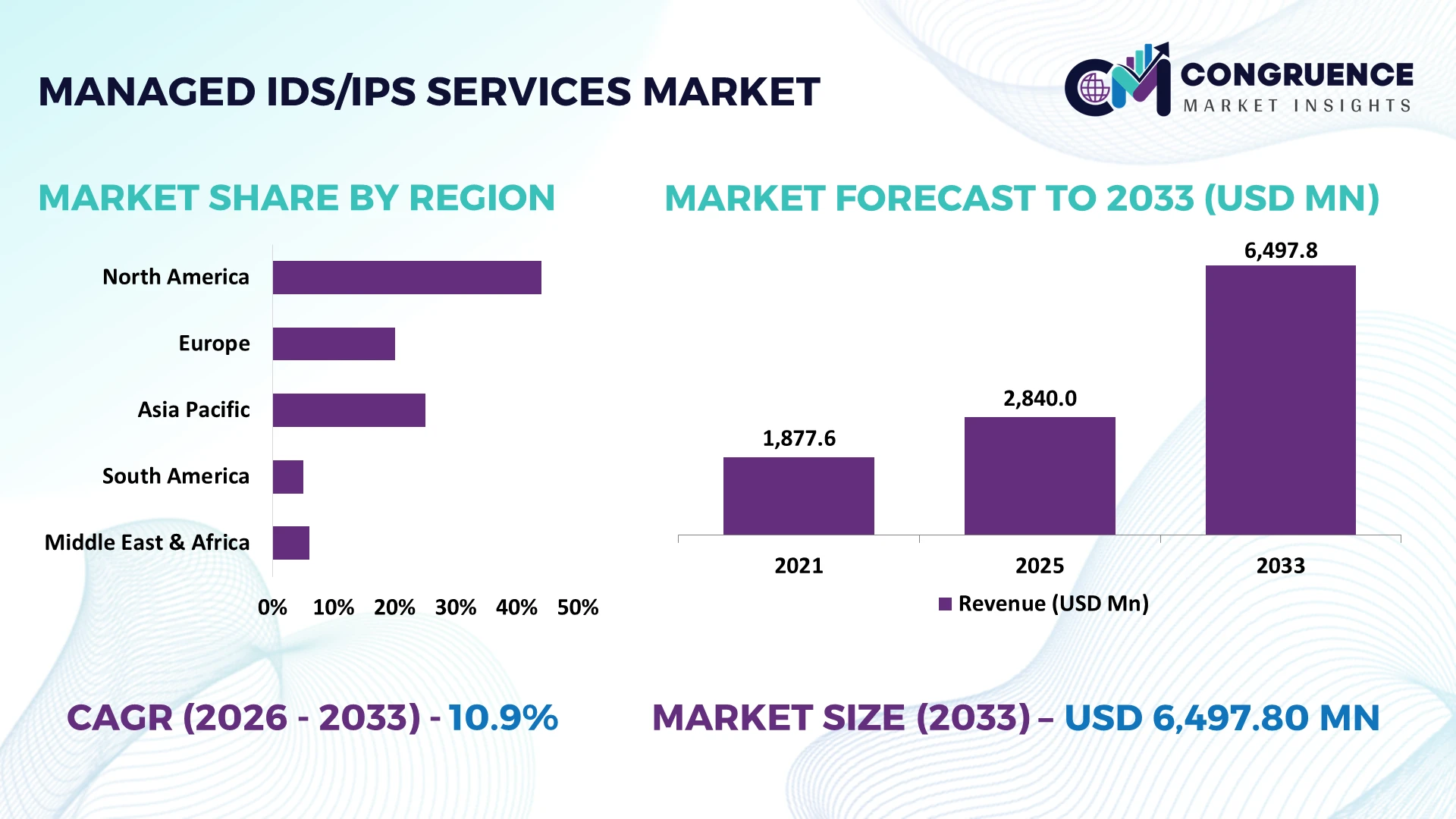
The Global Managed IDS/IPS Services Market was valued at USD 2840 Million in 2025 and is anticipated to reach a value of USD 6497.8 Million by 2033 expanding at a CAGR of 10.9% between 2026 and 2033. Growth is driven by ransomware detection requirements, cloud network traffic inspection, automated intrusion prevention, and continuous security monitoring across distributed enterprise infrastructure.
The United States dominates the Managed IDS/IPS Services Market through extensive cybersecurity infrastructure, enterprise security spending, and managed detection capabilities. IBM's 2025 research identified USD 10.22 million as the average United States data breach cost, strengthening demand for preventive network security. The country's cybersecurity ecosystem includes Microsoft, Cisco, Palo Alto Networks, and Fortinet, serving financial services, healthcare, government, and technology enterprises. Compared with Germany, the United States maintains greater cybersecurity vendor concentration, while Germany emphasizes NIS2 compliance and industrial network protection.
Strategically, enterprises combining continuous intrusion monitoring with automated response can prioritize the 2 highest operational objectives: faster threat containment and lower incident investigation costs.
Market Size & Growth: USD 2,840 million in 2025, reaching USD 6,497.8 million by 2033 at 10.9% CAGR, supported by managed threat detection.
Top Growth Drivers: Ransomware involved 44% of breaches, third party involvement reached 30%, and vulnerability exploitation accounted for 20% of initial access.
Short Term Forecast: By 2028, automated intrusion response targets 30% faster containment, representing an illustrative operational improvement scenario.
Emerging Technologies: AI threat classification, behavioral analytics, and automated response orchestration represent 3 important managed security technology developments.
Regional Leaders: North America, Europe, and Asia Pacific dominate deployment; verified regional USD forecasts remain unavailable without validated market allocations.
Consumer & End User Trends: Verizon's 2025 investigation identified ransomware in 44% of breaches, reinforcing enterprise demand for continuous network monitoring.
Pilot/Case Example: IBM's 2025 research associated extensive AI security deployment with approximately USD 1.9 million lower average breach costs.
Competitive Landscape: Cisco, Palo Alto Networks, Fortinet, IBM, and AT&T compete; individual managed IDS/IPS market shares remain undisclosed.
Regulatory & ESG Impact: NIS2 covers 18 critical sectors, strengthening cybersecurity monitoring and incident management requirements.
Investment & Funding: Microsoft announced USD 80 billion in AI data center investment during fiscal 2025, supporting broader security infrastructure modernization.
Innovation & Future Outlook: AI driven inspection, encrypted traffic analytics, and 24/7 security operations integration reshape managed intrusion prevention delivery.
The Managed IDS/IPS Services Market supports organizations requiring continuous network traffic inspection, malicious activity detection, and automated threat containment across cloud and enterprise environments. Financial institutions, healthcare providers, telecommunications operators, and government agencies prioritize managed intrusion monitoring to address ransomware, credential exploitation, and unauthorized network access. Verizon's 2025 investigations identified third party involvement in 30% of breaches, reinforcing the importance of monitoring interconnected infrastructure. Emerging deployment models combine network detection and response, machine learning analytics, and security operations integration. These developments strengthen the strategic importance of detection accuracy, operational scalability, and coordinated incident response.
Managed IDS/IPS services are becoming strategically important as enterprises shift from perimeter focused cybersecurity toward continuous inspection of distributed networks, cloud workloads, and interconnected suppliers. Verizon's 2025 investigations identified ransomware in 44% of breaches and third party involvement in 30%, demonstrating why network visibility influences operational resilience. Europe's NIS2 Directive is also changing procurement requirements across 18 critical sectors, encouraging investment in monitored intrusion prevention, incident escalation, and documented security controls.
AI assisted detection offers measurable advantages over traditional signature dependent monitoring. IBM's 2025 research associated extensive security AI adoption with approximately 80 days shorter breach lifecycles, although outcomes depend on implementation maturity. United States enterprises benefit from established managed security infrastructure, while German industrial operators emphasize operational technology protection and regulatory accountability. Providers are integrating behavioral analytics, threat intelligence, and automated containment to improve detection accuracy without proportionately expanding analyst workloads.
Between 2026 and 2028, investment priorities will increasingly favor integrated network detection, encrypted traffic analytics, and coordinated security operations. A multinational manufacturer can connect factory intrusion sensors with centralized monitoring to identify suspicious lateral movement before production systems are affected. Cisco, Palo Alto Networks, and Fortinet are strengthening platform integration and automated response capabilities. Competitive differentiation will depend on detection reliability, incident handling speed, and consistent protection across complex enterprise networks.
Increasing ransomware exposure is strengthening enterprise procurement of managed intrusion detection and prevention services. Verizon's 2025 investigations identified ransomware in 44% of breaches, vulnerability exploitation in 20% of initial access cases, and third party involvement in 30% of breaches. These attack patterns expose weaknesses in conventional perimeter monitoring, particularly across interconnected suppliers and remote infrastructure. United States financial institutions and healthcare operators are expanding continuous network inspection to detect malicious traffic, suspicious lateral movement, and unauthorized access attempts. Cisco, Fortinet, and Palo Alto Networks are integrating behavioral analytics with managed detection capabilities and automated containment. Providers combining network telemetry with incident response workflows strengthen customer retention by reducing investigation fragmentation and improving operational security coverage.
Encrypted enterprise traffic creates structural limitations for managed IDS/IPS deployment because conventional packet inspection cannot directly examine protected application payloads. Google's transparency reporting has shown HTTPS usage exceeding 90% across major browsing environments, illustrating the scale of encrypted communications. Flexera's 2025 research identified 70% hybrid cloud adoption and 84% of organizations experiencing cloud spending management challenges, complicating sensor deployment and monitoring economics. German manufacturers operating legacy industrial networks face additional constraints from incompatible protocols and limited inspection points. Decryption infrastructure introduces processing overhead and privacy considerations, increasing implementation complexity. Providers are addressing these limitations through metadata analytics, selective inspection, virtual network sensors, and subscription arrangements that align monitoring capacity with operational requirements.
AI assisted intrusion analysis creates opportunities for managed security providers to reduce investigation workloads and strengthen detection consistency across distributed enterprise networks. IBM's 2025 research associated extensive security AI deployment with approximately 80 days shorter breach lifecycles, while Verizon identified ransomware in 44% of breaches and third party involvement in 30%. These findings reinforce the commercial importance of rapid threat classification and coordinated response. India's expanding digital payment infrastructure creates opportunities for specialized network monitoring services protecting transaction systems and interconnected applications. Providers are investing in machine learning detection models, security orchestration, and managed network detection platforms. Differentiation increasingly depends on translating high volume security telemetry into actionable alerts without expanding analyst staffing proportionately.
Maintaining reliable intrusion detection across changing attack techniques presents a long term operational challenge for managed security providers. Verizon's 2025 investigations identified vulnerability exploitation in 20% of initial access cases, while ransomware appeared in 44% of breaches. Third party involvement reached 30%, increasing the complexity of identifying malicious activity across organizational boundaries. United States enterprises must coordinate cloud telemetry, endpoint signals, and network inspection without overwhelming security operations teams with false alerts. Rapid application changes and attacker evasion techniques require continuous detection engineering and threat intelligence updates. Providers must invest in analyst training, automated alert correlation, detection validation, and incident response partnerships. Sustainable competitive performance depends on maintaining high detection precision while supporting enterprise expansion and consistent service quality.
Cloud Native Sensor Deployment Expands: Enterprises are replacing fixed network inspection appliances with virtual sensors deployed alongside cloud workloads. Flexera's 2025 research identified 70% hybrid cloud adoption, while 84% of respondents reported cloud spending management challenges. Security providers are introducing elastic inspection capacity and centralized policy administration, reducing hardware dependency and improving coverage across changing network environments.
Encrypted Traffic Metadata Analysis Advances: Network security teams increasingly analyze connection behavior, certificate characteristics, and traffic patterns without decrypting every session. Google's transparency measurements indicate HTTPS usage exceeds 90% in major browsing environments, while TLS 1.3 removes several legacy inspection assumptions. Cisco and Palo Alto Networks are expanding encrypted traffic analytics, helping enterprises maintain network visibility while limiting privacy exposure and computational overhead.
Industrial Network Monitoring Becomes Specialized: Manufacturing operators are separating operational technology inspection policies from conventional enterprise network controls. Europe's NIS2 framework addresses 18 critical sectors, while IEC 62443 establishes security requirements across 4 industrial security levels. Fortinet and Cisco are expanding industrial protocol visibility and passive monitoring integrations. This approach reduces the operational disruption associated with aggressive packet blocking inside production networks.
Managed Security Reporting Becomes Continuous: Enterprises are replacing periodic security summaries with continuously updated detection dashboards and documented incident workflows. The Digital Operational Resilience Act became applicable in January 2025, while NIS2 establishes incident notification milestones of 24 hours and 72 hours. Managed security providers are integrating alert records, escalation histories, and compliance reporting, reducing manual evidence collection and strengthening accountability during regulatory examinations.
Managed IDS Services represent the leading segment, with an indicative market share of approximately 40% to 45%, supported by established enterprise requirements for continuous network monitoring, threat identification, and security event investigation. These services allow organizations to inspect suspicious activity without automatically interrupting business applications, making them particularly relevant for regulated infrastructure and production environments. Managed IPS Services maintain substantial demand among financial institutions, telecommunications operators, and digital enterprises requiring automated traffic blocking and policy enforcement. Their value lies in immediate containment of recognized malicious activity, although aggressive prevention policies require careful tuning to avoid legitimate traffic disruption.
Hybrid IDS/IPS Services represent the fastest advancing segment as enterprises combine passive threat visibility with selective automated prevention. An indicative 30% to 35% of demand is associated with integrated detection and prevention configurations, reflecting the shift toward coordinated network security operations. Providers are expanding unified management consoles, cloud sensor integration, and configurable response policies. Investment priorities increasingly favor services that balance inspection accuracy, operational continuity, and centralized incident management across distributed infrastructure.
Network Threat Detection represents the leading application, with an indicative market share of approximately 35% to 40%, reflecting enterprise requirements for identifying suspicious connections, unauthorized access, and malicious network behavior. Financial institutions, telecommunications providers, and government agencies prioritize continuous traffic inspection to protect distributed infrastructure and critical applications. Intrusion Prevention remains essential for blocking recognized attack patterns and enforcing network security policies. Malware Detection supports identification of malicious communications and compromised systems, while Compliance Monitoring addresses documented security controls, incident records, and audit requirements. Providers are integrating detection telemetry with centralized security operations platforms to improve investigation efficiency and operational visibility.
Vulnerability Monitoring represents the fastest advancing application as enterprises connect exposure intelligence with real time network activity. Verizon's 2025 investigations identified vulnerability exploitation in 20% of initial access cases, emphasizing the importance of linking known weaknesses with observed attack behavior. Managed security providers are expanding threat intelligence integrations, asset context enrichment, and automated prioritization. Competitive differentiation increasingly depends on identifying exploitable exposures before they develop into active security incidents.
BFSI represents the leading end user segment, with an indicative market share of approximately 30% to 35%, supported by extensive digital transaction infrastructure, regulatory obligations, and continuous requirements for network threat monitoring. Banks, payment processors, and financial technology operators prioritize managed intrusion prevention to protect interconnected applications and sensitive financial systems. IT and Telecommunications companies represent another significant buyer category because of their distributed network infrastructure, high traffic volumes, and extensive service availability requirements. Government organizations emphasize critical infrastructure protection, secure communications, and documented incident escalation. Providers are developing sector specific monitoring policies, dedicated security operations support, and service agreements aligned with institutional security requirements.
Manufacturing represents the fastest advancing end user category as industrial operators connect operational technology systems with enterprise networks and remote maintenance infrastructure. Healthcare organizations also require specialized intrusion monitoring to protect clinical applications and connected medical environments. Managed security providers are expanding industrial protocol inspection, passive sensor deployment, and tailored incident response partnerships. Investment increasingly favors solutions that protect production continuity while maintaining reliable detection coverage.
North America accounted for the largest estimated market share at 38% in 2025 however, Asia Pacific is expected to register the fastest growth, expanding at a CAGR of an estimated 13.2% between 2026 and 2033.
Integrated Security Operations Strengthen Enterprise Network Protection
North America represents an estimated 38% of the global Managed IDS/IPS Services Market, supported by established cybersecurity infrastructure, extensive enterprise networks, and concentrated managed security expertise. The United States hosts major technology providers including Cisco, Palo Alto Networks, Fortinet, and IBM, supporting intrusion monitoring across financial services, healthcare, telecommunications, and government environments. Verizon's 2025 investigations identified ransomware in 44% of breaches, reinforcing the importance of continuous network inspection and coordinated incident response. Canadian organizations increasingly integrate managed intrusion monitoring with cloud security and centralized security operations. Regional providers are expanding network detection capabilities, automated response integration, and managed firewall services to address distributed infrastructure requirements. Enterprise procurement increasingly prioritizes detection reliability, incident escalation speed, and compatibility with existing security platforms. Providers combining network telemetry with managed investigation capabilities strengthen competitive positioning.
United States Market Outlook: The United States maintains technological leadership through cybersecurity research, enterprise security investment, and advanced network protection platforms. The Cybersecurity and Infrastructure Security Agency coordinates critical infrastructure defense across 16 designated sectors, reinforcing the importance of network monitoring and incident readiness. Financial institutions and healthcare operators increasingly require managed intrusion detection across cloud applications, remote networks, and interconnected suppliers. Providers are strengthening security operations partnerships and automated containment capabilities to improve enterprise response coordination.
Cybersecurity Regulation Accelerates Managed Monitoring Modernization
Europe accounts for an estimated 27% of global Managed IDS/IPS Services Market activity, supported by cybersecurity regulation, industrial network protection, and enterprise infrastructure modernization. Germany, France, and the United Kingdom represent important deployment environments through their manufacturing sectors, financial institutions, and established cybersecurity service providers. The NIS2 Directive covers 18 critical sectors, strengthening requirements for risk management, incident reporting, and network security governance. The Digital Operational Resilience Act became applicable in January 2025, increasing operational resilience expectations for financial entities. European organizations are expanding managed intrusion monitoring across cloud infrastructure, industrial control networks, and critical digital services. Providers are responding through regional security operations centers, industrial protocol inspection, and compliance reporting capabilities. Procurement increasingly favors services combining continuous threat detection with documented response procedures and jurisdictionally appropriate data handling.
Germany Market Outlook: Germany maintains a strategically important position through its industrial manufacturing base, automotive supply chains, and critical infrastructure security requirements. The Federal Office for Information Security supports national cybersecurity standards and operational threat awareness. German manufacturers increasingly require passive industrial network monitoring to identify suspicious activity without interrupting production systems. Managed security providers are developing operational technology inspection capabilities, specialized incident response procedures, and integration partnerships with industrial automation suppliers.
Digital Infrastructure Expansion Strengthens Managed Threat Detection
Asia Pacific represents an estimated 24% of global Managed IDS/IPS Services Market demand, supported by expanding digital infrastructure, financial technology adoption, and enterprise cybersecurity modernization. China, India, Japan, Australia, and Singapore contribute through telecommunications networks, digital banking platforms, and cloud infrastructure development. India's expanding digital payment ecosystem increases the operational importance of continuous network monitoring and secure transaction infrastructure. Japan emphasizes resilient enterprise security and protection of industrial networks, while Singapore maintains advanced cybersecurity governance across financial and digital service sectors. Regional providers are expanding managed security operations centers, cloud inspection capabilities, and threat intelligence partnerships. Enterprises increasingly seek scalable monitoring services that protect distributed applications without requiring extensive internal analyst teams. Competitive differentiation centers on localized threat intelligence, deployment flexibility, and reliable incident escalation across complex operating environments.
India Market Outlook: India benefits from rapid digital infrastructure expansion, a large technology services workforce, and increasing enterprise cybersecurity investment. The Indian Computer Emergency Response Team coordinates national cybersecurity incident response and threat awareness. India's Unified Payments Interface processed more than 20 billion monthly transactions during 2025, illustrating the operational scale of interconnected financial infrastructure. Managed security providers are targeting banking, telecommunications, and technology enterprises through continuous network inspection and integrated incident response services.
Digital Banking Expansion Strengthens Network Security Procurement
South America represents an estimated 6% of global Managed IDS/IPS Services Market activity, with Brazil leading regional demand through digital banking, telecommunications infrastructure, and enterprise cloud adoption. Brazil's Pix payment ecosystem has expanded digital transaction activity, increasing the importance of protecting interconnected financial applications and network infrastructure. The country's General Personal Data Protection Law strengthens enterprise attention to information security governance. Argentina, Chile, and Colombia contribute additional demand through financial services modernization and commercial technology investment. However, specialized cybersecurity workforce availability, integration expenses, and uneven infrastructure maturity influence managed service deployment. Providers are expanding partnerships with telecommunications operators, regional system integrators, and cloud security platforms. Subscription based monitoring arrangements support organizations seeking predictable security operations expenses without building extensive internal detection teams.
Brazil Market Outlook: Brazil maintains a strong regional position through its financial technology ecosystem, large telecommunications networks, and expanding cloud infrastructure. The Central Bank of Brazil reported more than 170 million individual Pix users by 2025, demonstrating extensive participation in digital payment services. Financial institutions require intrusion monitoring, malicious traffic identification, and coordinated incident response to protect transaction infrastructure. Managed security providers are strengthening local security operations capabilities and enterprise integration partnerships.
National Digital Transformation Strengthens Security Infrastructure Investment
The Middle East and Africa represent an estimated 5% of global Managed IDS/IPS Services Market activity, supported by government digitization, critical infrastructure modernization, and cybersecurity investment. Saudi Arabia and the United Arab Emirates maintain significant deployment opportunities through national technology initiatives, financial services development, and expanding cloud infrastructure. Saudi Arabia's Vision 2030 program supports digital government modernization and infrastructure development, strengthening demand for managed network protection. The United Arab Emirates emphasizes cybersecurity readiness across financial institutions, telecommunications providers, and public sector networks. South Africa contributes through banking, commercial cloud adoption, and telecommunications infrastructure. Regional providers are developing security operations partnerships, managed intrusion prevention platforms, and locally delivered incident response capabilities. Procurement increasingly prioritizes continuous monitoring, infrastructure resilience, and compliance with national cybersecurity requirements across sensitive operating environments.
Saudi Arabia Market Outlook: Saudi Arabia benefits from extensive digital transformation investment, expanding cloud infrastructure, and cybersecurity requirements across energy, government, and financial services. The National Cybersecurity Authority establishes cybersecurity controls influencing enterprise security procurement. Saudi Aramco and other critical infrastructure operators maintain complex industrial networks requiring specialized monitoring and threat containment. Managed security providers are expanding operational technology security capabilities, local service delivery, and incident response partnerships to support national infrastructure protection.
Cisco, Palo Alto Networks, and Fortinet compete through integrated network security platforms, while IBM and AT&T emphasize managed security operations and enterprise service delivery. The five leading providers hold an indicative combined market share of 40% to 45%, although managed IDS/IPS specific disclosures remain limited. Verizon's 2025 research identified ransomware in 44% of breaches, third party involvement in 30%, and vulnerability exploitation in 20% of initial access cases, shaping enterprise procurement priorities. Platform vendors compete through inspection performance, automation, and unified policy management. Managed service specialists differentiate through analyst expertise, incident response coverage, and integration flexibility. Providers are expanding cloud inspection, industrial network monitoring, and threat intelligence partnerships. Competition increasingly shifts toward coordinated detection and response rather than standalone intrusion alerts. High infrastructure costs, specialized workforce requirements, and established enterprise contracts constrain entry. Winning requires measurable detection accuracy, rapid containment, and consistent service delivery across complex networks.
Cisco Systems, Inc.
Palo Alto Networks, Inc.
Fortinet, Inc.
IBM Corporation
AT&T Inc.
BT Group plc
Orange Cyberdefense
NTT DATA Group Corporation
Secureworks
Check Point Software Technologies Ltd.
Sophos Limited
Trend Micro Incorporated
Arctic Wolf Networks, Inc.
Tata Consultancy Services Limited
Current managed intrusion detection and prevention technologies combine signature inspection, behavioral analytics, deep packet inspection, and centralized security monitoring. Cisco, Fortinet, and Palo Alto Networks integrate network telemetry with automated policy enforcement across enterprise infrastructure. Verizon's 2025 investigations identified ransomware in 44% of breaches, reinforcing demand for continuous traffic analysis. Cloud sensors and virtual inspection appliances extend coverage beyond physical network boundaries, improving visibility across distributed applications without requiring dedicated hardware at every location.
Emerging technologies integrate encrypted traffic analysis, machine learning classification, and security orchestration to improve threat prioritization. IBM's 2025 research associated extensive security AI adoption with approximately 80 days shorter breach lifecycles, equivalent to roughly 29% of a 276 day illustrative legacy response cycle. This comparison demonstrates potential efficiency gains, not a universal IDS/IPS performance benchmark. Managed providers are combining network detection with endpoint signals and threat intelligence, reducing fragmented investigations and strengthening analyst productivity.
Between 2026 and 2028, disruptive innovation will emphasize autonomous detection engineering, adaptive prevention policies, and industrial network protection. Manufacturing operators benefit from passive protocol monitoring that preserves production continuity, while financial institutions prioritize rapid containment. Providers investing in continuous detection validation, encrypted traffic metadata analytics, and interoperable response platforms strengthen competitive positioning. Procurement increasingly rewards demonstrable detection precision, resilient operations, and efficient security service delivery.
June 2025: Cisco introduced Secure Firewall 6100 Series, delivering 200 Gbps per rack unit, alongside expanded Hybrid Mesh Firewall capabilities. The innovation strengthens high density intrusion prevention and centralized security enforcement, supporting enterprise data center modernization. Source: newsroom.cisco.com
May 2025: Check Point launched Quantum Force branch security gateways, delivering fourfold faster threat prevention performance than previous models. The expansion strengthens distributed network protection, improves inspection capacity, and supports managed security deployments across enterprise branch environments. Source: checkpoint.com
July 2025: Palo Alto Networks expanded Advanced Threat Prevention to detect encrypted Sliver command communications over TLS 1.3 without decrypting traffic. The innovation strengthens network visibility, enabling earlier detection of covert attacker activity while preserving encrypted communications. Source: docs.paloaltonetworks.com
April 2025: IBM introduced its Autonomous Threat Operations Machine, expanding managed detection and response services with agentic artificial intelligence. The platform supports continuous 24/7 security operations, automating threat investigation and remediation to reduce analyst workload and strengthen response consistency. Source: newsroom.ibm.com
The Managed IDS/IPS Services Market Report examines industry developments between 2026 and 2033 across Managed IDS Services, Managed IPS Services, and Hybrid IDS/IPS Services. Application coverage includes Network Threat Detection, Intrusion Prevention, Malware Detection, Vulnerability Monitoring, and Compliance Monitoring. End user analysis evaluates BFSI, IT and Telecommunications, Healthcare, Government, and Manufacturing. Geographic coverage encompasses North America, Europe, Asia Pacific, South America, and the Middle East and Africa, emphasizing infrastructure maturity, cybersecurity regulation, and enterprise deployment patterns.
The report assesses signature inspection, behavioral analytics, encrypted traffic monitoring, automated containment, and industrial network security. Competitive evaluation examines Cisco, Palo Alto Networks, Fortinet, IBM, and specialized managed security providers. Strategic insights address investment planning, regional expansion, detection performance, service delivery economics, and technology partnerships, supporting procurement decisions and competitive positioning across evolving enterprise security environments.
| Report Attribute/Metric | Report Details |
|---|---|
Market Revenue in 2025 | USD 2840 Million |
Market Revenue in 2033 | USD 6497.8 Million |
CAGR (2026 - 2033) | 10.9% |
Base Year | 2025 |
Forecast Period | 2026 - 2033 |
Historic Period | 2021 - 2025 |
Segments Covered | By Type
By Application
By End-User
|
Key Report Deliverable | Revenue Forecast, Growth Trends, Market Dynamics, Segmental Overview, Regional and Country-wise Analysis, Competition Landscape |
Region Covered | North America, Europe, Asia-Pacific, South America, Middle East, Africa |
Key Players Analyzed | Cisco Systems, Inc., Palo Alto Networks, Inc., Fortinet, Inc., IBM Corporation, AT&T Inc., BT Group plc, Orange Cyberdefense, NTT DATA Group Corporation, Secureworks, Check Point Software Technologies Ltd., Sophos Limited, Trend Micro Incorporated, Arctic Wolf Networks, Inc., Tata Consultancy Services Limited |
Customization & Pricing | Available on Request (10% Customization is Free) |




