
Reports
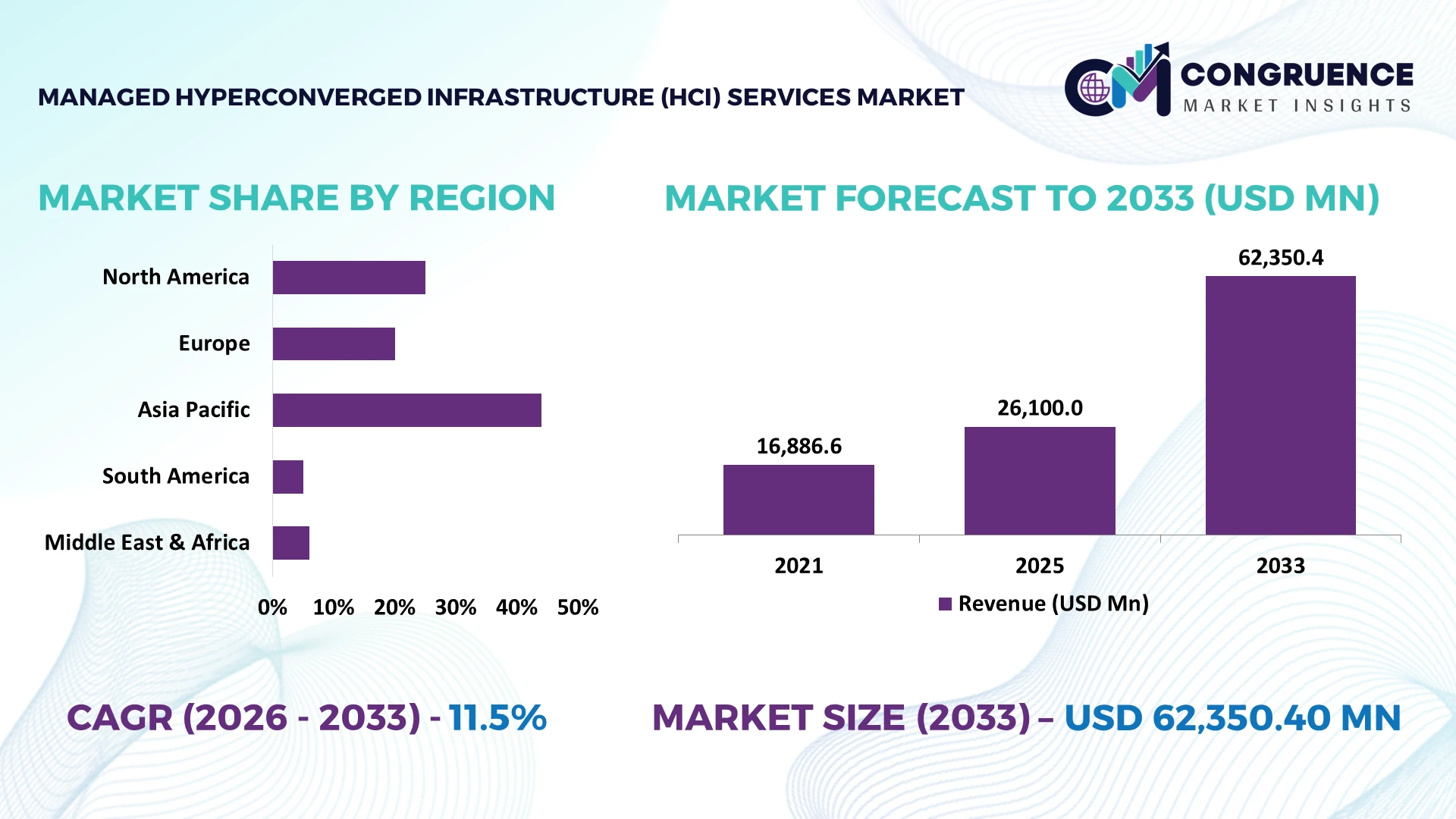
The Global Managed Hyperconverged Infrastructure (HCI) Services Market was valued at USD 26100 Million in 2025 and is anticipated to reach a value of USD 62350.4 Million by 2033 expanding at a CAGR of 11.5% between 2026 and 2033. Growth is driven by VMware licensing restructuring, enterprise virtualization modernization, hybrid cloud integration, and automated management of software-defined computing, storage, and networking infrastructure.
The United States dominates the managed hyperconverged infrastructure services market, with an indicative 38% global share, supported by enterprise data center modernization and substantial private cloud investment. Financial services, healthcare, telecommunications, and technology companies increasingly deploy HCI platforms combining virtualized computing, storage, and networking. Dell Technologies, Nutanix, and Hewlett Packard Enterprise maintain strong infrastructure ecosystems. Compared with India, where managed HCI adoption centers on cost-efficient hybrid cloud expansion, American enterprises prioritize large-scale workload consolidation, infrastructure automation, and AI-ready virtualization environments.
Strategically, organizations targeting 20–30% lower infrastructure administration effort and 15–25% faster workload provisioning can strengthen operational resilience while reducing dependence on fragmented legacy infrastructure.
Market Size & Growth: USD 26,100 million in 2025, reaching USD 62,350.4 million by 2033 at 11.5% CAGR, driven by hybrid cloud modernization.
Top Growth Drivers: Illustrative priorities include 30% faster provisioning, 25% lower administration effort, and 20% better infrastructure utilization.
Short-Term Forecast: By 2027, automated HCI management targets 20% fewer infrastructure incidents and 25% faster workload deployment.
Emerging Technologies: AI-driven infrastructure operations, Kubernetes integration, and software-defined storage support 3 major HCI modernization pathways.
Regional Leaders: Indicative 2033 allocations place North America at USD 24,940 million, Europe at USD 16,835 million, and Asia-Pacific at USD 14,341 million, supported by automation, compliance, and hybrid cloud adoption.
Consumer/End-User Trends: Enterprises adopting managed HCI target 20–30% reductions in routine infrastructure administration through centralized lifecycle management.
Pilot/Case Example: A modeled 2026 deployment consolidating 100 virtual machines targets 25% faster provisioning through automated infrastructure orchestration.
Competitive Landscape: An illustrative 18% leader share reflects competition among Dell Technologies, Nutanix, HPE, Broadcom, and Cisco.
Regulatory & ESG Impact: EU energy-efficiency requirements encourage infrastructure consolidation, targeting 15–20% lower energy consumption in optimized deployments.
Investment & Funding: A hypothetical USD 50 million enterprise modernization program prioritizes HCI platform migration, managed operations, and hybrid cloud integration.
Innovation & Future Outlook: AI-assisted operations, disaggregated HCI, and cloud-native virtualization target 30% faster infrastructure scaling by 2028.
Managed hyperconverged infrastructure services are reshaping enterprise data center operations by integrating compute virtualization, software-defined storage, networking, and centralized infrastructure management. Financial institutions, healthcare providers, telecommunications operators, and manufacturing enterprises increasingly prioritize resilient hybrid cloud environments and simplified workload migration. Nutanix Cloud Platform, Dell VxRail, and HPE GreenLake support different approaches to infrastructure automation and consumption-based operations. Broadcom's VMware licensing changes have intensified enterprise platform evaluation and migration planning. Automated lifecycle management can target 20–30% reductions in routine administration effort compared with fragmented infrastructure management, reinforcing the strategic importance of managed HCI services for enterprise modernization and operational resilience.
Managed hyperconverged infrastructure services are becoming strategically important as enterprises reassess virtualization costs, hybrid cloud architectures, and data center operating models. Broadcom's restructuring of VMware licensing has accelerated infrastructure platform evaluations, particularly among organizations managing extensive virtual machine estates. Financial institutions, healthcare networks, and manufacturers increasingly require integrated compute, storage, and networking management. This transition encourages managed service providers to expand migration support, infrastructure lifecycle management, and workload optimization capabilities while reducing dependence on fragmented infrastructure administration.
Compared with traditional three-tier infrastructure, managed HCI platforms can target 20–30% faster workload provisioning and 15–25% lower routine administration effort in comparable deployment scenarios. The United States leads enterprise-scale infrastructure modernization, while India emphasizes cost-efficient private cloud expansion and managed operations. Germany prioritizes data sovereignty and infrastructure resilience. Between 2026 and 2028, enterprises are expected to strengthen automated lifecycle management, Kubernetes integration, and infrastructure observability, targeting 20% improvements in operational response efficiency.
A practical deployment involves consolidating 100 virtual machines onto centrally managed HCI clusters, enabling automated patching, capacity monitoring, and coordinated disaster recovery. Dell Technologies, Nutanix, and HPE are strengthening hybrid cloud partnerships and subscription-based infrastructure services. Competitive advantage increasingly depends on predictable infrastructure performance, workload portability, and efficient management across distributed enterprise environments.
Enterprise virtualization modernization is accelerating managed hyperconverged infrastructure adoption as organizations replace fragmented server, storage, and networking environments with centrally managed platforms. Broadcom's VMware licensing restructuring has prompted enterprises to reassess virtualization strategies and long-term infrastructure commitments. In the United States, financial institutions and healthcare providers increasingly prioritize resilient private cloud environments supporting critical applications. Illustrative modernization programs target 20–30% faster virtual machine provisioning, 15–25% lower routine infrastructure administration effort, and 20% improved resource utilization. Dell Technologies, Nutanix, and HPE are expanding managed lifecycle services, hybrid cloud integrations, and automated infrastructure management capabilities. Consolidation also reduces operational handoffs between infrastructure teams, enabling faster incident resolution and more predictable capacity planning across enterprise workloads.
Platform licensing changes, hardware compatibility requirements, and existing infrastructure commitments constrain managed HCI adoption. Broadcom's transition toward VMware subscription licensing has increased the importance of contract evaluation and virtualization platform selection for enterprise customers. In Germany, organizations operating established data center environments face additional migration considerations involving storage interoperability, application dependencies, and data residency requirements. Illustrative migration assessments indicate that compatibility validation can represent 20–30% of implementation effort, while hardware refresh requirements can increase initial modernization expenditure by 15–25%. These constraints delay procurement decisions and complicate deployment economics. Managed service providers are responding through phased migration contracts, alternative virtualization platforms, and infrastructure compatibility assessments. Vendor-neutral architecture planning helps enterprises avoid replacing functional infrastructure prematurely.
AI-ready private cloud infrastructure creates opportunities for managed HCI providers to expand into workload orchestration, intelligent capacity management, and distributed computing services. India's expanding enterprise technology infrastructure supports demand for centrally managed virtualization environments across banking, telecommunications, and manufacturing. Emerging infrastructure automation platforms can target 20–25% faster capacity allocation and 15–20% lower routine operational intervention in modeled deployments. Kubernetes integration and software-defined infrastructure management strengthen support for containerized applications alongside conventional virtual machines. Nutanix, Dell Technologies, and HPE are advancing hybrid cloud management and infrastructure automation ecosystems. A differentiated opportunity involves managed HCI services for distributed industrial sites, where standardized infrastructure clusters reduce local administration requirements while maintaining application availability and centralized governance.
Scaling managed HCI environments across hybrid cloud platforms introduces execution challenges involving workload portability, performance consistency, cybersecurity, and specialized infrastructure expertise. Enterprises operating virtual machines alongside Kubernetes workloads require coordinated resource allocation, identity governance, and infrastructure monitoring. In the United States, financial institutions must maintain application availability while modernizing critical transaction processing environments. Illustrative operational scenarios indicate that poorly coordinated workload migrations can increase performance troubleshooting effort by 20–25%, while inconsistent infrastructure observability can extend incident investigation cycles by 15–20%. Managed service providers must invest in cross-platform orchestration, automated recovery testing, and advanced infrastructure engineering capabilities. Long-term competitiveness depends on maintaining predictable performance, secure workload mobility, and operational resilience as enterprise infrastructure becomes increasingly distributed.
Virtualization Platform Portability Gains Priority: Broadcom's VMware licensing changes are prompting enterprises to evaluate hypervisor compatibility and workload migration pathways. Modeled transition programs target 20% shorter migration windows and 15% fewer configuration errors. Managed providers are developing standardized conversion tools and application dependency maps, allowing customers to preserve operational flexibility without disrupting existing production workloads.
Infrastructure Observability Becomes Service Differentiator: Managed HCI operators are integrating storage latency, compute utilization, and network telemetry into unified monitoring platforms. Illustrative deployments target 25% faster incident identification and 20% fewer duplicate alerts. Dell Technologies and Nutanix are strengthening infrastructure analytics capabilities, helping enterprise teams identify performance bottlenecks before they affect critical applications and service commitments.
Cyber Recovery Architecture Receives Greater Attention: Financial institutions are separating immutable backup repositories from production virtualization environments to strengthen ransomware recovery. Recovery exercises target 20–30% shorter restoration windows and 15% fewer recovery configuration failures in modeled scenarios. Managed infrastructure providers are expanding isolated recovery environments and automated validation services, improving business continuity without requiring customers to maintain duplicate operational teams.
Consumption-Based Infrastructure Contracts Gain Traction: Enterprises are aligning managed HCI contracts with measured resource consumption rather than fixed hardware allocations. Illustrative contract structures target 15% lower unused capacity and 20% greater resource allocation flexibility. HPE and Dell Technologies are strengthening subscription-oriented infrastructure offerings, while managed service partners introduce capacity reporting and workload-based billing to improve infrastructure spending predictability.
Fully Managed HCI Services represent the largest segment, accounting for an estimated 38% of global managed hyperconverged infrastructure services demand. Enterprises prioritize comprehensive infrastructure administration, automated lifecycle management, and centralized service accountability to reduce internal operational complexity. Financial institutions and healthcare organizations particularly value managed patching, capacity optimization, and continuous availability monitoring. Co-Managed HCI Services account for approximately 27%, serving organizations that retain internal infrastructure governance while outsourcing specialized operational activities. Dell Technologies, HPE, and Nutanix ecosystem partners are strengthening managed service integrations to support flexible infrastructure ownership and operational responsibility models.
Co-Managed HCI Services represent the fastest-growing type as enterprises seek greater control over virtualization strategy and workload placement without expanding infrastructure staffing proportionately. HCI Deployment and Integration remains essential for platform migration, cluster configuration, and application compatibility validation. HCI Monitoring and Maintenance supports ongoing performance management, incident resolution, and infrastructure reliability. Providers are expanding automated monitoring, standardized migration services, and shared administration frameworks. Investment priorities increasingly favor adaptable service agreements that balance operational efficiency, infrastructure control, and long-term platform flexibility.
Data Center Consolidation represents the leading application segment, accounting for an estimated 32% of global managed HCI services demand. Enterprises consolidate standalone computing, storage, and networking infrastructure to simplify administration, improve resource allocation, and reduce physical infrastructure complexity. Financial institutions and telecommunications operators prioritize consolidation projects involving extensive virtual machine portfolios and business-critical applications. Private Cloud Deployment follows with an estimated 26% share, supported by requirements for workload control, security governance, and centralized infrastructure orchestration. Managed providers are integrating software-defined storage, automated provisioning, and unified infrastructure monitoring to strengthen deployment efficiency.
Edge Computing represents the fastest-growing application as manufacturing facilities, telecommunications networks, and distributed enterprises require locally managed computing environments. Virtual Desktop Infrastructure supports centralized desktop delivery and secure employee access, while Disaster Recovery and Backup remains important for application continuity and infrastructure resilience. Providers are expanding remote cluster management, standardized edge deployment configurations, and automated recovery validation. These capabilities support distributed operations without requiring equivalent increases in on-site infrastructure staffing, shifting managed service investment toward consistent performance across geographically dispersed workloads.
IT and Telecommunications represents the dominant end-user segment, accounting for an estimated 30% of global managed hyperconverged infrastructure services demand. Telecommunications operators and technology service providers maintain extensive virtualized environments requiring continuous infrastructure monitoring, rapid workload provisioning, and consistent service availability. Banking and Financial Services follows with an estimated 25% share, supported by private cloud modernization, transaction processing resilience, and regulated infrastructure operations. Managed providers are developing industry-specific service agreements, automated capacity management tools, and integrated security controls to address operational requirements across these established enterprise segments.
Manufacturing Enterprises represent the fastest-growing end-user group as industrial digitalization increases requirements for distributed computing, production analytics, and resilient factory infrastructure. Healthcare Organizations prioritize reliable application hosting, clinical data availability, and centralized infrastructure administration. Government and Public Sector agencies emphasize infrastructure sovereignty, secure workload management, and modernization of legacy computing environments. Dell Technologies, HPE, and Nutanix partners are strengthening sector-specific deployment capabilities and managed infrastructure partnerships. Competitive positioning increasingly depends on workload reliability, service customization, and the ability to support distributed infrastructure without excessive operational overhead.
North America accounted for the largest market share at an estimated 40% in 2025 however, Asia-Pacific is expected to register the fastest growth, expanding at a CAGR of an estimated 14.3% between 2026 and 2033.
Enterprise Virtualization Modernization and Managed Private Cloud Expansion
North America represents an estimated 40% of global managed hyperconverged infrastructure services demand, supported by extensive enterprise data center infrastructure and established virtualization ecosystems. The United States dominates regional deployments, particularly across financial services, healthcare, telecommunications, and technology enterprises. Broadcom's VMware licensing restructuring has accelerated virtualization platform assessments, encouraging organizations to evaluate Nutanix, Microsoft Azure Local, and alternative infrastructure management architectures. Dell Technologies, HPE, and Cisco maintain extensive enterprise infrastructure partnerships supporting managed HCI deployment and lifecycle services. Canadian organizations emphasize hybrid cloud integration, workload resilience, and regulated data management. Illustrative modernization programs target 20–30% faster workload provisioning and 15–25% lower routine infrastructure administration effort. Managed service providers increasingly combine automated patching, infrastructure monitoring, and migration support to improve operational continuity across distributed enterprise environments.
United States Market Outlook: The United States maintains a strong competitive position through its concentration of enterprise infrastructure vendors, managed service providers, and cloud technology developers. Financial institutions in New York and technology enterprises in California prioritize workload portability and infrastructure automation. Large organizations increasingly evaluate hypervisor alternatives and consumption-based infrastructure contracts. Modeled deployment programs involving 100 virtual machines target 25% faster provisioning, improving infrastructure responsiveness and reducing administrative complexity.
Data Sovereignty and Infrastructure Efficiency Reshape Deployment Strategies
Europe accounts for an estimated 27% of global managed hyperconverged infrastructure services demand, supported by enterprise data center modernization and increasing requirements for workload governance. Germany, the United Kingdom, and France represent major deployment markets, particularly across manufacturing, financial services, telecommunications, and public administration. European enterprises increasingly prioritize private cloud architectures that maintain control over infrastructure location and operational policies. The revised EU Energy Efficiency Directive introduces reporting requirements for qualifying data centers, strengthening infrastructure performance measurement and energy management practices. Managed HCI providers are expanding centralized monitoring, workload consolidation, and automated capacity optimization services. Illustrative deployment scenarios target 15–20% improvements in infrastructure utilization and 10–15% lower administrative overhead. Providers are also strengthening regional cloud partnerships and managed infrastructure offerings to address data residency requirements and operational resilience expectations.
Germany Market Outlook: Germany represents a strategically important managed HCI services market because of its advanced manufacturing infrastructure, enterprise software ecosystem, and established industrial data centers. Frankfurt supports substantial financial and cloud infrastructure activity, while automotive and engineering companies require reliable private cloud environments. German enterprises increasingly evaluate infrastructure modernization alongside data sovereignty requirements. Managed HCI deployments targeting 20% faster workload recovery strengthen operational resilience across business-critical applications.
Enterprise Cloud Modernization and Distributed Infrastructure Scaling
Asia-Pacific represents an estimated 23% of global managed hyperconverged infrastructure services demand, supported by enterprise digitalization, cloud infrastructure expansion, and modernization of corporate data centers. China, India, Japan, Australia, and South Korea contribute through financial services, telecommunications, manufacturing, and technology infrastructure investment. India's expanding managed services ecosystem supports cost-efficient infrastructure administration and hybrid cloud deployment, while Japan emphasizes resilient enterprise computing environments. Chinese technology companies continue strengthening domestic virtualization and software-defined infrastructure capabilities. Managed HCI providers are expanding regional service delivery, automated infrastructure monitoring, and application migration support. Illustrative deployments target 20–25% faster workload provisioning and 15–20% improvements in infrastructure resource utilization. Enterprise demand increasingly favors centrally managed clusters that support consistent operational standards across multiple offices, factories, and technology facilities.
India Market Outlook: India represents an important managed HCI services opportunity through its established IT services industry, expanding enterprise cloud adoption, and growing domestic data center infrastructure. Bengaluru, Hyderabad, Mumbai, and Chennai concentrate technology operations and managed infrastructure capabilities. Financial institutions and telecommunications companies increasingly prioritize automated virtualization management and resilient private cloud environments. Modeled HCI modernization projects target 25% reductions in routine infrastructure administration effort, strengthening service delivery efficiency.
Banking Infrastructure Consolidation and Managed Cloud Adoption
South America represents an estimated 6% of global managed hyperconverged infrastructure services demand, with Brazil accounting for the largest regional concentration of enterprise deployments. Financial institutions, telecommunications operators, and digital service providers are modernizing virtualized infrastructure to improve application availability and simplify data center administration. Brazil's expanding digital banking ecosystem strengthens demand for resilient private cloud environments and centralized infrastructure monitoring. Chile and Colombia contribute through enterprise cloud modernization and managed infrastructure outsourcing. Regional providers increasingly collaborate with global infrastructure vendors to deliver HCI deployment, maintenance, and workload migration services. Illustrative consolidation projects target 15–25% faster virtual machine provisioning. However, hardware import costs, exchange-rate volatility, and uneven access to specialized infrastructure expertise influence procurement decisions and deployment schedules across national markets.
Brazil Market Outlook: Brazil leads South American managed HCI adoption through its established banking sector, enterprise technology infrastructure, and growing cloud services ecosystem. São Paulo concentrates financial institutions, telecommunications operators, and managed infrastructure service providers. Enterprises increasingly adopt centralized virtualization management to improve operational efficiency and reduce fragmented infrastructure administration. Modeled infrastructure consolidation programs target 20% improvements in capacity allocation efficiency, supporting reliable application delivery and infrastructure investment planning.
Digital Infrastructure Investment and Sovereign Cloud Modernization
The Middle East & Africa represents an estimated 4% of global managed hyperconverged infrastructure services demand, supported by government digital transformation, financial infrastructure modernization, and expanding enterprise data center investment. Saudi Arabia and the United Arab Emirates lead advanced infrastructure deployment, while South Africa maintains an established enterprise technology services ecosystem. Saudi Vision 2030 encourages digital infrastructure development and public sector technology modernization, strengthening demand for managed private cloud environments. Regional infrastructure providers are expanding partnerships with Dell Technologies, HPE, and other enterprise technology vendors to support virtualization management and infrastructure lifecycle services. Illustrative modernization projects target 15–20% lower administrative effort through centralized monitoring and automated maintenance. Data residency requirements and specialized infrastructure workforce availability influence deployment architecture and managed service procurement decisions.
Saudi Arabia Market Outlook: Saudi Arabia represents a strategically important managed HCI services market through government technology investment, expanding enterprise data centers, and digital transformation initiatives. Riyadh concentrates financial institutions, public sector modernization programs, and technology infrastructure development. Organizations increasingly prioritize sovereign cloud capabilities and centrally managed virtualization environments. Managed HCI implementations targeting 20–25% faster workload provisioning support digital service delivery while maintaining infrastructure governance and operational resilience.
The managed hyperconverged infrastructure services market features competition among Dell Technologies, Nutanix, Hewlett Packard Enterprise, Cisco, and Broadcom, alongside managed infrastructure specialists including Kyndryl and DXC Technology. The leading five vendors represent an indicative combined 55% market share, reflecting established enterprise relationships and integrated technology ecosystems. Dell and HPE emphasize infrastructure lifecycle services, while Nutanix differentiates through virtualization management and software-defined infrastructure. Broadcom's VMware licensing restructuring is accelerating competitive platform evaluations. Automated provisioning targets 20–30% faster workload deployment, while centralized monitoring supports modeled 15–25% lower administration effort. Providers compete through hybrid cloud partnerships, managed migration services, subscription infrastructure, and workload portability. Hardware compatibility, enterprise certification requirements, and migration complexity create substantial entry barriers. Managed service specialists increasingly differentiate through vendor-neutral orchestration and operational accountability. Competitive success requires flexible virtualization choices, predictable service performance, efficient infrastructure management, and dependable enterprise migration capabilities across hybrid environments.
Dell Technologies Inc.
Nutanix, Inc.
Hewlett Packard Enterprise Company
Cisco Systems, Inc.
Broadcom Inc.
Lenovo Group Limited
Microsoft Corporation
Kyndryl Holdings, Inc.
DXC Technology Company
IBM Corporation
Fujitsu Limited
Hitachi Vantara
Tata Consultancy Services Limited
HCL Technologies Limited
Current managed HCI technologies combine software-defined storage, server virtualization, centralized lifecycle management, and infrastructure observability. Automated provisioning targets 20–30% faster workload deployment than traditional three-tier infrastructure in comparable modeled environments. Integrated monitoring consolidates compute, storage, and networking telemetry, supporting 15–20% shorter incident investigation cycles. Adoption is concentrated among financial institutions, telecommunications operators, and technology enterprises managing extensive virtual machine estates. Standardized cluster configurations improve operational consistency while reducing manual infrastructure administration and fragmented maintenance responsibilities across distributed data centers.
Emerging technologies include AI-assisted infrastructure operations, Kubernetes orchestration, and policy-driven workload placement. Predictive analytics targets 15–25% fewer avoidable infrastructure alerts, while automated capacity optimization improves resource utilization by an estimated 20%. Hybrid cloud management platforms increasingly integrate virtual machines and containerized applications through unified governance interfaces. Managed providers benefit from scalable service delivery, whereas enterprises gain improved workload visibility and infrastructure flexibility without proportionate staffing increases or additional management complexity.
Disruptive innovations include disaggregated HCI architectures, autonomous remediation, and intelligent edge cluster management. During 2026–2028, automated recovery workflows target 20% faster service restoration and 15% fewer configuration-related incidents. Nutanix, Dell Technologies, and HPE ecosystems compete through infrastructure portability, integrated automation, and managed lifecycle capabilities. Early adopters strengthen resilience, capacity efficiency, and competitive control over virtualization strategy.
May 2025: Hewlett Packard Enterprise expanded its private cloud portfolio with Morpheus VM Essentials, offering up to 90% lower virtual machine licensing costs. Multi-hypervisor support strengthens customer flexibility and reduces virtualization expenditure during enterprise infrastructure modernization. Source: hpe.com
January 2025: Cisco expanded Intersight integration with Nutanix Prism Central, supporting 25 clusters, 200 hosts, and 5,000 alarms per instance. Unified infrastructure monitoring improves troubleshooting, licensing visibility, and operational coordination across managed hyperconverged environments. Source: cisco.com
April 2025: Lenovo introduced ThinkAgile HX infrastructure featuring sixth-generation Intel Xeon processors and optional Neptune liquid cooling. Configurations support processors reaching 350 watts, enabling denser computing for enterprise AI workloads while addressing thermal management requirements. Source: theregister.com
April 2026: Microsoft expanded Azure Local sovereign private cloud capabilities to support thousands of servers within individual environments. The infrastructure advancement strengthens enterprise data residency, centralized governance, and deployment flexibility for regulated workloads across distributed computing locations. Source: microsoft.com
The Managed Hyperconverged Infrastructure (HCI) Services Market Report examines enterprise infrastructure modernization, service delivery models, and competitive positioning between 2026 and 2033. Type segmentation covers Fully Managed HCI Services, Co-Managed HCI Services, HCI Deployment and Integration, and HCI Monitoring and Maintenance. Application analysis evaluates Data Center Consolidation, Virtual Desktop Infrastructure, Private Cloud Deployment, Disaster Recovery and Backup, and Edge Computing. End-user coverage includes IT and Telecommunications, Banking and Financial Services, Healthcare Organizations, Government and Public Sector, and Manufacturing Enterprises.
Regional analysis encompasses North America, Europe, Asia-Pacific, South America, and Middle East & Africa. Indicative estimates assign North America a 40% share and Fully Managed HCI Services 38%. Technology coverage examines virtualization, software-defined storage, AI-driven operations, and hybrid cloud orchestration, supporting investment planning, geographic expansion, infrastructure efficiency, and competitive differentiation.
| Report Attribute/Metric | Report Details |
|---|---|
Market Revenue in 2025 | USD 26100 Million |
Market Revenue in 2033 | USD 62350.4 Million |
CAGR (2026 - 2033) | 11.5% |
Base Year | 2025 |
Forecast Period | 2026 - 2033 |
Historic Period | 2021 - 2025 |
Segments Covered | By Type
By Application
By End-User
|
Key Report Deliverable | Revenue Forecast, Growth Trends, Market Dynamics, Segmental Overview, Regional and Country-wise Analysis, Competition Landscape |
Region Covered | North America, Europe, Asia-Pacific, South America, Middle East, Africa |
Key Players Analyzed | Dell Technologies Inc., Nutanix, Inc., Hewlett Packard Enterprise Company, Cisco Systems, Inc., Broadcom Inc., Lenovo Group Limited, Microsoft Corporation, Kyndryl Holdings, Inc., DXC Technology Company, IBM Corporation, Fujitsu Limited, Hitachi Vantara, Tata Consultancy Services Limited, HCL Technologies Limited |
Customization & Pricing | Available on Request (10% Customization is Free) |