
Reports
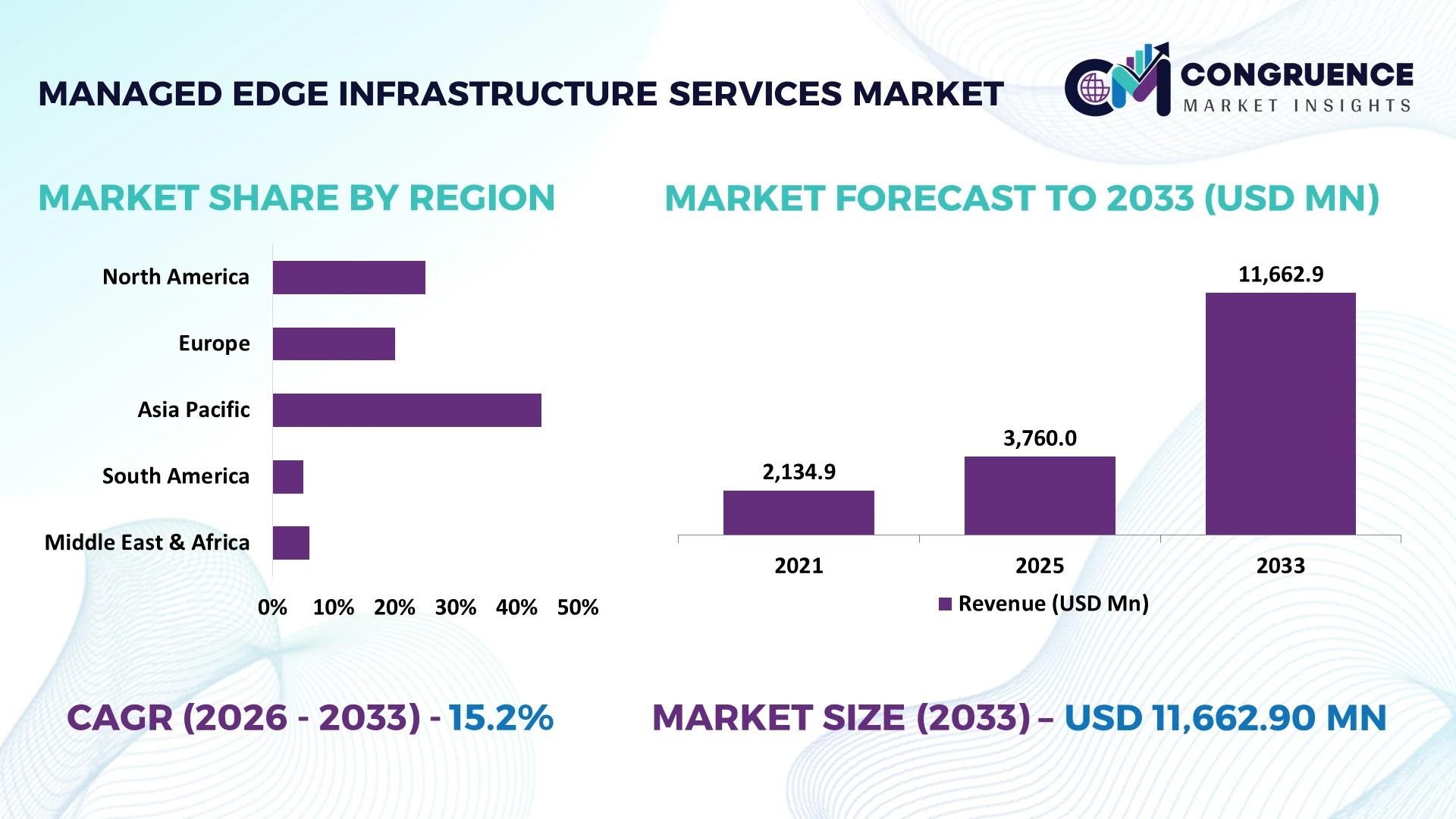
The Global Managed Edge Infrastructure Services Market was valued at USD 3760 Million in 2025 and is anticipated to reach a value of USD 11662.9 Million by 2033 expanding at a CAGR of 15.2% between 2026 and 2033. Growth is driven by the convergence of private 5G networks, AI-powered edge inference, industrial IoT workloads, and rising requirements for localized data processing, cybersecurity, and real-time infrastructure management.
The United States maintains a leading position in edge infrastructure development, supported by 36 GW of installed hyperscale and colocation data center capacity in 2025, equivalent to approximately 43.4% of the 83 GW capacity across the countries covered in the comparative assessment. China followed with 20 GW, representing approximately 24.1%, supported by domestic AI computing expansion, telecommunications infrastructure, and industrial automation. The US-China technology competition, particularly around advanced semiconductors and AI computing infrastructure, is accelerating investment in geographically distributed processing capabilities. Meanwhile, Germany leads European secure edge deployment with 1,771 nodes, reinforcing its industrial manufacturing and automotive technology ecosystem.
Strategic implication: Infrastructure providers should prioritize US enterprise and telecommunications deployments while expanding partnerships across China-independent Asian supply chains and Germany's industrial edge ecosystem to capture geographically diversified opportunities.
Market Size & Growth: USD 3.76 billion in 2025 to USD 11.66 billion by 2033, at 15.2% CAGR, driven by AI inference and private 5G infrastructure expansion.
Top Growth Drivers: Industrial IoT represented 20.97% of application demand, telecommunications and IT 22.76% of end-user demand, and on-premises deployments 33.28% of deployment share in 2026.
Short-Term Forecast: Edge AI deployment benchmarks demonstrate up to 35% lower processing latency, 28% lower cloud usage, and 13.2% higher throughput against cloud-only architectures.
Emerging Technologies: AI inference, autonomous infrastructure monitoring, and federated learning are advancing distributed workload management and real-time industrial decision-making.
Regional Leaders: North America leads infrastructure investment; Europe prioritizes secure, climate-neutral edge nodes; Asia-Pacific benefits from 5G and industrial automation expansion. The available evidence does not establish comparable regional USD forecasts for this specific market.
Consumer/End-User Trends: In Europe, 20% of organizations extensively use edge solutions, 42% plan adoption, and projected AI-related adoption reaches 54%.
Pilot/Case Example: A 2025 digital-twin and edge-AI research project demonstrated 35% lower latency, 28% lower cloud consumption, and 13.2% higher production throughput.
Competitive Landscape: AWS, Microsoft, Google, IBM, and Dell Technologies are leading market participants, alongside HPE, Cisco, Ericsson, Nokia, and NTT DATA. A defensible market-specific leader share is not publicly established.
Regulatory & ESG Impact: The EU recorded 7,451 secure, climate-neutral edge nodes in 2025, targeting approximately 14,000 by 2030, an 88% deployment increase.
Investment & Funding: Global AI infrastructure spending reached USD 318 billion in 2025, more than doubling from USD 153 billion in 2024, accelerating investment in distributed compute and networking.
Innovation & Future Outlook: The next competitive shift centers on autonomous edge operations, sovereign AI infrastructure, workload orchestration, and integrated cybersecurity, favoring providers with multi-site management capabilities.
The Managed Edge Infrastructure Services Market is gaining traction across telecommunications, manufacturing, automotive, healthcare, and BFSI, where localized processing supports mission-critical applications and uninterrupted operations. AI-enabled infrastructure monitoring, edge-native cybersecurity, automated workload orchestration, and software-defined networking are strengthening managed service portfolios. Industrial deployments are particularly significant, with edge-based digital-twin architectures demonstrating up to 35% lower latency compared with cloud-only processing. An emerging trend is the integration of sovereign AI infrastructure with distributed edge environments as organizations respond to data-residency requirements and semiconductor supply-chain restrictions. These developments are reshaping provider differentiation and long-term infrastructure investment priorities.
Managed Edge Infrastructure Services is becoming strategically important as enterprises compete on processing speed, network resilience, data sovereignty, and operational continuity. The shift toward distributed AI workloads is changing infrastructure investment priorities, making localized computing a competitive requirement for manufacturing, telecommunications, automotive, and logistics operators. US-China semiconductor export controls are also accelerating supply-chain diversification and encouraging companies to reassess hardware sourcing, deployment locations, and infrastructure partnerships.
Edge architectures offer measurable advantages over centralized legacy systems. A 2025 smart-factory research implementation combining edge AI, digital twins, and federated learning reduced processing latency by 35%, cloud communication requirements by 28%, and increased production throughput by 18%. Meanwhile, Europe is prioritizing secure and climate-neutral infrastructure, whereas the United States emphasizes hyperscale integration and AI computing capacity. These differences are creating distinct managed-service investment opportunities.
Over the next 2–3 years, providers will prioritize multi-site orchestration, automated infrastructure monitoring, and secure workload distribution. The European Union's target of 10,000 secure edge nodes by 2030 is strengthening deployment visibility. Manufacturers are increasingly integrating edge gateways with existing operational technology rather than replacing entire production networks. Providers that combine hardware-neutral management, cybersecurity, and localized technical support will secure stronger enterprise relationships and more defensible competitive positioning.
Industrial AI integration is accelerating managed edge infrastructure adoption as manufacturers require localized processing for predictive maintenance, machine vision, and automated production control. In 2026, 62% of surveyed organizations had adopted edge computing for IoT deployments, while 78% of deployments had progressed beyond pilot stages. Additionally, 42% prioritized edge processing as a leading technology investment. India's expanding 5G ecosystem and manufacturing modernization are strengthening demand for managed edge gateways and industrial network integration. Companies are responding through AI infrastructure partnerships, private 5G deployments, and managed multi-site monitoring. The strategic advantage lies in reducing dependence on centralized processing while maintaining consistent operational visibility across geographically distributed facilities.
High initial infrastructure expenditure and uneven access to specialized computing hardware constrain managed edge deployment economics, particularly for smaller enterprises. In 2026, 21% of surveyed IoT decision-makers identified budget limitations as an adoption challenge. European infrastructure deployment also highlights capacity concentration: in-country edge data centers represented only 6% of secure edge nodes in 2025, despite accounting for potentially 92% of aggregate capacity at maximum rated operation. Semiconductor export controls affecting US-China technology trade further complicate hardware procurement and vendor selection. Providers are mitigating exposure through diversified sourcing, modular infrastructure packages, and longer-term equipment agreements. Commercial viability increasingly depends on matching computing capacity to workload intensity rather than overbuilding distributed infrastructure.
The expansion of sovereign AI infrastructure creates opportunities for managed providers to deliver localized computing, compliance management, and workload orchestration. Europe's secure and climate-neutral edge infrastructure reached 7,451 nodes in 2025, with approximately 14,000 projected by 2030, representing an 88% increase. Additionally, 54% of European organizations are projected to adopt edge solutions as AI and machine-learning workloads expand. India's industrial corridors, automotive manufacturing clusters, and expanding telecommunications infrastructure offer further opportunities for managed edge deployments. Providers are investing in compact AI inference systems, federated learning, and automated lifecycle management. A particularly attractive opportunity lies in managing distributed infrastructure for mid-sized manufacturers that lack dedicated edge engineering teams but require enterprise-grade reliability and security.
Scaling managed edge infrastructure across heterogeneous enterprise environments requires consistent integration between operational technology, legacy applications, industrial networks, and distributed security systems. In 2026, 31% of surveyed organizations identified security as a leading deployment challenge, while 29% reported difficulties integrating edge infrastructure with operational technology and business processes; 28% cited legacy IT integration problems. These constraints complicate service standardization, increase troubleshooting requirements, and create inconsistent performance across geographically dispersed facilities. Manufacturing operators must also maintain continuous production during infrastructure upgrades. Providers need to strengthen zero-trust security, interoperable management platforms, automated patching, and skilled industrial-network support. Competitive differentiation will increasingly depend on delivering reliable cross-vendor integration without disrupting mission-critical operations.
Enterprise Edge Deployments Move Beyond Pilots: Edge computing is transitioning into production infrastructure, with 62% of organizations adopting edge architectures for IoT and 78% of deployments progressing beyond pilot stages in 2026. This shift reflects greater confidence in distributed computing for business-critical workloads. US technology providers are expanding managed operations, remote monitoring, and multi-site service agreements to support enterprise-wide deployment without proportionate increases in local IT staffing.
AI Workloads Reshape Infrastructure Placement: Enterprises are increasingly processing AI-generated data closer to connected devices, reducing dependence on centralized cloud infrastructure. In 2025, 82% of surveyed enterprises were using or planning real-time analytics, while more than 75% were layering AI and machine learning into IoT deployments. Companies are integrating edge inference, workload orchestration, and automated analytics to improve response times and control data transmission costs.
Energy Efficiency Influences Edge Architecture: Infrastructure operators are incorporating power optimization, workload consolidation, and intelligent cooling into distributed computing strategies. The European Union's target of approximately 14,000 secure, climate-neutral edge nodes by 2030 is strengthening investment in energy-efficient infrastructure. Providers are prioritizing modular edge facilities, remote energy monitoring, and renewable electricity partnerships to manage operating costs across geographically dispersed installations.
Managed Security Becomes a Procurement Priority: Cybersecurity is increasingly influencing managed edge vendor selection as distributed endpoints expand enterprise attack surfaces. In 2026, 31% of surveyed organizations identified security as a leading deployment challenge, while 29% reported operational technology integration difficulties. Companies are strengthening zero-trust architecture, centralized policy enforcement, and automated patch management, positioning security-integrated managed services as a differentiator in industrial and telecommunications contracts.
Edge Infrastructure Management Leads Through Operational Scale
Edge Infrastructure Management Services represents the leading type, accounting for approximately 37.66% of the market in 2026. Its dominance reflects enterprise dependence on continuous infrastructure monitoring, configuration management, hardware lifecycle oversight, and performance optimization across distributed locations. Large organizations prioritize integrated management because centralized oversight reduces site-level administration requirements and improves service consistency. Edge Computing Services supports workload deployment, application execution, and localized processing, while Edge Network Services maintains connectivity and traffic optimization across distributed environments.
Edge Security Services is emerging as a particularly strong incremental investment priority as organizations expand connected infrastructure. Security concerns influence 31% of enterprise edge deployment decisions, strengthening demand for threat detection, endpoint protection, and zero-trust controls. Companies are increasingly integrating security capabilities into infrastructure management contracts rather than purchasing isolated protection solutions. Providers are responding with unified service platforms, automated monitoring, and cross-vendor integration. Investment priorities are consequently shifting toward integrated management and security capabilities that improve infrastructure reliability and simplify enterprise procurement.
IoT Connectivity Establishes the Largest Application Base
IoT and Connected Devices represents the leading application category, with Industrial IoT and Predictive Maintenance accounting for approximately 20.97% of the comparable application market in 2026. Demand concentration reflects the growing deployment of connected sensors, industrial gateways, and equipment-monitoring systems across manufacturing facilities and distributed operations. Real-Time Data Processing is gaining strategic importance as enterprises require immediate analytics for production decisions, equipment diagnostics, and operational control. Omdia reported that 82% of surveyed enterprises were already using or planning real-time analytics in 2025, highlighting the transition from passive data collection toward actionable intelligence.
Industrial Automation is strengthening demand through machine vision, predictive maintenance, and automated production workflows. Content Delivery remains relevant for reducing network latency and improving digital-service performance, while Remote Monitoring supports geographically dispersed assets and facilities. Companies are expanding edge-enabled application portfolios and integrating connected-device management with AI analytics. Investment is increasingly shifting toward applications that generate measurable operational benefits, particularly reduced downtime, faster decision-making, and improved asset utilization.
IT and Telecommunications Maintain Infrastructure Leadership
IT and Telecommunications represents the leading end-user category, accounting for approximately 22.76% of the comparable market in 2026. Its dominance reflects extensive network infrastructure, distributed computing requirements, enterprise connectivity services, and continuous demand for low-latency data processing. Telecommunications operators are integrating edge infrastructure with 5G networks, network-function virtualization, and localized computing facilities to support enterprise connectivity and digital services. Manufacturing represents an important emerging buyer group, driven by connected machinery, industrial automation, and predictive maintenance requirements. Healthcare is also strengthening adoption through medical imaging, connected diagnostic equipment, and localized patient-data processing.
Retail is adopting managed edge capabilities for inventory visibility, connected checkout systems, and distributed store operations, while BFSI prioritizes secure transaction processing, infrastructure resilience, and data governance. Providers are increasingly developing sector-specific service packages, combining infrastructure management, cybersecurity, and application support. Healthcare and manufacturing offer attractive expansion opportunities because their workloads require specialized integration and operational reliability. Competitive positioning will depend on delivering customized service-level agreements and scalable infrastructure across different enterprise environments.
North America accounted for the largest market share at approximately 35.44% in 2026; however, Asia-Pacific is expected to register the fastest growth, expanding at an annual rate of 11.62% between 2027 and 2032.
Hyperscale Connectivity and Enterprise Edge Modernization Strengthen Regional Leadership
North America maintains its leadership through established cloud ecosystems, extensive colocation infrastructure, private 5G deployment, and enterprise outsourcing capabilities. The United States anchors demand through hyperscaler edge extensions, telecommunications infrastructure, and distributed AI computing. Canada contributes through telecommunications modernization, industrial digitization, and data-intensive enterprise applications. The region's competitive advantage lies in the integration of network connectivity, computing resources, and managed operational services. In October 2026, AWS announced managed private connectivity expansion through Megaport, connecting branches and remote locations to cloud infrastructure. Providers are strengthening carrier partnerships, expanding metro-edge capacity, and integrating AI workload orchestration to improve service coverage. Investment increasingly favors interconnected infrastructure platforms rather than isolated edge installations.
United States Market Outlook: The United States leads through hyperscaler investment, advanced semiconductor ecosystems, and extensive enterprise technology adoption. Major technology companies are integrating distributed computing with private 5G, AI inference, and automated infrastructure management. In March 2026, Akamai introduced AI Grid orchestration across more than 4,400 edge locations, demonstrating the country's ability to commercialize geographically distributed AI infrastructure. Industrial automation, financial services, and telecommunications remain important enterprise deployment markets.
Data Sovereignty and Industrial Modernization Shape Infrastructure Deployment
Europe's managed edge market is shaped by stringent data governance, industrial automation, and secure infrastructure modernization. Germany, the United Kingdom, and France represent important demand centers, supported by manufacturing, automotive engineering, financial services, and telecommunications. The European Union recorded 7,451 secure and climate-neutral edge nodes by the end of 2025, establishing a measurable infrastructure foundation for localized computing. Germany leads deployment concentration, while France and the Netherlands strengthen public edge infrastructure through established data center ecosystems. Data residency requirements and the EU Data Act are increasing the importance of localized workload management. Providers are responding with compliant infrastructure operations, energy-efficient edge facilities, and partnerships with industrial automation companies. Investment priorities increasingly favor secure, interoperable platforms that support regulated enterprise workloads.
Germany Market Outlook: Germany benefits from its advanced automotive, machinery, chemicals, and industrial automation industries. Its manufacturing ecosystem generates demand for machine-vision processing, predictive maintenance, connected production systems, and industrial cybersecurity. The country recorded 1,771 secure and climate-neutral on-premises edge nodes in 2025, leading European deployment. Providers are targeting industrial hubs with integrated operational technology management and localized AI processing.
Manufacturing Scale and 5G Expansion Accelerate Distributed Computing
Asia-Pacific is the fastest-growing market, supported by manufacturing modernization, telecommunications investment, industrial automation, and expanding digital infrastructure across China, Japan, South Korea, India, and Australia. China benefits from large-scale industrial digitization, while Japan and South Korea emphasize advanced manufacturing, robotics, and connected production systems. India is strengthening its position through 5G expansion, enterprise cloud adoption, and domestic data center investment. In September 2025, Equinix opened its CN1 AI-ready data center in Chennai with an initial investment of USD 69 million and capacity for 800 cabinets. Providers are expanding regional partnerships, localized infrastructure, and AI-enabled managed services. Competitive advantage increasingly depends on delivering scalable infrastructure across diverse regulatory environments and manufacturing ecosystems.
China Market Outlook: China offers substantial deployment opportunities through its electronics manufacturing base, automotive production, telecommunications infrastructure, and industrial AI adoption. Domestic technology development and data localization requirements are encouraging investment in locally managed computing environments. Providers are focusing on industrial edge gateways, private 5G, machine-vision systems, and automated infrastructure monitoring. Partnerships with domestic telecommunications operators and industrial equipment manufacturers remain important for market access and deployment scale.
Telecommunications Modernization Opens New Enterprise Deployment Opportunities
South America remains an emerging market for managed edge infrastructure services, with demand concentrated in Brazil, Argentina, Chile, and Colombia. Telecommunications modernization, financial-sector digitization, connected retail, and industrial automation are creating requirements for localized processing and reliable distributed connectivity. Brazil represents the principal commercial opportunity because of its large enterprise base, extensive telecommunications market, and manufacturing activity. However, uneven fiber connectivity, electricity infrastructure limitations, and high equipment import dependence affect deployment economics across less-developed markets. Companies are prioritizing metropolitan data center locations, carrier partnerships, and phased enterprise deployments to control initial infrastructure expenditure. Managed service providers are also emphasizing remote monitoring and centralized maintenance to reduce dependence on scarce local engineering resources. The strongest commercial opportunities lie in financial services, telecommunications, and industrial operations requiring dependable local processing.
Brazil Market Outlook: Brazil leads regional demand through its banking ecosystem, automotive manufacturing, agribusiness technology, and expanding telecommunications infrastructure. Its extensive agricultural supply chains create opportunities for edge-enabled equipment monitoring, logistics visibility, and precision operations. Providers are targeting São Paulo and other major industrial and commercial centers through carrier partnerships, colocation facilities, and managed network services. Localized infrastructure management offers an advantage where connectivity interruptions affect distributed business operations.
Smart Infrastructure Investment Accelerates Localized Computing Adoption
The Middle East and Africa market is developing through digital government programs, telecommunications modernization, smart-city investment, and industrial diversification. Saudi Arabia and the United Arab Emirates are establishing important deployment centers through investments in data centers, cloud infrastructure, connected transport, and AI-enabled public services. South Africa contributes through financial services, telecommunications, mining, and enterprise technology modernization. The UAE's expanding cloud ecosystem and Saudi Arabia's Vision 2030 initiatives are encouraging providers to establish localized infrastructure and regional delivery partnerships. However, electricity availability, specialized technical skills, and uneven connectivity remain operational constraints in several African markets. Providers are responding through modular edge facilities, managed connectivity agreements, and partnerships with local telecommunications operators. Investment opportunities are strongest where national digital programs provide identifiable enterprise workloads and long-term infrastructure requirements.
Saudi Arabia Market Outlook: Saudi Arabia benefits from Vision 2030, large-scale smart-city development, industrial diversification, and national digital infrastructure investment. NEOM-related technology programs, connected logistics, energy operations, and digital government services are creating demand for localized processing and secure distributed infrastructure. Providers are positioning through cloud partnerships, telecommunications integration, and managed AI infrastructure. The country's large-scale infrastructure projects create opportunities for multi-site management contracts and long-term operational service agreements.
The Managed Edge Infrastructure Services Market features competition between hyperscalers AWS, Microsoft, and Google; infrastructure OEMs Dell Technologies, HPE, and Cisco; telecommunications providers Ericsson and Nokia; and IT service integrators Accenture and NTT DATA. The market remains fragmented, with no independently verified combined market share for the top five providers; its competitive structure is classified as low concentration. Competition centers on technology integration, network reliability, cybersecurity, service customization, and deployment speed. Enterprise demand is concentrated, with large enterprises accounting for 71.88% of the market in 2026, while on-premises deployments represent 33.28%. Security influences 31% of reported deployment challenges, strengthening demand for integrated managed services. Hyperscalers are expanding AI orchestration, OEMs are integrating compute and security, and telecom operators are combining connectivity with edge management. Partnerships increasingly connect infrastructure ownership with operational delivery. High certification requirements, specialized engineering capabilities, and established enterprise relationships create entry barriers. Winning requires interoperable infrastructure, reliable multi-site operations, strong security, and measurable workload performance.
Amazon Web Services (AWS)
Microsoft Corporation
Google LLC
IBM Corporation
Dell Technologies Inc.
Hewlett Packard Enterprise (HPE)
Cisco Systems, Inc.
Ericsson
Nokia Corporation
Huawei Technologies Co., Ltd.
Schneider Electric SE
NTT DATA Corporation
Accenture plc
AI inference is shifting compute from centralized data centers toward factories, stores, hospitals, and telecom sites. Compared with cloud-only processing, edge-AI digital-twin deployments have reported 35% lower latency, improving machine response and reducing network round trips. Currently, 36% of surveyed organizations have scaled AI at the edge; 72% expect to do so by 2028. Cloud-managed edge, used by 68%, is the leading model, benefiting providers that combine local compute with centralized control.
Kubernetes, containerization, and software-defined networking standardize deployment across mixed hardware estates. Automated orchestration reduces manual configuration, accelerates workload placement, and supports consistent patching across remote sites. AI-based resource allocation routes inference between edge, regional, and core infrastructure, limiting unnecessary premium-GPU use. Dell, HPE, Cisco, and hyperscalers benefit from interoperable platforms, while customers gain flexibility to avoid vendor dependency and match compute to workload intensity.
Confidential computing, zero-trust security, and federated learning advance regulated and industrial deployments. Local processing limits sensitive-data transfers, while distributed security policies improve endpoint control. Between 2026 and 2028, edge-AI adoption among surveyed organizations is expected to rise from 36% to 72%. Providers integrating lifecycle management, cybersecurity, and workload orchestration now will be better positioned as enterprise pilots transition into production systems at scale.
February 2024: Dell Technologies and Nokia expanded their partnership, making Dell a preferred infrastructure supplier and Nokia a preferred private-wireless partner for enterprise edge use cases. The agreement links PowerEdge servers, private 5G, and NativeEdge management for telecom operators. Source: dell.com
February 2025: Aramco Digital, Armada, and Microsoft began deploying modular Galleon edge data centers in Saudi Arabia, integrating Azure IoT Operations, Azure Arc, and Azure Local. The project brings AI safety monitoring and real-time analytics to energy sites at scale. Source: datacenterdynamics.com
December 2025: FiberCop and Microsoft Italy agreed to build a national edge-cloud platform using FiberCop's 10,500 sites and approximately 27 million kilometres of fibre. Azure Local supports sovereign cloud and AI services for Italian businesses and public administration nationwide. Source: fibercop.com
March 2026: Akamai launched NVIDIA AI Grid orchestration across 4,400 edge locations, routing inference workloads between edge, regional, and core infrastructure. The deployment uses thousands of Blackwell GPUs, positioning Akamai to serve latency-sensitive enterprise AI workloads at scale globally. Source: akamai.com
The Managed Edge Infrastructure Services Market Report evaluates industry structure, competitive positioning, technology adoption, and investment opportunities across four service types: Edge Infrastructure Management, Edge Computing Services, Edge Network Services, and Edge Security Services. Application coverage includes IoT and Connected Devices, Real-Time Data Processing, Industrial Automation, Content Delivery, and Remote Monitoring. End-user analysis examines IT and Telecommunications, Manufacturing, Healthcare, Retail, and BFSI, highlighting differences in deployment requirements, infrastructure intensity, and purchasing priorities.
Geographical coverage includes North America, Europe, Asia-Pacific, South America, and the Middle East and Africa, with country-level assessments of infrastructure development and enterprise adoption. The report also examines AI inference, private 5G, Kubernetes orchestration, zero-trust security, and sovereign edge infrastructure. Competitive assessments cover major technology providers, infrastructure OEMs, telecommunications companies, and managed service specialists. These insights support investment allocation, market-entry planning, partnership development, competitive differentiation, and infrastructure expansion decisions throughout 2026–2033.
| Report Attribute/Metric | Report Details |
|---|---|
Market Revenue in 2025 | USD 3760 Million |
Market Revenue in 2033 | USD 11662.9 Million |
CAGR (2026 - 2033) | 15.2% |
Base Year | 2025 |
Forecast Period | 2026 - 2033 |
Historic Period | 2021 - 2025 |
Segments Covered | By Type
By Application
By End-User
|
Key Report Deliverable | Revenue Forecast, Growth Trends, Market Dynamics, Segmental Overview, Regional and Country-wise Analysis, Competition Landscape |
Region Covered | North America, Europe, Asia-Pacific, South America, Middle East, Africa |
Key Players Analyzed | Amazon Web Services (AWS), Microsoft Corporation, Google LLC, IBM Corporation, Dell Technologies Inc., Hewlett Packard Enterprise (HPE), Cisco Systems, Inc., Ericsson, Nokia Corporation, Huawei Technologies Co., Ltd., Schneider Electric SE, NTT DATA Corporation, Accenture plc |
Customization & Pricing | Available on Request (10% Customization is Free) |




