Global Managed Digital Mailroom Services Market Report Overview
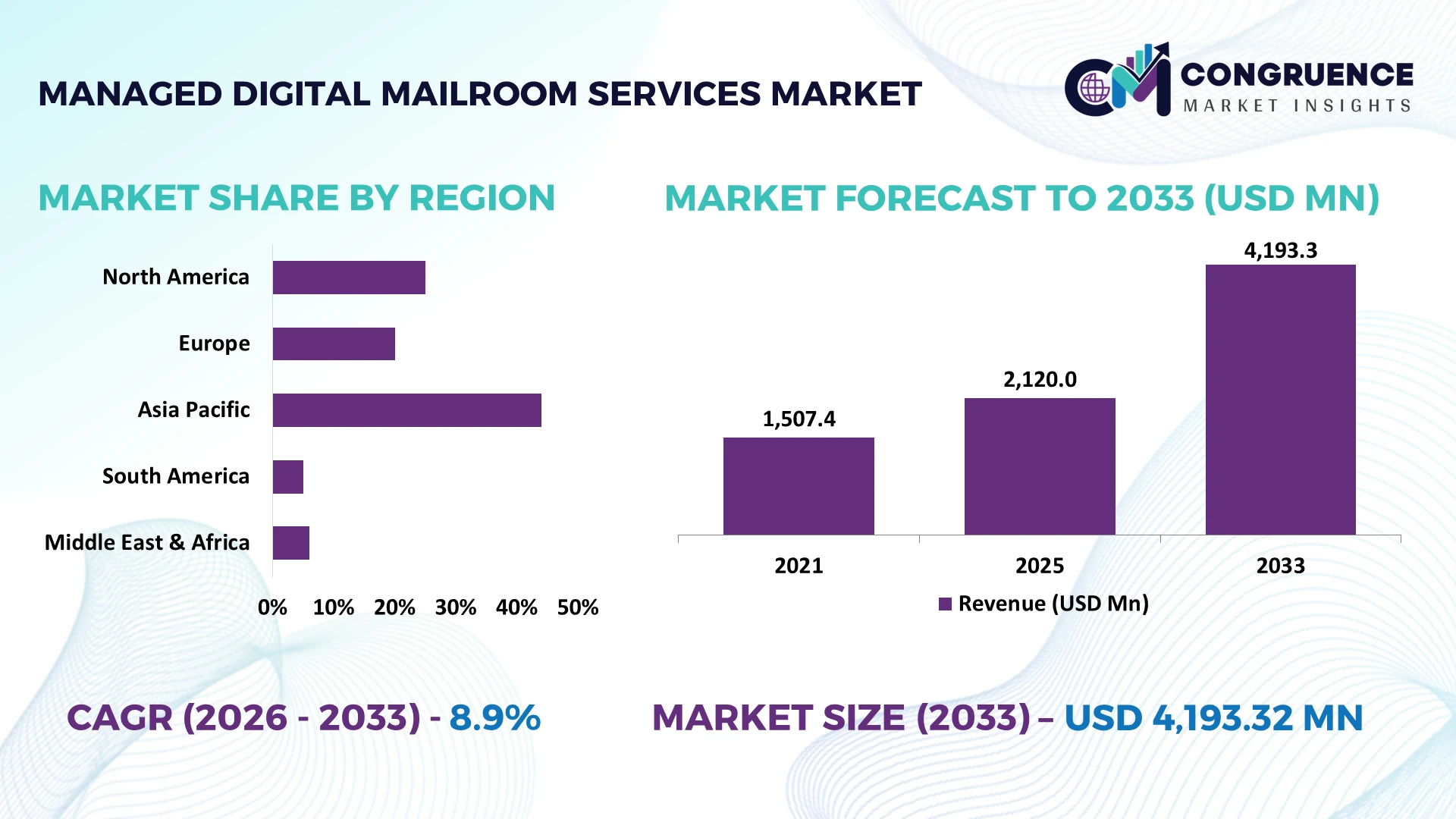
The Global Managed Digital Mailroom Services Market was valued at USD 2120 Million in 2025 and is anticipated to reach a value of USD 4193.32 Million by 2033 expanding at a CAGR of 8.9% between 2026 and 2033. Growth is driven by AI powered document classification, enterprise workflow automation, regulatory digitization requirements, and outsourcing of physical correspondence processing across banking, healthcare, insurance, and government institutions.
The United States dominates the managed digital mailroom services landscape, supported by its extensive financial infrastructure, enterprise outsourcing ecosystem, and advanced document management capabilities. More than 4,000 FDIC insured banking institutions create substantial opportunities for automated correspondence processing. Compared with India, where digital public infrastructure accelerates electronic documentation, American enterprises emphasize integration with established content management platforms. Federal records modernization, HIPAA requirements, and investments in cloud infrastructure strengthen adoption across financial services, healthcare administration, and government agencies, reinforcing the country's competitive position in intelligent document processing.
Strategically, providers integrating AI powered document extraction, secure cloud delivery, and automated compliance workflows can strengthen enterprise contract retention while reducing document processing costs.
Key Highlights of the Global Managed Digital Mailroom Services Market
-
Market Size & Growth: USD 2,120 million in 2025, reaching USD 4,193.32 million by 2033 at 8.9% CAGR, driven by AI enabled document automation.
-
Top Growth Drivers: Illustrative operational improvement targets include 30% faster document routing, 25% lower manual processing costs, and 20% fewer classification errors.
-
Short Term Forecast: By 2027, automated document processing deployments target 25% faster correspondence turnaround through intelligent indexing and workflow integration.
-
Emerging Technologies: Three technologies lead modernization: generative AI, intelligent optical character recognition, and robotic process automation for document extraction and distribution.
-
Regional Leaders: Estimated 2033 values place North America at USD 1,551.53 million, Europe at USD 1,216.06 million, and Asia Pacific at USD 922.53 million, reflecting cloud, compliance, and AI adoption.
-
Consumer/End User Trends: Banking, insurance, healthcare, and government organizations prioritize 24/7 digital correspondence accessibility and centralized document management.
-
Pilot/Case Example: In 2025, Fujifilm DMS reported 263% higher straight through processing rates and 99% digital document processing for an insurance client.
-
Competitive Landscape: Iron Mountain, Ricoh, Xerox, Conduent, and DATAMARK compete through secure document capture, enterprise integration, and outsourced processing capabilities.
-
Regulatory & ESG Impact: GDPR compliance and electronic records requirements strengthen secure retention, while paperless workflow initiatives target 20% lower physical document handling.
-
Investment & Funding: Estimated 2025 market allocation of USD 318 million toward technology modernization highlights AI integration, cloud infrastructure, and automated workflow expansion.
-
Innovation & Future Outlook: Next generation platforms combine 3 capabilities: intelligent document extraction, automated exception resolution, and integrated enterprise content management.
The Managed Digital Mailroom Services Market is transforming enterprise correspondence management through intelligent document processing, cloud integration, and outsourced operational workflows. Financial institutions prioritize automated customer communication, compliance documentation, and transaction correspondence, while healthcare organizations emphasize secure patient records and claims administration. Advanced optical character recognition, natural language processing, and AI powered classification improve document accuracy and accelerate distribution. Enterprise automation programs target processing efficiency improvements exceeding 25% under optimized implementation conditions. European GDPR requirements and expanding digital government initiatives reinforce secure information governance, creating opportunities for specialized service providers to differentiate through automation performance and compliance expertise.
What Is the Strategic Relevance and Future Pathways of the Managed Digital Mailroom Services Market?
Managed digital mailroom services are becoming strategically important as enterprises restructure document intensive operations to improve processing speed, regulatory compliance, and administrative efficiency. The transition from physical correspondence handling to centralized digital workflows is reshaping outsourcing strategies across banking, insurance, healthcare, and government institutions. Organizations implementing intelligent document processing can target 25% to 35% reductions in manual handling requirements, strengthening operational productivity and enabling employees to focus on customer service and compliance management.
Artificial intelligence powered document classification offers an estimated 30% improvement in processing efficiency compared with conventional scanning and manual indexing systems. The United States emphasizes enterprise content management integration and secure document automation, while Germany prioritizes GDPR compliant information governance and India benefits from expanding digital public infrastructure. Between 2026 and 2028, advanced implementations are expected to target 40% automated correspondence routing and 20% shorter document retrieval cycles, supporting broader deployment across distributed enterprise operations.
A practical deployment involves insurance companies integrating intelligent optical character recognition with claims administration platforms to automatically classify incoming correspondence and distribute documents to appropriate departments. Service providers are expanding cloud capabilities, strengthening cybersecurity partnerships, and investing in multilingual document recognition. Competitive advantage increasingly depends on processing accuracy, seamless enterprise integration, and measurable service delivery performance rather than basic scanning capacity.
Managed Digital Mailroom Services Market Dynamics
DRIVER:
Enterprise Document Automation and Regulatory Digitization
Enterprise modernization initiatives are accelerating managed digital mailroom adoption as organizations replace manual correspondence distribution with intelligent document processing. Automated classification and workflow routing can deliver estimated 25% to 35% faster document handling, while integrated optical character recognition targets 20% lower administrative processing costs. In the United States, HIPAA requirements and federal records modernization reinforce secure electronic document management across healthcare and government institutions. Financial organizations increasingly consolidate physical mail operations into centralized digital processing environments, reducing fragmented administrative workflows. Providers such as Iron Mountain and Ricoh are strengthening document automation capabilities and enterprise software integration. The strategic advantage lies in converting correspondence processing from a labor intensive function into a measurable, service level driven operation.
RESTRAINT:
Legacy Infrastructure and Integration Cost Pressures
Legacy enterprise infrastructure creates structural limitations for managed digital mailroom deployment, particularly among organizations operating fragmented document repositories and proprietary business applications. Complex system integration can account for an estimated 20% to 30% of implementation expenditure, while customized workflow configuration increases initial deployment requirements by approximately 15% to 25%. In Germany, GDPR obligations impose additional controls on personal data processing, retention, and cross border information transfers. These requirements increase compliance expenditure and complicate outsourcing contracts involving multiple jurisdictions. Providers are responding through standardized application programming interfaces, modular deployment architectures, and localized data hosting partnerships. Organizations prioritizing interoperable platforms achieve stronger implementation economics than enterprises dependent on extensive legacy system customization.
OPPORTUNITY:
Intelligent Document Processing and Emerging Digital Ecosystems
Next generation intelligent document processing creates opportunities beyond conventional scanning through generative AI, multilingual extraction, and automated business process orchestration. Advanced AI classification deployments can target 30% to 40% reductions in manual document review, while automated exception handling offers potential workflow efficiency improvements of 20% to 25%. India's Digital India initiatives and expanding digital public infrastructure create opportunities for managed correspondence services supporting banking, insurance, and public administration. Between 2026 and 2028, providers integrating AI powered document understanding with enterprise resource planning platforms can capture specialized outsourcing contracts. Companies are investing in language recognition models, cloud partnerships, and industry specific workflow solutions. Multilingual document intelligence offers differentiation in markets where conventional automation struggles with diverse document formats.
CHALLENGE:
Cybersecurity Resilience and Automation Scalability
Maintaining processing accuracy and cybersecurity resilience across high volume document environments presents significant execution challenges. Complex correspondence containing handwritten information, inconsistent layouts, and multilingual content can increase automated classification error rates, requiring human validation. Advanced deployments commonly establish operational targets exceeding 95% classification accuracy and 99.9% platform availability, while exception management programs aim to reduce manual review workloads by 25%. In the United States, evolving cybersecurity expectations and sensitive healthcare information requirements intensify pressure on outsourced document processing providers. Companies must invest in continuous model validation, encrypted document transmission, identity management, and disaster recovery infrastructure. Long term competitiveness depends on sustaining automation performance across expanding document volumes without compromising information security or service continuity.
Managed Digital Mailroom Services Market Latest Trends
-
Centralized Mailroom Network Consolidation Accelerates: Large enterprises are consolidating distributed mail receiving locations into centralized processing hubs. Illustrative operating models target 20% to 30% fewer physical handling points and 15% to 25% lower internal transportation requirements. In the United States, hybrid workplace arrangements are reshaping corporate mail distribution. Service providers are restructuring collection schedules, consolidating sorting facilities, and introducing location independent digital delivery. This shift improves facility utilization while reducing dependence on permanent office occupancy.
-
Digital Chain of Custody Expands: Organizations are strengthening document traceability through barcode tracking, timestamped receipt confirmation, and electronic delivery verification. Advanced operational models target 95% to 98% correspondence traceability and 20% faster dispute resolution. Financial institutions increasingly require auditable handoffs between physical receipt and digital distribution. Managed service providers are introducing centralized tracking dashboards and standardized custody records, improving accountability across outsourced mailroom operations.
-
Usage Based Service Contracts Expand: Enterprise buyers are shifting toward transaction based pricing instead of fixed staffing arrangements. Illustrative contracts target 15% to 20% greater billing flexibility and 10% to 15% improvement in capacity utilization. Seasonal correspondence fluctuations in insurance and retail operations are accelerating this transition. Providers are introducing volume based service tiers, flexible processing capacity, and performance linked agreements to protect margins while accommodating unpredictable workloads.
-
Distributed Workforce Delivery Models Evolve: Hybrid employment patterns are changing how organizations distribute physical correspondence to remote employees. Modern digital delivery systems target 30% faster employee notification and 20% fewer internal mail transfers. Companies are introducing centralized employee mail portals, electronic acknowledgment, and scheduled physical forwarding. Service providers are partnering with workplace management platforms to improve correspondence accessibility without expanding traditional office mailroom infrastructure.
Segmentation Analysis
By Type
Digital Mail Processing Leads Enterprise Service Adoption
Digital Mail Processing dominates the Managed Digital Mailroom Services Market with an estimated 38% share in 2025, supported by established enterprise document handling infrastructure and integration with content management systems. Financial institutions, healthcare providers, and government agencies rely on centralized processing to convert incoming correspondence into searchable electronic records. Automated indexing and electronic distribution can reduce document handling time by approximately 25% to 30% in optimized workflows. Physical Mail Digitization maintains a significant position because organizations continue receiving paper contracts, regulatory notices, and customer documentation requiring secure scanning and verification. Providers are expanding high capacity capture facilities and standardized document conversion services. Cloud-Based Mailroom Services represent the fastest growing type, supported by enterprise migration toward remotely accessible correspondence platforms and subscription based processing models. Hybrid Mailroom Services remain strategically important for organizations balancing physical delivery requirements with digital workflow modernization. Cloud deployments can target 20% lower infrastructure administration costs compared with internally maintained systems. Providers are prioritizing scalable cloud architectures, enterprise integrations, and flexible service packages to capture customers transitioning away from conventional mailroom infrastructure.
- The World Economic Forum's Future of Jobs Report 2025 found that 86% of employers expect AI and information processing technologies to transform business operations by 2030, reinforcing investment priorities for automated document processing and cloud delivery.
By Application
Document Management Dominates Enterprise Workflow Integration
Document Management leads the Managed Digital Mailroom Services Market with an estimated 34% share in 2025, reflecting its essential role in enterprise correspondence organization, electronic archiving, and information retrieval. Banking institutions, healthcare administrators, and government departments prioritize centralized document repositories to improve accessibility and regulatory oversight. Integrated document management workflows can target 25% faster information retrieval and approximately 20% lower administrative handling requirements. Invoice Processing remains a mature application, supported by recurring supplier documentation and accounting workflows requiring accurate data extraction. Records Management maintains steady demand among organizations managing retention schedules, audit documentation, and legally sensitive correspondence. Providers are expanding enterprise content management integrations and automated document indexing capabilities. Claims Processing represents the fastest growing application as insurers accelerate digital intake, supporting document verification, and automated case assignment. Customer Correspondence also gains importance as enterprises improve communication visibility and service responsiveness. Intelligent claims intake systems can target 30% faster initial document classification, improving processing capacity during seasonal volume fluctuations. Providers are developing insurance specific workflow connectors and configurable correspondence distribution platforms to strengthen enterprise customer relationships.
- McKinsey's State of AI research published in 2025 reported that 78% of surveyed organizations used AI in at least one business function, supporting wider enterprise readiness for automated document classification, invoice extraction, and claims administration workflows.
By End-User
BFSI Dominates Regulated Document Processing Demand
BFSI represents the leading end user segment in the Managed Digital Mailroom Services Market, accounting for an estimated 32% share in 2025. Banks, insurers, and financial service providers process extensive customer correspondence, contractual documentation, regulatory notices, and transaction records requiring controlled distribution. Centralized digital mailroom deployments can target 25% lower administrative handling effort while strengthening document traceability. Healthcare represents another established buyer group, supported by patient correspondence, insurance documentation, and medical administration requirements. Government institutions prioritize secure records handling and standardized correspondence management, particularly where public service modernization requires reliable document retention. Providers are expanding compliance focused service portfolios and dedicated processing environments for regulated institutions. Retail and E-commerce represents the fastest growing end user group as increasing supplier correspondence, returns documentation, and distributed fulfillment operations require centralized document visibility. Legal Services maintains specialized demand for confidential case files, contractual records, and evidence handling. Automated correspondence routing can target 30% faster internal distribution in optimized deployments. Providers are introducing transaction based pricing, sector specific integrations, and configurable security controls to address differing operational requirements.
- Microsoft's 2025 Work Trend Index found that 81% of business leaders expected AI agents to become extensively integrated into their organizations' AI strategies within 12 to 18 months, supporting investment in automated administrative workflows and correspondence management.
Region-Wise Market Insights
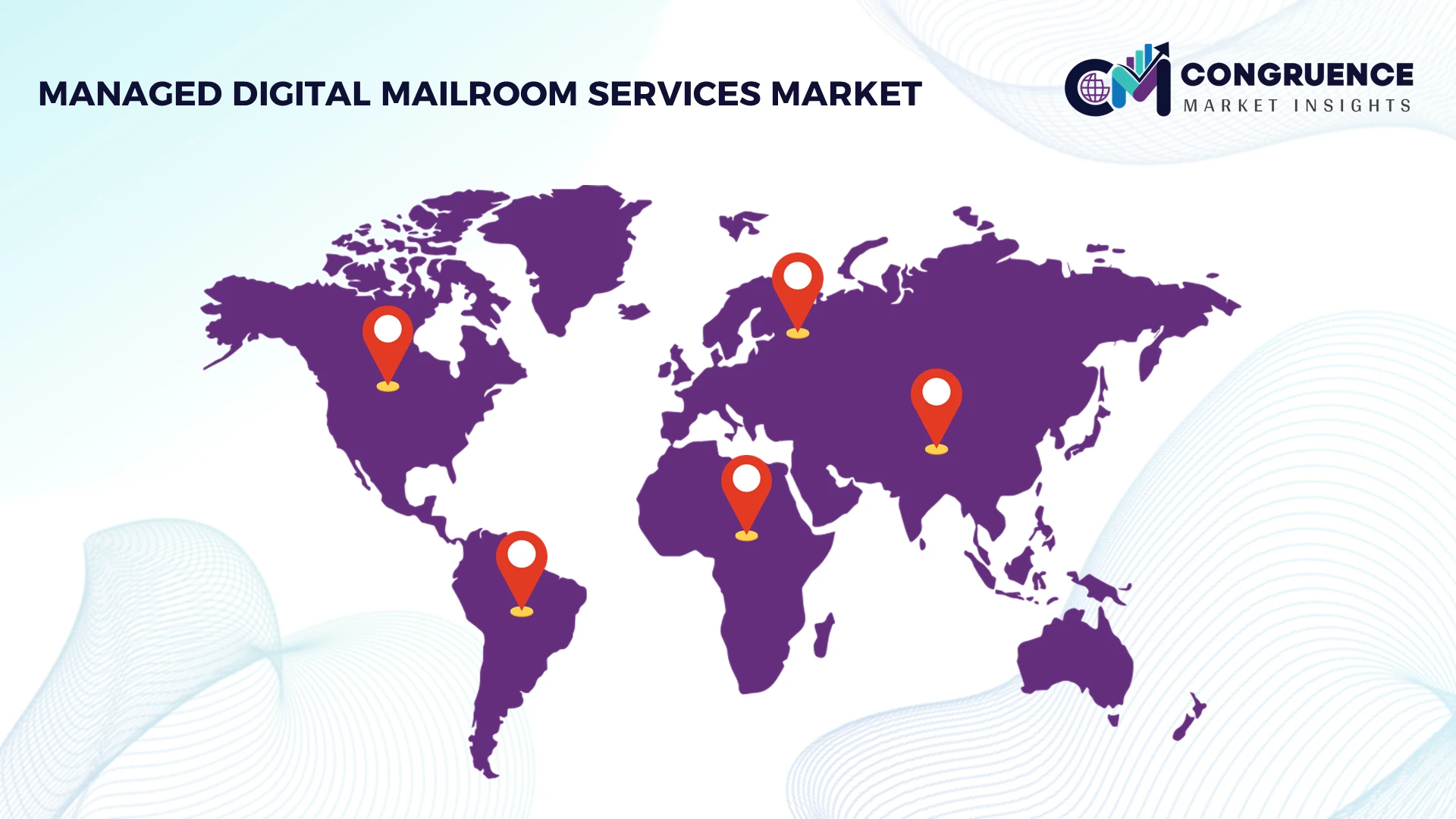
North America accounted for the largest market share at an estimated 37% in 2025 however, Asia Pacific is expected to register the fastest growth, expanding at an estimated CAGR of 11.8% between 2026 and 2033.
North America Managed Digital Mailroom Services Market
Enterprise Outsourcing and Intelligent Correspondence Modernization
North America maintains an estimated 37% share of the global Managed Digital Mailroom Services Market, supported by established business process outsourcing infrastructure, advanced enterprise content management systems, and extensive document intensive operations. The United States dominates regional deployment, particularly across banking, insurance, healthcare administration, and federal agencies. Canada contributes through financial services modernization and public sector digitization initiatives. Enterprise customers increasingly consolidate distributed physical mailrooms into centralized processing facilities equipped with intelligent document capture and secure electronic distribution. Advanced deployments target 25% to 30% faster correspondence processing and improved document traceability. HIPAA requirements and federal records management standards reinforce demand for controlled information handling. Providers including Iron Mountain, Ricoh, and Xerox are strengthening workflow integration capabilities, managed processing contracts, and cloud delivery platforms. Competitive differentiation increasingly depends on service reliability, regulatory expertise, and integration with existing enterprise applications.
United States Market Outlook: The United States benefits from extensive enterprise outsourcing networks, sophisticated cloud infrastructure, and established financial services operations. More than 4,000 FDIC insured banking institutions create a substantial addressable customer base for correspondence digitization. Federal electronic records modernization and healthcare information security requirements encourage investment in secure document processing. Enterprises increasingly prioritize automated audit trails, electronic retention policies, and integration with existing customer relationship management platforms.
Europe Managed Digital Mailroom Services Market
Regulatory Compliance Drives Document Infrastructure Consolidation
Europe accounts for an estimated 29% of global managed digital mailroom services demand, supported by financial services outsourcing, public administration modernization, and stringent information governance requirements. Germany, the United Kingdom, and France represent important enterprise deployment centers, with banking, insurance, legal services, and government organizations prioritizing secure correspondence management. GDPR requirements strengthen demand for controlled document access, retention management, and auditable processing environments. The European Union's eIDAS framework further supports trusted electronic transactions and digital documentation. Enterprises implementing centralized correspondence systems target 20% to 25% reductions in physical document handling requirements. Providers are expanding localized cloud hosting, multilingual document classification, and compliance focused workflow services. Competitive positioning increasingly depends on demonstrating information sovereignty, contractual transparency, and compatibility with established enterprise records management platforms across different national regulatory environments.
Germany Market Outlook: Germany maintains a strategically important position through its industrial enterprise base, established financial institutions, and strong data protection framework. The country's electronic invoicing transition began in January 2025, increasing business attention toward structured digital documentation. German enterprises prioritize secure document capture, SAP integration, and controlled correspondence distribution. Service providers offering localized processing infrastructure and configurable retention policies gain advantages among regulated corporate customers.
Asia-Pacific Managed Digital Mailroom Services Market
Digital Infrastructure Expansion Accelerates Enterprise Deployment
Asia Pacific holds an estimated 22% share of the global Managed Digital Mailroom Services Market, supported by expanding digital infrastructure, enterprise services outsourcing, and increasing adoption of electronic business documentation. China, India, Japan, and Australia represent important markets with differing operational priorities. Japan emphasizes administrative process modernization, while Australia prioritizes secure digital correspondence across financial institutions and government agencies. India benefits from extensive information technology services capabilities and expanding enterprise automation infrastructure. Advanced mailroom implementations target 30% faster document classification and approximately 25% lower manual processing requirements. Regional providers are developing multilingual optical character recognition, centralized scanning facilities, and cloud integrated correspondence platforms. Enterprise demand increasingly favors flexible processing contracts capable of supporting geographically distributed operations. Competitive advantage depends on combining localized language processing capabilities with scalable service delivery and cost efficient implementation.
India Market Outlook: India benefits from its established business process management industry, extensive technology workforce, and Digital India infrastructure. The Unified Payments Interface processed more than 16 billion transactions in October 2024, demonstrating the scale of national digital adoption. Banking institutions, insurance providers, and government departments are expanding electronic documentation practices. Managed service providers can leverage domestic processing centers, multilingual automation, and enterprise software partnerships to serve international and local customers.
South America Managed Digital Mailroom Services Market
Financial Services Digitization Reshapes Outsourcing Demand
South America represents an estimated 7% of the global Managed Digital Mailroom Services Market, with Brazil accounting for the largest concentration of enterprise document processing activity. Financial institutions, insurance providers, telecommunications operators, and government agencies are modernizing correspondence management to reduce administrative complexity. Brazil's expanding digital financial ecosystem strengthens demand for electronic records integration, while Chile and Colombia support opportunities through banking modernization and public administration digitization. Centralized document processing initiatives target 20% to 25% reductions in manual correspondence handling and faster internal distribution. However, fragmented enterprise software environments and uneven cloud infrastructure maturity complicate implementation across smaller organizations. Providers are responding through modular service packages, localized hosting partnerships, and flexible outsourcing agreements. Competitive differentiation increasingly depends on affordable deployment models, Portuguese and Spanish document recognition, and integration with domestic financial systems.
Brazil Market Outlook: Brazil leads regional opportunities through its extensive banking infrastructure, established outsourcing industry, and expanding electronic financial services. The Central Bank's Pix payment system recorded more than 63 billion transactions during 2024, reflecting substantial digital transaction adoption. Brazil's General Data Protection Law strengthens requirements for controlled personal information processing. Enterprises increasingly prioritize automated customer correspondence, secure electronic archiving, and integration with domestic financial administration platforms.
Middle East & Africa Managed Digital Mailroom Services Market
Government Modernization Strengthens Digital Processing Infrastructure
The Middle East & Africa region accounts for an estimated 5% of global managed digital mailroom services demand, supported by government digitization programs, financial sector modernization, and investment in enterprise cloud infrastructure. The United Arab Emirates and Saudi Arabia lead regional digital administration initiatives, while South Africa maintains established financial services outsourcing capabilities. Saudi Vision 2030 encourages electronic government services and institutional process modernization, strengthening opportunities for secure correspondence management. Enterprise deployment models target 20% faster document distribution and approximately 15% lower physical handling requirements. Providers are expanding regional hosting partnerships, Arabic language document recognition, and integrated records management services. Data residency requirements and varying infrastructure maturity influence procurement decisions. Successful providers prioritize localized processing capabilities, government contracting expertise, and secure integration with existing enterprise systems rather than standardized international service packages.
United Arab Emirates Market Outlook: The United Arab Emirates benefits from advanced telecommunications infrastructure, expanding cloud availability, and government digital transformation initiatives. The UAE Digital Government Strategy 2025 emphasized integrated digital public services and improved institutional efficiency. Financial institutions, healthcare organizations, and government entities increasingly require secure electronic correspondence management. Dubai and Abu Dhabi offer attractive enterprise deployment environments through concentrated commercial activity, advanced data center infrastructure, and investment in automated administrative services.
Market Competition Landscape
The Managed Digital Mailroom Services Market features competition between established document outsourcing providers Iron Mountain, Ricoh, and Xerox and technology oriented service specialists including Conduent and DATAMARK. The five collectively represent an estimated 28% of global managed service activity, indicating fragmented procurement and substantial regional competition. Large providers leverage scanning infrastructure, enterprise contracts, and regulated document custody, while specialists differentiate through customized workflow integration and flexible delivery. Automated classification programs target 25% faster routing, whereas centralized processing models pursue 20% lower handling costs and 30% fewer manual touchpoints. Iron Mountain emphasizes secure information governance, Ricoh integrates workplace and document services, and Conduent develops transaction processing capabilities. Partnerships with cloud platforms and enterprise software vendors are shifting competition from physical mail collection toward digital workflow ownership. Legacy integration complexity and stringent information security requirements remain entry barriers. Winning requires demonstrable processing accuracy, predictable service levels, sector compliance, and scalable customer integrations.
Companies Profiled in the Managed Digital Mailroom Services Market Report
-
Iron Mountain Incorporated
-
Ricoh Company, Ltd.
-
Xerox Holdings Corporation
-
Conduent Incorporated
-
Canon Inc.
-
Swiss Post Ltd.
-
Quadient S.A.
-
Pitney Bowes Inc.
-
DATAMARK, Inc.
-
Exela Technologies, Inc.
-
Access Information Management Corporation
-
Restore plc
-
MHC Software, LLC
-
Williams Lea Limited
Technology Insights for the Managed Digital Mailroom Services Market
Intelligent optical character recognition, robotic process automation, and cloud document management form the technological foundation of managed digital mailroom services. Advanced OCR platforms target 95% to 98% extraction accuracy for standardized documents, while automated indexing reduces manual classification effort by an estimated 25%. Compared with legacy scanning and manual distribution, intelligent document processing can improve correspondence turnaround efficiency by approximately 30%. Enterprise adoption concentrates in banking, insurance, healthcare, and government operations, where secure document capture, electronic routing, and integration with existing content management systems improve administrative productivity.
Emerging technologies include generative AI, natural language processing, and intelligent workflow orchestration. Generative AI supports contextual document interpretation, while automated exception management targets 20% fewer manual reviews. Cloud native processing platforms enable centralized access across distributed offices, with optimized implementations targeting 25% lower infrastructure administration effort. Integration with enterprise resource planning and customer relationship management systems strengthens operational visibility. Providers offering multilingual recognition and configurable compliance controls gain competitive advantages in regulated industries.
Between 2026 and 2028, agentic document processing and predictive workflow analytics will reshape service delivery. Advanced deployments target 40% automated correspondence resolution and faster exception handling. Providers investing in secure AI infrastructure and interoperable platforms strengthen scalability, contract retention, and operational differentiation.
Recent Developments in the Global Managed Digital Mailroom Services Market
-
April 2024: Ricoh acquired German AI specialist natif.ai, adding 46 employees and advanced document recognition capabilities. The acquisition strengthened intelligent capture, handwriting recognition, and automated data extraction across Ricoh's enterprise document management and process automation portfolio. Source: ricoh.com.
-
March 2025: KnowledgeLake partnered with OMG Services to integrate AI powered document capture into UbiMAIL. KnowledgeLake's platform served over 2 million users, supporting the partnership's objective of automating enterprise mail classification, recipient identification, and electronic distribution. Source: businesswire.com.
-
March 2026: Iron Mountain documented its internal Digital Mail deployment across shared services operations, automating approximately 70% of initial document handling. Centralized intelligent processing accelerated correspondence routing and strengthened auditability, reducing dependence on decentralized physical mailrooms. Source: ironmountain.com.
-
November 2024: OPEX Corporation introduced its OMATION Model 606 Envelopener, capable of processing 40,000 envelopes hourly. The system incorporated precision opening and configurable processing features, enabling enterprise mailrooms to increase throughput, reduce handling interruptions, and improve operational efficiency. Source: opex.com.
Scope of the Managed Digital Mailroom Services Market Report
The Managed Digital Mailroom Services Market Report examines industry developments, technology adoption, competitive positioning, and enterprise outsourcing strategies between 2026 and 2033. Segmentation covers four service types: Physical Mail Digitization, Digital Mail Processing, Hybrid Mailroom Services, and Cloud-Based Mailroom Services. Application analysis evaluates Invoice Processing, Document Management, Customer Correspondence, Claims Processing, and Records Management. End user coverage includes BFSI, Healthcare, Government, Legal Services, and Retail and E-commerce, highlighting sector specific operational requirements and procurement priorities.
Regional analysis covers North America, Europe, Asia Pacific, South America, and Middle East & Africa, including country level deployment patterns. The report evaluates intelligent optical character recognition, AI classification, cloud integration, and workflow automation. Competitive benchmarking examines processing efficiency, compliance capabilities, service differentiation, and investment priorities, supporting enterprise expansion planning, vendor selection, and strategic market positioning.
Managed Digital Mailroom Services Market Report Summary
| Report Attribute/Metric | Report Details |
|---|
Market Revenue in 2025 | USD 2120 Million |
Market Revenue in 2033 | USD 4193.32 Million |
CAGR (2026 - 2033) | 8.9% |
Base Year | 2025 |
Forecast Period | 2026 - 2033 |
Historic Period | 2021 - 2025 |
Segments Covered | By TypePhysical Mail Digitization Cloud-Based Mailroom Services
By ApplicationBy End-User |
Key Report Deliverable | Revenue Forecast, Growth Trends, Market Dynamics, Segmental Overview, Regional and Country-wise Analysis, Competition Landscape |
Region Covered | North America, Europe, Asia-Pacific, South America, Middle East, Africa |
Key Players Analyzed | Iron Mountain Incorporated, Ricoh Company, Ltd., Xerox Holdings Corporation, Conduent Incorporated, Canon Inc., Swiss Post Ltd., Quadient S.A., Pitney Bowes Inc., DATAMARK, Inc., Exela Technologies, Inc., Access Information Management Corporation, Restore plc, MHC Software, LLC, Williams Lea Limited |
Customization & Pricing | Available on Request (10% Customization is Free) |





