
Reports
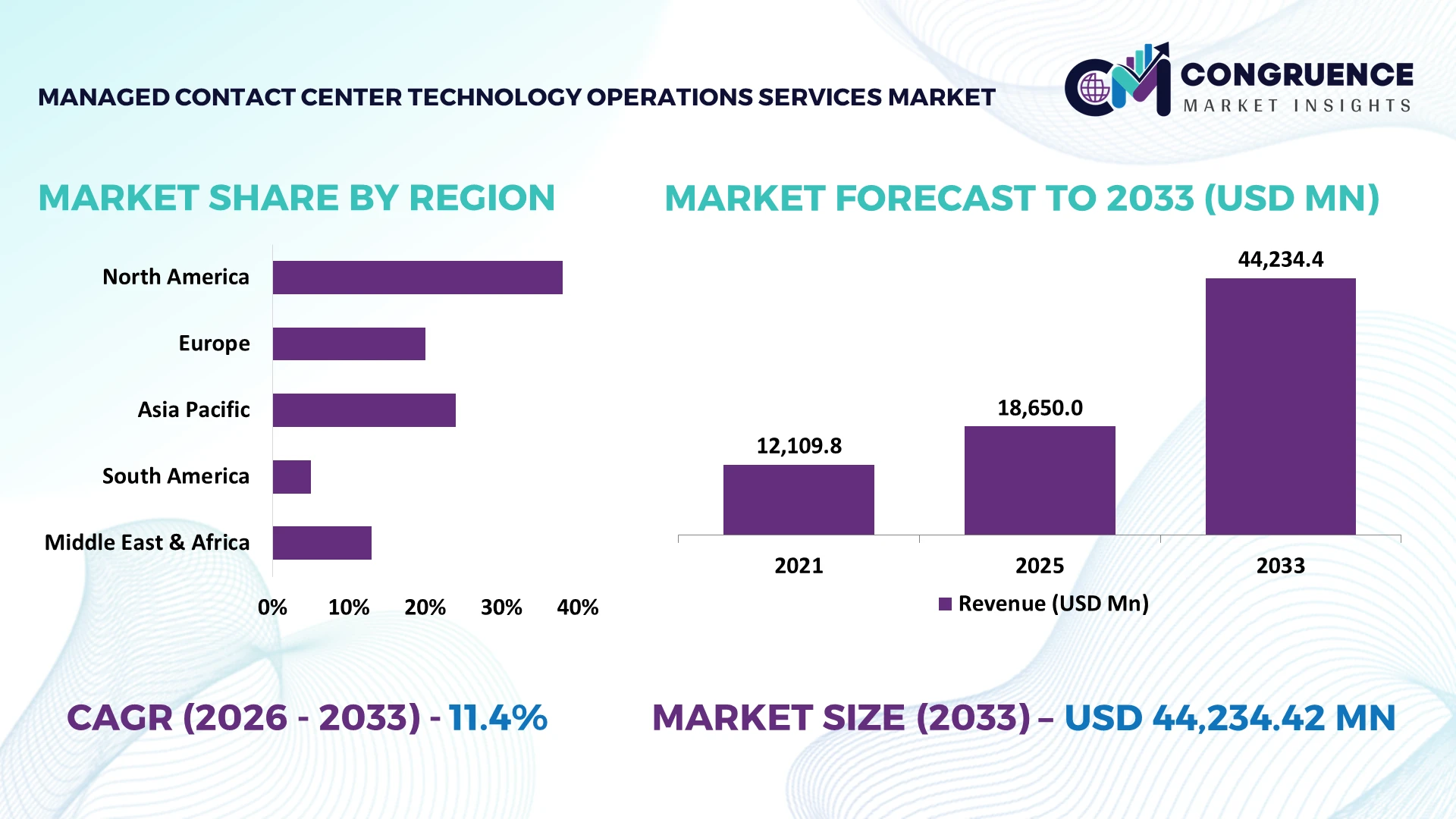
The Global Managed Contact Center Technology Operations Services Market was valued at USD 18650 Million in 2025 and is anticipated to reach a value of USD 44234.42 Million by 2033 expanding at a CAGR of 11.4% between 2026 and 2033. Growth is driven by cloud contact center migration, AI powered customer interaction automation, omnichannel orchestration, and outsourcing of platform administration, cybersecurity, and workforce optimization operations.
The United States dominates the Managed Contact Center Technology Operations Services Market with an estimated 38% global share, supported by extensive enterprise customer service infrastructure and investment in cloud communications. The country accounts for substantial deployments across banking, healthcare, telecommunications, and retail. Microsoft announced USD 80 billion in planned AI data center investment during fiscal 2025, strengthening supporting infrastructure. Compared with India's outsourcing focused delivery ecosystem, American enterprises emphasize advanced customer experience platforms, generative AI integration, and automated workforce management. An estimated 45% of large enterprise contact centers prioritize AI assisted service modernization.
Strategically, providers combining cloud platform management, intelligent automation, and cybersecurity operations can secure higher value enterprise contracts while improving customer experience performance and technology operating efficiency.
Market Size & Growth: USD 18,650 million in 2025, reaching USD 44,234.42 million by 2033 at 11.4% CAGR, supported by cloud contact center modernization.
Top Growth Drivers: Estimated adoption priorities include 45% AI integration, 35% cloud migration, and 30% omnichannel workflow modernization.
Short Term Forecast: By 2027, managed AI operations target 25% faster customer issue resolution and 20% lower routine interaction handling costs.
Emerging Technologies: Three innovations dominate investment: conversational AI, agentic automation, and real time speech analytics, improving service orchestration and agent productivity.
Regional Leaders: Estimated 2033 values reach USD 16,809.08 million in North America, USD 12,385.64 million in Europe, and USD 10,174.92 million in Asia Pacific, driven by cloud and AI adoption.
Consumer/End User Trends: An estimated 60% of enterprise contact center modernization programs prioritize integrated voice, chat, email, and messaging workflows.
Pilot/Case Example: In 2024, Klarna reported its AI assistant handled two thirds of customer service chats, demonstrating scalable conversational automation.
Competitive Landscape: Estimated market leader Accenture holds approximately 7% share, competing with IBM, Teleperformance, Concentrix, and TTEC in managed operations.
Regulatory & ESG Impact: GDPR and evolving AI governance encourage secure customer data handling, with automated compliance monitoring targeting 20% faster audit preparation.
Investment & Funding: Microsoft's announced USD 80 billion fiscal 2025 AI infrastructure investment strengthens cloud capacity supporting enterprise customer experience automation.
Innovation & Future Outlook: Three technologies reshape managed operations: autonomous AI agents, predictive customer engagement, and unified customer experience orchestration platforms.
The Managed Contact Center Technology Operations Services Market is transforming enterprise customer engagement through outsourced platform management, cloud infrastructure modernization, and intelligent interaction automation. Banking and financial services organizations prioritize secure customer authentication, automated dispute handling, and regulatory call recording, while telecommunications and retail enterprises emphasize omnichannel responsiveness. Generative AI copilots, real time sentiment analysis, and predictive workforce scheduling improve service consistency and operational control. Advanced implementations target 25% reductions in routine handling effort through intelligent routing and automated knowledge retrieval. Growing scrutiny of AI driven customer interactions strengthens demand for transparent governance, positioning specialized technology operations providers for strategic enterprise partnerships.
Managed Contact Center Technology Operations Services are becoming strategically essential as enterprises shift customer engagement infrastructure from internally maintained systems toward cloud platforms, intelligent automation, and specialized technology outsourcing. This transformation is reshaping competitive positioning across banking, telecommunications, healthcare, and retail. Enterprises implementing managed cloud contact center operations can target 25% to 30% lower infrastructure administration effort while improving service availability. Increasing customer expectations for continuous digital engagement and regulatory scrutiny of AI interactions are accelerating investment in secure, integrated customer experience platforms.
AI powered contact center operations can deliver an estimated 30% faster routine inquiry resolution compared with legacy interactive voice response systems and manually configured routing. The United States leads advanced cloud deployment and generative AI integration, while India maintains advantages in multilingual service delivery and technology operations outsourcing. Between 2026 and 2028, enterprise modernization programs are targeting 40% automation of repetitive customer interactions and 20% improvements in workforce scheduling efficiency, strengthening operational scalability.
A practical deployment involves financial institutions integrating conversational AI, cloud telephony, and workforce engagement management to automate account inquiries while escalating complex cases to human agents. Providers including Accenture, IBM, and TTEC are strengthening hyperscaler partnerships, platform engineering capabilities, and AI operations services. Long term competitive advantage depends on measurable customer experience improvements, secure technology integration, and consistent service performance across communication channels.
Enterprise migration from legacy telephony infrastructure to cloud contact center platforms is accelerating demand for specialized technology operations management. Cloud based deployments can target 25% to 30% lower infrastructure administration effort, while AI assisted routing supports approximately 20% faster customer issue resolution. In the United States, financial institutions and telecommunications providers are modernizing customer engagement systems to support distributed service teams and integrated digital channels. Generative AI adoption strengthens demand for continuous model monitoring, platform optimization, and secure interaction management. Providers including IBM, Accenture, and TTEC are expanding cloud engineering capabilities and technology partnerships. The strategic advantage lies in managing complex customer experience infrastructure through measurable service agreements rather than maintaining fragmented internal technology teams.
Legacy telephony infrastructure and fragmented enterprise applications create structural constraints on managed contact center technology operations. Complex migration projects can require an estimated 20% to 30% additional integration expenditure, while customized application interfaces increase implementation effort by approximately 15% to 25%. In Germany, GDPR requirements impose strict controls on customer information processing, recording retention, and international data transfers. Dependence on major cloud communication platforms also exposes providers to vendor pricing changes and contractual restrictions. These pressures reduce operating flexibility and complicate service pricing for organizations maintaining older customer relationship management systems. Providers are responding through multicloud architectures, standardized integration frameworks, regional data hosting agreements, and phased migration contracts to protect profitability and deployment continuity.
Agentic AI creates opportunities to transform managed contact center services from infrastructure administration into autonomous customer experience orchestration. Advanced AI agents can target 35% to 45% automation of routine service requests, while predictive interaction analytics supports approximately 20% faster issue identification. India's expanding digital services ecosystem and multilingual customer base create opportunities for AI enabled support across banking, telecommunications, and electronic commerce. Between 2026 and 2028, integration of autonomous agents with customer relationship management and enterprise knowledge platforms will strengthen demand for specialized AI operations management. Providers are investing in conversational model development, multilingual speech recognition, and partnerships with cloud technology vendors. Competitive differentiation increasingly depends on managing automated resolution quality rather than simply increasing agent capacity.
Maintaining consistent AI performance across high volume, multilingual customer interactions presents significant execution challenges for managed technology operations providers. Enterprise deployments commonly establish operational targets exceeding 99.9% platform availability, while automated quality monitoring programs aim to evaluate 100% of recorded interactions. Complex customer requests and changing knowledge bases can require additional human review, with advanced implementations targeting 20% fewer escalation errors. In the European Union, AI Act implementation introduces evolving governance requirements affecting certain automated customer interaction applications. Providers must strengthen model validation, identity security, real time monitoring, and human escalation controls. Sustainable competitiveness depends on maintaining customer trust, regulatory accountability, and service continuity while scaling automation across increasingly complex enterprise environments.
Real Time Agent Assistance Expands: Contact centers are embedding live transcription, knowledge retrieval, and automated response recommendations into agent desktops. Illustrative deployments target 15% to 25% shorter average handling times and 20% faster knowledge retrieval. In the United States, rising service complexity is encouraging enterprises to consolidate agent assistance tools. Providers are integrating contextual guidance with existing customer relationship management platforms, improving first contact resolution without replacing experienced service representatives.
Workforce Engagement Analytics Becomes Predictive: Contact center operators are replacing retrospective staffing reports with intraday forecasting and automated schedule adjustments. Advanced implementations target 10% to 15% improvements in forecasting accuracy and 12% lower overtime requirements. India's large customer service workforce strengthens demand for capacity planning tools. Technology operations providers are expanding workforce analytics partnerships and integrating real time queue information with scheduling platforms to reduce service level fluctuations.
Customer Authentication Workflows Become Frictionless: Financial institutions are introducing voice biometrics, behavioral authentication, and continuous identity verification to reduce repetitive security questions. Optimized deployments target 20% faster customer verification and 15% fewer authentication related transfers. Increasing account takeover threats are accelerating investment in secure identity workflows. Managed service providers are integrating fraud detection platforms with contact center authentication systems, strengthening security without extending customer interaction duration.
Interaction Observability Gains Operational Priority: Enterprises are consolidating call quality telemetry, application performance monitoring, and network diagnostics into unified operational dashboards. Advanced monitoring programs target 25% faster incident identification and 20% shorter service restoration cycles. Cloud communication dependencies make end to end visibility increasingly important. Providers are strengthening observability partnerships, introducing automated incident correlation, and expanding service assurance capabilities to protect customer experience during infrastructure disruptions.
Cloud-Based Operations dominate the Managed Contact Center Technology Operations Services Market with an estimated 52% share in 2025, supported by flexible infrastructure provisioning, centralized platform administration, and integration with enterprise customer experience applications. Financial institutions, telecommunications providers, and retail enterprises increasingly favor managed cloud environments for geographically distributed service teams. Cloud deployments can target 25% lower infrastructure administration effort compared with conventional internally maintained environments. Providers are expanding cloud platform engineering capabilities, automated service monitoring, and integration partnerships with major customer experience technology vendors. On-Premises Operations retain relevance among organizations requiring direct infrastructure control, specialized telephony integration, and restrictive data handling arrangements, particularly within regulated financial and healthcare operations.
Hybrid Operations represent the fastest growing type as enterprises balance existing telephony investments with modern cloud communication capabilities. Hybrid architectures allow gradual infrastructure modernization without immediate replacement of established customer interaction systems. Optimized implementations target 20% lower migration disruption and approximately 15% faster deployment of new communication channels. Providers are introducing unified monitoring, interoperable routing frameworks, and flexible managed service agreements to capture enterprises pursuing phased technology transitions.
Customer Support represents the largest application segment in the Managed Contact Center Technology Operations Services Market, accounting for an estimated 39% share in 2025. Banking institutions, telecommunications operators, and retail enterprises rely on managed technology platforms to maintain consistent customer interaction handling across voice and digital channels. Integrated routing, workforce optimization, and agent assistance tools can target 25% faster routine inquiry resolution. Technical Support remains an established application, particularly among software providers and telecommunications companies requiring structured incident escalation and technical knowledge integration. Complaint Management maintains strategic importance for regulated organizations where customer grievances require documented resolution procedures and service accountability. Providers are expanding platform administration capabilities, service analytics, and configurable escalation workflows to improve operational consistency.
Sales and Lead Management represents the fastest growing application as enterprises integrate predictive engagement, customer relationship management data, and automated lead qualification. Advanced implementations target 20% higher lead handling productivity through intelligent prioritization and reduced administrative effort. Order Processing remains important for transaction verification, fulfillment inquiries, and customer communication. Providers are developing application specific automation packages and performance-linked contracts to strengthen enterprise adoption.
BFSI dominates the Managed Contact Center Technology Operations Services Market with an estimated 31% share in 2025, supported by extensive customer interaction volumes, strict information security requirements, and continuous service availability expectations. Banks and insurance providers prioritize secure authentication, transaction support, complaint handling, and integrated customer communication platforms. Managed operations can target 20% lower technology administration effort while improving service monitoring and regulatory reporting. IT and Telecommunications represents another established end user group, requiring scalable interaction routing, technical support infrastructure, and network service assurance. Healthcare organizations increasingly adopt managed contact center platforms for appointment coordination, patient communication, and insurance administration. Providers are strengthening industry specific compliance controls and integration capabilities to address these operational requirements.
Retail and E-commerce represents the fastest growing end user segment as digital shopping platforms expand customer engagement across messaging, voice, and application interfaces. Advanced deployments target 30% faster order inquiry resolution during seasonal demand fluctuations. Travel and Hospitality maintains specialized demand for reservation support and multilingual customer assistance. Providers are introducing consumption based pricing, industry specific automation, and flexible capacity management to capture expanding enterprise contracts.
North America accounted for the largest market share at an estimated 38% in 2025 however, Asia Pacific is expected to register the fastest growth, expanding at an estimated CAGR of 14.2% between 2026 and 2033.
Cloud Platform Modernization and AI Driven Service Operations
North America dominates the Managed Contact Center Technology Operations Services Market with an estimated 38% share in 2025, supported by extensive enterprise customer engagement infrastructure and established technology outsourcing networks. The United States leads deployments across banking, telecommunications, healthcare, and retail, while Canada contributes through financial services modernization and multilingual customer support operations. Enterprises increasingly outsource cloud platform administration, workforce optimization, and customer interaction monitoring to specialized managed service providers. Advanced deployments target 25% faster customer issue resolution and approximately 20% lower infrastructure management effort. Microsoft announced USD 80 billion in planned AI infrastructure investment for fiscal 2025, strengthening the broader computing ecosystem supporting intelligent customer engagement platforms. Providers including Accenture, IBM, and TTEC are expanding hyperscaler partnerships and managed customer experience capabilities. Competitive differentiation increasingly depends on AI integration expertise, platform reliability, and measurable service performance.
United States Market Outlook: The United States maintains technology leadership through its extensive cloud infrastructure, enterprise software ecosystem, and established customer experience outsourcing industry. The Federal Communications Commission oversees telecommunications compliance, while financial institutions require secure interaction recording and customer authentication. Enterprise deployments increasingly integrate conversational AI, real time analytics, and customer relationship management platforms. Advanced service operations target 99.9% platform availability, supporting continuous customer engagement across distributed contact center environments.
Regulatory Governance Accelerates Secure Customer Experience Modernization
Europe accounts for an estimated 28% of global managed contact center technology operations services demand, supported by established financial institutions, telecommunications operators, and enterprise outsourcing networks. The United Kingdom, Germany, and France represent important deployment markets, emphasizing secure cloud communications, customer data protection, and multilingual service management. GDPR requirements strengthen demand for controlled interaction recording, customer information governance, and compliant data processing. The European Union AI Act introduces additional governance considerations for certain automated customer engagement applications. Enterprises implementing centralized technology operations target 20% lower administrative overhead and approximately 25% faster incident identification. Providers are expanding localized cloud infrastructure partnerships, compliance monitoring capabilities, and multilingual conversational AI services. European procurement increasingly favors providers offering transparent data processing arrangements, interoperable customer engagement platforms, and documented operational resilience across multiple national jurisdictions.
United Kingdom Market Outlook: The United Kingdom benefits from its concentrated financial services industry, advanced telecommunications infrastructure, and established business process outsourcing ecosystem. London's banking and insurance institutions prioritize secure customer authentication, automated complaint management, and interaction analytics. The Financial Conduct Authority's Consumer Duty framework reinforces customer service accountability. Managed service providers are strengthening cloud communications integration and quality monitoring capabilities, with optimized implementations targeting 20% faster complaint handling.
Outsourcing Scale and Multilingual Automation Strengthen Deployment
Asia Pacific represents an estimated 23% of the global Managed Contact Center Technology Operations Services Market, supported by extensive customer service outsourcing infrastructure, enterprise digitization, and expanding cloud communications adoption. India and the Philippines maintain established contact center delivery ecosystems, while Japan, Australia, and China contribute through enterprise technology modernization. India's information technology services capabilities support complex platform administration, workforce management, and multilingual interaction operations. The Philippines maintains substantial voice support capacity serving international customers. Advanced managed deployments target 30% improvements in routine inquiry processing efficiency and approximately 20% lower technology administration requirements. Providers are expanding AI enabled service delivery centers, regional cloud partnerships, and multilingual speech analytics capabilities. Competitive advantage increasingly depends on combining cost efficient operations with secure platform engineering, consistent service quality, and integration expertise across geographically distributed enterprise environments.
India Market Outlook: India maintains a strategic position through its extensive IT services industry, skilled technology workforce, and established international customer support operations. NASSCOM reported approximately 5.8 million technology sector employees in fiscal 2025, highlighting the country's substantial technical talent base. Bengaluru, Hyderabad, Pune, and Chennai support cloud engineering and customer experience technology operations. Providers increasingly develop conversational AI capabilities, automated workforce scheduling, and integrated service monitoring for global enterprise customers.
Financial Services Digitization Expands Managed Technology Demand
South America accounts for an estimated 7% of global managed contact center technology operations services activity, with Brazil representing the largest enterprise deployment market. Financial institutions, telecommunications providers, retail organizations, and digital commerce platforms are modernizing customer interaction infrastructure to improve service accessibility. Brazil's expanding digital payments ecosystem strengthens requirements for secure customer authentication and transaction support. Colombia and Argentina contribute through established customer service outsourcing capabilities and Spanish language operations. Managed cloud implementations target 20% faster customer inquiry routing and approximately 15% lower infrastructure administration effort. However, telecommunications reliability differences and fragmented legacy customer relationship management environments complicate deployment across smaller enterprises. Providers are responding through localized cloud partnerships, modular platform administration contracts, and multilingual service integration. Competitive positioning increasingly depends on affordable managed operations, reliable connectivity, and compatibility with domestic financial technology systems.
Brazil Market Outlook: Brazil benefits from its extensive banking infrastructure, telecommunications market, and expanding digital financial services ecosystem. The Central Bank's Pix payment system processed more than 63 billion transactions during 2024, demonstrating substantial digital customer interaction activity. São Paulo concentrates major financial institutions and enterprise technology operations. Brazil's General Data Protection Law strengthens demand for secure customer information management, compliant interaction recording, and controlled cloud communication infrastructure.
Digital Infrastructure Investment Reshapes Enterprise Customer Engagement
The Middle East & Africa region represents an estimated 4% of the global Managed Contact Center Technology Operations Services Market, supported by government digitization, telecommunications modernization, and expanding enterprise cloud infrastructure. Saudi Arabia and the United Arab Emirates lead investment in intelligent customer service platforms, while South Africa maintains established outsourced customer support capabilities. Saudi Vision 2030 encourages digital public services and enterprise technology modernization, strengthening demand for secure contact center operations. Advanced deployments target 25% faster customer interaction routing and approximately 20% improvements in workforce scheduling efficiency. Providers are expanding regional cloud partnerships, Arabic language conversational AI, and managed platform monitoring capabilities. Data residency requirements and varying telecommunications infrastructure maturity influence enterprise procurement strategies. Competitive differentiation increasingly depends on localized service delivery, regulatory compliance, and integration with government and financial sector technology environments.
Saudi Arabia Market Outlook: Saudi Arabia benefits from substantial digital infrastructure investment, expanding cloud availability, and government modernization initiatives. Vision 2030 supports digital public administration and private sector technology adoption. Riyadh concentrates major financial institutions, telecommunications operators, and government service organizations. Enterprises increasingly prioritize Arabic language customer engagement, intelligent call routing, and secure cloud contact center platforms. Managed service providers are developing localized operations capabilities and partnerships with enterprise technology vendors.
The Managed Contact Center Technology Operations Services Market features competition between global technology integrators Accenture, IBM, and HCLTech and customer experience specialists Teleperformance, Concentrix, and TTEC. The leading five providers collectively command an estimated 32% market share, reflecting fragmented enterprise outsourcing contracts and specialized technology requirements. Global integrators compete through cloud engineering, cybersecurity, and enterprise application integration, while customer experience specialists emphasize interaction analytics, workforce optimization, and operational flexibility. Advanced managed deployments target 25% lower infrastructure administration costs, 30% faster routine inquiry resolution, and 20% improved workforce scheduling efficiency. Accenture and IBM strengthen hyperscaler partnerships, while Concentrix and Teleperformance expand AI enabled customer engagement capabilities. Competition is shifting toward integrated AI operations, predictive service assurance, and outcome based contracts. Legacy platform interoperability, regulatory compliance, and specialized engineering talent remain significant entry barriers. Sustainable competitive advantage requires demonstrable automation performance, secure multicloud operations, industry expertise, and consistent enterprise service delivery.
Accenture plc
International Business Machines Corporation (IBM)
Teleperformance SE
Concentrix Corporation
TTEC Holdings, Inc.
HCL Technologies Limited
Tata Consultancy Services Limited
Infosys Limited
Wipro Limited
Cognizant Technology Solutions Corporation
Genpact Limited
Capgemini SE
Tech Mahindra Limited
NTT DATA Group Corporation
Cloud contact center platforms, conversational AI, and workforce engagement management systems underpin modern managed technology operations. Intelligent routing targets 20% faster inquiry distribution, while automated quality monitoring enables evaluation of nearly 100% of recorded interactions. Compared with legacy telephony and manually configured routing, cloud integrated operations can deliver an estimated 30% improvement in administrative efficiency. Enterprise deployment concentrates across banking, telecommunications, healthcare, and retail, where unified communication platforms support centralized monitoring, secure customer authentication, and consistent service availability across geographically distributed teams and multiple customer engagement channels.
Emerging technologies include generative AI copilots, real time speech analytics, and predictive workforce optimization. AI assisted knowledge retrieval targets 25% shorter information search times, while predictive scheduling can reduce overtime requirements by approximately 15%. Integration with customer relationship management platforms enables contextual recommendations and automated interaction summaries. Enterprises increasingly combine voice, messaging, and customer history within unified agent workspaces. Providers offering specialized AI model monitoring, multilingual speech recognition, and industry specific compliance controls gain competitive advantages over conventional infrastructure outsourcing providers.
Between 2026 and 2028, agentic AI and autonomous service assurance will transform technology operations. Advanced deployments target 40% automated routine inquiry resolution and 20% faster incident recovery. Providers investing in secure orchestration and continuous model validation strengthen enterprise retention and operational scalability.
January 2025: Accenture expanded its AI Refinery portfolio with telecommunications agent assistance capabilities, estimating 24% higher call accuracy. The solution combines conversational intelligence with personalized recommendations, enabling contact center operators to improve service consistency and accelerate customer interaction processing. Source: accenture.com.
April 2025: Teleperformance announced partnerships with Ema and Parloa to integrate agentic AI into customer experience operations, supporting its €100 million AI investment program. The agreements strengthen automated interaction orchestration and expand enterprise access to intelligent customer engagement capabilities. Source: euronext.com.
July 2025: Concentrix introduced Harmony and Clarity features within its iX Hero platform, reporting 33.6% higher communication scores from production studies. Enhanced speech clarity and background noise suppression strengthen advisor effectiveness, customer comprehension, and service quality across voice interactions. Source: concentrix.com.
June 2025: TTEC expanded its Zendesk partnership, building on deployments among hundreds of enterprise clients. The agreement adds migration tooling, industry solutions, and implementation support, strengthening managed customer experience integration and accelerating adoption of AI enabled service workflows. Source: ttec.com.
The Managed Contact Center Technology Operations Services Market Report examines enterprise technology outsourcing, operational modernization, and competitive developments between 2026 and 2033. Segmentation covers Cloud-Based Operations, On-Premises Operations, and Hybrid Operations, with cloud deployments representing an estimated 52% market share. Application analysis evaluates Customer Support, Technical Support, Sales and Lead Management, Complaint Management, and Order Processing. End user coverage includes BFSI, Healthcare, Retail and E-commerce, IT and Telecommunications, and Travel and Hospitality, emphasizing operational requirements and technology procurement priorities.
Regional analysis covers North America, Europe, Asia Pacific, South America, and Middle East & Africa. The report assesses conversational AI, cloud communications, predictive workforce management, and automated service assurance. Competitive benchmarking evaluates platform integration, operational efficiency, cybersecurity, and outsourcing capabilities, supporting investment planning, geographic expansion, vendor selection, and strategic positioning across evolving enterprise customer engagement environments.
| Report Attribute/Metric | Report Details |
|---|---|
Market Revenue in 2025 | USD 18650 Million |
Market Revenue in 2033 | USD 44234.42 Million |
CAGR (2026 - 2033) | 11.4% |
Base Year | 2025 |
Forecast Period | 2026 - 2033 |
Historic Period | 2021 - 2025 |
Segments Covered | By Type
By Application
By End-User
|
Key Report Deliverable | Revenue Forecast, Growth Trends, Market Dynamics, Segmental Overview, Regional and Country-wise Analysis, Competition Landscape |
Region Covered | North America, Europe, Asia-Pacific, South America, Middle East, Africa |
Key Players Analyzed | Accenture plc, International Business Machines Corporation (IBM), Teleperformance SE, Concentrix Corporation, TTEC Holdings, Inc., HCL Technologies Limited, Tata Consultancy Services Limited, Infosys Limited, Wipro Limited, Cognizant Technology Solutions Corporation, Genpact Limited, Capgemini SE, Tech Mahindra Limited, NTT DATA Group Corporation |
Customization & Pricing | Available on Request (10% Customization is Free) |




