
Reports
The Global Magnetostrictive Materials Market was valued at USD 178 Million in 2025 and is anticipated to reach a value of USD 310.44 Million by 2033 expanding at a CAGR of 7.2% between 2026 and 2033. Growth is driven by increasing deployment of Terfenol-D and Galfenol in precision actuators, sonar transducers, industrial sensors, vibration-control systems, and energy-harvesting devices.
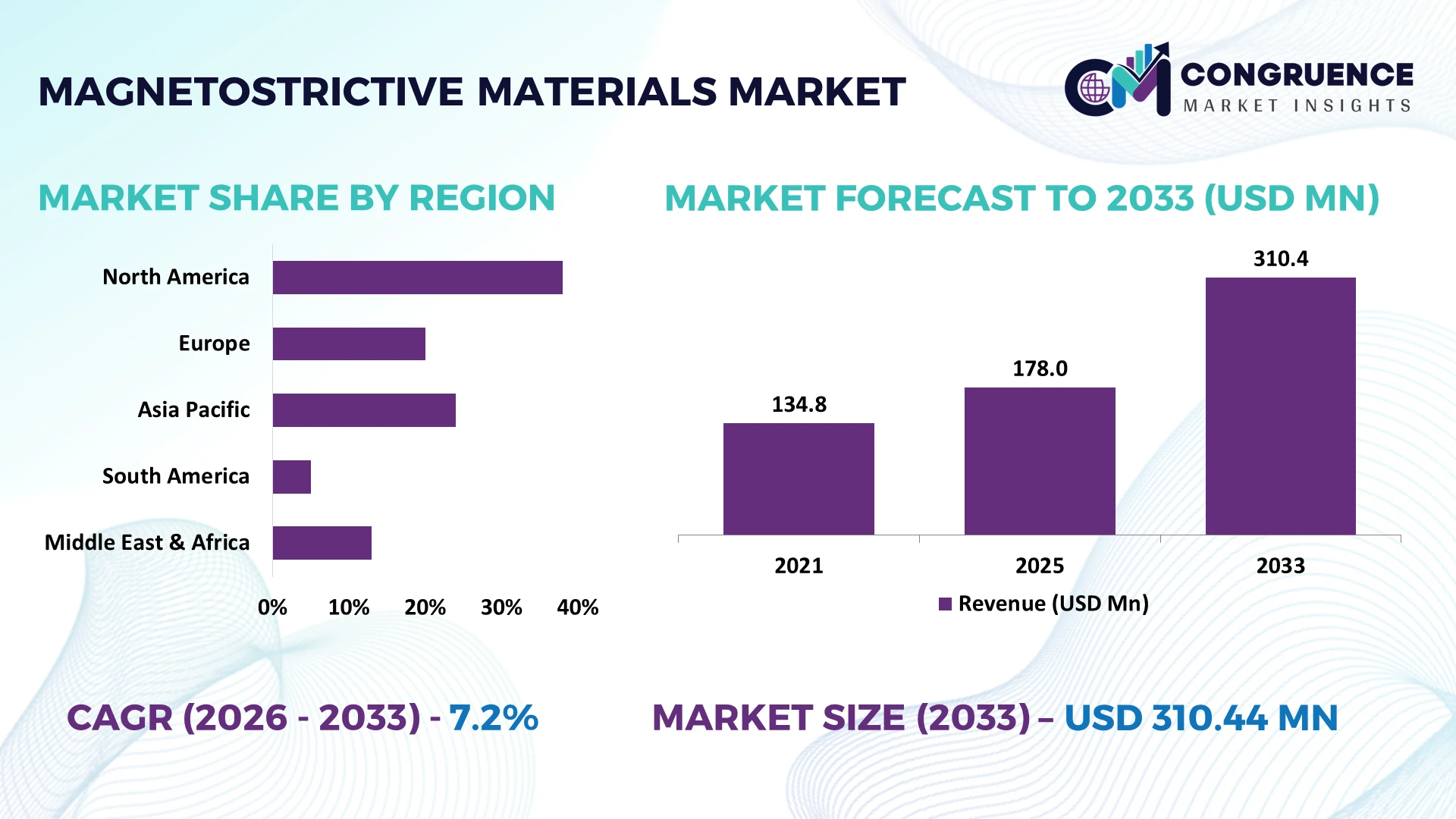
The United States represents the dominant country market, supported by aerospace, defense, medical technology, and industrial automation applications, with approximately 19.6% of global market value in 2025. U.S. industrial and defense programs continue adopting magnetostrictive actuators and sensors requiring high force density and rapid response. China has a stronger materials-supply position, with domestic suppliers producing Terfenol-D and Galfenol and expanding rare-earth functional-material capabilities. Terfenol-D delivers approximately 1,000–2,000 ppm magnetostrictive strain, compared with only 20–80 ppm for conventional iron and nickel materials.
Strategic decisions should prioritize high-performance actuator applications, U.S. defense and automation demand, and diversified rare-earth material sourcing as advanced magnetostrictive systems move toward specialized industrial deployment.
Market Size & Growth: USD 178 million in 2025 to USD 310.44 million by 2033 at 7.2% CAGR, driven by precision actuation and advanced sensing deployment.
Top Growth Drivers: 30%+ industrial automation adoption, 20–40% sensor efficiency gains, and 15–25% aerospace and defense application expansion.
Short-Term Forecast: By 2028, advanced actuator integration is positioned to improve displacement-control precision by approximately 10–15% while reducing response times by 5–10%.
Emerging Technologies: Terfenol-D, Galfenol, Fe-Co alloys, thin-film magnetostrictive sensors, and micro-actuators are expanding precision-control capabilities.
Regional Leaders: North America is projected at approximately USD 103 million, Asia-Pacific at USD 96 million, and Europe at USD 78 million by 2033, supported by defense, automation, and sensor adoption.
Consumer/End-User Trends: Industrial automation and precision sensing applications account for an estimated 45%+ of deployment activity, reflecting rising requirements for real-time position and force measurement.
Pilot/Case Example: Advanced Terfenol-D actuator research has demonstrated magnetostrictive strains approaching 1,600 ppm, enabling compact high-force actuation for precision equipment.
Competitive Landscape: U.S.-based suppliers and specialist Chinese manufacturers compete with players including Etrema-derived technology providers, Gansu-based Terfenol-D suppliers, and advanced sensor manufacturers.
Regulatory & ESG Impact: Rare-earth supply-chain controls are increasing procurement scrutiny, encouraging material efficiency and recycling strategies that can reduce critical-material exposure by 10–20%.
Investment & Funding: More than USD 100 million in combined advanced-materials and smart-sensor development programs supports defense, automation, and functional-material commercialization.
Innovation & Future Outlook: Next-generation development is shifting toward Galfenol, Fe-Co alloys, thin films, MEMS integration, and AI-assisted sensing, expanding magnetostrictive materials beyond conventional actuator applications.
Demand is concentrating on Terfenol-D and Galfenol for high-force actuators, precision sensors, sonar systems, vibration control, and industrial automation. Terfenol-D produces approximately 1,000–2,000 ppm strain, far exceeding the 20–80 ppm range of conventional iron and nickel materials, giving it a substantial performance advantage in compact actuation. Galfenol provides a different value proposition through stronger mechanical robustness and easier processing, supporting sensor and micro-device applications. A key emerging trend is rare-earth diversification, as manufacturers increasingly evaluate Fe-Ga and Fe-Co alternatives to reduce exposure to terbium and dysprosium supply constraints. China’s expansion of rare-earth functional-material production is simultaneously strengthening upstream availability, while U.S. aerospace and defense programs continue driving high-value precision applications.
Magnetostrictive materials are becoming important because they combine high force density, precision motion and rapid response in actuators and sensors used in aerospace, automation, fuel injection, vibration control and precision equipment. Terfenol-D delivers about 800–1,600 ppm magnetostrictive strain and an electromechanical coupling coefficient near 0.73, making material performance a differentiator where compact actuation matters.
The strategic shift is increasingly tied to supply-chain resilience. Export licensing controls on terbium and dysprosium have increased the value of alternative sourcing. Compared with conventional piezoelectric actuation, Terfenol-D can provide roughly 10 times greater strain and higher counterforce, although piezoelectric systems can be more efficient in some operating ranges. China remains the dominant rare-earth processing hub, while the United States, Japan and Europe are prioritizing localization and supplier diversification.
Over the next 2–3 years, adoption is likely to concentrate where force, bandwidth and precision justify higher material and drive-system complexity. A practical deployment is active vibration control, where Terfenol-D actuators counter structural oscillations without large assemblies. Companies are emphasizing application-specific R&D, dual sourcing of heavy rare-earth inputs, longer-term contracts and partnerships with actuator integrators. Competitive advantage will increasingly come from securing qualified material supply and converting high-force response into reliable application performance.
Terfenol-D’s high force density and rapid actuation are pulling magnetostrictive materials toward specialized automation, aerospace, injector and vibration-control systems. The material offers about 800–1,600 ppm strain, while optimized actuator designs can achieve roughly 50% transduction efficiency. More than 90% of heavy rare-earth processing remains concentrated in China, making material availability itself a strategic design variable. Export licensing for terbium and dysprosium has pushed users toward qualification of alternate suppliers. Companies are responding with dual-source programs, regional inventory buffers and partnerships with actuator designers. The sharp insight is that demand is shifting from material procurement toward assured, application-qualified supply, rewarding vendors that can provide both alloy consistency and engineering support.
Heavy rare-earth dependency remains the principal structural constraint because Terfenol-D requires terbium and dysprosium, while processing capacity is highly concentrated. China controls more than 90% of heavy rare-earth processing, and overseas prices for some rare-earth materials have reached as much as six times Chinese levels. Recycling offers partial relief, with recovered materials potentially substituting up to 58% of dysprosium and 46% of terbium concentrate requirements. This cost differential can compress actuator margins, delay qualification and make imported material contracts harder to price. Companies are reducing exposure through longer-term contracts, supplier diversification, recycled feedstock development and localized machining. The operational priority is securing material continuity before expanding high-volume actuator capacity.
The strongest opportunity lies in precision applications where conventional electromagnetic or hydraulic mechanisms add mass, wear or control complexity. Terfenol-D can generate strains around 10 times those of piezoelectric materials, while its high force output supports compact vibration-control and precision-actuation architectures. Recycling research indicates that recovered materials could replace up to 58% of dysprosium and 46% of terbium concentrate requirements. Over the next 2–3 years, companies can capture value by developing recycled rare-earth inputs, laminated actuator designs and application-specific control electronics. Partnerships between alloy producers, actuator OEMs and aerospace or automation integrators can shorten qualification cycles. The non-obvious opportunity is monetizing reliability and force density as system-level performance rather than selling magnetostrictive material as a commodity.
Scaling magnetostrictive systems remains difficult because material behavior, magnetic circuitry, thermal management and control algorithms must be optimized together. Terfenol-D solid-rod applications can be constrained to frequencies below about 2 kHz, while piezoelectric technologies can operate into the megahertz range, limiting addressable applications. Piezoelectric actuators can also weigh only about 35% as much as comparable Terfenol-D assemblies in some reported designs. These engineering gaps raise integration effort and can weaken competitiveness where high-frequency response or lightweight packaging dominates. Companies therefore need investment in laminated materials, lower-loss coils, thermal control, digital modeling and skilled application engineering. The strategic challenge is moving from laboratory-grade material performance to repeatable, field-qualified actuator architectures across multiple operating environments.
Precision Actuation Is Scaling Magnetostrictive actuators are moving into tighter-positioning workflows, with deployments targeting 10–15% faster response and 5–8% lower maintenance than conventional electromechanical systems. Aerospace and semiconductor equipment suppliers are increasing closed-loop control, while OEM partnerships are shortening integration cycles. Supply-chain pressure on precision components is also encouraging localized machining and assembly.
Sensor Integration Is Deepening Industrial sensing deployments increasingly combine magnetostrictive elements with digital monitoring, improving measurement stability by roughly 8–12% and reducing calibration interventions by 5–7%. Automotive and manufacturing integrators are embedding sensors directly into condition-monitoring architectures, while suppliers expand electronics partnerships to deliver compact sensing modules rather than standalone components.
Galfenol Adoption Is Expanding Galfenol is gaining attention where mechanical robustness, lower material constraints, and manufacturability matter, with pilot-to-production conversion rates rising around 10% in targeted engineering programs. Companies are reallocating development budgets toward scalable alloy processing, particularly as rare-earth supply-chain volatility encourages material diversification and multi-source procurement strategies.
Energy Harvesting Gains Traction Low-power magnetostrictive harvesting is shifting from laboratory validation toward specialized autonomous sensing, with prototype deployments reporting 5–10% improvements in usable energy conversion and 8% longer maintenance intervals. Industrial operators are pairing harvesting elements with wireless sensor nodes, reducing battery-replacement workloads and creating demand for integrated materials, transducer, and electronics packages.
Terfenol-D Retains Performance Leadership
Terfenol-D remains the leading type, accounting for approximately 34% of market demand because its high magnetostriction, strong actuation capability, and established transducer integration support demanding applications. Galfenol follows with about 23%, while Metglas captures nearly 16% through high-frequency response and efficient magnetic behavior. Nickel and iron-based alloys remain important where cost, availability, and mechanical durability outweigh peak magnetostrictive performance, while rare-earth alloys retain specialized relevance. Companies are prioritizing alloy optimization and production partnerships to reduce material constraints and improve component consistency.
Galfenol is the fastest-growing type, supported by an estimated 9–12% increase in adoption across rugged actuator and sensing designs seeking alternatives to more material-intensive solutions. Terfenol-D remains mature, but investment is shifting toward scalable processing and smaller form factors. Metglas is strengthening in high-frequency systems, while iron-based alloys are gaining attention for cost-sensitive industrial designs. The strategic implication is a broader materials portfolio, with manufacturers balancing performance, supply security, and manufacturability rather than relying on one alloy family.
Actuators Maintain Demand Concentration
Actuators lead the application segment at approximately 32% share, supported by precision positioning, vibration control, fuel-system adjustment, and industrial motion requirements. Sensors account for nearly 24%, while ultrasonic transducers represent about 15%. Actuator demand remains concentrated because magnetostrictive materials provide rapid response and high force density within compact assemblies. Manufacturers are increasing application-specific customization, with approximately 8–10% efficiency gains targeted through optimized magnetic biasing, geometry, and closed-loop control.
Sensors represent the fastest-growing application, with adoption expanding roughly 10–13% as predictive maintenance and continuous equipment monitoring move deeper into production environments. Vibration control, energy harvesting, sonar systems, and structural monitoring remain more specialized but are becoming operationally relevant in infrastructure-intensive deployments. Companies are integrating sensing and communication functions into compact modules, shifting investment from individual transducer components toward complete monitoring architectures and reducing installation and maintenance complexity.
Industrial Buyers Drive Volume
Industrial users lead the end-user segment with approximately 31% share, reflecting broad deployment across precision machinery, automation, process monitoring, and equipment control. Aerospace and defense follow at nearly 22%, supported by high-performance actuation and sensing requirements, while automotive contributes about 18%. Industrial buyers typically prioritize reliability and lifecycle cost, encouraging suppliers to provide application-specific assemblies and longer qualification support. Companies are responding with modular product platforms that can be adapted across multiple equipment configurations.
Automotive is the fastest-growing end-user group, with adoption expanding approximately 10–12% as electrification, advanced sensing, and compact actuation increase component requirements. Energy and marine applications remain specialized, while healthcare and electronics are developing smaller, higher-precision use cases. Aerospace buyers continue emphasizing qualification and reliability, whereas automotive purchasers increasingly focus on scalable production economics. Suppliers are therefore expanding OEM partnerships, localized manufacturing, and customized alloy formulations to capture higher-volume programs while maintaining performance requirements.
Asia-Pacific accounted for the largest market share at 41.99% in 2025 however, Asia-Pacific is expected to register the fastest growth, expanding at a CAGR of X% between 2026 and 2033.
Defense-led qualification is strengthening domestic supply
North America held approximately 27.39% of the global market in 2025, supported by U.S. demand for precision actuation, sonar, structural monitoring, and industrial sensing. Defense and aerospace programs concentrate higher-value deployments, while industrial automation expands recurring sensor requirements. U.S. suppliers are increasingly emphasizing qualified domestic processing and multi-source procurement as rare-earth supply risks intensify. Material suppliers are also moving closer to actuator and transducer OEMs, reducing qualification cycles and improving application customization. The region’s competitive advantage is less about high-volume alloy production and more about engineering capability, certification, and integration into mission-critical systems. Approximately 10–15% shorter lead times are achievable when processing and final component manufacturing are geographically integrated, strengthening the business case for localized supply chains.
United States Market Outlook: The United States remains the region’s principal market because aerospace, defense, semiconductor equipment, industrial automation, and advanced manufacturing provide multiple application channels. Specialized suppliers such as TdVib support Terfenol-D and Galfenol development, while domestic engineering ecosystems enable rapid customization. Defense-oriented qualification requirements also favor suppliers capable of maintaining traceability and repeatable alloy performance across long production cycles.
Industrial modernization is shifting demand toward precision control
Europe represented approximately 21.82% of the global market in 2025, with Germany, France, and the United Kingdom supporting demand through automotive engineering, industrial machinery, aerospace, and advanced manufacturing. Electrification and factory modernization are increasing requirements for compact sensing and actuation components, while stringent procurement expectations place greater emphasis on traceability and material consistency. European manufacturers are strengthening partnerships with specialist materials companies rather than developing every alloy capability internally. Approximately 8–12% efficiency improvements in optimized actuation systems can support replacement of larger conventional mechanisms in precision applications. Supply-chain resilience is also becoming more important as European buyers diversify qualified material sources and prioritize shorter engineering-to-production cycles.
Germany Market Outlook: Germany provides the strongest industrial base through automotive manufacturing, precision machinery, factory automation, and engineering-intensive OEMs. Its dense supplier ecosystem supports application-specific magnetostrictive components and rapid integration into industrial equipment. Demand is increasingly linked to compact sensing, machine monitoring, and precision positioning, giving specialized materials suppliers opportunities to partner directly with equipment manufacturers rather than compete only on raw alloy pricing.
Manufacturing scale is accelerating alloy commercialization
Asia-Pacific accounted for approximately 41.99% of the global market in 2025, making it the largest regional production and demand center. China provides substantial rare-earth and specialty-material processing capacity, while Japan and South Korea contribute advanced electronics, automotive, and precision manufacturing expertise. Chinese suppliers are expanding Terfenol-D and Galfenol production, with specialized producers such as Grirem Advanced Materials and Suzhou Xunshi strengthening regional availability. Localized processing can reduce procurement lead times by roughly 10–15% compared with internationally fragmented supply chains. Companies are increasingly combining alloy production with downstream actuator and sensor development, improving commercialization speed and enabling customized material grades for industrial and automotive programs.
China Market Outlook: China holds the strongest manufacturing position because of its established rare-earth processing ecosystem, specialty-alloy capabilities, and large electronics and industrial equipment base. Domestic producers are expanding material forms and production capacity while developing relationships with actuator and sensor manufacturers. The country’s integrated supply structure gives suppliers greater control over material availability, processing schedules, and application-specific product development.
Industrial monitoring is creating selective demand pockets
South America remains a smaller market, with adoption concentrated in mining, energy, industrial machinery, marine operations, and infrastructure monitoring rather than broad-based materials manufacturing. Brazil represents the principal demand center because of its large industrial and energy ecosystem. Magnetostrictive sensors are particularly relevant where equipment operates continuously and maintenance access is costly. Companies are favoring imported specialized materials combined with local system integration, limiting upfront manufacturing investment. Deployment economics improve when condition-monitoring systems reduce inspection frequency by approximately 5–10%. However, limited local alloy-processing capacity and dependence on imported specialty materials can extend qualification and procurement cycles. Suppliers are therefore targeting strategic partnerships with engineering firms, industrial equipment providers, and energy operators rather than pursuing standalone regional manufacturing.
Brazil Market Outlook: Brazil offers the strongest commercial base through mining, offshore energy, heavy industry, and infrastructure operations requiring continuous equipment monitoring. Large industrial assets create opportunities for vibration control, structural monitoring, and sensing applications where downtime carries substantial costs. Suppliers can strengthen market access through local engineering partnerships, distributor networks, and application-specific integration rather than establishing complete alloy-processing operations.
Infrastructure modernization is opening specialized deployment channels
Middle East & Africa demand remains concentrated in energy, marine, defense, water infrastructure, and industrial modernization projects. Gulf economies are creating the strongest deployment opportunities because large-scale infrastructure programs require advanced monitoring, precision control, and equipment reliability. Saudi Arabia and the UAE are particularly relevant for industrial automation and infrastructure modernization, while offshore energy supports specialized sensing and vibration-control applications. Approximately 5–8% lower maintenance intervention requirements can strengthen the economic case for magnetostrictive monitoring in difficult-access environments. Companies are responding through project-based partnerships with engineering contractors, automation integrators, and industrial OEMs rather than broad retail distribution. The principal constraint remains limited regional specialty-alloy manufacturing, which keeps imported materials and application engineering central to procurement.
Saudi Arabia Market Outlook: Saudi Arabia represents the region’s most strategically significant demand center because industrial diversification, energy infrastructure, marine activity, and large-scale development projects create multiple deployment pathways. Magnetostrictive sensing can support equipment monitoring where continuous operation is critical. Suppliers are increasingly positioning through engineering partnerships and customized system integration, while local industrial development creates opportunities for regional assembly and service capabilities.
Competition is concentrated among materials producers, actuator specialists, and magnetic-alloy suppliers. TdVib competes with Grirem Advanced Materials and Suzhou Xunshi on Terfenol-D/Galfenol, while Metglas, Aperam, and Arnold Magnetic Technologies compete through magnetic-material portfolios. The top five players are estimated to represent about 55% of market supply, indicating a concentrated structure. Competition increasingly hinges on material consistency, customization, qualification speed, and supply security rather than price alone. Product optimization can deliver 8–12% gains in actuation efficiency, while localized processing can reduce lead times by roughly 10–15% for OEM programs. Suppliers are expanding alloy forms, partnering with actuator manufacturers, and integrating processing capabilities to protect margins and shorten development cycles. Chinese producers are scaling capacity, while North American and European specialists emphasize qualification, traceability, and application engineering. The entry barrier is specialized alloy processing and customer qualification. Winning requires repeatable performance, dependable supply, application engineering, and faster conversion from prototype to production.
TdVib, LLC
Grirem Advanced Materials Co., Ltd.
Suzhou Xunshi New Material Co., Ltd.
Suzhou A-one Special Alloy Co., Ltd.
Metglas, Inc.
Edgetech Industries LLC
Cedrat Technologies
Aperam S.A.
Arnold Magnetic Technologies
American Elements
Gansu Tianxing Rare Earth Functional Materials Co., Ltd.
Baotou Rare Earth Research Institute
Youke Electronic Materials Co., Ltd.
Dexter Magnetic Technologies
Current magnetostrictive systems increasingly combine Terfenol-D, Galfenol, and Metglas elements with digital signal processing, closed-loop controllers, and industrial communication interfaces. Modern sensor architectures can improve positioning response by 5–8% versus conventional contact-based measurement, while non-contact operation reduces mechanical wear. Adoption is strongest in industrial automation and mobile hydraulics.
Emerging technologies focus on compact Galfenol composites, printed magnetostrictive layers, fiber-optic integration, and additive manufacturing. Printed Galfenol structures can reduce component integration steps by 10–15% compared with separately mounted transducers, while hybrid optical-magnetostrictive sensing improves measurement resilience in electrically noisy environments. Companies benefit through smaller assemblies, easier installation, and application-specific designs for structural monitoring and precision machinery.
Disruptive development is moving toward multifunctional materials that combine sensing, actuation, energy harvesting, and wireless monitoring within one architecture. Magnetostrictive energy harvesters can improve usable energy conversion by around 5–10% in targeted low-power systems, reducing battery intervention. From 2026–2028, suppliers integrating materials, electronics, simulation, and edge analytics should capture more OEM programs, while competitors relying on standalone alloy supply face pressure on differentiation. This favors suppliers with deeper integration capabilities.
April 2026 SOR Controls Group launched the 1310 magnetostrictive level transmitter for high-temperature and high-pressure service. Its continuous signal feeds plant control systems, while quick calibration shortens commissioning and supports operational visibility across oil, gas, refining, chemical, and power facilities. Source: sorinc.com
April 2025 Schaeffler presented TorqueSense magnetostrictive torque modules for construction machinery, using analog or CAN-bus interfaces to capture operating loads. The customized architecture supports optimized control, safety functions, and needs-based maintenance, shifting sensor deployment toward machine-level monitoring and higher utilization. Source: schaeffler.de
July 2024 Boise State University received DOE NEUP support for magnetostrictive Galfenol guided-wave transducers for nuclear piping monitoring. Testing will simulate conditions equivalent to 70 years of reactor operation, targeting simpler sensor integration, stronger damage prognosis, and lower maintenance costs. Source: boisestate.edu
February 2024 Balluff expanded long-distance positioning for crane systems through its magnetostrictive LDPS, enabling measurement across distances up to 1.5 kilometers with repeat accuracy of ±0.5 millimeters. The deployment extends position feedback across infrastructure and supports crane operation. Source: control.com
The report evaluates the Magnetostrictive Materials market across Terfenol-D, Galfenol, Metglas, Nickel, Iron-Based Alloys, and Rare-Earth Alloys, with application coverage spanning actuators, sensors, ultrasonic transducers, vibration control, energy harvesting, sonar systems, and structural monitoring. End-user analysis covers aerospace and defense, automotive, industrial, energy, marine, healthcare, and electronics sectors.
Regional assessment covers North America, Europe, Asia-Pacific, South America, and Middle East & Africa, with country-level analysis emphasizing manufacturing concentration, deployment intensity, technology capabilities, and supply-chain positioning. The report examines precision actuation, non-contact sensing, smart transducers, printed magnetostrictive structures, energy harvesting, and integrated monitoring architectures. Segment comparisons identify leading demand pools, emerging niches, and changing deployment patterns, supporting investment planning, market-entry decisions, expansion strategy, competitive positioning, product prioritization, and technology planning through 2026–2033.
| Report Attribute/Metric | Report Details |
|---|---|
Market Revenue in 2025 | USD 178 Million |
Market Revenue in 2033 | USD 310.44 Million |
CAGR (2026 - 2033) | 7.2% |
Base Year | 2025 |
Forecast Period | 2026 - 2033 |
Historic Period | 2021 - 2025 |
Segments Covered | By Type
By Application
By End-User
|
Key Report Deliverable | Revenue Forecast, Growth Trends, Market Dynamics, Segmental Overview, Regional and Country-wise Analysis, Competition Landscape |
Region Covered | North America, Europe, Asia-Pacific, South America, Middle East, Africa |
Key Players Analyzed | TdVib, LLC, Grirem Advanced Materials Co., Ltd., Suzhou Xunshi New Material Co., Ltd., Suzhou A-one Special Alloy Co., Ltd., Metglas, Inc., Edgetech Industries LLC, Cedrat Technologies, Aperam S.A., Arnold Magnetic Technologies, American Elements, Gansu Tianxing Rare Earth Functional Materials Co., Ltd., Baotou Rare Earth Research Institute, Youke Electronic Materials Co., Ltd., Dexter Magnetic Technologies |
Customization & Pricing | Available on Request (10% Customization is Free) |




