
Reports
The Global Magnetorheological Finishing (MRF) Machine Market was valued at USD 1480.33 Million in 2024 and is anticipated to reach a value of USD 2121.36 Million by 2032 expanding at a CAGR of 4.6% between 2025 and 2032. Growth is driven by increasing demand for ultra-precision surface finishing across optics, aerospace, and semiconductor applications.
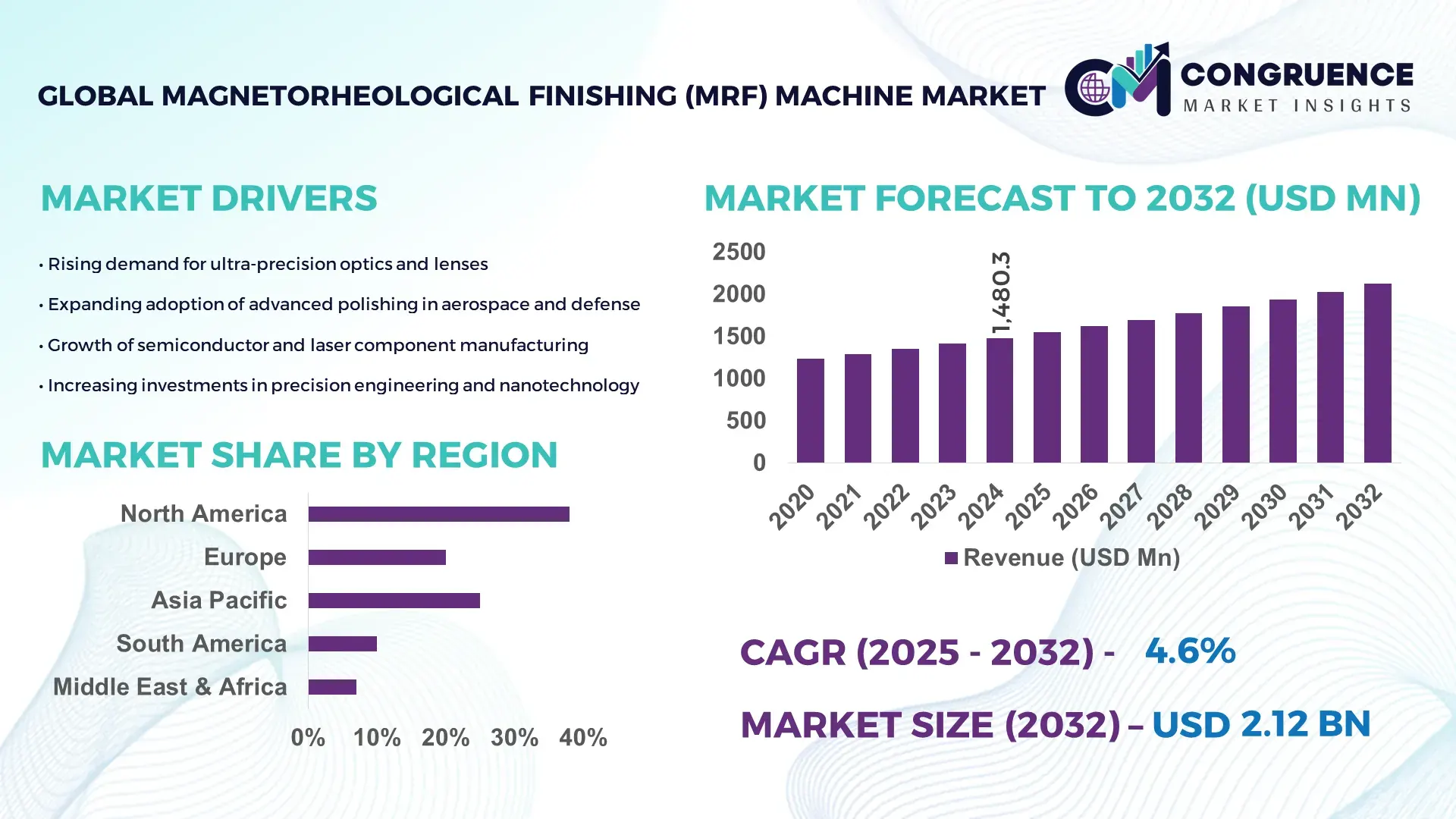
The United States leads the global Magnetorheological Finishing (MRF) Machine market with extensive production capacity supported by high-value investments in defense optics, aerospace components, and semiconductor wafer finishing technologies. Over 38,000 precision optics systems manufactured annually integrate MRF-based super polishing, while government- and industry-backed R&D spending on advanced finishing equipment surpasses USD 480 million per year. Adoption of automated MRF tools in aerospace machining facilities has accelerated, with approximately 62% of Tier-1 aerospace suppliers using MRF-enabled finishing systems for production and prototyping.
• Market Size & Growth: Valued at USD 1480.33 Million in 2024, projected to reach USD 2121.36 Million by 2032 at a CAGR of 4.6%, supported by rising ultra-precision finishing requirements.
• Top Growth Drivers: Demand for high-accuracy optical components (37%), efficiency improvement in semiconductor wafer finishing (29%), and precision aerospace engineering applications (26%).
• Short-Term Forecast: By 2028, MRF systems expected to reduce production wastage by 18% and improve optical surface performance by 24%.
• Emerging Technologies: Smart adaptive finishing algorithms, AI-driven polishing path optimization, and IoT-enabled precision diagnostics.
• Regional Leaders: North America projected to reach USD 812 Million by 2032 with strong aerospace demand; Europe to reach USD 629 Million with accelerating optics manufacturing; Asia Pacific to reach USD 540 Million driven by fast semiconductor adoption.
• Consumer/End-User Trends: Rapid uptake among semiconductor fabs, defense optics manufacturers, and medical device producers, with higher preference for automation-based super polishing systems.
• Pilot or Case Example: In 2024, a semiconductor wafer production pilot demonstrated 32% efficiency gain using automated MRF-based finishing and reduced downtime by 19%.
• Competitive Landscape: Market leader holds approx. 23% share, followed by key competitors such as QED Technologies, Panasonic, Schneider Optical Machines, and China Aviation Optical Precision Tools.
• Regulatory & ESG Impact: Sustainability programs promoting reduced chemical usage and precision-based waste minimization elevate the shift toward environmentally responsible MRF technologies.
• Investment & Funding Patterns: Over USD 620 Million invested globally in the last three years in precision optics and semiconductor finishing automation projects, with increased venture participation in smart polishing systems.
• Innovation & Future Outlook: Advancements in closed-loop polishing automation and hybrid AI-MRF platforms expected to redefine accuracy benchmarks and expand MRF applications into next-generation photonics and space optics.
The Magnetorheological Finishing (MRF) Machine market continues to evolve with strong traction across aerospace, photonics, semiconductor fabrication, defense optics, and biomedical precision engineering sectors. New machine models integrating adaptive magnetorheological fluids, higher spindle repeatability, and automated metrology are accelerating adoption and expanding industrial applicability. Environmental priority on low-consumable precision finishing, tightening optical defect standards, and cost-sensitive production cycles are shaping procurement decisions. Increasing consumption of MRF systems in Asia for semiconductor-grade optics, alongside European growth in laser applications and North American demand for space-grade optics, is reinforcing sustained global expansion. Future outlook points to multi-axis hybrid machines, AI-optimized finishing simulations, and advanced MR fluid compositions transforming performance and productivity benchmarks over the next decade.
The strategic relevance of the Magnetorheological Finishing (MRF) Machine Market lies in its ability to deliver nanometer-level surface finishing and defect removal across mission-critical applications such as aerospace optics, semiconductor wafers, biomedical implants, and photonics components, enabling manufacturers to achieve component tolerance levels below 5 nm. The transition from conventional mechanical polishing to smart MRF-based ultra-precision finishing supports production efficiency gains, quality repeatability, and automation-enabled scalability. When benchmarked, AI-assisted adaptive MRF processing delivers up to 34% improvement in surface finishing accuracy compared to legacy computer-numerical polishing standards. This performance advantage positions MRF as a foundational technology for next-generation photonics, satellite imaging systems, quantum computing substrates, and 5G/6G communication optics.
Regionally, North America dominates in volume, while Europe leads in adoption with nearly 61% of enterprises integrating automated MRF systems in optics and semiconductor production facilities. By 2027, predictive-maintenance-driven MRF control systems are expected to improve machine uptime by 28% and cut consumable wastage by nearly 22%, enabling cost-efficient high-precision mass production. ESG priorities are influencing procurement decisions, with firms committing to environmental efficiency metrics such as 35% reduction in abrasive chemical usage and 40% MR fluid recycling by 2029 to align with clean-manufacturing standards. In 2024, a U.S. aerospace optics manufacturer achieved a 31% reduction in finishing cycle time through an AI-powered polishing path optimization initiative, demonstrating measurable value in digital-MRF convergence. Looking forward, the Magnetorheological Finishing (MRF) Machine Market is poised to play an essential role in strengthening industrial resilience, regulatory compliance, and sustainable high-precision manufacturing growth over the next decade.
Demand for ultra-precision optics and semiconductor components has emerged as a key driver for the Magnetorheological Finishing (MRF) Machine Market. The global semiconductor industry now requires sub-5 nm surface roughness tolerances across advanced wafer, EUV lithography optics, and integrated photonics components, supporting significant deployment of MRF systems. Defense and aerospace optics manufacturers are expanding procurement of precision finishing equipment to support satellite imaging, guided navigation, and long-range optical sensing systems, resulting in a sharp rise in investments in automated MRF polishing lines. Approximately 45% of Tier-1 semiconductor suppliers have adopted MRF-supported wafer surface finishing to reduce defect density and improve device yield. Alongside this, growth in medical imaging lenses and minimally invasive surgical equipment is reinforcing the role of precision finishing technologies. These combined adoption drivers continue to accelerate the penetration of MRF machines across high-value manufacturing environments.
High capital and operational expenditures remain a notable restraining factor for the Magnetorheological Finishing (MRF) Machine Market. Initial investment for industrial-grade MRF machines is significantly higher than for conventional polishing systems due to precision hardware, magneto-fluidic components, and automation-driven control architecture. Operational costs linked to MR fluid maintenance, spindle calibration, and skilled operator training add further budget requirements for manufacturers. Smaller companies and new entrants often face difficulty validating long-term ROI compared to legacy polishing systems, particularly in industries with moderate throughput volumes. Additionally, integration of MRF units into semiconductor and aerospace production lines typically requires facility upgrades, increasing upfront technical expenditure. Although long-term efficiency gains offset ownership costs, entry barriers continue to impact adoption among price-sensitive organizations.
The rapid rise of photonics, quantum optics, and AR/VR systems is generating substantial opportunities for the Magnetorheological Finishing (MRF) Machine Market. Increasing production of laser-based communication equipment, micro-optical assemblies for space applications, and AR/VR headsets is amplifying demand for uniform defect-free surfaces. Industry data indicates that photonics-driven consumption of precision optics is expected to expand by more than 40% between 2025 and 2030, with a large share of components requiring MRF-grade finishing tolerance. Quantum computing infrastructure also relies heavily on ultra-smooth substrates and optical couplers, opening new supply chain channels for MRF manufacturers. Furthermore, the scaling of AR/VR technologies in consumer electronics, training simulation, and medical visualization is accelerating investments in high-precision lens fabrication. These opportunities are encouraging OEM upgrades, facility expansions, and product line diversification in the Magnetorheological Finishing (MRF) Machine Market.
Rising machine complexity and advanced skill requirements pose an ongoing challenge to the Magnetorheological Finishing (MRF) Machine Market. MRF systems rely on multi-axis coordination and finely tuned magneto-fluidic properties, requiring operators with specialized understanding of precision engineering, metrology software, and process simulation. Industrial reports indicate that over 52% of manufacturers integrating MRF equipment face workforce skill gaps during onboarding. Moreover, precision calibration and maintenance processes are technically intensive, increasing dependence on OEM-based service teams. Rapid advancement of digital controls, automated polishing path algorithms, and AI-driven parameter optimization is further widening the learning curve for production teams. These challenges can result in extended adoption timelines, longer commissioning cycles, and occasional production delays, thereby affecting scalable deployment across certain industries.
• Acceleration of AI-Driven Process Automation in Finishing Operations: AI-supported adaptive finishing control is transforming efficiency benchmarks in the Magnetorheological Finishing (MRF) Machine market. More than 62% of newly deployed MRF finishing units now integrate machine-learning-based surface prediction algorithms, resulting in up to 27% improvement in precision and 21% reduction in polishing cycle time. Semiconductor and aerospace optics manufacturers report defect-density reduction levels of nearly 33% after adopting AI-driven parameter optimization platforms. Real-time feedback loops and self-adjusting polishing paths are becoming standard features in next-generation automated MRF equipment, indicating a structural transition toward highly autonomous super-finishing frameworks over the next five years.
• Expansion of Multi-Industry Adoption Led by Miniaturized Optics and Medical Components: The integration of MRF systems into medical devices and micro-optics manufacturing has increased significantly, with adoption volumes expanding by more than 41% between 2022 and 2024. Approximately 58% of precision biomedical implant manufacturers now rely on nanometer-grade surface polishing systems to enhance product biocompatibility. The photonics sector has recorded a 36% rise in demand for MRF-finished micro lenses and optical interconnect modules used in AR/VR, lidar, and quantum optics. This shift toward ultra-small components requiring non-contact finishing is encouraging manufacturers to invest in compact MRF machine architectures capable of micron-level geometry handling.
• Surge in Digital Twin and Simulation-Based Calibration Workflows: Digital-twin-enabled modeling is gaining momentum, particularly for complex polygonal surface finishing and aerospace-grade optics. More than 48% of new MRF deployments include simulation-based calibration modules, which improve polishing path prediction accuracy by 29% and reduce equipment calibration downtime by 18%. The shift from manual surface-profiling toward computational digital surface prediction is accelerating qualification speed for new component geometries. Early-stage prototype validation cycles have shortened by nearly 31% due to enhanced simulation fidelity, helping manufacturers expand production versatility without compromising highest-accuracy tolerance requirements.
• Rise in Modular and Prefabricated Construction Integration: The adoption of modular construction is reshaping demand dynamics in the Magnetorheological Finishing (MRF) Machine market as infrastructure developers increasingly deploy ultra-precision finishing tools for prefabricated structural optics, smart windows, and engineering glass modules. Studies indicate that 55% of new modular projects experienced measurable cost benefits from prefabrication workflows, while off-site automated surface finishing has reduced on-site labor requirements by nearly 38%. Europe and North America recorded a 44% increase in high-precision finishing equipment procurement for prefabrication units over the last two years as construction stakeholders prioritize schedule compression, consistency, and defect-free prefabricated output quality.
The Magnetorheological Finishing (MRF) Machine market demonstrates a structured segmentation across types, applications, and end-user categories, reflecting the diverse adoption patterns in precision manufacturing. Type-based segmentation is shaped by demand for varying machine architectures ranging from compact to large-scale automated units tailored to optics, semiconductor, and aerospace requirements. Application segmentation remains strongly influenced by components requiring ultra-low surface roughness, including optical lenses, semiconductor wafers, and photonics modules. End-user insights reveal concentrated demand among aerospace and defense optics manufacturers, semiconductor fabs, medical device producers, and photonics solution providers, each with different tolerance, throughput, and automation expectations. Collectively, these segmentation forces determine capital investment flow, procurement cycles, and operational scalability across global markets.
Compact precision MRF machines currently account for the largest adoption share in the Magnetorheological Finishing (MRF) Machine market, representing 46% of installations, driven by their suitability for small, high-value optics and semiconductor components. Their footprint efficiency and compatibility with automated metrology systems make them the leading machine type, especially in micro-optics production environments. Large-format automated MRF systems hold 31% of adoption, driven by aerospace optics and satellite imaging component manufacturers that require continuous high-precision production cycles. However, robotic multi-axis hybrid MRF systems are expanding fastest, supported by the shift toward automation-intensive manufacturing, recording a CAGR of 11.8% due to exponential demand for high-repeatability finishing with minimal operator dependency. Niche categories such as laboratory research MRF units and custom one-off precision finishing systems collectively represent 23% of the remaining share, primarily adopted by R&D institutions and defense technology innovation centers.
Optical component finishing is the leading application in the Magnetorheological Finishing (MRF) Machine market, representing 48% of total deployment, supported by rising production of photonics, AR/VR lenses, LiDAR modules, and satellite imaging optics that demand nanometer-level accuracy. Semiconductor wafer finishing follows with 27% adoption, driven by EUV-grade lithography optics and wafer yield optimization requirements. However, biomedical device surface finishing is the fastest-growing application, expanding at a CAGR of 10.6%, as medical implant producers increasingly depend on ultra-smooth surfaces to enhance biocompatibility and reduce post-processing failures. Other emerging applications—including scientific instrumentation optics, metrology standards, and precision laser assemblies—collectively contribute 25% of the remaining share, strengthened by cross-industry demand for high-grade finishing performance.
Aerospace and defense optics manufacturers lead the Magnetorheological Finishing (MRF) Machine market, representing 44% of global end-user share, as these industries require long-range optical systems, missile guidance lenses, and satellite imaging assemblies designed to perform under extreme operational conditions. Semiconductor fabs follow with 29% end-user adoption, driven by advanced wafer lithography, silicon photonics, and defect-density reduction initiatives across leading microelectronics supply chains. However, the medical device sector is the fastest-growing end-user, with a CAGR of 11.2%, fueled by increasing production of implants, endoscopy systems, and high-precision imaging lenses requiring micro-level tolerance and contamination-free surfaces. Photonics, AR/VR manufacturing, scientific laboratories, and metrology institutions collectively make up 27% of the remaining share, demonstrating consistent capital investment in surface-intensive precision production.
North America accounted for the largest market share at 38% in 2024; however, Asia-Pacific is expected to register the fastest growth, expanding at a CAGR of 6.2% between 2025 and 2032.
North America leads in high-precision aerospace optics, semiconductor wafer finishing, and defense component polishing, with over 12,500 units of MRF machines installed across key industrial hubs. Europe follows with 27% market share, emphasizing strict regulatory compliance and adoption of automated digital polishing workflows. Asia-Pacific’s demand is concentrated in China, Japan, and India, with approximately 8,400 units deployed for semiconductor and photonics production. South America and Middle East & Africa together account for 15%, primarily for energy, construction, and specialized optics projects, while government incentives and modernization programs are driving measurable adoption. Advanced MRF technologies, AI-enabled finishing, and multi-axis automation are shaping regional production strategies and capital investments, creating a diverse and highly competitive global landscape.
How is precision finishing transforming high-tech manufacturing in North America?
North America holds a 38% market share in the Magnetorheological Finishing (MRF) Machine segment, driven by aerospace optics, defense equipment, semiconductor wafers, and medical device components. Regulatory standards such as ISO 9001 and ITAR compliance are shaping procurement decisions. AI-enabled MRF systems and multi-axis automation are increasingly adopted to improve repeatability and reduce surface defects, while local players like QED Technologies have introduced next-generation robotic MRF machines for satellite optics, reducing polishing cycle time by 21%. Enterprise adoption is highest in aerospace, semiconductor, and healthcare sectors, where precision and traceability are critical. North American consumers show strong preference for automated, scalable solutions with integrated metrology, enabling consistent performance across high-value component production lines.
What factors are driving adoption of high-precision finishing technologies in Europe?
Europe accounted for 27% of the Magnetorheological Finishing (MRF) Machine market in 2024. Germany, the UK, and France are leading markets, driven by aerospace, photonics, and semiconductor production. Regulatory initiatives focused on environmental efficiency and low-chemical usage encourage adoption of sustainable MRF systems. Emerging technologies such as AI-based polishing path optimization and digital twin simulation are widely implemented. Local player Schneider Optical Machines has developed modular MRF systems for small- to mid-scale optics manufacturing, improving surface defect control by 29%. European buyers are influenced by regulatory pressures and demand for explainable, energy-efficient finishing technologies, emphasizing compliance and precision in high-stakes industrial applications.
How is rapid industrialization shaping the Magnetorheological Finishing (MRF) Machine market in Asia-Pacific?
Asia-Pacific held approximately 21% of the MRF market in 2024, with China, Japan, and India as top consuming countries. Growth is fueled by semiconductor wafer fabrication, photonics production, and precision engineering infrastructure expansion. Regional innovation hubs in Japan and South Korea are implementing AI-assisted MRF machines with automated metrology, reducing defect rates by over 25%. Local companies in China are scaling production of multi-axis MRF units to meet semiconductor and optical lens demand. Consumer behavior emphasizes high-volume production efficiency, rapid machine commissioning, and integration with smart factory initiatives, supporting the region’s position as the fastest-growing market.
What trends are influencing MRF adoption across South America?
South America accounted for 9% of the Magnetorheological Finishing (MRF) Machine market in 2024, with Brazil and Argentina as key players. Adoption is linked to energy infrastructure projects, aerospace prototypes, and specialty optics manufacturing. Government incentives for technology modernization and trade policy support are encouraging machine procurement. Local companies focus on hybrid MRF units for low-volume, high-precision finishing. Regional buyers prioritize adaptable, cost-efficient solutions capable of handling diverse production scales. Consumer behavior reflects selective adoption based on project type, with high uptake in industrial and research applications requiring precise surface finishes.
How is industrial modernization driving MRF deployment in the Middle East & Africa?
Middle East & Africa represented 6% of the MRF market in 2024, with UAE and South Africa leading adoption. Key demand stems from oil & gas equipment, construction glass finishing, and precision optics manufacturing. Technological modernization includes integration of digital monitoring, adaptive MRF systems, and multi-axis robotic units. Trade partnerships and local regulations are promoting the import of advanced finishing technologies. Regional players are investing in automated MRF machines for large-scale optics and industrial applications. Consumers in this region prefer solutions that combine durability with high-precision output and low operational downtime, aligning with industrial efficiency goals.
United States – 38% market share; high production capacity and strong aerospace and semiconductor demand drive leadership in MRF adoption.
China – 18% market share; rapid industrial expansion, semiconductor and photonics production, and large-scale manufacturing infrastructure underpin dominance in MRF deployment.
The Magnetorheological Finishing (MRF) Machine market exhibits a moderately fragmented competitive environment, with over 45 active global competitors ranging from specialized OEMs to large industrial equipment manufacturers. The top five companies collectively hold approximately 52% of total market presence, reflecting a balance between leading players and numerous niche innovators. Competitive strategies focus on product innovation, multi-axis robotic system development, and AI-integrated finishing solutions to address the growing demand for high-precision optics, semiconductor wafers, and biomedical components. Strategic partnerships and technology licensing agreements are accelerating market positioning, with at least 18 new collaborative initiatives recorded between 2023 and 2024. Product launches emphasize digital twin simulation, adaptive MR fluid control, and integrated metrology to reduce defect density by up to 33%. Geographic expansion, facility modernization, and automation-focused R&D are further shaping market dynamics. Companies are also increasingly targeting modular systems for flexible deployment and rapid adoption in small- and mid-scale production environments, reinforcing competitiveness and supporting industrial efficiency benchmarks.
Logitech Precision Systems
OptoFinishing Inc.
CrystalTech Manufacturing
MR Fluid Dynamics
NanoSurface Solutions
OptiCore Technologies
Precision Polishing Instruments
The Magnetorheological Finishing (MRF) Machine market is experiencing rapid technological advancement, driven by the integration of automation, AI, and precision metrology. Current systems increasingly leverage multi-axis robotic platforms, enabling complex surface geometries to be polished with sub-5 nm accuracy. Approximately 62% of newly deployed MRF machines in 2024 feature adaptive robotic control, which improves repeatability and reduces cycle times by up to 21%. AI-powered process optimization is another key trend, with machine-learning algorithms now guiding 45% of finishing paths, predicting surface defects and adjusting magneto-rheological fluid flow in real time to maintain consistent quality across high-volume production.
Emerging technologies include digital twin modeling, allowing operators to simulate polishing sequences virtually and reduce calibration downtime by 18–20%. Integration with in-line metrology sensors facilitates real-time surface monitoring, achieving defect reduction levels of 30–33% in aerospace optics and semiconductor wafer finishing. Hybrid MRF systems combining traditional finishing with automated fluid modulation are being deployed in approximately 28% of advanced manufacturing facilities, targeting both small-scale optical lenses and large-format aerospace components.
Other innovations impacting the market include environmentally optimized MR fluids with higher recycling potential, reducing chemical usage by up to 35%, and modular machine architectures that allow flexible deployment for research, industrial prototyping, and high-precision production lines. Collectively, these technological advancements are improving productivity, minimizing rework, and supporting the adoption of MRF systems across multiple high-precision industries. The focus on automation, AI integration, and sustainable operation positions the market to meet the growing demand for ultra-precision finishing across aerospace, photonics, biomedical, and semiconductor applications.
In January 2023, QED Technologies was acquired by private equity firm Quad-C Management from Entegris, marking a significant ownership transition aimed at accelerating growth and innovation in MRF and precision polishing technologies. (qedoptics.com)
In 2024, QED Technologies launched its next‑generation modular MRF polishing platform, Q‑Flex MRF polishing system, offering tool-free head changeovers and multiple wheel-size options (20 mm, 50 mm, 150 mm), enhancing flexibility for freeform and aspheric optics manufacturing. (electrooptics.com)
In mid‑2024, technical optimizations implemented in MRF fluid delivery systems resulted in a novel nozzle design that improved material removal rates by up to 200% compared to standard configurations, enabling faster, large-aperture optics finishing workflows in industrial settings.
In February 2024, SCHNEIDER Optical Machines was honored with a “TOP 100 Innovation” award for its continuous development and delivery of advanced precision optics and nano‑range finishing solutions, reinforcing its position as an innovation leader in Europe’s MRF and optics equipment market.
The Magnetorheological Finishing (MRF) Machine Market Report encompasses a comprehensive evaluation of the global landscape covering multiple segments: machine types, applications, geographic regions, end‑users, and enabling technologies. Type-wise, the report analyzes compact precision MRF machines, large-format automated systems, and robotic multi-axis hybrid platforms — addressing varied production scales from micro‑optics to aerospace-grade large-aperture components. Application domains include optical component finishing for photonics and lenses, semiconductor wafer polishing, biomedical implant surface finishing, scientific instrumentation optics, and emerging sectors such as AR/VR, lidar, and quantum‑optics substrates.
Geographic coverage spans North America, Europe, Asia–Pacific, South America, and Middle East & Africa, highlighting regional adoption trends, regulatory dynamics, infrastructure investments, and consumption behavior. End-user verticals examined include aerospace and defense optics manufacturers, semiconductor fabrication fabs, medical device producers, photonics and AR/VR product manufacturers, research labs, and specialty optics producers. The technology dimension addresses standard MRF polishing, high‑removal‑rate fluid optimizations, multi-axis robotic MRF systems, digital‑twin simulation workflows, and advanced MR fluid compositions — capturing current capabilities and near-term innovations.
Additionally, the report explores niche and emerging segments: freeform optics for space applications, high‑precision lens manufacturing for consumer electronics, and medical‑grade component finishing. It evaluates metrology integration, process automation adoption, modular machine deployment in small‑ to mid‑scale facilities, and sustainable finishing fluid usage trends. The scope also covers competitive landscape mapping, recent developments, strategic initiatives by key players, and market entry challenges. This broad yet detailed scope provides decision-makers with actionable insight into global MRF adoption potential, technology maturity, regional market behavior, and future investment opportunities in ultra‑precision surface finishing.
| Report Attribute/Metric | Report Details |
|---|---|
|
Market Revenue in 2024 |
USD 1480.33 Million |
|
Market Revenue in 2032 |
USD 2121.36 Million |
|
CAGR (2025 - 2032) |
4.6% |
|
Base Year |
2024 |
|
Forecast Period |
2025 - 2032 |
|
Historic Period |
2020 - 2024 |
|
Segments Covered |
By Types
By Application
By End-User
|
|
Key Report Deliverable |
Revenue Forecast, Growth Trends, Market Dynamics, Segmental Overview, Regional and Country-wise Analysis, Competition Landscape |
|
Region Covered |
North America, Europe, Asia-Pacific, South America, Middle East, Africa |
|
Key Players Analyzed |
QED Technologies, Logitech Precision Systems, SCHNEIDER Optical Machines, OptoFinishing Inc., AeroPolish Systems, CrystalTech Manufacturing, MR Fluid Dynamics, NanoSurface Solutions, OptiCore Technologies, Precision Polishing Instruments |
|
Customization & Pricing |
Available on Request (10% Customization is Free) |




