
Reports
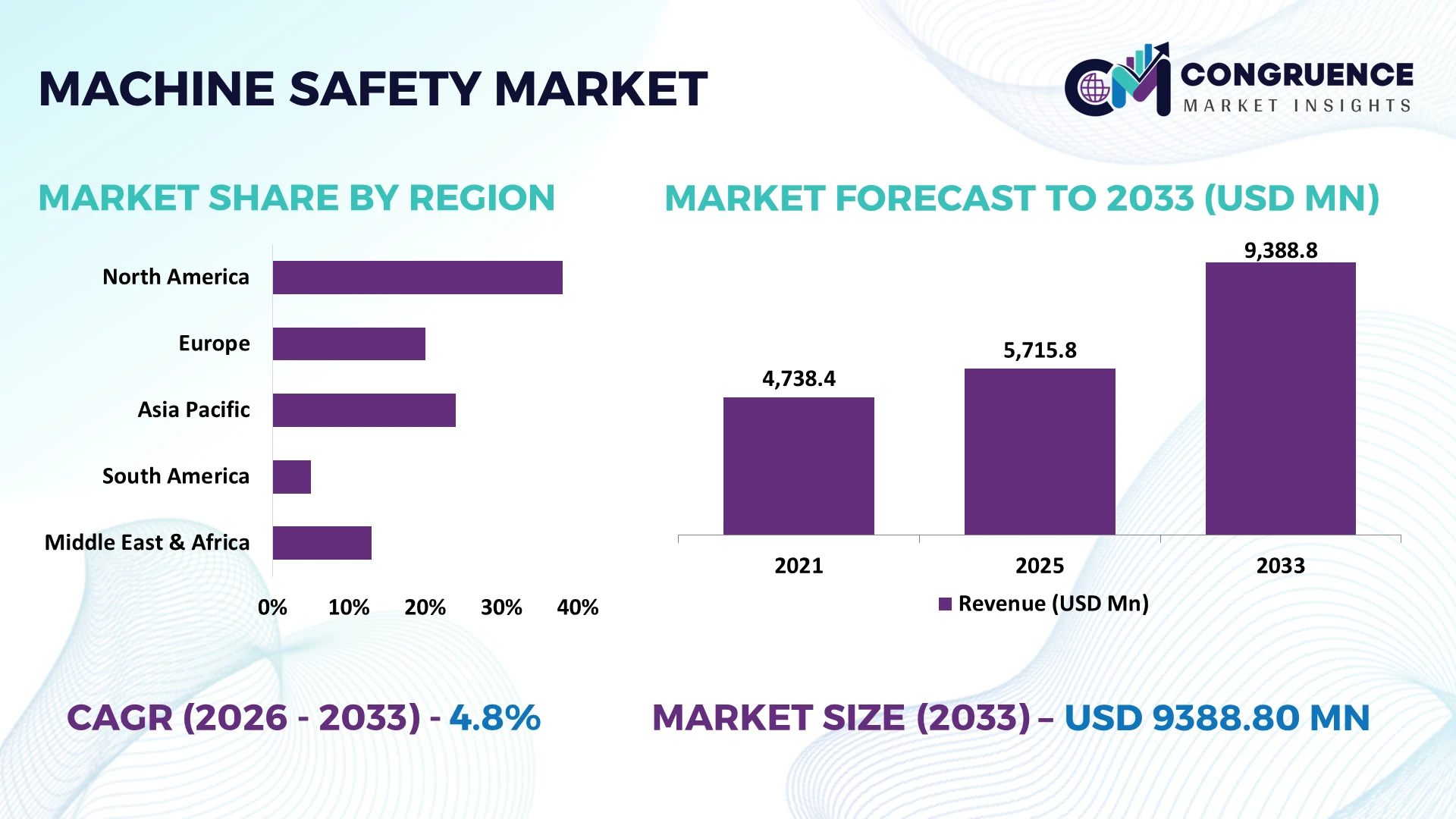
The Global Machine Safety Market was valued at USD 5715.83 Million in 2025 and is anticipated to reach a value of USD 9388.8 Million by 2033 expanding at a CAGR of 4.8% between 2026 and 2033. Growth is driven by accelerated industrial automation, mandatory functional safety compliance, AI-enabled safety monitoring, and modernization of high-risk manufacturing facilities across automotive, electronics, and process industries.
Germany remains the leading country, accounting for approximately 18% of global machine safety equipment deployment, supported by over EUR 30 billion in annual industrial automation investments and strong automotive and machinery production. Compared with China, which leads large-scale manufacturing expansion, Germany records higher adoption of advanced functional safety systems, with over 70% of new automated production lines integrating intelligent safety controllers. Ongoing European industrial resilience initiatives following regional supply-chain realignment continue strengthening investment priorities.
Manufacturers prioritizing advanced safety automation, compliance-ready platforms, and digital monitoring capabilities are positioned to secure long-term competitive advantage in high-value industrial sectors.
Market Size & Growth: USD 5715.83 Million (2025) to USD 9388.8 Million (2033) at 4.8% CAGR, driven by advanced industrial automation and smart factory modernization.
Top Growth Drivers: Functional safety adoption +16%, robotic installations +12%, industrial digitalization investments +14% across manufacturing operations.
Short-Term Forecast: By 2028, automated safety systems improve production efficiency by 18% while reducing unplanned downtime by 15%.
Emerging Technologies: AI-based risk analytics, machine vision, and Industrial IoT enhance predictive safety performance across high-growth manufacturing facilities.
Regional Leaders: Europe approaches USD 3.3 Billion through regulatory compliance, Asia Pacific exceeds USD 3.1 Billion via factory expansion, North America reaches USD 2.4 Billion through automation upgrades.
Consumer/End-User Trends: More than 68% of large manufacturers prioritize integrated safety platforms for connected production environments.
Pilot/Case Example: In 2026, an automotive manufacturing deployment reduced safety incidents by 32% and improved equipment availability by 19%.
Competitive Landscape: Leading vendors collectively hold nearly 42% market share, led by Siemens, ABB, Schneider Electric, Rockwell Automation, and Honeywell.
Regulatory & ESG Impact: Safety compliance initiatives lower workplace incidents by approximately 25% while supporting sustainable manufacturing targets during global supply-chain restructuring.
Investment & Funding: Over USD 2.5 Billion supports automation partnerships, smart manufacturing expansion, and digital safety infrastructure across industrial facilities.
Innovation & Future Outlook: Next-generation intelligent safety controllers, edge AI, and cybersecurity-integrated safety architectures accelerate strategic industrial transformation.
Machine Safety Market demand is expanding across automotive manufacturing, semiconductor fabrication, food processing, and logistics automation, where intelligent safety systems improve operational continuity and workforce protection. AI-enabled diagnostics and configurable safety controllers now reduce commissioning time by nearly 20%, while stricter industrial compliance requirements and resilient manufacturing supply-chain strategies continue accelerating technology upgrades, setting the foundation for broader strategic market evaluation.
Machine safety has become a strategic investment priority as manufacturers pursue higher production efficiency, workforce protection, and regulatory compliance while modernizing automated facilities. Supply-chain restructuring since 2024 has accelerated factory localization across the United States, Germany, and India, prompting greater deployment of intelligent safety systems. Companies increasingly view machine safety as an operational enabler that minimizes production interruptions while supporting advanced digital manufacturing strategies.
AI-enabled safety controllers and vision-based monitoring systems outperform conventional relay-based architectures by reducing fault-detection time by nearly 35% and lowering maintenance effort by approximately 20% through predictive diagnostics. Germany leads high-value functional safety integration across precision manufacturing, while China deploys machine safety at larger production volumes through rapid factory expansion. This contrast highlights a market balancing technological sophistication with scalable industrial deployment.
During 2026, several automotive component manufacturers integrated collaborative robotics with intelligent safety sensors, reducing unexpected production stoppages by more than 15% while improving operational visibility. Equipment suppliers are responding through software-focused partnerships, localized engineering capabilities, and integrated automation portfolios. Over the next two to three years, digital safety platform adoption is expected to exceed 60% among newly automated production facilities, strengthening competitive positioning through resilient operations, regulatory readiness, and lifecycle productivity improvements.
Industrial modernization is driving widespread adoption of advanced machine safety technologies as manufacturers integrate robotics, AI, and connected production assets. More than 65% of new automated production lines now incorporate integrated safety architectures, while predictive safety diagnostics reduce unplanned downtime by nearly 18% and lower maintenance interventions by approximately 15%. Germany continues strengthening industrial safety compliance through advanced manufacturing upgrades, encouraging faster deployment of programmable safety controllers and intelligent sensors. In response, leading automation companies are expanding digital safety portfolios, forming software partnerships, and investing in modular safety platforms that simplify installation across multi-site operations. The resulting integration of compliance, productivity, and operational resilience creates measurable competitive advantages beyond traditional workplace protection.
Many industrial facilities continue operating legacy equipment that lacks compatibility with modern networked safety systems, increasing deployment costs and engineering complexity. Retrofitting older production assets can raise project implementation expenses by 20–30%, while system integration timelines often extend by nearly 25% due to interoperability challenges. Japan and several mature manufacturing economies face increasing replacement cycles for aging industrial equipment, slowing standardization across production facilities. Manufacturers are reducing these constraints through localized component sourcing, long-term supplier agreements, and modular retrofit solutions compatible with existing control architectures. Companies that simplify cross-platform integration gain stronger operational scalability while minimizing disruption during modernization initiatives.
The convergence of AI, Industrial IoT, edge computing, and digital twins is transforming machine safety into a continuous operational intelligence platform. Intelligent monitoring can improve hazard detection accuracy by approximately 30% while reducing inspection workloads by nearly 22%. India is rapidly expanding advanced manufacturing capacity under industrial modernization initiatives, creating strong demand for scalable safety automation across electronics and automotive production. Equipment manufacturers are increasing R&D investment, building cloud-connected safety ecosystems, and partnering with industrial software providers to deliver lifecycle services rather than standalone hardware. This transition creates recurring value through predictive maintenance, remote diagnostics, and performance optimization across complex manufacturing environments.
The long-term success of intelligent machine safety depends on skilled engineering talent and secure industrial connectivity. Nearly 40% of manufacturers report shortages of functional safety specialists, while connected production environments have experienced more than a 25% increase in industrial cybersecurity incidents requiring enhanced protection strategies. The United States is placing greater emphasis on securing operational technology networks as connected factories become standard across advanced manufacturing. Companies must strengthen workforce training, adopt cybersecurity-by-design principles, and collaborate with automation, software, and cybersecurity partners to maintain reliable machine safety performance. Organizations that successfully combine digital resilience with workforce capability will sustain stronger operational consistency and long-term competitive differentiation.
Automated Functional Safety Integration Intelligent safety architectures are becoming standard across new production facilities, with more than 68% of newly automated manufacturing lines integrating programmable safety controllers and networked diagnostics. Labor shortages and stricter compliance requirements are accelerating deployment, enabling up to 20% faster commissioning. Automation vendors are expanding integrated hardware-software portfolios and strengthening engineering partnerships to simplify implementation across multi-site industrial operations.
AI-Driven Predictive Protection Manufacturers are embedding AI-enabled vision systems and predictive analytics into safety platforms, improving hazard detection accuracy by nearly 30% while reducing unexpected equipment stoppages by approximately 18%. Germany's advanced manufacturing sector is scaling these deployments to optimize productivity. Companies are responding through cloud-enabled monitoring platforms, software acquisitions, and lifecycle service models that extend beyond conventional machine protection.
Modular Retrofit Deployment Models Rather than replacing complete production systems, nearly 45% of industrial modernization projects now prioritize modular safety retrofits for existing machinery. This approach lowers installation disruption by about 25% while shortening project schedules. Supply-chain resilience initiatives are encouraging equipment suppliers to develop interoperable safety modules and localized engineering support, expanding retrofit opportunities across mature manufacturing facilities.
Cybersecure Safety Architectures Industrial safety is increasingly converging with operational technology cybersecurity as connected factories become standard. More than 55% of large manufacturers now evaluate cyber resilience alongside functional safety during equipment procurement, while secure industrial communication reduces operational vulnerabilities by roughly 20%. Companies are restructuring digital engineering teams and collaborating with cybersecurity specialists to deliver integrated protection across automated production environments.
Safety Sensors remain the leading segment, accounting for approximately 31% of market demand due to their scalability, rapid response capability, and seamless integration with automated production systems. Their widespread deployment across automotive, electronics, and industrial manufacturing supports real-time hazard detection while reducing machine downtime. Safety Controllers represent the fastest-growing segment as manufacturers adopt programmable safety architectures supporting connected factories and complex robotic operations. Intelligent controller installations have increased by nearly 22% across newly automated facilities, reflecting the shift toward centralized safety management.
Safety Switches continue serving mature production environments requiring reliable access control, while Emergency Stop Devices remain mandatory across virtually every industrial installation because of regulatory compliance requirements. Safety Relays retain strategic relevance in cost-sensitive retrofit projects where replacing complete control systems is unnecessary. Equipment manufacturers are expanding intelligent sensor portfolios, developing software-configurable controllers, and strengthening automation partnerships to improve interoperability and lifecycle performance. Investment priorities increasingly favor flexible digital safety ecosystems rather than standalone safety components.
Assembly Lines represent the largest application segment with an estimated 34% share, supported by extensive deployment across automotive, electronics, and heavy manufacturing facilities where continuous production requires integrated machine safeguarding. Manufacturers are upgrading production lines with intelligent safety monitoring, reducing unplanned stoppages by approximately 16% while improving operational visibility. Robotics is the fastest-growing application as collaborative automation expands, with robotic safety integration increasing by nearly 24% across advanced manufacturing environments.
Material Handling continues strengthening through warehouse automation and autonomous logistics systems requiring coordinated safety controls. Packaging operations increasingly deploy vision-based safety technologies to improve throughput while maintaining operator protection. Process Automation remains essential across chemical, pharmaceutical, and energy facilities where continuous operations demand high-integrity safety systems. Automation providers are scaling integrated solutions, expanding software capabilities, and partnering with robotics companies to support increasingly complex industrial workflows and accelerate digital manufacturing transformation.
Automotive remains the dominant end-user, representing approximately 29% of total demand due to extensive robotic production, high-volume assembly operations, and rigorous workplace safety requirements. Continuous investment in electric vehicle manufacturing and flexible production systems reinforces deployment of advanced machine safety technologies. Electronics is the fastest-growing end-user segment as semiconductor fabrication and precision manufacturing expand, with intelligent safety installations increasing by nearly 21% across highly automated facilities requiring micron-level process reliability.
Industrial Manufacturing continues investing in machine modernization to improve productivity and regulatory compliance, while Food & Beverage producers deploy hygienic safety solutions supporting automated packaging and processing operations. Pharmaceuticals increasingly integrate programmable safety systems within validated production environments to protect operators without interrupting controlled manufacturing processes. Equipment suppliers are tailoring sector-specific safety platforms, expanding technical service networks, and collaborating with original equipment manufacturers to deliver application-focused solutions that improve operational efficiency and strengthen long-term customer relationships.
North America accounted for the largest market share at 36% in 2025 however, Asia-Pacific is expected to register the fastest growth, expanding at a CAGR of 6.2% between 2026 and 2033.

Advanced Industrial Automation Drives Regional Leadership
North America remains the largest contributor to the Machine Safety Market due to extensive deployment of automated production systems across automotive, aerospace, semiconductor, food processing, and logistics industries. The region accounts for approximately 36% of global demand, supported by early adoption of Industrial IoT, AI-enabled safety platforms, and integrated machine control systems. More than 68% of new industrial automation projects incorporate intelligent safety technologies during commissioning, while digital retrofit initiatives have reduced machine downtime by nearly 18% in large manufacturing facilities. Companies continue expanding software-enabled safety portfolios, strengthening OEM partnerships, and increasing localized engineering support to improve operational efficiency, regulatory compliance, and lifecycle asset performance across high-value manufacturing operations.
United States Market Outlook: The United States dominates regional deployment through advanced manufacturing capacity, strong automation investment, and a mature industrial ecosystem. Automotive, aerospace, warehouse automation, and semiconductor industries continue integrating programmable safety controllers and intelligent sensors into production lines. More than 70% of large manufacturing modernization projects now include connected machine safety solutions, while leading automation companies continue expanding domestic engineering centers and digital service capabilities to accelerate deployment and improve long-term operational reliability.
Regulatory Modernization Accelerates Smart Safety Adoption
Europe maintains a strong position through rigorous industrial safety regulations, advanced machinery manufacturing, and widespread adoption of functional safety technologies. The region contributes nearly 29% of global market activity, supported by automotive, industrial equipment, pharmaceuticals, and food processing sectors. More than 65% of newly commissioned automated production facilities deploy integrated safety controllers and intelligent monitoring systems. Factory modernization programs have improved production efficiency by approximately 16% through connected safety infrastructure. Equipment suppliers continue investing in software-based safety platforms, engineering partnerships, and interoperable automation solutions that simplify compliance while improving operational flexibility across industrial environments.
Germany Market Outlook: Germany leads the regional market through its globally competitive machinery, automotive, and industrial automation industries. Over 72% of newly installed robotic manufacturing cells integrate advanced functional safety technologies. Manufacturers continue prioritizing intelligent production systems, while automation providers expand digital engineering capabilities, collaborative innovation programs, and integrated software solutions to strengthen manufacturing productivity and maintain industrial competitiveness.
Manufacturing Expansion Strengthens Intelligent Safety Deployment
Asia-Pacific is the fastest-growing regional market, driven by large-scale industrial expansion, electronics manufacturing, and smart factory investments across major production hubs. The region represents approximately 27% of global deployment, with automated production installations increasing by nearly 20% during recent factory expansion programs. Manufacturers are rapidly integrating AI-enabled safety systems, collaborative robot protection, and Industrial IoT connectivity to improve production continuity. International and domestic equipment suppliers are expanding manufacturing facilities, technical support centers, and strategic partnerships to meet increasing enterprise demand for scalable and intelligent machine safety solutions.
China Market Outlook: China remains the largest national market within Asia-Pacific because of its extensive manufacturing base and rapid industrial automation. More than 60% of newly established large-scale factories deploy integrated machine safety systems during initial commissioning. Domestic automation providers continue enhancing intelligent safety technologies, while multinational companies strengthen localized manufacturing, engineering services, and product customization to support expanding industrial modernization programs.
Industrial Modernization Supports Automation Investments
South America continues strengthening machine safety adoption through modernization of automotive, mining, food processing, and consumer goods manufacturing facilities. The region accounts for approximately 5% of global market activity, supported by gradual investment in automated production systems and industrial safety compliance. Modern retrofit projects have reduced maintenance-related production interruptions by nearly 12%, while automated material handling deployments continue increasing across large industrial facilities. Equipment manufacturers are expanding regional partnerships, localized technical services, and modular safety solutions to improve affordability and accelerate implementation across existing manufacturing infrastructure.
Brazil Market Outlook: Brazil leads regional demand through its diversified industrial economy and expanding factory modernization initiatives. Automotive manufacturing, mining operations, and food processing facilities continue investing in intelligent safety technologies to improve operational efficiency and regulatory compliance. Automated production upgrades have increased by approximately 15%, encouraging automation suppliers to strengthen local engineering capabilities, product support services, and strategic partnerships with industrial equipment manufacturers.
Industrial Diversification Accelerates Intelligent Safety Infrastructure
The Middle East & Africa market is expanding through industrial diversification, infrastructure development, and increased automation across energy, petrochemical, pharmaceutical, and logistics sectors. The region contributes close to 3% of global deployment while steadily increasing investment in digitally connected production facilities. Recent industrial modernization programs have improved equipment reliability by nearly 14% through implementation of integrated safety systems and intelligent monitoring technologies. Global automation companies continue expanding regional engineering support, technical training, and industrial partnerships to strengthen deployment capabilities and improve compliance with international safety standards.
Saudi Arabia Market Outlook: Saudi Arabia leads regional growth through large-scale industrial diversification programs and advanced manufacturing investments. Petrochemical complexes, logistics facilities, and industrial production plants increasingly deploy intelligent safety platforms to support automated operations. More than 50% of newly developed industrial facilities integrate advanced machine safety technologies during construction, prompting global automation companies to expand local partnerships, engineering resources, and lifecycle service capabilities to support long-term industrial transformation.
The Machine Safety Market is led by Siemens, ABB, Schneider Electric, Rockwell Automation, and Honeywell, which primarily compete against agile regional automation specialists and low-cost component suppliers across industrial manufacturing projects. The top five companies collectively control approximately 48% of the global market, creating a moderately consolidated competitive structure. Competition centers on intelligent safety software, integrated automation platforms, deployment speed, and lifecycle support rather than hardware pricing alone. AI-enabled safety solutions reduce engineering time by nearly 20%, while modular architectures shorten commissioning by approximately 18% and predictive diagnostics lower maintenance interventions by around 15%. Leading companies are expanding through strategic acquisitions, industrial software partnerships, localized engineering centers, and vertically integrated automation portfolios that combine controllers, sensors, and digital services. Competitive pressure is shifting toward software-defined functional safety and cybersecurity-enabled platforms, raising certification and integration requirements for new entrants. Winning requires scalable digital ecosystems, strong OEM relationships, rapid deployment capability, and continuous innovation that delivers measurable operational improvements beyond regulatory compliance.
Siemens AG
ABB Ltd.
Schneider Electric SE
Rockwell Automation, Inc.
Honeywell International Inc.
Emerson Electric Co.
Omron Corporation
SICK AG
Pilz GmbH & Co. KG
Banner Engineering Corp.
Keyence Corporation
Pepperl+Fuchs SE
Bosch Rexroth AG
Machine safety technology is rapidly evolving from isolated hardware protection toward intelligent, connected safety ecosystems. AI-enabled vision systems, Industrial IoT connectivity, programmable safety controllers, and edge computing are becoming standard across advanced manufacturing facilities. More than 60% of newly automated production lines now integrate networked safety architectures, while AI-assisted diagnostics improve hazard detection accuracy by approximately 30% and reduce unplanned downtime by nearly 18%. Companies increasingly deploy cloud-connected monitoring platforms that enable centralized safety management across multiple production sites.
Modern programmable safety controllers outperform conventional relay-based systems by reducing engineering complexity by nearly 25% and shortening commissioning time by approximately 20%. Digital twins and predictive analytics further improve maintenance planning, lowering service interventions by around 15%. Automotive, semiconductor, and electronics manufacturers gain the greatest competitive advantage because integrated safety platforms support flexible production, faster product changeovers, and higher equipment availability without compromising operational compliance.
Between 2026 and 2028, cybersecurity-integrated safety architectures, autonomous inspection, collaborative robotics, and edge AI will become defining competitive technologies. Manufacturers are expanding software partnerships, embedding intelligent analytics into automation platforms, and investing in interoperable safety ecosystems. Organizations adopting these technologies early will strengthen operational resilience, accelerate deployment, reduce lifecycle costs, and establish sustainable competitive differentiation in increasingly automated industrial environments.
September 2025 Siemens announced a machine builder data alliance to develop Industrial Foundation Models for manufacturing AI, enabling secure industrial data sharing across equipment ecosystems. The initiative strengthens intelligent machine safety, digital engineering, and predictive operations for advanced factories.
April 2026 Siemens expanded its Industrial Edge ecosystem by launching the Industrial AI Suite with IEC 62443-4-2 cybersecurity functions and bidirectional data integration, strengthening secure machine operations. UL Solutions awarded its Smart Systems Verified Platinum certification, enhancing confidence in safety-critical industrial deployments.
May 2026 Siemens partnered with Xometry to integrate AI-native supply-chain intelligence into Siemens Xcelerator, supported by an approximately USD 50 million minority investment. The collaboration accelerates design-to-source workflows, improving manufacturing responsiveness and strengthening digital industrial ecosystems.
June 2026 Siemens and IFS formed a strategic Industrial AI partnership connecting engineering, production, and asset management to reduce unplanned downtime and improve manufacturing performance. The integrated lifecycle approach enhances operational efficiency while strengthening machine safety across connected industrial facilities. Source: (Siemens Digital Industries Software)
This report provides comprehensive analysis of the Machine Safety Market across Safety Sensors, Safety Switches, Safety Controllers, Emergency Stop Devices, and Safety Relays, together with detailed assessment of Assembly Lines, Material Handling, Packaging, Robotics, and Process Automation applications. It evaluates demand across Automotive, Food & Beverage, Pharmaceuticals, Electronics, and Industrial Manufacturing while examining competitive positioning of more than 10 leading global technology providers. The study also reviews adoption trends, deployment patterns, and digital transformation across North America, Europe, Asia-Pacific, South America, and the Middle East & Africa.
The report delivers strategic insights supporting investment prioritization, capacity expansion, product development, and partnership decisions between 2026 and 2033. It evaluates intelligent safety technologies, AI-enabled monitoring, Industrial IoT integration, cybersecurity-enabled functional safety, and predictive diagnostics while identifying emerging deployment opportunities in smart manufacturing, collaborative robotics, and industrial modernization. Business-focused benchmarking, regional comparisons, competitive assessment, and operational trend analysis enable stakeholders to strengthen market positioning and long-term strategic planning.
| Report Attribute/Metric | Report Details |
|---|---|
Market Revenue in 2025 | USD 5715.83 Million |
Market Revenue in 2033 | USD 9388.8 Million |
CAGR (2026 - 2033) | 4.8% |
Base Year | 2025 |
Forecast Period | 2026 - 2033 |
Historic Period | 2021 - 2025 |
Segments Covered | By Type
By Application
By End-User
|
Key Report Deliverable | Revenue Forecast, Growth Trends, Market Dynamics, Segmental Overview, Regional and Country-wise Analysis, Competition Landscape |
Region Covered | North America, Europe, Asia-Pacific, South America, Middle East, Africa |
Key Players Analyzed | Siemens AG, ABB Ltd., Schneider Electric SE, Rockwell Automation, Inc., Honeywell International Inc., Emerson Electric Co., Omron Corporation, SICK AG, Pilz GmbH & Co. KG, Banner Engineering Corp., Keyence Corporation, Pepperl+Fuchs SE, Bosch Rexroth AG |
Customization & Pricing | Available on Request (10% Customization is Free) |




