
Reports
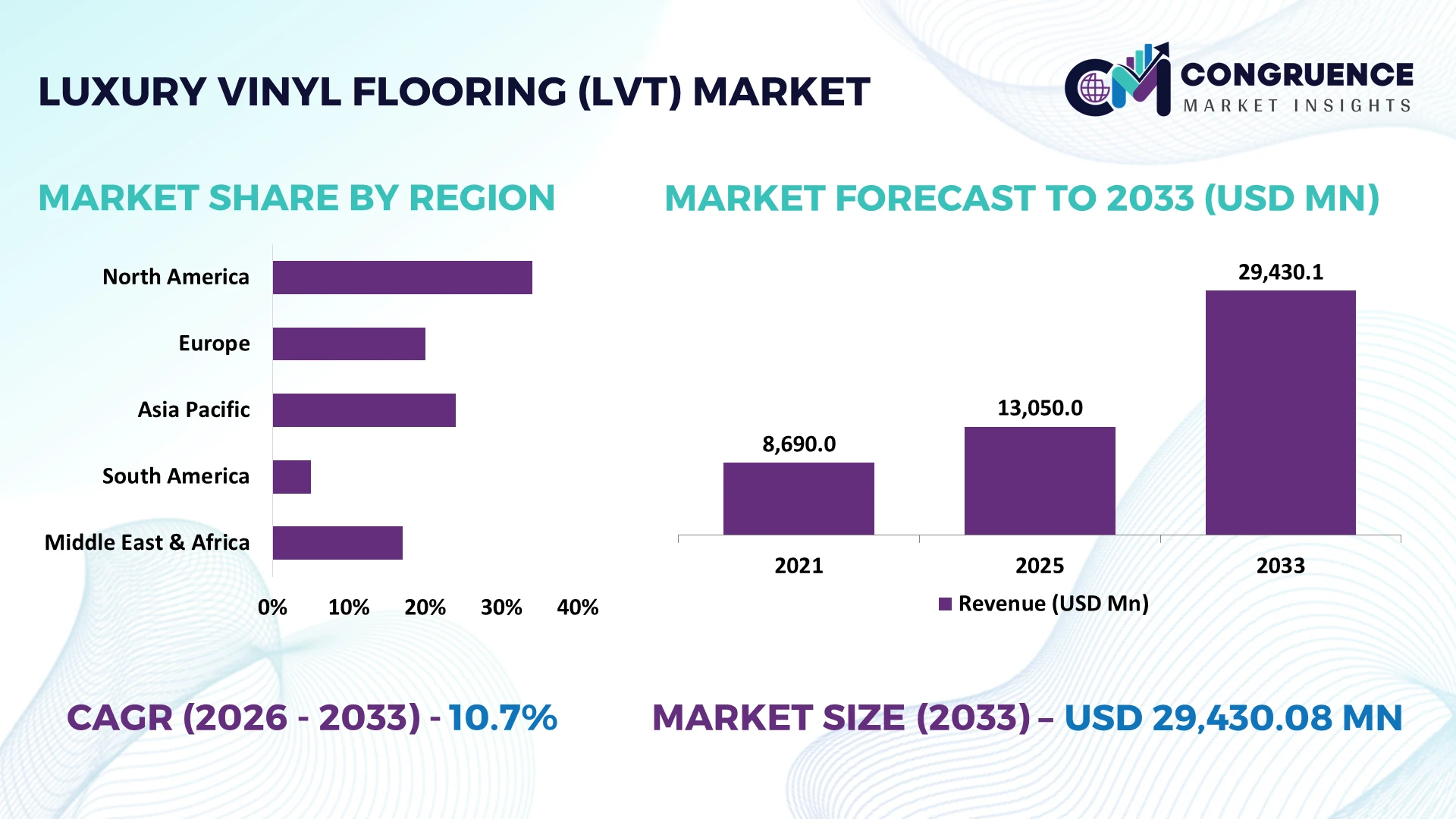
The Global Luxury Vinyl Flooring (LVT) Market was valued at USD 13050 Million in 2025 and is anticipated to reach a value of USD 29430.08 Million by 2033 expanding at a CAGR of 10.7% between 2026 and 2033. Growth is driven by rigid-core SPC/WPC penetration, click-lock installation, renovation-led flooring replacement, digitally embossed wood visuals, and domestic capacity investment reducing dependence on imported resilient flooring.
The United States remains the most strategically concentrated consumption market: LVT represented approximately 51.5% of U.S. hard-surface flooring sales in 2025, while rigid-core products contributed about 70% of LVT sales. Shaw Industries’ USD 90 million Georgia expansion is designed to more than double resilient-flooring capacity. China retains major manufacturing leverage, with the U.S. absorbing about 16.1% of Chinese PVC-flooring exports compared with roughly 7.4% for Germany.
U.S.–Asia tariff and sourcing realignment is increasing the strategic value of localized LVT manufacturing, making domestic capacity, rigid-core technology, automated production, and vertically integrated material sourcing decisive investment priorities.
Market Size & Growth: USD 13.05 billion in 2025 reaches USD 29.43 billion by 2033 at 10.7%, driven by rigid-core adoption, renovation activity, and click-lock installation.
Top Growth Drivers: Rigid-core penetration near 70%, residential LVT representing approximately 90% of U.S. residential resilient-flooring sales, and commercial LVT accounting for about 76.8% of commercial resilient sales.
Short-Term Forecast: By 2028, integrated extrusion, profiling, inspection, and packaging automation is positioned to improve advanced LVT production throughput by approximately 8–12%.
Emerging Technologies: SPC/WPC cores, digital embossing, automated optical inspection, and PVC-free hybrid materials are targeting 5–10% improvements in production consistency, installation performance, or material efficiency.
Regional Leaders: North America represents roughly USD 4.6 billion, Asia-Pacific about USD 4.0 billion, and Europe approximately USD 3.2 billion in 2025, with rigid-core adoption strengthening across all three.
Consumer/End-User Trends: LVT captures approximately 51.5% of U.S. hard-surface flooring sales, reflecting strong preference for waterproof construction, realistic visuals, durability, and installation flexibility.
Pilot/Case Example: Shaw Industries’ 2025–2026 Ringgold, Georgia expansion involves approximately USD 90 million and is designed to more than double the facility’s resilient-flooring manufacturing capacity.
Competitive Landscape: Mohawk Industries holds an estimated high-single-digit global position, competing with Shaw Industries, Tarkett, Interface, and AHF Products through design, rigid-core technology, distribution, and manufacturing scale.
Regulatory & ESG Impact: European circularity requirements are accelerating recyclable and lower-PVC flooring development, while take-back systems targeting more than 90% material recovery strengthen closed-loop product strategies.
Investment & Funding: Shaw Industries’ approximately USD 90 million U.S. resilient-flooring investment highlights the shift toward localized manufacturing, automation, capacity expansion, and lower exposure to Asian import disruption.
Innovation & Future Outlook: Next-generation SPC, digitally synchronized embossing, acoustic layers, and PVC-free constructions target 10%+ gains in installation efficiency and material performance, shifting competition toward engineered flooring platforms.
Luxury Vinyl Flooring demand is strengthening across residential renovation, multifamily housing, hospitality, retail, healthcare, and commercial interiors. Rigid-core products account for about 70% of U.S. LVT sales, highlighting the shift toward waterproof SPC/WPC systems and click-lock installation. Digital embossing, acoustic backing, and PVC-free constructions are advancing differentiation, while U.S.–Asia supply-chain restructuring increasingly favors localized manufacturing and automated capacity.
Luxury Vinyl Flooring is becoming strategically important as rigid-core engineering, localized manufacturing, and renovation economics reshape flooring competition. In the United States, LVT represents approximately 51.5% of hard-surface flooring sales, with rigid-core products contributing about 70% of LVT activity. U.S.–Asia tariff restructuring is pushing manufacturers toward domestic capacity, diversified sourcing, and vertically integrated production rather than import-dependent portfolios.
Technology is reinforcing this shift. Click-lock SPC systems can reduce installation time by roughly 20–30% versus traditional glue-down flooring by eliminating adhesive application and curing stages. North America leads premium rigid-core deployment, while China retains advantages in integrated PVC flooring manufacturing and export-scale production. Europe is differentiating through circularity, lower-PVC construction, and recycling infrastructure, creating distinct technology and material priorities.
Through 2026–2028, automated extrusion, profiling, digital printing, synchronized embossing, and optical inspection will become increasingly integrated. Shaw Industries' Georgia expansion, designed to more than double resilient-flooring capacity, demonstrates the localization strategy. Producers are also developing PVC-free cores, acoustic layers, and recyclable systems. Competitive leadership will depend on combining manufacturing proximity, installation efficiency, design precision, and material innovation rather than relying primarily on low-cost imported products.
Rigid-core adoption is the primary structural driver, with SPC and WPC products accounting for approximately 70% of U.S. LVT sales and LVT representing about 51.5% of hard-surface flooring activity. Within residential resilient flooring, LVT penetration approaches 90%, demonstrating how waterproof construction, dimensional stability, and click installation have displaced traditional sheet and flexible products. U.S. renovation and multifamily projects particularly favor rigid-core systems because installation can proceed over many existing subfloors with limited preparation. Manufacturers are responding through domestic extrusion, profiling, attached-underlayment integration, and digitally synchronized visuals. Shaw Industries' Georgia capacity expansion illustrates this production shift. Strategically, rigid-core technology increases value per installation while reducing contractor dependency on adhesives, making installation productivity as important as visual design in purchasing decisions.
LVT manufacturing remains structurally exposed to PVC resin, plasticizers, limestone fillers, stabilizers, backing materials, and transportation costs. PVC can represent roughly 30–40% of conventional flexible LVT composition by weight, while mineral-rich SPC cores contain substantially higher filler content, creating different procurement sensitivities. U.S. sourcing is additionally affected by trade measures covering Chinese flooring products, while European environmental rules are increasing scrutiny of plastics, chemical additives, and end-of-life treatment. These pressures complicate pricing for producers dependent on imported finished flooring or concentrated Asian component supply. Manufacturers are responding through U.S. capacity localization, supplier diversification, longer-term resin procurement, and increased recycled-material integration. The critical operational constraint is not simply input inflation: changing resin or additive suppliers requires performance requalification because dimensional stability, VOC characteristics, locking strength, and visual consistency directly influence warranty exposure.
Next-generation opportunity is shifting toward PVC-free constructions, recycled feedstocks, digital surface replication, and automated manufacturing. LVT already captures approximately 51.5% of U.S. hard-surface flooring sales, providing manufacturers with sufficient installed scale to commercialize higher-value upgrades rather than build an entirely new channel. Digital printing and synchronized embossing can reproduce wood and stone patterns with substantially fewer physical design constraints, while automated inspection can improve defect detection by approximately 10–15% over conventional sampling-based quality control. Europe provides a particularly attractive commercialization environment as circular-product policies strengthen demand for recyclable constructions and take-back systems. Producers are investing in mono-material concepts, bio-attributed inputs, PVC-free cores, digital design libraries, and recycling partnerships. A non-obvious opportunity lies in product passports and material traceability, which can turn environmental documentation into an architectural-specification advantage rather than merely a compliance expense.
The long-term challenge is converting technically recyclable LVT into economically circular flooring at industrial scale. Installed products combine wear layers, printed films, rigid cores, backing, coatings, and sometimes adhesives, making separation and material recovery substantially harder than factory-scrap recycling. European construction and demolition waste represents more than 35% of total EU waste generation, intensifying pressure for recoverable building materials, while industry take-back programs increasingly target recovery rates above 90%. Collection remains fragmented because flooring replacement occurs across thousands of construction sites rather than centralized facilities. Manufacturers must therefore coordinate installers, distributors, recyclers, and specification professionals while maintaining recycled-content quality. Investment is shifting toward take-back networks, mechanical separation, material identification, and design-for-disassembly. The strategic challenge is building reverse logistics economically; without collection density, recyclable product engineering alone cannot deliver competitive circularity at scale.
WPC Regains Premium Momentum: WPC sales increased about 4.2% in 2025 versus 2.9% for SPC, reflecting renewed preference for acoustic comfort and softer underfoot performance. Suppliers are expanding thicker 8–10 mm constructions, attached pads, and embossed surfaces. The shift improves premium mix and helps dealers differentiate beyond price-led rigid-core offerings.
Commercial LVT Deployment Accelerates: Commercial LVT captured approximately 76.8% of commercial resilient sales and 71% of volume in 2025, with 874 million square feet installed. Healthcare, hospitality, and workplace refurbishment are driving deployment. Manufacturers are scaling glue-down and loose-lay collections, strengthening specification teams, and prioritizing faster-turn commercial projects where durability and maintenance economics determine product selection.
Flexible Formats Hold Commercial Ground: Flexible LVT represented nearly 68% of commercial resilient sales and approximately 63% of commercial volume in 2025, despite losing residential share. Glue-down alone reached 721 million square feet. Producers are retaining flexible platforms for hospitals, retail, and heavy-use interiors while concentrating residential investment on easier-install rigid products.
Tariffs Reshape Product Architecture: U.S. tariff pressure increased pricing across imported resilient flooring during 2025, even as category volume declined about 1.2%. Suppliers responded by raising specifications, shifting sourcing, and accelerating domestic capacity. A non-obvious consequence is portfolio premiumization: manufacturers are using thicker cores, enhanced acoustics, and improved visuals to justify tariff-driven price increases rather than competing through discounting.
Rigid Core leads the provided type segments with approximately 70% of total LVT sales in 2025, supported by dimensional stability, click-lock installation, waterproof performance, and compatibility with residential renovation. Luxury Vinyl Planks remain the dominant visual format across living spaces and multifamily interiors, while Luxury Vinyl Tiles retain relevance in stone-look kitchens, bathrooms, retail, and institutional installations. Flexible Vinyl is more mature in residential applications, where its volume share has fallen to about 23.4% of residential LVT as easier-install rigid systems capture renovation demand.
Waterproof Vinyl is the fastest-strengthening type proposition, supported by SPC/WPC construction, moisture-resistant cores, and attached underlayments. WPC-based rigid products increased approximately 4.2% in 2025, outperforming SPC growth as buyers prioritized acoustic comfort and underfoot feel. Companies are adding thicker 8–10 mm platforms, pressed bevels, enhanced wear layers, and synchronized embossing. Investment is consequently moving toward rigid extrusion, waterproof core engineering, and premium plank differentiation, while Flexible Vinyl remains strategically important for specification-driven commercial installations.
Residential Flooring remains the largest application, representing approximately 72% of U.S. resilient flooring sales in 2025, with residential LVT accounting for about 90% of that segment. Demand is concentrated in kitchens, living areas, basements, multifamily units, and renovation projects where waterproof construction and click installation reduce disruption. Commercial Flooring is gaining share, supported by approximately 76.8% LVT penetration within commercial resilient flooring and stronger specification activity in healthcare, hospitality, and workplace environments.
Hospitality is the fastest-strengthening supplied application as hotels increasingly replace carpet with hard-surface flooring in guestrooms, corridors, restaurants, and public areas. Healthcare favors glue-down products for cleanability and rolling-load stability, while Retail Spaces increasingly use rigid and flexible systems to combine rapid installation with visual zoning. Manufacturers are expanding commercial specification teams, hospitality collections, antimicrobial-compatible surfaces, acoustic layers, and large-format planks. Investment priorities are shifting toward application-specific wear layers and installation systems because operating environment now determines product architecture more directly than decorative preference alone.
Homeowners represent the largest end-user group, accounting indirectly for roughly 70% of resilient flooring demand through residential installations, replacement projects, and remodeling. Their buying behavior increasingly favors waterproof planks, realistic wood visuals, attached acoustic backing, and click-lock systems that reduce dependence on specialist installation. Contractors remain critical specification influencers because rigid-core products now represent approximately 70% of LVT sales, rewarding faster installation and reduced subfloor preparation.
Property Developers are the fastest-strengthening buyer group as multifamily construction and renovation programs prioritize repeatable installation, standardized SKUs, and lower lifecycle maintenance. Hospitality Operators increasingly specify LVT for guestrooms and public spaces, while Commercial Facility Managers favor glue-down and loose-lay systems where replacement speed and rolling-load performance matter. Manufacturers are targeting these buyers through builder programs, contractor training, project pricing, digital visualization, and property-level specification partnerships. Competitive positioning is moving toward channel-specific portfolios: homeowners reward appearance and ease, while developers and facility managers prioritize lifecycle economics, availability, and repeatable installation performance.
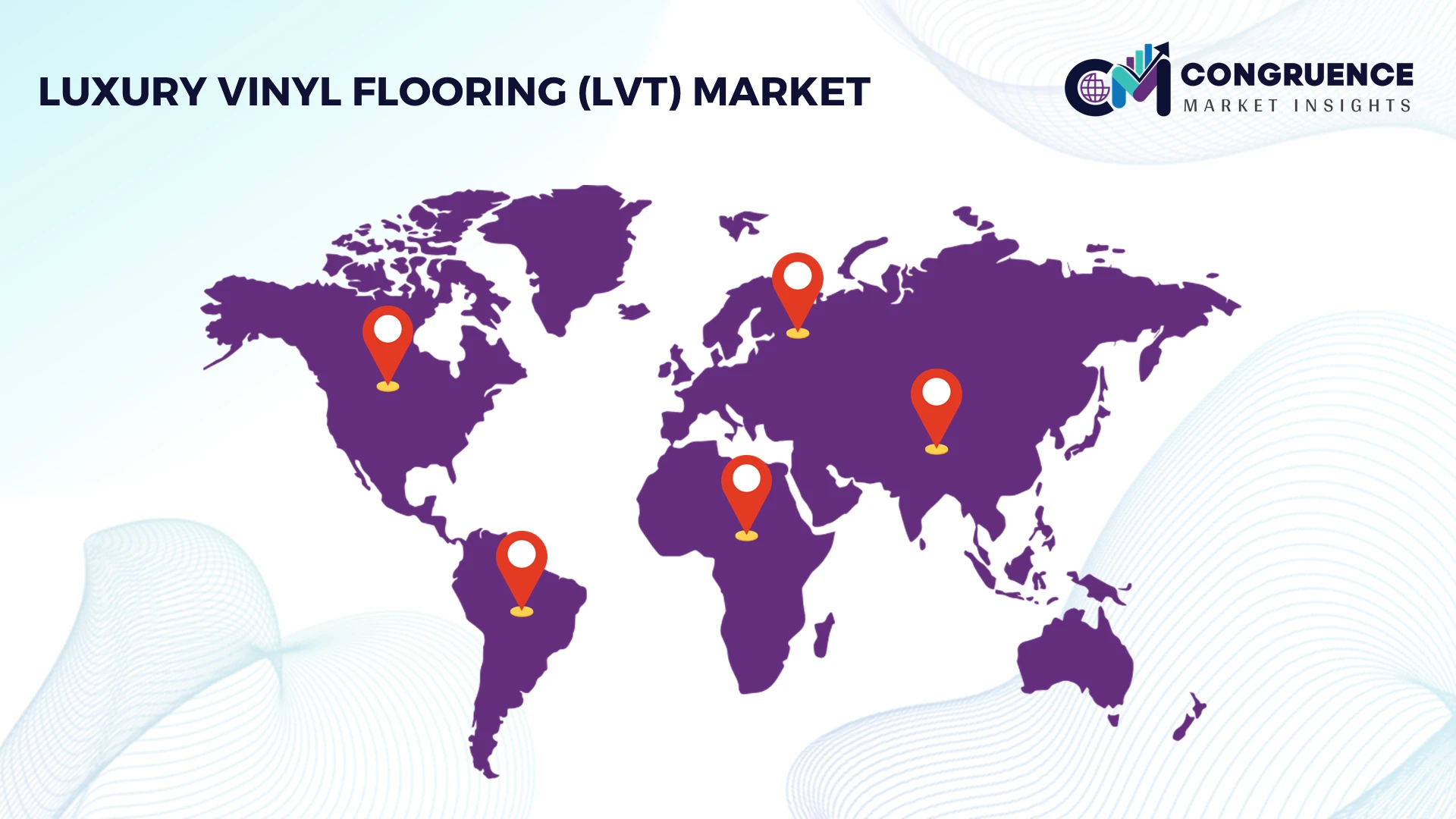
North America accounted for the largest market share at 35.2% in 2025 however, Asia-Pacific is expected to register the fastest growth, expanding at a CAGR of 12.4% between 2026 and 2033.
Rigid-Core Adoption Drives Manufacturing Localization
North America accounted for approximately 35.2% of global LVT demand in 2025, supported by residential remodeling, multifamily construction, healthcare refurbishment, and commercial replacement. In the United States, LVT represented approximately 51.5% of hard-surface flooring sales, while rigid-core products generated about 70% of LVT sales. Tariff exposure and extended Asian supply chains are accelerating domestic production, inventory regionalization, and automated extrusion investment. Shaw Industries' approximately USD 90 million Ringgold, Georgia project is designed to more than double resilient-flooring capacity, illustrating the localization shift. Manufacturers are simultaneously expanding SPC/WPC collections, attached acoustic backing, digital embossing, and click-lock platforms. Distribution scale remains strategically important because installers and retailers increasingly expect rapid SKU availability alongside design differentiation.
United States Market Outlook: The United States combines the region's deepest renovation channel with extensive specialty flooring distribution and domestic manufacturing investment. Residential LVT represented about 90% of residential resilient-flooring sales in 2025. Import tariffs are strengthening the economics of localized production, giving manufacturers with U.S. extrusion, warehousing, automated finishing, and contractor networks greater control over lead times and inventory availability.
Circularity Redefines Flooring Product Engineering
Europe represented approximately 24.5% of global LVT demand in 2025, with Germany, the United Kingdom, France, Italy, and the Netherlands supporting substantial residential and commercial deployment. Product competition increasingly incorporates recyclability, low-emission chemistry, environmental product declarations, and material traceability alongside durability and design. Construction and demolition activities generate more than 35% of EU waste, intensifying regulatory and specification pressure for recoverable building materials. Manufacturers are responding with take-back networks, recycled PVC, phthalate-free formulations, PVC-free alternatives, and design-for-disassembly systems. Digital printing and synchronized embossing are also enabling premium wood and stone aesthetics without increasing SKU complexity proportionately. This combination of environmental regulation and architectural specification gives technically validated circular products stronger positioning in commercial projects than low-cost imported flooring lacking documented lifecycle performance.
Germany Market Outlook: Germany provides a strong specification-led market through large renovation activity, commercial building modernization, and established recycling infrastructure. The country's construction sector generates substantial material recovery volumes, strengthening demand for flooring designed around recyclability and documented emissions. Manufacturers offering take-back programs, environmental declarations, acoustic performance, and mechanically installed LVT gain an advantage in offices, healthcare facilities, retail, and multifamily refurbishment.
Integrated Manufacturing Creates Export-Scale Advantage
Asia-Pacific represented approximately 30.1% of global LVT demand in 2025 and remains the industry's primary manufacturing ecosystem for PVC flooring, SPC cores, wear layers, printing films, and finished products. China exported approximately 4.16 million tonnes of PVC flooring during 2025, demonstrating manufacturing scale unmatched by other individual countries. Producers benefit from clustered extrusion, calendaring, digital printing, profiling, packaging, and component supply chains that shorten industrial lead times. Vietnam and other Southeast Asian manufacturing locations are gaining strategic relevance as suppliers diversify production footprints in response to U.S. tariffs and trade-policy changes. Meanwhile, domestic demand in China, India, Japan, and Australia increasingly favors waterproof rigid-core flooring. Manufacturers are adding automated inspection, synchronized embossing, higher-speed extrusion, and export-oriented compliance capabilities to protect competitiveness beyond labor-cost advantages.
China Market Outlook: China remains the industry's most influential production base, with the United States absorbing approximately 16.1% of Chinese PVC-flooring exports in 2025 versus roughly 7.4% for Germany. Its advantage extends from PVC processing through SPC extrusion and decorative-film production. Chinese manufacturers are countering trade pressure through automation, premium product development, overseas capacity diversification, and greater penetration of non-U.S. export markets.
Commercial Renovation Broadens LVT Deployment
South America accounted for approximately 4.3% of global LVT demand in 2025, led by Brazil and supported by Chile, Argentina, and Colombia. Adoption is concentrated in apartments, offices, hospitality properties, healthcare interiors, and retail refurbishments where installation speed and moisture resistance provide advantages over ceramic and laminate alternatives. Brazil's large construction and renovation ecosystem supports local resilient-flooring production, while imported SPC products broaden design availability. Currency volatility and freight costs, however, make import-dependent portfolios harder to price consistently. Manufacturers and distributors are therefore increasing local inventory, regional converting relationships, and contractor-oriented product ranges. Click-lock flooring reduces installation complexity and allows faster renovation of occupied commercial spaces, creating a particularly useful lifecycle proposition where businesses cannot tolerate extended closures.
Brazil Market Outlook: Brazil provides the strongest regional platform through its large housing stock, domestic construction-material industry, hospitality infrastructure, and extensive retail network. More than 90% of its population lives in urban areas, concentrating renovation demand around major metropolitan markets. Local manufacturing, distributor inventories, moisture-resistant products, and installer partnerships provide strategic insulation against exchange-rate volatility and long imported-product replenishment cycles.
Mega-Projects Elevate Specification Demand
Middle East & Africa represented approximately 5.9% of global LVT demand in 2025, with Saudi Arabia and the UAE providing the strongest specification momentum. Hotel construction, mixed-use developments, healthcare infrastructure, offices, and residential projects increasingly require flooring combining rapid installation, acoustic performance, moisture resistance, and premium visuals. Saudi Vision 2030 projects are creating large-scale specification opportunities, while UAE hospitality and commercial refurbishment support premium plank and tile formats. Imported products dominate many markets, making distributor inventories, project logistics, and specification partnerships essential competitive assets. Suppliers are adapting products for heavy footfall, temperature variation, and accelerated project schedules while expanding architect and contractor engagement. African deployment remains more fragmented because logistics and purchasing power vary considerably, favoring targeted urban distribution rather than broad inventory expansion.
Saudi Arabia Market Outlook: Saudi Arabia offers the strongest project-driven opportunity through giga-projects, tourism infrastructure, housing development, and healthcare modernization. The Kingdom targets 150 million annual tourist visits by 2030, reinforcing hotel, retail, entertainment, and mixed-use flooring requirements. Manufacturers with local distributors, specification teams, project inventories, and rapid-install rigid-core portfolios are positioned to capture large-volume packages while reducing imported-product lead-time risk.
Mohawk Industries, Shaw Industries, Tarkett, Interface, and AHF Products compete against Asian rigid-core manufacturers and regional flooring specialists across residential and commercial channels. The top five players collectively hold approximately 30–35% of global LVT demand, leaving substantial share with Chinese OEMs and private-label suppliers. Competition centers on rigid-core technology, visual realism, pricing, availability, and installation speed. Rigid core represents about 70% of LVT sales, while click-lock systems can shorten installation time by 20–30% versus glue-down products. Automated inspection can reduce quality-related defects by roughly 10–15%. Leaders are expanding domestic capacity, integrating extrusion and finishing, strengthening distributor partnerships, and developing PVC-free or recyclable platforms. Tariffs and supply-chain restructuring are shifting advantage from import dependence toward localized manufacturing and diversified sourcing. High tooling, design, certification, inventory, and distribution requirements restrict entry. Winning requires manufacturing scale, differentiated surfaces, rapid fulfillment, contractor acceptance, and disciplined control of material supply and quality consistency.
Mohawk Industries, Inc.
Shaw Industries Group, Inc.
Tarkett S.A.
Interface, Inc.
AHF Products
Mannington Mills, Inc.
Forbo Holding Ltd.
Gerflor Group
Karndean Designflooring
CFL Flooring
LX Hausys
Congoleum Corporation
NOX Corporation
Responsive Industries Limited
Current LVT technology centers on SPC/WPC rigid cores, click-lock joints, embossed-in-register surfaces, and automated extrusion. Rigid core represents about 70% of LVT sales, confirming scaled adoption. Modern click systems can shorten installation time 20–30% versus glue-down flooring by removing adhesive curing, improving contractor productivity and accelerating residential renovation turnover.
Emerging technology combines digital printing, synchronized embossing, recycled feedstocks, and automated optical inspection. High-definition imaging reduces pattern repetition while machine vision can improve defect detection 10–15% over manual sampling. PVC-free platforms now integrate 70% recycled content and cores containing 80% renewable plant-based material, giving manufacturers stronger differentiation in sustainability-sensitive architectural specifications and retail channels.
Through 2026–2028, disruptive development will concentrate on AI-assisted inspection, closed-loop extrusion control, recyclable cores, and digitally customized surfaces. Advanced PVC-free products already deliver three-times greater scratch resistance than traditional LVT, demonstrating performance can accompany material substitution. Domestic automated plants will increasingly integrate extrusion, milling, embossing, inspection, and packing, reducing inventory and supply-chain exposure. Manufacturers controlling core chemistry, digital design, and localized production gain the strongest competitive advantage. Technology investment matters now because tariffs, circularity requirements, installer productivity, and premium visual expectations are simultaneously redefining product qualification and supplier selection across global flooring channels.
October 2024 Shaw Industries announced a USD 90 million expansion of its Ringgold, Georgia SPC/LVT plant, designed to more than double resilient-flooring capacity by 2026. Domestic manufacturing enables smaller production runs, additional embossing textures, improved dimensional stability, and faster customer service. Source: shawinc.com
December 2024 Tarkett reported its new Essence LVT collection containing up to 55% recycled material, while European Elegance and Essence Rigid 55 ranges incorporate 20–30%. The material redesign strengthens circular product specifications and reduces dependence on virgin flooring inputs. Source: tarkett-group.com
November 2025 AHF Products completed its Cartersville rigid-core manufacturing acquisition, expanding its network to 12 plants, including 11 in the United States. The transaction internalized advanced rigid-core capability and strengthened domestic production, private-label flexibility, supply availability, and channel responsiveness. Source: fcnews.net
April 2026 AHF Products restarted its 328,000-square-foot Cartersville facility with automated rigid-core production and approximately 40–45-day lead times. High-speed milling, packing, EIR finishing, and flexible wear layers reduce import exposure while accelerating product launches and inventory replenishment for customers. Source: floordaily.net
The Luxury Vinyl Flooring (LVT) Market report evaluates Luxury Vinyl Planks, Luxury Vinyl Tiles, Rigid Core, Flexible Vinyl, and Waterproof Vinyl across residential flooring, commercial flooring, hospitality, healthcare, and retail spaces. End-user analysis covers homeowners, contractors, property developers, hospitality operators, and commercial facility managers. Regional coverage spans North America, Europe, Asia-Pacific, South America, and Middle East & Africa, including country-level manufacturing and deployment dynamics.
Technology assessment covers SPC/WPC cores, click-lock systems, digital printing, synchronized embossing, automated inspection, recycled materials, and PVC-free constructions. Rigid core represents about 70% of LVT sales, providing an important indicator of technology concentration. The report also examines localized manufacturing, circular flooring systems, tariff-driven sourcing changes, and commercial specification trends. Between 2026 and 2033, these insights support capacity investment, geographic expansion, supplier selection, product portfolio planning, partnership development, and competitive positioning.
| Report Attribute/Metric | Report Details |
|---|---|
Market Revenue in 2025 | USD 13050 Million |
Market Revenue in 2033 | USD 29430.08 Million |
CAGR (2026 - 2033) | 10.7% |
Base Year | 2025 |
Forecast Period | 2026 - 2033 |
Historic Period | 2021 - 2025 |
Segments Covered | By Type
By Application
By End-User
|
Key Report Deliverable | Revenue Forecast, Growth Trends, Market Dynamics, Segmental Overview, Regional and Country-wise Analysis, Competition Landscape |
Region Covered | North America, Europe, Asia-Pacific, South America, Middle East, Africa |
Key Players Analyzed | Mohawk Industries, Inc., Shaw Industries Group, Inc., Tarkett S.A., Interface, Inc., AHF Products, Mannington Mills, Inc., Forbo Holding Ltd., Gerflor Group, Karndean Designflooring, CFL Flooring, LX Hausys, Congoleum Corporation, NOX Corporation, Responsive Industries Limited |
Customization & Pricing | Available on Request (10% Customization is Free) |




