
Reports
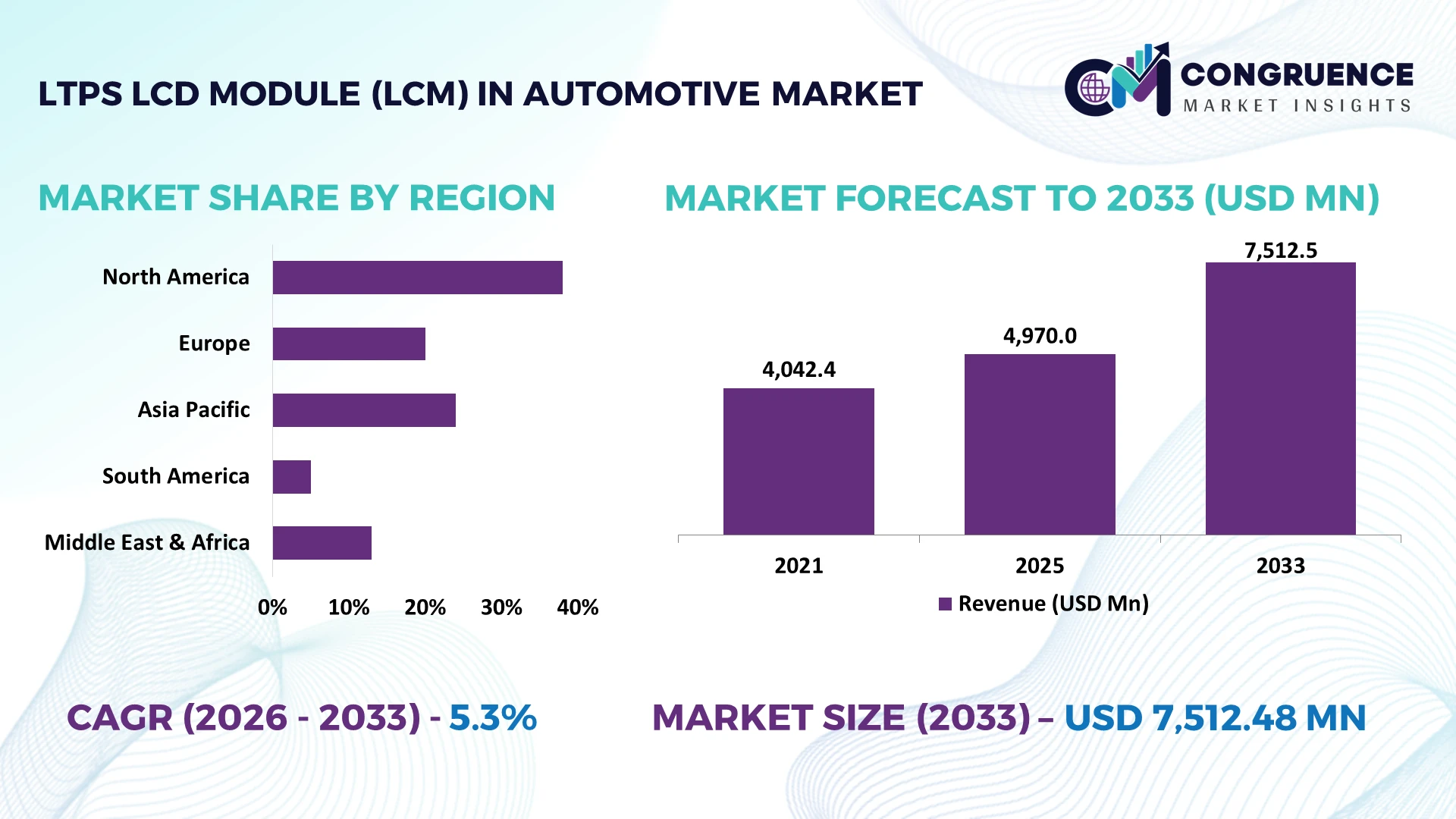
The Global LTPS LCD Module (LCM) In Automotive Market was valued at USD 4970 Million in 2025 and is anticipated to reach a value of USD 7512.48 Million by 2033 expanding at a CAGR of 5.3% between 2026 and 2033. Growth is driven by digital instrument cluster integration, larger automotive infotainment displays, electric vehicle cockpit modernization, and adoption of high resolution LTPS backplane technology.
China represents the dominant automotive display manufacturing and consumption center, supported by integrated semiconductor fabrication, display module assembly, and electric vehicle production. China manufactured approximately 34.53 million vehicles in 2025, substantially exceeding Japan's automotive production scale. New energy vehicles accounted for approximately 47.9% of China's domestic vehicle sales, accelerating adoption of integrated digital cockpit displays. BOE Technology, Tianma Microelectronics, and other domestic suppliers benefit from established thin film transistor manufacturing infrastructure. China's industrial localization initiatives strengthen automotive display supply chains and reduce dependence on imported display components.
Strategically, manufacturers should prioritize China's 47.9% new energy vehicle sales penetration and extensive display fabrication infrastructure while strengthening automotive grade qualification, high resolution integration, and diversified international sourcing.
Market Size & Growth: USD 4,970 million in 2025, reaching USD 7,512.48 million by 2033 at 5.3% CAGR, driven by integrated digital cockpits and LTPS display upgrades.
Top Growth Drivers: Automotive display shipments increased 5.1%, instrument cluster shipments rose 16.8%, and head up display shipments expanded 25.3% during the first half of 2025.
Short-Term Forecast: By 2027, projected market expansion reaches approximately 10.9% against 2025, strengthening automotive module capacity planning.
Emerging Technologies: Three developments shape advanced modules: LTPS in cell touch, Mini LED backlighting, and AI optimized cockpit visualization.
Regional Leaders: Illustrative 2033 allocations place Asia Pacific at USD 4,507.49 million, Europe at USD 1,352.25 million, and North America at USD 1,126.87 million, assuming 60%, 18%, and 15% shares respectively.
Consumer/End-User Trends: LTPS penetration in automotive center displays increased from 29.1% in 2023 to 46.4% in 2025.
Pilot/Case Example: BOE Varitronix reported 68% growth in automotive LTPS display shipment volume during 2025, demonstrating successful production scaling.
Competitive Landscape: BOE led overall automotive display panel shipments with 17.6% share in 2024; competitors include Tianma, AUO, Japan Display, and LG Display.
Regulatory & ESG Impact: Automotive display qualification under AEC Q100 requires 100% compliance with applicable reliability testing criteria for qualifying semiconductor components.
Investment & Funding: BOE budgeted approximately USD 4 billion equivalent for its sixth generation semiconductor display production project, strengthening advanced fabrication capacity.
Innovation & Future Outlook: LTPS is projected to exceed 50% of automotive display panel value by 2028, reinforcing advanced backplane investment.
The Global LTPS LCD Module (LCM) In Automotive Market is transitioning toward integrated digital cockpit architectures, high resolution instrument clusters, and advanced driver information displays. LTPS technology enables higher pixel density, narrower bezels, improved touch integration, and compact module construction compared with conventional amorphous silicon LCD systems. During the first half of 2025, LTPS captured 46.4% of automotive center display shipments, reflecting accelerating technology adoption. Chinese manufacturing localization and automotive semiconductor supply chain restructuring are influencing procurement strategies. These developments strengthen the strategic importance of display qualification, manufacturing efficiency, and long term supplier partnerships.
The LTPS LCD Module (LCM) In Automotive Market is becoming strategically important as automakers integrate digital instrument clusters, intelligent infotainment platforms, and advanced driver information systems. China's new energy vehicles represented approximately 47.9% of domestic vehicle sales in 2025, strengthening demand for sophisticated cockpit electronics. Automotive manufacturers are restructuring display procurement toward integrated module suppliers capable of supporting high resolution panels, touch interfaces, and automotive qualification requirements. BOE, Tianma, and AUO are expanding advanced display capabilities to strengthen supplier relationships.
LTPS backplanes enable higher pixel density and narrower display borders than conventional amorphous silicon LCD architectures. Industry adoption indicators show LTPS penetration in automotive center displays increasing from 29.1% in 2023 to approximately 46.4% in 2025, representing a 17.3 percentage point improvement in technology adoption. China emphasizes large scale production integration, while Germany and Japan prioritize automotive reliability, optical performance, and advanced cockpit engineering. Between 2026 and 2028, integrated touch displays and Mini LED backlighting will influence qualification priorities.
BOE Varitronix reported 68% automotive LTPS display shipment growth during 2025, demonstrating practical manufacturing scale expansion. Suppliers are investing in automated inspection, thermal reliability testing, and integrated display assemblies. Competitive advantage increasingly depends on production consistency, automotive qualification, and dependable long term supply partnerships.
Automotive cockpit modernization is accelerating adoption of LTPS LCD modules across instrument clusters, infotainment systems, and passenger displays. LTPS penetration in automotive center displays increased from 29.1% in 2023 to approximately 46.4% in 2025, reflecting growing preference for high resolution display architectures. During the first half of 2025, automotive instrument cluster display shipments increased 16.8%, while head up display shipments expanded 25.3%. China's expanding electric vehicle manufacturing ecosystem is strengthening demand for integrated cockpit electronics and compact display assemblies. BOE, Tianma, and AUO are investing in advanced backplane technologies, touch integration, and automated module production. Manufacturers increasingly prioritize scalable display platforms supporting multiple vehicle configurations.
LTPS LCD module manufacturing requires sophisticated semiconductor processing, precision photolithography, and specialized driver integration, increasing production complexity compared with conventional LCD technologies. Asia Pacific represents an estimated 60% of global automotive LTPS LCD module demand, concentrating supplier relationships and manufacturing dependencies. Automotive display manufacturing requires stringent quality controls, with suppliers frequently targeting defect rates below 0.1% for critical module characteristics. China's established display fabrication ecosystem provides scale advantages, but dependence on specialized semiconductor materials and equipment creates procurement vulnerabilities. Trade restrictions affecting advanced manufacturing equipment increase qualification and sourcing complexity. Suppliers are diversifying component procurement, developing alternative material specifications, and strengthening production localization to reduce operational disruptions.
Mini LED backlighting and integrated touch technologies create opportunities for higher performance automotive LTPS LCD modules. LTPS adoption in automotive center displays reached approximately 46.4% in 2025, establishing a substantial installed technology base for advanced module upgrades. Mini LED systems can incorporate thousands of localized dimming zones, improving contrast management and display visibility under varying lighting conditions. Automotive manufacturers are targeting display brightness exceeding 1,000 nits for selected premium cockpit applications, strengthening demand for advanced optical engineering. Chinese manufacturers are expanding integrated display development, while German automakers prioritize premium digital cockpit architectures. BOE, Tianma, and AUO are investing in Mini LED integration, advanced driver electronics, and automated optical inspection to improve product differentiation.
Maintaining long term display reliability across temperature extremes, vibration exposure, and complex cockpit electronics presents significant engineering challenges. Automotive display modules commonly require qualification across operating temperatures extending from minus 40°C to 85°C, depending on vehicle specifications. Premium digital cockpit platforms increasingly integrate 3 or more displays, increasing synchronization, electromagnetic compatibility, and thermal management requirements. Automotive suppliers frequently target product defect rates below 0.1% for critical visual and functional characteristics, demanding extensive process validation. Germany's automotive manufacturers emphasize functional safety and stringent component qualification across vehicle platforms. Display suppliers must invest in accelerated aging tests, automated optical inspection, and integrated software validation. Competitive positioning depends on maintaining consistent display performance throughout extended vehicle lifecycles.
Larger Displays Reshape Cockpit Packaging: Automotive manufacturers are integrating panoramic displays exceeding 30 inches, replacing fragmented dashboard arrangements with continuous visual interfaces. Mercedes Benz introduced a 39.1 inch pillar to pillar MBUX Superscreen configuration, while BMW demonstrated a 17.9 inch central display. Suppliers are redesigning module housings, optical bonding processes, and cockpit interfaces to improve packaging efficiency and display integration.
Optical Bonding Becomes Manufacturing Priority: Automotive display manufacturers are expanding optical bonding capabilities to improve sunlight readability and reduce internal reflections. Conventional display assemblies contain multiple reflective interfaces, while full bonding eliminates the internal air gap. Suppliers increasingly target optical transmittance above 90% and reflectance below 2% in premium applications. BOE and Tianma are strengthening optical engineering and automated bonding processes to improve production consistency.
Automotive Display Qualification Becomes More Rigorous: Vehicle manufacturers are strengthening validation requirements for display modules exposed to vibration, temperature fluctuations, and prolonged operation. Automotive components commonly undergo testing from minus 40°C to 85°C, while qualification programs can include 1,000 hour thermal aging assessments. Suppliers are expanding accelerated reliability testing and automated defect detection, improving qualification consistency and reducing field failure exposure.
Integrated Touch Manufacturing Simplifies Module Assembly: Automotive display suppliers are adopting embedded touch architectures that reduce separate sensor layers and simplify module construction. Advanced touch controllers support 10 point interaction, while integrated display assemblies increasingly combine 2 or more cockpit functions. Manufacturers are consolidating touch sensing, display driving, and optical bonding operations, reducing assembly complexity and strengthening compatibility with software defined vehicle platforms.
Touchscreen LCD Modules represent the leading category, accounting for an estimated 38% of the global LTPS LCD Module (LCM) In Automotive Market. Their dominance reflects integration across infotainment interfaces, navigation controls, and centralized vehicle operating systems. Embedded touch sensing reduces separate component requirements and supports compact dashboard configurations. Standard LCD Modules account for approximately 27%, maintaining relevance in established vehicle platforms where cost control and dependable visual performance remain important. Manufacturers including BOE, Tianma, and AUO are strengthening integrated touch development, advanced optical bonding, and standardized module architectures to improve production scalability and compatibility across automotive platforms.
High-Brightness LCD Modules represent the fastest growing category, supported by increasing requirements for sunlight readability and premium cockpit visualization. Automotive manufacturers increasingly specify display brightness exceeding 1,000 nits for selected applications, encouraging investment in advanced backlighting and optical efficiency. Wide-Temperature LCD Modules serve demanding operating environments where thermal stability and long term reliability are critical. Suppliers are expanding specialized qualification capabilities and automated inspection systems. Investment priorities increasingly favor integrated functionality, optical performance, and reliable operation across diverse vehicle configurations.
Center Information Displays represent the leading application, accounting for an estimated 34% of the global LTPS LCD Module (LCM) In Automotive Market. Their dominance reflects extensive deployment in navigation systems, vehicle settings, multimedia interfaces, and centralized cockpit controls. Instrument Clusters account for approximately 28%, supported by digital speedometers, driver assistance visualization, and configurable information layouts. Infotainment Systems maintain substantial demand through connected entertainment, smartphone integration, and software driven vehicle functions. Manufacturers are standardizing display architectures and integrating advanced touch controllers to improve functionality while reducing component complexity across vehicle platforms.
Head-Up Displays represent the fastest growing application, supported by increasing adoption of advanced driver assistance systems and augmented reality visualization. Automotive head up display shipments increased approximately 25.3% during the first half of 2025, highlighting expanding deployment activity. Rear-Seat Displays serve premium passenger entertainment and personalized cabin interfaces, particularly in larger vehicles. BOE, Tianma, and Japan Display are strengthening optical engineering, module customization, and automotive qualification capabilities. Investment priorities increasingly emphasize visual clarity, interface integration, and compatibility with centralized vehicle electronics.
Passenger Vehicle Manufacturers represent the leading end user category, accounting for an estimated 46% of the global LTPS LCD Module (LCM) In Automotive Market. Their dominance reflects extensive vehicle production, digital dashboard integration, and standardized procurement across multiple automotive platforms. Electric Vehicle Manufacturers account for approximately 25%, supported by advanced cockpit electronics and integrated touchscreen architectures. China's new energy vehicles represented approximately 47.9% of domestic vehicle sales in 2025, demonstrating substantial electrification across its automotive industry. Display suppliers are developing modular architectures and strengthening manufacturing partnerships to support diversified passenger vehicle production requirements.
Electric Vehicle Manufacturers represent the fastest growing end user category, supported by software defined cockpit development and centralized electronic architectures. Automotive Tier-1 Suppliers maintain an important role through display system integration, electronic control development, and direct relationships with vehicle manufacturers. Commercial Vehicle Manufacturers prioritize durable modules, dependable instrument visualization, and extended operating lifecycles. BOE, Tianma, and AUO are expanding automotive display qualification and integrated module development. Competitive investment increasingly targets platform standardization, efficient component integration, and long term supply agreements.
Asia Pacific accounted for the largest market share at an estimated 60% in 2025 however, Asia Pacific is expected to register the fastest growth, expanding at an estimated CAGR of 6.2% between 2026 and 2033.
Automotive Electronics Localization Strengthens Advanced Display Integration
North America accounts for an estimated 15% of the global LTPS LCD Module (LCM) In Automotive Market, supported by established automotive manufacturing clusters, digital cockpit engineering, and electronic component integration. The United States dominates regional automotive display procurement through passenger vehicle production, electric vehicle development, and advanced infotainment system integration. General Motors, Ford, and Tesla are incorporating increasingly sophisticated driver information interfaces across vehicle platforms. Mexico contributes through automotive assembly operations and established cross border component supply chains. The United States Mexico Canada Agreement supports integrated automotive production, with regional value content requirements reaching 75% for qualifying passenger vehicles. Display manufacturers are strengthening partnerships with automotive Tier 1 suppliers to improve module qualification, procurement coordination, and localized assembly. Competitive priorities include reliable semiconductor sourcing, integrated touch interfaces, and efficient adaptation to changing vehicle electronics architectures.
United States Market Outlook: The United States benefits from established automotive research capabilities, advanced electronic system integration, and extensive vehicle manufacturing infrastructure. General Motors and Ford maintain significant digital cockpit development programs, while Tesla emphasizes centralized vehicle interfaces. The United States produced approximately 10.56 million motor vehicles in 2024, supporting substantial demand for automotive electronic components. Display suppliers prioritize functional reliability, automotive qualification, and long term procurement partnerships.
Premium Vehicle Engineering Accelerates Display System Modernization
Europe represents an estimated 18% of global LTPS LCD Module (LCM) In Automotive Market demand, supported by premium automotive manufacturing, advanced cockpit engineering, and established automotive electronics suppliers. Germany remains the principal regional center for digital instrument cluster development, infotainment integration, and premium display architecture. BMW, Mercedes Benz, Volkswagen, and Stellantis are integrating advanced display systems across passenger vehicle platforms. The European Union's General Safety Regulation, applicable to new vehicles from July 2024, strengthens requirements for vehicle safety technologies and driver information systems. Automotive suppliers including Continental, Bosch, and FORVIA are developing integrated cockpit electronics and display control platforms. European manufacturers increasingly prioritize high resolution visualization, electromagnetic compatibility, and extended component reliability. Display suppliers are strengthening qualification partnerships and localized engineering support to meet complex vehicle integration requirements while maintaining consistent manufacturing quality.
Germany Market Outlook: Germany combines premium automotive manufacturing with advanced electronic engineering and established component qualification infrastructure. BMW introduced its Panoramic iDrive architecture, featuring a 17.9 inch central display and windshield information projection. Mercedes Benz continues developing integrated digital cockpit systems, strengthening requirements for sophisticated display electronics. German automotive suppliers emphasize optical performance, functional safety, and software integration, supporting demand for specialized automotive display modules.
Integrated Display Manufacturing Establishes Global Supply Leadership
Asia Pacific dominates the LTPS LCD Module (LCM) In Automotive Market with an estimated 60% share, supported by extensive semiconductor display fabrication, automotive electronics manufacturing, and integrated module assembly infrastructure. China maintains the largest production ecosystem, while Japan, South Korea, and Taiwan contribute advanced display technologies, semiconductor materials, and specialized manufacturing equipment. BOE, Tianma, AUO, and Japan Display maintain established automotive display development capabilities. China's automotive industry manufactured approximately 34.53 million vehicles in 2025, creating substantial domestic demand for instrument clusters and center information displays. LTPS penetration in automotive center displays reached approximately 46.4% during 2025, reinforcing investment in advanced backplane manufacturing. Suppliers are strengthening automated inspection, optical bonding, and module integration capabilities. Regional manufacturing concentration enables coordinated procurement, faster engineering collaboration, and efficient production scaling across automotive display supply chains.
China Market Outlook: China benefits from integrated automotive manufacturing, display fabrication, and semiconductor component supply networks. BOE and Tianma maintain substantial domestic production capabilities, supporting partnerships with electric vehicle manufacturers and automotive electronics suppliers. New energy vehicles represented approximately 47.9% of China's domestic vehicle sales in 2025. Government initiatives supporting industrial localization strengthen domestic display procurement, while manufacturers invest in advanced backplane processing, integrated touch technology, and automotive qualification.
Vehicle Electronics Upgrades Reshape Regional Component Procurement
South America accounts for an estimated 4% of global LTPS LCD Module (LCM) In Automotive Market demand, supported by automotive assembly operations, vehicle electronics modernization, and established component distribution networks. Brazil represents the region's principal automotive manufacturing center, followed by Argentina and Colombia in vehicle assembly and related industrial activity. Volkswagen, Stellantis, General Motors, and Toyota maintain regional manufacturing operations, supporting procurement of digital instrument clusters and infotainment displays. Brazil produced approximately 2.55 million vehicles in 2024, demonstrating substantial automotive assembly capacity. Regional display module demand is primarily linked to vehicle production rather than large scale domestic LTPS fabrication. Imported semiconductor components, currency volatility, and logistics costs influence procurement strategies. Automotive suppliers are strengthening local electronics assembly, standardized module sourcing, and regional distribution partnerships to improve component availability and manage production expenses.
Brazil Market Outlook: Brazil maintains established automotive manufacturing infrastructure across São Paulo and neighboring industrial centers. Volkswagen, Stellantis, and General Motors support substantial vehicle assembly activity, creating opportunities for automotive display module integration. Brazil's Rota 2030 automotive policy encourages industrial development, engineering investment, and technological modernization. Domestic electronics suppliers benefit from proximity to vehicle assembly operations, although specialized LTPS display panels remain dependent on international semiconductor manufacturing networks.
Automotive Industrialization Expands Advanced Electronics Procurement
The Middle East and Africa represent an estimated 3% of global LTPS LCD Module (LCM) In Automotive Market demand, supported by automotive assembly expansion, electric vehicle investment, and developing electronics supply chains. South Africa maintains established vehicle manufacturing operations, while Morocco contributes through integrated automotive production and export infrastructure. Saudi Arabia is investing in domestic electric vehicle manufacturing under its industrial diversification strategy. Morocco produced approximately 559,645 vehicles in 2024, demonstrating its growing importance as an automotive manufacturing center. Renault and Stellantis maintain manufacturing operations in Morocco, supporting regional automotive component procurement. Display module demand remains dependent on imported advanced panels and localized vehicle electronics integration. Manufacturers are strengthening supplier partnerships, engineering capabilities, and logistics infrastructure to improve procurement reliability. Long term competitiveness depends on automotive qualification capabilities and integration with established international display supply networks.
Morocco Market Outlook: Morocco benefits from automotive manufacturing clusters around Tangier and Kenitra, supported by established export logistics and international vehicle manufacturer partnerships. Renault and Stellantis maintain significant industrial operations, creating demand for automotive electronic systems and integrated display components. Morocco's proximity to European automotive markets strengthens supply chain coordination and component distribution. Industrial investment incentives support supplier localization, although advanced LTPS panel fabrication remains concentrated outside the country.
The global LTPS LCD Module (LCM) In Automotive Market is led by BOE Technology, Tianma Microelectronics, AUO Corporation, Japan Display, and LG Display, competing through fabrication scale, automotive qualification, optical performance, and integrated module engineering. Their combined market share is estimated at 65% to 75%, pending category specific verification. BOE competes through manufacturing capacity and Chinese automotive partnerships, while Tianma emphasizes specialized automotive displays. AUO and Japan Display differentiate through reliability engineering and advanced cockpit integration. LTPS penetration in automotive center displays reached approximately 46.4% in 2025, compared with 29.1% in 2023, intensifying investment in advanced backplanes. Asia Pacific's estimated 60% regional concentration reinforces supply chain advantages for established manufacturers. Companies are expanding automated inspection, optical bonding, and integrated touch capabilities. Specialized equipment requirements, automotive certification, and prolonged qualification cycles restrict market entry. Winning requires scalable production, validated reliability, competitive pricing, and dependable automotive partnerships.
BOE Technology Group Co., Ltd.
Tianma Microelectronics Co., Ltd.
AUO Corporation
Japan Display Inc.
LG Display Co., Ltd.
Innolux Corporation
Sharp Corporation
Truly International Holdings Limited
HannStar Display Corporation
Kyocera Corporation
Futaba Corporation
Visionox Technology Inc.
TCL China Star Optoelectronics Technology Co., Ltd.
Raystar Optronics, Inc.
Current automotive LTPS LCD technologies combine high mobility transistor backplanes, integrated touch sensors, and precision optical bonding. Reported LTPS penetration in automotive center displays increased from 29.1% in 2023 to 46.4% in 2025, a 17.3 percentage point adoption gain. Compared with conventional amorphous silicon backplanes, LTPS supports higher pixel density and faster transistor switching. Manufacturers target 10% lower module power consumption through optimized driving circuits, although actual savings depend on display configuration.
Emerging technologies include Mini LED backlighting, advanced local dimming, and automated optical inspection. Premium modules target 1,000 nit brightness, while integrated touch architectures eliminate separate sensing layers. A 15% reduction in assembly steps represents an engineering target rather than a verified industry average. BOE, Tianma, and AUO benefit from integrated fabrication capabilities, enabling tighter process control and faster automotive qualification.
Disruptive development focuses on adaptive display driving, intelligent defect detection, and centralized cockpit integration. Between 2026 and 2028, suppliers will prioritize software controlled brightness, advanced thermal management, and modular display electronics. Automotive manufacturers benefit from simplified system integration, while established panel producers strengthen competitive differentiation through production consistency, qualification expertise, and scalable manufacturing partnerships across increasingly complex vehicle platforms worldwide.
January 2025: BOE showcased its collaboration with Stoneridge at CES 2025, introducing an innovation truck featuring an LTPS central display and camera monitoring system. The partnership strengthens commercial vehicle cockpit integration and expands applications for advanced automotive visualization technologies. Source: boe.com.
May 2025: Tianma presented approximately 60 display demonstration units at Display Week 2025, including automotive LTPS LCD technologies and advanced cockpit solutions. The showcase strengthened its product innovation pipeline, expanded customer engagement, and demonstrated capabilities across multiple display architectures. Source: tianma.com.
July 2025: Omdia reported that LTPS TFT LCD panels were projected to capture 45% of automotive display shipment revenue during 2025. The technology transition strengthens advanced panel suppliers while encouraging manufacturers to redirect production capabilities toward higher performance automotive applications. Source: omdia.tech.informa.com.
April 2025: Nippon Seiki signed agreements with Emerging Display Technologies to establish an automotive TFT LCD module manufacturing venture in India, targeting mass production in 2027. The partnership advances regional manufacturing localization and strengthens automotive electronics supply chain diversification. Source: nippon-seiki.co.jp.
The LTPS LCD Module (LCM) In Automotive Market Report evaluates technological developments, manufacturing capabilities, supplier positioning, and automotive display adoption between 2026 and 2033. Product segmentation covers Standard LCD Modules, Touchscreen LCD Modules, High-Brightness LCD Modules, and Wide-Temperature LCD Modules. Application analysis includes Instrument Clusters, Infotainment Systems, Head-Up Displays, Rear-Seat Displays, and Center Information Displays. End user assessment examines Passenger Vehicle Manufacturers, Commercial Vehicle Manufacturers, Electric Vehicle Manufacturers, and Automotive Tier-1 Suppliers.
Regional coverage includes North America, Europe, Asia Pacific, South America, and the Middle East and Africa. Asia Pacific's estimated 60% market concentration highlights manufacturing scale and procurement dependencies. The report assesses LTPS backplane innovation, Mini LED integration, optical bonding, and automotive qualification requirements. Strategic findings support manufacturing investment, supplier diversification, competitive benchmarking, localization strategies, and advanced cockpit technology planning.
| Report Attribute/Metric | Report Details |
|---|---|
Market Revenue in 2025 | USD 4970 Million |
Market Revenue in 2033 | USD 7512.48 Million |
CAGR (2026 - 2033) | 5.3% |
Base Year | 2025 |
Forecast Period | 2026 - 2033 |
Historic Period | 2021 - 2025 |
Segments Covered | By Type
By Application
By End-User
|
Key Report Deliverable | Revenue Forecast, Growth Trends, Market Dynamics, Segmental Overview, Regional and Country-wise Analysis, Competition Landscape |
Region Covered | North America, Europe, Asia-Pacific, South America, Middle East, Africa |
Key Players Analyzed | BOE Technology Group Co., Ltd., Tianma Microelectronics Co., Ltd., AUO Corporation, Japan Display Inc., LG Display Co., Ltd., Innolux Corporation, Sharp Corporation, Truly International Holdings Limited, HannStar Display Corporation, Kyocera Corporation, Futaba Corporation, Visionox Technology Inc., TCL China Star Optoelectronics Technology Co., Ltd., Raystar Optronics, Inc. |
Customization & Pricing | Available on Request (10% Customization is Free) |




