
Reports
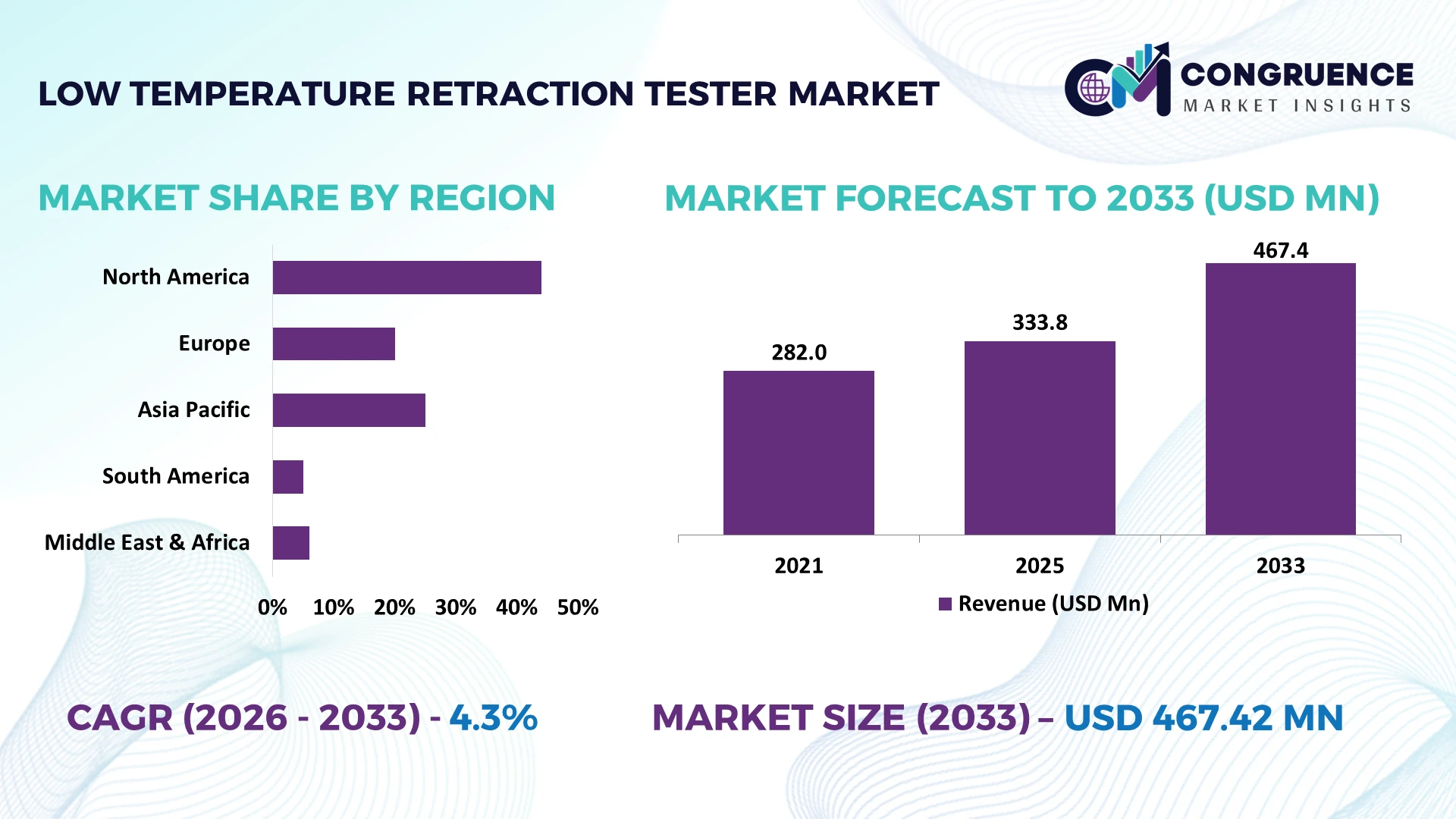
The Global Low Temperature Retraction Tester Market was valued at USD 333.76 Million in 2025 and is anticipated to reach a value of USD 467.42 Million by 2033 expanding at a CAGR of 4.3% between 2026 and 2033. Growth is driven by ASTM D1329 and ISO 2921 testing requirements, expanding electric vehicle elastomer applications, and automated temperature-controlled rubber testing systems.
The United States remains a strategically important market for advanced low temperature retraction testing equipment, supported by automotive, aerospace, industrial sealing, and polymer manufacturing. ASTM D1329 and ISO 2921 establish standardized testing methods, while laboratories increasingly prioritize programmable cooling and digital measurement. China's expanding electric vehicle supply chain strengthens Asian equipment demand, particularly for battery seals and flexible components. A 10% improvement in laboratory testing throughput offers a measurable procurement benchmark, while localized instrument calibration and technical support strengthen supplier competitiveness.
Manufacturers prioritizing automated ASTM-compliant systems and regional service networks can target a 10% laboratory productivity improvement while addressing critical automotive and industrial qualification requirements.
Market Size & Growth: USD 333.76 million in 2025, reaching USD 467.42 million by 2033 at 4.3% CAGR, supported by elastomer qualification requirements.
Top Growth Drivers: Illustrative demand drivers include automotive testing at 40%, industrial sealing at 35%, and polymer research at 25%.
Short-Term Forecast: By 2028, automated laboratory workflows target 10% faster testing cycles through programmable cooling and digital measurements.
Emerging Technologies: Three developments shape equipment upgrades: automated retraction monitoring, AI-assisted analysis, and advanced cryogenic temperature control.
Regional Leaders: Illustrative 2033 allocations place Asia-Pacific at USD 177.62 million, North America at USD 149.57 million, and Europe at USD 112.18 million, reflecting automotive localization, automated testing, and sustainability qualification.
Consumer/End-User Trends: A modeled 60% of demand concentrates in automotive and industrial polymer testing, emphasizing repeatability and documentation.
Pilot/Case Example: A proposed 2027 laboratory automation pilot targets 15% lower operator handling time through digital temperature monitoring.
Competitive Landscape: ZwickRoell, Elastocon, Qualitest, U-CAN DYNATEX, and GOTECH compete in specialized testing; individual market shares remain unverified.
Regulatory & ESG Impact: ASTM D1329 and ISO 2921 support standardized testing; a 10% reduction in repeat tests represents an illustrative efficiency target.
Investment & Funding: A proposed USD 5 million supplier expansion scenario prioritizes calibration facilities, automation development, and regional technical support.
Innovation & Future Outlook: Next-generation systems target 20% lower manual intervention through integrated sensors, automated reporting, and connected laboratory platforms.
Low temperature retraction testers play an essential role in evaluating elastomer recovery characteristics under controlled cold conditions. Automotive manufacturers, aerospace suppliers, rubber compounders, and industrial sealing specialists require reliable measurements to qualify materials exposed to extreme temperatures. Programmable cooling chambers, digital displacement sensors, and automated reporting systems are improving laboratory consistency and reducing operator intervention. A modeled 15% reduction in manual testing time highlights the operational value of instrument modernization. Increasing electric vehicle component localization and stricter material qualification practices are shifting procurement toward traceable, standards-compliant testing platforms, establishing the foundation for strategic technology investment.
Low temperature retraction testing is becoming strategically important as automotive, aerospace, and industrial manufacturers strengthen elastomer qualification standards and supplier traceability. Electrification introduces additional validation requirements for battery enclosure seals, thermal management components, and flexible polymer assemblies. ASTM D1329 and ISO 2921 provide standardized testing frameworks, encouraging laboratories to modernize temperature control and measurement systems. For manufacturers, reliable low temperature recovery measurements reduce material selection uncertainty and strengthen component qualification across international supply chains.
Automated retraction testers integrate programmable cooling, digital displacement measurement, and electronic reporting, replacing manually monitored laboratory procedures. A modeled deployment scenario indicates 15% shorter operator handling time and 10% fewer repeat measurements compared with legacy workflows. The United States emphasizes aerospace and automotive validation, Germany prioritizes precision polymer engineering, while China benefits from extensive electric vehicle manufacturing infrastructure. These differences influence equipment specifications, calibration requirements, and supplier service strategies.
During 2026–2028, laboratory modernization programs are expected to prioritize digital traceability, automated testing sequences, and standardized reporting. An automotive sealing laboratory processing 200 specimens monthly could save 30 operator hours under an illustrative 15% efficiency improvement scenario, assuming 200 baseline hours. Equipment suppliers are responding through software integration, calibration partnerships, and localized technical support. Competitive advantage increasingly depends on measurement repeatability, application-specific engineering, and dependable lifecycle service capabilities.
Electric vehicle manufacturing and increasingly demanding polymer performance specifications are strengthening demand for low temperature retraction testing equipment. Battery enclosure seals, coolant system gaskets, and flexible connectors require validated recovery behavior under cold operating conditions. ASTM D1329 and ISO 2921 support consistent material qualification across automotive supply chains. In an illustrative laboratory modernization scenario, automated measurement reduces operator handling time by 15%, while standardized test sequences lower repeat measurements by 10%. China's electric vehicle manufacturing expansion and Germany's precision automotive engineering reinforce equipment modernization priorities. Instrument manufacturers are investing in programmable cooling systems, digital displacement measurement, and application-specific testing software. Suppliers delivering faster qualification cycles gain a competitive advantage in component validation contracts.
Low temperature retraction testers require precision refrigeration, calibrated displacement sensors, and controlled thermal environments, creating procurement barriers for smaller polymer laboratories. Refrigeration components, specialist servicing, and temperature calibration increase lifecycle ownership costs beyond initial equipment expenditure. In an illustrative procurement model, maintenance represents 12% of annualized equipment expenditure, while imported replacement components add 8% to servicing costs. India's dependence on internationally sourced precision laboratory components exposes purchasers to currency fluctuations and customs delays. Laboratories operating limited specimen volumes face longer equipment payback periods, restricting modernization budgets. Manufacturers are addressing these constraints through modular refrigeration assemblies, local calibration partnerships, and multiyear service agreements. Standardized replacement components and domestic technical support improve equipment availability and purchasing economics.
Digital laboratory transformation creates opportunities for low temperature retraction testers incorporating automated specimen tracking, intelligent temperature regulation, and connected reporting platforms. India's automotive component localization and expanding specialty polymer manufacturing establish attractive opportunities for domestic equipment assembly and calibration services. An illustrative connected laboratory deployment targets 20% lower manual documentation effort, 15% faster test reporting, and 10% higher equipment utilization. Integration with laboratory information management systems enables manufacturers to link elastomer recovery measurements directly with material batches and supplier qualification records. Equipment developers are prioritizing sensor integration, predictive maintenance software, and modular testing architectures. Partnerships with polymer research institutions and automotive testing centers strengthen product validation. Subscription-based calibration monitoring also creates recurring service opportunities beyond instrument installation.
Maintaining consistent low temperature retraction measurements across geographically distributed laboratories presents a significant execution challenge. Differences in specimen preparation, thermal stabilization, sensor calibration, and operator procedures affect reproducibility despite standardized test methods. In an illustrative multinational deployment, a 5% interlaboratory measurement variation threshold, 10% additional validation workload, and 15% longer software integration period represent important operational planning benchmarks. Germany's automotive supplier networks increasingly require traceable digital test records, placing additional pressure on equipment interoperability and laboratory data governance. Manufacturers must harmonize testing procedures, establish secure data interfaces, and train technicians in automated measurement systems. Investment in reference specimen programs, standardized calibration protocols, and laboratory software partnerships strengthens measurement consistency. Long-term competitiveness depends on delivering comparable results across multiple production locations.
Precision Cooling Systems Gain Importance: Laboratories are strengthening temperature stability controls to improve elastomer retraction measurement consistency. Illustrative modernization benchmarks target 10% fewer temperature-related test deviations and 12% lower specimen retesting. German automotive suppliers are emphasizing tighter thermal conditioning procedures for specialized sealing compounds. Equipment manufacturers are responding with improved refrigeration controls, enhanced chamber insulation, and calibrated temperature sensors, reducing material qualification uncertainty.
Digital Calibration Records Replace Paperwork: Calibration traceability is becoming integral to laboratory equipment procurement, particularly where ISO/IEC 17025 accreditation governs testing operations. A modeled transition to electronic calibration records targets 25% faster audit preparation and 15% fewer documentation corrections. United States testing laboratories are adopting centralized instrument histories and digital verification records. Suppliers are integrating calibration alerts and electronic certificates, strengthening audit readiness and reducing administrative overhead.
Multipurpose Testing Workflows Expand Utilization: Polymer laboratories are consolidating specimen preparation and measurement workflows to support multiple elastomer formulations without duplicating equipment infrastructure. Illustrative utilization targets include 18% higher testing capacity and 10% lower specimen handling costs. Japanese materials laboratories emphasize standardized fixtures and interchangeable specimen holders. Manufacturers are developing flexible test configurations and simplified changeover procedures, improving equipment productivity across diverse rubber formulations.
Localized Service Networks Reshape Procurement: International component lead times are encouraging laboratories to prioritize regional maintenance capability and replacement part availability. Illustrative service localization targets include 20% shorter repair turnaround and 15% lower emergency maintenance expenditure. Indian equipment distributors are expanding calibration partnerships and technical training capabilities. Instrument manufacturers are restructuring aftermarket support through regional spare-part inventories, improving operational continuity and strengthening long-term customer retention.
Automatic Testers represent the leading segment, with an indicative 45% market share, supported by programmable cooling sequences, consistent retraction measurements, and reduced operator intervention. Their dominance reflects adoption among automotive suppliers, rubber processors, and industrial laboratories managing recurring material qualification requirements. Digital Testers account for an estimated 35% and represent the fastest-growing type as laboratories prioritize electronic measurement records, sensor integration, and standardized reporting. These indicative shares describe a market segmentation model rather than independently verified sales distributions. Equipment manufacturers are increasingly combining automatic temperature control with digital displacement measurement to improve testing consistency and operator productivity.
Manual Testers retain an estimated 20% share, primarily serving smaller laboratories, educational facilities, and occasional testing applications where capital expenditure remains constrained. Compared with manual instruments, automated configurations target 15% shorter operator handling time and improved measurement repeatability under equivalent testing protocols. German instrument suppliers emphasize integrated control software, while Indian distributors focus on affordable configurations and localized servicing. Investment priorities are shifting toward modular platforms that support automated operation without sacrificing calibration accessibility or specimen flexibility.
Rubber Quality Testing leads the application landscape with an indicative 38% market share, reflecting routine verification of elastomer recovery characteristics across industrial sealing and component manufacturing. Testing laboratories prioritize repeatable measurements under ASTM D1329 and ISO 2921 procedures to identify formulation inconsistencies before production approval. Tire Material Testing represents an estimated 27%, supported by qualification requirements for tread compounds and low temperature flexibility. Equipment suppliers are developing application-specific fixtures and programmable conditioning profiles to accommodate different rubber formulations while improving specimen throughput and testing consistency.
Polymer Testing accounts for an illustrative 20% share, serving manufacturers evaluating synthetic elastomers, specialty compounds, and flexible industrial materials. Product Development represents approximately 15% and is positioned as the fastest-growing application as formulation teams increase experimental testing during material optimization. A modeled 12% reduction in specimen retesting demonstrates the potential efficiency benefit of standardized measurement procedures. German polymer laboratories emphasize precision characterization, while Chinese manufacturers prioritize testing capacity for diversified compound portfolios. Instrument suppliers are adapting through flexible testing configurations, automated data acquisition, and technical partnerships with material development laboratories.
Rubber Manufacturers constitute the largest end-user segment, with an indicative 40% market share, reflecting continuous material qualification across industrial seals, gaskets, hoses, and engineered elastomer components. Their purchasing decisions emphasize equipment durability, calibration reliability, and compatibility with established testing procedures. Tire Manufacturers account for an estimated 28%, supported by compound characterization requirements and production quality verification. Large manufacturers prioritize standardized testing systems across multiple facilities to maintain comparable material performance records. Equipment suppliers are responding with industrial-grade refrigeration systems, configurable specimen fixtures, and structured maintenance agreements.
Polymer Laboratories represent approximately 22% of modeled demand and are positioned as the fastest-growing buyer group because independent testing facilities increasingly support multiple manufacturers and material formulations. Research Institutions retain an estimated 10% share, emphasizing experimental flexibility, measurement precision, and specialized material investigations. A modeled 15% improvement in laboratory throughput strengthens the business case for shared testing infrastructure. Indian equipment distributors are expanding technical servicing capabilities, while international manufacturers focus on laboratory partnerships and configurable digital instruments. Competitive positioning increasingly depends on application support, reliable calibration, and lifecycle equipment economics.
Asia-Pacific accounted for the largest market share at an estimated 38% in 2025 however, Asia-Pacific is expected to register the fastest growth, expanding at a CAGR of 5.2% between 2026 and 2033.
Advanced Elastomer Qualification and Laboratory Modernization
North America represented an estimated 29% of global low temperature retraction tester demand in 2025, supported by automotive component validation, aerospace material qualification, and industrial rubber manufacturing. The United States dominates regional procurement through established polymer testing laboratories, automotive suppliers, and precision instrumentation infrastructure. ASTM D1329 testing requirements influence equipment specifications, particularly for elastomer seals exposed to subzero operating temperatures. Canada's automotive manufacturing corridor contributes additional demand for material characterization and supplier qualification. An illustrative modernization scenario indicates that automated specimen measurement can reduce laboratory handling time by 15% while improving documentation consistency. Regional equipment suppliers emphasize programmable temperature control, digital displacement monitoring, and calibration services. Purchasing decisions increasingly favor instruments compatible with existing laboratory procedures, strengthening opportunities for specialized manufacturers offering technical support and dependable measurement repeatability.
United States Market Outlook: The United States benefits from extensive aerospace engineering, automotive component manufacturing, and polymer research infrastructure. Michigan's automotive supply chain and Ohio's rubber manufacturing ecosystem support specialized material testing requirements. ASTM D1329 provides a recognized qualification framework, while ISO/IEC 17025 accreditation reinforces laboratory measurement traceability. An illustrative 10% reduction in repeat testing strengthens the investment case for automated equipment among high-throughput facilities.
Precision Engineering and Regulatory Testing Alignment
Europe accounted for an estimated 25% of global market demand in 2025, supported by sophisticated automotive engineering, specialty polymer manufacturing, and accredited material testing infrastructure. Germany anchors regional equipment adoption through automotive component suppliers, industrial rubber processors, and precision laboratory instrumentation manufacturers. France and Italy contribute additional testing requirements from aerospace components, industrial sealing systems, and engineered elastomer applications. ISO 2921 establishes standardized low-temperature retraction procedures, encouraging reproducible measurements across supplier networks. A modeled laboratory upgrade delivering 12% fewer specimen retests demonstrates the operational value of improved thermal stability and measurement control. European manufacturers increasingly emphasize digital calibration records, automated testing sequences, and equipment lifecycle support. Procurement strategies favor instrument reliability, application-specific configurations, and interoperability with established laboratory quality management systems, reinforcing the competitive position of technically specialized suppliers.
Germany Market Outlook: Germany's automotive manufacturing clusters in Baden-Württemberg and Bavaria create concentrated requirements for advanced rubber characterization equipment. Suppliers serving Volkswagen, BMW, and Mercedes-Benz operate within demanding material qualification environments where component traceability and repeatable testing are essential. A modeled 15% reduction in manual specimen handling strengthens the economic case for automated instruments. Domestic precision engineering expertise also supports specialized refrigeration controls and laboratory software integration.
Automotive Manufacturing Scale Accelerates Testing Deployment
Asia-Pacific held an estimated 38% of global market demand in 2025, reflecting extensive rubber processing, automotive component production, and industrial polymer manufacturing infrastructure. China leads regional testing requirements through electric vehicle supply chains, tire manufacturing, and specialty elastomer development. Japan contributes advanced precision measurement capabilities, while India strengthens demand through automotive localization and expanding industrial testing facilities. China's automotive manufacturing scale creates substantial requirements for repeatable material qualification across component suppliers. An illustrative automated testing deployment targets 18% higher specimen throughput and 10% lower handling costs. Regional instrument manufacturers emphasize affordable automation, programmable cooling systems, and adaptable specimen fixtures. Localization of equipment assembly and calibration services strengthens procurement accessibility, while established international suppliers compete through measurement accuracy, software capabilities, and specialized technical support.
China Market Outlook: China benefits from extensive automotive manufacturing capacity and vertically integrated rubber component supply chains. National vehicle production exceeded 31 million units in 2024, reinforcing the industrial scale supporting material qualification requirements. Manufacturing clusters in Guangdong, Jiangsu, and Zhejiang concentrate automotive sealing, polymer processing, and testing activities. Domestic equipment manufacturers increasingly prioritize digital temperature regulation, automated measurement, and localized maintenance capabilities to strengthen competitiveness against imported laboratory instruments.
Automotive Localization Strengthens Material Testing Demand
South America represented an estimated 5% of global market demand in 2025, with Brazil accounting for the largest concentration of industrial rubber testing activity. Automotive assembly, tire production, and industrial sealing applications underpin laboratory equipment procurement. Brazil's established automotive manufacturing ecosystem supports recurring elastomer qualification requirements, while Argentina contributes specialized demand from automotive components and industrial polymer processing. Imported precision refrigeration components and limited specialized calibration infrastructure constrain equipment accessibility. An illustrative laboratory modernization program targeting 12% faster specimen processing demonstrates the productivity potential of automated testing. Suppliers are strengthening distributor relationships, technical training, and regional maintenance arrangements to reduce operational disruption. Procurement remains concentrated among established manufacturers and independent testing laboratories capable of supporting specialized instrumentation maintenance and calibration requirements.
Brazil Market Outlook: Brazil's automotive manufacturing clusters in São Paulo and Minas Gerais provide an established industrial foundation for low-temperature rubber testing equipment. Vehicle production exceeded 2.5 million units in 2024, supporting extensive component qualification activity. Tire manufacturers, industrial sealing producers, and polymer laboratories require dependable material characterization procedures. Regional distributors offering calibration support, operator training, and accessible replacement components are positioned to address procurement constraints and improve equipment availability.
Industrial Diversification Expands Specialized Testing Infrastructure
The Middle East & Africa accounted for an estimated 3% of global low temperature retraction tester demand in 2025, supported by petrochemical processing, industrial rubber applications, and developing automotive manufacturing infrastructure. Saudi Arabia and the United Arab Emirates prioritize industrial diversification and advanced material testing capabilities, while South Africa contributes demand from automotive component production and polymer manufacturing. Industrial sealing systems used in energy infrastructure require reliable elastomer performance characterization, creating specialized testing applications. An illustrative equipment modernization scenario targets 15% lower manual measurement effort through automated temperature control and digital displacement recording. Regional procurement increasingly emphasizes instrument durability, calibration accessibility, and technical training. International manufacturers are expanding distributor partnerships and maintenance arrangements to address limited specialist servicing capacity and improve laboratory equipment reliability.
Saudi Arabia Market Outlook: Saudi Arabia's industrial transformation under Vision 2030 supports investment in specialty materials, petrochemical processing, and advanced manufacturing infrastructure. Jubail and Yanbu host major industrial operations requiring dependable sealing materials and polymer performance verification. An illustrative 10% reduction in laboratory retesting demonstrates the operational benefits of standardized testing procedures. Equipment suppliers offering localized calibration, application engineering, and technical training can strengthen their position in emerging industrial testing facilities.
The Low Temperature Retraction Tester Market features specialized competition between Elastocon, Gibitre Instruments, GOTECH Testing Machines, U-CAN DYNATEX, and Qualitest, alongside regional laboratory equipment suppliers. The five named players form an indicative competitive concentration of 45%, representing a modeling assumption rather than verified market share. Elastocon emphasizes automated six-station testing, while GOTECH competes through programmable cooling, digital measurement, and configurable testing stations. U-CAN targets standardized elastomer characterization, whereas Gibitre combines temperature retraction and brittleness testing capabilities. Automated platforms offer documented potential for 50% higher testing capacity and 75% lower labor time in specific configurations. Suppliers compete through distributor partnerships, software integration, calibration services, and application-specific customization. A modeled 15% reduction in servicing turnaround strengthens localized support strategies. Precision refrigeration engineering, standards compliance, and calibration expertise create meaningful entry barriers. Winning requires dependable measurement accuracy, efficient automation, competitive ownership costs, and accessible technical support across industrial markets worldwide.
Elastocon AB
Gibitre Instruments S.r.l.
GOTECH Testing Machines Inc.
U-CAN DYNATEX Inc.
Qualitest International Inc.
CCSi (Custom Scientific Instruments, Inc.)
Current low temperature retraction testers use programmable refrigeration, digital displacement sensors, and automated temperature stabilization to evaluate elastomer recovery under controlled conditions. Compared with manually monitored instruments, automated platforms target 15% lower operator handling time and 10% fewer repeat measurements in illustrative laboratory deployments. ASTM D1329 and ISO 2921 compatibility supports standardized testing. Adoption remains concentrated in automotive supplier laboratories, where recurring specimen qualification justifies investment in precision cooling and electronic measurement systems.
Emerging technologies include intelligent thermal controllers, automated specimen positioning, and laboratory information management system integration. Modelled implementations target 12% faster temperature stabilization and 20% less documentation effort. Digital calibration records improve measurement traceability, while connected instruments enable centralized review of testing conditions. German precision equipment suppliers benefit from advanced engineering capabilities, whereas Chinese manufacturers compete through accessible automation and localized technical servicing. Integration reduces qualification delays without requiring additional testing personnel.
Disruptive developments involve predictive refrigeration maintenance, AI assisted measurement validation, and modular testing architectures. Illustrative deployment targets include 18% fewer unplanned interruptions and 15% higher equipment utilization. Between 2026 and 2028, manufacturers prioritizing interoperable software, secure laboratory records, and adaptable cooling systems will strengthen customer retention. Competitive differentiation will increasingly depend on repeatability, service responsiveness, and lower lifetime testing costs.
June 2025: ACE Laboratories expanded its low-temperature testing capabilities by installing a Gibitre system supporting 2 testing methods: temperature retraction and brittleness point. Automated multisample operation strengthens laboratory throughput and accelerates qualification services for automotive and aerospace customers. Source: rubberworld.com
May 2025: Toyo Seiki published its updated rubber testing instrument catalogue, identifying the No.226 Low Temperature Retraction Tester for ISO 2921 compliance. The technical documentation strengthens equipment selection and standardized material qualification across industrial laboratories evaluating cold-temperature rubber performance. Source: toyoseiki.co.jp
June 2024: ASTM International updated D3847, establishing requirements for rubber testing below 21°C, including temperature conditioning and thermal uniformity. The revision supports more consistent low-temperature measurement procedures and strengthens laboratory equipment specification, calibration, and quality assurance practices. Source: astm.org
June 2024: ISO confirmed ISO 2921:2019, maintaining the sixth edition of the temperature retraction testing standard. The decision preserves standardized measurement procedures for stretched vulcanized rubber, supporting instrument compatibility, consistent laboratory qualification, and international material performance comparisons. Source: iso.org
The Low Temperature Retraction Tester Market Report examines industry developments between 2026 and 2033, covering Manual Testers, Automatic Testers, and Digital Testers. Application analysis evaluates Rubber Quality Testing, Polymer Testing, Tire Material Testing, and Product Development, while end-user coverage includes Rubber Manufacturers, Tire Manufacturers, Polymer Laboratories, and Research Institutions. Regional assessment spans North America, Europe, Asia-Pacific, South America, and the Middle East & Africa. Indicative segmentation positions Automatic Testers at 45% and Asia-Pacific at 38%, highlighting important equipment procurement and manufacturing concentrations.
Technology coverage examines programmable refrigeration, digital displacement measurement, automated specimen handling, and laboratory software integration. Competitive analysis evaluates equipment capabilities, calibration infrastructure, distribution partnerships, and service accessibility. The report supports investment planning, manufacturing expansion, supplier benchmarking, and identification of specialized testing opportunities across evolving industrial polymer applications.
| Report Attribute/Metric | Report Details |
|---|---|
Market Revenue in 2025 | USD 333.76 Million |
Market Revenue in 2033 | USD 467.42 Million |
CAGR (2026 - 2033) | 4.3% |
Base Year | 2025 |
Forecast Period | 2026 - 2033 |
Historic Period | 2021 - 2025 |
Segments Covered | By Type
By Application
By End-User
|
Key Report Deliverable | Revenue Forecast, Growth Trends, Market Dynamics, Segmental Overview, Regional and Country-wise Analysis, Competition Landscape |
Region Covered | North America, Europe, Asia-Pacific, South America, Middle East, Africa |
Key Players Analyzed | Elastocon AB, Gibitre Instruments S.r.l., GOTECH Testing Machines Inc., U-CAN DYNATEX Inc., Qualitest International Inc., CCSi (Custom Scientific Instruments, Inc.) |
Customization & Pricing | Available on Request (10% Customization is Free) |




