
Reports
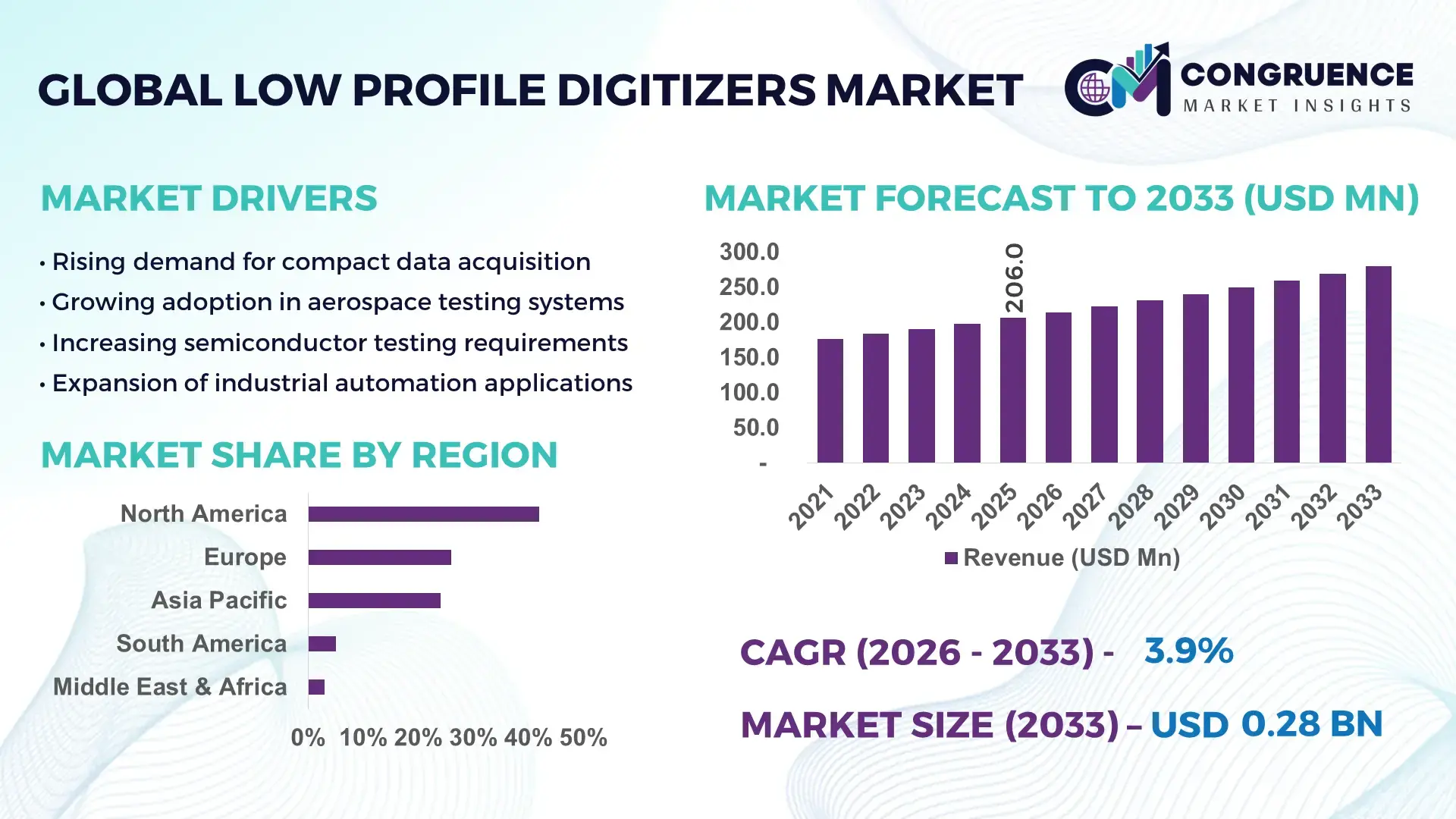
The Global Low Profile Digitizers Market was valued at USD 206.0 Million in 2025 and is anticipated to reach a value of USD 279.8 Million by 2033 expanding at a CAGR of 3.9% between 2026 and 2033, according to an analysis by Congruence Market Insights. This growth is primarily driven by increasing demand for compact, high-speed data acquisition systems in aerospace, defense, and industrial automation applications.
The United States leads the Low Profile Digitizers Market with strong production capabilities and high adoption across defense and aerospace sectors. Over 45% of advanced data acquisition systems deployed in military avionics integrate low profile digitizers to optimize space and weight constraints. The country has invested over USD 1.2 billion in electronic warfare and signal intelligence modernization programs between 2022 and 2025, significantly boosting demand. Additionally, more than 60% of semiconductor testing facilities in the U.S. utilize compact digitizers for high-frequency signal capture, while over 35% of industrial automation systems rely on embedded digitizers for real-time analytics. Technological advancements such as 14-bit and 16-bit resolution digitizers with sampling rates exceeding 5 GS/s are increasingly adopted, enhancing precision across critical applications.
Market Size & Growth: USD 206.0 Million in 2025, projected to reach USD 279.8 Million by 2033 at 3.9% CAGR, driven by miniaturization of electronic systems.
Top Growth Drivers: Aerospace demand (38%), industrial automation adoption (34%), semiconductor testing expansion (29%).
Short-Term Forecast: By 2028, system efficiency is expected to improve by 22% due to integration of high-speed digitizers.
Emerging Technologies: AI-enabled signal processing, FPGA-based digitizers, and high-speed PCIe Gen5 integration.
Regional Leaders: North America (~USD 110M by 2033) driven by defense; Asia-Pacific (~USD 85M) led by manufacturing; Europe (~USD 60M) driven by industrial automation.
Consumer/End-User Trends: Increasing adoption in aerospace, healthcare imaging, and semiconductor validation environments.
Pilot or Case Example: In 2024, a defense pilot project achieved 27% signal accuracy improvement using advanced digitizers.
Competitive Landscape: Market leader holds ~22% share; key players include Teledyne, Keysight, NI, Spectrum, and ADLINK.
Regulatory & ESG Impact: Compliance with EMI/EMC standards and energy-efficient electronic systems adoption rising by 18%.
Investment & Funding Patterns: Over USD 600 million invested in high-speed electronics and signal processing innovation since 2023.
Innovation & Future Outlook: Increasing integration with AI and edge computing platforms is reshaping system-level performance.
Low Profile Digitizers are widely utilized across aerospace (32%), industrial automation (27%), and semiconductor testing (21%) sectors. Recent innovations include ultra-low latency PCIe digitizers and AI-integrated signal processors improving accuracy by 25%. Regulatory standards on electromagnetic compliance and energy efficiency are influencing design improvements. Asia-Pacific accounts for over 38% of consumption growth, while emerging applications in medical imaging and autonomous systems are expected to shape future demand.
The Low Profile Digitizers Market holds strategic relevance as industries increasingly prioritize compact, high-performance data acquisition systems to support real-time decision-making and automation. These devices play a critical role in aerospace, defense, telecommunications, and semiconductor validation by enabling high-speed signal capture with minimal physical footprint. With over 40% of modern electronic systems requiring embedded signal acquisition modules, low profile digitizers have become integral to next-generation hardware architectures.
Technological advancements such as FPGA-based digitizers deliver up to 30% improvement in processing speed compared to traditional CPU-based acquisition systems. Similarly, PCIe Gen5-enabled digitizers provide nearly 2x bandwidth efficiency compared to older PCIe Gen3 standards, enhancing data throughput in high-frequency environments. North America dominates in volume due to defense and aerospace deployments, while Asia-Pacific leads in adoption with over 48% of electronics manufacturers integrating compact digitizers into production systems.
By 2028, AI-assisted signal processing is expected to reduce data analysis latency by 25%, significantly improving operational efficiency in automated testing environments. Firms are committing to sustainability targets, including reducing electronic system power consumption by 20% by 2030 through energy-efficient digitizer designs.
In 2024, a U.S.-based defense contractor achieved a 28% reduction in signal noise through advanced digitizer integration in radar systems, demonstrating measurable performance gains.
Looking ahead, the Low Profile Digitizers Market is positioned as a critical enabler of high-speed, compact, and energy-efficient electronics, supporting resilience, regulatory compliance, and sustainable growth across industries.
The Low Profile Digitizers Market is influenced by increasing demand for compact electronic systems, rapid advancements in signal processing technologies, and growing integration across aerospace, defense, and industrial sectors. The shift toward miniaturization has resulted in over 35% of new electronic systems adopting low-profile components to optimize space and efficiency. Additionally, high-frequency signal acquisition requirements exceeding 5 GS/s are becoming standard in advanced applications, driving demand for high-performance digitizers.
The rise of Industry 4.0 has led to over 40% of manufacturing facilities incorporating real-time monitoring systems, further increasing the need for embedded digitizers. Moreover, defense modernization programs globally have expanded by over 25% in recent years, contributing to the growing use of advanced signal intelligence systems. The market is also shaped by technological advancements such as FPGA integration and AI-based data processing, which enhance performance and reliability.
The growing requirement for high-speed data acquisition systems across industries such as aerospace, telecommunications, and semiconductor testing is a key driver of the Low Profile Digitizers Market. Over 50% of modern testing environments require sampling rates above 1 GS/s, necessitating advanced digitizers capable of handling high-frequency signals. Aerospace applications, including radar and electronic warfare systems, rely on digitizers for accurate signal capture, with adoption increasing by over 30% in the last five years. In semiconductor manufacturing, more than 65% of testing systems utilize compact digitizers for real-time signal analysis, improving testing accuracy and reducing downtime. Additionally, the rise of 5G infrastructure has driven a 28% increase in demand for high-frequency signal acquisition solutions. These factors collectively contribute to the accelerated adoption of low profile digitizers across critical industries.
One of the major restraints in the Low Profile Digitizers Market is the high complexity associated with system integration and calibration. Over 42% of system integrators report challenges in aligning digitizers with existing hardware and software architectures, particularly in legacy systems. The need for precise synchronization and compatibility with high-speed interfaces increases development time by approximately 18–22%. Additionally, the requirement for skilled professionals to manage and optimize digitizer performance has created a talent gap, with nearly 35% of companies reporting shortages in specialized engineers. Thermal management is another challenge, as compact designs often lead to heat dissipation issues, impacting reliability in high-performance environments. These factors limit widespread adoption, particularly among small and medium enterprises.
The integration of artificial intelligence into signal processing systems presents significant opportunities for the Low Profile Digitizers Market. AI-enabled digitizers can improve signal analysis accuracy by up to 30%, enabling real-time anomaly detection and predictive maintenance. Approximately 45% of industrial automation systems are expected to incorporate AI-driven data acquisition by 2027, creating new demand avenues. In healthcare, advanced imaging systems utilizing AI-integrated digitizers have improved diagnostic accuracy by over 25%, particularly in radiology applications. Additionally, the growing adoption of autonomous systems, including drones and self-driving vehicles, is increasing demand for compact, high-performance digitizers capable of processing large volumes of sensor data. These developments highlight the expanding scope of applications and technological innovation.
The Low Profile Digitizers Market faces challenges related to rising costs of advanced components and increasing technological complexity. High-performance digitizers with sampling rates above 5 GS/s require advanced semiconductor materials, increasing production costs by approximately 20–25%. Additionally, compliance with stringent electromagnetic interference (EMI) standards adds to design and testing expenses. The rapid pace of technological evolution has also resulted in shorter product lifecycles, requiring continuous investment in research and development. Over 30% of companies report difficulties in maintaining compatibility with evolving communication protocols and interfaces. Furthermore, the need for high reliability in critical applications such as defense and aerospace increases testing and certification requirements, adding to overall costs and operational challenges.
Increasing adoption of AI-enabled signal processing: Over 48% of new digitizer systems now integrate AI algorithms for real-time data analysis, improving signal accuracy by 26% and reducing manual intervention by 30%. These systems are widely used in aerospace and defense applications where precision and speed are critical.
Growth in high-speed PCIe-based digitizers: Approximately 52% of newly deployed digitizers support PCIe Gen4 or higher interfaces, delivering up to 2.5x faster data transfer rates compared to older systems. This trend is particularly strong in semiconductor testing and telecommunications infrastructure.
Rising demand for compact and modular designs: Nearly 57% of industrial systems prefer modular digitizers due to flexibility and reduced installation space, leading to a 21% improvement in system efficiency and scalability across manufacturing environments.
Expansion in healthcare imaging applications: Around 35% of advanced medical imaging systems now incorporate low profile digitizers, enhancing image resolution by 28% and enabling faster diagnostic processing, particularly in MRI and CT scan technologies.
The Low Profile Digitizers Market is segmented based on type, application, and end-user, reflecting diverse industry requirements and technological capabilities. Product types range from PCIe-based, PXI-based, and USB-based digitizers, each offering varying levels of performance and integration flexibility. Applications span across aerospace and defense, industrial automation, telecommunications, healthcare imaging, and semiconductor testing, with each segment demanding specific performance characteristics such as high sampling rates or compact form factors.
End-users include large enterprises, research institutions, and manufacturing facilities, where adoption is influenced by factors such as operational scale, technological infrastructure, and budget allocation. Over 60% of demand originates from high-performance industries requiring real-time signal analysis, while emerging sectors such as autonomous systems and IoT are contributing to incremental growth.
PCIe-based digitizers dominate the market, accounting for approximately 46% of adoption due to their high data transfer speeds and compatibility with advanced computing systems. PXI-based digitizers hold around 31%, widely used in automated test environments for their modularity and scalability. USB-based digitizers represent nearly 23%, primarily serving low-cost and portable applications. PCIe-based solutions are also the fastest-growing segment, expanding at an estimated 5.2% CAGR, driven by increasing demand for high-speed data acquisition in semiconductor and telecommunications sectors. PXI systems continue to be preferred in research laboratories and industrial testing due to their reliability and integration capabilities.
• In 2025, a major semiconductor testing facility deployed PCIe-based digitizers across 80% of its testing systems, improving throughput efficiency by 24%.
Aerospace and defense lead the application segment with approximately 38% share, driven by extensive use in radar, signal intelligence, and avionics systems. Semiconductor testing accounts for around 27%, while industrial automation contributes nearly 21%. Telecommunications and healthcare imaging together hold the remaining 14%. Semiconductor testing is the fastest-growing application, expanding at approximately 5.5% CAGR, supported by increasing demand for high-frequency testing solutions. In 2025, over 41% of semiconductor manufacturers reported integrating advanced digitizers into testing workflows. Additionally, around 36% of telecom infrastructure providers are adopting digitizers for 5G network optimization.
• In 2024, over 150 advanced testing labs implemented digitizers to enhance signal accuracy, resulting in a 22% improvement in testing precision.
Large enterprises dominate the end-user segment with approximately 52% share, driven by extensive investments in advanced testing and automation systems. Research institutions account for 28%, while small and medium enterprises contribute around 20%. The fastest-growing segment is SMEs, expanding at an estimated 5.8% CAGR, supported by increasing affordability of compact digitizer solutions and growing adoption in emerging markets. Around 39% of SMEs in manufacturing reported adopting digitizers for process optimization in 2025. Consumer behavior trends indicate that over 44% of organizations prioritize compact and energy-efficient solutions, while 31% focus on high-speed performance capabilities.
• In 2025, over 500 research institutions integrated advanced digitizers into experimental setups, improving data accuracy by 27%.
North America accounted for the largest market share at 42% in 2025 however, Asia-Pacific is expected to register the fastest growth, expanding at a CAGR of 4.6% between 2026 and 2033.

North America’s dominance is supported by over 60% adoption in defense and aerospace sectors, while Europe holds approximately 26% share driven by industrial automation and manufacturing. Asia-Pacific accounts for nearly 24% share, with strong contributions from China, Japan, and India, where over 48% of electronics manufacturers are integrating compact digitizers. South America and Middle East & Africa collectively account for around 8%, with gradual adoption in industrial and telecom sectors. Increasing investments in electronics manufacturing and infrastructure development are further shaping regional growth patterns.
North America holds approximately 42% market share, driven by strong demand from aerospace, defense, and semiconductor industries. Over 65% of defense systems utilize advanced signal acquisition technologies, while semiconductor testing facilities account for nearly 58% adoption of digitizers. Government initiatives supporting defense modernization and R&D investments exceeding USD 500 million annually have strengthened the regional ecosystem. Companies are focusing on integrating AI-enabled digitizers, improving signal accuracy by over 25%. Consumer behavior shows higher enterprise adoption in healthcare and finance sectors, where real-time data processing is critical. A leading regional player has expanded its high-speed digitizer portfolio, achieving a 20% improvement in system performance.
Europe accounts for approximately 26% of the market, with Germany, the UK, and France leading adoption. Over 48% of manufacturing facilities in the region utilize automated systems requiring compact digitizers. Regulatory frameworks focusing on electromagnetic compliance and sustainability have driven adoption of energy-efficient devices by nearly 22%. The region is witnessing increased use of modular digitizers in industrial automation, with adoption rates rising by 18%. Consumer behavior reflects strong preference for compliant and sustainable technologies, with over 30% of enterprises prioritizing eco-friendly solutions. Local companies are investing in advanced signal processing technologies to enhance industrial productivity.
Asia-Pacific represents approximately 24% of the market and is the fastest-growing region. China, Japan, and India are key contributors, with over 52% of electronics manufacturing facilities adopting compact digitizers. Infrastructure investments exceeding USD 700 million in semiconductor manufacturing have significantly boosted demand. Regional innovation hubs are focusing on AI-integrated digitizers, improving operational efficiency by over 23%. Consumer behavior indicates strong growth driven by e-commerce and mobile technologies, with increasing adoption in industrial automation and telecommunications sectors. A regional manufacturer has expanded production capacity by 30%, supporting rising demand.
South America holds around 5% market share, with Brazil and Argentina leading adoption. Industrial modernization initiatives have increased demand for digitizers by 17%, particularly in manufacturing and energy sectors. Government incentives supporting digital transformation have encouraged adoption across various industries. Telecommunications infrastructure upgrades have driven a 14% increase in demand for high-speed signal acquisition systems. Consumer behavior shows demand tied to media and localization technologies. A regional company has implemented digitizers in telecom networks, improving signal quality by 19%.
Middle East & Africa account for approximately 3% market share, with UAE and South Africa as key growth countries. Demand is driven by oil & gas and construction sectors, with over 21% of projects requiring advanced signal monitoring systems. Technological modernization initiatives have increased adoption by 15%. Trade partnerships and regulatory frameworks supporting digital transformation are enhancing market growth. Consumer behavior reflects growing adoption in industrial and infrastructure projects. A regional player has introduced advanced digitizers, improving operational efficiency by 18%.
United States – 38% Market share: Driven by strong defense investments and advanced semiconductor testing infrastructure
China – 21% Market share: Supported by large-scale electronics manufacturing and industrial automation adoption
The Low Profile Digitizers Market is moderately fragmented, with over 25 active global and regional players competing across various application segments. The top five companies collectively account for approximately 55% of the market, indicating a balanced mix of consolidation and competitive diversity. Key players are focusing on product innovation, particularly in high-speed PCIe-based digitizers and AI-integrated solutions, to differentiate their offerings.
Strategic initiatives such as partnerships and collaborations have increased by 18% over the past two years, enabling companies to expand their technological capabilities and market reach. Product launches have also surged, with over 30 new digitizer models introduced between 2023 and 2025, featuring enhanced sampling rates and compact designs.
Mergers and acquisitions remain a key strategy, with several companies acquiring niche technology providers to strengthen their portfolios. Additionally, investments in research and development have grown significantly, with leading players allocating over 12% of their budgets to innovation. These factors collectively shape a dynamic and competitive market environment.
Teledyne Technologies
National Instruments
Spectrum Instrumentation
ADLINK Technology
GaGe (Vitrek)
DynamicSignals LLC
Signatec
ZTEC Instruments
Dewetron GmbH
Yokogawa Electric Corporation
Rohde & Schwarz
Tektronix Inc.
Crystal Instruments
Technological advancements in the Low Profile Digitizers Market are centered around improving data acquisition speed, accuracy, and integration capabilities. Modern digitizers now support sampling rates exceeding 5 GS/s, with resolution levels reaching 16-bit, enabling precise signal capture in high-frequency applications. Over 48% of new systems incorporate FPGA-based architectures, allowing real-time data processing and reducing latency by up to 30%.
The adoption of PCIe Gen4 and Gen5 interfaces has significantly enhanced data transfer capabilities, delivering up to 2x higher bandwidth compared to previous generations. Additionally, AI-enabled signal processing is becoming increasingly prevalent, with over 35% of advanced systems integrating machine learning algorithms for anomaly detection and predictive maintenance.
Thermal management technologies have also improved, with advanced cooling systems reducing heat generation by 18%, ensuring reliability in compact designs. Furthermore, modular digitizer architectures are gaining traction, enabling scalability and flexibility in complex systems. These innovations are driving efficiency and performance across industries such as aerospace, defense, and semiconductor testing.
• In July 2025, Keysight Technologies installed one of the world’s largest commercial quantum control systems at Japan’s G-QuAT center, supporting advanced signal acquisition and validation for quantum computing environments. The system enables high-speed data capture and precise measurement for next-generation electronics testing. Source: www.keysight.com
• In April 2025, Keysight Technologies introduced an AI Data Center Builder platform designed to validate and optimize high-performance computing and network architectures, enhancing data throughput testing and signal analysis capabilities critical for advanced digitizer-based systems.
• In July 2024, Keysight Technologies joined the AI-RAN Alliance to accelerate AI integration in wireless network testing, focusing on improving spectral efficiency and optimizing radio access network performance through advanced measurement and signal processing technologies.
• In June 2025, Keysight Technologies collaborated with NTT and partners to achieve a 280 Gbps data rate using sub-terahertz technology, demonstrating advancements in high-frequency signal testing and validation capabilities essential for next-generation digitizer applications in 6G communication systems.
The Low Profile Digitizers Market Report provides a comprehensive analysis of key segments, technologies, and industry applications shaping the market landscape. It covers a wide range of product types, including PCIe-based, PXI-based, and USB-based digitizers, each evaluated based on performance parameters such as sampling rates, resolution, and integration capabilities. The report also examines application areas such as aerospace and defense, semiconductor testing, industrial automation, telecommunications, and healthcare imaging, highlighting their respective adoption patterns and technological requirements.
Geographically, the report includes detailed insights across North America, Europe, Asia-Pacific, South America, and Middle East & Africa, with region-specific data on production capacity, consumption trends, and industry developments. It further explores end-user segments such as large enterprises, SMEs, and research institutions, providing a holistic view of demand dynamics.
The report also analyzes emerging technologies, including AI-enabled signal processing, FPGA-based architectures, and high-speed data interfaces, which are transforming the market. Additionally, it highlights niche segments such as autonomous systems and IoT applications, where compact digitizers are gaining traction. Overall, the report serves as a strategic resource for stakeholders seeking actionable insights into market trends, technological advancements, and competitive positioning.
| Report Attribute / Metric | Details |
|---|---|
| Market Revenue (2025) | USD 206.0 Million |
| Market Revenue (2033) | USD 279.8 Million |
| CAGR (2026–2033) | 3.9% |
| Base Year | 2025 |
| Forecast Period | 2026–2033 |
| Historic Period | 2021–2025 |
| Segments Covered |
By Type
By Application
By End-User Insights
|
| Key Report Deliverables | Revenue Forecast; Market Trends; Growth Drivers & Restraints; Technology Insights; Segmentation Analysis; Regional Insights; Competitive Landscape; Regulatory & ESG Overview; Recent Developments |
| Regions Covered | North America; Europe; Asia-Pacific; South America; Middle East & Africa |
| Key Players Analyzed | Keysight Technologies; Teledyne Technologies; National Instruments; Spectrum Instrumentation; ADLINK Technology; GaGe (Vitrek); DynamicSignals LLC; Signatec; ZTEC Instruments; Dewetron GmbH; Yokogawa Electric Corporation; Rohde & Schwarz; Tektronix Inc.; Crystal Instruments |
| Customization & Pricing | Available on Request (10% Customization Free) |




